Trump’s Attack on Cruz’s Wife Proves He’s Too Sexist to Stand a Chance Against Clinton

Trump sneers at Cruz’s wife, showing why he’s not just going to lose female voters, but a lot of male voters, too.

Source: AlterNet

Author: Amanda Marcotte/Salon

Emphasis Mine

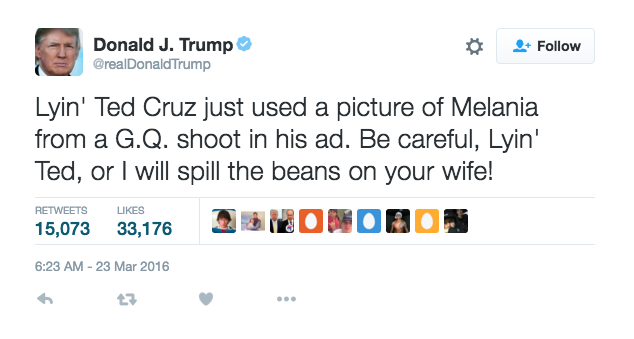
While most of the U.S. political world was focused on the terrorist attacks in Brussels and the primaries in some Western states Tuesday night, Donald Trump—surprise, surprise—was sitting around nursing a grudge. And he decided it needed airing out on Twitter, of course.
screen_shot_2016-03-23_at_4.53.38_pm

add
add

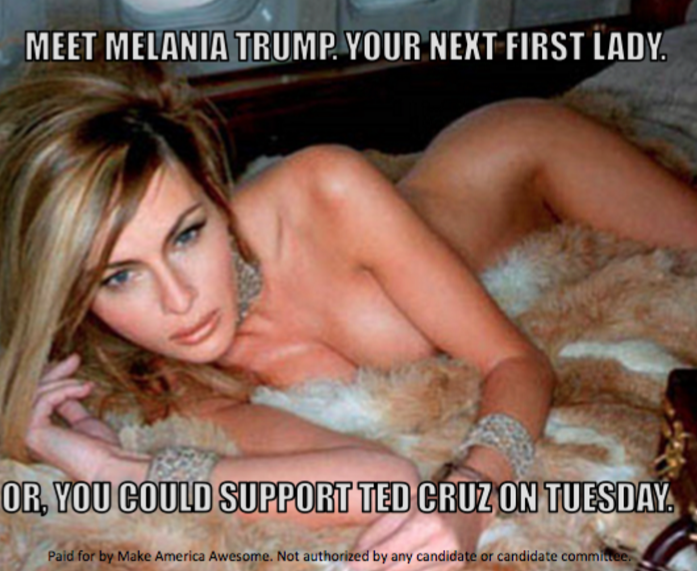
There’s been a robust discussion in feminist circles about this ad that is actually a meme and how it’s unfair and slut-shaming. There’s a strong argument to be had supporting this, but you have to give the woman who made it, Liz Mair, some credit for finding and exploiting a real vulnerability when it comes to Trump and female voters, both liberal and conservative.

While it’s true that Melania Trump is smarter than a lot of people realize and isn’t doing anything wrong by taking risqué photos, this ad isn’t really about her. This ad is about Donald Trump, highlighting that he really is a cartoonish stereotype: The wealthy sexist who talks about women like they’re objects for purchase and who is probably not interested in his wife because she speaks five languages and has studied architecture and design. One can politely ignore that fact in public, but there’s simply no way women aren’t taking note of it in private.

(Conversation I heard from two women talking in public recently: “Well, she’s probably smarter than the rest of us. We’re working and she’s probably out on 5th Avenue shopping right now.” “Yeah, but him? Ugh. He can’t really think she wants him for himself.”)

Trump’s reaction to this—to try to drag Ted Cruz into a wife-measuring contest, like they are debating the merits of owning a Ferrari vs. a Toyota Corolla—just confirms the suspicions that this ad is trying to raise.

This is why those who worry that Trump’s over-the-top sexism will somehow help him in a general election match-up against Hillary Clinton are completely misreading these particular tea leaves. Sure, there are a lot of men out there who see things the way Trump does. Those men admire him for his history of categorizing women as either sex objects or wastes of space whose continued existence is a mystery to him.

But those men are not the dominant voting bloc in a general election. In fact, men, as a group, do not make up the majority of voters. Women vote more than men and have since 1980And women hate Trump. Sure, there’s a lot of sexist dislike for Clinton, which explains why her unfavorability ratings are significantly higher with men than women. But Trump’s sexism has an even more profound impact on his popularity with women, as Jon Schwartz at The Intercept explains:

Women dislike Trump with what’s likely a historically unique intensity for a national politician. Trump’s average net favorability among women over the past six weeks is minus 33 percent—far worse than the minus 2 percent net favorability among women for Marco Rubio or the minus 14 percent for Ted Cruz. Likewise, in a poll taken just before the 2012 election, Mitt Romney had a net favorability among women of minus 2 percent.

And this is before the general election even really gets underway and Trump starts pulling his “why is this woman I don’t want to have sex with even talking” act with Hillary Clinton. As Jeet Heer points out at the New Republic, the only time Carly Fiorina was really doing well with Republicans was when Trump was disrespecting her in this way. And that’s with a crowd that has way higher tolerance for overt sexism. The public at large is not going to like it, not one bit. Nor will this hurt Trump with just women, either. Sure, Trump plays well with the Maxim crowd, but he takes the sexist vitriol so far that it repulses a whole bunch of men, both liberal and conservative. The exchange with Cruz was a good example of how the way Trump talks about women is also insulting to men.
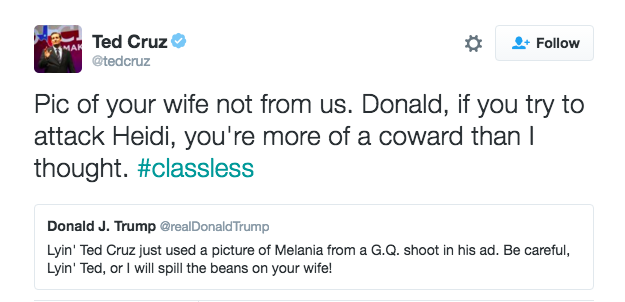
screen_shot_2016-03-23_at_4.59.36_pmMost news sources are assuming that Trump was referring to Heidi Cruz’s history of struggling with depression, and if so, then congratulations, Trump. You did the impossible: You made Ted Cruz, by far the creepiest politician on the national stage since Ross Perot, seem like a decent man who cares for and stands by his wife.

That sort of thing doesn’t just impact female voters, but a lot of men, as well. Even some men who might have some sympathy for Trump’s leering sexism are going to draw the line at treating a beloved wife like she’s a defective product who needs to be returned to the factory just because she has some health problems. Most men’s marriages are more like the Cruz marriage than the Trump marriage. They aren’t going to be keen on the idea that Trump would look down on them for that.

Six out of 10 female voters think Trump is an embarrassment, but it’s also true that 4 out of 10 male voters think that. Just wait until the general election, where his sexist antics will get even more attention (as hard as that may be to believe) than they are getting now. This is a man who can’t crack 50% of Republican voters, even in Arizona, where his xenophobic campaign should be going over like gangbusters. On a national stage, against a female opponent whose very existence counters Trump’s reductionist attitudes about women’s worth, Trump is going to look even more like an embarrassment.

Amanda Marcotte is a politics writer for Salon. She’s on Twitter @AmandaMarcotte. 

See:http://www.alternet.org/election-2016/trumps-female-problems-donald-trumps-attack-ted-cruzs-wife-proves-hes-too-sexist-stand?utm_source=Amanda+Marcotte%27s+Subscribers&utm_campaign=c6e2f1532d-RSS_AUTHOR_EMAIL&utm_medium=email&utm_term=0_f2b9a8ae81-c6e2f1532d-79824733

Trump Loves the Poorly Educated—and They Love Him Right Back

Trump is taking advantage of his supporters using psychology rather than reason.

Source: AlterNet

Author: David Masciotra/Salon

Emphasis Mine

For all of his buffoonery about “telling it like it is,” Donald Trump is the most politically correct and cowardly candidate in the presidential race. If he actually had the strength to articulate uncomfortable and inconvenient truths, he would turn his favorite word—“loser”—not on full-time professionals in the press, but on his supporters.

The New York Times recently ran a report on “Trump geography,” seeking to solve one of the most bizarre mysteries of modern political history: Why do people support Donald Trump, and who are these people?

Journalists found that in the counties where Trump is most dominant, there are large numbers of white high school dropouts, and unemployed people no longer looking for work. An alliance with the incoherent personality cult of Donald Trump’s candidacy correlates strongly with failure to obtain a high school diploma, and withdrawal from the labor force. The counties also have a consistent history of voting for segregationists, and have an above average percentage of its residents living in mobile homes. Many conservatives, and even some kindhearted liberals, might object to the conclusions one can draw from the data as stereotyping, but the empirical evidence leaves little choice. Donald Trump’s supporters confirm the stereotype against them. The candidate himself even acknowledged the veracity of the caricature of his “movement” when he made the odd and condescending claim, “I love the poorly educated.” His affection for illiteracy and ignorance did not extend to himself or any of his children, all of whom have degrees from some of the best universities in the world.

The low-educated, low-income counties of Trump’s America also receive large sums of public assistance. Social Security fraud—seeking disability payments for minor injuries or conditions—is so rampant that attorneys have created a cottage industry out of offering to secure services for clients willing to pay a one-time fee for longtime subsidy.

Much discussion and analysis followed the revelation that for the first time in decades the life expectancy for middle-aged white men is declining. Another study shows that Trump easily wins the counties and cities where this reversal of the national trend—rising life expectancy—is happening. Scrutiny shows that much of the failure to take advantage of advancement in medical technology and healthcare availability results from working-class white men’s high rates of alcoholism, obesity and tobacco use.

Widespread poverty throughout the heartland and Southern United States is a lamentable social problem, but even in the best economic conditions, and under the friendliest government policies, the career options for high school dropouts will forever remain few and poor. Rather than accepting some “personal responsibility”—a favorite conservative concept—for their low standard of living and destructive lifestyle, the wrongly romanticized white working class is flocking to a candidate who allows them to blame other people for their problems. Their poor health is not the result of a pack a day habit and fatty diet, just as their financial misery has nothing to do with their rejection of education. It is all because of those damn Mexicans coming up from the border, the Chinese villains overseas, or the Muslim immigrant illegally occupying the Oval Office.

Never mind that illegal immigrants comprise a mere 3.5 percent of the population, and that most of them are concentrated in six states, a “big, beautiful wall” will cure all the ills of a high school dropout no longer applying for jobs.

Kevin Williamson of the National Review recently wrote an essay identifying some of the personal problems of Trump supporters, and members of the right-wing media immediately slipped into fits. Once they finished wiping the foam from their mouths, they condemned Williamson for his “snobbery” and “elitism,” but as Williamson suggested in a follow-up article, his critics never explained how any of his information or argumentation was flawed.

Donald Trump’s celebration of the “poorly educated,” conservative commentators’ indignation at Williamson, and even the mainstream media’s continued characterization of Trump’s supporters as victims of “failed government policy” or “cracks in the economy” expose the Republican Party and powerful parts of the press as facilitators and enablers of America’s worst historical sin: racism.

The inconsistency and hypocrisy evident in the right-wing portrayal of poverty, and even in the softer version of the mainstream media’s differing depiction of poor people, is overwhelming. The black, urban poor are lazy parasites who need to get it together, study longer and work harder, but the unemployed and uneducated white people empowering Trump’s vulgarity and bigotry are helpless victims of large economic conspiracies.

Personal responsibility, it would appear, is only applicable to the lives of black people.

Trump supporters on public aid believe that they are the exceptions to their anti-government ideology, and Trump allows them to wallow in self-pity and racism. In Illinois, xenophobia and stupidity joined forces to actually hurt the Republican front-runner. Voting for a primary presidential candidate in Illinois requires voters to select delegates, rather than vote directly for the politician. Each delegate has his or her corresponding candidate’s name in parentheses, but even so, many Trump supporters refused to vote for Trump delegates with the names, Nabi Fakroddin and Raja Sadiq.

The imbecility of Trump’s slogan, “Make America Great Again,” provokes the question, “Make America great again for whom?”

At no point in American history was there a greater amount of liberty and opportunity for blacks, women, gays and Latinos. Together those groups form a gigantic swath of the population, but apparently, they are not included in the calculus of Trump and his supporters.

Trump himself recently spoke out of both sides of his mouth when he said that a young black gentleman at the Chicago fiasco, who was better dressed and better groomed than the Trump supporters at the rally, was a “bum” who should “get a job.” Trump’s entire campaign is predicated on the phony populism of American recovery from third-world status. His out-of-work white constituency is in desperate need of his artistic deal making, but the black protestor is just lazy.

While it is far from perfect, the truth is that the American economy is doing rather well. Unemployment has dropped in half since the black Muslim became president, the housing market has begun to come back, gas prices are significantly lower, GDP rates are decent, and the United States has experienced 72 consecutive months of private sector job growth.

The failure of the recovery to penetrate the lives of high school dropouts who have stopped filling out job applications is not evidence that the “American dream is dead” or that “America is going to hell,” as Trump often puts it with characteristically inspirational rhetoric.

He is able to make his gullible supporters believe him, however, and that is all that really matters to his campaign. Never in the history of American politics has a candidate been so far apart from his constituency. Donald Trump is an Ivy League-educated, billionaire real estate developer living in Manhattan with his supermodel wife. His lifestyle is a distant fantasy to his voters, and it seems unlikely that, in any other context, Trump would ever share a room with any of them. He is running a con.

“I love the poorly educated” makes sense, because the ability to see through the sophisticated bullshit of confidence men is one benefit, among many, of a good education.

David Masciotra is the author of Mellencamp: American Troubadour (University Press of Kentucky). He has also written for Salon, the Atlantic and the Los Angeles Review of Books. For more information visit www.davidmasciotra.com.


See:http://www.alternet.org/election-2016/trump-loves-poorly-educated-and-they-love-him-right-back?akid=14100.123424.Q56xM3&rd=1&src=newsletter1052977&t=10

What Right-Wing Media Doesn’t Understand About Rage and the White Working Class

Especially clueless National Review story gets origins of working-class anger wrong, and misunderstands Trumpism.

Source: AlterNet

Author: Paul Campos/Salon

Emphasis Mine

The following first appeared on Salon

A few days ago, the National Review’s Kevin Williamson caused something of a storm when he published an article entitled “Chaos in the Family, Chaos in the State: The White Working Class’s Dysfunction.” The article might as well have been called “Establishment Conservatives Really Aren’t Racists: We Hate Lots of White People, Too.”

Williamson’s thesis is that the white working class is largely responsible for its own degraded condition, apparently because way too many of the roughly 100 million white American adults without college degrees are shiftless drug addicts, who “whelp” babies they can’t take care of, while suckling on the teat of our overly-generous welfare state, instead of moving from their dysfunctional Rust Belt ghettos to places where good-paying jobs are going unfilled. (In a remarkable oversight, Williamson fails to say where those places might be).

Williamson’s thesis is not exactly novel. Indeed, it’s part of a series of conservative screeds that could be called “Working-Class White is the New Black.” The problem with “those people,” you see, isn’t that their jobs, their communities, and their whole way of life have been destroyed by global capitalism. It isn’t that being thrust to the margins or the heart of poverty tends to create stresses that break apart families. It isn’t that economic calamity leads to substance abuse as an eminently predictable form of self-medication.

After all, these sorts of structural explanations for social breakdown are only supported by social science, which, like reality itself, is known to have a strong left-wing bias. Williamson and company’s right-wing critique, by contrast, is supported by the very interesting theory that roughly two-thirds of America’s white population suddenly developed poor moral characters, around the time that “The Brady Bunch” went into syndication.

Ah yes, “The Brady Bunch.” Behold conservative cultural studies, as brought to you by the National Review:

The manufacturing numbers — and the entire gloriously complex tale of globalization — go in fits and starts: a little improvement here, a little improvement there, and a radically better world in raw material terms (and let’s not sniff at those) every couple of decades. Go back and read the novels of the 1980s or watch “The Brady Bunch” and ask yourself why well-to-do suburban families living in large, comfortable homes and holding down prestigious jobs were worried about the price of butter and meat, and then ask yourself when was the last time you heard someone complain that he couldn’t afford a stick of butter.

OK I asked myself, and the answer is: last week. Does Williamson actually know any middle-class — let alone working-class or poor — Americans? The average income of the other half, the bottom 50% of American households (that’s 160 million people) is$26,520 per year. That’s barely more than $2,000 per month, before subtracting payroll and state taxes. If your entire household is living on $2,000 per month, you can bet you’re worried about the price of butter and meat.

But let’s get back to “The Brady Bunch.” Leave aside the absurdity of citing TV mogul Sherwood Schwartz’s fantasy creations as evidence for the actual economic circumstances of middle class professionals in the early 1970s (For example, the Bradys had a live-in housekeeper, because lots of people in Schwartz’s social circle had one). Consider what sorts of costs the real-life parallels to the fictional Bradys were dealing with.

It’s true that butter and meat cost about 20% less in real dollars than they did 40 years ago. On the other hand: the real-life North Hollywood house which Schwartz used for the exterior shots of the Brady home sold in 1973 for $61,000 ($325,761 in 2016 dollars). According to the popular real estate website Zillow, buying this house today would cost $1,791,835. Now real estate values in Los Angeles have skyrocketed, but in the nation as a whole, the inflation-adjusted cost of a new home has almost doubled since the early 1970s, while median household income has barely budged.

If the Brady children had gone off to college, they would have paid, in 1975an average of $541 per year to attend a four-year public university, and $2,290 to go to a private school (the 2015 dollar equivalents are $2,387 and $10,088). Today, average tuition is, in real dollars, three times higher at private schools and four times higher at public institutions.

When “The Brady Bunch” came on the air, Americans were paying $2,171 per year, in 2016 dollars, for health care. Today that figure is four and half times higher.

In sum, while over the past four decades real median household incomes have stagnated (and those of working class households have declined), housing prices have doubled, higher education costs have tripled and quadrupled, and medical costs have risen even more. That establishment Republicans such as Williamson are deluded enough to believe that the last 40 years haven’t been an economic disaster for working class Americans, and that therefore their personal struggles provide an appropriate occasion for sanctimonious moralizing, helps explain why Donald Trump is winning the battle for the Republican nomination.

See:http://www.alternet.org/media/what-right-wing-media-doesnt-understand-about-rage-and-white-working-class?akid=14080.123424.MZYW4e&rd=1&src=newsletter1052897&t=8

Why the Rise of Trump, Cruz and Sanders Is the Logical Result of the 1% Not Paying Taxes, and Shutting off Opportunity to the Poor

the U.S. protects “everything that deals with capital and property but we cannot deal with protecting basic human rights.”

Source:AlterNet

Author: Vijay Prashad

Emphasis Mine

You reap what you sow. The Republican Party – pushed along by large segments of the “Third Way” Democrats – crafted policies that allowed the American rich to go on tax strike, that allowed them to deindustrialize the United States and that allowed their banks to control the destiny of people from the redwood forest to the gulf stream waters.

This land is their land. Democracy is the mask of the 1 percent.

The detritus of those policies created under-employment and endemic social crises. Between the prison industrial complex and the opioid crisis lies the fault line of race: otherwise these are identical. Wages plummeted, but debt-fueled consumption allowed the American Dream to remain alive. The Great Recession of 2007 awoke sections of the country from its credit card somnolence. For the first time in decades, the American Dream seemed unrealistic. The lives of American children would most certainly be economically more fragile than those of their parents.

Race stayed the hand of unity. The Tea Party movement covered itself in the old rags of racism to blame migrants and minorities for the degradation of their country. Egged on by the Republican elites, this movement took the hatred of government and of outsiders to the limit. Out of it came Ted Cruz and Marco Rubio, with fire against Washington as their ammunition. It is fitting that the old Gadsden flag was taken up by the Tea Party – with its rattlesnake above the sign, “Don’t Tread on Me.”

To associate oneself with the rattlesnake is a curious gesture. This is venom incarnate.

The Great Recession hit black and Latino families hardest, but there was no room for them in the Tea Party consensus. It was Obama’s presidential campaign that became their ark. That Obama did little to constrain the banks and force the rich to pay tax was disappointing, but not sufficient for disillusionment. What choice has there been? It was organizations such as Stand Up United, Black Lives Matter, Dream Defenders, Defend the Dream, Stand Up/Don’t Shoot and Black Youth Project that drew in the more critical segments – spurred on by Ferguson.

They are the antithesis of the Tea Party, although survivors of a similar dynamic set in motion by the American rich’s tax strike.

Many of these young people have now taken refuge in the Sanders’ campaign. Hillary Clinton was part of the “Third Way” Democrats that allowed Wall Street its excesses. She does not have the compass to bring in this segment. It is fitting that the wife of Eric Garner (killed by the New York police department) supports Clinton, while their daughter – Erica Garner – who is an activist in these movements supports Sanders.

Donald Trump and Ted Cruz are the end-points of Republican policy. They are what emerge when the rich don’t pay their fair share of taxes and the working poor cannot any longer dream of a better life. But they are particularly the salvation of the white working poor. Theirs is a populism narrowed by racism and misogyny.

Stop Trump, goes the slogan. But replace him with what? Ted Cruz, who is not only as bellicose as Trump (bomb the desert to “make it glow”), but is also a zealot? These men are mirror reflections of each other. They are Crump.

Both Trump and Sanders attract the white workers who had been battered by the trade agreements of the 1 percent. Trump’s rhetoric is familiar to the American right, which heard it from Pat Buchanan in an earlier era. Sanders comes from a long line of Democratic barnstormers who opposed these recent trade deals – whether Tom Harkin or Sherrod Brown and most recently the Sanders’ supporter Keith Ellison. These are Mid-western politicians who know how the trade deals eviscerated the working class of their heartland.

In this skepticism of the 1 percent’s trade deals there is the potential of great unity, but again race is the obstacle. Buchanan’s fulminations on the “end of White America” are far from Harkin’s 1992 objections to NAFTA on the grounds that the U.S. protects “everything that deals with capital and property but we cannot deal with protecting basic human rights.”

Exit from this current nightmare is not evident. Until the American Rich give up their tax strike, there is little hope for necessary social investments. Unity is impossible as long as the toxicity of racism diminishes social life. Trump and Cruz offer bluster, empty slogans that reduce the potential of people. Clinton and Rubio have little to offer beyond the prattle of the Beltway, which is continued adherence to Wall Street’s failed dogmas and belief in the Security establishment’s failed imagination for the world.

The Republican elite wants to sow fear of Trump in order to sneak in Cruz. Under both shells sit rotten peas.

It is better to pick neither.

Vijay Prashad is professor of international studies at Trinity College in Hartford, Connecticut. He is the author of 18 books, including Arab Spring, Libyan Winter (AK Press, 2012), The Poorer Nations: A Possible History of the Global South (Verso, 2013) and the forthcoming The Death of a Nation and the Future of the Arab Revolution (University of California Press, 2016). His columns appear at AlterNet every Wednesday.

See: http://www.alternet.org/election-2016/why-rise-trump-cruz-and-sanders-logical-result-americas-wealthiest-not-paying-their?akid=14080.123424.MZYW4e&rd=1&src=newsletter1052897&t=12


Why Bernie’s Revolution Has Just Begun

With each primary victory—and each close call—Sanders has shown us our own strength.

Source: AlterNet

Author: D.D. Guttenplan/The Nation

Emphasis Mine

Well, we’ll always have Michigan….

A week after Bernie Sanders stunned pollsters with a victory that nobody predicted, lifting his campaign—and his supporters’ expectations—those hopes came crashing down to earth yesterday with defeats in Florida, Ohio, Illinois, and North Carolina. Hillary Clinton’s late-breaking win in Missouri gives her a clean sweep on a night that was meant to mark the turn in the tide for Sanders, who poured time and money into Ohio, where Clinton took every big city on her way to a convincing 14-point victory, and Illinois, where Sanders hoped to profit from dissatisfaction with Chicago Mayor Rahm Emanuel, a longtime Clinton ally. Though voters did punish Cook County prosecutor Anita Alvarez for her handling of the police shooting of Laquan McDonald, favoring challenger Kim Foxx by a margin of 2 to 1, Clinton carried Cook County by a comfortable 8 points.

Yes, it’s true that the rest of the primary calendar is more favorable to Sanderswho has won more states, garnered many more votes, and has a larger share of the delegates than any of the Republicans challenging Donald Trump. Whose presumptive grasp on his party’s nomination is denied almost daily by the same media who have been burying Sanders—when they could be bothered to write about him—from Iowa onward. We never said this was going to be easy—or a fair fight.

Hillary Clinton has always been the favored candidate of the party establishment. And unlike 2008, when the powerful Cook County portion of that establishment broke for Obama, a favorite son, this time the establishment remains unified in the face of the Sanders insurgency. Which would be reason enough for Sanders to carry on his fight all the way to Philadelphia, even if it really were mathematically impossible for him to win the nomination—a point we are still unlikely to reach before California votes on June 7. The strength of Sanders’s challenge, and the enthusiasm of his supporters, have already pulled Hillary Clinton off dead center on police violence, trade policy, access to education, and making the wealthy pay their share of taxes. 

As long as he stays in the race, and stays true to his beliefs, Sanders will keep winning those arguments, even if Clinton’s willingness to steal her opponent’s best ideas—and even some of his best lines—help her to win voters who will be crucial in defeating Trump in November. Turnout remains the Democrats’ Achilles’ heel: In Ohio, where Trump came second, he still got more votes than either Democrat. Clinton herself seems to get this, and yesterday declined to endorse calls for Sanders to drop out. Any other course would leave Trump in sole possession of the media for the next four months.

Speaking of the Donald, it also seems odd that while his impact on the Republican party is endlessly analyzed, almost nothing has been said about the way Trump’s likely nomination has influenced Democratic primary voters. My own guess is that fear of Trump probably carried Clinton over the line in Illinois and Missouri.

Keeping Clinton from reverting to a neoliberal default isn’t the only reason for Sanders to stay in the race—or the most important. As Sanders has always said, his aim is “a political revolution.” Winning the nomination would be nice, but is neither necessary nor sufficient to bring that about. Building a nationwide, durable network of mobilized, active supporters prepared to keep working for universal healthcare, a living wage, ending Wall Street welfare and America’s endless wars—including the drug wars—in numbers great enough to Occupy the Democratic Party and take it back from its corporate funders is absolutely crucial. So, too, is the difficult work of stitching together movements like #BlackLivesMatter, Fight for 15, immigrant rights, climate justice, and voting rights into a coalition prepared to march together, vote together, and transform our politics—and our country. Yet that is the task we face.

Are the odds against us? Of course. That’s what it means to live inside a rigged system. But remember where we were only a few months ago. With each primary victory—and each close call—Sanders shows us our own strength. With each packed rally we see the claim that socialism is un-American exposed as a lie, that a world where no one starves, healthcare is not rationed by wealth, and energy companies aren’t allowed to rape the earth for profit and leave the rest of us to take the consequences is not only possible but popular.

Why cut off that momentum? Especially when, as Daniel Cantor of the Working Families Party points out, Sanders actually keeps getting stronger: “Bernie’s North Carolina performance was 15 points better than his South Carolina performance last month, and 5 points better than his Virginia performance two weeks ago. Meanwhile, the margin in Cook County, Illinois, is half of that in Wayne County, Michigan.”

So we fight on—to July, November, and beyond. For the nomination, so long as that remains a possibility. For our country—which may in November face as stark a choice as any in our lifetimes. And for our future, which is far too precious a prize to abandon for the sake of a few thousand votes.

 See:http://www.alternet.org/election-2016/why-bernies-revolution-has-just-begun?akid=14080.123424.MZYW4e&rd=1&src=newsletter1052897&t=4

How the U.S. Went Fascist: Mass Media Makes Excuses for Trump Voters

Networks and newspapers are trying to explain away racism from a prominent GOP candidate. That he won the evangelical vote again in Nevada is helpful for us in seeing that American evangelicalism itself is in some part a form of white male chauvinist nationalism and only secondarily about religion.

Source: AlterNet

Author: Jaun Cole/Informed Comment

Emphasis Mine

The rise of Donald Trump to the presumptive Republican standard bearer for president in 2016 is an indictment of, and a profound danger to the American republic.

The Founding Fathers were afraid of the excitability of the voters and their vulnerability to the appeal of demagogues. That is the reason for a senate (which was originally appointed), intended to check those notorious hotheads in Congress, who are elected from districts every two years.

But it isn’t only the checks and balances in government that are necessary to keep the republic. It is the Fourth Estate, i.e. the press, it is the country’s leaders, and the general public who stand between the republic and the rise of a Mussolini. The notables have been shown to be useless. Donald Trump should have been kicked out of the Republican Party the moment he began talking about violating the Constitution. The first time he hinted about assaulting the journalists covering his rallies, he should have been shown the door. When he openly advocated torture (‘worse than waterboarding’), he should have been ushered away. When he began speaking of closing houses of worship, he should have been expelled. He has solemnly pledged to violate the 1st, 4th and 8th Amendments of the Constitution, at the least. If someone’s platform is unconstitutional, it boggles the mind that a major American party would put him or her up for president. How can he take the oath of office with a straight face? The party leaders were afraid he’d mount a third-party campaign. But who knows how that would have turned out? Someone with power needs to say that Trump is unacceptable and to define him out of respectable politics, the same way David Duke is treated (Trump routinely retweets Duke fellow-travellers).

Then there is the mass media. As Amy Goodman has pointed out, corporate television has routinely pumped Trump into our living rooms. They have virtually blacked out Bernie Sanders. Trump seems to have connived to have 10 or 15 minutes at 7:20 every evening on the magazine shows, such as Chris Matthews’ Hardball, who obligingly cut away to Il Duce II’s rants and gave away his show to him on a nightly basis.

Not long ago, extremely powerful television personalities and sportscasters were abruptly fired for saying things less offensive than Trump’s bromides. Don Imus was history for abusive language toward women basketball players. But Trump’s strident attack on Megyn Kelly as a menstruating harridan was just allowed to pass. Jimmy ‘the Greek’ Snyder was fired by CBS for saying African-Americans were ‘bred’ to be better athletes. But Trump issued a blanket characterization of undocumented Mexican labor migrants as rapists, thieves and drug dealers. Of course this allegation is untrue.

I watched the Nevada caucus coverage on MSNBC and was appalled at the discourse. One reporter tried to assure us that Trump voters were not actually voting for racism and bullying politics, they were just upset. But polling in South Carolina demonstrated that Trump voters were significantly to the right of most Republicans on some issues. In SC, 38% of Trump voters wished the South had won the Civil War, presumably suggesting that they regretted the end of slavery.

Another MSNBC reporter helpfully explained that Trump voters feel that ‘political correctness’ has gone too far. But what does Trump mean by ‘political correctness’? He means sexism and racism. So what is really being said is that Trump supporters resent that sexist and racist discourse and policies have been banned from the public sphere. There is ample proof that Trump’s use of ‘political correctness’ identifies it with sexist and racist remarks and actions.

Yet another asserted that ‘some of’ Trump’s positions ‘are not that extreme.’ Exhibit A was his praise for Planned Parenthood. But he wants to outlaw abortion, i.e. overturn the current law of the land, which is extreme. (A majority of Americans support the right to choose, so he is in a minority).

Chris Matthews explained to us that people hoped he would do something for the country rather than for the government.

But Trump has made it very clear that he is not interested in a significant proportion of the people in the country. He is a white nationalist, and his message is that he will stand up for white Christian people against the Chinese, the Mexicans, and the Muslims. Just as Adolph Hitler hoped for an alliance with Anglo-Saxon Britain on racial grounds (much preferring it to the less white Italy), the only foreign leader Trump likes is the ‘white’ Vladimir Putin. That he won the evangelical vote again in Nevada is helpful for us in seeing that American evangelicalism itself is in some part a form of white male chauvinist nationalism and only secondarily about religion.

By the way, the idea that Trump won the Latino vote in Nevada is nonsense. In one of a number of fine interventions at MSNBC, Lawrence O’Donnell pointed out that something on the order of 1800 Latinos voted in the Nevada GOP caucuses, of whom perhaps 800 voted for Trump, i.e. 44% of this tiny group. Trump lost the vote of even this small group of hard right Latinos, since 56% of them voted for someone else.

There are 800,000 Latinos in the state of Nevada (pop. 2.8 million). In 2012, 70 percent of Latinos voted for Barack Obama, while Mitt Romney got 25%. My guess is that Trump can’t do as well among them as Romney did.

It has been a dreadful performance by the press and by party leaders. They are speaking in such a way as to naturalize the creepy, weird and completely un-American positions Trump has taken.

This is how the dictators came to power in the 1920s and 1930s. Good people remained silent or acquiesced. People expressed hope that something good would come of it. Mussolini would wring the laziness out of Italy and make the trains run on time.

When Benjamin Franklin was asked by a lady after the Constitutional Convention what sort of government the US had, he said, “A Republic, Madame, if you can keep it.”

You have to wonder if we can keep it.

Juan Cole is a professor of history at the University of Michigan and maintains the blog Informed Comment.


See:http://www.alternet.org/election-2016/how-us-went-fascist-mass-media-makes-excuses-trump-voters?akid=14008.123424.GcZEKd&rd=1&src=newsletter1051277&t=8

Republican Party’s Nightmare Coming True as Trump Gets Closer to the 2016 Nomination

Trump is positioned to win big on Super Tuesday.

Source: AlterNet

Author:Steven Rosenfeld

Emphasis Mine

The Republican Party is running out of time and options to stop Donald Trump after winning as expected in Nevada’s Tuesday night caucuses, although party insiders are increasingly desperate about what to do.

Trump, who was leading in Nevada polls—where he has a big Las Vegas hotel-casino—won his largest percentage yet in any of 2016’s caucuses and primaries, with 46 percent of the vote, which was almost twice as much as both Marco Rubio (24 percent) and Ted Cruz (21 percent) received.

So far, 1.2 million Republicans in four states—Iowa, New Hampshire, South Carolina and Nevada—have participated in caucuses or voted, in contests where 133 delegates have been at stake under party rules where 1,237 are needed for the presidential nomination. Cruz won Iowa. Trump has won everything since. And next week is when 12 states, with 632 delegates, will vote on March 1, so-called Super Tuesday.

Right now, the latest polls in those states listed on RealClearPolitics.com show Trump ahead in nine of those states—Georgia, Massachusetts, Minnesota, Oklahoma, Alabama, Tennessee, Virginia, Arkansas and Vermont. Cruz is ahead in Texas and Arkansas. And Ben Carson is ahead in Colorado, but that survey was taken in November, rendering it meaningless. If Trump wins all these states, he stands to gain upward of 400 delegates, where as the prior states only had 133 delegates in play and awarded some to non-winners.

Beyond the math, the Republican Party establishment is in a real tizzy over what to do. An array of scenarios have been floated—such as pundits like Larry Sabato suggesting Rubio and John Kasich team up, creating a way to likely win Florida and Ohio in the fall. Others have pushed a Cruz-Rubio ticket. Still others have said true conservatives may need to back a third-party candidate. And other GOP strategists have suggested that maybe New York City’s former mayor Michael Bloomberg might be more acceptable than another Clinton presidency. Or they are saying principled Republicans might just have to sit this one out, while others respond that’s impossible, they cannot surrender the party’s brand.

No matter the fanciful fantasy embraced, the reality is the clock is running out on the GOP to stop Trump’s hostile takeover of the party. This is not a conclusion based on the particulars of Trump’s showing in Nevada—as he is very well-known there—but more on the weaknesses of Rubio and Cruz as seen in that state. As Nate Silver at FiveThirtyEight.com noted, Rubio still hasn’t won a single state, and Cruz lost badly in Nevada and before that in South Carolina among constituencies thought to be his best supporters.

He carried only 27 percent of the white born-again and evangelical Christian vote, behind Trump’s 41 percent. Cruz also lost this group in New Hampshire and South Carolina,” Silver and Harry Enten co-wrote. “Cruz also trailed among ‘very conservative’ voters in Nevada, 34 percent to Trump’s 38 percent.” In short, even if Cruz wins his home state of Texas and nearby Arkansas next Tuesday, as RealClearPolitics’ latest polls have him 4 to 5 points ahead of Trump in both states, it is looking like the beginning of the end of the Cruz campaign.

Of course, the only thing certain about the 2016 campaign trail is nothing is certain. But next Tuesday’s dozen GOP contests with half of the delegates needed to secure the nomination in play is going to be a milestone that can’t be ignored. It is likely that the most virulent voters in the party’s base, who have embraced Trump’s boasts, bullying, bigotry and brashness will be on their way to vanquishing their party’s pro-corporate elites.

Where this goes next is unclear, but it’s surely not toward scenarios where cooler heads will prevail—even if Trump will surprise everyone by trying to sound more moderate after fanning the flames. Anybody who has been on the receiving end of GOP tirades (pro-choice women, LBGT individuals, voters in communities of color, climate change scientists, undocumented migrants, labor unions, etc.) or suffered from their obstructionism—as epitomized by Senate Republicans refusing to consider a Supreme Court nomination—knows the modern GOP has been extremist for years.

The difference now is Trump’s ascent seems to have brought an old and ugly form of mob rule into mainstream view, whereas pledges years ago by now-Republican Senate Majority Leader Mitch McConnell to impede President Obama at every turn and create a failed presidency were cloaked in more “acceptable” partisan gamesmanship under Washington’s political rules.

As many people have noted, Republicans have sown the seeds of Trump’s increasing electoral successes for years. But now they have to live with the consequences, which may mean the end of their party as many know it. The time appears to be running out to stop Trump from gaining the nomination, making the immediate future a belwether for where one of the country’s major parties is going—over the edge and toward a darkening unknown.

Steven Rosenfeld covers national political issues for AlterNet, including America’s retirement crisis, democracy and voting rights, and campaigns and elections. He is the author of “Count My Vote: A Citizen’s Guide to Voting” (AlterNet Books, 2008).

See:http://www.alternet.org/election-2016/republican-partys-nightmare-coming-true-trump-gets-closer-2016-nomination?akid=14008.123424.GcZEKd&rd=1&src=newsletter1051277&t=4

Donald Trump’s Idiot Guide to Foreign Policy: The GOP Frontrunner Has No Idea How the World Actually Works

It’s becoming increasingly clear that Trump isn’t just inexperienced — he’s actually living in a fantasy world.

Source: AlterNet

Author: Daniel Denvir/Salon

Emphasis Mine

Over the past several months, Donald Trump has famously said a lot of nasty things about Mexican immigrants. What’s less often noted is that he thinks the Mexican government is run by the world’s most hyper-competent  supervillains. The upshot is that only Trump has the wherewithal to beat them.

“When Mexico sends its people, they’re not sending their best,” he said as he announced his candidacy last June. “They’re not sending you. They’re not sending you. They’re sending people that have lots of problems, and they’re bringing those problems with us. They’re bringing drugs. They’re bringing crime. They’re rapists. And some, I assume, are good people.”

“The Mexican government,” he later added, “forces many bad people into our country because they’re smart…. They’re smarter than our leaders, and their negotiators are far better than what we have, to a degree that you wouldn’t believe.”

Trump honestly seems to believe that Mexican migration to the United States is controlled by the Mexican government, rather than, say, complex economic changes and cross-border social ties. Now, it turns out, he thinks that the Mexican government controls the Pope as well, and tricked the head of the Catholic Church into disliking Trump.

“The Pope was in Mexico,” Trump said, responding to Francis’s comment yesterday that his border-wall lust disqualified him from Christianity. “Do you know that? Does everyone know that? He said negative things about me because the Mexican government convinced him that Trump is not a good guy because I want to have a strong border, I want to stop illegal immigration, I want to stop people from being killed.”

People, for very good reason, pay a lot of attention to Trump’s racism. But his comments about immigration point to something else critical to his worldview: Trump thinks that world events can be reduced to the raw genius or stupidity of a given country’s leaders. Trump takes a MENSA member approach to the world, fetishizing intelligence without demonstrating actual intellectual competence. Just as Trump represents a poor man’s idea of what a rich man must be like, his theory of governance is statecraft as a marketing executive might see it.

For what it’s worth, Mexicans don’t think much of a government that fails to address widespread poverty, corruption and impunity. A recent Grupo Reforma poll found that after El Chapo’s recapture, more Mexicans’ opinions of President Enrique Peña Nieto’s government actually fell rather than rose, and a strong majority credited cartel leaders’ carelessness for his capture rather than the government’s competence.

When Peña Nieto is feeling down, which I imagine is quite frequently, he should pick up the phone and give Trump a call. Trump, at least, thinks the Mexican government doing a helluva good job.

Daniel Denvir is a writer at Salon covering criminal justice, policing, education, inequality and politics. You can follow him at Twitter @DanielDenvir.

See: http://www.alternet.org/election-2016/donald-trumps-remedial-guide-foreign-policy-gop-frontrunner-has-no-idea-how-world?akid=13997.123424.TOXRxD&rd=1&src=newsletter1051079&t=8

Stop Comparing Trump and Sanders: The Two Candidates Aren’t Equal and Opposite Radicals

Both candidates’ supporters are fed up with their country, but the sources of their rage are radically different.

Source: AlterNet

Author: Matthew Rozsa/The Good Men Project

Emphasis Mine

This piece originally appeared on The Good Men Project.

As the 2016 presidential election gathers steam, it’s tempting to compare the Bernie Sanders surge among Democrats with the Donald Trump phenomenon among Republicans. After all, both candidates are marshalling support from the ideological grassroots in their respective parties (the left in Sanders’ case, the right for Trump), and both have successfully tapped into a deeper anger that animates their campaigns.

When you reflect on the nature of that anger, however, a crucial distinction between the two candidates emerges: Sanders is drawing on a compassionate anger, while Trump is fanning the flames of a selfish anger. This may seem like a small difference, but it’s one that will literally determine the fate of millions. First, a quick moment of clarification. When I discuss “compassionate” and “selfish” forms of anger, I’m referring to the underlying philosophy embedded in a given set of frustrations. Although both forms of anger tap into a visceral sense of outrage within their listeners, the former insists that they exhibit empathy for others, while the latter encourages them to focus on advancing their own interests at the expense of others. Thus – to use the analogy of a schoolyard setting – the practitioner of empathetic anger will demand that the rules be fair and the toys be shared, while the practitioner of selfish anger will raise a fuss whenever he’s losing the game or doesn’t have as many toys as he’d like… regardless of whether real cheating or unjust inequality is actually involved.

This brings us to the current election cycle. As the most recent Democratic debate demonstrated, Sanders is practically monomaniacal in his focus on the problem of income inequality in America. Whether he’s discussing the importance of raising the minimum wage, proposing a substitute for Obamacare that would guarantee free health coverage for everyone, or advocating policies that would lower college tuition and student loan rates, all of his positions are bound by a common thread. Sanders sees an America that, despite proclaiming itself the “land of opportunity,” is clearly rigged to offer better opportunities for the affluent than the poor.

Similarly, despite its nickname as the “land of the free,” Sanders vocalizes a widespread outrage at the notion that anyone can have a freedom worth having while languishing in insurmountable poverty. Listening to his rhetoric, one hears undeniable echoes of Franklin Roosevelt’s famous Economic Bill of Rights:

“We have come to a clear realization of the fact that true individual freedom cannot exist without economic security and independence.”

Whereas Sanders’ campaign has been fueled by a consistent ideology of economic progressivism (or, as he likes to call it, democratic socialism), the Trump boom has gathered momentum by pitting various groups of Americans against each other. It’s easy to forget that when Trump skyrocketed to his current frontrunner status over the summer, it was by vilifying undocumented Mexican immigrants as rapists and criminals. Since that time, his campaign has wallowed in the depth of misogyny, racism, and Islamophobia, with Trump garnering headlines and gaining support by openly promoting the prejudices that have marginalized non-white males in the past. While it’s tempting to identify this pattern of bigotry as the common thread tying his campaign themes together, this wouldn’t be precisely accurate. The actual thread is Trump’s cynical awareness of the fact that, by shattering the so-called “politically correct” taboos against attacking traditionally oppressed groups of people, he can simultaneously speak on behalf of the privileged while making both them and himself seem like the underdogs.

Indeed, the evidence of this can be found not on the many occasions when Trump’s hate mongering has succeeded, but on the numerous times it has failed. Take his anti-Semitic comments during a speech in front of the Republican Jewish Coalition; when he declared to his appalled audience that “you’re not going to support me because I don’t want your money,” he clearly intended to position himself as a brave challenger of a Jew-controlled status quo. This approach didn’t gain traction, so naturally he abandoned it, but structurally it was identical to the rhetoric he has successfully used against Mexicans or Muslims – insinuate that racist assumptions about those groups are correct, feed off of the media outrage regarding his remarks, and profit from the support that rallies behind him for “speaking the truth.” The same thing can be said of his efforts to mobilize a bigoted reaction against the Cuban heritage of his chief rival, Ted Cruz; when he urged an Iowa audience to remember that “not too many evangelicals come out of Cuba,” the goal was once again to politically weaponized what he hoped would be the racist inclinations of his own supporters. The fact that this tactic didn’t work against Cubans (and thus Cruz) simply proves that Trump’s strategy, though often successful, is still a hit-and-miss affair. Of course, because the hits yield such great rewards and the misses have yet to hurt him politically, Trump has no particular incentive to stop.

Even though Trump will probably never redeem the quality of his anger, though, that doesn’t mean we can’t learn from his actions. If Americans truly want to elevate the quality of their political discourse, it is imperative to start by distinguishing between the type of anger that speaks to legitimate needs among the vulnerable and the type of anger that only sows seeds of dissent and hatred. This is an issue that transcends the Sanders and Trump campaigns, or indeed the 2016 presidential election entirely. At its core, this is about what it means to be a responsible citizen within a democratic society – something that Sanders clearly understands, and Trump just as clearly does not.

Matthew Rozsa is a Ph.D. student in history at Lehigh University as well as a political columnist. His editorials have been published in “The Morning Call,” “The Express-Times,” “The Newark Star-Ledger,” “The Baltimore Sun,” and various college newspapers and blogs. He actively encourages people to reach out to him at matt.rozsa@gmail.co

See:http://www.alternet.org/election-2016/stop-comparing-trump-and-sanders-two-candidates-arent-equal-and-opposite-radicals?akid=13935.123424.2TWQRD&rd=1&src=newsletter1049911&t=8

GOP Establishment in Freak-Out Mode: They Can’t Stop Trump or Cruz From Grabbing Nomination

“The party has been hijacked,” says one GOP insider.

Source: Alternet

Author: Steven Rosenfeld

Emphasis Mine

The Republican Party has added a new twist to its renowned blame games. Its Washington-centric establishment is saying the race for the 2016 presidential nominee is all but over before the voting starts.

As national news organizations are reporting just days before Iowa caucuses, it looks like either Donald Trump will mount a successful hostile takeover of the GOP, or the senator most despised by its establishment, Ted Cruz, will grab the nomination. That realization has prompted a growing chorus of GOP strategists and party insiders to chime in with last-minute advice to avoid what others say is inevitable, or simply panic.

“Whoever is not named Trump and not named Cruz that looks strong out of both Iowa and New Hampshire, we should consolidate around,” Henry Barbour, a Mississippi-based strategist told the New York Times, in a piece this week emphasizing time is running out for a “credible alternative.” His uncle is ex-RNC chair and former Mississippi Gov. Haley Barbour.

This whole thing is a disaster,” Curt Anderson, ex-RNC political director and veteran operative, told Politico.com in a piece that asked who let Trump get this far. “I feel the party has been hijacked,” said RNC member Holland Redfield. “It will be a major internal fight.”

“All of the hand-wringing and alarm-sounding within the Republican establishment is sound and fury signifying nothing,” Chris Cizilla, the Washington Post’s top handicapper wrote Wednesday. “The train has left the station. The boat has left the dock. The genie is out of the bottle. Pandora’s box is open.”

And what a box it is! Before Trump hijacked the headlines by trying to bully Fox News into dumping Megyn Kelly as a moderator for Thursday night’s debate, and then walked away because he didn’t get his way (his press statement said, “this takes guts”), he was drawing the worst GOP publicity hounds. In recent days, that’s included Sarah Palin, Jerry Falwell. Jr., Iowa Sen. Chuck Grassley and Donald Rumsfeld.

“I see someone who has touched a nerve with our country,” Rumsfeld said of Trump. But the one-two punch of Palin’s and Grassley’s support is seen as influential among Iowa Republicans, who are disproportionately right-wing and evangelical. That’s why Mike Huckabee won Iowa in 2008 and Rick Santorum won in 2012.

No matter the reason, the finger-pointing has begun. Republicans who tried to ignite a stop-Trump movement told Politico that the super PACS and donors that lined up behind their more mainsteam candidates—Jeb Bush, Marco Rubio, John Kasich, Chris Christie—misspent millions by slamming each other and not attacking Trump or Cruz. “It’s not just campaigns that are coming under fire—it’s also donors, many of whom were presented with the opportunity to go after Trump but didn’t pull the trigger,” Politico wrote. “Much frustration has been directed at the RNC, which some believe has been pushed around by the party’s surprise poll-leader.”

Trump’s Fox News Gambit

Going into the week before the Iowa caucuses, polls showed the dark mood of Republicans favors Trump and Cruz. The base is in a “sour” mood, the Post reported, although that’s too genteel. Ninety percent say the country is on a wrong track. Eighty percent don’t like the way the federal government works. Sixty percent say people like them are losing influence in America. Forty percent say they are “angry” about all of this—hence Trump’s standing: he has the support of 37 percent or so of likely GOP primary voters and has been leading for months.

Trump yet again showed how he can uniquely manipulate the media by reviving his fight with Fox News’ anchor Megyn Kelly. He deliberately picked a fight with her the way he picks fights with protesters at his rallies. The timeline of this latest attention-grabbing gambit saw Trump threaten to pull out of Thursday’s TV debate unless Fox pulled Kelly from one of three moderator slots. But Fox did not budge, forcing Trump to follow through on his threat or look weak—a cardinal sin for him.

The great negotiator might have pulled a dumb move on the eve of what was lining up to be the biggest night of his life—winning the Iowa caucuses to begin his hostile takeover of the GOP. As he will see, politics ahbors a vacuum and he just gave Cruz, who’s slightly trailing, and the posse of other mainstream candidates more airtime to attack and make their case. Undecided Republicans will see other choices without Trump hogging the limelight. Whether that’s a masterful move by the master negotiator remains to be seen. The Washington Post Wednesday reported that Trump supporters are parroting his lines that Kelly is biased and Fox can’t be trusted.

What’s most notable about this latest made-for-media dustup is what it reveals about Trump’s character—how thin-skinned he is when faced with critics who don’t fawn over him. On Tuesday night, Trump held a rare press conference and clashed with reporters who repeatedly asked him to respond to charges that he should not be endorsed by evangelicals because of his past marital infidelities. Come Wednesday, the Times’ campaign blog speculated that Trump knows he will be attacked for past pro-choice stances and would not be able to monopolize the debate coverage by attending. The Times also blogged that his campaign was walking back remarks about not attending the debate.

As the Boston Globe noted, “Cruz continues to work on his Iowa ground game while Trump continues to fight with the media.”

Not Republican, But Authoritarian

Whether he shows up or not, what the country is witnessing is not just a candidate whose uncanny ability to provoke and manipulate the press has upended previous rules of presidential campaigns, rendering mainstream competition all but irrelevant. Voters are also witnessing what an extreme authoritarian looks like and how he operates. That searing conclusion comes from former Nixon White House counsel John Dean, who has written many books about political authoritarians and their rise in the Republican Party.

Trump, after decades in the glare of media attention, instinctively understands exactly how to manipulate the fourth estate better than any political figure in modern America,” he recently wrote. “By being himself, he is taking the country to school on how to dominate public attention with his inflammatory rhetoric, which he intuitively employs through unfiltered social media.”

Dean wrote that people who know Trump say he’s not behaving any differently on the campaign trail than he does in his business life. “I spoke with an attorney who has been involved in a number of real estate disputes with Trump, over many years, who said Trump acts in a very similar fashion in his business dealings. He insults and belittles opponents, and is an extremely sore loser, whose standard operating procedure is to try to bully and bend the rules his way.”

“We are going to know a lot more about authoritarian politics when the 2016 presidential race is completed,” Dean said, referring not just to Trump but also to the vast numbers of Americans who are drawn to following extreme authoritarians. What that says about the fate of the modern Republican Party also remains to be seen, but you can be sure that its mainstream leaders see the writing on the wall and are finding it disconcerting.

Steven Rosenfeld covers national political issues for AlterNet, including America’s retirement crisis, democracy and voting rights, and campaigns and elections. He is the author of “Count My Vote: A Citizen’s Guide to Voting” (AlterNet Books, 2008).

See:http://www.alternet.org/election-2016/gop-establishment-freak-out-mode-they-cant-stop-trump-or-cruz-grabbing-nomination?akid=13921.123424.JgWJCy&rd=1&src=newsletter1049697&t=2