Why Do Voters Say Hillary Clinton Is Untrustworthy?

Even using objective measures of trustworthiness, like Politifact’s Truth-O-Meter scale, she rates as the most honest compared to every other candidate in the 2016 race.

Photo: Hillary Clinton: Whoever you want her to be? REUTERS/Mike Stone

Source: National Memo

Author: Stephanie Schwartz

Emphasis Mine

Hillary Clinton is not trustworthy.

That’s the belief of many, many Americans – and in this case, let’s exclude the right-wing orthodoxy, who have hated Hillary since she first said she’d rather not stay home baking chocolate-chip cookies in 1992.

Forty percent of Democratic primary voters, according to March CBS/New York Times poll, believe that Mrs. Clinton is politically calculating; somone they don’t trust with the presidency. She’s been asked about it in debates and on the stump, and there’s a whole genre of literature devoted to her “fabrications.”

But even journalists like Jill Abramson, who has covered Clinton for decades as the the New York Times’ Washington bureau chief, managing editor and executive editor, have defended Clinton against mostly-baseless accusations that she is “dishonest.”

Abramson, in an op-ed in The Guardian, writes that while Hillary has shown bad judgment before – she specifically refers to her use of a private email server while Secretary of State, over which Clinton will be speaking to the FBI, and her taking Wall Street money for speeches she’s given – she suffers from a level of scrutiny not given to male candidates, and her long record in politics gives her opponents ample fodder.

This type of criticism, which many use as a feminist defense, might fall on hostile ears. But as Chaz Pazienza argues in The Daily Banter, it’s Clinton’s reputation, for good or for ill, that makes it so impossible for many voters to look at her objectively: The “personality” that’s been sold to the American electorate is largely manufactured, and not by Clinton herself (another facet of the smear: that she’s a phony). The reality is that Clinton was one of the most liberal members of the Senate during her time there, ranking within ten points of progressive messiah Bernie Sanders and her history as a crusader for progressive causes is precisely what so motivated the GOP to destroy her in the first place. As far as the right was concerned, Clinton stepped far over the line when she pushed for healthcare reform way back in 1993 and her activist past informed a future as a “difficult woman.” Even using objective measures of trustworthiness, like Politifact’s Truth-O-Meter scale, she rates as the most honest compared to every other candidate in the 2016 race. (Let’s not even go into the GOP frontrunner, who’s entire candidacy is based upon saying the most outrageous lie he can think of in any given moment.)

But unlike other politicians, the supposed scandals stick. You might be sick of hearing about Hillary’s damn emails, but they’re still getting coverage.

Hillary has learned to become guarded through her decades in public life. When the most intimate details of your life are splayed across front pages for everyone to see – and judge and scold and criticize – it’s natural that she would carefully take pains to draw her private life around her as much as possible. And that’s made blunders about her lack of transparency – like not releasing transcripts of her private speeches to Wall Street – make her look like she’s hiding something, even if it’s just embarrassment or hypocrisy.

As Abramson points out, this doesn’t mean that Hillary is above scrutiny, and she’s not excusing her record. But Abramson isn’t alone in finding Clinton’s “liar” reputation extremely dubious.

After all, America has elected prevaricating politicians before.

See:http://www.nationalmemo.com/why-do-voters-say-hillary-clinton-is-untrustworthy/

Most Trump Voters Say Whites Are ‘Losing out’–and, in a Way, They Are

Trump’s candidacy is reviving latent racism among white men who see equality as a threat.

Source: AlterNet

Author: Robyn Pennacchia/The Frisky

Emphasis Mine

A poll conducted by the Washington Post has found that 54% of Trump voters believe that white people are “losing out” to minorities.

When asked “Which of these do you think is a bigger problem in this country — blacks and Hispanics losing out because of preferences for whites, or whites losing out because of preferences for blacks and Hispanics?,” Trump voters were 12% more likely to say whites were losing out than Republican voters at large–though the fact that 42% of Republicans feel this way is also pretty telling.

The thing is? They’re not entirely wrong. I mean, they’re objectively wrong, given that we live in a society that privileges white skin–but they are losing at the game they’re trying to play.

For the past several decades the Left has wondered what causes “poor whites” to vote Republican against their own economic best interests. A large part of that has been the dog whistle promises from GOP politicians that the end result of their economic policies, which largely benefit the rich, would hurt minorities more than it hurt them. Republican strategist Lee Atwater said as much in a 1981 interview.

The point of these promises had almost nothing to do with economic power – in fact, it was more about social power. Most of those people weren’t necessarily sitting around going “Gee! I sure hope black people stay poor!,” they just didn’t want to be at the bottom of the barrel themselves. A capitalist society is arranged like a pyramid– someone always has to be at the bottom. The trade-off for economic policies that hurt them was the promise that they were still going to get to be better than someone. They’d feel like they were winning even if they weren’t.

While those economic policies did hurt minorities more, the GOP wasn’t able to keep the real promise of allowing them to maintain the amount of social power they wanted. In their minds, they see women, black people, immigrants and LGBT people progressing faster than they are (even while they’re still ahead), having the chutzpah to call them out on bigotry without fear of negative social reprisal, openly discussing things like privilege and in many ways gaining a control over the larger culture that they simply don’t have anymore.

The thing is–this trade-off didn’t work for them. Republican economic policies have had disastrous effects in states like Kansas and Louisiana. The wealth gap has only grown, and at this point it’s near-impossible for anyone without a college degree to get a job where they can support their families. As taxes on the rich have gone down and production has gone up, wages–particularly blue collar wages–have actually gone down. If the estate tax is eliminated, as the GOP hopes, our country will eventually be in the position where almost all our money is held by rich heirs who don’t ever have to work a day in their lives. If funding for education is stripped, as it was in Kansas and Louisiana, these people aren’t going to have the opportunity to provide a way for their kids to succeed.

In the meantime, we have a Black president, same-sex couples can get married, and, for all intents and purposes, they’ve lost the culture war. They have neither the economic security the Left would have provided, nor the social power the Right promised them. It’s no wonder they now feel like they’re losing even when they’re not.

The kind of white people who feel as though white people are “losing out” are those that see things as a zero sum game, and the progress of other groups as a net loss for themselves. If someone else is winning, that means they must be losing, and the only way for them to win is for someone else to lose. Thus, instead of trying to climb up the ladder themselves and pry power from those at the top, instead of demanding better wages and better schools and things that would actually improve their lives, they spend all their time on the second-to-last rung desperately kicking at anyone coming up behind them, just for the small, sad privilege of getting to say “Well, I may not have a pot to piss in, but at least I’m not ____.”

If a Mexican immigrant gets a job somewhere, they see it as a loss for themselves regardless of whether they wanted that particular job or not. They see same-sex marriage as a loss for themselves, because it means that their marriages aren’t “special” anymore. They’re mad at Black Lives Matter for saying that black lives matter in regards to the tendency of police killing unarmed black people, because all they can hear is “and that means YOUR life doesn’t.” They’re mad at store clerks saying “Happy Holidays” because they want to feel like their religion is the most important religion. They’re mad at women and minorities arguing for equal pay, because that insinuates that they didn’t earn their higher paycheck on their own merit. Now, as they see the culture at large encouraging women and minorities, and talking about unearned privileges, they’re lashing out at everything in sight.

Then in comes Donald Trump, promising again – this time far more directly – to give them back the world that they see slipping through their fingers. He feeds their egos. He tells them how important they are, how special they are, how much he loves them, and how he’s gonna give them back their country and the world they believe they were were promised.

Is he going to be able to do that? No. Polls show he has almost no chance of winning the general election. But, even if he did, it’s unlikely that he would be able to restore the social hierarchy to their liking, since most of the things they’re most upset about have nothing to do with anything the President actually has any power over. Even if he wanted to, the President could not issue an executive order making it socially acceptable for white people to use racial slurs, or illegal for anyone to not like what they have to say.

By continuing to see the progress of other groups as a net loss for them, these “angry white voters” are always going to feel like they’re losing–but that’s not anyone’s fault but their own.

Robyn Pennachia is a writer for The Frisky. Follow her on Twitter @robynelyse. 

See: http://www.alternet.org/election-2016/most-trump-voters-say-whites-are-losing-out-and-way-they-are?akid=14113.123424.5Q82yN&rd=1&src=newsletter1053402&t=8

Nominating Trump Would Be An Electoral ‘Bloodbath’: ‘Weekly Standard’

2000px-ElectoralCollege1928.svg-1-e1458884980368-668x501

Source: National Memo

Author: Matt Shuham

Emphasis Mine

We’ve written a lot recently about Donald Trump’s poor prospects in the general election, should he become the Republican nominee: he motivates Muslims and Latinos to register to vote (against him), he’s repulsive to Mormons and others who value religious liberty, and the international community would consider his success a complete disaster — something we’ll surely hear more about as this cycle rolls on.

On top of all that, Trump’s electoral strategy — essentially, it’s just “bring out angry, disengaged conservatives to the polls” — forgets the fact that the vast majority of voters are some combination of young people, minorities, and women, most of whom find him entirely unelectable.

It’s not just us lefties ranting about how bad Donald is for our politics, though. After all, the #NeverTrump movement started with conservatives on Twitter who swore they would never support Trump as their party’s standard-bearer, and has since become a slogan for anti-Trump activists of all stripes.

Take conservative outlet The Weekly Standard, whose Trump coverage is particularly bleak. In an episode of their wonderful near-daily podcast on Monday, staff writer and number cruncher Jay Cost laid out his forecast for Trump’s general election chances, and they’re not pretty. I’ll let Cost explain, in one of the best electoral math rants I’ve heard in a while:

Let me state flatly and unequivocally that if Donald Trump is the nominee, Hillary Clinton’s floor in the electoral college is 400 votes. That’s the floor, number one. Number two, kiss the Senate goodbye. I mean, it’s not even going to be a close call. It will be a bloodbath. Number three, and this is a little more controversial at this point, but I would give the Republicans no better than 40 percent odds hold the House of Representatives.

This guy is an abject disaster for the Republican Party in November, there is no other way to put it. And the notion that he’s going to bring in some tranche of voters is just a complete fiction, for two reasons: number one, there aren’t enough of them, okay?

I live in Western Pennsylvania. I live right near places that, up until very recently, were voting Democratic. And yeah, can Trump bring some new voters in from Beaver County? Yeah, maybe he can. But I’m telling you what, I live in Butler County, which has been voting Republican since 1856, and he’s going to get killed in Butler County. He is going to get killed in the Cranberry Township suburbs in Butler County. Because people are going to look at him and they are going to think, “No Way.”  You watch, suburban women in Cranberry Township are going to bolt [from] him in droves. And the same thing’s going to happen… replicate that times 100 in the Philadelphia suburbs. It’s going to be an absolute slaughter.

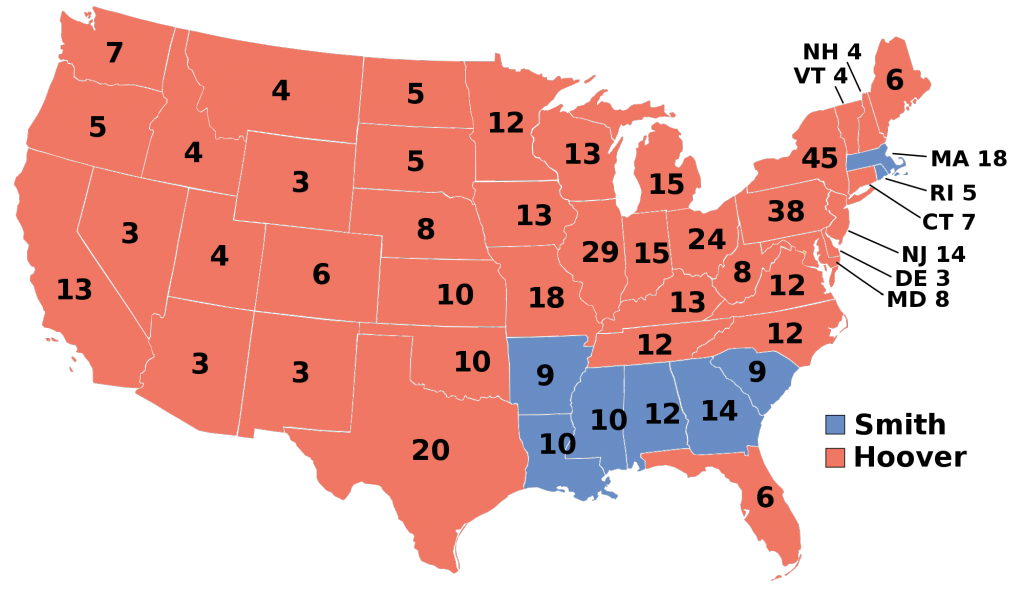
And I think that he can hold the line, maybe, in the South. I see him winning Mississippi and Alabama, and maybe Louisiana. I think he loses Georgia, I think he loses North Carolina. But I think… that’s only one area where the Republican Party is strong. You go to the Great Plains, right… So the Great Plains starts with Texas and then goes up to the Canadian border, and then it goes west up though Montana, Idaho, Wyoming, Utah. He is going to punk out all through that region. These people want nothing to do with this guy. Maybe they’ll vote for him over Hillary Clinton, because they find Hillary Clinton so objectionable, but he is not going to win those states by anything approaching a solid margin. If you want a view of what Trump looks like on election day, I think the best map you can look at is probably the 1928 map between Al Smith and Herbert Hoover. And Herbert Hoover massacred Al Smith. It is going to be an absolute, total bloodbath for Republicans. It will give the Democrats not only control of the White House and the Senate, but very possibly the House of Representatives That 1928 electoral map is about as one-sided as Trump’s electoral predictions get. I can’t say I’d look forward to such a lopsided win, mainly because I don’t want to think about the type of politician who will be able to capitalize on disappointed Trump voters (just as Trump spoke to disaffected Tea Partiers). Still if it means dealing a serious blow to the darkest corners of Trump’s twisted rhetoric, I’m all for it:

1928
1928

See: http://www.nationalmemo.com/nominating-trump-would-be-an-electoral-bloodbath-weekly-standard/

Brussels: Just the Latest Failure of the ‘War on Terror’

The two major aspects of the West’s ‘War on Terror,’ an enormous amount of violence and the demonization of Muslims, are only recipes for increased terrorism.

Source: RSN

Author: Paul Gottinger – Reader Supported News

Emphasis Mine

Once again the West has been stirred to outrage. Two bombs were set off in a bustling airport and one in crowded subway car in Brussels. Now we #PrayForBelgium.

The West has long turned a blind eye to the violence it wages around the world, but this is different. Once again, ‘they’ are attacking ‘us’ here at home.

The attack is tragic, but it shouldn’t be a surprise. To say the West’s ‘War on Terror’ has been an extraordinary failure is inaccurate. In actuality, it is accelerating terrorism.

In fact, during the 14 years of the ‘War on Terror,’ the West has failed to eliminate even one terror organization, yet groups like ISIS have risen from the ashes of the West’s counterterror policy.

My analysis of US State Department data shows that terror attacks have increased by a staggering 65 percent since 9/11. This massive escalation in terror really skyrocketed during the US War in Iraq. British Intelligence has dubbed this the ‘Iraq Effect.’

According the US State Department, in 2003 there were 208 terror attacks around the world, but that number had jumped to 11,000 attacks just two years later. In the years since, the number of attacks has generally been above 10,000.

It’s tragically fitting that the attack in Brussels occurred just 2 days after the 13th anniversary of the War in Iraq. That war, the centerpiece of the US ‘War on Terror,’ gave rise to ISIS, the very terror organization that claimed responsibility for the attack in Brussels.

Many of the US’s counterterror failures have their roots in the colossal disaster that was the Iraq War. ISIS exploited the destruction and instability of war to attract foreign jihadists, gain local support, and create a deeply rooted organizational structure.

Anger over the Iraq War is a common motivation cited for why individuals join ISIS, according to interviews with captured militants.

Most of the leadership of ISIS is Iraqi, and the group’s rise reflects the political failures in Iraq and Syria. The discrimination and violent repression of the Sunni community by the Iraqi government and the Assad regime in Syria created a situation where many Sunnis see ISIS as a preferable option to the state structures ISIS has replaced.

In response to the rise of ISIS, the West has taken its preferred form of action, violence. The US-led coalition has launched almost 11,000 strikes, which have killed 10,000 ISIS fighters in an ISIS military force that the CIA officially estimates to be 30,000, though this is likely a large underestimate.

This enormous use of force has predictably been largely unsuccessful. In fact, it actually fuels resentment by the local populations by leaving communities caught between ISIS’s harsh rule and the West’s indiscriminate violence. Military destruction without a political solution has only deepened the crisis and aided ISIS recruitment.

The US-Russia/Iran rivalry is another serious problem. It only sows division in the effort to fight terrorism in Iraq and Syria. The effect is that the US is turning its back on some of the most effective partners in the fight against ISIS.

Anyone hoping for a change of course in the West’s reaction to terror was quickly disappointed this week.

The US Secretary of Defense quickly announced that the Pentagon will increase funding for the US air strikes on ISIS, and Obama is even concerned a major terror attack in the US may force the US into a “large and costly war in the Middle East.”

But more violence abroad wasn’t the only response to Brussels the US offered. We also saw Donald Trump renewing his pledge to ban Muslims from entering the US, and Ted Cruz calling for police patrols in ‘Muslims neighborhoods.’

Not to be outdone by politicians, ordinary citizens exhibited some of that famous ‘Western civilization’ with the hateful hashtag #StopIslam, which was trending worldwide on Twitter.

Hillary Clinton also got in on the action. She called for censoring the Internet and for Muslims to rat on their friends and family if someone they know catches the ‘extremism’ bug.

Based on these responses, it seems the West will be unable to stem the tide of terror in the West, and worse yet, there doesn’t seem to even be an understanding of what drives individuals towards ‘jihadism.’

The two major aspects of the West’s ‘War on Terror,’ an enormous amount of violence and the demonization of Muslims, are only recipes for increased terrorism.

ISIS may lose territory, but if the underlying sectarian polarization and political crisis is unresolved, the conditions that allow ISIS to exist will remain in place in Iraq and Syria.

Ultimately, if the vast majority of the West’s resources continue to go to escalating the risks of terror and the West continues to ignore the Persian Gulf’s funding for extremism, then all the police and intelligence integration imaginable will fail to stop terrorism. The fundamental goal of counterterror should be to prevent the conditions that draw people to become terrorists, rather than just attempting to prevent attacks from being carried out.

A seismic shift is needed in the West’s counterterrorism policy, or the attacks in Belgium are sure to be but a small taste of what is to come for Europe and the US.


Paul Gottinger is a staff reporter at RSN whose work focuses on the Middle East and the arms industry. He can be reached on Twitter @paulgottinger or via email.

See: http://readersupportednews.org/opinion2/277-75/35950-focus-brussels-just-the-latest-failure-of-the-war-on-terror

February continues streak of record low Arctic sea ice extent

Figure1-350x417

Figure 1. Arctic sea ice extent for February 2016 was 14.22 million square kilometers (5.48 million square miles). The magenta line shows the 1981 to 2010 median extent for that month. The black cross indicates the geographic North Pole. Sea Ice Index data. About the data

Credit: National Snow and Ice Data Center
High-resolution image


Source: Arctic Sea News

Author:

Emphasis Mine

Arctic sea ice was at a satellite-record low for the second month in a row. The first three weeks of February saw little ice growth, but extent rose during the last week of the month. Arctic sea ice typically reaches its maximum extent for the year in mid to late March.

Arctic sea ice extent for February averaged 14.22 million square kilometers (5.48 million square miles), the lowest February extent in the satellite record. It is 1.16 million square kilometers (448,000 square miles) below the 1981 to 2010 long-term average of 15.4 million square kilometers (5.94 million square miles) and is 200,000 square kilometers (77,000 square miles) below the previous record low for the month recorded in 2005.

The first three weeks of February saw little ice growth, but extent rose during the last week of the month primarily due to growth in the Sea of Okhotsk (180,000 square kilometers or 70,000 square miles) and to a lesser extent in Baffin Bay (35,000 square kilometers or 13,500 square miles). Extent is presently below average in the Barents and Kara seas, as well as the Bering Sea and the East Greenland Sea. Extent decreased in the Barents and East Greenland seas during the month of February. In other regions, such as the Sea of Okhotsk, Baffin Bay, and the Labrador Sea, ice conditions are near average to slightly above average for this time of year. An exception is the Gulf of St. Lawrence, which remains largely ice free. In the Antarctic, sea ice reached its minimum extent for the year on February 19, averaging 2.6 million square kilometers (1 million square miles). It is the ninth lowest Antarctic sea ice minimum extent in the satellite record.

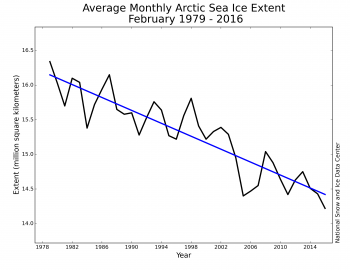
NASA and NOAA announced that January 2016 was the ninth straight month of record-breaking high surface temperatures for the globe. In terms of regional patterns, the Arctic stands out, with surface temperatures more than 4 degrees Celsius (7.2 degrees Fahrenheit) above the 1951 to 1980 average. These high temperatures were in part responsible for the record low sea ice extent observed for January. Persistent warmth has continued into February; air temperatures at the 925 hPa level were 6 to 8 degrees Celsius (11 to 14 degrees Fahrenheit) above the 1981 to 2010 average over the central Arctic Ocean near the pole. The rate of ice growth for February was near average at 19,700 square kilometers (7,600 square miles) per day, compared to 20,200 square kilometers (7,800 square miles) per day for the 1981 to 2010 average. Atmospheric circulation patterns have also favored low sea ice extent, particularly in the Barents and Kara seas. Ice motion drift data derived from the Advanced Microwave Scanning Radiometer 2 (AMSR2) satellite and provided by the Centre ERS d’Archivage et de Traitement (CERSAT) show that since January 1, there has been cyclonic, or counterclockwise, sea ice motion in the Barents Sea helping to keep sea ice from advancing south. During the second half of January, an anti-cyclonic, or clockwise, circulation pattern developed in the Beaufort Sea, which subsequently strengthened and expanded to include most of the Arctic Ocean. This, combined with high pressure over Greenland and low pressure over Spitsbergen, has favored enhanced ice export out of Fram Strait, helping to flush old, thick ice out of the Arctic Ocean, leaving behind thinner ice that is more apt to melt away in summer. Whether this circulation pattern will continue and set the stage for very low September sea ice extent remains to be seen. February 2016 sea ice extent was the lowest in the satellite record at 14.22 million square kilometers (5.48 million square miles). The linear rate of decline for February is now 3.0 percent per decade.

Figure3_0301-350x270Figure 3. Monthly February sea ice extent for 1979 to 2016 shows a decline of 3.0 percent per decade.

Credit: National Snow and Ice Data Center
High-resolution image

Since 2003, the Atmospheric Infrared Sounder (AIRS) onboard the NASA Aqua satellite has collected daily temperature and humidity profiles globally. Although the record is fairly short, AIRS data can provide insight into recent changes in Arctic climate. February average air temperatures, measured by AIRS at 925 hPa, are around 5 degrees Celsius (9 degrees Fahrenheit) above the 2003 to 2015 average over the Beaufort and Chukchi seas and the central Arctic Ocean. Above-average temperatures are also the rule over the Kara Sea and Northern Siberia (6 degrees Celsius or 11 degrees Fahrenheit above average). Regions with especially higher than average temperatures correspond to regions of low sea ice, demonstrating the role played by heat fluxes from open water areas. For example, the Sea of Okhotsk experienced below-average air temperatures, and also had above-average sea ice extents, whereas the Kara, Barents, and Bering seas and the Gulf of St. Lawrence had higher air temperatures compared to average, which coincides with lower than average sea ice extent.

A similar relationship is seen in the total precipitable water for February 2016. Precipitable water is the amount of water vapor in the atmospheric column totaled from the surface to the top of the troposphere, expressed as kilograms of water per square meter (one kilogram per square meter equals 1 millimeter of water depth). In February, areas with precipitable water between 12 percent (Bering Sea) to 70 percent (Kara Sea) above the 2003 to 2015 February average corresponded to regions with below-average sea ice extent. Water vapor is a greenhouse gas, and with more water vapor in the air, there is a stronger emission of longwave radiation to the surface. Conversely, the observation that above-average amounts of water vapor are found over areas of reduced sea ice extent points to a role of local evaporation, and evaporation is a cooling process that by itself will favor ice growth.

Sea ice reformed or refroze later than average throughout most of the Arctic, especially in the Kara and Barents seas where the freeze-up happened about two months later than average. Ice was also late to form in the Beaufort, Chukchi, East Siberian, and Laptev seas, between ten and forty days later than average. In contrast, the timing of freeze-up over the central Arctic Ocean near the pole was near average, as was also the case in Baffin Bay and parts of Hudson Bay. When freeze-up happens late, the ice has less time to thicken before the melt season starts, leading to a thinner ice cover that is more prone to melting out in summer.

Figure 5. This images shows freeze-up anomalies in the Arctic for 2015. Reds indicate areas where freeze-up began later than average and blues indicate freeze-up beginning earlier than average. Credit: National Snow and Ice Data Center, data provided by J. Miller/T. Markus, NASA Goddard Space Flight Center High-resolution imag
Figure 5. This images shows freeze-up anomalies in the Arctic for 2015. Reds indicate areas where freeze-up began later than average and blues indicate freeze-up beginning earlier than average.
Credit: National Snow and Ice Data Center, data provided by J. Miller/T. Markus, NASA Goddard Space Flight Center
High-resolution imag


See:https://nsidc.org/arcticseaicenews/


This is what climate change looks like.


110109_Algeria_slashes_food_prices_amid_riots_002

Source: dailykos

Author: grumpynerd

Emphasis Mine

It’s important to express solidarity with Belgium at this time of grief and fear, but we have to also start thinking longer term about these kinds of events.  One of the overlooked factors leading to the Paris and Brussels attacks is something we’ll be living with a long time: climate change.

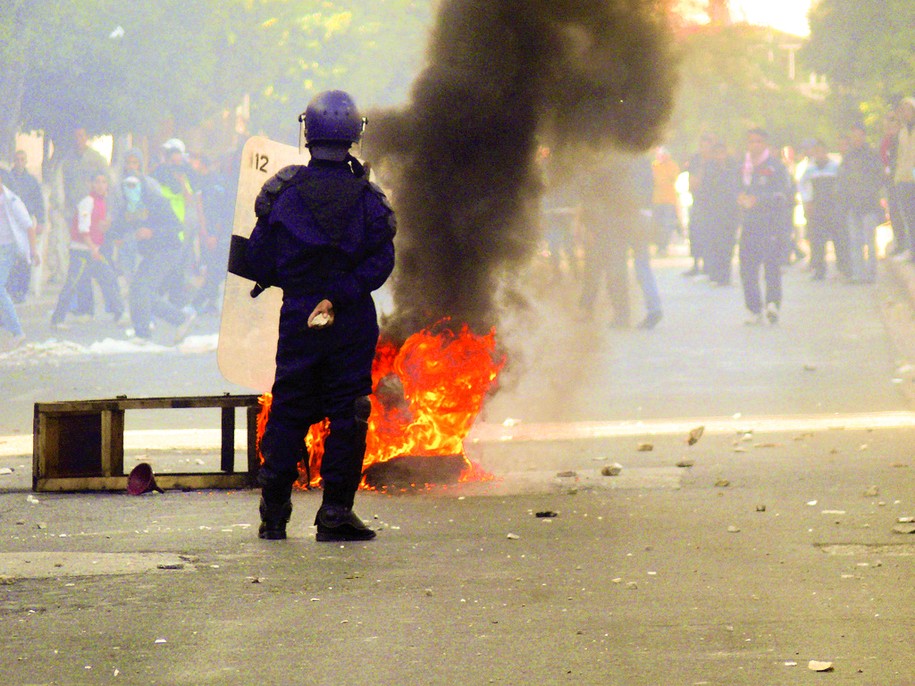
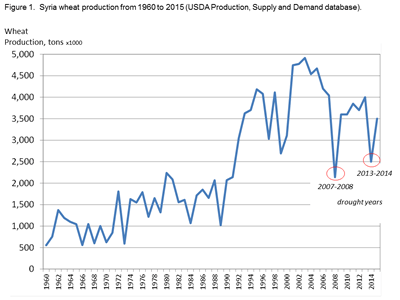
We have to start making this point: regional political instability and the resulting export of terrorism are climate change problems. And no doubt we’ll be ridiculed for saying that. “Don’t be ridiculous,” some people will say,”the problem is radical Islam.” Well the Assads have ruled over radical Islamists for decades, and have ruthlessly but successfully put down past Islamist risings.  So what was different about 2011?  This was:

SyriaWheatProduction.jpg

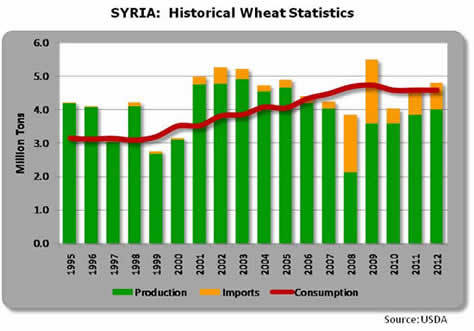
Now note that by 2011 Syrian grain production actually had begun to recover from the record-setting failures of 2008, but measured against the levels of production in the first half of the decade we’re looking at a bad harvest. And by that year many people had migrated to the cities when their farms failed.  Syria had 1.3 million internal refugees — climate refugees — when the first “Day of Rage” was staged in February 2011.  160 villages had been completely depopulated. [source]

We get a better picture of what was going on by comparing consumption, production and importation of wheat to Syria:

Syria_wheat_supply_chart

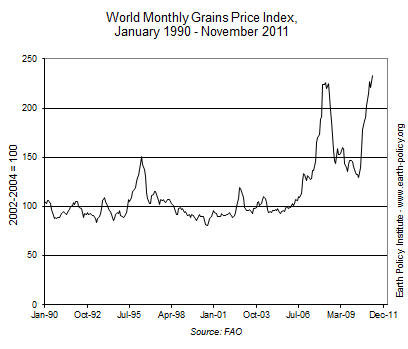
Look at what the red line — the amount of consumption — does in 2010. It goes down.  Bread is a staple of the Syrian diet much more than it is in the American diet, so what you are looking at are people going hungry.  In 2009 they were able to import their way around the bad wheat harvests, then in 2010 you have a hungry year. Why? The local harvests weren’t any worse in 2010 than 2009, but imports drop precipitously because of this:

indicator3_2012_GrainPrice

In 2011, there was enough wheat in Syria, but only if you had the money buy it. In some places the price of bread had risen ten-fold.  High food prices can destabilize any country, regardless of its culture or religion.  The French Revolution began with bread riots.  So did the Arab Spring in 2011.  Any country with large numbers of hungry, un- or under-employed people is a threat to peace and international security.

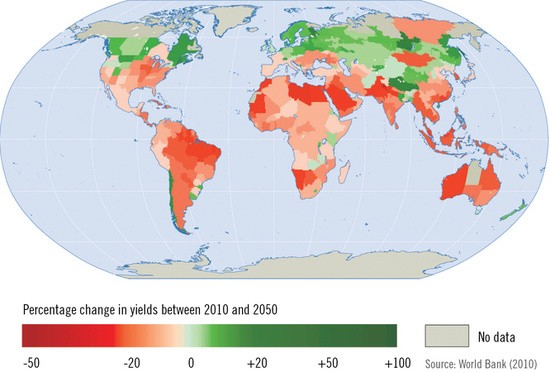
Finally, consider this map:

WorldBankAgChanges

Think of this not as an agricultural map, but as a risk map.  Where an area of climate-induced agricultural failure coincides with an affluent population that can afford to source its food globally, the risk can be discounted. But other countries won’t be able to afford to roll snake eyes when it comes to local harvests and global commodity prices. Some of those countries are important US trading partners and allies.

I am not suggesting we don’t need a security apparatus response to terrorism.  Of course we do.  But ISIL isn’t an aberration; it’s the start of a long-term, climate-driven trend that will cross religious and cultural boundaries.  A security response won’t be enough; we need to get out ahead of that trend by addressing global food security.  That’ll require an “all of the above” approach: both reductions in human contributions to climate change and preparations for the changes we can’t avoid.


See:http://www.dailykos.com/story/2016/03/22/1504837/-This-is-what-climate-change-looks-like?detail=email&&can_id=d57025b8908d671dcc8edc84e5855f8f&source=email-arizona-officials-confirm-legal-action-in-primary-fiasco-2&email_referrer=arizona-officials-confirm-legal-action-in-primary-fiasco-2&email_subject=arizona-officials-confirm-legal-action-in-primary-fiasco&link_id=7

Nixon Aide Reportedly Admitted Drug War Was Meant To Target Black People

Source: HuffP{ost

Author:Hilary Hanson

Emphasis Mine

An eye-opening remark from a former aide to President Richard Nixon pulls back the curtain on the true motivation of the United States’ war on drugs.

John Ehrlichman, who served 18 months in prison for his central role in the Watergate scandal, was Nixon’s chief domestic advisor when the president announced the “war on drugs” in 1971. The administration cited a high death toll and the negative social impacts of drugs to justify expanding federal drug control agencies. Doing so set the scene for decades of socially and economically disastrous policies.

Journalist Dan Baum wrote in the April cover story of Harper’s about how he interviewed Ehrlichman in 1994 while working on a book about drug prohibition. Ehrlichman provided some shockingly honest insight into the motives behind the drug war. From Harper’s:

“You want to know what this was really all about?” he asked with the bluntness of a man who, after public disgrace and a stretch in federal prison, had little left to protect. “The Nixon campaign in 1968, and the Nixon White House after that, had two enemies: the antiwar left and black people. You understand what I’m saying? We knew we couldn’t make it illegal to be either against the war or black, but by getting the public to associate the hippies with marijuana and blacks with heroin, and then criminalizing both heavily, we could disrupt those communities. We could arrest their leaders, raid their homes, break up their meetings, and vilify them night after night on the evening news. Did we know we were lying about the drugs? Of course we did.”

In other words, the intense racial targeting that’s become synonymous with the drug war wasn’t an unintended side effect — it was the whole point.

The quote kicks off Baum’s “Legalize It All,” the cover story for Harper’s April 2016 issue. Read the whole article, which is a comprehensive argument for drug legalization, here.

Baum explained to The Huffington Post why he didn’t include the quote in his 1996 book, Smoke and Mirrors: The War on Drugs and the Politics of Failure.

“There are no authorial interviews in [Smoke and Mirrors] at all; it’s written to put the reader in the room as events transpire,” Baum said in an email. “Therefore, the quote didn’t fit. It did change all the reporting I did for the book, though, and changed the way I worked thereafter.”

The quote does, however, appear in the 2012 book The Moment, a collection of “life-changing stories” from writers and artists.

Baum also talked to HuffPost about why Ehrlichman would confess such a thing in such blunt terms.

“It taught me that people are often eager to unburden themselves, once they no longer have a dog in the fight,” Baum said. “The interviewer needs to be patient sometimes, and needs to ask the right way. But people will often be incredibly honest if given the chance.”

See:http://www.huffingtonpost.com/entry/nixon-drug-war-racist_us_56f16a0ae4b03a640a6bbda1

Trump’s Attack on Cruz’s Wife Proves He’s Too Sexist to Stand a Chance Against Clinton

Trump sneers at Cruz’s wife, showing why he’s not just going to lose female voters, but a lot of male voters, too.

Source: AlterNet

Author: Amanda Marcotte/Salon

Emphasis Mine

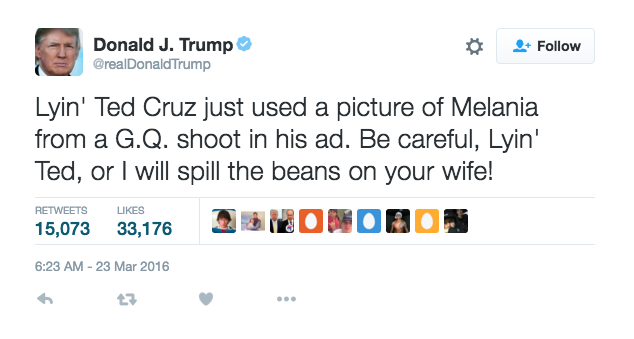
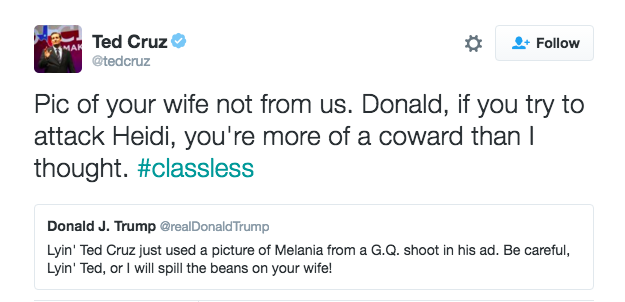
While most of the U.S. political world was focused on the terrorist attacks in Brussels and the primaries in some Western states Tuesday night, Donald Trump—surprise, surprise—was sitting around nursing a grudge. And he decided it needed airing out on Twitter, of course.

screen_shot_2016-03-23_at_4.53.38_pm

add
add

There’s been a robust discussion in feminist circles about this ad that is actually a meme and how it’s unfair and slut-shaming. There’s a strong argument to be had supporting this, but you have to give the woman who made it, Liz Mair, some credit for finding and exploiting a real vulnerability when it comes to Trump and female voters, both liberal and conservative.

While it’s true that Melania Trump is smarter than a lot of people realize and isn’t doing anything wrong by taking risqué photos, this ad isn’t really about her. This ad is about Donald Trump, highlighting that he really is a cartoonish stereotype: The wealthy sexist who talks about women like they’re objects for purchase and who is probably not interested in his wife because she speaks five languages and has studied architecture and design. One can politely ignore that fact in public, but there’s simply no way women aren’t taking note of it in private.

(Conversation I heard from two women talking in public recently: “Well, she’s probably smarter than the rest of us. We’re working and she’s probably out on 5th Avenue shopping right now.” “Yeah, but him? Ugh. He can’t really think she wants him for himself.”)

Trump’s reaction to this—to try to drag Ted Cruz into a wife-measuring contest, like they are debating the merits of owning a Ferrari vs. a Toyota Corolla—just confirms the suspicions that this ad is trying to raise.

This is why those who worry that Trump’s over-the-top sexism will somehow help him in a general election match-up against Hillary Clinton are completely misreading these particular tea leaves. Sure, there are a lot of men out there who see things the way Trump does. Those men admire him for his history of categorizing women as either sex objects or wastes of space whose continued existence is a mystery to him.

But those men are not the dominant voting bloc in a general election. In fact, men, as a group, do not make up the majority of voters. Women vote more than men and have since 1980And women hate Trump. Sure, there’s a lot of sexist dislike for Clinton, which explains why her unfavorability ratings are significantly higher with men than women. But Trump’s sexism has an even more profound impact on his popularity with women, as Jon Schwartz at The Intercept explains:

Women dislike Trump with what’s likely a historically unique intensity for a national politician. Trump’s average net favorability among women over the past six weeks is minus 33 percent—far worse than the minus 2 percent net favorability among women for Marco Rubio or the minus 14 percent for Ted Cruz. Likewise, in a poll taken just before the 2012 election, Mitt Romney had a net favorability among women of minus 2 percent.

And this is before the general election even really gets underway and Trump starts pulling his “why is this woman I don’t want to have sex with even talking” act with Hillary Clinton. As Jeet Heer points out at the New Republic, the only time Carly Fiorina was really doing well with Republicans was when Trump was disrespecting her in this way. And that’s with a crowd that has way higher tolerance for overt sexism. The public at large is not going to like it, not one bit. Nor will this hurt Trump with just women, either. Sure, Trump plays well with the Maxim crowd, but he takes the sexist vitriol so far that it repulses a whole bunch of men, both liberal and conservative. The exchange with Cruz was a good example of how the way Trump talks about women is also insulting to men.

screen_shot_2016-03-23_at_4.59.36_pmMost news sources are assuming that Trump was referring to Heidi Cruz’s history of struggling with depression, and if so, then congratulations, Trump. You did the impossible: You made Ted Cruz, by far the creepiest politician on the national stage since Ross Perot, seem like a decent man who cares for and stands by his wife.

That sort of thing doesn’t just impact female voters, but a lot of men, as well. Even some men who might have some sympathy for Trump’s leering sexism are going to draw the line at treating a beloved wife like she’s a defective product who needs to be returned to the factory just because she has some health problems. Most men’s marriages are more like the Cruz marriage than the Trump marriage. They aren’t going to be keen on the idea that Trump would look down on them for that.

Six out of 10 female voters think Trump is an embarrassment, but it’s also true that 4 out of 10 male voters think that. Just wait until the general election, where his sexist antics will get even more attention (as hard as that may be to believe) than they are getting now. This is a man who can’t crack 50% of Republican voters, even in Arizona, where his xenophobic campaign should be going over like gangbusters. On a national stage, against a female opponent whose very existence counters Trump’s reductionist attitudes about women’s worth, Trump is going to look even more like an embarrassment.

Amanda Marcotte is a politics writer for Salon. She’s on Twitter @AmandaMarcotte. 

See:http://www.alternet.org/election-2016/trumps-female-problems-donald-trumps-attack-ted-cruzs-wife-proves-hes-too-sexist-stand?utm_source=Amanda+Marcotte%27s+Subscribers&utm_campaign=c6e2f1532d-RSS_AUTHOR_EMAIL&utm_medium=email&utm_term=0_f2b9a8ae81-c6e2f1532d-79824733

Trump Loves the Poorly Educated—and They Love Him Right Back

Trump is taking advantage of his supporters using psychology rather than reason.

Source: AlterNet

Author: David Masciotra/Salon

Emphasis Mine

For all of his buffoonery about “telling it like it is,” Donald Trump is the most politically correct and cowardly candidate in the presidential race. If he actually had the strength to articulate uncomfortable and inconvenient truths, he would turn his favorite word—“loser”—not on full-time professionals in the press, but on his supporters.

The New York Times recently ran a report on “Trump geography,” seeking to solve one of the most bizarre mysteries of modern political history: Why do people support Donald Trump, and who are these people?

Journalists found that in the counties where Trump is most dominant, there are large numbers of white high school dropouts, and unemployed people no longer looking for work. An alliance with the incoherent personality cult of Donald Trump’s candidacy correlates strongly with failure to obtain a high school diploma, and withdrawal from the labor force. The counties also have a consistent history of voting for segregationists, and have an above average percentage of its residents living in mobile homes. Many conservatives, and even some kindhearted liberals, might object to the conclusions one can draw from the data as stereotyping, but the empirical evidence leaves little choice. Donald Trump’s supporters confirm the stereotype against them. The candidate himself even acknowledged the veracity of the caricature of his “movement” when he made the odd and condescending claim, “I love the poorly educated.” His affection for illiteracy and ignorance did not extend to himself or any of his children, all of whom have degrees from some of the best universities in the world.

The low-educated, low-income counties of Trump’s America also receive large sums of public assistance. Social Security fraud—seeking disability payments for minor injuries or conditions—is so rampant that attorneys have created a cottage industry out of offering to secure services for clients willing to pay a one-time fee for longtime subsidy.

Much discussion and analysis followed the revelation that for the first time in decades the life expectancy for middle-aged white men is declining. Another study shows that Trump easily wins the counties and cities where this reversal of the national trend—rising life expectancy—is happening. Scrutiny shows that much of the failure to take advantage of advancement in medical technology and healthcare availability results from working-class white men’s high rates of alcoholism, obesity and tobacco use.

Widespread poverty throughout the heartland and Southern United States is a lamentable social problem, but even in the best economic conditions, and under the friendliest government policies, the career options for high school dropouts will forever remain few and poor. Rather than accepting some “personal responsibility”—a favorite conservative concept—for their low standard of living and destructive lifestyle, the wrongly romanticized white working class is flocking to a candidate who allows them to blame other people for their problems. Their poor health is not the result of a pack a day habit and fatty diet, just as their financial misery has nothing to do with their rejection of education. It is all because of those damn Mexicans coming up from the border, the Chinese villains overseas, or the Muslim immigrant illegally occupying the Oval Office.

Never mind that illegal immigrants comprise a mere 3.5 percent of the population, and that most of them are concentrated in six states, a “big, beautiful wall” will cure all the ills of a high school dropout no longer applying for jobs.

Kevin Williamson of the National Review recently wrote an essay identifying some of the personal problems of Trump supporters, and members of the right-wing media immediately slipped into fits. Once they finished wiping the foam from their mouths, they condemned Williamson for his “snobbery” and “elitism,” but as Williamson suggested in a follow-up article, his critics never explained how any of his information or argumentation was flawed.

Donald Trump’s celebration of the “poorly educated,” conservative commentators’ indignation at Williamson, and even the mainstream media’s continued characterization of Trump’s supporters as victims of “failed government policy” or “cracks in the economy” expose the Republican Party and powerful parts of the press as facilitators and enablers of America’s worst historical sin: racism.

The inconsistency and hypocrisy evident in the right-wing portrayal of poverty, and even in the softer version of the mainstream media’s differing depiction of poor people, is overwhelming. The black, urban poor are lazy parasites who need to get it together, study longer and work harder, but the unemployed and uneducated white people empowering Trump’s vulgarity and bigotry are helpless victims of large economic conspiracies.

Personal responsibility, it would appear, is only applicable to the lives of black people.

Trump supporters on public aid believe that they are the exceptions to their anti-government ideology, and Trump allows them to wallow in self-pity and racism. In Illinois, xenophobia and stupidity joined forces to actually hurt the Republican front-runner. Voting for a primary presidential candidate in Illinois requires voters to select delegates, rather than vote directly for the politician. Each delegate has his or her corresponding candidate’s name in parentheses, but even so, many Trump supporters refused to vote for Trump delegates with the names, Nabi Fakroddin and Raja Sadiq.

The imbecility of Trump’s slogan, “Make America Great Again,” provokes the question, “Make America great again for whom?”

At no point in American history was there a greater amount of liberty and opportunity for blacks, women, gays and Latinos. Together those groups form a gigantic swath of the population, but apparently, they are not included in the calculus of Trump and his supporters.

Trump himself recently spoke out of both sides of his mouth when he said that a young black gentleman at the Chicago fiasco, who was better dressed and better groomed than the Trump supporters at the rally, was a “bum” who should “get a job.” Trump’s entire campaign is predicated on the phony populism of American recovery from third-world status. His out-of-work white constituency is in desperate need of his artistic deal making, but the black protestor is just lazy.

While it is far from perfect, the truth is that the American economy is doing rather well. Unemployment has dropped in half since the black Muslim became president, the housing market has begun to come back, gas prices are significantly lower, GDP rates are decent, and the United States has experienced 72 consecutive months of private sector job growth.

The failure of the recovery to penetrate the lives of high school dropouts who have stopped filling out job applications is not evidence that the “American dream is dead” or that “America is going to hell,” as Trump often puts it with characteristically inspirational rhetoric.

He is able to make his gullible supporters believe him, however, and that is all that really matters to his campaign. Never in the history of American politics has a candidate been so far apart from his constituency. Donald Trump is an Ivy League-educated, billionaire real estate developer living in Manhattan with his supermodel wife. His lifestyle is a distant fantasy to his voters, and it seems unlikely that, in any other context, Trump would ever share a room with any of them. He is running a con.

“I love the poorly educated” makes sense, because the ability to see through the sophisticated bullshit of confidence men is one benefit, among many, of a good education.

David Masciotra is the author of Mellencamp: American Troubadour (University Press of Kentucky). He has also written for Salon, the Atlantic and the Los Angeles Review of Books. For more information visit www.davidmasciotra.com.


See:http://www.alternet.org/election-2016/trump-loves-poorly-educated-and-they-love-him-right-back?akid=14100.123424.Q56xM3&rd=1&src=newsletter1052977&t=10
What Right-Wing Media Doesn’t Understand About Rage and the White Working Class

Especially clueless National Review story gets origins of working-class anger wrong, and misunderstands Trumpism.

Source: AlterNet

Author: Paul Campos/Salon

Emphasis Mine

The following first appeared on Salon

A few days ago, the National Review’s Kevin Williamson caused something of a storm when he published an article entitled “Chaos in the Family, Chaos in the State: The White Working Class’s Dysfunction.” The article might as well have been called “Establishment Conservatives Really Aren’t Racists: We Hate Lots of White People, Too.”

Williamson’s thesis is that the white working class is largely responsible for its own degraded condition, apparently because way too many of the roughly 100 million white American adults without college degrees are shiftless drug addicts, who “whelp” babies they can’t take care of, while suckling on the teat of our overly-generous welfare state, instead of moving from their dysfunctional Rust Belt ghettos to places where good-paying jobs are going unfilled. (In a remarkable oversight, Williamson fails to say where those places might be).

Williamson’s thesis is not exactly novel. Indeed, it’s part of a series of conservative screeds that could be called “Working-Class White is the New Black.” The problem with “those people,” you see, isn’t that their jobs, their communities, and their whole way of life have been destroyed by global capitalism. It isn’t that being thrust to the margins or the heart of poverty tends to create stresses that break apart families. It isn’t that economic calamity leads to substance abuse as an eminently predictable form of self-medication.

After all, these sorts of structural explanations for social breakdown are only supported by social science, which, like reality itself, is known to have a strong left-wing bias. Williamson and company’s right-wing critique, by contrast, is supported by the very interesting theory that roughly two-thirds of America’s white population suddenly developed poor moral characters, around the time that “The Brady Bunch” went into syndication.

Ah yes, “The Brady Bunch.” Behold conservative cultural studies, as brought to you by the National Review:

The manufacturing numbers — and the entire gloriously complex tale of globalization — go in fits and starts: a little improvement here, a little improvement there, and a radically better world in raw material terms (and let’s not sniff at those) every couple of decades. Go back and read the novels of the 1980s or watch “The Brady Bunch” and ask yourself why well-to-do suburban families living in large, comfortable homes and holding down prestigious jobs were worried about the price of butter and meat, and then ask yourself when was the last time you heard someone complain that he couldn’t afford a stick of butter.

OK I asked myself, and the answer is: last week. Does Williamson actually know any middle-class — let alone working-class or poor — Americans? The average income of the other half, the bottom 50% of American households (that’s 160 million people) is$26,520 per year. That’s barely more than $2,000 per month, before subtracting payroll and state taxes. If your entire household is living on $2,000 per month, you can bet you’re worried about the price of butter and meat.

But let’s get back to “The Brady Bunch.” Leave aside the absurdity of citing TV mogul Sherwood Schwartz’s fantasy creations as evidence for the actual economic circumstances of middle class professionals in the early 1970s (For example, the Bradys had a live-in housekeeper, because lots of people in Schwartz’s social circle had one). Consider what sorts of costs the real-life parallels to the fictional Bradys were dealing with.

It’s true that butter and meat cost about 20% less in real dollars than they did 40 years ago. On the other hand: the real-life North Hollywood house which Schwartz used for the exterior shots of the Brady home sold in 1973 for $61,000 ($325,761 in 2016 dollars). According to the popular real estate website Zillow, buying this house today would cost $1,791,835. Now real estate values in Los Angeles have skyrocketed, but in the nation as a whole, the inflation-adjusted cost of a new home has almost doubled since the early 1970s, while median household income has barely budged.

If the Brady children had gone off to college, they would have paid, in 1975an average of $541 per year to attend a four-year public university, and $2,290 to go to a private school (the 2015 dollar equivalents are $2,387 and $10,088). Today, average tuition is, in real dollars, three times higher at private schools and four times higher at public institutions.

When “The Brady Bunch” came on the air, Americans were paying $2,171 per year, in 2016 dollars, for health care. Today that figure is four and half times higher.

In sum, while over the past four decades real median household incomes have stagnated (and those of working class households have declined), housing prices have doubled, higher education costs have tripled and quadrupled, and medical costs have risen even more. That establishment Republicans such as Williamson are deluded enough to believe that the last 40 years haven’t been an economic disaster for working class Americans, and that therefore their personal struggles provide an appropriate occasion for sanctimonious moralizing, helps explain why Donald Trump is winning the battle for the Republican nomination.

See:http://www.alternet.org/media/what-right-wing-media-doesnt-understand-about-rage-and-white-working-class?akid=14080.123424.MZYW4e&rd=1&src=newsletter1052897&t=8