The New Progressive Movement

Those who think that the cold weather will end the protests should think again. A new generation of leaders is just getting started. The new progressive age has begun

From NY Times, via RSN

By:  Jeffrey D. Sachs

N.B.: Organisers take note: blueprint inclosed.

“Occupy Wall Street and its allied movements around the country are more than a walk in the park. They are most likely the start of a new era in America. Historians have noted that American politics moves in long swings. We are at the end of the 30-year Reagan era, a period that has culminated in soaring income for the top 1 percent and crushing unemployment or income stagnation for much of the rest. The overarching challenge of the coming years is to restore prosperity and power for the 99 percent.

Thirty years ago, a newly elected Ronald Reagan made a fateful judgment: “Government is not the solution to our problem. Government is the problem.Taxes for the rich were slashed, as were outlays on public services and investments as a share of national income. Only the military and a few big transfer programs like Social Security, Medicare, Medicaid and veterans’ benefits were exempted from the squeeze.

Reagan’s was a fateful misdiagnosis. He completely overlooked the real issue – the rise of global competition in the information age – and fought a bogeyman, the government. Decades on, America pays the price of that misdiagnosis, with a nation singularly unprepared to face the global economic, energy and environmental challenges of our time.

Washington still channels Reaganomics. The federal budget for nonsecurity discretionary outlays – categories like highways and rail, education, job training, research and development, the judiciary, NASA, environmental protection, energy, the IRS and more – was cut from more than 5 percent of gross domestic product at the end of the 1970s to around half of that today. With the budget caps enacted in the August agreement, domestic discretionary spending would decline to less than 2 percent of GDP by the end of the decade, according to the White House. Government would die by fiscal asphyxiation.

Both parties have joined in crippling the government in response to the demands of their wealthy campaign contributors, who above all else insist on keeping low tax rates on capital gains, top incomes, estates and corporate profits. Corporate taxes as a share of national income are at the lowest levels in recent history. Rich households take home the greatest share of income since the Great Depression. Twice before in American history, powerful corporate interests dominated Washington and brought America to a state of unacceptable inequality, instability and corruption. Both times a social and political movement arose to restore democracy and shared prosperity.

The first age of inequality was the Gilded Age at the end of the 19th century, an era quite like today, when both political parties served the interests of the corporate robber barons. The progressive movement arose after the financial crisis of 1893. In the following decades Theodore Roosevelt and Woodrow Wilson came to power, and the movement pushed through a remarkable era of reform: trust busting, federal income taxation, fair labor standards, the direct election of senators and women’s suffrage.

The second gilded age was the Roaring Twenties. The pro-business administrations of Harding, Coolidge and Hoover once again opened up the floodgates of corruption and financial excess, this time culminating in the Great Depression. And once again the pendulum swung. FDR’s New Deal marked the start of several decades of reduced income inequality, strong trade unions, steep top tax rates and strict financial regulation. After 1981, Reagan began to dismantle each of these core features of the New Deal.

Following our recent financial calamity, a third progressive era is likely to be in the making. This one should aim for three things. The first is a revival of crucial public services, especially education, training, public investment and environmental protection. The second is the end of a climate of impunity that encouraged nearly every Wall Street firm to commit financial fraud. The third is to re-establish the supremacy of people votes over dollar votes in Washington.

None of this will be easy. Vested interests are deeply entrenched, even as Wall Street titans are jailed and their firms pay megafines for fraud. The progressive era took 20 years to correct abuses of the Gilded Age. The New Deal struggled for a decade to overcome the Great Depression, and the expansion of economic justice lasted through the 1960s. The new wave of reform is but a few months old.

The young people in Zuccotti Park and more than 1,000 cities have started America on a path to renewal. The movement, still in its first days, will have to expand in several strategic ways. Activists are needed among shareholders, consumers and students to hold corporations and politicians to account. Shareholders, for example, should pressure companies to get out of politics. Consumers should take their money and purchasing power away from companies that confuse business and political power. The whole range of other actions – shareholder and consumer activism, policy formulation, and running of candidates – will not happen in the park.

The new movement also needs to build a public policy platform. The American people have it absolutely right on the three main points of a new agenda. To put it simply: tax the rich, end the wars and restore honest and effective government for all.

Finally, the new progressive era will need a fresh and gutsy generation of candidates to seek election victories not through wealthy campaign financiers but through free social media. A new generation of politicians will prove that they can win on YouTube, Twitter, Facebook and blog sites, rather than with corporate-financed TV ads. By lowering the cost of political campaigning, the free social media can liberate Washington from the current state of endemic corruption. And the candidates that turn down large campaign checks, political action committees, Super PACs and bundlers will be well positioned to call out their opponents who are on the corporate take.

Those who think that the cold weather will end the protests should think again. A new generation of leaders is just getting started. The new progressive age has begun.”
Jeffrey D. Sachs is the director of the Earth Institute at Columbia University and the author, most recently, of “The Price of Civilization: Reawakening American Virtue and Prosperity.”


Emphasis Mine

see:http://readersupportednews.org/opinion2/277-75/8379-the-new-progressive-movement

Occupy the Education System: Students, Teachers and Parents Find New Spirit and Challenge the Attack on Public Schools

In the past couple of weeks, Occupy Wall Street has spurred dedicated education activists into some of the most innovative and inspiring actions.

From: Alternet

By:Sarah Jaffe

“I work hard, but my grades don’t matter. But I have a voice and I will be heard!”

Jordan is 13, and she’s speaking to a crowd of mostly adults, sitting on the granite steps of the New York City Department of Education at Tweed Hall. Or rather, she is speaking through them, as her words echo through the people’s mic used at Occupy Wall Street just few blocks south from where she’s speaking.

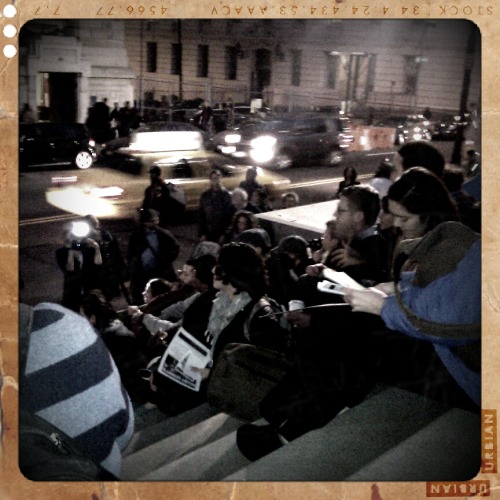
Tonight the steps of the DOE themselves have been occupied and are packed with teachers, students, parents, and supporters holding a general assembly on the state of public education in New York.

Jordan was far from the only student to speak. A young girl holding up one end of a sign that read “Nothing about us, without us, is for us!” declared “I am angry! I am PISSED! And I want JUSTICE!” in ringing tones, and Devan, a poet, read a poem over the people’s mic.

Perhaps the most remarkable thing about this event was the way in which it brought together those who might be considered adversaries in a conversation about the things they feel are hurting schools.

Students spoke about the pressure of high-stakes testing, but also of their teachers’ hard work and low pay. Teachers worried that their students were not learning because they were cramming for tests, and parents called for teachers to be supported, not threatened.

Rosie Frascella, a teacher and one of the organizers of this general assembly, told me before the event happened that invitations to speak had been issued to Mayor Mike Bloomberg and Schools Chancellor Dennis Walcott.

“If Chancellor Walcott and Bloomberg choose to show up, they will have the same opportunity to speak as all of us, and to show them what a democratic process looks like, because obviously they don’t know,” she said.

The Fight in New York

The first Occupy the Department of Education (Occupy the DOE) action took place on October 25 at the Panel for Educational Policy’s regular public meeting where teachers, parents and students are invited to speak to the city’s education policymakers—but on the policymakers’ terms.

“The PEP represents the struggle of OWS in many ways. The PEP is essentially mayoral control, the mayor appoints eight out of 13 panelists, so whatever Bloomberg decides, he makes sure that his panelists vote in alliance with his beliefs. It’s very clear who the 1 percent is in education: Bloomberg and Chancellor Walcott. The rest of us feel like the 99 percent: teachers, students, and parents,” Frascella said.

Brian Jones, a teacher at Brooklyn’s PS 261, told me there was intense frustration with the PEP among parents and teachers who had gone to many meetings and testified through the approved channels, only to have their voices ignored. “When they tried to close the 19 schools people testified until four in the morning, hundreds testified, and the PEP of course votes with the mayor,” he said. “We’re going through these motions of democracy even though what stands behind it is a dictatorship.”

The discussion that night was supposed to have been on new standards to be implemented in the schools. “We should’ve had the discussion before the implementation of such standards,” Jones said. “These standards were funded by Bill Gates. The guy who wrote them is not even a teacher. it’s like having a Surgeon General who never practiced medicine.”

Frascella said, “We’re thinking of new ways that we can allow parents and students and teachers to have a voice in the decisions that are affecting our lives, our working conditions, addressing and combating this mayoral control. Mayoral control is really killing our city.”

She noted that Mayor Bloomberg renewed a $120 million contract with Verizon while 45,000 of its workers were on strike, and when the company was already involved in a scandal around fraudulent billing—in August, Manhattan Borough President Scott Stringer called for the return of $800,000 to the city from Verizon.

“We don’t have mayoral control in white suburbia, you only see policies like these in urban settings,” Frascella said.

It’s not just the handing over of education department dollars to big corporations that led to the education actions, though. Standardized, high-stakes testing at the expense of real teaching time is also a major complaint. Jones told me that plans are now underway for high-stakes testing in arts and music. “There’s urgency around making sure that every kid takes a music test but not that every kid has a music teacher,” he said. “The city has laid off 700 school aides. Meanwhile we have tens of millions of dollars wasted on technology consultants, and the DOE is hiring more data specialists, data consultants at very high salaries.”

And the drive toward more charter schools led the Grassroots Education Movement (of which Jones is a part) to create a documentary called The Inconvenient Truth Behind Waiting for Supermanto push back against the seemingly endless flood of pro-charter-school media.

Jones pointed out that charter schools are pushed by people who have an agenda, like Eva Moskowitz, a former city councilwoman and failed candidate for Manhattan borough president who now runs a multi-million-dollar charter school network. Moskowitz has her sights set on Brooklyn now. “This new charter school that Moskowitz is trying to build is backed by Goldman Sachs,” Jones noted. “You don’t have to work very hard to make the connections.”

“I think there’s certainly a critical mass of consciousness–a critical mass of people who through their direct experience with so-called education reform have come to figure out that this is a wolf in sheep’s clothing,” Jones said.

Occupy the DOE

The Occupy the DOE movement sprang out of teachers’ involvement with the encampment in Liberty Plaza. Frascella explained, “We were doing these grade-ins at OWS, where teachers would come together and just grade at Wall Street. And while we were grading we were thinking about ways we could bring the Occupy movement to education.”

The group held a meeting at one of their grade-ins and decided to take their movement to the PEP, and gathered supporters to join them.

And so on October 25 over 200 parents, teachers and students headed for the PEP meeting, unsure of what would happen, but determined to make their voices heard.

As the panel began, the cry of “mic check!” familiar to anyone who’s attended an Occupy Wall Street event rang out.”

Eventually, the panel, including Chancellor Walcott, left the room, while parents and teachers and students (including 8-year-old Adriana, who told the meeting about her crowded class of 28 students) continued to hold their teach-in on the state of New York’s schools.

“The first speaker was prepared to be escorted out,” Frascella told me. “We were prepared to cooperate and to leave but to have enough people to keep the people’s mic going. It was kind of the best-case scenario that the panel decided to leave and go upstairs and hold their meeting upstairs.”

“I was almost in tears,” Jones said, explaining that he was seated at the end of a row in the back when the first speaker stood up. “There were cops lining the hallways. another sure sign of a strong democracy. There was a plainclothesman behind us and I’m sitting right on the aisle, and I’m thinking, is he gonna grab me? Well, why me? Sure enough, the police were baffled, they had no idea what to do.”

As Occupy Wall Street has grown and spread, working groups within the movement have explored ways to use its direct action tactics in different places to different ends. This was one of the first times the People’s Mic itself was used as a tactic for occupying a space—which was later done to great effect at a speech by Wisconsin Governor Scott Walker as well.

“It was an amazing nonviolent form of civil disobedience,” Jones said. “[The people’s mic] was invented for having a meeting, because [city officials] had prohibited them from having a sound system. They are the ones who prevented people from being amplified and then we used it to amplify ourselves in a different form and a different way.”

“[Chancellor Walcott] tried to spin it like we were taking away the voices of the parents. But we brought out more parents than he did,” Frascella noted.

Jones said the feeling among the crowd was: “We know and you know that this is a sham, it really does not matter, so why should we listen to you at all? Why not just break the farce and do our own thing? That’s what we decided to do. Maybe we were rude but they, with quiet voices and with perfect manners, do horrible things. So frankly I think there’s a lesson in here about form and content. One can do horrible things with perfect manners, is that worse than doing the right thing by shouting?”

Building a National Movement

New York is far from the only state with a fight on its hands over education. Lisa Morrow (a pseudonym) is a Texas schoolteacher who told me, “The school districts are hurting for money big-time.”

To avoid teacher layoffs in her district, Morrow said, they’re packing more and more students to a classroom. “Pre-K is up to 26 now that they can have in a classroom, it went up from 22. It’s a different ratio for different grade levels. It’s 30-something for high school, it’s approaching 30 at the elementary level, which is ridiculous. It’s ridiculous to be expected to teach that many little people.”

In addition, in her district, when teachers are absent, instead of hiring substitutes, they simply split up the kids and send them to other classrooms. “One day last week teachers had 12 extra people,” she said. “Almost 40 little people in your room, you don’t have enough places to put them, you don’t have enough material because you didn’t know you were going to have that many people.”

Finally, despite the fact that many students in her district don’t speak English at home, she said, “They’re phasing out ESL as a separate program, so they’re requiring that all teachers have to get ESL-certified. So all the little kids who don’t speak English, they’re going to split them all up and it’s going to be sink or swim.”

The problem with schools, in other words, is a nationwide issue requiring nationwide solutions as well as local action. But, Jones said, there seems to be little indication of real solutions coming from the top. “Barack Obama campaigned on the idea that he was going to challenge No Child Left Behind, that there was going to be a reversal of this whole top-down high stakes testing policy. Instead of a reversal of the Bush-era approach, we’ve gotten a ramping up of that.”

He argued, “The high-stakes test eliminates the connection between life and learning. It’s this remote, very artificial exercise that is given so much importance. Not only do the children’s careers depend on it but now the adults depend on it too.”

Jordan, the 13-year-old speaking at the Occupy the DOE General Assembly, agreed with him. “A test is a one-shot deal, if I forget something I could do bad.”

Teachers’ unions have faced blame in New York and elsewhere for the problems with education, but Morrow’s school district (and much of Texas) is not unionized and still faces the same crunch. “Teachers really have no power and no voice, they need their jobs and so all kinds of illegal things happen, people find all kinds of creative ways to get around the law, to violate students’ rights, violate teachers’ rights, violate parents’ rights.”

“We’re moving toward a system the same way they did for Wall Street, they want the deregulation of education. They want to get rid of pesky union contracts and let the free market rip. It’s not going to be shocking that we see all kinds of scandals blossom,” Jones said.

But teachers have been at the heart of the resistance that’s sparked in this country this year, from Wisconsin to Wall Street. Jones noted that despite what wound up being a loss in Wisconsin, teachers are very proud of the leading role that Wisconsin’s educators played in fighting back against union-busting.

“Over the summer I went to at least two different meetings that were meetings of teachers from around the country trying to make these local struggles into a national struggle, trying to connect the dots from these different localities. It’s part of the aftermath of Wisconsin, but it’s also it is a national attack.”

School reformers like Michelle Rhee, who recently charged a university $35,000 for a speech, have claimed success for charter schools—Rhee wants to raise $1 billion to fight teachers’ unions. But as Jones noted, scandals have been erupting that disprove some of the claims of success—and the teachers I spoke with feel the system is working just fine for education’s 1 percent.

“What would they do if our students were 100-percent college bound? They don’t have the financial aid and the resources to fund those kids to go to school,” Frascella said. “What would happen? You’d have more educated people with no jobs. They want people to work in the service industry. Until we create more high-paying, respectable jobs, where are the students going to go, even if they do get a college education?”

Morrow said that some people in her part of the country think the ultimate goal for the Right is the end of public schools entirely. “They want to privatize education so that the school districts will go out of business. Public school is really for poor people, moderate-income people, and everyone else can go to private school and they don’t care. It’s shown just how little they really care about the education system.”

She continued, “The way they have education finance set up, it’s unequal in its conception. It’s based off the tax base in your neighborhood, it reinforces the status quo.”

So what can be done? Can Occupy the DOE become a movement that spreads, like its parent movement, around the country and changes the way education conversations happen?

Jones pointed out that the movement’s successes thus far make it seem like a time to dream big. “If we can hold Zuccotti Park, what else can we hold? What else should we hold? If we can take over a PEP meeting, what else can we take over? What else should we take over?”

“The students are really excited about Occupy Wall Street and are interested in it,” Frascella agreed.

But the education reform crowd is big and well-funded, and won’t give up easily. Jones noted, “They don’t have to teach all day, they are working overtime to make sure that that never ever happens again, and we’re busy trying to figure out how to make sure it always happens.”

Still, the New York crowd was elated on Monday night at the Department of Education, the students thrilling to the feeling of speaking to a crowd and having their words repeated back to them with the same gravitas as their teachers and parents. Plans for splitting Occupy the DOE into working groups to plan strategies and more actions going forward were discussed at the general assembly, and on Sunday, Nov. 13, the group will be meeting at 60 Wall Street at noon to plan those working groups.

Jones said, “Once you get a taste of [victory], it’s hard to put that genie back in the bottle. You always remember what it felt like to challenge them and win.”

Sarah Jaffe is an associate editor at AlterNet, a rabblerouser and frequent Twitterer. You can follow her at @seasonothebitch.

Emphasis Mine.

see:http://www.alternet.org/story/153028/the_1%27s_war_on_america%27s_public_education_challenged_by_brave_ows_kids%2C_teachers_and_parents?page=entire

Thirty Years of Unleashed Greed

It is class warfare.

From TruthOut, by Robert Scheer, TruthDig

“Class inequality had been rising sharply in the United States even before the banking-induced recession…

It is class warfare.

It was not begun, however, by the tear-gassed, rain-soaked protesters asserting their constitutionally guaranteed right of peaceful assembly. Rather, this war was sparked by the financial overlords who control all of the major levers of power in what passes for our democracy. It is they who subverted the American ideal of a nation of stakeholders in control of their economic and political destiny.

Between 1979 and 2007, as the Congressional Budget Office reported this week, the average real income of the top 1 percent grew by an astounding 275 percent. And that’s after payment of the taxes that the super-rich and their Republican apologists find so onerous.

Those three decades of rampant upper-crust greed unleashed by the Reagan Revolution of the 1980s will be well-marked by future historians recording the death of the American dream. In that decisive historical period, the middle class began to evaporate and the nation’s income gap increased to alarming proportions.

“As a result of that uneven growth,” the CBO explained, “the distribution of after-tax household income in the United States was substantially more unequal in 2007 than in 1979: The share of income accruing to higher-income households increased, whereas the share accruing to other households declined. … The share of after-tax household income for the 1 percent of the population with the highest income more than doubled.”

That was before the 2008 meltdown, which ushered in the massive increase in unemployment and housing foreclosures that further eroded the standard of living of the vast majority of Americans while the super-rich rewarded themselves with immense bonuses. To stress the role of the financial industry in this march to greater income inequality, as the Occupy Wall Street movement has done, is not a matter of ideology or rhetoric but — as the CBO report details — a matter of discernible fact.

The CBO noted in comparing top earners that “the (income) share of financial professionals almost doubled from 1979 to 2005” and that “employees in the financial and legal professions made up a larger share of the highest earners than people in those other groups.”

And no wonder, since it was the bankers and the lawyers serving them who managed to end the sensible government regulations that contained their greed. The undermining of those regulations began during the Reagan presidency, so it’s not surprising that, as the CBO reports, “the compensation differential between the financial sector and the rest of the economy appears inexplicably large from 1990 onward.” Citing a major study on the subject, the CBO added, “The authors believe that deregulation and corporate finance activities linked to initial public offerings and credit risks are the primary causes of the higher compensation differential.”

So much for the claim that excessive government regulation has discouraged business activity. The CBO report also denies the charge that taxes on the wealthy have placed an undue burden on the economy, documenting that federal revenue sources have become more regressive and that the tax burden on the wealthy has declined since 1979.

In the face of the evidence that class inequality had been rising sharply in the United States even before the banking-induced recession, it would seem that the Occupy Wall Street protests are a quite measured and even timid response to the crisis.

Actually, the rallying cry of that movement was originally enunciated not by the protesters in the streets but by one of the nation’s most respected economists.

Last April, Nobel Laureate Joseph Stiglitz wrote an article in Vanity Fair titled “Of the 1 percent, by the 1 percent, for the 1 percent,” and it should be required reading for those well-paid pundits who question the logic and motives of the Wall Street protesters. “Americans have been watching protests (abroad) against repressive regimes that concentrate massive wealth in the hands of an elite few,” Stiglitz wrote. “Yet, in our democracy, 1 percent of the people take nearly a quarter of the nation’s income — an inequality even the wealthy will come to regret.”

Maybe justice will prevail despite the suffering that the 1 percent has inflicted on the foreclosed and the jobless. But to date, those who have seized 40 percent of the nation’s wealth still control the big guns in this war of classes.”

emphasis mine

see:http://www.truth-out.org/30-years-unleashed-greed/1319808045

Incomes down for most but up for wealthiest

growing income gap between the nation’s rich and poor.

News Alert?!

By Associated Press Staff

“The government is reporting that 50 percent of U.S. workers earned less than $26,364 last year, reflecting a growing income gap between the nation’s rich and poor.

According to the Social Security administration, there were fewer jobs, and overall pay was trending down — except for the wealthiest Americans. The number of people making $1 million or more soared by over 18 percent from 2009. There were 5.2 million fewer jobs in 2010 than in 2007, when the deepest recession since the 1930s began.

The payroll figures are based on W-2 forms submitted by employers to the IRS. The figures were posted by Social Security on its website as demonstrations raged on Wall Street and across the country protesting high unemployment and a growing income gap.”

Emphasis Mine

see:http://www.cleveland.com/business/index.ssf/2011/10/incomes_down_for_most_but_up_f.html#incart_mce

Three Reasons Why It’s Better for the Economy if the Super-Committee Fails to Get a Deal

By Robert Creamer, HuffPost

“Last Thursday’s Washington Post headline blared: “Debt panel’s lack of progress raises alarm on Hill.”

In fact it is far better for everyday Americans if the so-called Super Committee fails entirely to get a deal.

The overarching reason is simple: any deal they are likely to strike will make life worse for everyday Americans — and worsen our prospects for long-term economic growth.

Of course that’s not the view of many denizens of the Capitol who are still obsessed by the notion that it is critical for the Congress to produce a “compromise” that raises revenue and cuts “entitlements.” There are three reasons why these people are wrong:

1). Any deal would likely slash the income of many everyday Americans. You could design a plan to substantially reduce the deficit without big cuts in Social Security, Medicare or Medicaid. My wife, Congresswoman Jan Schakowsky, who served on President Obama’s Fiscal Commission, designed just such a proposal last year. And, of course, Social Security has nothing to do with the deficit in the first place.

Unfortunately, however, in order to get Republican support any large-scale deal in the Super Committee would almost certainly require big cuts in either Social Security, Medicare or Medicaid — or all of them. Substantial cuts in any of these programs will make life harder for everyday Americans and reduce the likelihood of long-term economic growth.

Without a “deal” in the Super Committee, the current budget plan does not cut Social Security, Medicare and Medicaid — and that’s a good thing.

According to the Social Security Administration, the average monthly Social Security check now averages the princely sum of $1,082 — or about $13,000 per year. Next year, for the first time since 2009, payments will increase by $39 per month to offset inflation, but $18 a month of that increase will go right back out the door in the form of Medicare premium increases.

Already under current law, Medicare Part B premiums, that cover services like doctors, outpatient care and home health services, must be set annually to cover 25% of program costs. And remember that Medicare recipients aren’t getting an “entitlement” — they are getting an earned benefit that they paid for throughout their working lives. The same, of course, is true of Social Security.

Mean while, Medicaid is the principle means of assuring that America actually begins to provide health care for all — including nursing home and home care.

The problem with medical care costs isn’t that “greedy” seniors and others are gobbling up too much care. The problem is that the costs of providing care are going up too fast. In fact, the per capita costs of providing health care in America is 50% higher than anywhere else on earth, and the World Health Organization only ranks health care outcomes as 37th, in the world.

Medicare is actually the most efficient means in the American economy for providing health care. Any action by the “Super Committee” that reduces the percentage of Americans on Medicare — say, by raising the eligibility age from 65 to 67 — would cost the American economy.

  • According to a study by the Kaiser Family Foundation, if such a proposal were operational in 2014 it would raise total health care spending in America by $5.7 billion per year.
  • This is so because, while it would save the Federal government a net of about $5.7 billion ($24 billion savings in Medicare payments largely offset by $18 billion of increased Medicaid payments and subsidies to low-income participants in exchanges), it would also generate an additional $11.4 billion in higher health care costs for individuals, employers and states — resulting in a net cost to the economy of $5.7 billion.

The one thing you could do to cut Medicare costs without hurting ordinary families or the economy as a whole is to require Medicare to negotiate with the drug companies for lower prices the same way the Veterans Administration does today. That would cut hundreds of billions in costs to the government over the next ten years, but don’t expect the Republicans to include that as an acceptable cut in “entitlements” as part of a Super Committee deal.

Of course, America has no business cutting the income of seniors who get $13,000 a year in Social Security payments regardless of anything else that is in a deal. The deficit problem should be fixed by asking millionaires and billionaires to pay their fair share and by jobs plans that put America back on a path of sustained economic growth. And we have no business reducing access to health care for everyday people so that CEO‘s can fly around in their corporate jets, oil companies can keep their tax breaks, or Wall Street hot shots — who we all bailed out just three years ago — can pack in their huge bonuses.

Even if a Super Committee proposal includes increases in revenue to the government from millionaires and billionaires, that is not reason that normal people — whose real incomes have dropped over the last decade — should also be called upon to “share in the sacrifice.”

The problem isn’t that everyday Americans are gorging themselves on excesses that “America can’t afford.” The problem is that Wall Street, the financial sector and the 1% have gobbled up all of the increases in economic growth that the country has produced over the last two decades.

That has meant that the standard of living for normal people has been stagnant. But just as problematic, it has lead to a stagnant economic growth. Since the incomes of everyday people haven’t increased at the same rate as increased worker productivity, there simply haven’t been enough new customers to buy the new products and services that American businesses produce. That is the formula for recession and depression. And that’s just what happened.

American corporations are sitting on two trillion dollars of cash. The reason they aren’t hiring has nothing to do with the need for more tax breaks. What stops them isn’t lack of “confidence,” it’s a lack of customers.

For decades the International Monetary Fund (IMF) has preached the need for fiscal constraint and austerity. According to the Washington Post, now even the IMF is warning that, “austerity may trigger a new recession, and is urging countries to look for ways to boost growth.”

If you want to lay a foundation for long-term economic growth in America, the last thing you would do is reduce the income going to ordinary Americans — even over the long run. That’s not the problem — just the opposite. We do not need ordinary people to “share in the sacrifice.” We need policies that will increase the share of income going to ordinary people and reduce the exploding inequality between the 99% and the 1%.

Any deal in the Super Committee will almost certainly do just the opposite.

2.). The worst effects of sequestration could be solved without a “grand bargain”. The one big downside of a failure of the Super-Committee to act would be the level of discretionary spending cuts that would be required through the resulting sequestration. This is particularly true of cuts in education funding.

The budget deal that was struck in order to prevent Republicans from plunging America into default last summer requires an additional $1.2 trillion reduction in the deficit over the next ten years. If the Super Committee fails to agree on the distribution of these cuts, they will automatically be spread over defense and non-defense segments of the budget beginning in 2013. But there would be no cuts in Social Security, Medicare or Medicaid.

Congress would have the ability to adjust these sequestration requirements between now and 2013, regardless. But the “fast track” authority that would require up or down votes on a proposal from the “Super Committee” would expire if the Committee cannot reach agreement by November 23rd.

The best solution to the problem of big cuts in discretionary spending would be to put together a smaller deal to raise some revenue and reduce cuts in discretionary and – if necessary — military spending — after the mandate of the Super Committee has expired.

The Congress will have a year to help solve this problem, and the pressure to ameliorate some of the cuts in military spending that have so far proved ineffective at forcing Republicans to consider big revenue increase, may be more persuasive when it comes to smaller increases as the actual date of sequestration (2013) draws near.

Of course it’s possible that the Super Committee itself could come with a small-bore deal of this sort, simply to avoid the full force of sequestration. But that would be very different than a $1.2 trillion dollar package that includes cuts in Social Security, Medicare and Medicaid. Progressives should avoid cuts to these programs at all costs, because any cuts that sliced Social Security, Medicare or Medicaid benefits would require changes in the structure of the programs themselves that would last forever. Cuts in discretionary spending — as bad as they might be — are one-time events and do not fundamentally change the structure of the American social contract.

3). There is no reason for Congress to fear that its failure to act on a “Super Committee” agreement will have massive adverse consequences on “market confidence,” since the level of the deficit will not be affected. That has already been set — with a mandate for a $1.2 trillion cut. The Wall Street gang and the ratings agencies might sputter something about government dysfunction for a day or two. But the fundamentals will not be affected, since the level of government borrowing won’t be affected by whether or not there is a deal.

It’s also worth noting that even after Standard and Poor’s downgraded the U.S. debt because of the process leading up to the debt ceiling deal, it had no effect on the interest rates the government is paying for bonds. In fact those interest rates dropped to record lows. U.S. government debt remains the safest investment in the world, no matter what S&P did, and the market reflected that indisputable fact.

In other words then, Congress does not have its back against the wall like it did during the debt ceiling “hostage” crisis. When it came to the debt-ceiling deadline, failure was not an option. In the case of the “Super Committee” failure to come to an agreement is a very real option — in fact, it’s the best option.

There are some in Congress — most notably in the Senate — who truly believe that what the country needs is a “grand bargain” that cuts the deficit by making ordinary people “share in the sacrifice” even if millionaires and billionaires are asked to share some as well.

Hopefully those who are working for such bargain will be thwarted by two important political realities.

First, that cuts in Social Security, Medicare and Medicaid are politically toxic. People get really angry when you take away something they have earned.

Second, the Republican’s stubborn unwillingness to give an ounce of new revenue from the pockets of millionaires and billionaires – who, after all, are the true core constituency of the Republican Party.

This time a little “gridlock” may be a good thing.”

Robert Creamer is a long-time political organizer and strategist, and author of the book: Stand Up Straight: How Progressives Can Win, available on Amazon.com. He is a partner in Democracy Partners and Senior Strategist for Americans United for Change. Follow him on Twitter @rbcreamer.

Emphasis Mine

see: /robert-creamer/three-reasons-why-its-bet_b_1030166.html

A Framing Memo for Occupy Wall Street

Unless you frame yourself, others will frame you – the media, your enemies, your competitors, your well-meaning friends. Above all: Frame yourselves before others frame you.

From ReaderSupportedNews, by Dr. George Lakoff

“I was asked weeks ago by some in the Occupy Wall Street movement to make suggestions for how to frame the movement. I have hesitated so far, because I think the movement should be framing itself. It’s a general principle: Unless you frame yourself, others will frame you – the media, your enemies, your competitors, your well-meaning friends. I have so far hesitated to offer suggestions. But the movement appears to maturing and entering a critical time when small framing errors could have large negative consequences. So I thought it might be helpful to accept the invitation and start a discussion of how the movement might think about framing itself.

About framing: It’s normal. Everybody engages in it all the time. Frames are just structures of thought that we use every day. All words in all languages are defined in terms of frame-circuits in the brain. But, ultimately, framing is about ideas, about how we see the world, which determines how we act.

In politics, frames are part of competing moral systems that are used in political discourse and in charting political action. In short, framing is a moral enterprise: it says what the character of a movement is. All politics is moral. Political figures and movements always make policy recommendations claiming they are the right things to do. No political figure ever says, do what I say because it’s wrong! Or because it doesn’t matter! Some moral principles or other lie behind every political policy agenda.

Two Moral Framing Systems in Politics

Conservatives have figured out their moral basis and you see it on Wall Street: It includes: The primacy of self-interest. Individual responsibility, but not social responsibility. Hierarchical authority based on wealth or other forms of power. A moral hierarchy of who is “deserving,” defined by success. And the highest principle is the primacy of this moral system itself, which goes beyond Wall Street and the economy to other arenas: family life, social life, religion, foreign policy, and especially government. Conservative “democracy” is seen as a system of governance and elections that fits this model.

Though OWS concerns go well beyond financial issues, your target is right: the application of these principles in Wall Street is central, since that is where the money comes from for elections, for media, and for right-wing policy-making institutions of all sorts on all issues.

The alternative view of democracy is progressive: Democracy starts with citizens caring about one another and acting responsibly on that sense of care, taking responsibility both for oneself and for one’s family, community, country, people in general, and the planet. The role of government is to protect and empower all citizens equally via The Public: public infrastructure, laws and enforcement, health, education, scientific research, protection, public lands, transportation, resources, art and culture, trade policies, safety nets, and on and on. Nobody makes it one their own. If you got wealthy, you depended on The Public, and you have a responsibility to contribute significantly to The Public so that others can benefit in the future. Moreover, the wealthy depend on those who work, and who deserve a fair return for their contribution to our national life. Corporations exist to make life better for most people. Their reason for existing is as public as it is private.

A disproportionate distribution of wealth robs most citizens of access to the resources controlled by the wealthy. Immense wealth is a thief. It takes resources from the rest of the population – the best places to live, the best food, the best educations, the best health facilities, access to the best in nature and culture, the best professionals, and on and on. Resources are limited, and great wealth greatly limits access to resources for most people.

It appears to me that OWS has a progressive moral vision and view of democracy, and that what it is protesting is the disastrous effects that have come from operating with a conservative moral, economic, and political worldview. I see OWS as primarily a moral movement, seeking economic and political changes to carry out that moral movement – whatever those particular changes might be.

A Moral Focus for Occupy Wall Street

I think it is a good thing that the occupation movement is not making specific policy demands. If it did, the movement would become about those demands. If the demands were not met, the movement would be seen as having failed.

It seems to me that the OWS movement is moral in nature, that occupiers want the country to change its moral focus. It is easy to find useful policies; hundreds have been suggested. It is harder to find a moral focus and stick to it. If the movement is to frame itself, it should be on the basis of its moral focus, not a particular agenda or list of policy demands. If the moral focus of America changes, new people will be elected and the policies will follow. Without a change of moral focus, the conservative worldview that has brought us to the present disastrous and dangerous moment will continue to prevail.

We Love America. We’re Here to Fix It

I see OWS as a patriotic movement, based on a deep and abiding love of country – a patriotism that it is not just about the self-interests of individuals, but about what the country is and is to be. Do Americans care about other citizens, or mainly just about themselves? That’s what love of America is about. I therefore think it is important to be positive, to be clear about loving America, seeing it in need of fixing, and not just being willing to fix it, but being willing to take to the streets to fix it. A populist movement starts with the people seeing that they are all in the same boat and being ready to come together to fix the leaks.

Publicize the Public

Tell the truth about The Public, that nobody makes it purely on their own without The Public, that is, without public infrastructure, the justice system, health, education, scientific research, protections of all sorts, public lands, transportation, resources, art and culture, trade policies, safety nets, … That is a truth to be told day after day. It is an idea that must take hold in public discourse. It must go beyond what I and others have written about it and beyond what Elizabeth Warren has said in her famous video. The Public is not opposed to The Private. The Public is what makes The Private possible. And it is what makes freedom possible. Wall Street exists only through public support. It has a moral obligation to direct itself to public needs.

All OWS approaches to policy follow from such a moral focus. Here are a handful examples.

Democracy should be about the 99%

Money directs our politics. In a democracy, that must end. We need publicly supported elections, however that is to be arranged.

Strong Wages Make a Strong America

Middle-class wages have not gone up significantly in 30 years, and there is conservative pressure to lower them. But when most people get more money, they spend it and spur the economy, making the economy and the country stronger, as well as making their individual lives better. This truth needs to be central to public economic discourse.

Global Citizenship

America has been a moral beacon to the world. It can function as such only if it sets an example of what a nation should be.

Do we have to spend more on the military that all other nations combined? Do we really need hundreds of military bases abroad?

Nature

We are part of nature. Nature makes us, and all that we love, possible. Yet we are destroying Nature through global warming and other forms of ecological destruction, like fracking and deep-water drilling.

At a global scale, nature is systemic: its effects are neither local nor linear. Global warming is causing the ferocity of the monster storms, tornados, floods, blizzards, heat waves, and fires that have devastated huge areas of our country. The hotter the atmosphere, the more evaporated water and the more energy going into storms, tornados, and blizzards. Global warming cannot be shown to cause any particular storm, but when a storm system forms, global warming will ramp up the power of the storm and the amount of water it carries. In winter, evaporated water from the overly heated Pacific will go into the atmosphere, blow northeast over the arctic, and fall as record snows.

We depend on nature – on clean air, water, food, and a livable climate. And we find beauty and grandeur in nature, and a sense of awe that makes life worth living. A love of country requires a love of nature. And a fair and thriving economy requires the preservation of nature as we have known it.

Summary

OWS is a moral and patriotic movement. It sees Democracy as flowing from citizens caring about one another as well as themselves, and acting with both personal and social responsibility. Democratic governance is about The Public, and the liberty that The Public provides for a thriving Private Sphere. From such a democracy flows fairness, which is incompatible with a hugely disproportionate distribution of wealth. And from the sense of care implicit in such a democracy flows a commitment to the preservation of nature.

From what I have seen of most members of OWS, your individual concerns all flow from one moral focus.

Elections

The Tea Party solidified the power of the conservative worldview via elections. OWS will have no long-term effect unless it too brings its moral focus to the 2012 elections. Insist on supporting candidates that have your overall moral views, no matter what the local issues are.

A Warning

This movement could be destroyed by negativity, by calls for revenge, by chaos, or by having nothing positive to say. Be positive about all things and state the moral basis of all suggestions. Positive and moral in calling for debt relief. Positive and moral in upholding laws, as they apply to finances. Positive and moral in calling for fairness in acquiring needed revenue. Positive and moral in calling for clean elections. To be effective, your movement must be seen by all of the 99% as positive and moral. To get positive press, you must stress the positive and the moral.

Remember: The Tea Party sees itself as stressing only individual responsibility. The Occupation Movement is stressing both individual and social responsibility.

I believe, and I think you believe, that most Americans care about their fellow citizens as well as themselves. Let’s find out! Shout your moral and patriotic views out loud, regularly. Put them on your signs. Repeat them to the media. Tweet them. And tell everyone you know to do the same. You have to use your own language with your own framing and you have to repeat it over and over for the ideas to sink in.

Occupy elections: voter registration drives, town hall meetings, talk radio airtime, party organizations, nomination campaigns, election campaigns, and voting booths.

Above all: Frame yourselves before others frame you.
George Lakoff is the author of “Moral Politics, Don’t Think of an Elephant!,” “Whose Freedom?,” and “Thinking Points” (with the Rockridge Institute staff). He is Richard and Rhoda Goldman Distinguished Professor of Cognitive Science and Linguistics at the University of California at Berkeley, and a founding senior fellow at the Rockridge Institute.


Emphasis Mine

see:http://www.readersupportednews.org/opinion2/275-42/7970-a-framing-memo-for-occupy-wall-street

Occupy Wall Street and its foes…

Paul Krugman, NY Times (Losing Their Immunity)

“As the Occupy Wall Street movement continues to grow, the response from the movement’s targets has gradually changed: contemptuous dismissal has been replaced by whining. (A reader of my blog suggests that we start calling our ruling class the “kvetchocracy.”) The modern lords of finance look at the protesters and ask, Don’t they understand what we’ve done for the U.S. economy?

The answer is: yes, many of the protesters do understand what Wall Street and more generally the nation’s economic elite have done for us. And that’s why they’re protesting.

On Saturday The Times reported what people in the financial industry are saying privately about the protests. My favorite quote came from an unnamed money manager who declared, “Financial services are one of the last things we do in this country and do it well. Let’s embrace it.”

This is deeply unfair to American workers, who are good at lots of things, and could be even better if we made adequate investments in education and infrastructure. But to the extent that America has lagged in everything except financial services, shouldn’t the question be why, and whether it’s a trend we want to continue?

For the financialization of America wasn’t dictated by the invisible hand of the market. What caused the financial industry to grow much faster than the rest of the economy starting around 1980 was a series of deliberate policy choices, in particular a process of deregulation that continued right up to the eve of the 2008 crisis.

Not coincidentally, the era of an ever-growing financial industry was also an era of ever-growing inequality of income and wealth. Wall Street made a large direct contribution to economic polarization, because soaring incomes in finance accounted for a significant fraction of the rising share of the top 1 percent (and the top 0.1 percent, which accounts for most of the top 1 percent’s gains) in the nation’s income. More broadly, the same political forces that promoted financial deregulation fostered overall inequality in a variety of ways, undermining organized labor, doing away with the “outrage constraint” that used to limit executive paychecks, and more.

Oh, and taxes on the wealthy were, of course, sharply reduced.

All of this was supposed to be justified by results: the paychecks of the wizards of Wall Street were appropriate, we were told, because of the wonderful things they did. Somehow, however, that wonderfulness failed to trickle down to the rest of the nation — and that was true even before the crisis. Median family income, adjusted for inflation, grew only about a fifth as much between 1980 and 2007 as it did in the generation following World War II, even though the postwar economy was marked both by strict financial regulation and by much higher tax rates on the wealthy than anything currently under political discussion.

Then came the crisis, which proved that all those claims about how modern finance had reduced risk and made the system more stable were utter nonsense. Government bailouts were all that saved us from a financial meltdown as bad as or worse than the one that caused the Great Depression.

And what about the current situation? Wall Street pay has rebounded even as ordinary workers continue to suffer from high unemployment and falling real wages. Yet it’s harder than ever to see what, if anything, financiers are doing to earn that money.

Why, then, does Wall Street expect anyone to take its whining seriously? That money manager claiming that finance is the only thing America does well also complained that New York’s two Democratic senators aren’t on his side, declaring that “They need to understand who their constituency is.” Actually, they surely know very well who their constituency is — and even in New York, 16 out of 17 workers are employed by nonfinancial industries.

But he wasn’t really talking about voters, of course. He was talking about the one thing Wall Street still has plenty of thanks to those bailouts, despite its total loss of credibility: money.

Money talks in American politics, and what the financial industry’s money has been saying lately is that it will punish any politician who dares to criticize that industry’s behavior, no matter how gently — as evidenced by the way Wall Street money has now abandoned President Obama in favor of Mitt Romney. And this explains the industry’s shock over recent events.

You see, until a few weeks ago it seemed as if Wall Street had effectively bribed and bullied our political system into forgetting about that whole drawing lavish paychecks while destroying the world economy thing. Then, all of a sudden, some people insisted on bringing the subject up again.

And their outrage has found resonance with millions of Americans. No wonder Wall Street is whining.”

Emphasis Mine

see:http://www.nytimes.com/2011/10/17/opinion/krugman-wall-street-loses-its-immunity.html?_r=1

3 Reality-Based Charts Your Right-Wing Relatives Will Have a Hard Time Ignoring

Here are some reality-based charts to help knock down absurd right-wing propaganda about the economy

From AlterNet, by RJ Eskow

Problem: Your right-wing brother-in-law is plugged into the FOX-Limbaugh lie machine, and keeps sending you emails about “Obama spending” and “Obama deficits” and how the “Stimulus” just made things worse.

Solution: Here are three “reality-based” charts to send to him. These charts show what actually happened.

Spending

Bush-Obama Spending Chart

Government spending increased dramatically under Bush. It has not increased much under Obama. Note that this chart does not reflect any spending cuts resulting from deficit-cutting deals.

Deficits

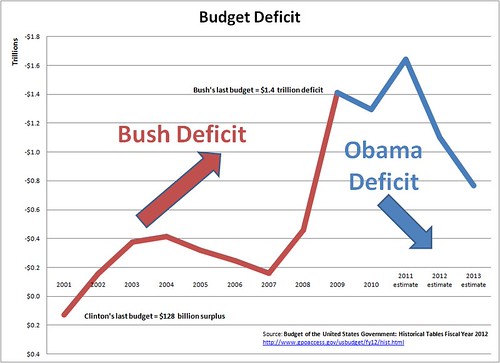
Bush-Obama Deficit Chart

Notes, this chart includes Clinton’s last budget year for comparison.

The numbers in these two charts come from Budget of the United States Government: Historical Tables Fiscal Year 2012. They are just the amounts that the government spent and borrowed, period, Anyone can go look then up. People who claim that Obama “tripled the deficit” are either misled or are trying to mislead.

The Stimulus and Jobs

Bush-Obama-Jobs-Chart

In this chart, the RED lines on the left side — the ones that keep doing DOWN — show what happened to jobs under the policies of Bush and the Republicans. We were losing lots and lots of jobs every month, and it was getting worse and worse.The BLUE lines — the ones that just go UP — show what happened to jobs when the stimulus was in effect. We stopped losing jobs and started gaining jobs, and it was getting better and better. The leveling off on the right side of the chart shows what happened as the stimulus started to wind down: job creation leveled off at too low a level.

It looks a lot like the stimulus reversed what was going on before the stimulus.

Conclusion: THE STIMULUS WORKED BUT WAS NOT ENOUGH!

More False Things

These are just three of the false things that everyone “knows.” Some others are (click through): Obama bailed out the banks, businesses will hire if they get tax cuts, health care reform cost $1 trillion, Social Security is a Ponzi Scheme or is “going broke”, government spending “takes money out of the economy.”

Why This Matters

These things really matter. We all want to fix the terrible problems the country has. But it is so important to know just what the problems are before you decide how to fix them. Otherwise the things you do to try to solve those problems might just make them worse. If you get tricked into thinking that Obama has made things worse and that we should go back to what we were doing before Obama — tax cuts for the rich, giving giant corporations and Wall Street everything they want — when those are the things that caused the problems in the first place, then we will be in real trouble.

Emphasis Mine

see:http://www.alternet.org/story/152201/3_reality-based_charts_your_right-wing_relatives_will_have_a_hard_time_ignoring?akid=7484.123424.OxQ7x8&rd=1&t=12