Happy Birthday Medicare!

Medicare

What is Medicare?

Medicare is a national social insurance program, (like Social Security) administered by the U.S. federal government since 1965, that guarantees access to health insurance for Americans ages 65 and older and younger people with disabilities as well as people with end stage renal disease. As a social insurance program, Medicare spreads the financial risk associated with illness across society to protect everyone, and thus has a somewhat different social role from private insurers, which must manage their risk portfolio to guarantee their own profit – if not solvency.

A brief history.

In 1965, Congress created Medicare under Title XVIII of the Social Security Act to provide health insurance to people age 65 and older, regardless of income or medical history. Before Medicare’s creation, only half of older adults had health insurance, with coverage often unavailable or unaffordable to the other half. Older adults had half as much income as younger people and paid nearly three times as much for health insurance. (Medicare also spurred the integration of thousands of waiting rooms, hospital floors, and physician practices by making payments to health care providers conditional on desegregation.)

Success

While the USA does not have good results (compared to other industrialized nations) in measures such as average life expectancy and infant mortality, we rank well in the measure of those who reach 65 living until 85.

Medicare administrative overhead costs (2%) are well below the overhead of large companies that are self-insured (5-10%), health insurers offering coverage to small employers (25-27%), and individual insurance (40%). Insurers offering coverage in “Medicare Advantage” plans spend up to 16.7% on profit and overhead.

Who is eligible?

As above, Americans ages 65 and older (who have been legal residents of the United States for at least 5 years ) and younger people with disabilities as well as people with end stage renal disease.

What is covered?

There are four parts to Medicare: types A, B, C, and D.

Part A (hospital insurance) covers inpatient hospital stays (at least overnight), including semiprivate room, food, and tests, and brief stays for convalescence in a skilled nursing facility if certain criteria are met.

Part B (medical insurance) helps pay for some services and products not covered by Part A, generally on an outpatient basis, e.g. doctor visits.

Part C With the passage of the Balanced Budget Act of 1997, Medicare beneficiaries were given the option to receive their Medicare benefits through private health insurance plans, instead of through the original Medicare plan (Parts A and B). As Part C cost the government about 14% more than traditional Medicare, it is being phased out, as per the ACA.

Part D (prescription drug plans)went into effect on January 1, 2006. Anyone with Part A or B is eligible for Part D. Part D is not ‘human friendly’ because it covers prescriptions up to a cost point, then no long covers them until another cost point is reached (the coverage gap or ‘donut hole’). Part D did not allow for negotiation of prescription prices, but this and the coverage gap are addressed in the ACA.

Who benefits from Medicare?

Those eligible above, and their children and/or other family members, as the latter do not have to bear the cost for the care!

How is it funded?

Medicare has several sources of financing. Part A largely is funded by revenue from a 2.9 percent [payroll tax] levied on employers and workers (each pay 1.45 percent). Until December 31, 1993, the law provided a maximum amount of compensation on which the Medicare tax could be imposed each year. Beginning January 1, 1994, the compensation limit was removed. Part B is funded in part by premiums paid by the recipient (about $100/month).

Changes under the ACA.

The Patient Protection and Affordable Care Act (“ACA”) of 2010 made a number of changes to the Medicare program. Several provisions of the law were designed to reduce the cost of Medicare. Congress reduced payments to privately managed Medicare Advantage plans to align more closely with rates paid for comparable care under traditional Medicare. Congress also slightly reduced annual increases in payments to physicians and to hospitals that serve a disproportionate share of low-income patients. Along with other minor adjustments, these changes reduced Medicare’s projected cost over the next decade by $455 billion.

Due to the passage of the ACA Medicare’s unfunded obligation over the next 75 years declined from $13.4 trillion to $3 trillion.

The ACA also made some changes to Medicare enrollee’s’ benefits. By 2020, it will close the so-called “donut hole” between Part D plans’ coverage limits and the catastrophic cap on out-of-pocket spending, reducing a Part D enrollee’s’ exposure to the cost of prescription drugs by an average of $2,000 a year.  Limits were also placed on out-of-pocket costs for in-network care for Medicare Advantage enrollees.  Meanwhile, Medicare Part B and D premiums were restructured in ways that reduced costs for most people while raising contributions from the wealthiest people with Medicare. The law also expanded coverage of preventive services.

What does Medicare Cost us as a nation?

As a share of GDP, Medicare cost is expected to increase from 3.6 percent in 2010 to 5.6 percent in 2035 and to 6.2 percent by 2080. That is, a mere 4% – 6 % to provide health care for our old and disabled citizens.

Why is Medicare Under attack?

This is not an easy point to address from a non-partisian standpoint! If one has as a dogma that no government program can be successful, then counter examples of very successful programs such as Medicare and Social Security are a threat. If one believes that Medicare is a major drain on our finances (it isn’t), then one might view it as an opportunity to cut spending. It revisits the failed privatize Social Security efforts of the last decade. The major causes of our current debut are the reduced tax rates on high incomes, and two wars.

From Politifact:

Barack Obama has slashed Medicare by $500 billion. Mitt Romney and House Republicans want to end Medicare. And a new board is going to ration care so Washington can waste more money. 

Believe any of that? You shouldn’t.” (Politifact)

Information from many sources, including:http://en.wikipedia.org/wiki/Medicare_(United_States)

The Tea Party History of the United States.

Until one understands what is wrong with the above, they have no hope of understanding the USA of today.

Things were almost perfect during the seventh and eighth years of the Presidency of GW Bush: The Axes of Evil had been subdued (Really?); income tax rates for the highest earners were at a historic low(TRUE); the terrorists had been vanquished(FALSE); income tax rates for the highest earners were at a historic low; the estate (death) tax – (inheriting an estate enables hard working Americans to be successful because of their birth situation) was on life support (TRUE);income tax rates for the highest earners were at a historic low; there was almost no deficit adding to the minuscule national debt (FALSE); income tax rates for the highest earners were at a historic low; access to contraception and abortion for people without means was low (TRUE); and fewer Americans than ever understood Natural Selection in specific or science in general (TRUE). The only dark cloud on the horizon (besides the fact that Social Security was on sound footing) was in housing: some very wealthy people – of the class know as job creators – had been growing our economy by speculating on increasing housing values, which had created a bubble getting ready to burst; and many home mortgages – of a type labeled  subprime – had been written because the government forced financial institutions to make loans to people who had no chance of ever paying them back(FALSE). (The job creators dealt with the latter issue by hiding these bad loans in a package of securities, which they – using the best of free market principles – sold to unsuspecting clients) (ALL TRUE).  When the housing bubble burst, the shady, worthless securities were exposed, markets collapsed, millions of job were lost (TRUE),  many homes became worth less than what was owed on them (TRUE), and then, even worse, a Democrat – and  a Black person – was elected President.

The President and his Democratic Party friends came into office and instantly the national debt and the deficit became huge (FALSE),unemployment reached levels almost as high as during the Reagan Administration(TRUE), gas prices skyrocketed, our national defense was compromised, and – horror of horrors – legislation to help people gain access to affordable health care was signed into law (TRUE).  Even worse, the policy – begun in the previous presidency – of helping the financial and auto industries by providing low interest loans was continued(TRUE). What could have been worse? Higher taxes? Food stamps and unemployment insurance for those who were living the American Dream until their jobs were destroyed? Higher taxes? Spending tax money on successful military missions?  Higher taxes?  Strengthening public schools in poor neighborhoods so that some could gain the skills to survive, and even prosper? Higher taxes?  Improved access to contraception and woman’s health needs?  Marriage equality?

N.B.: taxes on moderate incomes are lower than they were on Jan 19, 2012; the marginal (highest) are unchanged.

Until one understands what is wrong with this tea party perception of history, they have no hope of understanding the USA of today.

Romney Tells The GOP He Is The Hero Who Will Destroy Social Security

Willard, like nearly all conservatives, also parrots the fallacy that Social Security is adding to the nation’s debt, but in accordance with the Trust’s rules, Social Security is forbidden from taking one penny from the government for administrative costs or benefit payments. It is a self-sufficient program that not only works well, but is extremely popular.

From: Politicususa

By:

“Human beings are fortunate that one function of memory is to forget the enormous amount of data a person absorbs throughout their lifetime. Important events are often difficult to forget and they either become valuable life lessons or unhealthy obsessions that if left unresolved become a grudge that gives a vindictive person a reason to hold something against someone. Conservatives have held a grudge against Progressives and FDR over the New Deal and especially the creation of the Social Security Trust, and they are obsessed with destroying the most successful and popular program in the nation’s history.

In 2010, George W. Bush said his greatest failure was not privatizing Social Security even though doing so in 2005 would have left tens-of-millions of retired Americans without security in their old age after the stock market crashed in 2008. Bush’s regret at not destroying Social Security when he had the opportunity informs the level of contempt conservatives have for the American people and it seemed that Republicans learned their lesson, but their obsession with the New Deal prevents them from learning. Perhaps Republicans are competing with each other to be the conservative hero that gets even with Progressives for creating Social Security, and if presidential hopeful Willard “Mitt” Romney wins the nomination and presidency, he promises to be the hero that destroys Social Security.

Romney resorts to every conservative hero’s tactic of lying to promote an agenda that harms millions of Americans. At the recent Conservative Political Action Conference (CPAC), Romney resorted to lying to promote privatizing Social Security. Willard said, “We’re going to have to recognize that Social Security and Medicare are unsustainable and we can’t afford to avoid these entitlement challenges any longer.” It is a typical Republican lie that Bush used in 2005, and the truth is that without any adjustments, Social Security will remain solvent for the next thirty years or more. Romney also lied when he said current retirees would not see a change in their benefits under his plan. During the same speech, Romney promised to  increase defense spending, give the wealthiest 1% approximately $6.7 trillion in tax cuts,  and slash “entitlement” spending that surely includes Medicare and Social Security as part of his balanced budget farce.

Then there is this recurring “Social Security is an entitlement” meme that Republicans use to portray the program as welfare. Every working American pays 6.2% of every dollar they earn into the Social Security Trust. The rate decreased by 1% as part of President Obama’s payroll tax holiday except for wealthy Americans like Romney who pays on only the first .5% of his income because his earnings exceed the current $110,100 cap. If Romney is concerned that Social Security is in jeopardy of running out of funds, his Republican pals can eliminate the cap on payroll tax contributions and keep the Trust bloated with cash forever. Every other American pays Social Security tax on 100% of their income and with the median income at $49,909, over 90% of Americans would never reach the cap limit.

Romney just wants to transfer approximately $2.7 trillion in surplus assets in the Social Security Trust Fund to Wall Street to enrich himself and other high-income investors. A typical conservative ploy to convince Americans Social Security does not work is to label it a failure and a fraud and Romney said, “To put it in a nutshell, the American people have been effectively defrauded out of their Social Security,” and that there is a “looming bankruptcy of Social Security.” Willard just doesn’t get that Social Security is popular with nearly every American (especially older tea party-supporting white voters) because it works and that is one reason why he is losing popularity by the second. Willard, like nearly all conservatives, also parrots the fallacy that Social Security is adding to the nation’s debt, but in accordance with the Trust’s rules, Social Security is forbidden from taking one penny from the government for administrative costs or benefit payments. It is a self-sufficient program that not only works well, but is extremely popular.

Republicans are so consumed with hatred for the New Deal that produced Social Security, that 76 years after its creation they are still attempting to dismantle the only retirement income for millions of Americans as well as the largest insurance program for children. The program has never failed to pay out benefits on schedule, and the surplus is invested in U.S. Treasury securities that are considered the safest investment in the world. More than anything, Social Security provides a measure of security that Wall Street can never match, but that doesn’t stop conservatives from lying about the system to garner support for eliminating it. Romney is not the first conservative to promote privatizing or eliminating Social Security and he will not be the last.

Romney is out-of-touch with America and out of touch with reality if he thinks he will ever convince Americans to allow him to take their hard-earned retirement savings and offer it up to his god Wall Street. It is a mystery why Republicans cannot recognize that despite their lies, misinformation, and scare tactics, Americans do not want Social Security privatized. It is telling that Bush laments not privatizing Social Security even though doing so would have left millions of Americans without income in their golden years, and it is a testament to the man’s vile contempt for Americans. Romney is worse than Bush. He is also stupider because his desire to be the conservative hero that dismantles the New Deal is taking the same path that began Bush’s popularity slide.

If Romney wants to raid programs to enrich Wall Street and his investor cohorts, he can return to Bain Capital and destroy struggling businesses because Americans will never allow him near the White House. As one pundit said, “There is a reason you are having serious trouble in primaries and caucuses in states where older white voters reside in disproportionately large numbers, such as Missouri, Maine (almost losing to Ron Paul?) and Minnesota.”  Romney will continue having trouble with Americans and it is a good lesson that holding a grudge is about as good of an idea as trying to be a hero for a losing cause; especially when the cause is dismantling the New Deal.””

Emphasis Mine

see:http://www.politicususa.com/en/social-security-romney

Understanding Social Security

From:AlterNet, co -sourced from Campaing for America‘s future.

N.B.: It is not my intention  pick on the Post – which should know better: misunderstanding is wide spread.

By:Dave Johnson

“See if you can spot the big mistake (giving them the benefit of the doubt) in this Washington Post story: Payroll tax cut raises worries about Social Security’s future funding:

This year, the Social Security system projects that it will pay out $46 billion more in benefits than it will collect in cash. It made up for the shortfall by redeeming Treasury bonds bought in years when there were cash surpluses.

Here is the mistake, thanks to Dean BakerSocial Security Is NOT Selling Government Bonds,

This is not true. The Social Security trust fund is projected to earn $114.9 billion in interest on the bonds it holds. It will use a portion of these earnings to pay current benefits. It will not be redeeming its bonds.

Social Security has a huge trust fund — if you think $2.6 trillion is huge. That trust fund is invested in US Treasury Bonds, and earns interest.

When you hear that Social Security is “in trouble’ or “going broke” you are hearing from people who ignore this huge, huge trust fund and the interest it earns. This trust fund, along with the money people pay in, means that Social Security has enough to pay full benefits until 2037. Even then it will still be able to pay everyone more than they receive today. (Yes, more, because of cost-of-living adjustments.)

One of the problems with Social Security is that the “cap” –– the top income that is taxed to pay into the fund — was calculated in the 80’s, and they didn’t foresee that all income gains after the 80s would only go to those at the top, where the income isn’t taxed to pay into the fund. So, since the 80s, as more and more of the income gains went to the top few, the Social Security fund started to not have quite enough to go on forever. So now it it projected to only last until 2037. This is, of course, easily fixed — as are so many of our country’s problems — by asking those at the top to pay in a little more.

So … will I be attacked with pepper spray and batons for suggesting that the rich should pay back a bit more?”

Emphasis Mine

see:

Incomes down for most but up for wealthiest

growing income gap between the nation’s rich and poor.

News Alert?!

By Associated Press Staff

“The government is reporting that 50 percent of U.S. workers earned less than $26,364 last year, reflecting a growing income gap between the nation’s rich and poor.

According to the Social Security administration, there were fewer jobs, and overall pay was trending down — except for the wealthiest Americans. The number of people making $1 million or more soared by over 18 percent from 2009. There were 5.2 million fewer jobs in 2010 than in 2007, when the deepest recession since the 1930s began.

The payroll figures are based on W-2 forms submitted by employers to the IRS. The figures were posted by Social Security on its website as demonstrations raged on Wall Street and across the country protesting high unemployment and a growing income gap.”

Emphasis Mine

see:http://www.cleveland.com/business/index.ssf/2011/10/incomes_down_for_most_but_up_f.html#incart_mce

Three Reasons Why It’s Better for the Economy if the Super-Committee Fails to Get a Deal

By Robert Creamer, HuffPost

“Last Thursday’s Washington Post headline blared: “Debt panel’s lack of progress raises alarm on Hill.”

In fact it is far better for everyday Americans if the so-called Super Committee fails entirely to get a deal.

The overarching reason is simple: any deal they are likely to strike will make life worse for everyday Americans — and worsen our prospects for long-term economic growth.

Of course that’s not the view of many denizens of the Capitol who are still obsessed by the notion that it is critical for the Congress to produce a “compromise” that raises revenue and cuts “entitlements.” There are three reasons why these people are wrong:

1). Any deal would likely slash the income of many everyday Americans. You could design a plan to substantially reduce the deficit without big cuts in Social Security, Medicare or Medicaid. My wife, Congresswoman Jan Schakowsky, who served on President Obama’s Fiscal Commission, designed just such a proposal last year. And, of course, Social Security has nothing to do with the deficit in the first place.

Unfortunately, however, in order to get Republican support any large-scale deal in the Super Committee would almost certainly require big cuts in either Social Security, Medicare or Medicaid — or all of them. Substantial cuts in any of these programs will make life harder for everyday Americans and reduce the likelihood of long-term economic growth.

Without a “deal” in the Super Committee, the current budget plan does not cut Social Security, Medicare and Medicaid — and that’s a good thing.

According to the Social Security Administration, the average monthly Social Security check now averages the princely sum of $1,082 — or about $13,000 per year. Next year, for the first time since 2009, payments will increase by $39 per month to offset inflation, but $18 a month of that increase will go right back out the door in the form of Medicare premium increases.

Already under current law, Medicare Part B premiums, that cover services like doctors, outpatient care and home health services, must be set annually to cover 25% of program costs. And remember that Medicare recipients aren’t getting an “entitlement” — they are getting an earned benefit that they paid for throughout their working lives. The same, of course, is true of Social Security.

Mean while, Medicaid is the principle means of assuring that America actually begins to provide health care for all — including nursing home and home care.

The problem with medical care costs isn’t that “greedy” seniors and others are gobbling up too much care. The problem is that the costs of providing care are going up too fast. In fact, the per capita costs of providing health care in America is 50% higher than anywhere else on earth, and the World Health Organization only ranks health care outcomes as 37th, in the world.

Medicare is actually the most efficient means in the American economy for providing health care. Any action by the “Super Committee” that reduces the percentage of Americans on Medicare — say, by raising the eligibility age from 65 to 67 — would cost the American economy.

  • According to a study by the Kaiser Family Foundation, if such a proposal were operational in 2014 it would raise total health care spending in America by $5.7 billion per year.
  • This is so because, while it would save the Federal government a net of about $5.7 billion ($24 billion savings in Medicare payments largely offset by $18 billion of increased Medicaid payments and subsidies to low-income participants in exchanges), it would also generate an additional $11.4 billion in higher health care costs for individuals, employers and states — resulting in a net cost to the economy of $5.7 billion.

The one thing you could do to cut Medicare costs without hurting ordinary families or the economy as a whole is to require Medicare to negotiate with the drug companies for lower prices the same way the Veterans Administration does today. That would cut hundreds of billions in costs to the government over the next ten years, but don’t expect the Republicans to include that as an acceptable cut in “entitlements” as part of a Super Committee deal.

Of course, America has no business cutting the income of seniors who get $13,000 a year in Social Security payments regardless of anything else that is in a deal. The deficit problem should be fixed by asking millionaires and billionaires to pay their fair share and by jobs plans that put America back on a path of sustained economic growth. And we have no business reducing access to health care for everyday people so that CEO‘s can fly around in their corporate jets, oil companies can keep their tax breaks, or Wall Street hot shots — who we all bailed out just three years ago — can pack in their huge bonuses.

Even if a Super Committee proposal includes increases in revenue to the government from millionaires and billionaires, that is not reason that normal people — whose real incomes have dropped over the last decade — should also be called upon to “share in the sacrifice.”

The problem isn’t that everyday Americans are gorging themselves on excesses that “America can’t afford.” The problem is that Wall Street, the financial sector and the 1% have gobbled up all of the increases in economic growth that the country has produced over the last two decades.

That has meant that the standard of living for normal people has been stagnant. But just as problematic, it has lead to a stagnant economic growth. Since the incomes of everyday people haven’t increased at the same rate as increased worker productivity, there simply haven’t been enough new customers to buy the new products and services that American businesses produce. That is the formula for recession and depression. And that’s just what happened.

American corporations are sitting on two trillion dollars of cash. The reason they aren’t hiring has nothing to do with the need for more tax breaks. What stops them isn’t lack of “confidence,” it’s a lack of customers.

For decades the International Monetary Fund (IMF) has preached the need for fiscal constraint and austerity. According to the Washington Post, now even the IMF is warning that, “austerity may trigger a new recession, and is urging countries to look for ways to boost growth.”

If you want to lay a foundation for long-term economic growth in America, the last thing you would do is reduce the income going to ordinary Americans — even over the long run. That’s not the problem — just the opposite. We do not need ordinary people to “share in the sacrifice.” We need policies that will increase the share of income going to ordinary people and reduce the exploding inequality between the 99% and the 1%.

Any deal in the Super Committee will almost certainly do just the opposite.

2.). The worst effects of sequestration could be solved without a “grand bargain”. The one big downside of a failure of the Super-Committee to act would be the level of discretionary spending cuts that would be required through the resulting sequestration. This is particularly true of cuts in education funding.

The budget deal that was struck in order to prevent Republicans from plunging America into default last summer requires an additional $1.2 trillion reduction in the deficit over the next ten years. If the Super Committee fails to agree on the distribution of these cuts, they will automatically be spread over defense and non-defense segments of the budget beginning in 2013. But there would be no cuts in Social Security, Medicare or Medicaid.

Congress would have the ability to adjust these sequestration requirements between now and 2013, regardless. But the “fast track” authority that would require up or down votes on a proposal from the “Super Committee” would expire if the Committee cannot reach agreement by November 23rd.

The best solution to the problem of big cuts in discretionary spending would be to put together a smaller deal to raise some revenue and reduce cuts in discretionary and – if necessary — military spending — after the mandate of the Super Committee has expired.

The Congress will have a year to help solve this problem, and the pressure to ameliorate some of the cuts in military spending that have so far proved ineffective at forcing Republicans to consider big revenue increase, may be more persuasive when it comes to smaller increases as the actual date of sequestration (2013) draws near.

Of course it’s possible that the Super Committee itself could come with a small-bore deal of this sort, simply to avoid the full force of sequestration. But that would be very different than a $1.2 trillion dollar package that includes cuts in Social Security, Medicare and Medicaid. Progressives should avoid cuts to these programs at all costs, because any cuts that sliced Social Security, Medicare or Medicaid benefits would require changes in the structure of the programs themselves that would last forever. Cuts in discretionary spending — as bad as they might be — are one-time events and do not fundamentally change the structure of the American social contract.

3). There is no reason for Congress to fear that its failure to act on a “Super Committee” agreement will have massive adverse consequences on “market confidence,” since the level of the deficit will not be affected. That has already been set — with a mandate for a $1.2 trillion cut. The Wall Street gang and the ratings agencies might sputter something about government dysfunction for a day or two. But the fundamentals will not be affected, since the level of government borrowing won’t be affected by whether or not there is a deal.

It’s also worth noting that even after Standard and Poor’s downgraded the U.S. debt because of the process leading up to the debt ceiling deal, it had no effect on the interest rates the government is paying for bonds. In fact those interest rates dropped to record lows. U.S. government debt remains the safest investment in the world, no matter what S&P did, and the market reflected that indisputable fact.

In other words then, Congress does not have its back against the wall like it did during the debt ceiling “hostage” crisis. When it came to the debt-ceiling deadline, failure was not an option. In the case of the “Super Committee” failure to come to an agreement is a very real option — in fact, it’s the best option.

There are some in Congress — most notably in the Senate — who truly believe that what the country needs is a “grand bargain” that cuts the deficit by making ordinary people “share in the sacrifice” even if millionaires and billionaires are asked to share some as well.

Hopefully those who are working for such bargain will be thwarted by two important political realities.

First, that cuts in Social Security, Medicare and Medicaid are politically toxic. People get really angry when you take away something they have earned.

Second, the Republican’s stubborn unwillingness to give an ounce of new revenue from the pockets of millionaires and billionaires – who, after all, are the true core constituency of the Republican Party.

This time a little “gridlock” may be a good thing.”

Robert Creamer is a long-time political organizer and strategist, and author of the book: Stand Up Straight: How Progressives Can Win, available on Amazon.com. He is a partner in Democracy Partners and Senior Strategist for Americans United for Change. Follow him on Twitter @rbcreamer.

Emphasis Mine

see: /robert-creamer/three-reasons-why-its-bet_b_1030166.html

Noah Chomsky on why the right hates social security.

It’s a very successful program. A large number people rely on it. It doesn’t pay munificently, but it at least keeps people alive, not just retired people, people with disabilities and others. Very low administrative costs, extremely efficient, and no burden on the deficit, doesn’t add to the deficit. The effort to try to present the Social Security program as if it’s a major problem, that’s just a hidden way of trying to undermine and destroy it.

From an interview on Democracy Now, see link below.

(N.B.:  While little is new,  it is presented very well.)

AARON MATÉ: Noam, you mentioned entitlements, and obviously this is an issue that’s come up a lot in the deficit debate. Governor Rick Perry, the Republican presidential hopeful, has called it a Ponzi scheme. But even Democrats seem to buy into this narrative that it’s in crisis. Can you address that?

NOAM CHOMSKY: Social Security is not in any crisis. I mean, the trust fund alone will fully pay benefits for, I think, another 30 years or so. And after that, taxes will give almost the same benefits. To worry about a possible problem 30 years from now, which can incidentally be fixed with little—a little bit of tampering here and there, as was done in 1983—to worry about that just makes absolutely no sense, unless you’re trying to destroy the program. It’s a very successful program. A large number people rely on it. It doesn’t pay munificently, but it at least keeps people alive, not just retired people, people with disabilities and others. Very low administrative costs, extremely efficient, and no burden on the deficit, doesn’t add to the deficit. The effort to try to present the Social Security program as if it’s a major problem, that’s just a hidden way of trying to undermine and destroy it.

Now, there has been a lot of opposition to it since—you know, since the 1930s, on the part of sectors of extreme wealth and privilege, especially financial capital. They don’t like it, for several reasons. One is the rich don’t barely—for them, it’s meaningless. Anyone with—you know, who’s had a fairly decent income, it’s a tiny addition to your retirement but doesn’t mean much. Another is, if the financial institutions and the insurance companies can get their hands on this huge financial resource—for example, if it’s privatized in some way or vouchers—I mean, that’s a huge bonanza. They’ll have trillions of dollars to play with, the banks, the investment firms and so on.

But I think, myself, that there’s a more subtle reason why they’re opposed to it, and I think it’s rather similar to the reason for the effort to pretty much dismantle the public education system. Social Security is based on a principle. It’s based on the principle that you care about other people. You care whether the widow across town, a disabled widow, is going to be able to have food to eat. And that’s a notion you have to drive out of people’s heads. The idea of solidarity, sympathy, mutual support, that’s doctrinally dangerous. The preferred doctrines are just care about yourself, don’t care about anyone else. That’s a very good way to trap and control people. And the very idea that we’re in it together, that we care about each other, that we have responsibility for one another, that’s sort of frightening to those who want a society which is dominated by power, authority, wealth, in which people are passive and obedient. And I suspect—I don’t know how to measure it exactly, but I think that that’s a considerable part of the drive on the part of small, privileged sectors to undermine a very efficient, very effective system on which a large part of the population relies, actually relies more than ever, because wealth, personal wealth, was very much tied up in the housing market. That was people’s personal wealth. Well, OK, that, quite predictably, totally collapsed. People aren’t destitute by the standards of, say, slums in India or southern Africa, but very—suffering severely. And they have nothing else to rely on, but what they—the, really, pittance that they’re getting from Social Security. To take that away would be just disastrous.

AMY GOODMAN: We’re talking to Noam Chomsky. He has a new book out, 10 years after his book 9-11. This is called 9-11: Was There an Alternative? We’ll come back to this conversation in a minute. And if you’d like to get a copy of the full show, you can go to our website at democracynow.org. Stay with us.”

Emphasis Mine.

see:http://www.readersupportednews.org/off-site-opinion-section/72-72/7440-noam-chomsky-on-why-the-right-hates-social-security

The Republicans’ intergalactic adventures

In the alternate universe where Republican candidates debated yesterday, tax breaks for the rich apparently create jobs while deregulation spurs economic growth and preserves natural resources.

N.B.: Our world versus their’s! 

By John Wojcik, Peoples World

“In the alternate universe where Republican candidates debated yesterday, tax breaks for the rich apparently create jobs while deregulation spurs economic growth and preserves natural resources.

In our universe, those tax breaks have created no jobs, and deregulation has destroyed our economy, our rivers, our lakes,  our air quality and the Gulf of Mexico.

In Gov. Rick Perry‘s universe, Social Security is a Ponzi scheme.

In our universe, a Ponzi scheme is something done by criminals who trick investors into giving them money that they then pocket for themselves. Social Security, in our universe, is something  It ishard-working people pay into so they can stay out of poverty when they get old. I is one of the most successful programs ever devised and has so much money in its coffers that everyone can be paid everything they are owed until 2037. No other program, government-run or private, can say the same.

In Perry’s universe, “President Obama has proven once and for all that government spending will not create one job.”

In our universe, the president’s stimulus program created 3 million jobs, 300,000 in the state of Texas, alone.

In Perry’s universe, “Keynesian policy and Keynesian theory is now done and disproven.”

In our universe, it’s the GOP program of deregulation and tax cuts that has been disproven. In our universe, deregulation caused the financial crisis and destroyed millions of jobs.

Mitt Romney and his advisors, however, ventured into the reality-based universe , if only briefly.

Romney jumped for joy after Perry reiterated his ongoing attack on Social Security. “Perry has lost,” Romney adviser Stuart Stevens said in an e-mail. “No federal candidate has ever won on the Perry platform to kill Social Security. Never has. Never will.” (A CNN poll in August found 57 percent of Republicans opposed to major changes in both Social Security and Medicare.)

Romney’s declaration last night that the nominee of the GOP must be someone committed to “saving,” not “killing” Social Security rings hollow, however.  He, like Wall Street itself, is also committed to killing Social Security with a variety of schemes that would allow people to “save and invest” rather than pay into the plan. The Romney approach is, at best, a backdoor way of turning over to Wall Street investors the huge Social Security pot of gold they have been trying to grab for years.

Romney says that corporations, which he views as “people,” should get even bigger tax breaks than they have gotten thus far and that almost all regulations on their activity should be eliminated. He has called for zero taxes on companies that have shipped jobs overseas as a way of luring them back home. In our universe, that amounts to rewarding the people who destroyed American jobs, American livelihoods and American hopes.

The Republican candidates all agreed with what Sen. Tom Harkin, D-Iowa, calls a “mindless march to austerity.” He said the Republican approach of focusing on the deficit, rather than the jobs crisis, would put the nation on  “a course of radical disinvestment and decline.

“Smart countries do not just turn a chainsaw on themselves. Instead of the current slash-and-burn approach, which is being sold through fear and fatalism, we need an approach that reflects the hopes and aspirations of the American people.”

Harkin pointed to tens of millions of jobs created by visionary leadership and government investment in the nation’s highway system, space exploration and research. For example, he noted, the federal government’s investment of $3.8 billion in the human genome project, between 1988 and 2003, translated into $796 billion in economic output and, in 2010 alone, created 310,000 jobs.

Yesterday evening the Republican candidates, under the colors of our flag and the wings of Ronald Reagan’s jet, offered no solution to the jobs crisis. Instead, they proffered a free-market fairy tale straight from their alternate universe. They made it abundantly clear that their reality is not the reality of the vast majority of the American people.”

Emphasis Mine

see:http://peoplesworld.org/the-republicans-intergalactic-adventures/

Fact checking the GOP debate of 7.9.11

From The Washington Post

By Glenn Kessler

“…

“It is a monstrous lie. It is a Ponzi scheme to tell our kids that are 25 or 30 years today you’re paying into a program that’s going to be there.”

— Gov. Perry

Perhaps the governor does not know the dictionary definition of a Ponzi scheme. Here’s what Merriam-Webster says: “An investment swindle in which some early investors are paid off with money put up by later ones in order to encourage more and bigger risks.”

This is a frequent mistake politicians make when talking about Social Security. It is not an investment vehicle; it is intended to provide income security as well disability and life insurance. Just more than 60 percent of the 54 million beneficiaries are retired workers; the rest are disabled workers, dependents or survivors.

Social Security is a pay-as-you-go system, which means that payments collected today are immediately used to pay benefits. Until recently, more payments were collected than were needed for benefits. So Social Security loaned the money to the U.S. government, which used it for other things. In exchange, Social Security received interest-bearing Treasury securities. The value of those bonds is now about $2.6 trillion. (We have written about this at length.)

In any case, Perry is wrong to label Social Security a Ponzi scheme. Ponzi schemes ultimately go bust and everyone (except possibly early investors) generally loses their money. Social Security faces a long-term funding issue, but one that most experts say is manageable. After all, the Social Security actuary says that Social Security’s shortfall is 0.7 percent of the gross domestic product over the next 75 years.

“Obamacare is killing jobs. We know that from the nonpartisan Congressional Budget Office.”

— Rep. Michele Bachmann (Minn.)

Bachmann won’t give up on this factoid, even though we debunked it seven months ago and said it was worth three Pinocchios. It’s just not correct, and remains a perfect example of how politicians twist the facts.

The Congressional Budget Office in August 2010 estimated that the new health care law over the next decade would reduce the number of overall workers in the United States by one-half of 1 percent, which translates into 800,000 people. But that’s not the same as saying it would “kill” that many jobs.

In dry economic language, the CBO essentially said that some people who are now in the workforce because they need health insurance would decide to stop working because the health care law guaranteed they would have access to health care. (As an example, think of someone who is 63, a couple of years before retirement, who is still in a job only because he or she is waiting to get on Medicare at age 65.)

These jobs would disappear, not to be replaced, so there is an intellectually defensible argument one could make that this is bad for the economy; others, however, might argue that this is a small price worth paying for universal health care.

But in any case, the CBO did not say the health law was killing jobs.

“We’ve had requested for years at the Health and Human Services agencies to have that type of flexibility, where we could have menus, where we could have co-pays. And the federal government refuses to give us that flexibility.”

— Perry

Perry gives a misleading account of this application for a waiver on Medicaid rules. The George W. Bush administration rejected the application in 2008, saying it was incomplete and riddled with problems. As far as we can tell, the state has not resubmitted the waiver.

“Obamacare took over one-sixth of the American economy… . If we fail to repeal Obamacare in 2012, it will be with us forever and it will be socialized medicine.”

— Bachmann

“In our state, our plan covered 8 percent of the people, the uninsured. His plan has taken over a 100 percent of the people.”

— Romney

It is simply not true, no matter how often candidates say that the Obama health care law represents socialized medicine or took over one-sixth of the economy. Socialized medicine is a single-payer system, in which the government pays the bills and controls costs (much like Medicare.)

Obama’s law was modeled closely on the law passed by Romney when he was governor of Massachusetts — an inconvenient fact that Romney tries hard to run away from. His comparison here is misleading, since both plans try to deal with the problem of the uninsured by requiring an individual mandate.

“For the president of the United States to go to El Paso, Texas, and say that the border is safer than its ever been, either he has some of the poorest intel of a president in the history of this country, or he was an abject liar to the American people. It is not safe on that border.”

— Perry

Perry is referring to a speech that Obama gave May 10, in which he did some boasting that earned the president a Pinocchio. Obama did not put it quite as bluntly as Perry suggests, and calling the president an “abject liar” seems over the top for the politically tinged comments Obama actually made.

“He only went along with the Libyan mission because the United Nations told him to.”

— Former Sen. Rick Santorum (Pa.)

Actually, Santorum has it backwards. The United States requested the U.N. resolution to gain international backing for the NATO-led intervention in the Libyan uprising.

“The idea that we would put Americans’ economy in jeopardy based on scientific theory that’s not settled yet to me is just — is nonsense. I mean, it — I mean, and I told somebody, I said, just because you have a group of scientists that have stood up and said, here is the fact — Galileo got outvoted for a spell.”

— Perry

(N.B.: Galileo?  Never ‘outvoted’ by scientists, only by the Roman Church)

We previously awarded Perry Four Pinocchios for his comments suggesting scientists were increasingly saying climate change was a fiction. We will note he repeatedly did not answer the question at the debate about whether he could name a scientists he thought was credible on the issue.

“As a matter of fact, what he’s done is, he’s said in fact to Israel that they need to shrink back to their indefensible 1967 borders.”

— Bachmann

Obama never said this. The president in May did give a controversial speech, in which he said the de facto border of 1967 should be a starting point for negotiations between the Israelis and Palestinians, with agreed swaps of territory. A few days later, he further clarified his comments to make clear he was not saying the lines should be Israel’s border, to the point that he was thanked by the Israeli prime minister in a speech to Congress.

We’ve given Bachmann Four Pinocchios for making a similar claim in the past.


Emphasis Mine

see:http://www.washingtonpost.com/blogs/fact-checker/post/fact-checking-the-gop-debate-at-the-reagan-library/2011/09/07/gIQAFrz5AK_blog.html?wpisrc=nl_politics

3 Reality-Based Charts Your Right-Wing Relatives Will Have a Hard Time Ignoring

Here are some reality-based charts to help knock down absurd right-wing propaganda about the economy

From AlterNet, by RJ Eskow

Problem: Your right-wing brother-in-law is plugged into the FOX-Limbaugh lie machine, and keeps sending you emails about “Obama spending” and “Obama deficits” and how the “Stimulus” just made things worse.

Solution: Here are three “reality-based” charts to send to him. These charts show what actually happened.

Spending

Bush-Obama Spending Chart

Government spending increased dramatically under Bush. It has not increased much under Obama. Note that this chart does not reflect any spending cuts resulting from deficit-cutting deals.

Deficits

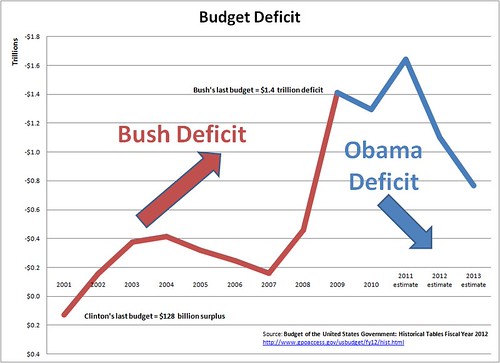
Bush-Obama Deficit Chart

Notes, this chart includes Clinton’s last budget year for comparison.

The numbers in these two charts come from Budget of the United States Government: Historical Tables Fiscal Year 2012. They are just the amounts that the government spent and borrowed, period, Anyone can go look then up. People who claim that Obama “tripled the deficit” are either misled or are trying to mislead.

The Stimulus and Jobs

Bush-Obama-Jobs-Chart

In this chart, the RED lines on the left side — the ones that keep doing DOWN — show what happened to jobs under the policies of Bush and the Republicans. We were losing lots and lots of jobs every month, and it was getting worse and worse.The BLUE lines — the ones that just go UP — show what happened to jobs when the stimulus was in effect. We stopped losing jobs and started gaining jobs, and it was getting better and better. The leveling off on the right side of the chart shows what happened as the stimulus started to wind down: job creation leveled off at too low a level.

It looks a lot like the stimulus reversed what was going on before the stimulus.

Conclusion: THE STIMULUS WORKED BUT WAS NOT ENOUGH!

More False Things

These are just three of the false things that everyone “knows.” Some others are (click through): Obama bailed out the banks, businesses will hire if they get tax cuts, health care reform cost $1 trillion, Social Security is a Ponzi Scheme or is “going broke”, government spending “takes money out of the economy.”

Why This Matters

These things really matter. We all want to fix the terrible problems the country has. But it is so important to know just what the problems are before you decide how to fix them. Otherwise the things you do to try to solve those problems might just make them worse. If you get tricked into thinking that Obama has made things worse and that we should go back to what we were doing before Obama — tax cuts for the rich, giving giant corporations and Wall Street everything they want — when those are the things that caused the problems in the first place, then we will be in real trouble.

Emphasis Mine

see:http://www.alternet.org/story/152201/3_reality-based_charts_your_right-wing_relatives_will_have_a_hard_time_ignoring?akid=7484.123424.OxQ7x8&rd=1&t=12