Fox News’ Audience Is Literally Dying: Is Roger Ailes’ Grand Experiment in Propaganda Doomed?

Source: The Nation, via Alternet

Author: Reed Richardson

“In the annals of Fox News, October 2012 will likely stand out as a shining moment. Buoyed by a wave of Republican optimism about Mitt Romney’s presidential campaign, the network seemed tantalizingly close to realizing one of its key ideological goals: ousting President Obama from the White House. Renewed enthusiasm among conservatives was, in turn, triggering record-high ratings for much of the network’s programming and helping it to beat not just rival news competitors MSNBC and CNN during prime time, but every other TV channel on the cable dial. What’s more, the prospect of an ascendant GOP come January meant Fox News might soon return to the era of access and prestige it enjoyed in Washington during the presidency of George W. Bush. The future looked so bright that News Corporation CEO Rupert Murdoch signed Fox News president Roger Ailes to a lucrative four-year contract extension, even though the 72-year-old Ailes’s existing contract wasn’t due to expire until 2013.

Then November arrived, and with it reality.

Fox News’s shellshocked election night coverage, punctuated by Karl Rove’s surreal meltdown upon hearing of Obama’s victory in Ohio and, thus, the election, capped off a historic day of reckoning for the network and conservatives alike. Chastened by defeat, Republican politicians and right-wing pundits have subsequently been grappling with the repercussions of the caustic tone and incendiary rhetoric their movement has adopted. This ongoing debate about whether broadening conservatism’s appeal requires new messages or just new messaging has ignored the 800-pound gorilla in the room, however. Noticeably absent from all the right wing’s public self-criticism is any interest in confronting the potent role played by the Republican Party’s single most important messenger, Fox News.

Standing at the epicenter of the network—and any new Republican Party groundswell—is Ailes. A former political operative of President Richard Nixon, Ailes has inextricably intertwined his professional and political pursuits since founding Fox News in 1996. Indeed, the network chief functions as a kind of proxy kingmaker within the party, frequently meeting with Republican politicians to offer strategic advice. He is a regular confidant of Senate minority leader Mitch McConnell, and at various times, he (or a network emissary of his) has counseled 2008 GOP vice presidential candidate Sarah Palin, New Jersey Governor Chris Christie and Gen. David Petraeus on their potential future. “Ailes,” says former Reagan White House economic adviser Bruce Bartlett, “is quite open about offering his free advice to Republicans…. If you visit New York City, you go see Roger Ailes and kiss his ring. It’s like visiting the Vatican. My guess is that there’s a lot of back-and-forth between Ailes and whoever is at the pinnacle of power in the Republican Party.”

To keep relying on a shrinking number of elderly, white and male subsets of the public, whether to win elections or win ratings, has become a strategy of diminishing returns, however. “I think that you can’t separate the problem at Fox [News] from the problem that the Republicans are going through,” Bartlett says. He can speak firsthand to this incestuous relationship, as his 2006 book, Impostor—which broke with party orthodoxy over the Bush administration’s deficit spending—quickly made him persona non grata at Fox News, he says. (Fox News did not respond to questions about his comment.) “The Republicans are trying to retool to win. That’s all they care about, and they’re trying to decide, ‘How can we be more pragmatic? How can we shave off the rough edges? How can we get rid of the whack jobs who are embarrassing us, costing us Senate seats? But at the same time, we can’t do this in such a way that it alienates our base.'” Fox News faces a similar dilemma, Bartlett contends: “It’s ‘How do we modernize? How do we attract new audiences without losing the old audience? How do we remain relevant without abandoning our traditions?'”

These are fundamental questions, and lately Fox News’s 
fundamentals—audience, ratings and public trust—have faltered. A 2010 study by Steve Sternberg found the network’s viewership to be the oldest (with an average age of 65) among an already elderly cable news audience. (CNN’s was 63 and MSNBC’s was 59.) By comparison, lifestyle cable channels Oxygen, Bravo and TLC were among the youngest, with an average viewer age of 42. And with MSNBC’s recent decision to plug 34-year-old rising star Chris Hayes into the coveted 
8 pm slot, the average age of that network’s prime-time hosts will now be 45, while Fox News’s rotation, anchored by 63-year-old Bill O’Reilly, has an average age of 57.

Having cable news’s oldest average age for both prime-time hosts and audiences represents something of a double-edged sword for Fox in the cutthroat world of cable TV. One advantage is that older audiences are traditionally more loyal, which is why several industry experts say that Fox News is unlikely to be dislodged from its perch atop overall cable TV news ratings anytime soon. This age-loyalty effect redounds to the benefit of Fox News’s best-known prime-time hosts, Sean Hannity and Bill O’Reilly, as roughly two-thirds of their viewers are age 50 or older, according to a recent Pew State of the News Media survey.

But at the same time, there is an undeniable actuarial reality at work—or as Bartlett bluntly puts it, “Their viewership is quite literally dying.” The most lucrative advertising dollars flow to TV shows that attract viewers “in the demo,” short for “demographic”—industry parlance for people ages 25 to 54. By contrast, Fox News’s prime-time commercial breaks are blanketed with pitches for cheap medical devices and insurance companies aimed at retirees and the elderly. Perhaps not surprisingly, the network’s advertising rates have grown at a much more modest pace in recent years, according to the Pew survey. Similarly, the growth of its ad revenues has diminished every year since 2008.

Because of the relatively older age and smaller size of the cable news audience, viewership tends to be relatively stable, says Columbia University Journalism School professor and former NBC News president Richard Wald. “Its [ratings] move in very small increments.” To understand why viewers come and go, he compares a TV network‘s audience to a target with concentric rings. The core audience—those who are loyal to your channel and watch frequently (and, for partisan media outlets, those who are most ideologically compatible)—is the bull’s-eye. Each concentric ring outward represents a segment of the audience that is less likely to watch because of diminished interest or less enthusiastic partisan sympathies. Dramatic ratings shifts can occur, but they tend to be driven by external events, like elections, rather than programming and thus affect all of the networks simultaneously. Most ratings fluctuations are statistical noise, Wald says, resulting from people in the outermost rings tuning in or out based on varying interest. “I would guess that [Fox News’s] numbers could change by 5, 6, 7, 8 percent and not reflect a change in the loyalty of the audience.”

But here, too, the news does not bode well. Though the network did retain its status as the top-rated cable news network in 2012—its eleventh consecutive year at number one—the steep drop in ratings that its shows have experienced since Election Day has raised eyebrows, precisely because corresponding shows on MSNBC and CNN have not experienced the same precipitous decline.

Just how much of a drop are we talking about? According to Nielsen data, Fox News’s prime-time monthly audience fell to its lowest level in twelve years in January among the 25-to-54 demographic. Daytime Fox News programming likewise saw its lowest monthly ratings in this age cohort since June 2008. Even the network’s two biggest stars, O’Reilly and Hannity, have not been immune from viewer desertion: Hannity lost close to 50 percent of his pre-election audience in the final weeks of 2012, and O’Reilly more than a quarter. The slide hasn’t stopped in 2013, either. Compared with a year ago, O’Reilly’s February prime-time ratings dropped 
26 percent in the coveted 25-to-54 demographic, his worst performance since July 2008. Hannity’s sank even further, to the lowest point in his show’s history.

As Wald points out, short-term ratings snapshots can be deceptive. But in the weeks following Obama’s 2009 inauguration, Fox News’s viewership actually surged, averaging 539,000 prime-time demo viewers versus 388,000 and 357,000 for CNN and MSNBC, respectively. This past January, however, Fox could only muster 267,000 average nightly viewers—a 50 percent drop from that 2009 level, and not much more than MSNBC’s 235,000 or CNN’s 200,000.

So why are all these Fox News viewers tuning out? Some of the decline may be due to a broader cultural trend of people deciding to avoid cable TV news altogether. However, a recent Public Policy Polling survey of news media trustworthiness suggests there’s more going on than public apathy. In February, PPP found a marked drop in Fox News’s credibility. A record-high
46 percent of Americans say they put no trust in the network, a nine-point increase over 2010. What’s more, 39 percent name Fox News as their least-trusted news source, dwarfing all other news channels. (MSNBC came in second, at 14 percent.)

As might be expected, Fox News’s credibility barely budged among liberals and moderates (roughly three-quarters of whom still distrust the network) and very conservative viewers (three-quarters of whom still trust it). However, among those who identified themselves as “somewhat conservative,” the level of trust fell by an eye-opening 27 percentage points during the previous twelve months (from a net plus–47 percent  “trust” rating in 2012 to plus–20 percent now). Only a bare majority of center-right conservatives surveyed by PPP say that Fox News is trustworthy.

“The people who are among the moderate-rights are actually the ones tuning out most,” says Dan Cassino, a political science professor at Fairleigh Dickinson University who specializes in studying partisan psychology. Last May, Cassino conducted a survey that found Fox News’s viewers were less informed about current political issues than those who watched no news at all. In response, the network’s public relations team mocked FDU’s college ranking in Forbes and belittled its student body as “ill-informed.” This kind of ad hominem attack symbolizes the over-the-top, pugilistic messaging style of Ailes, whose no-holds-barred political instincts have dictated the network’s direction since day one.

Ailes’s foundational idea for Fox News, explains Washington Post media critic Erik Wemple, was to package this bias under the guise of “fair and balanced” news. “It is indeed the artifice of neutrality that makes so much of what they do objectionable, or not just objectionable but noteworthy,” Wemple says. And it is effective, he adds: at a recent Value Voters conference, rock-ribbed conservatives almost involuntarily spouted the network’s motto back at him when he asked them about Fox’s coverage. It’s a maddeningly clever bit of misdirection—the network whose branding is most identified with objectivity and accuracy is, in fact, anything but.

“Fox viewers are the most misled…especially in areas of political controversy,” Chris Mooney writes in The Republican Brain, his 2012 book about the psychology of right-wing myths. The network’s singularly corrosive impact on its viewers’ understanding of reality, confirmed by numerous studies Mooney highlights in his book, is amplified by this “fair and balanced” motto, he says. It delegitimizes all other news media to create a vicious feedback loop within the right wing.

Thanks to its loyal conservative audience and its cozy relationship with the GOP leadership, Fox News has long been insulated from the consequences of its serial misinforming. “If your job is to say the most outrageous thing you possibly can and be rewarded for it, why shouldn’t you?” Cassino points out. “As long as you get ratings, you’re going to keep on doing it.” But the recent erosion in ratings and cracks in the network’s reputation, Cassino says, have created external pressure to make changes inside the network. (Neither Ailes nor anyone else at Fox News would comment when contacted for this story.)

Most notable among these post-election changes involved Fox News ridding itself of contributors Sarah Palin and Dick Morris and replacing them with former Congressman and left-wing gadfly Dennis Kucinich, former GOP Senator Scott Brown of Massachusetts, and RedState.com editor in chief Erick Erickson. To some, this personnel turnover confirmed that Fox News was embracing a more intellectually honest, ideologically diverse worldview.

But there’s less here than meets the eye. First of all, the impact an individual contributor can have on the network’s overall nature is minimal; permanent hosts like O’Reilly and Hannity drive its day-to-day brand. And in the midst of the 2012 campaign, Ailes locked up O’Reilly and Hannity as well as news host Bret Baier—the Fox News lineup from 7 through 10 pm—all the way to 2016. What’s more, one shouldn’t read too much into the cashiering of Palin and Morris, since, by all accounts, they were terrible at their jobs: the former was criticized internally for being uncooperative with programming suggestions and personally disloyal to Ailes, while the latter was guilty of humiliating the network with his ridiculous election predictions (as well as auctioning off an unauthorized personal tour of Fox News’ studios at a GOP fund-
raiser). “They were only interested in promoting themselves or perhaps promoting an ideology that may not win,” says Bartlett, who singles out Palin’s lack of substance for his harshest criticism. “Totally and professionally, she’s the Lindsay Lohan of cable news.”

Indeed, Ailes’s new hires are little more than new faces plugged into a well-worn programming strategy. Kucinich fills the slot of house liberal formerly occupied by Alan Colmes, serving as a handy foil for conservatives to shout at or over. The telegenic Brown, a blue-state Republican, endorses textbook anti-woman Republican policies, but does so without giving off an overtly extremist vibe. And die-hard conservative Erickson is there to reassure the Tea Partiers and the netroots—some of whom inexplicably believe that Fox News is drifting left—that they still have a voice on the network.

Erickson is an interesting case. In February, not long after being hired by Fox, he posted a refreshingly frank essay complaining that the conservative media functions like an “echo chamber” that “peddle[s] daily outrage.” Erickson, however, was careful not to include his new employer by name. Of course, selective indignation is something of a running theme for him. After accusing Supreme Court Justice David Souter of bestiality and pederasty in 2009, it took him almost a year to apologize—waiting until after he took a prominent pundit gig at CNN. “Erick Erickson is obviously a whack job by the standards of a normal person,” says Bartlett. “But within the ranks of the right-wing wacko universe, he is far closer to the center than, say, Sarah Palin, because at the bottom, he wants to win, see, where people like Sarah Palin don’t give a fuck about winning.”

Winning, famously, is what drives Ailes, and Rove as well. In the aftermath of the election, Fox instructed Rove to lie low for several weeks. But this benching didn’t last long, and by mid-
January the network had signed him to a new multi-year contract. Coincidentally, Rove launched a new project geared toward finding more electable candidates for 2014 just a few weeks later. But if the past is prologue, many of these future candidates won’t be acceptable to fellow Fox commentator Erickson. “This is perfect grist for the sort of stuff Fox loves to do: ‘Let’s have a debate between somebody on the right and somebody on the far right,'” Bartlett explains. “That suits their agenda just fine.”

In other words, the best interests of Fox News and those of the Republican Party, though inexorably connected, aren’t always aligned. The currency of the former is ratings and of the latter, votes. “There’s always a tension between the two,” says Jonathan Ladd, political science professor at Georgetown University and author of the 2012 book Why Americans Hate the Media and How It Matters. But because the GOP relies so heavily on Fox News to reach its constituents and spread its message, the network exerts its own gravitational pull on the party. “If the Republican Party wants to make an ideological shift, if they want to modify their vision on immigration, say, it matters a lot if Fox commentators and management are willing to go along with that,” Ladd points out.

Fox News clearly jumped out in front of the party on the immigration issue. Only two days after Obama’s re-election, Hannity, a hardline opponent of undocumented immigrants, came out on his radio program (which is not affiliated with Fox News) in favor of a pathway to citizenship for them. To gun-shy Republicans like Senator Marco Rubio, who had spent 2012 opposing just such a proposal, Hannity was sending an unmistakable signal: they would now have some political cover on the network if they similarly changed their public views, which Rubio quickly did. In a February article in The New Republic, Ailes, too, made a point of striking a more moderate tone toward Hispanics and said he dislikes the term “illegal immigrant,” which the Fox News Latino network no longer uses. These changes of heart, it should be noted, involve only as much courage as it takes to agree with the owner of the company. One day after Obama’s re-election and one day before Hannity’s epiphany, Rupert Murdoch had tweeted: “Must have sweeping, generous immigration reform, make existing law-abiding Hispanics welcome.”

Whether these recent, road-to-Damascus conversions are genuine or artificial may not matter much at this point, though. Hannity and many of his Fox News colleagues have invested so much time inciting animosity toward “illegals” and excoriating legislative attempts at “amnesty” that the network has acquired a reputation of harboring anti-Hispanic tendencies. In the aforementioned PPP poll on media trustworthiness, Hispanics ranked Fox News as their least credible news source, with a net four-point negative rating. (Broadcast news networks all enjoyed double-digit positive ratings.) Likewise, a National Hispanic Media Coalition survey from last fall found that Fox News hosts were more likely than those from any other network to negatively stereotype Latinos. It also noted that the network’s audience had the highest percentage of viewers with negative feelings about Hispanics and undocumented immigrants.

Jim Gilmore, the former Republican governor of Virginia and current head of the Free Congress Foundation, a conservative think tank, warned against just this type of demographic alienation in a January interview with National Review. “Shrillness and extreme language are driving away the voters who could help us build a majority,” Gilmore said. When contacted for this story, Gilmore made a point of saying that the network is “vital” to the conservative movement and added that his critique was not an implicit indictment of Fox News: “All I can say is that if they are doing anything like that and polling is reflecting it, they ought to stop it, because that would reflect badly on the Republican Party.”

That Gilmore’s willingness to confront the party’s mistakes hasn’t yet caught up to understanding what’s causing them is symbolic of the broad dilemma confronting the conservative movement right now. The unquestioning faith in Fox gives the network little incentive to undertake real change, since it allows Ailes to feel confident those prodigal conservative viewers will eventually return to the fold. While Fox still enjoys ratings victories, albeit narrower ones, conservatives have suffered significant losses at the ballot box in three of the past four national elections. And they face the prospect of even more defeats if they don’t lead their movement out of the wilderness of serial misinformation and forgo the temptation of perpetual outrage.

Arresting this descent into grand conspiracy theories and self-destructive rancor won’t be easy, though. “It makes it very difficult for guests who are being asked about Benghazi and Solyndra to talk about concrete policy issues,” Cassino notes. Gilmore, at least, acknowledges as much. “It is our burden to go on Fox News and give the right message,” he says. “If for some reason—ratings or whatever the reason is—the commentators try to drag you to a place where you ought not to be, you have to resist going there.”

John Stuart Mill, in his famous treatise On Liberty, understood that a “healthy state of political life” must necessarily include “a party of order or stability, and a party of progress or reform.” So where exactly the conservative movement goes from here becomes a critical issue, since the Republican Party isn’t about to spiral into electoral irrelevance anytime soon. Therefore, the degree to which it is grounded in reality and willing to collaborate reasonably in governance should matter a great deal to liberals, specifically, and to our democracy in general.

The devil’s bargain that Ailes struck between his network and his politics seventeen years ago, however, looks unlikely to change within the foreseeable future. Fox News remains an all-too-comfortable gilded cage for Republicans—one that showcases the party but also shelters it from the slings and arrows of honest intellectual debate. One can rigidly confine an ideology for only so long, however, before its beliefs begin to ossify and its policies atrophy. It’s an ironic twist: the more the network enables conservative ideas to stray from the mainstream, the less appealing the network’s conservative coverage becomes. And after years of deeming their codependent relationship an unalloyed good, it’s time Fox News and the Republican Party face cold reality. For both to enjoy long-term future success, each must recognize that the other isn’t its salvation; instead, they’re both part of the problem.”

Emphasis Mine

see: http://www.alternet.org/fox-news-audience-literally-dying-roger-ailes-grand-experiment-propaganda-doomed?akid=10337.123424.4hBEFS&rd=1&src=newsletter826540&t=5

How Fox News Screwed the GOP

The grand experiment of marrying a political movement around a cable TV channel was a grand failure in 2012.

From: MediaMatters, via AlterNet

By: Eric Boehlert

“Suffering an election hangover after having been told by Fox News that Mitt Romney‘s victory was a sure thing (a “landslide [2]” predicted by Dick Morris), some Republicans have promised to break their addiction to the right-wing news channel in the coming year. Vowing to venture beyond the comforts of the Fox News bubble, strategists insist it’s crucial that the party address its “choir-preaching problem.”

Good luck.

This grand experiment [3] of marrying a political movement around a cable TV channel was a grand failure in 2012. But there’s little indication that enough Republicans will have the courage, or even the desire, to break free from Fox’s firm grip on branding the party.

For Fox News chief Roger Ailes, the network’s slash-and-burn formula worked wonders in terms of catering a hardcore, hard-right audience of several million viewers. (Fox News is poised to post $1 billion in profits [4] this year.) But in terms of supporting a national campaign and hosting a nationwide conversation about the country’s future, Fox’s work this year was a marked failure.

And that failure helped sink any hopes the GOP had of winning the White House.

From the farcical, underwhelming GOP primary that Fox News sponsored, through the general election campaign, it seemed that at every juncture where Romney suffered a major misstep, Fox misinformation hovered nearby. Again and again, Romney damaged his presidential hopes when he embraced the Fox News rhetoric; when he ran as the Fox News candidate [5].

Whether it was botching the facts surrounding the terrorist raid on the U.S. consulate in Benghazi, parroting the Fox talking point about lazy, shiftless voters who make up “47 percent” of the electorate, or Romney’s baffling embrace of reality TV show host-turned Fox News pontificator Donald Trump, the Republican candidate did damage to his chances whenever he let Fox News act as his chief campaign adviser.

Fox viewers didn’t fare much better. Fed a year’s worth of misinformation about the candidates, and completely misled about the state of the race (all the polls are skewed!), Fox faithful were left crushed on Election Night when Romney’s fictitious landslide failed to materialize.

“On the biggest political story of the year,” wrote [6] Conor Friedersdorf at The Atlantic, “the conservative media just got its ass handed to it by the mainstream media.”

Indeed, Fox’s coverage of the campaign has been widely panned as an editorial and political fiasco. The coverage failed to move the needle in the direction of its favored Republican candidate, and the coverage remained detached from campaign reality for months at a time. (Megyn Kelly in July: The Obama campaign is “starting to panic.” That was false.)

Following another lopsided loss to Obama, Republican strategist Mike Murphy urged Republicans to embrace a view of America that’s not lifted from “Rush Limbaugh‘s dream journal.” (The Fox News dream journal looks nearly identical to Limbaugh’s.)

And San Francisco Chronicle columnist Jon Carroll wondered [7] if Romney’s defeat marked the end of a Fox News era:

You had to wonder about Fox. This is the third presidential election in which Fox has been a major player, and the Democrats have won two of them. A combination of big money and big propaganda was supposed to carry the day for Romney and the Republicans, but it didn’t. Could it be that the Fox model has played out?

Is the Fox model of a cable paranoia played out in terms of ratings? It is not. Is the Fox model of cable paranoia played out as an electoral blueprint? It sure looks that way.

Of course, conservatives should have thought that through before handing over the control of a political movement to Ailes and his misinformation minions. They should have thought twice about the long-term implication of having irresponsible media outlets like Fox supersede leadership within the Republican Party, and should have figured out first if Fox News had an off switch to use in case of emergencies.

It doesn’t.

Yet as Fox News segued into the de facto leader of the Republican Party, becoming the driving electoral force, and with Ailes entrenched in his kingmaker role, candidates had to bow down to Fox in search of votes and the channel’s coveted free airtime.

And Andrew Sullivan noted [8] in January:

The Republican Establishment is Rush Limbaugh, Roger Ailes, Karl Rove, and their mainfold products, from Hannity to Levin. They rule on the talk radio airwaves and on the GOP’s own “news” channel, Fox.

There’s a reason New York magazine labeled Ailes “the head of the Republican Party.” And that’s why a GOP source told the magazine, “You can’t run for the Republican nomination without talking to Roger Every single candidate has consulted with Roger.”

That meant campaigns were forced to become part of the channel’s culture of personal destruction, as well as to blanket itself in Fox’s signature self-pity. (Here [9] was Mitt Romney adopting the right-wing whine that the conspiratorial press was out to sink his campaign.)

Still, the right-wing bubble was a comfortable place to inhabit if you thought of Obama as an historic monster, or if you required to be reminded of that fact many time a day, every day of the year. The bubble is the place where followers for four years were fed the feel-good GOP narrative about how Obama’s presidency was a fiasco, that the Americans suffered a severe case of 2008 buyer’s remorse, and that the president’s re-election defeat was all but pre-ordained.

The one-part-panic, one-part-denial message may have cheered obsessive Obama-haters, but it didn’t prepare conservatives for the reality of the campaign season. And it cost the GOP a lost year in the Fox News bubble.”

Emphasis Mine

see:http://www.alternet.org/how-fox-news-screwed-gop?page=0%2C0&akid=9888.123424.2fM1Ms&rd=1&src=newsletter770394&t=19


Cui Bono?

The key is messaging; messaging is the key. Listening to conservatives yesterday, their message was that this is a large tax burden. Our first message? That is a Lie: the only people who would pay the fee are those who can afford health care insurance, and choose not to get it. (The best example of a tax on Pure, Utter, Stupidity yet offered!)

The Patient Protection and Affordable Care Act has been protected by the SCOTUS, who judicated that to those for whom health insurance is affordable, they must either purchase same, or pay a fine.

Hooray for Us!

The question is: who benefits?

There are three dimensions to the answer: human, business, and political.
The first two are straight forward.  For the first: those under 27, those over 65, those who cannot afford adequate health care, and those who can. The second: private health insurance companies (at least for a decade), and health care providers will benefit from an increase in customers.
Political?  “Aye, there’s the rub…”
This decision may well have motivated the conservative base – something their candidate has been incapable of achieving.  (To those who find joy in others not being able to obtain adequate health care, there is no hope.)
It also provides a unifying issue for progressives, and defines a clear difference between the parties: The GOP, who want to go back to the past; and the Democrats, who want to move forward.
How do we progressives protect our gains and move forward?  By re-electing President Obama, and by electing solid progressive majorities in the House and Senate.   How do we achieve that?  By organizing, motivating, messaging, and getting out the vote.
The key is messaging; messaging is the key.  Listening to conservatives yesterday, their message was that this is a large tax burden.  Our first message? That is a Lie: the only people who would pay the fee are those who can afford health care insurance, and choose not to get it.  (The best example of a tax on Pure, Utter, Stupidity yet offered!)
We must frame messages to the middle of the political spectrum on why the ACA is good for all, bad for none, and that includes them.
N.B.: cui bono is Latin for Who Benefits: the basis of any homicide case.

The Strange Conservative Brain: 3 Reasons Republicans Refuse to Accept Reality About Global Warming

Even many well-educated Republicans deny global warming. What’s going on here?

From:AlterNet

By: Chris Mooney

Note: These are notes for remarks that I gave recently at the Tucson Festival of Books, where I was asked to talk about my new book The Republican Brain on a panel entitled “Will the Planet Survive the Age of Humans?”

So the question before us on this panel is, “Will the Planet Survive the Age of Humans?” And I want to focus on one particular aspect of humans that makes them very problematic in a planetary sense — namely, their brains.

What I’ve spent the last year or more trying to understand is what it is about our brains that makes facts such odd and threatening things; why we sometimes double down on false beliefs when they’re refuted; and maybe, even, why some of us do it more than others.

And of course, the new book homes in on the brains — really, the psychologies — of politically conservative homo sapiens in particular. You know, Stephen Colbert once said that “reality has a well-known liberal bias.” And essentially what I’m arguing is that, not only is that a funny statement, it’s factually true, and perhaps even part of the nature of things.

Colbert also talked about the phenomenon of “truthiness,” and as it turns out, we can actually give a scientific explanation of truthiness — which is what I’m going to sketch in the next ten minutes, with respect to global warming in particular.

I almost called the book The Science of Truthiness — but The Republican Brain turns out to be a better title.

The Facts About Global Warming

So first off, let’s start with the facts about climate change — facts that you’d think (or you’d hope) any human being ought to accept.

It turns out that the case for human-caused global warming is based on simple and fundamental physics. We’ve known about the greenhouse effect for over one hundred years. And we’ve known that carbon dioxide is a heat trapping gas, a greenhouse gas. Some of the key experiments on this, by the Irishman John Tyndall, actually occurred in the year 1859, which is the same year that Darwin published On the Origin of Species.

We also know that if we do nothing, seriously bad stuff starts happening. If we melt Greenland and West Antarctica, we’re looking at 40 feet of sea level rise. This is, like, bye bye to key parts of Florida.

Enter the Denial

So then, the question is, why do people deny this? And why, might I add, do Republicans in particular deny this so strongly?

And if your answer to that question is, “oh, because they’re stupid” — well, you’re wrong. That’s what liberals want to think, but it doesn’t seem be correct. In fact, it seems to be precisely the opposite — smarter (or more educated) Republicans turn out to be worse science deniers on this topic.

This is a phenomenon that I like to call the “smart idiot” effect, and I just wrote about it for AlterNet and Salon.com.

Let me tell you how I stumbled upon this effect — which is really what set the book in motion. I think the key moment came in the year 2008 when I came upon Pew data showing:

    • That if you’re a Republican, then the higher your level of education, the less likely you are to accept scientific reality — which is, that global warming is human caused.
  • If you’re a Democrat or Independent, precisely the opposite is the case.

This is actually a consistent finding now across the social science literature on the resistance to climate change. So, for that matter, is the finding that the denial is the worst among conservative white males — so it has a gender aspect to it — and among the Tea Party.

So seriously: What’s going on here? More education leading to worse denial, but only among Republicans? How can you explain that?

A Three-Level Explanation

Well, I think we need to understand three points in order to understand why conservatives act this way. And I will list them here, before going into them in more detail:

    1. Conservatism is a Defensive Ideology, and Appeals to People Who Want Certainty and Resist Change.
    1. Conservative “Morality” Impels Climate Denial — and in particular, conservative Individualism.
  1. Fox News is the Key “Feedback Mechanism” — whereby people already inclined to believe false things get all the license and affirmation they need.

So let’s go into more detail:

1: Conservatism is a Defensive Ideology, and Appeals to People Who Want Certainty and Resist Change.

There’s now a staggering amount of research on the psychological and even the physiological traits of people who opt for conservative ideologies. And on average, you see people who are more wedded to certainty, and to having fixed beliefs. You also see people who are more sensitive to fear and threat — in a way that can be measured in their bodily responses to certain types of stimuli.

At the extreme of these traits, you see a group called authoritarians — those who are characterized by cognitive rigidity, seeing things in black and white ways — “in group/out group,” my way or the highway.

So in this case, if someone high on such traits latches on to a particular belief — in this case, “global warming is a hoax” — then more knowledge about it is not necessarily going to open their minds. More knowledge is just going to be used to argue what they already think.

And we see this in the Tea Party, where we have both the highest levels of global warming denial, but also this incredibly strong confidence that they know all they need to know about the issue, and they don’t want any more information, thank you very much.

2. Conservative “Morality” Impels Climate Denial — in particular, Conservative Individualism.

But, you might say, “well, Tea Party conservatives don’t deny every aspect of reality.” And it’s true. Presumably, they still will accept a factual correction if they have, say, the date of Mother’s Day wrong. Presumably they’re still open minded about that… we hope.

So why deny this particular thing? Why deny that global warming is caused by humans? And here, I think you’ve got to look at deep seated moral intuitions that differs from left to right. And it’s important to note at the outset that whatever your moral intuitions are, they push you emotionally to reason in a particular direction long before you are actually consciously thinking about it.

So, conservatives tend to be “individualists”– meaning, essentially, that they prize a system in which government leaves you alone — and “hierarchs,” meaning, they are supportive of various types of inequality.

The individualist is threatened by global warming, deeply threatened, because it means that markets have failed and governments — including global governments — have to step in to fix the problem. And some individualists are so threatened by this reality that they even spin out conspiracy theories, arguing that all the world’s scientists are in a cabal with, like, the UN, to make up phony science so they can crash economies.

So now let’s look at what these individualist assumptions do to the denial of science. In one study by Yale’s Dan Kahan and colleagues:

    • “Individualist-hierarchs” and “egalitarian-communitarians” are asked: Who’s an expert on global warming?
  • Only 23 percent of H-I’s agree that a scientist who thinks GW is human-caused is a “trustworthy and knowledgeable expert,” vs. 88 percent of E-Cs.

In another study, meanwhile, Kahan showed that if you frame the science of global warming as supporting nuclear power, then conservatives are more open to accepting it, presumably because it does not insult their values any longer.

3. Fox News is the Key “Feedback Mechanism” — whereby people who want to believe false things get all the license they need.

So clearly, there are some deeply rooted attributes that predispose conservatives towards the denial of global warming.

But there are also “environmental” factors — things that have come to exist in our world that did not exist before, that interact with these things about conservatives, and make all this much worse.

And here, Fox News is undeniably at the top of the list. There are now a host of studies (video here) showing that Fox News viewers are more misinformed about various aspects of reality, including two such studies about global warming.

So if you’ve got Fox News, you’ve got a place to go to reaffirm your beliefs. And that serves this psychological need for certainty and security. So conservatives opt in, they get the misinformation, their beliefs are reaffirmed, and they’re set to argue, argue, argue about why they’re right and all the scientists of the world are wrong.

Conclusion

So in sum, we need a nature-nurture, or a combined psychological and environmental account of the conservative denial of global warming. And only then do we see why they are so doggedly espousing a set of beliefs that are so wildly dangerous to the planet.”

Chris Mooney is the author of four books, including “The Republican War on Science” (2005). His next book, “The Republican Brain: The Science of Why They Deny Science—and Reality,” is due out in April.

Emphasis Mine

see:http://www.alternet.org/story/154709/the_strange_conservative_brain%3A_3_reasons_republicans_refuse_to_accept_reality_about_global_warming?page=entire

The Definitive Guide to Racism, Sexism, and Homophobia in the 2012 Republican Primaries (So Far)

The Republican field for 2012 is pretty competitive–when it comes to regressive statements and bigotry, that is.

From AlterNet, by Sally Kohn

“There is a reflecting pool between the Washington Monument and the Lincoln Memorial in our nation’s capital. Stretched out between the memories of two presidents, the water reminds us that politics are merely a reflection of American society, for better or worse. The best of our society was on display 48 years ago when hundreds of thousands of Americans stood in scenic unity along the reflecting pool in support of civil rights. Today, the 2012 presidential elections reflect a nation still plagued by bias and inequality. Troubled and ugly waters indeed.

The following is a guide to use when you consider casting a vote for one of the 2012 Republican presidential candidates. You may be among the Americans who have lost faith in Obama or the Democratic Party and pondering a step to the right. Faulty as the Democrats may be, read this guide and remember that liberals still believe abolishing slavery was a good idea and that women should not be confined to the kitchen—which is not something you can say about all of the Republican contenders.

Rick Santorum, Former Senator from Pennsylvania

In 2003, then-Sen. Santorum conflated being gay with bigamy, incest and having sex with farm animals, then said, “That’s not to pick on homosexuality.” Really?

Later, Sen. Santorum actually copped to his prejudices, but spun them as a positive trait. “You can say I’m a hater, but I would argue I’m a lover,” Santorum said. “I’m a lover of traditional families and of the right of children to have a mother and father…. I would argue that the future of America hangs in the balance.” Sounds like a hater to me.

In 2008, Santorum tried to manufacture liberal angst about then-candidate Barack Obama, saying Democrats feared Obama “may go to Indonesia and bow to more Muslims.” That’s not to pick on Muslims, right? Still, the one thing I can say about Santorum is at least he’s openly and consistently bigoted. There’s something oddly old fashioned about that.

Michele Bachmann, Representative from Minnesota

Bachmann signed the infamous “black kids were better off under slavery” pledge and ushered in a real high point in the campaign season as pundits struggled in-artfully to talk about the nation’s ugly racial history. Then Bachmann demeaned President Obama’s economic policies by alleging he’s tying the U.S. economy to Zimbabwe.

But Bachmann is not all rhetoric—she takes it to the streets. In 2006, then State Sen. Bachmann hid behind a bush to spy on a gay rights rally, crouching with her husband Marcus who runs a cure-away-the-gay reparative therapy organization of which she is “extremely proud.”

Speaking of her husband, Bachmann’s gender does not make her a feminist. She once told wives “to be submissive to your husbands” like she was when Marcus told her to go to grad school and run for Congress. “I was going to be faithful to what I felt God was calling me to do through my husband,” Bachmann said.

Herman Cain, Former CEO of Godfather’s Pizza

I hate to suggest that an otherwise ridiculously under-qualified black conservative is only a contender for the Republican nod because mildly self-aware conservative voters think they can cover up their profound racial resentment toward the current black president by endorsing Cain. So I won’t suggest it.

Rick Perry, Governor of Texas

Gov. Perry has some extreme beliefs. “Social Security is a Ponzi scheme,” and “Medicare needs to be changed or potentially abolished” are two that have gotten lots of attention since he joined the race. But it’s his constant embrace of “states’ rights” that has me most worried, given that “state’s rights” was a pro-segregation refrain when white southerners wanted to preserve the right to own slaves. And taking “state’s rights” to a whole new creepy level, Perry has actually endorsed the idea of Texas seceding to become a separate nation. Maybe the Confederate flag can be re-appropriated?

There’s more. Activists and bloggers are now digging into Perry’s relationship with David Barton, a pseudo-historian and close ally of Glenn Beck who has argued that the California wildfires and Hurricane Katrina were “God’s punishment for tolerating gays.” Barton also argued that Martin Luther King, Jr., doesn’t deserve credit for civil rights because “only majorities can expand political rights“—in other words, Barton thinks white people in power should get all the credit. If Obama got flack for his ties to Jeremiah Wright, Perry should be scrutinized for his embrace of Barton and his extremism.

Ron Paul, Representative from Texas

The libertarian member of Congress has said plainly that he would have voted against the 1964 Civil Rights Act. And a newsletter Paul published in 1992 says the Los Angeles riots only stopped when blacks went to “pick up their welfare checks.” Another Paul newsletter alleged that black children “are trained to hate whites, to believe that white oppression is responsible for all black ills, to ‘fight the power,’ to steal and loot as much money from the white enemy as possible.” Paul has denied authoring these newsletters, though they were published by him and called “The Ron Paul Political Report.” Perhaps for Paul—or whoever he let write under his name—libertarianism means government shouldn’t stop people like him from being racist.

Mitt Romney, Former Governor of Massachusetts

In April of this year, Romney said conservatives have to hang something called the Obama Misery Index “around [the President’s] neck.” In the same speech, Romney tried to step it back, saying “We’re going to hang him—uh, so to speak, metaphorically—with, uh, with, uh—you have to be careful these days, I’ve learned that.” It was either an idiotic choice of metaphors or a revealing slip of the noose—I mean tongue. In the past, Romney has used the racial epithet “tar baby” to demean government programs.

And if Obama has Jeremiah Wright and Rick Perry has David Barton, some wonder whether Romney should have to answer for the racist history of the Mormon Church, which until 1978 did not allow blacks to become priests or lead certain ordinances. In 1963, Joseph Smith, the founder of Mormonism, was quoted in Life Magazine defending his religion’s racism, saying, “Darkies are wonderful people.”

Meanwhile, Mitt Romney was for marriage equality before he was against it. Now, to prove his homophobic bona fides, he’s signed an anti-gay marriage pledge by the National Organization for Marriage. Santorum and Bachmann have also signed.

Jon Huntsman, Former Governor of Utah and Ambassador to China

Last but not least, there’s Jon Huntsman. But the fact is he is far too knowledgeable, experienced and, above all, reasonable to have a shot at winning with the increasingly fringe Republican base. Huntsman has far too few overt or even veiled racist, sexist or homophobic rants under his belt to gain popularity with today’s influential right wing voters.

Oh, and I’ve skipped Newt Gingrich, because he’s a joke even to Republicans.

+++

Whether it’s a reflection of actual values or of the values that GOP candidates feel they must project, all the people above oppose abortion rights. All except Ron Paul favor amending the United States Constitution to prevent two men from getting married. All have engaged in feverish anti-immigrant rhetoric and complained that the Obama administration, which has deported more Americans than the Republican president before him, isn’t doing enough to persecute immigrants.

Republican voters say that jobs are their number one concern. Do they think aborted fetuses and gay couples are stealing their jobs along with blacks and immigrants? How else can we explain such persistent pandering to manufactured culture wars, even in the midst of very real and ominous economic disaster that is affecting all of us?

A friend told me that the reflecting pool on the Mall rippled during last week’s earthquake. Unlike Michele Bachmann, I don’t think it was a message from ananti-government God, but I do think the symbolism is stunning in the context of these candidates—all of whom have a shot at becoming the next president. The ripples in the reflecting pool were not ripples of hope and change that echoed from 1963 all the way to the election of Barack Obama. Rather, they were ripples of fear emanating from the GOP candidates and targeting our nation’s most vulnerable communities.

The recent earthquake also cracked the Washington Monument. It was as though, already destabilized by centuries of racism and bias, the tremors of politics unearthed the structural cracks. If we brush off hateful views as political theater, we face a deepening of the cracks that threaten to fracture our entire political system and society.

Then again, as Mitt Romney said, one has to be careful with metaphors.”

Sally Kohn, Chief Agitation Officer of the Movement Vision Lab, is a community organizer, writer and political commentator. You can read more about her work at:http://movementvision.org.

emphasis mine

see:http://www.alternet.org/story/152244/the_definitive_guide_to_racism%2C_sexism%2C_and_homophobia_in_the_2012_republican_primaries_%28so_far%29?page=entire

Al Gore On Climate Change Deniers: It’s Crucial To ‘Win The Conversation’

from HuffPost, see link below

“former Vice President Al Gore suggests that people today need to “win the conversation” against skeptics of climate change in the same way people stood up to racist comments during the civil rights movement.

Speaking with Climate Reality Project’s Alex Bogusky, Gore argues that in some places, even the words “climate change” have become politically incorrect.

Bogusky explains that it is often difficult to stand up to climate change deniers, but Gore says, “it is no more difficult than it was for Southerners to talk about the evils of racism.”

Gore agrees that explaining the science beyond climate change may be more difficult than confronting racism, but says the moral component is the same.

In the same interview, Gore takes on comments by Texas Governor and presidential hopeful Rick Perry, who has been an outspoken critic of climate change scientists. Perry recently said he believes there are “a substantial number of scientists who have manipulated data so that they will have dollars rolling in to their projects.”

Gore explains that scientists have previously overturned accepted views, so there’s a “natural respect” for a contrarian impulse in the scientific community. But he argues that comments by Perry and others are totally different. He says, “This is an organized effort to attack the reputation of the scientific community as a whole. To attack their integrity, and to slander them with the lie that they are making up the science in order to make money.”

Gore says members of the scientific community did not enter their profession to make money. Nor did they expect to be regularly defending themselves from political attack.

Out of fear of the public supporting “the scientific reality,” Gore contends that:

Powerful polluters … see it as a useful strategy to try to convince the public that the scientists are liars and that they’re greedy and they’re making stuff up. All in the service of their overarching strategy of creating enough doubt to persuade people that there shouldn’t be any sense of urgency about addressing this crisis.

Not all of the candidates for the Republican presidential nomination are as unconvinced of climate change as Perry, however. Former Utah Governor Jon Huntsman tweeted several weeks ago that he “trust[s] scientists on global warming.”

The Huffington Post’s Lynne Peeples reported that, according to some scientists, Hurricane Irenemight be part of a growing trend of extreme weather events that are linked to climate change.

Over the past two weeks, hundreds of people have been arrested in front of the White House for protesting the proposed Keystone XL pipeline. According to Tar Sands Action leader Bill McKibben,it is expected to be “the largest collective act of civil disobedience in the history of the climate movement.”

Emphasis Mine

see:http://www.huffingtonpost.com/2011/08/30/gore-climate-change-deniers_n_940802.html

We’re Not in Lake Wobegon Anymore

“I don’t want to abolish government. I simply want to reduce it to the size where I can drag it into the bathroom and drown it in the bathtub.” Republicans: The No.1 reason the rest of the world thinks we’re deaf, dumb and dangerous.

Written in 2004.

How did the Party of Lincoln and Liberty transmogrify into the party of Newt Gingrich’s evil spawn and their Etch-A-Sketch president, a dull and rigid man, whose philosophy is a jumble of badly sutured body parts trying to walk?

By GARRISON KEILLOR

Something has gone seriously haywire with the Republican Party. Once, it was the party of pragmatic Main Street businessmen in steel-rimmed spectacles who decried profligacy and waste, were devoted to their communities and supported the sort of prosperity that raises all ships. They were good-hearted people who vanquished the gnarlier elements of their party, the paranoid Roosevelt-haters, the flat Earthers and Prohibitionists, the antipapist antiforeigner element. The genial Eisenhower was their man, a genuine American hero of D-Day, who made it OK for reasonable people to vote Republican. He brought the Korean War to a stalemate, produced the Interstate Highway System, declined to rescue the French colonial army in Vietnam, and gave us a period of peace and prosperity, in which (oddly) American arts and letters flourished and higher education burgeoned—and there was a degree of plain decency in the country. Fifties Republicans were giants compared to today’s. Richard Nixon was the last Republican leader to feel a Christian obligation toward the poor.

In the years between Nixon and Newt Gingrich, the party migrated southward down the Twisting Trail of Rhetoric and sneered at the idea of public service and became the Scourge of Liberalism, the Great Crusade Against the Sixties, the Death Star of Government, a gang of pirates that diverted and fascinated the media by their sheer chutzpah, such as the misty-eyed flag-waving of Ronald Reagan who, while George McGovern flew bombers in World War II, took a pass and made training films in Long Beach. The Nixon moderate vanished like the passenger pigeon, purged by a legion of angry white men who rose to power on pure punk politics. “Bipartisanship is another term of date rape,” says Grover Norquist, the Sid Vicious of the GOP. “I don’t want to abolish government. I simply want to reduce it to the size where I can drag it into the bathroom and drown it in the bathtub.” The boy has Oedipal problems and government is his daddy.

The party of Lincoln and Liberty was transmogrified into the party of hairy-backed swamp developers and corporate shills, faith-based economists, fundamentalist bullies with Bibles, shriekChristians of convenience, freelance racists, misanthropic frat boys, shreiking midgets of AM radio, tax cheats, nihilists in golf pants, brownshirts in pinstripes, sweatshop tycoons, hacks, fakirs, aggressive dorks, Lamborghini libertarians, people who believe Neil Armstrong’s moonwalk was filmed in Roswell, New Mexico, little honkers out to diminish the rest of us, Newt’s evil spawn and their Etch-A-Sketch president, a dull and rigid man suspicious of the free flow of information and of secular institutions, whose philosophy is a jumble of badly sutured body parts trying to walk. Republicans: The No.1 reason the rest of the world thinks we’re deaf, dumb and dangerous.

Rich ironies abound! Lies pop up like toadstools in the forest! Wild swine crowd round the public trough! Outrageous gerrymandering! Pocket lining on a massive scale! Paid lobbyists sit in committee rooms and write legislation to alleviate the suffering of billionaires! Hypocrisies shine like cat turds in the moonlight! O Mark Twain, where art thou at this hour? Arise and behold the Gilded Age reincarnated gaudier than ever, upholding great wealth as the sure sign of Divine Grace.

Here in 2004, George W. Bush is running for reelection on a platform of tragedy—the single greatest failure of national defense in our history, the attacks of 9/11 in which 19 men with box cutters put this nation into a tailspin, a failure the details of which the White House fought to keep secret even as it ran the country into hock up to the hubcaps, thanks to generous tax cuts for the well-fixed, hoping to lead us into a box canyon of debt that will render government impotent, even as we engage in a war against a small country that was undertaken for the president’s personal satisfaction but sold to the American public on the basis of brazen misinformation, a war whose purpose is to distract us from an enormous transfer of wealth taking place in this country, flowing upward, and the deception is working beautifully.

The concentration of wealth and power in the hands of the few is the death knell of democracy. No republic in the history of humanity has survived this. The election of 2004 will say something about what happens to ours. The omens are not good.

Our beloved land has been fogged with fear—fear, the greatest political strategy ever. An ominous silence, distant sirens, a drumbeat of whispered warnings and alarms to keep the public uneasy and silence the opposition. And in a time of vague fear, you can appoint bullet-brained judges, strip the bark off the Constitution, eviscerate federal regulatory agencies, bring public education to a standstill, stupefy the press, lavish gorgeous tax breaks on the rich.

There is a stink drifting through this election year. It isn’t the Florida recount or the Supreme Court decision. No, it’s 9/11 that we keep coming back to. It wasn’t the “end of innocence,” or a turning point in our history, or a cosmic occurrence, it was an event, a lapse of security. And patriotism shouldn’t prevent people from asking hard questions of the man who was purportedly in charge of national security at the time.

Whenever I think of those New Yorkers hurrying along Park Place or getting off the No.1 Broadway local, hustling toward their office on the 90th floor, the morning paper under their arms, I think of that non-reader George W. Bush and how he hopes to exploit those people with a little economic uptick, maybe the capture of Osama, cruise to victory in November and proceed to get some serious nation-changing done in his second term.

This year, as in the past, Republicans will portray us Democrats as embittered academics, desiccated Unitarians, whacked-out hippies and communards, people who talk to telephone poles, the party of the Deadheads. They will wave enormous flags and wow over and over the footage of firemen in the wreckage of the World Trade Center and bodies being carried out and they will lie about their economic policies with astonishing enthusiasm.

The Union is what needs defending this year. Government of Enron and by Halliburton and for the Southern Baptists is not the same as what Lincoln spoke of. This gang of Pithecanthropus Republicanii has humbugged us to death on terrorism and tax cuts for the comfy and school prayer and flag burning and claimed the right to know what books we read and to dump their sewage upstream from the town and clear-cut the forests and gut the IRS and mark up the constitution on behalf of intolerance and promote the corporate takeover of the public airwaves and to hell with anybody who opposes them.

This is a great country, and it wasn’t made so by angry people. We have a sacred duty to bequeath it to our grandchildren in better shape than however we found it. We have a long way to go and we’re not getting any younger.

Dante said that the hottest place in Hell is reserved for those who in time of crisis remain neutral, so I have spoken my piece, and thank you, dear reader. It’s a beautiful world, rain or shine, and there is more to life than winning.

  • Help In These Times publish more articles like this. Donate today!
  • Subscribe today and save 46% off the newsstand price!
Garrison Keillor is the host and writer of A Prairie Home Companion, now in its 34th year on the air and a syndicated newspaper columnist.

Emphasis Mine.

see:http://readersupportednews.org/off-site-opinion-section/72-72/7193-were-not-in-lake-wobegon-anymore

3 Reality-Based Charts Your Right-Wing Relatives Will Have a Hard Time Ignoring

Here are some reality-based charts to help knock down absurd right-wing propaganda about the economy

From AlterNet, by RJ Eskow

Problem: Your right-wing brother-in-law is plugged into the FOX-Limbaugh lie machine, and keeps sending you emails about “Obama spending” and “Obama deficits” and how the “Stimulus” just made things worse.

Solution: Here are three “reality-based” charts to send to him. These charts show what actually happened.

Spending

Bush-Obama Spending Chart

Government spending increased dramatically under Bush. It has not increased much under Obama. Note that this chart does not reflect any spending cuts resulting from deficit-cutting deals.

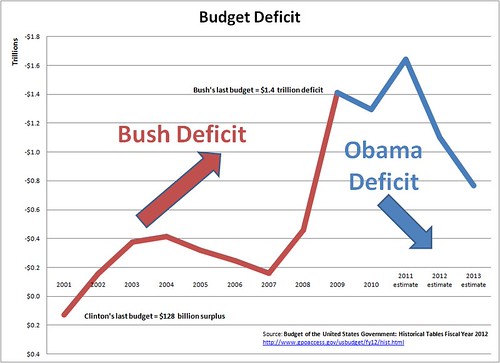
Deficits

Bush-Obama Deficit Chart

Notes, this chart includes Clinton’s last budget year for comparison.

The numbers in these two charts come from Budget of the United States Government: Historical Tables Fiscal Year 2012. They are just the amounts that the government spent and borrowed, period, Anyone can go look then up. People who claim that Obama “tripled the deficit” are either misled or are trying to mislead.

The Stimulus and Jobs

Bush-Obama-Jobs-Chart

In this chart, the RED lines on the left side — the ones that keep doing DOWN — show what happened to jobs under the policies of Bush and the Republicans. We were losing lots and lots of jobs every month, and it was getting worse and worse.The BLUE lines — the ones that just go UP — show what happened to jobs when the stimulus was in effect. We stopped losing jobs and started gaining jobs, and it was getting better and better. The leveling off on the right side of the chart shows what happened as the stimulus started to wind down: job creation leveled off at too low a level.

It looks a lot like the stimulus reversed what was going on before the stimulus.

Conclusion: THE STIMULUS WORKED BUT WAS NOT ENOUGH!

More False Things

These are just three of the false things that everyone “knows.” Some others are (click through): Obama bailed out the banks, businesses will hire if they get tax cuts, health care reform cost $1 trillion, Social Security is a Ponzi Scheme or is “going broke”, government spending “takes money out of the economy.”

Why This Matters

These things really matter. We all want to fix the terrible problems the country has. But it is so important to know just what the problems are before you decide how to fix them. Otherwise the things you do to try to solve those problems might just make them worse. If you get tricked into thinking that Obama has made things worse and that we should go back to what we were doing before Obama — tax cuts for the rich, giving giant corporations and Wall Street everything they want — when those are the things that caused the problems in the first place, then we will be in real trouble.

Emphasis Mine

see:http://www.alternet.org/story/152201/3_reality-based_charts_your_right-wing_relatives_will_have_a_hard_time_ignoring?akid=7484.123424.OxQ7x8&rd=1&t=12

5 Reasons Capitalism Has Failed

The root cause of our recent turmoil is the failure of the dominant economic paradigm — global corporate capitalism.

By Bob Burnett, The Smirking Chimp, via AlterNet

(N.B.: Marx was right, after all…)

We live in interesting times. The global economy is splintering. U.S. voters hate all politicians and there’s political unrest throughout the world. The root cause of this turmoil is the failure of the dominant economic paradigm — global corporate capitalism.

The modern world is ruled by multinational corporations and governed by a capitalistic ideology that believes: Corporations are a special breed of people, motivated solely by self-interest. Corporations seek to maximize return on capital by leveraging productivity and paying the least possible amount for taxes and labor. Corporate executives pledge allegiance to their directors and shareholders. The dominant corporate perspective is short term, the current financial quarter, and the dominant corporate ethic is greed, doing whatever it takes to maximize profit.

Five factors are responsible for the failure of global corporate capitalism. First, global corporations are too big. We’re living in the age of corporate dinosaurs. (The largest multinational is JP Morgan Chase with assets of $2 Trillion, 240,000 employees, and offices in 100 countries.) The original dinosaurs perished because their huge bodies possessed tiny brains. Modern dinosaurs are failing because their massive bureaucracies possess miniscule hearts.

Since the Reagan era global corporations have followed the path of least resistance to profit; they’ve swallowed up their competitors and created monopolies, which have produced humongous bureaucracies. In the short-term, scale helps corporations grow profitable, but in the long-term it makes them inflexible and difficult to manage. Gigantism creates a culture where workers are encouraged to take enormous risks in order to create greater profits; it’s based upon the notion that the corporation is “too big to fail.”

Second, global corporations disdain civil society. They’ve created a culture of organizational narcissism, where workers pledge allegiance to the enterprise. Corporate employees live in a bubble, where they log obscene hours and then vacation with their co-workers. Multinationals develop their own code of ethics and worldview separate from that of any national state. Corporate executives don’t care about the success or failure of any particular country, only the growth and profitability of their global corporation. (Many large corporations pay no U.S. income tax; in 2009 Exxon Mobil actually got a $156 M rebate.)

Third, global corporations are modern outlaws, living outside the law. There is noinvisible hand that regulates multinationals. In 1759 Philosopher Adam Smith argued that while wealthy individuals and corporations were motivated by self interest, an “invisible hand” was operating in the background ensuring that capitalist activities ultimately benefited society. In modern times this concept became the basis for the pronouncements of the Chicago School of Economics that markets were inherently self regulating. However, the last five years have demonstrated that there is no “invisible hand”unregulated markets have spelled disaster for the average person. The “recovery” of 2009-10 ensured that “too big to fail” institutions would survive and the rich would continue to be rich. Meanwhile millions of good jobs were either eliminated or replaced by low-wage jobs with poor or no benefits.

Fourth, global corporations are ruining our natural capital. Four of the top 10 multinational corporations are energy companies, with Exxon Mobil leading the list. But there are many indications that our oil reserves are gone. Meanwhile, other forms of natural capital have been depleted — arable land, water, minerals, forests, fish, and so forth. Multinational corporations have treated the environment as a free resource. When the timberlands of North America began to be depleted, lumber corporations moved to South America and then Asia. Now, the “easy pickings” are gone. Global corporations have ravished the world and citizens of every nation live with the consequences: dirty air, foul water, and pollution of every sort.

Fifth, global corporations have angered the world community. The world GDP is $63 Trillion but multinational corporations garner a disproportionate share — with banks accounting for an estimated $4 trillion (bank assets are $100 trillion). Global black markets make $2 trillion — illegal drugs account for at least $300 billion. In many parts of the world, a worker is not able to earn a living wage, have a bank account or drive a car, but can always obtain drugs, sex, and weapons. And while the world may not be one big village in terms of lifestyle, it shares an image of “the good life” that’s proffered in movies, TV, and the Internet. That’s what teenagers in Afghanistan have in common with teenagers in England; they’ve been fed the same image of success in the global community and they know it’s inaccessible. They are angry and, ultimately, their anger has the same target — multinational corporations (and the governments that support them).

We live in interesting times. The good news is we’re witnessing the failure of global corporate capitalism. The bad news is we don’t know what will replace it.”

(N.B.: Perhaps we do – see peoplesworld.org)

Bob Burnett is a writer and activist in Berkeley, Calif.

Emphasis Mine

see:http://www.alternet.org/story/152118/5_reasons_capitalism_has_failed?page=entire

The Dangerous Reagan Cult

Exclusive: Ronald Reagan’s anti-government philosophy inspires Tea Party extremists to oppose any revenue increase, even from closing loopholes on corporate jets. Democrats try the spin that “even Reagan” showed flexibility on debt and taxes. But Robert Parry says it is the “Reagan cult” that is at the heart of America’s crisis.

From RSN, by Robert Parry

“Exclusive: Ronald Reagan’s anti-government philosophy inspires Tea Party extremists to oppose any revenue increase, even from closing loopholes on corporate jets. Democrats try the spin that “even Reagan” showed flexibility on debt and taxes. But Robert Parry says it is the “Reagan cult” that is at the heart of America’s crisis.

In the debt-ceiling debate, both Republicans and Democrats wanted Ronald Reagan on their side. Republicans embraced the 40th president’s disdain for government and fondness for tax cuts, while Democrats noted that “even Reagan” raised the debt limit many times and accepted some tax increases.

But Reagan – possibly more than any political leader – deserves the blame for the economic/political mess that the United States now finds itself in. He was the patriarch for virtually every major miscalculation that the country has made over the past three decades.

It was Reagan who slashed taxes on the rich to roughly their current level; he opened the flood gates on deficit spending; he accelerated the decline of the middle class by busting unions and slashing support for local communities; he disparaged the value of government regulations; he squandered money on the Pentagon; he pushed more militaristic strategies abroad; and he rejected any thoughtful criticism of past U.S. foreign policies.

Reagan also created what amounted to a “populist” right-wing cult that targeted the federal government as the source of nearly all evil. In his First Inaugural Address, he famously declared that “government is not the solution to our problem; government is the problem.”

It is that contempt for government that today is driving the Tea Party extremists in the Republican Party. Yet, as with many cults, the founder of this one was somewhat more practical in dealing with the world around him, thus explaining some of Reagan’s compromises on the debt ceiling and taxes.

But once the founder is gone, his teachings can become definitive truth to the disciples. Flexibility disappears. No deviation is permitted. No compromise is tolerated.

So, at a time when government intervention is desperately needed to address a host of national problems, members of this Reagan cult apply the teachings of the leader in the most extreme ways. Since “government is the problem,” the only answer is to remove government from the equation and let the corporations, the rich and the magical “market” dictate national solutions.

It is an ironic testament to Ronald Reagan’s enduring influence that America’s most notable “populist” movement, the Tea Party, insists that tax cuts for the wealthy must be protected, even minor ones like tax loopholes for corporate jets. Inside the Tea Party, any suggestion that billionaire hedge-fund managers should pay a tax rate equal to that of their secretaries is anathema.

Possibly never in history has a “populist” movement been as protective of the interests of the rich as the Tea Party is. But that is because it is really a political cult dedicated to the most extreme rendering of Ronald Reagan’s anti-government philosophy.

Astro-Turf ‘Populists’

Granted, the Tea Party also can be viewed as an astro-turf outfit financed by billionaires like the Koch brothers and promoted by billionaire media mogul Rupert Murdoch. But Election 2010 proved that the movement is capable of putting like-minded politicians into office, especially when discouraged elements of the American Left choose to sit on the sidelines.

During the debt-ceiling battle, the GOP’s Tea Party caucus showed it was strong enough to block any compromise that included a revenue increase. The thinking is that the “evil” government must be starved even if that means defending indefensible tax loopholes and shoving the world’s economy to the brink of catastrophe.

The Tea Party’s rabid enforcement of the Reagan orthodoxy instills such fear among top Republicans that every one of the eight presidential hopefuls at a recent Iowa debate vowed to reject a deal that would include just $1 of higher taxes for each $10 in spending cuts. Even supposed moderates like Mitt Romney and Jon Huntsman threw up their hands.

But the Reagan cult reaches far beyond the Republican Party. Last February, a Gallup poll of Americans cited Reagan as the greatest president ever, with a five percentage point lead over Abraham Lincoln.

These days, virtually no one in Washington’s political or media circles dares to engage in a serious critique of Reagan’s very checkered record as president. It’s much easier to align yourself with some position that Reagan took during his long career, much like a pastor selectively picking a Bible passage to support his theological argument.

When negative national trends are cited – such as the decline of the middle class or the widening gap between rich and poor – the self-censorship demands that Reagan’s name not be spoken. Instead, there are references to these problems deepening “over the past three decades,” without mentioning whose presidency got things going big time.

Creating an Icon

And there is a self-interested reason for this hesitancy. The Republicans and the Right have made it a high priority to transform Reagan into an icon and to punish any independent-minded political figure or journalist who resists the group think.

The first step in this process occurred in the late 1980s, with aggressive cover-ups of Reagan’s crimes of state, such as scandals over the Iran-Contra arms-for-hostages affair, Contra-cocaine trafficking, and the Iraq-gate support of dictator Saddam Hussein.

Faced with furious Republican defenses of Reagan and his inner circle, most Democrats and mainstream journalists chose career discretion over valor. By the time Bill Clinton was elected in 1992, the refrain from Democrats and Washington pundits was to “leave that for the historians.”

Those who didn’t go along with the cover-ups – like Iran-Contra special prosecutor Lawrence Walsh – were subjected to ridicule from both the right-wing and mainstream media, from both the Washington Times and the Washington Post. Journalists who challenged the implausible Reagan cover-ups also found themselves marginalized as “conspiracy theorists.”

Leading Democrats decided it made more sense to look to the future, not dwell on the past. Plus, acquiescing to the cover-ups was a way to show their bipartisanship.

However, Republicans had other ideas. Having pocketed the concessions regarding any serious investigations of Reagan and his cohorts, the Republicans soon went on the offensive by investigating the heck out of President Clinton and his administration.

Then, having stirred up serious public doubts about Clinton’s integrity, the Republicans trounced the Democrats in the 1994 congressional elections. With their new majorities, the Republicans immediately began the process of enshrining Reagan as a national icon.

By and large, the Democrats saw these gestures, like attaching Reagan’s name to National Airport, as another way to demonstrate their bipartisanship.

But Republicans knew better. They understood the strategic value of elevating Reagan’s legacy to the status of an icon. If everyone agreed that Reagan was so great, then it followed that the hated “guv-mint” must be that bad.

More Accommodations

Increasingly, Democrats found themselves arguing on Republican ground, having to apologize for any suggestion that the government could do anything good for the country. Meanwhile, the Clinton-era stock market boom convinced more Americans that the “market” must know best.

Going with that flow, President Clinton signed a Republican-sponsored bill that removed Depression-era regulations in the Glass-Steagall Act, which had separated commercial and investment banks. With the repeal, the doors were thrown open for Wall Street gambling.

In the short run, lots of money was made, encouraging more Americans to believe that the government and its “safety net” were indeed anachronisms for losers. People with any gumption could simply day-trade their way to riches.

Reagan, it seemed, was right all along: government was the problem; the “free market” was not only the solution but it could “self-regulate.”

That was the political/media environment around Election 2000 when the wonkish Vice President Al Gore ran against the brash Texas Gov. George W. Bush, who came across to many as another version of Ronald Reagan, someone who spoke simply and disdained big government.

Though Gore could point to the economic successes of the Clinton years, including a balanced federal budget and the prospect of the total elimination of the federal debt, the major media mocked him as a know-it-all nerd who wore “earth-toned sweaters.” Meanwhile, mainstream journalists swooned over Bush, the regular guy.

Still, Gore eked out a narrow victory in the national popular vote and would have carried the key state of Florida if all legally cast votes were counted. But Bush relied on his brother’s administration in Florida and his father’s friends on the U.S. Supreme Court to make sure that didn’t happen. Bush was declared the winner in Florida and thus the new president. [For details, see Neck Deep.]

In retrospect, Election 2000 was a disastrous turning point for the United States, putting into the highest office in the land an unqualified ne’er do well who had lost the election.

But this outrage against democracy was largely accepted because of the muscular right-wing machine, the on-bended-knee mainstream media and the weak-kneed Democrats – a political/media dynamic that Reagan had helped create and had left behind.

The progress that the Clinton administration had made toward putting the U.S. financial house in order was quickly undone as Bush pushed through two massive tax cuts benefiting mostly the rich and waged two open-ended wars financed with borrowed money.

Years of Reaganism also had taken its toll on the government’s regulatory structures. Reagan had consistently appointed regulators who were hostile to the very concept of regulating, such as Anne Gorsuch at the Environmental Protection Agency and James Watt at Interior. He also elevated Alan Greenspan, a “free market” admirer of Ayn Rand, to be chairman of the Federal Reserve Board.

In the 1980s, the looting of America was underway in earnest, but the elites of Washington and New York saw little to protest since they were getting a cut of the plunder. The real losers were the average Americans, especially factory workers who saw their unions broken or their jobs shipped overseas under the banner of “free trade.”

Feeling Good

But many Americans were kept entranced by Reagan’s feel-good magic.

Taking office after a difficult decade of the 1970s, when America’s defeat in Vietnam and the Arab oil price hikes had shaken the nation’s confidence, Reagan simply assured everyone that things would work out just fine and that no excessive sacrifice was in order. Nor should there be any feelings of guilt, Reagan made clear.

By the late 1970s, it was widely accepted even among many Republicans that the Vietnam War had been an abomination. But Reagan simply rebranded it a “noble cause,” no reason for any serious self-reflection on America’s imperial role in the world.

Reagan then allied the United States with “death-squad” regimes all over Latin America and across the Third World. His administration treated the resulting carnage as a public-relations problem that could be managed by challenging the patriotism of critics.

At the 1984 Republican National Convention, Reagan’s United Nations Ambassador Jeane Kirkpatrick labeled Americans who dared criticize U.S. foreign policy as those who would “blame America first.”

To continue this sort of verbal pummeling on those who continued to get in the way, Reagan credentialed a bunch of thuggish intellectuals known as the neoconservatives.

For the rest of the country, there were happy thoughts about “the shining city on a hill” and “morning in America.”

In reality, however, Reagan had set the stage for the tragedies that would follow. When George W. Bush grabbed power in 2001, he simply extended the foreign and economic policies of the Republican cult leader: more tax cuts, more militarism, less regulation, more media manipulation.

Soon, the gap between rich and poor was widening again. Soon, the United States was at open war in two countries and involved in secret wars in many others. Soon, the nation was confronted with new scandals about torture and deception. Soon, the federal budget was flowing with red ink.

And near the end of Bush’s presidency, the de-regulated excesses of Wall Street pushed the country to the brink of a financial cataclysm. Bush supported a bail-out to save the bankers but didn’t do much for the millions of Americans who lost their jobs or their homes.

Second Thoughts?

One might have thought that the financial crack-up in 2008 (plus the massive federal deficits and the botched wars in Iraq and Afghanistan) would have confronted the Reagan cult with an existential crisis of faith. It would seem obvious that Reagan’s nostrums just didn’t work.

However, after only a brief interregnum of Barack Obama, the Republicans seem poised to restore the Reagan cult to full power in the United States. The new apparent GOP frontrunner, Texas Gov. Rick Perry, is already being hailed in the Washington Post as “The Texas Gipper.”

The Washington Times (yes, Rev. Sun Myung Moon’s right-wing propaganda sheet is still around) fairly cooed over Perry’s tough attacks on Obama, depicting America’s first black president as someone who apologizes for America and isn’t deserving of its soldiers in uniform.

“One of the powerful reasons for running for president of the United States is to make sure every man and woman who puts on the uniform respects highly the president of the United States,” Perry said. “We are indignant about a president who apologizes for America.”

As far as Perry is concerned, America has nothing to apologize for.

These are themes right out of Ronald Reagan’s playbook. And it appears likely that Election 2012 will be fought over terrain defined by Reagan, even though he left office in 1989 and died in 2004.

It is already clear that President Obama will be on the defensive, trying to justify a role for the federal government in America and explaining why the Reaganesque policy of low taxes on the rich must finally be reversed. Obama also is certain to shy away from any serious examination of how U.S. foreign policy went so wrong, so as not to be labeled “apologist-in-chief.”

Rick Perry or whatever other Republican gets the party’s nomination will hold the high ground of Reagan’s lofty standing among the American people. The GOP nominee can continue blaming “guv-mint” for the nation’s problems and promising another “morning in America” if only the nation further reduces the size of “guv-mint.”

With Democrats also trying to associate themselves with the “greatest president ever,” it appears doubtful that any serious effort will be made to explain to the American people that the charming Reagan was the pied piper who led them to their current demise.”

[For more on these topics, see Robert Parry’s Secrecy & Privilege and Neck Deep, now available in a two-book set for the discount price of only $19. For details, click here.]

Robert Parry broke many of the Iran-Contra stories in the 1980s for the Associated Press and Newsweek. His latest book,Neck Deep: The Disastrous Presidency of George W. Bush, was written with two of his sons, Sam and Nat, and can be ordered at neckdeepbook.com. His two previous books, Secrecy & Privilege: The Rise of the Bush Dynasty from Watergate to Iraq and Lost History: Contras, Cocaine, the Press & ‘Project Truth’ are also available there.

emphasis mine