Trumpism Can’t Last Forever, Right?

Source: AlterNet

Author: Simon Radford

Emphasis Mine

So what’s The Donald’s plan? He’s donning his camouflage, dusted off his traps and nets, and setting off in search of that rarest of beasts: the white man.

But he can’t win, right? As Donald Trump rolls towards a Republican convention where he will be the overwhelming favourite to take the party’s nod as their general election candidate, the same question repeats in tasteful living rooms, oak-paneled boardrooms, and faculty common rooms. Donald Trump might have been defeating the political gravity of common sense, but it can’t last forever, right? The quiescence underpinned by the conviction that Trump would implode in a hailstorm of bluster and bad hair has turned to an urgency that something this mad can’t actually come to pass. But as the Economist Intelligence Unit now lists the threat of a Trump presidency as a quantifiable possibility to be hedged against, we should dust off a tome from 2002 for reassuranceThe Emerging Democratic Majority argues that a combination of professionals, women, and minority voters give the Democrats a powerful in-built advantage towards winning presidential elections. With the Donald’s approval ratings rivalling Charles Manson’s amongst women and Hispanics, and urban professionals showing no signs of deserting their Democratic home, it’s a coalition that “white men can’t trump”.

In 2002 this emerging Democratic majority was less easy to see. John Judis, a veteran of the world of Washington political magazines, teamed up with Ray Teixeira, a demographer and political scientist, to make the case that America was in the midst of an historic shift in American Political Development (APD). APD is a sub-field of political science that aims to show how shifting constellations of political forces create durable governing coalitions. Judis and Teixeira argued that the era of New Right Reaganism was coming to an end. The 1980s may have seen the Democrats control Congress while Republicans won national elections, but the 1990s saw Newt Gingrich take back the House for the Republicans for the first time in 40 years. Conservatism might never have seemed so strong, but this too would pass and a nascent Democratic permanent revival was in the works. 

For a liberal in the 90s this seemed hard to believe. Three traditional Democratic candidates, each with impressive credentials, were crushed at the polls. To win back the White House, Bill Clinton never had to win 50% of the popular vote, but still felt the necessity to assert his distance from traditional Democratic constituencies by visibly enforcing the death penalty and being “tough on crime”, using an invite from Jesse Jackson to critique hip-hop and violence against the police, and proclaiming that “the era of Big Government is over” while reforming welfare. Clinton’s victories convinced many that it was a Republican world and liberals just lived in it. To win, they needed the votes of the white men who deserted the party for Reagan. A Democratic consultant called “Mudcat” advised candidates on Nascar, grits, and whistling Dixie. A Democrat who compromised with a radical Republican party was still better than having a radical Republican elected.

Even the strong currents of a booming economy, a balanced budget, and a bumbling Republican candidate, hobbled by a last-minute drink driving scandal that may have cost him millions of votes, couldn’t get Al Gore to the White House and the Democrats a third term. Bush’s chief strategist boasted of having createda permanent Republican majority”. So it was with that, Judis and Teixeira’s book resembled a friend’s reassurance after a particularly nasty break-up: things might be rough now but your time will come. Things would get better. Past isn’t destiny, it’s merely prologue.

And lo! It came to pass! And president Obama delivered us from permanent conservatism. But if you had told Al From and William Galston, who pioneered Clinton’s pivot between 80s liberalism and Reaganite orthodoxy, that the Democrats would nominate an African-American candidate, known for opposing a war in the Middle East, with a liberal policy agenda and a funny name – and win! – they would have pegged the odds somewhere around Jerry Springer becoming next Fed Chairman. But Obama was nominated. And he did win. And he won with a coalition that neatly resembled that detailed by Judis and Teixeira. Perhaps 2008 resembled what some political scientists called a “crucial election” and the Democrats could move from being the political brake pedal to the accelerator again.

So why wouldn’t the same coalition power Hillary to victory once more? Three answers get bandied around: firstly, that Hillary is a poor candidate; secondly, that holding the White House for a third time is not the same proposition as winning it for the first or second time; and, relatedly, that turnout for Hillary’s campaign is likely to be down from 2012. Finally, Republicans who refuse to believe that they must adjust their political project due to new demographic realities speak of ‘the missing white voters’. The case that Trump can win hinges on these claims, although Ted Cruz has made a similar claim about missing evangelical voters, and they rely more on hope than cold analysis.

Firstly, Hillary is indeed a poor candidate. Her voice is scratchy and the noise in the room often leads to her seeming to shout to those watching on TV; her pitch tends to be more about her than about those she claims she wants to fight for; and she lacks an overarching diagnosis of what ails America and how best to fix it. The fact that she has been in or close to power for so long and often hob-nobs with the rich and powerful, makes it seem that she has more invested in piecing back together the status quo than trying to fix the underlying problems that see so many fearful for their economic future. Especially to millennials who crave authenticity, tend to be suffering economically and reel under a barrage of student loans and poor job prospects, Hillary can often seem like the ‘let them eat cake’ candidate. Her attempt to use ‘the gender card’ against Bernie caused resentment among the young, female voters who she needed to win over, while her lack of an overarching message turns off those who tend to be left out of identity politics coalition stitching. Hillary’s main weakness – working class male voters – are exactly those who are most pissed off and most open to entertaining a pitch from Donald Trump.

However, while Hillary might be more Al Gore than Bill Clinton when it comes to inspiring or “the vision thing” (as George H.W. Bush called it), she does have a savvy campaign team and the potential to expropriate much of Bernie Sander’s message once he exits the race. Hillary will inherit a sophisticated voter-targeting machine from the Obama campaign – updated with fresh real-world election data thanks to the primaries – while the Koch Brothers and their extensive fundraising network and data provider to Republican candidates might just sit this one out with Trump as the nominee. Hillary also has the opportunity to supplement her campaign by choosing an effective vice-presidential running mate. Her weakness with white, working-class men (especially in key, swing states) might see her plump for someone like senator (and former SNL funnyman) Al FrankenSherrod Brown, or Tom Kaine; if she felt the need to motivate Hispanic voters, labour secretary Tom Perez might prove a savvy outsider choice. As a candidate Hillary Clinton is not RFK, but there is plenty to argue that she will run a competent, if somewhat uninspiring, general election campaign.

Secondly, it is hard for any party to hold the White House for a third term. Grievances accumulate over time and it is only natural that people should blame the party in charge of the most visible part of the government. Indeed, in election prediction models, the length of time a party has held the White House is a powerful variable in predicting the election outcome. The most well known of these models, Alan Abramovitz’s “Time for a Change” model, has an elegant simplicity in how it comes to make its predictions: “The basic Time for Change Model uses three factors– the incumbent president’s net approval rating at the end of June, the change in real GDP in the second quarter of the election year, and a first term incumbency advantage, to predict the winner of the national popular vote.” Hillary will lack any incumbency advantage that Obama could lay claim to in 2012, but the latter’s job approval ratings have hovered around 50%, having climbed over the last year. Economics news has been bumpy but much of voters’ economic assessment is baked into the president’s job approval ratings. A strong Republican candidate would like these numbers when sizing up their chances of taking out Hillary but as headwinds go, the numbers seem like more of a gust than a hurricane.

Thirdly, turnout is indeed a worry. While many fret about turnout during primary season compared to the records of 8 years ago, there is a good argument that this is a data point not worth getting hung up over. However, there is still the question mark over how much the Obama coalition was due to Obama. The infamous Bannock Street project, larded with $60m of donor largesse, promised to activate these voters to keep the Senate in Democratic hands in 2014, with arguable results. Millennials have largely shunned Hillary’s candidacy and will have to be persuaded with difficulty to warm to her; African-Americans don’t have one of their own in the Oval Office to fight for; and Hispanic voters feel let down that Obama did not pursue comprehensive immigration reform with enough vigour. Unions failed to secure card-check legislation under Obama, have further declined in power, and have injected themselves into a Democratic civil war over TPP. Meanwhile Republicans have been pouring money into catching up the Democrats’ technical advantage and overtaking it. Hillary might well struggle to inspire the Obama coalition to the ballot box in the same numbers. A Republican candidate that would reach Hispanic voters or young people, as argued by the GOP’s own 2012 “Autopsy” report, could steal from a fragile Democratic base and win the White House. But so far the party has not tried to find a message that can win over these voters. Still, even with this lack of active competition for their affections, Hillary will have to reach her turnout figures regardless.

So we see a somewhat lukewarm prognosis for Hillary’s general election chances, but Hillary has one secret weapon: Donald Trump. Hispanic voters unsurprisingly loathe the Donald. Professionals who remained in the Republican camp are still trying to steal the Republican nomination from his clammy, short-fingered, grasp. And Trump’s ratings among women are about as healthy as his comments about dating his own daughter. Indeed, just as fellow-conservative Newt Gingrich previewed how the Democrats would define Mitt Romney before he had a chance to create his own image for the voters, Republican SuperPACs have already shown exactly what is coming Trump’s way over the airwaves from now until election day. The Democrats already had a ‘women gap’ in their favour, this is likely to make it grow to record levels. He’s just lucky that kids don’t vote.

With 2016’s electors set to be the most diverse in history, Trump is driving the Obama coalition into Hillary’s hands. While mass defections to Hillary from Republican stalwarts is overblown because of partisan polarisation and reverse-partisanship, Democrats who might have had trouble getting voters enthused enough to vote for Hillary will now have plenty of fuel to stoke their enthusiasm. So what’s Trump’s plan? He’s donning his camouflage, dusted off his traps and nets, and is topping up his liquid sustenance, and setting off in search of that rarest of beasts: the white man. 

The counterweight to the demography-as-destiny argument of the “emerging democratic majority” is themissing white voter” thesis. This argument makes the claim that almost 6 million fewer white voters went to the polls in 2012 than we should have expected based on projections. If this number reverted to the mean or a candidate enthused these voters, then the GOP could get back to the White House without changing its coalition of voters. This missing bloc is crucial because if one looks at the 2012 electorate, then Trump’s path looks extremely narrow, as Bill James points out:

“The math suggests Trump would need a whopping 70% of white male voters to cast their ballots for him. That’s a larger percentage than Republicans have ever won before — more than the GOP won in the landslide victories of Ronald Reagan and George H.W. Bush, and far more than they won during the racially polarized elections of Barack Obama.“

Of course, all white voters are not the same. There is a striking class difference in the Trump base. Blue-collar voters tend to be much warmer than those who belong to the professional classes. This difference is crucial, as Teixeira himself explained in a recent sit-down with the New Yorker:

“In Ohio in 2012, Mitt Romney won the white working-class vote by a 16% margin: 57% to 41%. According to Teixeira’s projections, Trump, to carry Ohio in November, would need to increase this margin to 22 or 23 points. “That’s a big ask,” Teixeira said. And Trump would also need to retain, or even increase, Romney’s ten-point margin among college-educated white Republicans, even though at least some members of this group may be sufficiently put off by Trump’s extremism to stay at home, or even to switch to the Democrats.”

Teixeira’s baseline there, of course, uses 2012 and treats these missing white voters as permanently gone, even though these missing voters seem to resemble the blue-collar, anti-free trade voters that would most respond to Donald Trump’s economic populist appeal. However, even those analysts most closely associated with the ‘missing white voters’ hypothesis, contend that those missing white voters would not have been enough to have coronated a president Romney in 2012: 

“But while this was the most salient demographic change, it was probably not, standing alone, enough to swing the election to Obama. After all, he won the election by almost exactly 5 million votes. If we assume there were 6.5 million “missing” white voters, than means that Romney would have had to win almost 90% of their votes to win the election. Given that whites overall broke roughly 60-40 for Romney, this seems unlikely. In fact, if these voters had shown up and voted like whites overall voted, the president’s margin would have shrunk, but he still would have won by a healthy 2.7% margin.”

There is an argument that a Republican strategy of targeting ‘missing white voters’ would have a chance at high-tide if the Democratic coalition turned out as if it were at low-tide. However, Trump’s ability to turn out these working class white voters founders on the irony that by doing so he activates the very Democratic coalition he seeks to overpower. Mitt Romney only won 27% of Latinos in 2012, but Donald Trump might struggle to win two-thirds of Romney’s total in a national voting population more Latino than ever and energised to turn out to vote against him. African-American turnout might struggle to reach the levels reached under president Obama, but the president will surely be relied upon again to turn out the vote in key states like North Carolina and Virginia. Trump’s use of a megaphone rather than a dog-whistle might activate these missing white voters, but at the very real risk of seeing defections from normally Republican women in the suburban battlegrounds of previous elections. While reverse-partisanship – the idea that many people vote against a candidate rather than for their own – might see Republicans rediscover their loathing for secretary Clinton and vote for Trump reluctantly, some professional-class Republicans will surely “do a France” and hold their nose to vote against Mr Trump or simply sit this race out.

The Republicans could have stopped a president Hillary Clinton if they had nominated a Republican candidate who would speak to voters in the veterans’ halls and union homes without turning off the country club and Rotary Club regulars. Adding the ‘missing white voters’ to the Romney coalition by discovering a more populist economic message on trade, taking on corporate welfare, and joining in the Democrat populists’ assault on dodgy practices on Wall Street, could have seen a Republican win even without gaining much ground in the short-term with Latinos and other minority groups. While John Kasich hangs around, hoping that Cruz and Trump’s antipathy sees delegates alight upon his inoffensiveness in the latter rounds of convention voting, he might hope to be able to perform this balancing act. But navigating what political scientists call a “two-level gamebetween the Republicans’ primary electorate and the narrow path to beating a large Democratic demographic bias in a changing American electorate might have been a quixotic hope from the get-go.

There was every prospect that Hillary’s weaknesses as a candidate could have allowed the Republicans to squeeze one more victory out of a dying voter profile that had previously served them so well.  Perhaps Trumpism will test Republican optimism to destruction just as Democrats trotted out liberal candidates in the 80s and were confounded by the electorate before realising that they had to accommodate with electoral reality. But both parties have made clear where each party needs to make gains if they are to win the White House in the future: Hillary will need Bernie’s authenticity and appeal to working-class white voters on trade and economics; Republicans will need to learn Spanish.Hasta la Vista, Trumpy.
 

Simon Radford is a Provost’s Fellow at the University of Southern California, a political consultant, and contributes regularly on politics to a variety of magazines and newspapers, both in the US and UK.

See:http://www.alternet.org/election-2016/trumpism-cant-last-forever-right?akid=14191.123424.T6930e&rd=1&src=newsletter1055175&t=8

Why Do Voters Say Hillary Clinton Is Untrustworthy?

Even using objective measures of trustworthiness, like Politifact’s Truth-O-Meter scale, she rates as the most honest compared to every other candidate in the 2016 race.

Photo: Hillary Clinton: Whoever you want her to be? REUTERS/Mike Stone

Source: National Memo

Author: Stephanie Schwartz

Emphasis Mine

Hillary Clinton is not trustworthy.

That’s the belief of many, many Americans – and in this case, let’s exclude the right-wing orthodoxy, who have hated Hillary since she first said she’d rather not stay home baking chocolate-chip cookies in 1992.

Forty percent of Democratic primary voters, according to March CBS/New York Times poll, believe that Mrs. Clinton is politically calculating; somone they don’t trust with the presidency. She’s been asked about it in debates and on the stump, and there’s a whole genre of literature devoted to her “fabrications.”

But even journalists like Jill Abramson, who has covered Clinton for decades as the the New York Times’ Washington bureau chief, managing editor and executive editor, have defended Clinton against mostly-baseless accusations that she is “dishonest.”

Abramson, in an op-ed in The Guardian, writes that while Hillary has shown bad judgment before – she specifically refers to her use of a private email server while Secretary of State, over which Clinton will be speaking to the FBI, and her taking Wall Street money for speeches she’s given – she suffers from a level of scrutiny not given to male candidates, and her long record in politics gives her opponents ample fodder.

This type of criticism, which many use as a feminist defense, might fall on hostile ears. But as Chaz Pazienza argues in The Daily Banter, it’s Clinton’s reputation, for good or for ill, that makes it so impossible for many voters to look at her objectively: The “personality” that’s been sold to the American electorate is largely manufactured, and not by Clinton herself (another facet of the smear: that she’s a phony). The reality is that Clinton was one of the most liberal members of the Senate during her time there, ranking within ten points of progressive messiah Bernie Sanders and her history as a crusader for progressive causes is precisely what so motivated the GOP to destroy her in the first place. As far as the right was concerned, Clinton stepped far over the line when she pushed for healthcare reform way back in 1993 and her activist past informed a future as a “difficult woman.” Even using objective measures of trustworthiness, like Politifact’s Truth-O-Meter scale, she rates as the most honest compared to every other candidate in the 2016 race. (Let’s not even go into the GOP frontrunner, who’s entire candidacy is based upon saying the most outrageous lie he can think of in any given moment.)

But unlike other politicians, the supposed scandals stick. You might be sick of hearing about Hillary’s damn emails, but they’re still getting coverage.

Hillary has learned to become guarded through her decades in public life. When the most intimate details of your life are splayed across front pages for everyone to see – and judge and scold and criticize – it’s natural that she would carefully take pains to draw her private life around her as much as possible. And that’s made blunders about her lack of transparency – like not releasing transcripts of her private speeches to Wall Street – make her look like she’s hiding something, even if it’s just embarrassment or hypocrisy.

As Abramson points out, this doesn’t mean that Hillary is above scrutiny, and she’s not excusing her record. But Abramson isn’t alone in finding Clinton’s “liar” reputation extremely dubious.

After all, America has elected prevaricating politicians before.

See:http://www.nationalmemo.com/why-do-voters-say-hillary-clinton-is-untrustworthy/

Nominating Trump Would Be An Electoral ‘Bloodbath’: ‘Weekly Standard’

2000px-ElectoralCollege1928.svg-1-e1458884980368-668x501

Source: National Memo

Author: Matt Shuham

Emphasis Mine

We’ve written a lot recently about Donald Trump’s poor prospects in the general election, should he become the Republican nominee: he motivates Muslims and Latinos to register to vote (against him), he’s repulsive to Mormons and others who value religious liberty, and the international community would consider his success a complete disaster — something we’ll surely hear more about as this cycle rolls on.

On top of all that, Trump’s electoral strategy — essentially, it’s just “bring out angry, disengaged conservatives to the polls” — forgets the fact that the vast majority of voters are some combination of young people, minorities, and women, most of whom find him entirely unelectable.

It’s not just us lefties ranting about how bad Donald is for our politics, though. After all, the #NeverTrump movement started with conservatives on Twitter who swore they would never support Trump as their party’s standard-bearer, and has since become a slogan for anti-Trump activists of all stripes.

Take conservative outlet The Weekly Standard, whose Trump coverage is particularly bleak. In an episode of their wonderful near-daily podcast on Monday, staff writer and number cruncher Jay Cost laid out his forecast for Trump’s general election chances, and they’re not pretty. I’ll let Cost explain, in one of the best electoral math rants I’ve heard in a while:

Let me state flatly and unequivocally that if Donald Trump is the nominee, Hillary Clinton’s floor in the electoral college is 400 votes. That’s the floor, number one. Number two, kiss the Senate goodbye. I mean, it’s not even going to be a close call. It will be a bloodbath. Number three, and this is a little more controversial at this point, but I would give the Republicans no better than 40 percent odds hold the House of Representatives.

This guy is an abject disaster for the Republican Party in November, there is no other way to put it. And the notion that he’s going to bring in some tranche of voters is just a complete fiction, for two reasons: number one, there aren’t enough of them, okay?

I live in Western Pennsylvania. I live right near places that, up until very recently, were voting Democratic. And yeah, can Trump bring some new voters in from Beaver County? Yeah, maybe he can. But I’m telling you what, I live in Butler County, which has been voting Republican since 1856, and he’s going to get killed in Butler County. He is going to get killed in the Cranberry Township suburbs in Butler County. Because people are going to look at him and they are going to think, “No Way.”  You watch, suburban women in Cranberry Township are going to bolt [from] him in droves. And the same thing’s going to happen… replicate that times 100 in the Philadelphia suburbs. It’s going to be an absolute slaughter.

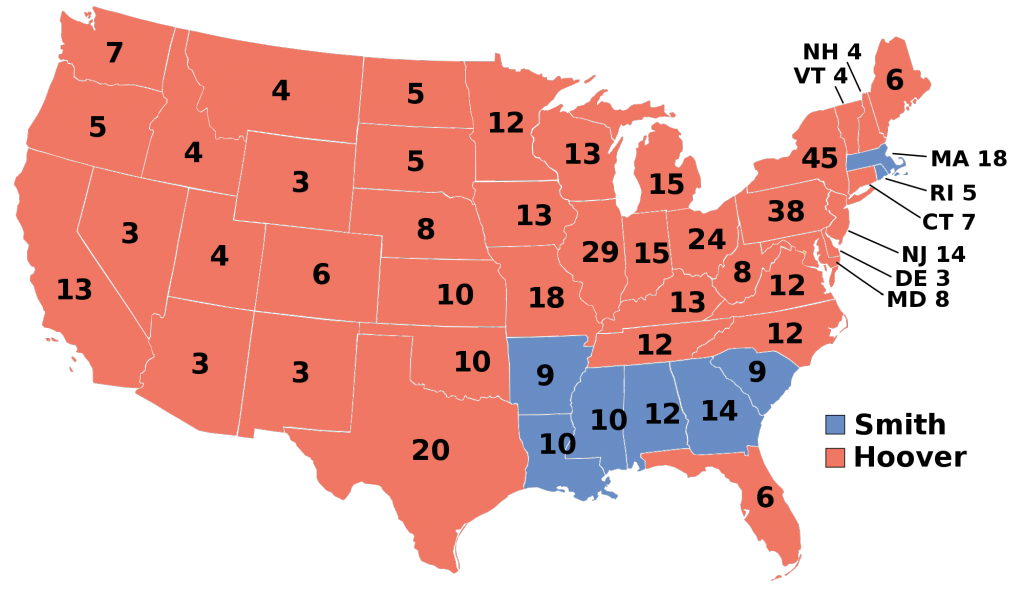
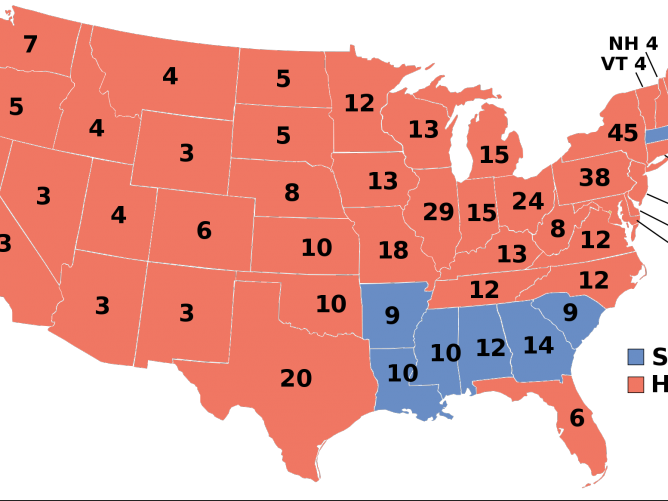
And I think that he can hold the line, maybe, in the South. I see him winning Mississippi and Alabama, and maybe Louisiana. I think he loses Georgia, I think he loses North Carolina. But I think… that’s only one area where the Republican Party is strong. You go to the Great Plains, right… So the Great Plains starts with Texas and then goes up to the Canadian border, and then it goes west up though Montana, Idaho, Wyoming, Utah. He is going to punk out all through that region. These people want nothing to do with this guy. Maybe they’ll vote for him over Hillary Clinton, because they find Hillary Clinton so objectionable, but he is not going to win those states by anything approaching a solid margin. If you want a view of what Trump looks like on election day, I think the best map you can look at is probably the 1928 map between Al Smith and Herbert Hoover. And Herbert Hoover massacred Al Smith. It is going to be an absolute, total bloodbath for Republicans. It will give the Democrats not only control of the White House and the Senate, but very possibly the House of Representatives That 1928 electoral map is about as one-sided as Trump’s electoral predictions get. I can’t say I’d look forward to such a lopsided win, mainly because I don’t want to think about the type of politician who will be able to capitalize on disappointed Trump voters (just as Trump spoke to disaffected Tea Partiers). Still if it means dealing a serious blow to the darkest corners of Trump’s twisted rhetoric, I’m all for it:

1928
1928

See: http://www.nationalmemo.com/nominating-trump-would-be-an-electoral-bloodbath-weekly-standard/

Trump’s Attack on Cruz’s Wife Proves He’s Too Sexist to Stand a Chance Against Clinton

Trump sneers at Cruz’s wife, showing why he’s not just going to lose female voters, but a lot of male voters, too.

Source: AlterNet

Author: Amanda Marcotte/Salon

Emphasis Mine

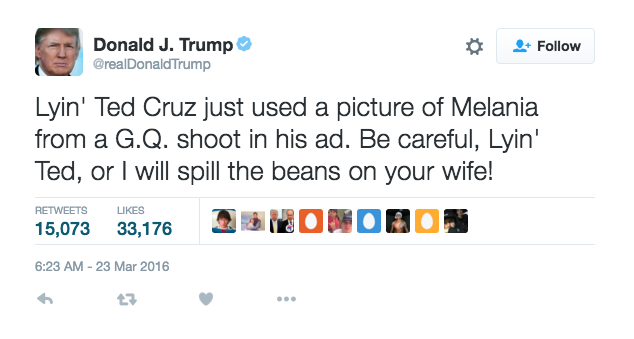
While most of the U.S. political world was focused on the terrorist attacks in Brussels and the primaries in some Western states Tuesday night, Donald Trump—surprise, surprise—was sitting around nursing a grudge. And he decided it needed airing out on Twitter, of course.

screen_shot_2016-03-23_at_4.53.38_pm

add
add

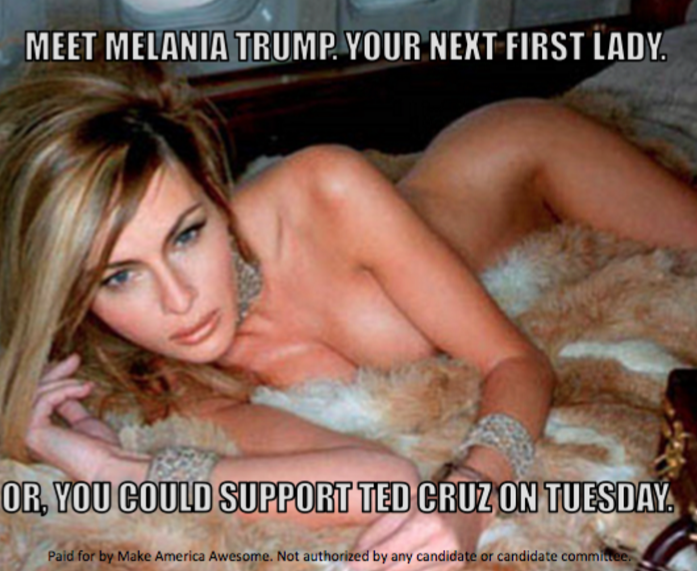
There’s been a robust discussion in feminist circles about this ad that is actually a meme and how it’s unfair and slut-shaming. There’s a strong argument to be had supporting this, but you have to give the woman who made it, Liz Mair, some credit for finding and exploiting a real vulnerability when it comes to Trump and female voters, both liberal and conservative.

While it’s true that Melania Trump is smarter than a lot of people realize and isn’t doing anything wrong by taking risqué photos, this ad isn’t really about her. This ad is about Donald Trump, highlighting that he really is a cartoonish stereotype: The wealthy sexist who talks about women like they’re objects for purchase and who is probably not interested in his wife because she speaks five languages and has studied architecture and design. One can politely ignore that fact in public, but there’s simply no way women aren’t taking note of it in private.

(Conversation I heard from two women talking in public recently: “Well, she’s probably smarter than the rest of us. We’re working and she’s probably out on 5th Avenue shopping right now.” “Yeah, but him? Ugh. He can’t really think she wants him for himself.”)

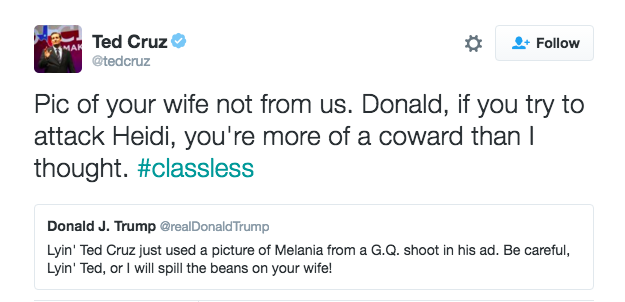
Trump’s reaction to this—to try to drag Ted Cruz into a wife-measuring contest, like they are debating the merits of owning a Ferrari vs. a Toyota Corolla—just confirms the suspicions that this ad is trying to raise.

This is why those who worry that Trump’s over-the-top sexism will somehow help him in a general election match-up against Hillary Clinton are completely misreading these particular tea leaves. Sure, there are a lot of men out there who see things the way Trump does. Those men admire him for his history of categorizing women as either sex objects or wastes of space whose continued existence is a mystery to him.

But those men are not the dominant voting bloc in a general election. In fact, men, as a group, do not make up the majority of voters. Women vote more than men and have since 1980And women hate Trump. Sure, there’s a lot of sexist dislike for Clinton, which explains why her unfavorability ratings are significantly higher with men than women. But Trump’s sexism has an even more profound impact on his popularity with women, as Jon Schwartz at The Intercept explains:

Women dislike Trump with what’s likely a historically unique intensity for a national politician. Trump’s average net favorability among women over the past six weeks is minus 33 percent—far worse than the minus 2 percent net favorability among women for Marco Rubio or the minus 14 percent for Ted Cruz. Likewise, in a poll taken just before the 2012 election, Mitt Romney had a net favorability among women of minus 2 percent.

And this is before the general election even really gets underway and Trump starts pulling his “why is this woman I don’t want to have sex with even talking” act with Hillary Clinton. As Jeet Heer points out at the New Republic, the only time Carly Fiorina was really doing well with Republicans was when Trump was disrespecting her in this way. And that’s with a crowd that has way higher tolerance for overt sexism. The public at large is not going to like it, not one bit. Nor will this hurt Trump with just women, either. Sure, Trump plays well with the Maxim crowd, but he takes the sexist vitriol so far that it repulses a whole bunch of men, both liberal and conservative. The exchange with Cruz was a good example of how the way Trump talks about women is also insulting to men.

screen_shot_2016-03-23_at_4.59.36_pmMost news sources are assuming that Trump was referring to Heidi Cruz’s history of struggling with depression, and if so, then congratulations, Trump. You did the impossible: You made Ted Cruz, by far the creepiest politician on the national stage since Ross Perot, seem like a decent man who cares for and stands by his wife.

That sort of thing doesn’t just impact female voters, but a lot of men, as well. Even some men who might have some sympathy for Trump’s leering sexism are going to draw the line at treating a beloved wife like she’s a defective product who needs to be returned to the factory just because she has some health problems. Most men’s marriages are more like the Cruz marriage than the Trump marriage. They aren’t going to be keen on the idea that Trump would look down on them for that.

Six out of 10 female voters think Trump is an embarrassment, but it’s also true that 4 out of 10 male voters think that. Just wait until the general election, where his sexist antics will get even more attention (as hard as that may be to believe) than they are getting now. This is a man who can’t crack 50% of Republican voters, even in Arizona, where his xenophobic campaign should be going over like gangbusters. On a national stage, against a female opponent whose very existence counters Trump’s reductionist attitudes about women’s worth, Trump is going to look even more like an embarrassment.

Amanda Marcotte is a politics writer for Salon. She’s on Twitter @AmandaMarcotte. 

See:http://www.alternet.org/election-2016/trumps-female-problems-donald-trumps-attack-ted-cruzs-wife-proves-hes-too-sexist-stand?utm_source=Amanda+Marcotte%27s+Subscribers&utm_campaign=c6e2f1532d-RSS_AUTHOR_EMAIL&utm_medium=email&utm_term=0_f2b9a8ae81-c6e2f1532d-79824733

Why the Rise of Trump, Cruz and Sanders Is the Logical Result of the 1% Not Paying Taxes, and Shutting off Opportunity to the Poor

the U.S. protects “everything that deals with capital and property but we cannot deal with protecting basic human rights.”

Source:AlterNet

Author: Vijay Prashad

Emphasis Mine

You reap what you sow. The Republican Party – pushed along by large segments of the “Third Way” Democrats – crafted policies that allowed the American rich to go on tax strike, that allowed them to deindustrialize the United States and that allowed their banks to control the destiny of people from the redwood forest to the gulf stream waters.

This land is their land. Democracy is the mask of the 1 percent.

The detritus of those policies created under-employment and endemic social crises. Between the prison industrial complex and the opioid crisis lies the fault line of race: otherwise these are identical. Wages plummeted, but debt-fueled consumption allowed the American Dream to remain alive. The Great Recession of 2007 awoke sections of the country from its credit card somnolence. For the first time in decades, the American Dream seemed unrealistic. The lives of American children would most certainly be economically more fragile than those of their parents.

Race stayed the hand of unity. The Tea Party movement covered itself in the old rags of racism to blame migrants and minorities for the degradation of their country. Egged on by the Republican elites, this movement took the hatred of government and of outsiders to the limit. Out of it came Ted Cruz and Marco Rubio, with fire against Washington as their ammunition. It is fitting that the old Gadsden flag was taken up by the Tea Party – with its rattlesnake above the sign, “Don’t Tread on Me.”

To associate oneself with the rattlesnake is a curious gesture. This is venom incarnate.

The Great Recession hit black and Latino families hardest, but there was no room for them in the Tea Party consensus. It was Obama’s presidential campaign that became their ark. That Obama did little to constrain the banks and force the rich to pay tax was disappointing, but not sufficient for disillusionment. What choice has there been? It was organizations such as Stand Up United, Black Lives Matter, Dream Defenders, Defend the Dream, Stand Up/Don’t Shoot and Black Youth Project that drew in the more critical segments – spurred on by Ferguson.

They are the antithesis of the Tea Party, although survivors of a similar dynamic set in motion by the American rich’s tax strike.

Many of these young people have now taken refuge in the Sanders’ campaign. Hillary Clinton was part of the “Third Way” Democrats that allowed Wall Street its excesses. She does not have the compass to bring in this segment. It is fitting that the wife of Eric Garner (killed by the New York police department) supports Clinton, while their daughter – Erica Garner – who is an activist in these movements supports Sanders.

Donald Trump and Ted Cruz are the end-points of Republican policy. They are what emerge when the rich don’t pay their fair share of taxes and the working poor cannot any longer dream of a better life. But they are particularly the salvation of the white working poor. Theirs is a populism narrowed by racism and misogyny.

Stop Trump, goes the slogan. But replace him with what? Ted Cruz, who is not only as bellicose as Trump (bomb the desert to “make it glow”), but is also a zealot? These men are mirror reflections of each other. They are Crump.

Both Trump and Sanders attract the white workers who had been battered by the trade agreements of the 1 percent. Trump’s rhetoric is familiar to the American right, which heard it from Pat Buchanan in an earlier era. Sanders comes from a long line of Democratic barnstormers who opposed these recent trade deals – whether Tom Harkin or Sherrod Brown and most recently the Sanders’ supporter Keith Ellison. These are Mid-western politicians who know how the trade deals eviscerated the working class of their heartland.

In this skepticism of the 1 percent’s trade deals there is the potential of great unity, but again race is the obstacle. Buchanan’s fulminations on the “end of White America” are far from Harkin’s 1992 objections to NAFTA on the grounds that the U.S. protects “everything that deals with capital and property but we cannot deal with protecting basic human rights.”

Exit from this current nightmare is not evident. Until the American Rich give up their tax strike, there is little hope for necessary social investments. Unity is impossible as long as the toxicity of racism diminishes social life. Trump and Cruz offer bluster, empty slogans that reduce the potential of people. Clinton and Rubio have little to offer beyond the prattle of the Beltway, which is continued adherence to Wall Street’s failed dogmas and belief in the Security establishment’s failed imagination for the world.

The Republican elite wants to sow fear of Trump in order to sneak in Cruz. Under both shells sit rotten peas.

It is better to pick neither.

Vijay Prashad is professor of international studies at Trinity College in Hartford, Connecticut. He is the author of 18 books, including Arab Spring, Libyan Winter (AK Press, 2012), The Poorer Nations: A Possible History of the Global South (Verso, 2013) and the forthcoming The Death of a Nation and the Future of the Arab Revolution (University of California Press, 2016). His columns appear at AlterNet every Wednesday.

See: http://www.alternet.org/election-2016/why-rise-trump-cruz-and-sanders-logical-result-americas-wealthiest-not-paying-their?akid=14080.123424.MZYW4e&rd=1&src=newsletter1052897&t=12


Why Bernie’s Revolution Has Just Begun

With each primary victory—and each close call—Sanders has shown us our own strength.

Source: AlterNet

Author: D.D. Guttenplan/The Nation

Emphasis Mine

Well, we’ll always have Michigan….

A week after Bernie Sanders stunned pollsters with a victory that nobody predicted, lifting his campaign—and his supporters’ expectations—those hopes came crashing down to earth yesterday with defeats in Florida, Ohio, Illinois, and North Carolina. Hillary Clinton’s late-breaking win in Missouri gives her a clean sweep on a night that was meant to mark the turn in the tide for Sanders, who poured time and money into Ohio, where Clinton took every big city on her way to a convincing 14-point victory, and Illinois, where Sanders hoped to profit from dissatisfaction with Chicago Mayor Rahm Emanuel, a longtime Clinton ally. Though voters did punish Cook County prosecutor Anita Alvarez for her handling of the police shooting of Laquan McDonald, favoring challenger Kim Foxx by a margin of 2 to 1, Clinton carried Cook County by a comfortable 8 points.

Yes, it’s true that the rest of the primary calendar is more favorable to Sanderswho has won more states, garnered many more votes, and has a larger share of the delegates than any of the Republicans challenging Donald Trump. Whose presumptive grasp on his party’s nomination is denied almost daily by the same media who have been burying Sanders—when they could be bothered to write about him—from Iowa onward. We never said this was going to be easy—or a fair fight.

Hillary Clinton has always been the favored candidate of the party establishment. And unlike 2008, when the powerful Cook County portion of that establishment broke for Obama, a favorite son, this time the establishment remains unified in the face of the Sanders insurgency. Which would be reason enough for Sanders to carry on his fight all the way to Philadelphia, even if it really were mathematically impossible for him to win the nomination—a point we are still unlikely to reach before California votes on June 7. The strength of Sanders’s challenge, and the enthusiasm of his supporters, have already pulled Hillary Clinton off dead center on police violence, trade policy, access to education, and making the wealthy pay their share of taxes. 

As long as he stays in the race, and stays true to his beliefs, Sanders will keep winning those arguments, even if Clinton’s willingness to steal her opponent’s best ideas—and even some of his best lines—help her to win voters who will be crucial in defeating Trump in November. Turnout remains the Democrats’ Achilles’ heel: In Ohio, where Trump came second, he still got more votes than either Democrat. Clinton herself seems to get this, and yesterday declined to endorse calls for Sanders to drop out. Any other course would leave Trump in sole possession of the media for the next four months.

Speaking of the Donald, it also seems odd that while his impact on the Republican party is endlessly analyzed, almost nothing has been said about the way Trump’s likely nomination has influenced Democratic primary voters. My own guess is that fear of Trump probably carried Clinton over the line in Illinois and Missouri.

Keeping Clinton from reverting to a neoliberal default isn’t the only reason for Sanders to stay in the race—or the most important. As Sanders has always said, his aim is “a political revolution.” Winning the nomination would be nice, but is neither necessary nor sufficient to bring that about. Building a nationwide, durable network of mobilized, active supporters prepared to keep working for universal healthcare, a living wage, ending Wall Street welfare and America’s endless wars—including the drug wars—in numbers great enough to Occupy the Democratic Party and take it back from its corporate funders is absolutely crucial. So, too, is the difficult work of stitching together movements like #BlackLivesMatter, Fight for 15, immigrant rights, climate justice, and voting rights into a coalition prepared to march together, vote together, and transform our politics—and our country. Yet that is the task we face.

Are the odds against us? Of course. That’s what it means to live inside a rigged system. But remember where we were only a few months ago. With each primary victory—and each close call—Sanders shows us our own strength. With each packed rally we see the claim that socialism is un-American exposed as a lie, that a world where no one starves, healthcare is not rationed by wealth, and energy companies aren’t allowed to rape the earth for profit and leave the rest of us to take the consequences is not only possible but popular.

Why cut off that momentum? Especially when, as Daniel Cantor of the Working Families Party points out, Sanders actually keeps getting stronger: “Bernie’s North Carolina performance was 15 points better than his South Carolina performance last month, and 5 points better than his Virginia performance two weeks ago. Meanwhile, the margin in Cook County, Illinois, is half of that in Wayne County, Michigan.”

So we fight on—to July, November, and beyond. For the nomination, so long as that remains a possibility. For our country—which may in November face as stark a choice as any in our lifetimes. And for our future, which is far too precious a prize to abandon for the sake of a few thousand votes.

 See:http://www.alternet.org/election-2016/why-bernies-revolution-has-just-begun?akid=14080.123424.MZYW4e&rd=1&src=newsletter1052897&t=4

The Bernie Sanders Era Is Upon Us: Why Iowa Was a Watershed Moment for American Politics

The Vermont senator’s Iowa showing indicates that something is changing in American politics.

Source: AlterNet

Author: Paul Blest/Salon

Emphasis Mine

On Monday night, a self-described socialist who has spent his entire career railing against the two-party system brought his first primary matchup — with the most visible and popular non-presidential Democrat over the past quarter-century — down to a couple of coin tosses. It is truly the most remarkable and unexpected event in American politics in a long time, and it could leave a lasting impression on the Democratic Party, the American left, and in particular on how those two entities interact with each other for years.

Bernie Sanders has done this against the conventional wisdom of the pundit class (he readily admits that he’d raise middle class taxes to pay for universal healthcare) and the infrastructure of an entire political party, one that has refused to take him seriously. Aside from Sens. Elizabeth Warren and Ron Wyden, an ally of Sanders on national security, there are few endorsements left that haven’t gone toward Hillary Clinton; with the first caucus in the books, Sanders’ only major nods have come from former Secretary of Labor Robert Reich and Reps. Keith Ellison and Raul Grijalva, the co-chairs of the Congressional Progressive Caucus. Clinton, by comparison, has endorsements from 38 out of the 44 sitting Democratic senators.

Clinton, whose Health Security Act in 1993 inadvertently started the Democratic Party’s long hibernation away from welfare liberalism due to its failure in Congress, recognizes this. She has spent the primary trying to tack to Sanders’ left on various issues including gun control and (misleadingly) Wall Street reform, has positioned herself as the only candidate willing to protect and continue Barack Obama’s legacy, and made a line from one of the Democratic debates — “I’m a progressive who gets things done” — a rallying cry for her whole campaign. Her choice of the word “progressive,” rather than “liberal,” gives an indication that she’d like to paint herself as “forward” rather than “left,” but the message to potential voters is implied: If you want to keep the country moving in a leftward direction — even at a snail’s pace — vote for me.

But on Monday night, rather than attack her only challenger remaining in the Democratic race, Clinton sought to reach out to Sanders supporters, saying that it was “rare that we have the opportunity to have a real contest of ideas…to really think hard about what the Democratic Party stands for and what we want the future to look like.” It doesn’t show that she’s going to pursue any of the policy goals Sanders got in the race to champion in the first place, but it does show that she’s taking Sanders, his supporters and the future of the party where she’s spent her life’s work seriously.

Sanders drawing Clinton in Iowa obviously doesn’t change the party overnight. Clinton still has the support of roughly half of the Democratic super-delegates locked up, and the current makeup of the party in Congress shows many self-described progressives yet very few who are truly sympathetic to pursuing policy goals like free college and universal healthcare. The Democratic Party has to go a long way before it becomes a party that someone with the politics of Seattle’s socialist councilwoman Kshama Sawant could feel at home in.

But even before Iowa, the Sanders campaign had already started making an impact. In down-ticket races, congressional candidates like populist Tim Canova and anti-corruption crusader Zephyr Teachout represent a new breed of Democratic politician more sympathetic to Bernie Sanders than Bill Clinton and maybe even Barack Obama. Elizabeth Warren might be the most high-profile endorsement either candidate could want right now. And in August, the Democratic Party made a $15 national minimum wage a part of its platform.

These are all people and positions that have been slammed by centrists and Third Way Democrats as being just as big of an obstacle to the way they’d like to govern as ultraconservative Republicans, and maybe even more of a nuisance. Now, after taking Clinton the distance in Iowa and with a strong shot to win in New Hampshire, this movement has proven that it is legitimate.

Still, we won’t know what Monday night truly meant until we start to see the many Sanders staffers, volunteers and supporters who are working in politics for the first time make their own forays in government and elected office. And even then, it’s impossible to predict future political trends and how committed to the same principles the Sanders coalition will be 10, 15 or 20 years down the line. We do know one thing for certain, however: Sanders’ Iowa showing indicates that something is changing in American politics. And for liberals and socialists alike who are looking for a movement where “the government belongs to all of us” (as Sanders said on Monday night), this couldn’t be better news.

Paul Blest is a freelance writer baed in Raleigh, North Carolina. Paul’s work has appeared in Vice, Salon, Noisey, New Republic, Indy Week and Deadspin. Follow him on Twitter @pblest.

See:http://www.alternet.org/election-2016/bernie-sanders-era-upon-us-why-iowa-was-watershed-moment-american-politics?akid=13952.123424.Fn62Zy&rd=1&src=newsletter1050206&t=8

Stop Comparing Trump and Sanders: The Two Candidates Aren’t Equal and Opposite Radicals

Both candidates’ supporters are fed up with their country, but the sources of their rage are radically different.

Source: AlterNet

Author: Matthew Rozsa/The Good Men Project

Emphasis Mine

This piece originally appeared on The Good Men Project.

As the 2016 presidential election gathers steam, it’s tempting to compare the Bernie Sanders surge among Democrats with the Donald Trump phenomenon among Republicans. After all, both candidates are marshalling support from the ideological grassroots in their respective parties (the left in Sanders’ case, the right for Trump), and both have successfully tapped into a deeper anger that animates their campaigns.

When you reflect on the nature of that anger, however, a crucial distinction between the two candidates emerges: Sanders is drawing on a compassionate anger, while Trump is fanning the flames of a selfish anger. This may seem like a small difference, but it’s one that will literally determine the fate of millions. First, a quick moment of clarification. When I discuss “compassionate” and “selfish” forms of anger, I’m referring to the underlying philosophy embedded in a given set of frustrations. Although both forms of anger tap into a visceral sense of outrage within their listeners, the former insists that they exhibit empathy for others, while the latter encourages them to focus on advancing their own interests at the expense of others. Thus – to use the analogy of a schoolyard setting – the practitioner of empathetic anger will demand that the rules be fair and the toys be shared, while the practitioner of selfish anger will raise a fuss whenever he’s losing the game or doesn’t have as many toys as he’d like… regardless of whether real cheating or unjust inequality is actually involved.

This brings us to the current election cycle. As the most recent Democratic debate demonstrated, Sanders is practically monomaniacal in his focus on the problem of income inequality in America. Whether he’s discussing the importance of raising the minimum wage, proposing a substitute for Obamacare that would guarantee free health coverage for everyone, or advocating policies that would lower college tuition and student loan rates, all of his positions are bound by a common thread. Sanders sees an America that, despite proclaiming itself the “land of opportunity,” is clearly rigged to offer better opportunities for the affluent than the poor.

Similarly, despite its nickname as the “land of the free,” Sanders vocalizes a widespread outrage at the notion that anyone can have a freedom worth having while languishing in insurmountable poverty. Listening to his rhetoric, one hears undeniable echoes of Franklin Roosevelt’s famous Economic Bill of Rights:

“We have come to a clear realization of the fact that true individual freedom cannot exist without economic security and independence.”

Whereas Sanders’ campaign has been fueled by a consistent ideology of economic progressivism (or, as he likes to call it, democratic socialism), the Trump boom has gathered momentum by pitting various groups of Americans against each other. It’s easy to forget that when Trump skyrocketed to his current frontrunner status over the summer, it was by vilifying undocumented Mexican immigrants as rapists and criminals. Since that time, his campaign has wallowed in the depth of misogyny, racism, and Islamophobia, with Trump garnering headlines and gaining support by openly promoting the prejudices that have marginalized non-white males in the past. While it’s tempting to identify this pattern of bigotry as the common thread tying his campaign themes together, this wouldn’t be precisely accurate. The actual thread is Trump’s cynical awareness of the fact that, by shattering the so-called “politically correct” taboos against attacking traditionally oppressed groups of people, he can simultaneously speak on behalf of the privileged while making both them and himself seem like the underdogs.

Indeed, the evidence of this can be found not on the many occasions when Trump’s hate mongering has succeeded, but on the numerous times it has failed. Take his anti-Semitic comments during a speech in front of the Republican Jewish Coalition; when he declared to his appalled audience that “you’re not going to support me because I don’t want your money,” he clearly intended to position himself as a brave challenger of a Jew-controlled status quo. This approach didn’t gain traction, so naturally he abandoned it, but structurally it was identical to the rhetoric he has successfully used against Mexicans or Muslims – insinuate that racist assumptions about those groups are correct, feed off of the media outrage regarding his remarks, and profit from the support that rallies behind him for “speaking the truth.” The same thing can be said of his efforts to mobilize a bigoted reaction against the Cuban heritage of his chief rival, Ted Cruz; when he urged an Iowa audience to remember that “not too many evangelicals come out of Cuba,” the goal was once again to politically weaponized what he hoped would be the racist inclinations of his own supporters. The fact that this tactic didn’t work against Cubans (and thus Cruz) simply proves that Trump’s strategy, though often successful, is still a hit-and-miss affair. Of course, because the hits yield such great rewards and the misses have yet to hurt him politically, Trump has no particular incentive to stop.

Even though Trump will probably never redeem the quality of his anger, though, that doesn’t mean we can’t learn from his actions. If Americans truly want to elevate the quality of their political discourse, it is imperative to start by distinguishing between the type of anger that speaks to legitimate needs among the vulnerable and the type of anger that only sows seeds of dissent and hatred. This is an issue that transcends the Sanders and Trump campaigns, or indeed the 2016 presidential election entirely. At its core, this is about what it means to be a responsible citizen within a democratic society – something that Sanders clearly understands, and Trump just as clearly does not.

Matthew Rozsa is a Ph.D. student in history at Lehigh University as well as a political columnist. His editorials have been published in “The Morning Call,” “The Express-Times,” “The Newark Star-Ledger,” “The Baltimore Sun,” and various college newspapers and blogs. He actively encourages people to reach out to him at matt.rozsa@gmail.co

See:http://www.alternet.org/election-2016/stop-comparing-trump-and-sanders-two-candidates-arent-equal-and-opposite-radicals?akid=13935.123424.2TWQRD&rd=1&src=newsletter1049911&t=8

Is Sanders’ Striking Success in New Hampshire a Sign of a National Political Shocker in the Making?

Polling continues to show the more people get to know Bernie, the more popular he becomes; and he whips Trump.

Source: AlterNet

Author:Eric Zuesse

Emphasis Mine

The latest New Hampshire Democratic primary poll indicates not only a current reality in that state, but an underlying and far more important national trend, a trend exhibited in N.H. that has bearing more broadly throughout the country, and that shows U.S. Senator Bernie Sanders already well on the road toward locking up the Democratic nomination, barring any future game-changing disclosures about one or both candidates, which are always possibilities in any political contest, and can never be ruled out. The same poll also shows Sanders performing more strongly against any Republican than Hillary Clinton would. This is not the way things looked to most prognosticators back on April 30th when Sanders started his campaign. On June 1st, I bannered, “My Prediction: Bernie Sanders Will Win the White House,” based upon the early indications being clear, even then, that he would have a higher net-favorability rating from likely Democratic Presidential primary voters than Hillary Clinton. (The same analysis, from many polls, indicated also that Sanders would likely beat any Republican candidate in the general election.) Whereas far more Democrats at that time were familiar with Clinton than with Sanders, and therefore Clinton scored far higher in the national polls then than he did (and so she was presumed to be the contest’s front-runner), the determinant of the future trendline  for any candidate is net-favorability ratings, especially comparing “strongly approve” versus “strongly disapprove,” which ratios tend to be, especially at such an early stage in a contest, a far better predictor of the contest’s ultimate winner than are the sheer poll-numbers at such a time. (N.B.: Nate Silver wrote this week that Bernie has the highest net approval rating (approve – disapprove), and Trump the lowest.) What the latest New Hampshire poll, taken now near the end of the contest in N.H., shows, is that the campaign in New Hampshire, as it is nearing its end, is increasingly displaying a strong edge over Clinton that Sanders has on this most crucial of all ratios, which is propelling him toward a substantial margin of victory in this, the first, primary state.

The CNN/WMUR New Hampshire Primary Poll, sponsored by WMUR-TV and CNN, and conducted by the University of New Hampshire Survey Center, randomly surveyed New Hampshire adults and found 420 who indicated that they intended to vote in the Democratic Presidential primary on February 9th. Here are the results:

More than nine in ten (91%) likely Democratic Primary voters have a favorable opinion of Sanders, only 7% have an unfavorable opinion of him, 2% are neutral, and 1% don’t know enough about him to say. Sanders’ net favorability rating is an almost unheard of +84%. 

Former Secretary of State and 2008 New Hampshire Primary winner Hillary Clinton also continues to be popular in the state – 65% of likely Democratic Primary voters have a favorable opinion of Clinton, 26% have an unfavorable opinion of her, 9% are neutral, and 1% don’t know enough about her to say. Clinton’s net favorability rating is +39%. 

Sanders’ net favorability rating has steadily increased over 2015 from +34% in February to +67% in September to +84% in the most recent poll. Clinton’s has eroded through the same period, from +74% in February to +44% in September, and remaining at +39% in the latest CNN/WMUR poll. 

The trendlines are starkly indicated in the following, from this N.H. poll:

Sanders is the most electable Democrat as measured by net electability, the percentage who support a candidate minus the percentage who would not vote for that candidate under any circumstances. Sanders net electability score is +56%, while Clinton’s net electability score is +19%, and O’Malley’s is -26%. Clinton’s net electability rating has been declining over the past year while Sanders’ has continued to increase.”

What this crucial fact means is: the more that voters get to know about Sanders, the more they approve of him, whereas the more that they get to know about Clinton, the less they approve of her. (As regards O’Malley, voters still can’t see any reason for him to be running, other than self-aggrandizement.)

Regarding the general-election contest in N.H., a later headline that same day, January 20th, was based upon the same poll, but included the results also from Republican voters, the 413 who were planning to vote on February 9th in the Republican primary, and the headline was “WMUR poll: Sanders is New Hampshire’s favorite general election candidate: Vermont Democrat fares better against top Republicans than Hillary Clinton.” That result showed:

In a match-up of the current New Hampshire frontrunners in each party, Sanders leads Republican businessman Donald Trump, 57 percent to 34 percent, with 6 percent favoring another candidate and 3 percent undecided. Independents favor Sanders, 55 percent to 33 percent.

Clinton leads Trump, 48 percent to 39 percent, with 10 percent supporting another candidate and 3 percent undecided. Independents favor Clinton 43 percent to 34 percent.

U.S. Sen. Ted Cruz, who jumped to second place in the latest WMUR/CNN New Hampshire Primary Poll of Republican candidates, trails Sanders, 56 percent to 33 percent, with independents favoring Sanders, 56 percent to 24 percent. Clinton has a much smaller lead over Cruz, 47 percent to 41 percent, with independents slightly favoring Cruz, 39 percent to 33 percent.

Eric Zuesse is the author, most recently, of “They’re Not Even Close: The Democratic vs. Republican Economic Records, 1910-2010” and “Christ’s Ventriloquists: The Event that Created Christianity.”

See:http://www.alternet.org/news-amp-politics/sanders-striking-success-new-hampshire-sign-national-political-shocker-making?akid=13911.123424.hwbR_f&rd=1&src=newsletter1049468&t=2

Bernie Would Do Better Than Hillary in 2016 Race Against Trump, National Poll Finds

But she would do better against other Republicans.

Source: AlterNet

Author: Steven Rosenfeld

Emphasis Mine

Another nationwide poll this week found Bernie Sanders would not only beat Donald Trump in the race for president, he would do significantly better than Hillary Clinton if he were the Democratic nominee facing Trump.

Trump trails either Democratic candidate, former Secretary of State Hillary Clinton or Sen. Bernie Sanders of Vermont, and 50 percent of American voters say they would be embarrassed to have Trump as president,” said the Quinnipiac University National poll. “American voters back Clinton over Trump 47-40 percent… Sanders tops Trump 51-38 percent.”

But that finding, based on interviews with 1,140 voters last week, also found that Sanders would lose by a few percentage points—just outside the poll’s margin of error—if he faced Sen. Marco Rubio for president, and that he would be tied with Sen. Ted Cruz if the race were held last week.

These hypotheticals don’t mean that much when looking toward voting in November 2016. But they are important signs about momentum and public perceptions going into the first nominating contests early next year, which begin in Iowa in less than six weeks. More than anything, the poll shows that the mainstream media’s lack of coverage of the Sanders campaign is doing a disservice to Democratic voters.

While many Democratic voters overwhelmingly say Clinton has the experience to be president, both she and Trump have the highest negative ratings of the entire 2016 field. Trump’s are worse: 59 percent of all voters polled give him an unfavorable rating overall, whereas that figure is 51 percent for Clinton and 31 percent for Sanders.

The public’s negative perceptions of Clinton and Trump are persistent and comparable, Quinnipiac found, even though two-thirds said she has the experience to be president and about the same percentage president, and that he would be tied with Sen. Ted Cruz if the race were held last week.

“Half of American voters say they’d be embarrassed to have Donald Trump as their Commander in Chief and most Americans think he doesn’t have a good chance in November, but there he is still at the top of the Republican heap,” said Tim Malloy, assistant director of the Quinnipiac University Poll. “Hillary Clinton tops him. Sen. Bernie Sanders hammers him and Sen. Ted Cruz is snapping at his heels. Can a candidate that half the American electorate thinks is an embarrassment win in November?”

Steven Rosenfeld covers national political issues for AlterNet, including America’s retirement crisis, democracy and voting rights, and campaigns and elections. He is the author of “Count My Vote: A Citizen’s Guide to Voting” (AlterNet Books, 2008).

See: http://www.alternet.org/election-2016/bernie-would-do-better-hillary-2016-race-against-trump-national-poll-finds?akid=13804.123424.6uuQ-M&rd=1&src=newsletter1047892&t=2