Proof That Obamacare ‘Rate Shock’ Is An Ugly Insurance Company Deception

Source: Forbes

Author: Rick Ungar

“Over the past few months, the nation’s largest health insurance companies have been hard at work selling a narrative claiming that the Affordable Care Act is about to result in dramatically larger premium costs for a significant number of Americans. Indeed, the warnings have become so worrisome that the massive increases they are predicting have taken on a frightening descriptor all its own—rate shock.

At the heart of the health insurers’ retelling of the Chicken Little story is a regulation promulgated by the Department of Health and Human Services a few months back limiting what a health insurer can charge a 64 year old to three times what they charge a 21 year old. Currently, the average bump for older participants is typically five times that of the younger customers—although there are examples where the increase can reach ten times what is paid by the young immortals buying coverage.

As a result of the lower premium prices that will be paid by older participant, the expectation—one created by the large insurance companies—is that the youngest participants will have to pay significantly more to make up the difference.

Now, The Urban Institute—an organization so clearly bi-partisan that even the most suspicious partisan would encounter extreme difficulty making a case for bias—is out with a study that states that the ‘rate shock’ argument is “unfounded”, particularly when applied to the millions of Americans in the individual market.

As noted in the report summary:

“Overall, we find that loosening the rate bands from 3:1
to 5:1 would have very little impact on out-of-pocket
rates paid by the youngest nongroup purchasers, once subsidies are taken into account. This is not only the case for all likely purchasers, but also for two populations of particular concern: the 10 million 21-27 year olds who are currently uninsured and the 3 million who currently have nongroup coverage.”

By suggesting that the insurance company claims are merely ‘unfounded’, The Urban Institute is being quite kind as I would suggest a far harsher explanation for their scare tactics.

What the insurance industry is not telling you—as revealed by The Urban Institute study—is that the overwhelming majority of young people who would be charged a higher premium to make up for the lower premiums to be paid by their elders will either be covered by the premium subsidies offered via the insurance exchanges or eligible for Medicaid under the expansion of the program extending health coverage to those earning 133 percent above the federal poverty line.

Therefore, as clearly stated by the report, the lowered premium costs to the oldest participants in an insurance plan would have very little impact on out-of-pocket rates paid by the youngest nongroup purchasers.” 

According to the study, here are the estimates:

  • 92 percent of people ages 21 to 27 projected to buy an individual plan in an exchange in 2017 are expected to have incomes less than 300 percent of the poverty line, so they would be eligible either for Medicaid (if their state expands it) or for substantial subsidies to help pay premiums in the exchange.
  • Similarly, 88 percent of 18- to 20-year-olds projected to buy a plan in the exchange are expected to be eligible for premium subsidies or Medicaid.

In addition to the above statistics, The Urban Institute study highlights the fact that of the 961,000 young adults between the age of 21 and 27 who currently buy their own health insurance as an individual and make too much money to qualify for premium subsidies or Medicaid, a full two-thirds are 26 years old or younger and are in families receiving employer coverage. Accordingly, these kids can receive health insurance coverage under their parent’s employment policy as Obamacare requires that insurers allow parents to add their kids who are under 26 to their employment based health care plan.

While any new law as significant as the Affordable Care Act creates questions and concerns, the false campaign being waged by the health insurance companies is a prime example of an industry using fear as a tool to get the government to change a regulation that they don’t like.

There remain questions as to the impact the rate band limitations will have on businesses that provide health insurance to employees—particularly those with a younger employee base. However, the expectation is that—given the reality that businesses tend to have a ‘spread’ in the age of employees—things should average out. Under the current structure, businesses are paying less in premium contributions for younger employees but considerably more for older employees. Under Obamacare, the prices will rise at the younger end of the scale but decrease significantly for older workers.

For this reason, the primary concern has been focused on what the changes will mean for younger health insurance customers who purchase individual policies.

As The Urban institute study makes crystal clear, the ‘rate shock’ controversy has far more to do with insurance company lobbying efforts and far less to do with the reality of what health insurance will cost for millions of young Americans.

Contact Rick at thepolicypage@gmail.com and follow me on Twitter andFacebook.

Emphasis Mine

see: http://www.forbes.com/sites/rickungar/2013/03/26/proof-that-obamacare-rate-shock-is-an-ugly-insurance-company-deception/


11 Most Absurd Lies Conservatives Are Using to Brainwash America’s School Kids

Now Republicans have a plan to try to recapture the youngest voters out there: Take over the curriculum in public schools, replace education with a bunch of conservative propaganda, and reap the benefits of having a new generation that can’t tell reality from right-wing fantasy.

Source: AlterNet

Author: Amanda Marcotte

” If recent elections have taught us anything, it’s that young Americans have taken a decided turn to the left. Young voters delivered Obama the election: the under-44 set voted Obama and the over-45 set broke for Romney. The youngest voters, age 18-29, gave Obama a whopping 60% of their vote.

Now Republicans have a plan to try to recapture the youngest voters out there: Take over the curriculum in public schools, replace education with a bunch of conservative propaganda, and reap the benefits of having a new generation that can’t tell reality from right-wing fantasy.

How well this plan will work is debatable, but in the meantime, these shenanigans present the very real possibility that public school students will graduate without a proper education. To make it worse, many of these attempts to rewrite school curriculum are happening in Texas,  which can set the textbook standards for the entire country by simply wielding its power as one of the biggest school textbook markets there is. With that in mind, here’s a list of 11 lies your kid may be in danger of learning in school.

Lie #1: Racism has barely been an issue in U.S. history and slavery wasn’t that big a deal.

The Thomas B. Fordham Institute reviewed the new social studies standards laid down by the rightwing-dominated Texas State School Board and found them to be a deplorable example of conservative wishful thinking replacing fact. At the top of list? Downplaying the role that slavery had in starting the Civil War, and instead focusing on “sectionalism” and “states rights,” even though the sectionalism and states rights arguments directly stemmed from Southern states wanting to keep slavery. There’s also a chance your kid might be misled to think post-Civil War racism was no big deal, as the standards excise any mention of the KKK, the phrase “Jim Crow” or the Black Codes. Mention is made of the Southern Democratic opposition to civil rights, but mysteriously, the mass defection of Southern Democrats to the Republican Party to punish the rest of the Democrats for supporting civil rights goes unmentioned.

Lie #2: Joe McCarthy was right.

The red-baiting of the mid-20th century has gone down in history, correctly, as a witch hunt that stemmed from irrational paranoia that gripped the U.S. after WWII. But now, according to the Thomas B. Fordham report, your kid might learn that the red baiters had a point: “It is disingenuously suggested that the House Un-American Activities Committee—and, by extension, McCarthyism—have been vindicated by the Venona decrypts of Soviet espionage activities (which had, in reality, no link to McCarthy’s targets).” Critical lessons about being skeptical of those who attack fellow Americans while wrapping themselves in the flag will be lost for students whose textbooks adhere to these standards.

Lie #3: Climate change is a massive hoaxscientistshave perpetuated on the public.

The American Legislative Exchange Council (ALEC) has been hard at work pushing for laws requiring that climate change denialism be taught in schools as a legitimate scientific theory. Unfortunately,  as Neela Banerjee of the  L.A. Times reports, they’ve already had some serious success: “Texas and Louisiana have introduced education standards that require educators to teach climate change denial as a valid scientific position. South Dakota and Utah passed resolutions denying climate change.” Other states are taking the “teach the controversy” strategy that helped get creationism into biology classrooms, asking teachers to treat climate change like it’s a matter of political debate instead of a scientifically established fact.

The reality is that climate change is a fact that has overwhelming scientific consensus. In 2004, Science  reviewed the 928 relevant studies on climate change published between 1993 and 2003 and found that exactly zero of them denied that climate change was a reality, and most found it had manmade causes. To claim that climate change is a “controversy” requires one to believe that there’s a massive conspiracy involving nearly all the scientists in the world. So, your kids are not only not learning the realities of climate change, they are also learning, if indirectly, to give credence to conspiracy theory paranoia.

Lie #4: The Bible is a history textbook and a scientific document.

Texas passed a law in 2007 pushing schools to teach the Bible as history and literature in schools. Since that was already being done in most schools, the law was clearly just a backdoor way to sneak religious instruction into schools, and a report by the Texas Freedom Network (TFN) demonstrates that many of them have taken full advantage. One district treats the Bible stories like history by “listing biblical events side by side with historical developments from around the globe.” Many other schools are teaching that the Bible “proves” that the Earth is only 6,000 years old. The Earth is actually over 4 billion years old.

Lie #5: Black people are the descendents of Ham and therefore cursed by God.

Among the courses justified by the 2007 Bible law, TFN found two school districts teaching that the various races are descended from the sons of Noah. All the Bible really says about the sons of Noah is that Ham was cursed by his father so that his descendents would be slaves, but American slave owners used this passage to claim that Africans must be the descendents of Ham and therefore their slave-owning was okay by God. Make no mistake. The only reason this legend has persisted and is popping up in 21st-century classrooms is that conservative Christians are still trying to justify the enslavement of African Americans over a century ago.

Lie #6: Evolution is a massive hoaxscientistshave perpetuated on the public.

Creationists have an endless store of creative ways to get around the Constitution and the courts when it comes to replacing legitimate biology education with fundamentalist Christian dogma. Various states have employed an extensive school voucher system that has allowed creationist dogma to flourish. College-age activist Zack Kopplin has been chronicling the problem, and has found various schools nationwide using taxpayer dollars to teach that evolution is a “mistaken belief” and that the Bible “refutes the man-made idea of evolution.” Why do these school administrators believe that scientists are hoaxing the public by making up evolution? Kopplin found a Louisiana school principal who claimed it’s because scientists are “sinful men” seeking to justify their own immorality, and another Florida school teaching that evolutionary theory is “the way of the heathen.”

Lie #7Sex is awful and filthy, and you should save it for someone you love.

While things are improving, even in notoriously fact-phobic states like Mississippi and Texas, “abstinence-only” education continues to persist in school districts across the nation. TFN found that nearly three-quarters of Texas high schools are still teaching abstinence-only, which is based on the fundamental and easily disproved lie that premarital sex is inherently dangerous to a person’s mental and physical health. On top of this, TFN found that many schools are still passing on inaccurate information on condoms and STI transmission, usually exaggerating the dangers in a futile bid to keep kids from having sex. Unfortunately, even Texas school districts that use curriculum that educates correctly on contraception use are still trying to spin abstinence-until-marriage as a desirable option for all students, even though premarital sex is near-universal in the real worldAbstinence-only may be discredited with the voters, but sadly it’s still very normal in Texas, other red states, and even across the nation.

Lie #8: Dragons actually once existed. 

As much as “Game of Thrones” fans might wish otherwise, dragons are not real and have never existed. But as reported by Mother Jones, Louisiana’s notorious voucher school system has let some crazy nonsense fly in the classroom, including the claim that dragons used to roam the planet. A book being used in Louisiana classrooms titled Life Science and published by Bob Jones University Press claims that “scientists” found “dinosaur skulls” that the book suggests are actually dragons. “The large skull chambers could have contained special chemical-producing glands. When the animal forced the chemicals out of its mouth or nose, these substances may have combined and produced fire and smoke,” the book claims.

Lie #9: Gay people do not actually exist.

After being beat back by gay rights and sexual health advocates, Republicans in the Tennessee legislature are once again trying to bring back the “don’t say gay bill.” The law would ban a teacher from admitting the existence of homosexuality to students prior to the 8th grade, even if the students ask them about it. Instead, the bill would require turning a student who confesses to being gay over to his parents, with the legislators clearly hoping that punishment will somehow make the kid not-gay. The entire bill rests on and promotes the premise that homosexuality isn’t a real sexual orientation, but just the result of mental illness or confusion, and if it’s enforced, that message will come across to the students.

Lie #10: Hippies were dirty, immoral Satan-worshippers.

In the 1960s, it was common for conservatives to try to discredit the left by stoking paranoia about hippie culture and denouncing the supposed evils of rock ‘n’ roll. Forty years have passed, but in Louisiana, some school administrators are apparently still afraid that possessing a Beatles record means a young person is on the verge of quitting bathing and taking up a lifestyle of taking LSD and worshipping Satan at psychedelic orgies.

A history textbook snagged from a Louisiana school funded by the voucher program tells students: “Many young people turned to drugs and immoral lifestyles and these youths became known as hippies. They went without bathing, wore dirty, ragged, unconventional clothing, and deliberately broke all codes of politeness or manners. Rock music played an important part in the hippie movement and had great influence over the hippies. Many of the rock musicians they followed belonged to Eastern religious cults or practiced Satan worship.” It’s unclear if the book also teaches that if you play a Queen record backward, you can hear Satan telling you to smoke pot, but that kind of critical information could also be conveyed during the teacher’s lectures on the subject.

Lie #11: Ayn Rand’s books have literary value.

Idaho state senator John Goedde, chairman of the state’s Senate Education Committee has introduced a bill that would require students not only to read Rand’s ponderous novel Atlas Shrugged, but also to pass a test on it in order to graduate. Goedde claims to mostly not be serious about this bill, but instead is using it as a childish attempt to piss off the liberals, but it’s still the sort of item parents need to watch out for.

After all, Texas textbook standards require that an obsession with the gold standard be taught as a legitimate economic theory instead of the mad ravings of cranks that it is. We live in an era where no amount of right-wing lunacy is considered too much to be pushed on innocent children like it’s fact. Anyone who doubts that should just remember one word: Dragons.”

Emphasis Mine

See: http://www.alternet.org/education/11-most-absurd-lies-conservatives-are-using-brainwash-americas-school-kids

Shocking New Evidence Reveals Depths of ‘Treason’ and ‘Treachery’ of Watergate and Iran-Contra

New evidence continues to accumulate showing how Official Washington got key elements of two major presidential scandals of the Nixon and Reagan administrations wrong.

Source: AlterNet

Author: Robert Parry

“A favorite saying of Official Washington is that “the cover-up is worse than the crime.” But that presupposes you accurately understand what the crime was. And, in the case of the two major U.S. government scandals of the last third of the Twentieth Century – Watergate and Iran-Contra – that doesn’t seem to be the case.

Indeed, newly disclosed documents have put old evidence into a sharply different light and suggest that history has substantially miswritten the two scandals by failing to understand that they actually were sequels to earlier scandals that were far worse. Watergate and Iran-Contra were, in part at least, extensions of the original crimes, which involved dirty dealings to secure the immense power of the presidency.

Shortly after Nixon took office in 1969, FBI Director J. Edgar Hoover informed him of the existence of the file containing national security wiretaps documenting how Nixon’s emissaries had gone behind President Lyndon Johnson’s back to convince the South Vietnamese government to boycott the Paris Peace Talks, which were close to ending the Vietnam War in fall 1968.In the case of Watergate – the foiled Republican break-in at the Democratic National Committee in June 1972 and Richard Nixon’s botched cover-up leading to his resignation in August 1974 – the evidence is now clear that Nixon created the Watergate burglars out of his panic that the Democrats might possess a file on his sabotage of Vietnam peace talks in 1968.

The disruption of Johnson’s peace talks then enabled Nixon to hang on for a narrow victory over Democrat Hubert Humphrey. However, as the new President was taking steps in 1969 to extend the war another four-plus years, he sensed the threat from the wiretap file and ordered two of his top aides, chief of staff H.R. “Bob” Haldeman and National Security Advisor Henry Kissinger, to locate it. But they couldn’t find the file.

We now know that was because President Johnson, who privately had called Nixon’s Vietnam actions “treason,” had ordered the file removed from the White House by his national security aide Walt Rostow.

Rostow labeled the file “The ‘X’ Envelope” [3] and kept it in his possession, although having left government, he had no legal right to possess the highly classified documents, many of which were stamped “Top Secret.” Johnson had instructed Rostow to retain the papers as long as he, Johnson, was alive and then afterwards to decide what to do with them.

Nixon, however, had no idea that Johnson and Rostow had taken the missing file or, indeed, who might possess it. Normally, national security documents are passed from the outgoing President to the incoming President to maintain continuity in government.

But Haldeman and Kissinger had come up empty in their search. They were only able to recreate the file’s contents, which included incriminating conversations between Nixon’s emissaries and South Vietnamese officials regarding Nixon’s promise to get them a better deal if they helped him torpedo Johnson’s peace talks.

So, the missing file remained a troubling mystery inside Nixon’s White House, but Nixon still lived up to his pre-election agreement with South Vietnamese President Nguyen van Thieu to extend U.S. military participation in the war with the goal of getting the South Vietnamese a better outcome than they would have received from Johnson in 1968.

Nixon not only continued the Vietnam War, which had already claimed more than 30,000 American lives and an estimated one million Vietnamese, but he expanded it, with intensified bombing campaigns and a U.S. incursion into Cambodia. At home, the war was bitterly dividing the nation with a massive anti-war movement and an angry backlash from war supporters.

Pentagon Papers

It was in that intense climate in 1971 that Daniel Ellsberg, a former senior Defense Department official, gave the New York Times a copy of the Pentagon Papers, the secret U.S. history of the Vietnam War from 1945 to 1967. The voluminous report documented many of the lies – most told by Democrats – to draw the American people into the war.

The Times began publishing the Pentagon Papers on June 13, 1971, and the disclosures touched off a public firestorm. Trying to tamp down the blaze, Nixon took extraordinary legal steps to stop dissemination of the secrets, ultimately failing in the U.S. Supreme Court.

But Nixon had an even more acute fear. He knew something that few others did, that there was a sequel to the Pentagon Papers that was arguably more explosive – the missing file containing evidence that Nixon had covertly prevented the war from being brought to a conclusion so he could maintain a political edge in Election 1968.

If anyone thought the Pentagon Papers represented a shocking scandal – and clearly millions of Americans did – how would people react to a file that revealed Nixon had kept the slaughter going – with thousands of additional American soldiers dead and the violence spilling back into the United States – just so he could win an election?

A savvy political analyst, Nixon recognized this threat to his reelection in 1972, assuming he would have gotten that far. Given the intensity of the anti-war movement, there would surely have been furious demonstrations around the White House and likely an impeachment effort on Capitol Hill.

So, on June 17, 1971, Nixon summoned Haldeman and Kissinger into the Oval Office and – as Nixon’s own recording devices whirred softly – pleaded with them again to locate the missing file. “Do we have it?” a Nixon asked Haldeman. “I’ve asked for it. You said you didn’t have it.”

Haldeman: “We can’t find it.”

Kissinger: “We have nothing here, Mr. President.”

Nixon: “Well, damnit, I asked for that because I need it.”

Kissinger: “But Bob and I have been trying to put the damn thing together.”

Haldeman: “We have a basic history in constructing our own, but there is a file on it.”

Nixon: “Where?”

Haldeman: “[Presidential aide Tom Charles] Huston swears to God that there’s a file on it and it’s at Brookings.”

Nixon: “Bob? Bob? Now do you remember Huston’s plan [for White House-sponsored break-ins as part of domestic counter-intelligence operations]? Implement it.”

Kissinger: “Now Brookings has no right to have classified documents.”

Nixon: “I want it implemented. … Goddamnit, get in and get those files. Blow the safe and get it.”

Haldeman: “They may very well have cleaned them by now, but this thing, you need to –“

Kissinger: “I wouldn’t be surprised if Brookings had the files.”

Haldeman: “My point is Johnson knows that those files are around. He doesn’t know for sure that we don’t have them around.”

But Johnson did know that the file was no longer at the White House because he had ordered Rostow to remove it in the final days of his own presidency.

Forming the Burglars

On June 30, 1971, Nixon again berated Haldeman about the need to break into Brookings and “take it [the file] out.” Nixon even suggested using former CIA officer E. Howard Hunt to conduct the Brookings break-in.

“You talk to Hunt,” Nixon told Haldeman. “I want the break-in. Hell, they do that. You’re to break into the place, rifle the files, and bring them in. … Just go in and take it. Go in around 8:00 or 9:00 o’clock.”

Haldeman: “Make an inspection of the safe.”

Nixon: “That’s right. You go in to inspect the safe. I mean, clean it up.”

For reasons that remain unclear, it appears that the Brookings break-in never took place, but Nixon’s desperation to locate Johnson’s peace-talk file was an important link in the chain of events that led to the creation of Nixon’s burglary unit under Hunt’s supervision. Hunt later oversaw the two Watergate break-ins in May and June of 1972.

While it’s possible that Nixon was still searching for the file about his Vietnam-peace sabotage when the Watergate break-ins occurred nearly a year later, it’s generally believed that the burglary was more broadly focused, seeking any information that might have an impact on Nixon’s re-election, either defensively or offensively.

As it turned out, Nixon’s burglars were nabbed inside the Watergate complex on their second break-in on June 17, 1972, exactly one year after Nixon’s tirade to Haldeman and Kissinger about the need to blow the safe at the Brookings Institution in pursuit of the missing Vietnam peace-talk file.

Ironically, too, Johnson and Rostow had no intention of exposing Nixon’s dirty secret regarding LBJ’s Vietnam peace talks, presumably for the same reasons that they kept their mouths shut back in 1968, out of a benighted belief that revealing Nixon’s actions might somehow not be “good for the country.”

In November 1972, despite the growing scandal over the Watergate break-in, Nixon handily won reelection, crushing Sen. George McGovern, Nixon’s preferred opponent. Nixon then reached out to Johnson seeking his help in squelching Democratic-led investigations of the Watergate affair and slyly noting that Johnson had ordered wiretaps of Nixon’s campaign in 1968.

Johnson reacted angrily to the overture, refusing to cooperate. On Jan. 20, 1973, Nixon was sworn in for his second term. On Jan. 22, 1973, Johnson died of a heart attack.

Toward Resignation

In the weeks that followed Nixon’s Inauguration and Johnson’s death, the scandal over the Watergate cover-up grew more serious, creeping ever closer to the Oval Office. Meanwhile, Rostow struggled to decide what he should do with “The ‘X’ Envelope.”

On May 14, 1973, in a three-page “memorandum for the record,” Rostow summarized what was in “The ‘X’ Envelope” and provided a chronology for the events in fall 1968. Rostow reflected, too, on what effect LBJ’s public silence then may have had on the unfolding Watergate scandal.

I am inclined to believe the Republican operation in 1968 relates in two ways to the Watergate affair of 1972,” Rostow wrote. He noted, first, that Nixon’s operatives may have judged that their “enterprise with the South Vietnamese” – in frustrating Johnson’s last-ditch peace initiative – had secured Nixon his narrow margin of victory over Hubert Humphrey in 1968.

“Second, they got away with it,” Rostow wrote. “Despite considerable press commentary after the election, the matter was never investigated fully. Thus, as the same men faced the election in 1972, there was nothing in their previous experience with an operation of doubtful propriety (or, even, legality) to warn them off, and there were memories of how close an election could get and the possible utility of pressing to the limit – and beyond.” [To read Rostow’s memo, click here [4], here [5] and here [6].]

What Rostow didn’t know was that there was a third – and more direct – connection between the missing file and Watergate. Nixon’s fear about the file surfacing as a follow-up to the Pentagon Papers was Nixon’s motive for creating Hunt’s burglary team in the first place.

Rostow apparently struggled with what to do with the file for the next month as the Watergate scandal expanded. On June 25, 1973, fired White House counsel John Dean delivered his blockbuster Senate testimony, claiming that Nixon got involved in the cover-up within days of the June 1972 burglary at the Democratic National Committee. Dean also asserted that Watergate was just part of a years-long program of political espionage directed by Nixon’s White House.

The very next day, as headlines of Dean’s testimony filled the nation’s newspapers, Rostow reached his conclusion about what to do with “The ‘X’ Envelope.” In longhand, he wrote a “Top Secret” note [7] which read, “To be opened by the Director, Lyndon Baines Johnson Library, not earlier than fifty (50) years from this date June 26, 1973.”

In other words, Rostow intended this missing link of American history to stay missing for another half century. In a typed cover letter [8] to LBJ Library director Harry Middleton, Rostow wrote: “Sealed in the attached envelope is a file President Johnson asked me to hold personally because of its sensitive nature. In case of his death, the material was to be consigned to the LBJ Library under conditions I judged to be appropriate. …

“After fifty years the Director of the LBJ Library (or whomever may inherit his responsibilities, should the administrative structure of the National Archives change) may, alone, open this file. … If he believes the material it contains should not be opened for research [at that time], I would wish him empowered to re-close the file for another fifty years when the procedure outlined above should be repeated.”

Ultimately, however, the LBJ Library didn’t wait that long. After a little more than two decades, on July 22, 1994, the envelope was opened and the archivists began the long process of declassifying the contents.

Yet, because Johnson and Rostow chose to withhold the file on Nixon’s “treason,” a distorted history of Watergate took shape and then hardened into what all the Important People of Washington “knew” to be true. The conventional wisdom was that Nixon was unaware of the Watergate break-in beforehand – that it was some harebrained scheme of a few overzealous subordinates – and that the President only got involved later in covering it up.

Sure, the Washington groupthink went, Nixon had his “enemies list” and played hardball with his rivals, but he couldn’t be blamed for the Watergate break-in, which many insiders regarded as “the third-rate burglary” that Nixon’s White House called it.

Even journalists and historians who took a broader view of Watergate didn’t pursue the remarkable clue from Nixon’s rant about the missing file on June 17, 1971. Though a few other historians did write, sketchily, about the 1968 events, they also didn’t put the events together.

So, the beloved saying took shape: “the cover-up is worse than the crime.” And Official Washington hates to rethink some history that is considered already settled. In this case, it would make too many important people who have expounded on the “worse” part of Watergate, i.e. the cover-up, look stupid. [For details, see Robert Parry’sAmerica’s Stolen Narrative [9].]

The Iran-Contra Cover-up

Similarly, Official Washington and many mainstream historians have tended to dismiss Ronald Reagan’s Iran-Contra scandal as another case of some overzealous subordinates intuiting what the President wanted and getting everybody into trouble.

The “Big Question” that insiders were asking after the scandal broke in November 1986 was whether President Reagan knew about the decision by White House aide Oliver North and his boss, National Security Advisor John Poindexter, to divert some profits from secret arms sales to Iran to secretly buy weapons for the Nicaraguan Contra rebels.

Once, Poindexter testified that he had no recollection of letting Reagan in on that secret – and with Reagan a beloved figure to many in Official Washington – the inquiry was relegated to insignificance. The remaining investigation focused on smaller questions, like misleading Congress and a scholarly dispute over whether the President’s foreign policy powers overrode Congress’ power to appropriate funds).

At the start of the Iran-Contra investigation, Attorney General Edwin Meese had set the time parameters from 1984 to 1986, thus keeping outside of the frame the possibility of a much more serious scandal originating during Campaign 1980, i.e., whether Reagan’s campaign undermined President Jimmy Carter’s negotiations to free 52 American hostages in Iran and then paid off the Iranians by allowing Israel to ship weapons to Iran for the Iran-Iraq War.

So, while congressional and federal investigators looked only at how the specific 1985-86 arms sales to Iran got started, there was no timely attention paid to evidence that the Reagan administration had quietly approved Israeli arms sales to Iran in 1981 and that those contacts went back to the days before Election 1980 when the hostage crisis destroyed Carter’s reelection hopes and ensured Reagan’s victory.

The 52 hostages were not released until Reagan was sworn in on Jan. 20, 1981.

Over the years, about two dozen sources – including Iranian officials, Israeli insiders, European intelligence operatives, Republican activists and even Palestinian leader Yasser Arafat – have provided information about alleged contacts with Iran by the Reagan campaign.

And, there were indications early in the Reagan presidency that something peculiar was afoot. On July 18, 1981, an Israeli-chartered plane crashed or was shot down after straying over the Soviet Union on a return flight from delivering U.S.-manufactured weapons to Iran.

In a PBS interview nearly a decade later, Nicholas Veliotes, Reagan’s assistant secretary of state for the Middle East, said he looked into the incident by talking to top administration officials. “It was clear to me after my conversations with people on high that indeed we had agreed that the Israelis could transship to Iran some American-origin military equipment,” Veliotes said.

In checking out the Israeli flight, Veliotes came to believe that the Reagan camp’s dealings with Iran dated back to before the 1980 election. “It seems to have started in earnest in the period probably prior to the election of 1980, as the Israelis had identified who would become the new players in the national security area in the Reagan administration,” Veliotes said. “And I understand some contacts were made at that time.”

When I re-interviewed Veliotes on Aug. 8, 2012, he said he couldn’t recall who the “people on high” were who had described the informal clearance of the Israeli shipments but he indicated that “the new players” were the young neoconservatives who were working on the Reagan campaign, many of whom later joined the administration as senior political appointees.

Neocon Schemes

Newly discovered documents [10] at the Reagan presidential library reveal that Reagan’s neocons at the State Department – particularly Robert McFarlane and Paul Wolfowitz – initiated a policy review in 1981 to allow Israel to undertake secret military shipments to Iran. McFarlane and Wolfowitz also maneuvered to put McFarlane in charge of U.S. relations toward Iran and to establish a clandestine U.S. back-channel to the Israeli government outside the knowledge of even senior U.S. government officials.

Not only did the documents tend to support the statements by Veliotes but they also fit with comments that former Israeli Prime Minister Yitzhak Shamir made in a 1993 interview in Tel Aviv. Shamir said he had read the 1991 book, October Surprise, by Carter’s former National Security Council aide Gary Sick, which made the case for believing that the Republicans had intervened in the 1980 hostage negotiations to disrupt Carter’s reelection.

With the topic raised, one interviewer asked, “What do you think? Was there an October Surprise?”

“Of course, it was,” Shamir responded without hesitation. “It was.”

And, there were plenty of other corroborating statements as well. In 1996, for instance, while former President Carter was meeting with Palestine Liberation Organization leader Arafat in Gaza City, Arafat tried to confess his role in the Republican maneuvering to block Carter’s Iran-hostage negotiations.

“There is something I want to tell you,” Arafat said, addressing Carter in the presence of historian Douglas Brinkley. “You should know that in 1980 the Republicans approached me with an arms deal [for the PLO] if I could arrange to keep the hostages in Iran until after the [U.S. presidential] election,” Arafat said, according to Brinkley’s article in the fall 1996 issue of Diplomatic Quarterly.

As recently as this past week, former Iranian President Abolhassan Bani-Sadr reiterated his account of Republican overtures to Iran during the 1980 hostage crisis and how that secret initiative prevented release of the hostages.

In a Christian Science Monitor commentary about the movie “Argo,” Bani-Sadr wrote that “Ayatollah Khomeini and Ronald Reagan had organized a clandestine negotiation … which prevented the attempts by myself and then-U.S. President Jimmy Carter to free the hostages before the 1980 U.S. presidential election took place. The fact that they were not released tipped the results of the election in favor of Reagan.”

Though Bani-Sadr had discussed the Reagan-Khomeini collaboration before, he added in his commentary that “two of my advisors, Hussein Navab Safavi and Sadr-al-Hefazi, were executed by Khomeini’s regime because they had become aware of this secret relationship between Khomeini, his son Ahmad, … and the Reagan administration.”

In December 1992, when a House Task Force was examining this so-called “October Surprise” controversy – and encountering fierce Republican resistance – Bani-Sadr submitted a letter detailing his behind-the-scenes struggle with Khomeini and his son Ahmad over their secret dealings with the Reagan campaign.

Bani-Sadr’s letter – dated Dec. 17, 1992 – was part of a flood of last-minute evidence implicating the Reagan campaign in the hostage scheme. However, by the time the letter and the other evidence arrived, the leadership of the House Task Force had decided to simply declare the Reagan campaign innocent. [See Consortiumnews.com’s “‘October Surprise’ and ‘Argo.’ [11]”]

Burying the History

Lawrence Barcella, who served as Task Force chief counsel, later told me that so much incriminating evidence arrived late that he asked Task Force chairman, Rep. Lee Hamilton, a centrist Democrat from Indiana, to extend the inquiry for three months but that Hamilton said no. (Hamilton told me that he had no recollection of Barcella’s request.)

Instead of giving a careful review to the new evidence, the House Task Force ignored, disparaged or buried it. I later unearthed some of the evidence in unpublished Task Force files. However, in the meantime, Official Washington dismissed the “October Surprise” and other Iran-Contra-connected scandals, like Contra drug trafficking, as conspiracy theories. [For the latest information on the October Surprise case, see Robert Parry’sAmerica’s Stolen Narrative [9].]

As with Watergate and Nixon, Official Washington has refused to rethink its conclusions absolving President Ronald Reagan and his successor President George H.W. Bush of guilt in a range of crimes collected under the large umbrella of Iran-Contra.

When journalist Gary Webb revived the Contra-Cocaine scandal in the mid-to-late 1990s, he faced unrelenting hostility from Establishment reporters at the New York Times, Washington Post and Los Angeles Times. The attacks were so ugly that Webb’s editors at the San Jose Mercury News forced him out, setting in motion his professional destruction.

It didn’t even matter when an internal investigation by the CIA’s inspector general in 1998 confirmed that the Reagan and Bush-41 administrations had tolerated and protected drug trafficking by the Contras. The major newspapers largely ignored the findings and did nothing to help rehabilitate Webb’s career, eventually contributing to his suicide in 2004. [For details on the CIA report, see Robert Parry’s Lost History [9].]

The major newspapers have been equally unwilling to rethink the origins – and the significance – of the October Surprise/Iran-Contra scandal. It doesn’t matter how much new evidence accumulates. It remains much easier to continue the politically safe deification of “Gipper” Reagan and the fond remembrances of “Poppy” Bush.

Not only would rethinking Iran-Contra and Watergate stir up anger and abuse from Republican operatives and the Right, but the process would reflect badly on many journalists and historians who built careers, in part, by getting these important historical stories wrong.

However, there must come a point when the weight of the new evidence makes the old interpretations of these scandals intellectually untenable and when treasured sayings – like “the cover-up is worse than the crime” – are swept into the historical dustbin.

Emphasis Mine

see: http://www.alternet.org/tea-party-and-right/shocking-new-evidence-reveals-depths-treason-and-treachery-watergate-and-iran


 

What Obama Should Do Now

Source: Reich’s Blog

By: Robert Reich

“What should the President do now?

Push to repeal the sequester (a reconciliation bill in the Senate would allow repeal with 51 votes, thereby putting pressure on House Republicans), and replace it with a “Build America’s Future” Act that would close tax loopholes used by the wealthy, end corporate welfare, impose a small (1/10 of 1%) tax on financial transactions, and reduce the size of the military.

Half the revenues would be used for deficit reduction, the other half for investments in our future through education (from early-childhood through affordable higher ed), infrastructure, and basic R&D.

Also included in that bill – in order to make sure our future isn’t jeopardized by another meltdown of Wall Street – would be a resurrection of Glass-Steagall and a limit on the size of the biggest banks.

I’d make clear to the American people that they made a choice in 2012 but that right-wing House Republicans have been blocking that choice, and the only way to implement that choice is for Congress to pass the Build America’s Future Act.

If House Republicans still block it, I’d make 2014 a referendum on it and them, and do whatever I could to take back the House.

In short, the President must reframe the public debate around the future of the country and the investments we must make together in that future, rather than austerity economics. And focus on good jobs and broad-based prosperity rather than prosperity for a few and declining wages and insecurity for the many.

Emphasis Mine

see:http://readersupportednews.org/opinion2/279-82/16330-focus-what-obama-should-do-now


Cleveland Laborfest & Forum and the Labor and New Deal Art Traveling Exhibition

The Main branch of the Cleveland Public Library (www,cpl.org) has been hosting a display of labor and New Deal (visual) art from January 18 – March 24, and on February 23 was host to Laborfest: a multimedia celebration from videos and powerpoint presentations to live drama and music.

I took the RTA downtown.

IMG_1975

Checked out some Russian  books in the old section:

IMG_1979

IMG_1982

The event was in the new section (Louis Stokes) wing:

IMG_1996

We were warmly welcomed by Leonard DiCosimo (President, Cleveland Federation of Musicians), who introduce Harriet AppleGate, (Executive Secretary of the North Shore Federation of Labor), who also welcomed us and introduced Patrick Gallagher (USW).

They were followed by three speakers: Prof. Ahmed White, Colorado School of Law; Prof. Patricia Hills, Boston University; and Dr. M. Melissa Wolfe, Curator of American Art at the Columbus Museum of Art. All were very well qualified to speak in their areas.

Mr. White covered the infamous ‘little steel’ strike of 1937, ranging from the Chicago Massacre, in which ten strikers were killed, through actions in Ohio, to the eventual, inadequate settlements, concluded in 1942. (I might add that he used the phrases ‘class struggle’ and ‘class consciousness’ positively and freely, and observed openly contributions made by Communists and ‘fellow travelers’). Those unfamiliar with the strike might see, for example: http://en.wikipedia.org/wiki/Memorial_Day_massacre_of_1937, or http://www.ohiohistorycentral.org/entry.php?rec=513

Ms. Hills spoke on Art and Politics in the Popular Front: The Union Work and Social Realism of Philip Evergood. (http://en.wikipedia.org/wiki/Philip_Evergood) She displayed works and covered the life of several other labor/New Deal artists, including William Gropper, Louis Lozowick, and Hugo Gellert. Many artists of the period gravitated to the CPUSA, and to the John Reed Clubs. (http://en.wikipedia.org/wiki/John_Reed_Clubs). Her talk emphasized the Popular Front era of the Party in the late 1930’s, which focused on stopping fascism and expanding union organizing. (The works of these and others were on display in the main library building.)

Ms. Wolfe presented the life and works of Joe Jones – a worker-artist. Joe – who started out as a house painter – said he wanted to make art that would knock holes in walls, rather than merely make them pretty. Ms. Wolfe: “What did it mean to be a Communist artist, as Jones clearly decided he would be?…To be a Communist artist during the Third Period of the Communist Party – between 1928 and 1935 – meant that you were a class-conscious worker whose production – art – acted as a weapon to incite a revolution that would end Fascist structures of power and give workers control of their production…”

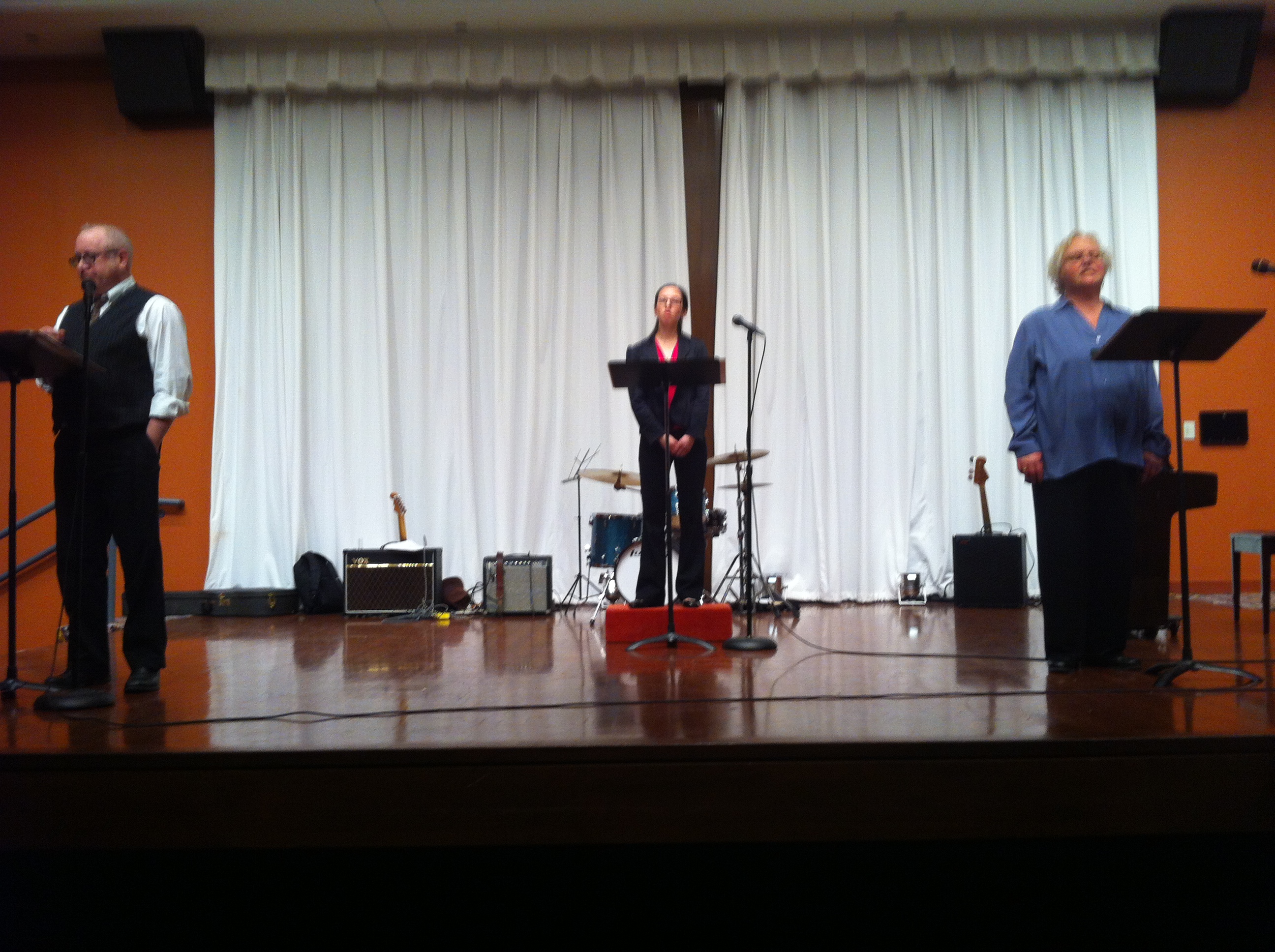
We then had a brief break: noshing on snacks, and networking with friends, and then we were treated to live theater, and live music. The former was a reading of “Capitalization”, by Marc Norwalk, presented by three members of Cleveland Public Theater;

IMG_1991

the latter music from the New Deal Era by Todd Smith and the New Deal All Stars.

IMG_1992

Enlightenment and entertainment: for what else could one ask? Senator Sherrod Brown? He and his lovely literary wife – thr Progressive Pulitzer winner Connie Schultz – were there as well.    

IMG_1994

We Still Need Higher Revenues to Reduce Our Deficit

From: American Progress

By Michael Linden and John Craig

“Though conservatives like to point to the “historical average” level of tax revenue as support for their position that further deficit reduction should not include more revenue, the historical data actually prove just the opposite. If we want to reduce our budget deficit, we will need higher revenues than are currently projected.

As Congress and the White House contemplate possible approaches to deficit reduction that would replace the $1.2 trillion sequester that is set to begin in March, the arguments over revenue and spending levels have intensified. Most conservatives in Congress insist that any plan to replace the sequester must be paid for entirely by cutting spending—not by bringing in new revenue. Their position rests on the contention that, “This isn’t a tax problem. It is a spending problem.” And as proof, they often point out that revenues are already projected to rise above the historical average over the next 10 years.

They’re not wrong—at least not about the historical average. Federal receipts, as a percentage of gross domestic product, or GDP, have averaged 17.9 percent over the last 40 years. The Congressional Budget Office projects that—with the fiscal cliff deal in place and assuming that a variety of “temporary” tax breaks will be extended yet again—federal revenues will average 18.5 percent of GDP over the next 10 years. 18.5 percent is certainly bigger than 17.9 percent, so some conservatives say that this proves that we don’t need more revenue.

But what they’re missing is that 17.9 percent of GDP hasn’t been enough revenue for the last 40 years—and it certainly won’t be enough for the next 40 years. Remember, the federal budget was in the red for nearly every one of these last 40 years—and often deeply so. And the deficits were bigger when revenue was lower, smaller when revenue was higher—a fact that should surprise no one.

Take, for example, the last four years. From 2009 to 2012 federal receipts averaged just 15.4 percent of GDP—lower than at any point since 1950. Not surprisingly, record-low revenues translated into record-high deficits.

This basic relationship holds true over the past four decades. In the 40 years since 1973, 11 years saw deficits greater than 4 percent of GDP. In those same 11 years, revenues averaged 16.7 percent of GDP—well below the much-vaunted historical average. Similarly, there were 12 years in which the deficit was smaller than 2 percent of GDP. And in those years, revenue averaged 18.9 percent of GDP—much higher than the average. And, of course, in the four years in which we actually balanced the budget, revenue averaged 20 percent of GDP. (see Figure 1)

But full budget balance isn’t necessarily what we’re aiming for right now, so perhaps revenues don’t need to be increased all the way up to 20 percent of GDP. Indeed, President Obama has called for just enough deficit reduction to prevent the national debt, measured as a share of GDP, from rising. Others have called for somewhat more deficit reduction. Those goals will require deficits in the range of 2.5 percent of GDP or lower. And in the years since 1973—when the deficit was less than or equal to 2.5 percent of GDP—the federal government collected 18.8 percent of GDP on average in revenue.

While the difference between 18.8 percent and the current projection of 18.5 percent may not appear to be substantial, that 0.3 percent increase over the next 10 years equates to about $640 billion in additional revenue. To put that in perspective, the president’s call to replace the sequester half with revenues and half with spending cuts would equate to about $500 billion in new revenue. That would still leave us short of the “historical average” for years with low deficits.

And let’s not forget that what was sufficient in the past may not be sufficient in the future—a point which the historical data itself proves. In the years between 1953 and 1983 in which the deficit was smaller than 2 percent of GDP, revenues averaged 17.9 percent of GDP. But during the following three decades, in the years in which the deficit was smaller than 2 percent of GDP, revenues averaged a much-higher 19.1 percent. Our needs grew over time as our demographic, economic, and security challenges changed, so revenues that were sufficient in one generation became insufficient in the next. (see Figure 2)

This is especially true right now. The anticipated demographic shift as a result of the “baby boom” generation retiring means that there will be a larger proportion of the population relying on Social Security and Medicare in the coming years. Even with significant changes to these programs, this will mean higher costs to the federal government. If we want smaller budget deficits in the future, revenues must be higher than they have been in the past.

Yes, revenues are currently projected to rise above the historical average—but this misleading factoid proves little. Rather than showing why we don’t need more revenue, the historical data actually show clearly why we do. When deficits were small in past years, revenues were higher—higher than the historical average and higher than the current projections. Not only that, but the average revenue in low-deficit years has increased over time.

The lesson is clear and simple: If we want to reduce the deficit, we’re going to need more revenue.

Michael Linden is the Director for Tax and Budget Policy at the Center for American Progress. John Craig is a Research Assistant in the Economic Policy department at the Center.

Emphasis Mine

see:http://www.americanprogress.org/issues/budget/news/2013/02/20/53961/we-still-need-higher-revenues-to-reduce-our-deficit/


Pope Benedict To Be Given Global Immunity From Catholic Church Sex Crime Prosecution

From: the freethought express

By: Dorian Staten

Pope Benedict turned a blind eye to Catholic priests molesting boys, then avoided charges due to diplomatic immunity, and will have police protection and continued immunity after he steps down as Pope. That’s one helluva lot more protection than the victims he ignored ever received.

From Reuters:

  • “His continued presence in the Vatican is necessary, otherwise he might be defenseless. He wouldn’t have his immunity, his prerogatives, his security, if he is anywhere else,” said one Vatican official, speaking on condition of anonymity.

Defenseless? Like the young boys who were raped by priests? Go on…

  • “It is absolutely necessary” that he stays in the Vatican, said the source, adding that Benedict should have a “dignified existence” in his remaining years.

Ah, yes. A ‘dignified existence.’ Just like all the victims of Catholic priest molestation who hanged themselves. Please, tell me more.

  • The final key consideration is the pope’s potential exposure to legal claims over the Catholic Church‘s sexual abuse scandals.

Oh those pesky sexual abuse lawsuits. Who wants to have to deal with all that nonsense? Certainly not the high and mighty ex-Pope.

While the victims the Pope turned a blind eye to try to put the pieces of their lives back together, the Pope will be living high off the hog with protection and diplomatic immunity. It’s one old, pious, delusional man’s middle finger to every one of the Catholic Church’s sexual assault victims.

Emphasis Mine

See:http://dastaten.com/Thread-Pope-Benedict-To-Be-Given-Global-Immunity-From-Catholic-Church-Sex-Crime-Prosecution#.USAy3X3sMdC


How the State of the Union Worked

From: HuffPost

By: George Lakoff

N.B.: Prof Lakoff is the master of the message, friend of the frame, and not easily pleased: he was.

“Political journalists have a job to do — to examine the SOTU’s long list of proposals. They are doing that job, many are doing it well, and I’ll leave it to them. Instead, I want to discuss what in the long run is a deeper question: How did the SOTU help to change public discourse? What is the change? And technically, how did it work?

The address was coherent. There was a single frame that fit together all the different ideas, from economics to the environment to education to gun safety to voting rights. The big change in public discourse was the establishment of that underlying frame, a frame that will, over the long haul, accommodate many more specific proposals.

Briefly, the speech worked via frame evocation. Not statement, evocation — the unconscious and automatic activation in the brains of listeners of a morally-based progressive frame that made sense of what the president said.

When a frame is repeatedly activated, it is strengthened. Obama‘s progressive frame was strengthened not only in die-hard progressives, but also in partial progressives, those who are progressive on some issues and conservative on others — the so-called moderates, swing voters, independents, and centrists. As a result, 77 percent of listeners approved of the speech, 53 percent strongly positive and 24 percent somewhat positive, with only 22 percent negative. When that deep progressive frame is understood and accepted by a 77 percent margin, the president has begun to move America toward a progressive moral vision.

If progressives are going to maintain and build on the president’s change in public discourse so far, we need to understand just what that change has been and how he accomplished it.

It hasn’t happened all at once.

In 2008, candidate Obama made overt statements. He spoke overtly about empathy and the responsibility to act on it as the basis of democracy. He spoke about the need for an “ethic of excellence.” He spoke about the role of government to protect and empower everyone equally.

After using the word “empathy” in the Sotomayor nomination, he dropped it when conservatives confused it with sympathy and unfairness. But the idea didn’t disappear.

By the 2013 Inaugural Address, he directly quoted the Declaration and Lincoln, overtly linking patriotism and the essence of democracy to empathy, to Americans caring for one another and taking responsibility for one another as well as themselves. He spoke overtly about how private success depends on public provisions. He carried out these themes with examples. And he had pretty much stopped making the mistake of using conservative language, even to negate it. The change in public discourse became palpable.

The 2013 SOTU followed this evolution a crucial step further. Instead of stating the frames overly, he took them for granted and the nation understood. Public discourse had shifted; brains had changed. So much so that John Boehner looked shamed as he slumped, sulking in his chair, as if trying to disappear. Changed so much that Marco Rubio‘s response was stale and defensive: the old language wasn’t working and Rubio kept talking in rising tones indicating uncertainty.

Here is how Obama got to 77 percent approval as an unapologetic progressive.

The president set his theme powerfully in the first few sentences — in about 30 seconds.

Fifty-one years ago, John F. Kennedy declared to this Chamber that ‘the Constitution makes us not rivals for power but partners for progress…It is my task,’ he said, ‘to report the State of the Union — to improve it is the task of us all.’ Tonight, thanks to the grit and determination of the American people, there is much progress to report. …

First, Obama recalled Kennedy — a strong, unapologetic liberal. “Partners” evokes working together, an implicit attack on conservative stonewalling, while “for progress” makes clear his progressive direction. “To improve it is the task of us all” evokes the progressive theme that we’re all in this together with the goal of improving the common good. “The grit and determination of the American people” again says we work together, while incorporating the “grit and determination” stereotype of Americans pulling themselves up by their bootstraps — overcoming a “grinding war” and “grueling recession.” He specifically and wisely did not pin the war and recession on the Bush era Republicans, as he reasonably could have. That would have divided Democrats from Republicans. Instead, he treated war and recession as if they were forces of nature that all Americans joined together to overcome. Then he moved on seamlessly to the “millions of Americans whose hard work and dedication have not yet been rewarded,” which makes rewarding that work and determination “the task of us all.”

This turn in discourse started working last year. Empathy and social responsibility as central American values reappeared in spades in the 2012 campaign right after Mitt Romney made his 47 percent gaff, that 47 percent of Americans were not succeeding because they were not talking personal responsibility for their lives. This allowed Obama to reframe people out of work, sick, injured, or retired as hard working and responsible and very much part of the American ideal, evoking empathy for them from most other Americans. It allowed him to meld the hard working and struggling Americans with the hard working and just getting by Americans into a progressive stereotype of hard working Americans in general who need help to overcome external forces holding them back. It is a patriotic stereotype that joins economic opportunity with equality, freedom and civil rights: “if you work hard and meet your responsibilities, you can get ahead, no matter where you come from, what you look like, or who you love.”

It is an all-American vision:

It is our unfinished task to make sure that this government works on behalf of the many, and not just the few; that it encourages free enterprise, rewards individual initiative, and opens the doors of opportunity to every child across this great nation.

“Our unfinished task” refers to citizens — us — as ruling the government, not the reverse. “We” are making the government do what is right. To work “on behalf of the many, and not just the few.” And he takes from the progressive vision the heart of the conservative message. “We” require the government to encourage free enterprise, reward individual initiative, and provide opportunity for all. It is the reverse of the conservative view of the government ruling us. In a progressive democracy, the government is the instrument of the people, not the reverse.

In barely a minute, he provided a patriotic American progressive vision that seamlessly adapts the heart of the conservative message. Within this framework comes the list of policies, each presented with empathy for ideal Americans. In each case, we, the citizens who care about our fellow citizens, must make our imperfect government do the best it can for fellow Americans who do meet, or can with help meet, the American ideal.

With this setting of the frame, each item on the list of policies fits right in. We, the citizens, use the government to protect us and maximally enable us all to make use of individual initiative and free enterprise.

The fact that the policy list was both understood and approved of by 77 percent of those watching means that one-third of those who did not vote for the president have assimilated his American progressive moral vision.

The president’s list of economic policies was criticized by some as a lull — a dull, low energy section of the speech. But the list had a vital communicative function beyond the policies themselves. Each item on the list evoked, and thereby strengthened in the brains of most listeners, the all-American progressive vision of the first section of the speech. Besides, if you’re going to build to a smash finish, you have to build from a lull.

And it was a smash finish! Highlighting his gun safety legislation by introducing one after another of the people whose lives were shattered by well-reported gun violence. With each introduction came the reframe “They deserve a vote” over and over and over. He was chiding the Republicans not just for being against the gun safety legislation, but for being unwilling to even state their opposition in public, which a vote would require. The president is all too aware that, even in Republican districts, there is great support for gun safety reform, support that threatens conservative representatives. “They deserve a vote” is a call for moral accounting from conservative legislators. It is a call for empathy for the victims in a political form, a form that would reveal the heartlessness, the lack of Republican empathy for the victims. “They deserve a vote” shamed the Republicans in the House. As victim after victim stood up while the Republicans sat slumped and close-mouthed in their seats, shame fell on the Republicans.

And then it got worse for Republicans. Saving the most important for last — voting reform — President Obama introduced Desiline Victor, a 102-year spunky African American Florida woman who was told she would have to wait six hours to vote. She hung in there, exhausted but not defeated, for many hours and eventually voted. The room burst into raucous applause, putting to shame the Republicans who are adopting practices and passing laws to discourage voting by minority groups.

And with the applause still ringing, he introduced police officer Brian Murphy who held off armed attackers at the Sikh Temple in Minneapolis, taking twelve bullets and lying in a puddle of his blood while still protecting the Sikhs. When asked how he did it, he replied, “That’s just how we’re made.”

That gave the president a finale to end where he began.

We may do different jobs, and wear different uniforms, and hold different views than the person beside us. But as Americans, we all share the same proud title: We are citizens. It’s a word that doesn’t just describe our nationality or legal status. It describes the way we’re made. It describes what we believe. It captures the enduring idea that this country only works when we accept certain obligations to one another and to future generations; that our rights are wrapped up in the rights of others; and that well into our third century as a nation, it remains the task of us all, as citizens of these United States, to be the authors of the next great chapter in our American story.

It was a finale that gave the lie to the conservative story of America, that democracy is an individual matter, that it gives each of us the liberty to seek his own interests and well-being without being responsible for anyone else or anyone else being responsible for him, from which it follows that the government should not be in the job of helping its citizens. Marco Rubio came right after and tried out this conservative anthem that has been so dominant since the Reagan years. It fell flat.

President Obama, in this speech, created what cognitive scientists call a “prototype” — an ideal American defined by a contemporary progressive vision that incorporates a progressive market with individual opportunity and initiative. It envisions an ideal citizenry that is in charge of the government, forcing the president and the Congress to do the right thing.

That is how the president has changed public discourse. He has changed it at the level that counts, the deepest level, the moral level. What can make that change persist? What will allow such an ideal citizenry to come into existence?

The president can’t do it. Congress can’t do it. Only we can as citizens, by adopting the president’s vision, thinking in his moral frames, and speaking out from that vision whenever possible. Speaking out is at the heart of being a citizen, speaking out is political action, and only if an overwhelming number of us speak out, and live out, this American vision, will the president and the Congress be forced to do what is best for all.

By all means, discuss the policies. Praise them when you like them, criticize them when they fall short. Don’t hold back. Talk in public. Write to others. But be sure to make clear the basic principles behind the policies.

And don’t use the language of the other side, even to negate it. Remember that if you say “Don’t Think of an Elephant,” people will think of an elephant.

Structure is important. Start with the general principles, move to policy details, finish with the general principles.”

George Lakoff is Professor of Cognitive Science and Linguistics at the University of California at Berkeley and is the author, with Elisabeth Wehling, of The Little Blue Book.

Emphasis Mine

see: http://www.huffingtonpost.com/george-lakoff/how-the-state-of-the-unio_b_2693810.html

Five Reasons Ayn Rand Would Have Despised Paul Ryan

From: The National Memo

By: Jason Sattler

Paul Ryan may be backing away from his devotion to Ayn Rand, the woman who inspired him to enter politics. But there are some things that the 20th century’s most prominent prophet of selfishness would have probably appreciated about the Republican’s soon-to-be nominee for vice president. (N.B.: not written yesterday).

In fourteen years in Washington D.C., Ryan only passed two bills—one naming a U.S. post office in his hometown, the other giving arrow makers a tax break. This abject uselessness on behalf of the American people is about as close as an elected official can get to “going Galt.” Being a star member of the most unproductive Congress in 65 years might also have impressed the author who saw the only purpose of government as protecting citizens from physical violence.

Rand might also admire Ryan’s desire to eventually zero out nearly every program that helps the poor and his desire to help rich people become richer with massive tax breaks. But there’s much about the Congressman from Wisconsin that she certainly would consider abhorrent. As Rand scholar Jennifer Burns said, “If Mr. Ryan becomes the next vice president, it wouldn’t be her dream come true, but her nightmare.”

Here are five reasons why Ayn Rand would have quickly shrugged off Paul Ryan.

Jack Kemp was a favorite of Ronald Reagan. The ex-football star, Congressman, and 1996 running mate of Bob Dole, Kemp gave Paul Ryan his first job in politics as a speechwriter. A prime requirement of such a job would be the ability to praise the Gipper slavishly and constantly, something Ryan has been doing ever since. Ryan says that Republicans need to offer the kind of “boldness and clarity that Reagan offered in the 1980s.” Rand would disagree. She hated Reagan with a boldness and clarity that few liberals can match. In 1976 she wrote, “I urge you, as emphatically as I can, not to support the candidacy of Ronald Reagan. I urge you not to work for or advocate his nomination, and not to vote for him. My reasons are as follows: Mr. Reagan is not a champion of capitalism, but a conservative in the worst sense of that word—i.e., an advocate of a mixed economy with government controls slanted in favor of business rather than labor.”

A “conservative in the worst sense of that word” may be the single finest phrase she ever wrote.

Paul Ryan is as anti-abortion rights as any modern politician can be. He authored the Protect Life Act, which would deny an abortion even to save the mother’s own life. Rand’s stand on abortion rights was equally firm in the opposite direction. In her book Of Living Death, Rand wrote, “Abortion is a moral right—which should be left to the sole discretion of the woman involved; morally, nothing other than her wish in the matter is to be considered.” The idea that a woman possesses ownership of her own body even after one of her eggs has been fertilized is certainly one concept of freedom that has not been transmitted to those on the right like Ryan, who publicize her philosophy.n his first speech as Mitt Romney’s running mate,

Paul Ryan, a practicing Catholic, said “Our rights come from nature and God, not from government.” He clearly hoped to soothe any doubters on the religious right who might worry that he is too influenced by Rand’s writings. A militant atheist, Rand believed the source of all rights came from simply existing. “The source of man’s rights is not divine law or congressional law, but the law of identity. A is A—and Man is Man,” she wrote. About faith, a fundamental aspect of Catholicism, Rand wrote: “Faith is the worst curse of mankind, as the exact antithesis and enemy of thought.” It isn’t hard to believe that Rand would consider Ryan to be a walking manifestation of that enemy.

Paul Ryan’s great grandfather started a company called Ryan Incorporated Central that has been contracting with the government for over a century. Ryan himself famously used his Social Security survivor’s benefits to pay for his college, which was easy to do considering that his father also left him a substantial share of his estate. And you’re well aware that since he began serving in Congress back in 1999, Paul Ryan has been enjoying government health care. Ayn Rand preached self-reliance and her heroes were always self-made—unlike Ryan and Romney, both of whom enjoyed extraordinary financial stability and connections coming out of college. These luxuries made Ryan insensitive to the troubles faced by typical Americans and the need for a safety net, which Ryan likes to call a “safety hammock.”

Some people are born on third base and think they hit a triple. Ryan is standing on third base wondering why the batboy is being so lazy. Not exactly a heroic stand.

For all her ranting about the limits of government and the need to be independent, Ayn Rand benefited from Medicare. After decades of smoking, she needed surgery for lung cancer. And where did she turn? The evil of collectivism. Her supporters argue that “she paid into [the Medicare system] her entire life. Why shouldn’t she accept the benefits?” I agree. But all the people under 55 who would get a vastly different version of Medicare under Ryan’s plan have paid their dues, too. Lao Tzu said, “Watch your character, for it becomes your destiny.” Whatever Ayn Rand’s beliefs or intentions, her character provided a real testament to the virtues of  government that promotes its citizens’ general welfare.

———————————————————————————————————————————————————–

Emphasis Mine & my comments

see: http://www.nationalmemo.com/five-reasons-ayn-rand-would-have-despised-paul-ryan/


God Wants You to Have an Assault Rifle

From: RSN

By: Zack Beauchamp, ThinkProgress

“Legislation aimed at reducing gun violence is “a limitation on a God-given right of man that has existed throughout the history of civil society,” according to an article published in the leading conservative opinion journal National Review.

The author, David French, interprets the Christian Bible as granting everyone a right to self-defense. He suggests that this, if true, means that God’s will is that people have access to guns, as they are the means for self defense:

In fact, Jesus’s disciples carried swords, and Jesus even said in some contexts the unarmed should arm themselves… What does all this mean? Essentially that gun control represents not merely a limitation on a constitutional right but a limitation on a God-given right of man that has existed throughout the history of civil society. All rights – of course – are subject to some limits (the right of free speech is not unlimited, for example), and there is much room for debate on the extent of those limits, but state action against the right of self-defense is by default a violation of the natural rights of man, and the state’s political judgment about the limitations of that right should be viewed with extreme skepticism and must overcome a heavy burden of justification.

Even if French is right about the Christian view of self-defense (though Jesus did have choice words about “turning the other cheek“), it’s a logical fallacy to say this implies anything about restrictions on access to guns. Saying that people have a right to defend themselves if attacked isn’t the same thing as saying they should have a right to possess any conceivable means of defending themselves – presumably, French is fine with banning grenade launchers. The burden, instead, is on French to prove that universal background checks or limitations on assault weapon ownership somehow prevent people from defending themselves; to prove, in other words, that gun regulation is actually a restriction on the right of self-defense proper rather than a crime-prevention statute.

Moreover, French is wrong about the role of “self-defense” in a democracy. He cites John Locke, enlightenment philosopher and inspiration for the American Revolution, to suggest that gun rights are “fundamental rights of nature.” But as Ari Kohen, a professor of political theory at the University of Nebraska, points out, French radically misinterprets Locke:

But for people to establish a political community, Locke asserts that people must give up to the government their natural right to punish criminal behavior and agree to have the government settle grievances. This is why we have standing laws that are meant to be applied equally by independent officers of the law and by the courts.

Locke, as Kohen says, held that our right to use force was necessarily limited by the creation of legitimate government – that’s why we have police. This means that the government can limit access to certain weapons as means of discharging its responsibility to keep the peace. While the government may not be able to legitimately ban you from say, killing a home invader who’s brandishing a gun, it also can take reasonable steps to prevent criminals from being able to threaten you with arms in the first place without having to overcome a “heavy burden of justification.”

This isn’t the first questionable gun piece published in National Review. After the Newtown shooting, its editors suggested that mass school shootings were the price we pay for the Second Amendment. One of its writers, Charlotte Allen, infamously wrote that the Newtown massacre happened because there were too many female teachers.

Emphasis Mine

see: http://readersupportednews.org/opinion2/436-2nd-amendment-rights/15774-god-wants-you-to-have-an-assault-rifle