Credible Threats Revealed

The Department of Homeland Security said today that it was studying several “credible threats” made to the United States government in a two-hour broadcast Wednesday night from a location believed to be the Reagan Library in Simi Valley, California.

From:borowitzreport.com andy@borowitzreport.com

“September 10, 2011

‘Credible Threats’ Made to US Government

Homeland Security Studying Two-Hour Video from Wednesday Night

WASHINGTON (The Borowitz Report) – The Department of Homeland Security said today that it was studying several “credible threats” made to the United States government in a two-hour broadcast Wednesday night from a location believed to be the Reagan Library in Simi Valley, California.

Homeland Security spokesman Harland Dorinson said that the Department did not want to alarm the American people, “but whenever you have a group of individuals threatening to dismantle the US government piece by piece, it has to be taken seriously.”

In reviewing the two-hour tape, Homeland Security officials said they found threats to some of the most essential functions of the US government, from Social Security to the Federal Reserve.

While stopping short of saying that the speakers were engaged in some sort of jihad, Mr. Dorinson did note that a tone of religious extremism dominated the video.

“One speaker in particular, seemed bent on rolling back the advances of science and plunging America back into the Dark Ages,” he said.

But the most terrifying moment in the tape came when that same speaker received thunderous applause from the audience after threatening to execute people.

“We’re posting pictures of this individual on our website,” Mr. Dorinson said.  “Hopefully he will be captured before he can carry out any of his plans.”

Fact checking the GOP debate of 7.9.11

From The Washington Post

By Glenn Kessler

“…

“It is a monstrous lie. It is a Ponzi scheme to tell our kids that are 25 or 30 years today you’re paying into a program that’s going to be there.”

— Gov. Perry

Perhaps the governor does not know the dictionary definition of a Ponzi scheme. Here’s what Merriam-Webster says: “An investment swindle in which some early investors are paid off with money put up by later ones in order to encourage more and bigger risks.”

This is a frequent mistake politicians make when talking about Social Security. It is not an investment vehicle; it is intended to provide income security as well disability and life insurance. Just more than 60 percent of the 54 million beneficiaries are retired workers; the rest are disabled workers, dependents or survivors.

Social Security is a pay-as-you-go system, which means that payments collected today are immediately used to pay benefits. Until recently, more payments were collected than were needed for benefits. So Social Security loaned the money to the U.S. government, which used it for other things. In exchange, Social Security received interest-bearing Treasury securities. The value of those bonds is now about $2.6 trillion. (We have written about this at length.)

In any case, Perry is wrong to label Social Security a Ponzi scheme. Ponzi schemes ultimately go bust and everyone (except possibly early investors) generally loses their money. Social Security faces a long-term funding issue, but one that most experts say is manageable. After all, the Social Security actuary says that Social Security’s shortfall is 0.7 percent of the gross domestic product over the next 75 years.

“Obamacare is killing jobs. We know that from the nonpartisan Congressional Budget Office.”

— Rep. Michele Bachmann (Minn.)

Bachmann won’t give up on this factoid, even though we debunked it seven months ago and said it was worth three Pinocchios. It’s just not correct, and remains a perfect example of how politicians twist the facts.

The Congressional Budget Office in August 2010 estimated that the new health care law over the next decade would reduce the number of overall workers in the United States by one-half of 1 percent, which translates into 800,000 people. But that’s not the same as saying it would “kill” that many jobs.

In dry economic language, the CBO essentially said that some people who are now in the workforce because they need health insurance would decide to stop working because the health care law guaranteed they would have access to health care. (As an example, think of someone who is 63, a couple of years before retirement, who is still in a job only because he or she is waiting to get on Medicare at age 65.)

These jobs would disappear, not to be replaced, so there is an intellectually defensible argument one could make that this is bad for the economy; others, however, might argue that this is a small price worth paying for universal health care.

But in any case, the CBO did not say the health law was killing jobs.

“We’ve had requested for years at the Health and Human Services agencies to have that type of flexibility, where we could have menus, where we could have co-pays. And the federal government refuses to give us that flexibility.”

— Perry

Perry gives a misleading account of this application for a waiver on Medicaid rules. The George W. Bush administration rejected the application in 2008, saying it was incomplete and riddled with problems. As far as we can tell, the state has not resubmitted the waiver.

“Obamacare took over one-sixth of the American economy… . If we fail to repeal Obamacare in 2012, it will be with us forever and it will be socialized medicine.”

— Bachmann

“In our state, our plan covered 8 percent of the people, the uninsured. His plan has taken over a 100 percent of the people.”

— Romney

It is simply not true, no matter how often candidates say that the Obama health care law represents socialized medicine or took over one-sixth of the economy. Socialized medicine is a single-payer system, in which the government pays the bills and controls costs (much like Medicare.)

Obama’s law was modeled closely on the law passed by Romney when he was governor of Massachusetts — an inconvenient fact that Romney tries hard to run away from. His comparison here is misleading, since both plans try to deal with the problem of the uninsured by requiring an individual mandate.

“For the president of the United States to go to El Paso, Texas, and say that the border is safer than its ever been, either he has some of the poorest intel of a president in the history of this country, or he was an abject liar to the American people. It is not safe on that border.”

— Perry

Perry is referring to a speech that Obama gave May 10, in which he did some boasting that earned the president a Pinocchio. Obama did not put it quite as bluntly as Perry suggests, and calling the president an “abject liar” seems over the top for the politically tinged comments Obama actually made.

“He only went along with the Libyan mission because the United Nations told him to.”

— Former Sen. Rick Santorum (Pa.)

Actually, Santorum has it backwards. The United States requested the U.N. resolution to gain international backing for the NATO-led intervention in the Libyan uprising.

“The idea that we would put Americans’ economy in jeopardy based on scientific theory that’s not settled yet to me is just — is nonsense. I mean, it — I mean, and I told somebody, I said, just because you have a group of scientists that have stood up and said, here is the fact — Galileo got outvoted for a spell.”

— Perry

(N.B.: Galileo?  Never ‘outvoted’ by scientists, only by the Roman Church)

We previously awarded Perry Four Pinocchios for his comments suggesting scientists were increasingly saying climate change was a fiction. We will note he repeatedly did not answer the question at the debate about whether he could name a scientists he thought was credible on the issue.

“As a matter of fact, what he’s done is, he’s said in fact to Israel that they need to shrink back to their indefensible 1967 borders.”

— Bachmann

Obama never said this. The president in May did give a controversial speech, in which he said the de facto border of 1967 should be a starting point for negotiations between the Israelis and Palestinians, with agreed swaps of territory. A few days later, he further clarified his comments to make clear he was not saying the lines should be Israel’s border, to the point that he was thanked by the Israeli prime minister in a speech to Congress.

We’ve given Bachmann Four Pinocchios for making a similar claim in the past.


Emphasis Mine

see:http://www.washingtonpost.com/blogs/fact-checker/post/fact-checking-the-gop-debate-at-the-reagan-library/2011/09/07/gIQAFrz5AK_blog.html?wpisrc=nl_politics

Did ‘we’ Lost the War(s)?

It became politically critical the way Nixon grasped at “Peace with Honor” as fig leaf modesty to cover our withdrawal from Vietnam. To be absolutely plain: Our military has been ineffective, in shocking contrast to initial war expectations. After 9/11 we worshiped our forces as Gods of War, and yet after ten years of heroic effort they could not meet even the most limited of US war goals

From HuffPost, By Michael Vlahos

Official Disclaimer: This is my take, and mine alone.

I thought at least someone would ask the question. This is after all a solemn commemorative occasion. It is perhaps our only real moment for constructive reflection, because this anniversary also effectively marks the end of the war itself.

It is almost as though we collectively decided not to say it, and focus instead on a fitting and proper emotional memorial — never the word, defeat.

But we will learn nothing and gain nothing from ten years of tragedy, waste, and ruin unless we face up to it. And facing up does not mean asking, “Did we win?” Not winning, as the coachman says in The Wizard of Oz, is a horse of a different color. It is for example the correct question to have asked at the end of the Korean War (Answer: No we did not win. But we did not lose either).

So how do we know we lost? The history of war shows us two stainless measures: One is emotional and one is objective. You have lost when you feel you have lost, no matter what you say in public. You have lost when your instruments of war fail to achieve your goals, and instead lead you to a place of strategic vulnerability and disadvantage — when you are in a worse situation coming out of war than going in.

The 9/11 War is a straight-up defeat on both counts. Our nation today is depressed and disheartened and feels itself in steep decline. The US military — the instrument we chose to achieve our goals — not only failed to achieve them: Its very enterprise has led to a world situation of severe vulnerability and disadvantage to the United States.

Emotional defeat is a quick review because it is so visible and clear:

  • We feel weak. We were in budget surplus going into war, and now we are going to top 100 percent GDP debt very soon — and a third of that will be paid to the war. Hence actual unemployment is at 1934 levels, and will hover there very much longer than it ever did after 1934.
  • We feel in decline. We feel China stole a march on us and we will never catch up. How we were startled by a report that China would surpass us by 2016, even though the message was couched in the deceptive measure of purchasing power parity. Yet we still feel like our time has passed.
  • We feel we have nothing to show for 200,000 casualties — which must include the yet uncounted wounded by TBI, PTSD, and toxic dust. They will witness and testify for this war for decades to come.
  • We feel divided as a nation. Republicans believe Democrats are socialist “defeatocrats” and thus traitors to the American idea. Democrats believe Republicans are sweatshop-loving Scrooges whose worldview is closer to medieval Taliban than modern American ideals. The only belief both share is a judgment that national political leadership has failed. Utterly.

Naturally all this is voiced, cacophonously. It is just that the wild surround sound is not connected to the very thing that caused it: The war.

Objective defeat seems like the more difficult argument because it is so hotly denied. But the very denial of objective defeat actually makes it a stronger argument, because denial is in itself powerful evidence for the prosecution.

Evidence falls into three baskets: Did the use of military force achieve our goals? How well has the military adapted to difficulties and shortcomings? What is the military’s concluding assessment?

    • Goals: The US Government has put forward many different war goals at different times and from different sources within Government. Yet the overarching goal announced in strategic initiation and six-year follow-through was twofold: The “transformation of the Middle East” into democratic polities according to US standards, and the extirpation of terrorism and its source, “violent extremism.” Specific benchmark-goals within this strategic framework were the establishment of democratic polities in Iraq and Afghanistan, and the maintenance of “stability and security in the Greater Middle East” (US official policy since 1991).None of these goals has been achieved, and as a consequence of the Arab Spring, stability and security in the Greater Middle East has also been lost. Iraq and Afghanistan are not stable, let alone democratic polities. Violent extremism, as defined by US leadership (i.e., al-Ikhwan), is an increasingly powerful and legitimate force in Muslim politics. Indeed it can be argued that military force in the short term highly encouraged and hardened Islamist “extremism.” In the longer term, because of the ways force was used to seduce occupied societies to adopt US political forms, our “kinetic” military administration encouraged wider popular revolution, even against “stable” tyrants that were America’s most valued “friends and allies in the region.”
    • Adaptation: The US military responded so slowly that its adaptation to military failure came too late to contain the dynamic surge of a changing Arab consciousness inspired by US military action. Moreover US military adaptation was operational rather than strategic — meaning the military chose to try only a different palette of techniques to bring resistance to heel. This approach is called counterinsurgency (COIN). But COIN has been an utter failure in Afghanistan (COIN in Iraq was of the storybook variety). Why? Because COIN believes that a larger community’s actively resistant consciousness can be broken by limited (even soft) techniques. Truth is that committed insurgent communities can be broken only through the slaughter or removal of military-age males and by placing the rest of the community in concentration camps. So far Americans have shown themselves incapable of wholeheartedly embracing such a strategy.Hence the US military adapted too little and too late. They also adopted the wrong approach. Honing our skills in 9-11-style COIN as advertised — the occupation and administration of entire countries — is waste. The American people will be unwilling to risk repeat defeat and debacle for the foreseeable future. But as to practical future courses of action, we can already see chaotic irregular environments awaiting us — whose scale and horror in coming decades will not permit even the thought of another Iraq or Afghanistan.
  • Assessment: I know of no military person, fraternity, or institution willing to utter the forbidden word: Defeat. Instead we are all just moving ahead and leaving a bitter past behind. This is both a terrible strategic mistake and a potential national tragedy in the making. To be absolutely plain: Our military has been ineffective, in shocking contrast to initial war expectations. After 9/11 we worshiped our forces as Gods of War, and yet after ten years of heroic effort they could not meet even the most limited of US war goals. This is not to say that our soldiers did not do their utmost. Furthermore their sacrifice in itself represents a stern civic message to the 99 percent of Americans who stayed home and “went shopping.”But their efforts achieved only marginal results. Even the shining narrative of “The Surge” was in the end just brilliant propaganda. The so-called “Sons of Iraq” came to us and wiped out AQI on their own, while it was the enemy “Mahdi Army” whose winning power-drills ethnically cleansed Baghdad — and now Iraq is his and we are out. Was our military poorly charged and led by Supreme Command (our leaders)? Yes. Were they given a task that we can admit now was unattainable? Yes. Can we see also that war has changed, and that there are conflict environments whose very nature makes submission to us unlikely? Yes. But even a shield-wall of denial cannot avoid what our senses tell us: That in not attaining, they — we — were defeated.

Yet harshest light shows nothing to so many who blithely insist that there were big “wins” coming out of 9/11, and that this is enough. They sanctimoniously aver that we defeated Al Qaeda, like a commonplace truth brooking no argument. Case closed.

This argument about Al Qaeda is reminiscent of Harry Summers telling an NVA colonel: “You know you never defeated us on the battlefield.” To which Col. Tu famously replied, “That may be so. But it is also irrelevant.” Defeating Al Qaeda was simply not the US main war goal after Tora Bora — instead it became critical only recently. It became politically critical the way Nixon grasped at “Peace with Honor” as fig leaf modesty to cover our withdrawal from Vietnam.

Defeating “Al Qaeda and Associated Movements” (AQAI) thus becomes like a Vietnam-era changeling — a strategic switcheroo. Yet pretending the dime-store trophy we now hold up is what we were all about these past ten years is also like asking us to throw away the whole decade — and in turn this becomes yet another badge of defeat.

But why bring up Vietnam again? Because right now our defeat in Vietnam should be a lodestar to the American military. Because our military transcended defeat in Vietnam. Because they faced up to an honest defeat, the US military made defeat a utility of virtue. Because of Vietnam our military transformed itself, and emerged as a force so potent it practically brought down the great Soviet Empire on its own.

America’s military services must find their utility of virtue in the 9/11 War. Our officers, our enlisted men and women need to answer questions like:

What are the limits of military effectiveness in the world today? How can the military be effective in the chaotic irregular environments of the human future? How can the military help national leaders understand changing limits and possibilities to military use? How can our military reinforce, rather than weaken, America’s world relationships and the nation itself?

Embracing defeat is an unsung virtue — but right now such virtue is necessity.”

Emphasis Mine.

see:http://www.huffingtonpost.com/michael-vlahos/post_2358_b_952745.html

The Definitive Guide to Racism, Sexism, and Homophobia in the 2012 Republican Primaries (So Far)

The Republican field for 2012 is pretty competitive–when it comes to regressive statements and bigotry, that is.

From AlterNet, by Sally Kohn

“There is a reflecting pool between the Washington Monument and the Lincoln Memorial in our nation’s capital. Stretched out between the memories of two presidents, the water reminds us that politics are merely a reflection of American society, for better or worse. The best of our society was on display 48 years ago when hundreds of thousands of Americans stood in scenic unity along the reflecting pool in support of civil rights. Today, the 2012 presidential elections reflect a nation still plagued by bias and inequality. Troubled and ugly waters indeed.

The following is a guide to use when you consider casting a vote for one of the 2012 Republican presidential candidates. You may be among the Americans who have lost faith in Obama or the Democratic Party and pondering a step to the right. Faulty as the Democrats may be, read this guide and remember that liberals still believe abolishing slavery was a good idea and that women should not be confined to the kitchen—which is not something you can say about all of the Republican contenders.

Rick Santorum, Former Senator from Pennsylvania

In 2003, then-Sen. Santorum conflated being gay with bigamy, incest and having sex with farm animals, then said, “That’s not to pick on homosexuality.” Really?

Later, Sen. Santorum actually copped to his prejudices, but spun them as a positive trait. “You can say I’m a hater, but I would argue I’m a lover,” Santorum said. “I’m a lover of traditional families and of the right of children to have a mother and father…. I would argue that the future of America hangs in the balance.” Sounds like a hater to me.

In 2008, Santorum tried to manufacture liberal angst about then-candidate Barack Obama, saying Democrats feared Obama “may go to Indonesia and bow to more Muslims.” That’s not to pick on Muslims, right? Still, the one thing I can say about Santorum is at least he’s openly and consistently bigoted. There’s something oddly old fashioned about that.

Michele Bachmann, Representative from Minnesota

Bachmann signed the infamous “black kids were better off under slavery” pledge and ushered in a real high point in the campaign season as pundits struggled in-artfully to talk about the nation’s ugly racial history. Then Bachmann demeaned President Obama’s economic policies by alleging he’s tying the U.S. economy to Zimbabwe.

But Bachmann is not all rhetoric—she takes it to the streets. In 2006, then State Sen. Bachmann hid behind a bush to spy on a gay rights rally, crouching with her husband Marcus who runs a cure-away-the-gay reparative therapy organization of which she is “extremely proud.”

Speaking of her husband, Bachmann’s gender does not make her a feminist. She once told wives “to be submissive to your husbands” like she was when Marcus told her to go to grad school and run for Congress. “I was going to be faithful to what I felt God was calling me to do through my husband,” Bachmann said.

Herman Cain, Former CEO of Godfather’s Pizza

I hate to suggest that an otherwise ridiculously under-qualified black conservative is only a contender for the Republican nod because mildly self-aware conservative voters think they can cover up their profound racial resentment toward the current black president by endorsing Cain. So I won’t suggest it.

Rick Perry, Governor of Texas

Gov. Perry has some extreme beliefs. “Social Security is a Ponzi scheme,” and “Medicare needs to be changed or potentially abolished” are two that have gotten lots of attention since he joined the race. But it’s his constant embrace of “states’ rights” that has me most worried, given that “state’s rights” was a pro-segregation refrain when white southerners wanted to preserve the right to own slaves. And taking “state’s rights” to a whole new creepy level, Perry has actually endorsed the idea of Texas seceding to become a separate nation. Maybe the Confederate flag can be re-appropriated?

There’s more. Activists and bloggers are now digging into Perry’s relationship with David Barton, a pseudo-historian and close ally of Glenn Beck who has argued that the California wildfires and Hurricane Katrina were “God’s punishment for tolerating gays.” Barton also argued that Martin Luther King, Jr., doesn’t deserve credit for civil rights because “only majorities can expand political rights“—in other words, Barton thinks white people in power should get all the credit. If Obama got flack for his ties to Jeremiah Wright, Perry should be scrutinized for his embrace of Barton and his extremism.

Ron Paul, Representative from Texas

The libertarian member of Congress has said plainly that he would have voted against the 1964 Civil Rights Act. And a newsletter Paul published in 1992 says the Los Angeles riots only stopped when blacks went to “pick up their welfare checks.” Another Paul newsletter alleged that black children “are trained to hate whites, to believe that white oppression is responsible for all black ills, to ‘fight the power,’ to steal and loot as much money from the white enemy as possible.” Paul has denied authoring these newsletters, though they were published by him and called “The Ron Paul Political Report.” Perhaps for Paul—or whoever he let write under his name—libertarianism means government shouldn’t stop people like him from being racist.

Mitt Romney, Former Governor of Massachusetts

In April of this year, Romney said conservatives have to hang something called the Obama Misery Index “around [the President’s] neck.” In the same speech, Romney tried to step it back, saying “We’re going to hang him—uh, so to speak, metaphorically—with, uh, with, uh—you have to be careful these days, I’ve learned that.” It was either an idiotic choice of metaphors or a revealing slip of the noose—I mean tongue. In the past, Romney has used the racial epithet “tar baby” to demean government programs.

And if Obama has Jeremiah Wright and Rick Perry has David Barton, some wonder whether Romney should have to answer for the racist history of the Mormon Church, which until 1978 did not allow blacks to become priests or lead certain ordinances. In 1963, Joseph Smith, the founder of Mormonism, was quoted in Life Magazine defending his religion’s racism, saying, “Darkies are wonderful people.”

Meanwhile, Mitt Romney was for marriage equality before he was against it. Now, to prove his homophobic bona fides, he’s signed an anti-gay marriage pledge by the National Organization for Marriage. Santorum and Bachmann have also signed.

Jon Huntsman, Former Governor of Utah and Ambassador to China

Last but not least, there’s Jon Huntsman. But the fact is he is far too knowledgeable, experienced and, above all, reasonable to have a shot at winning with the increasingly fringe Republican base. Huntsman has far too few overt or even veiled racist, sexist or homophobic rants under his belt to gain popularity with today’s influential right wing voters.

Oh, and I’ve skipped Newt Gingrich, because he’s a joke even to Republicans.

+++

Whether it’s a reflection of actual values or of the values that GOP candidates feel they must project, all the people above oppose abortion rights. All except Ron Paul favor amending the United States Constitution to prevent two men from getting married. All have engaged in feverish anti-immigrant rhetoric and complained that the Obama administration, which has deported more Americans than the Republican president before him, isn’t doing enough to persecute immigrants.

Republican voters say that jobs are their number one concern. Do they think aborted fetuses and gay couples are stealing their jobs along with blacks and immigrants? How else can we explain such persistent pandering to manufactured culture wars, even in the midst of very real and ominous economic disaster that is affecting all of us?

A friend told me that the reflecting pool on the Mall rippled during last week’s earthquake. Unlike Michele Bachmann, I don’t think it was a message from ananti-government God, but I do think the symbolism is stunning in the context of these candidates—all of whom have a shot at becoming the next president. The ripples in the reflecting pool were not ripples of hope and change that echoed from 1963 all the way to the election of Barack Obama. Rather, they were ripples of fear emanating from the GOP candidates and targeting our nation’s most vulnerable communities.

The recent earthquake also cracked the Washington Monument. It was as though, already destabilized by centuries of racism and bias, the tremors of politics unearthed the structural cracks. If we brush off hateful views as political theater, we face a deepening of the cracks that threaten to fracture our entire political system and society.

Then again, as Mitt Romney said, one has to be careful with metaphors.”

Sally Kohn, Chief Agitation Officer of the Movement Vision Lab, is a community organizer, writer and political commentator. You can read more about her work at:http://movementvision.org.

emphasis mine

see:http://www.alternet.org/story/152244/the_definitive_guide_to_racism%2C_sexism%2C_and_homophobia_in_the_2012_republican_primaries_%28so_far%29?page=entire

Al Gore On Climate Change Deniers: It’s Crucial To ‘Win The Conversation’

from HuffPost, see link below

“former Vice President Al Gore suggests that people today need to “win the conversation” against skeptics of climate change in the same way people stood up to racist comments during the civil rights movement.

Speaking with Climate Reality Project’s Alex Bogusky, Gore argues that in some places, even the words “climate change” have become politically incorrect.

Bogusky explains that it is often difficult to stand up to climate change deniers, but Gore says, “it is no more difficult than it was for Southerners to talk about the evils of racism.”

Gore agrees that explaining the science beyond climate change may be more difficult than confronting racism, but says the moral component is the same.

In the same interview, Gore takes on comments by Texas Governor and presidential hopeful Rick Perry, who has been an outspoken critic of climate change scientists. Perry recently said he believes there are “a substantial number of scientists who have manipulated data so that they will have dollars rolling in to their projects.”

Gore explains that scientists have previously overturned accepted views, so there’s a “natural respect” for a contrarian impulse in the scientific community. But he argues that comments by Perry and others are totally different. He says, “This is an organized effort to attack the reputation of the scientific community as a whole. To attack their integrity, and to slander them with the lie that they are making up the science in order to make money.”

Gore says members of the scientific community did not enter their profession to make money. Nor did they expect to be regularly defending themselves from political attack.

Out of fear of the public supporting “the scientific reality,” Gore contends that:

Powerful polluters … see it as a useful strategy to try to convince the public that the scientists are liars and that they’re greedy and they’re making stuff up. All in the service of their overarching strategy of creating enough doubt to persuade people that there shouldn’t be any sense of urgency about addressing this crisis.

Not all of the candidates for the Republican presidential nomination are as unconvinced of climate change as Perry, however. Former Utah Governor Jon Huntsman tweeted several weeks ago that he “trust[s] scientists on global warming.”

The Huffington Post’s Lynne Peeples reported that, according to some scientists, Hurricane Irenemight be part of a growing trend of extreme weather events that are linked to climate change.

Over the past two weeks, hundreds of people have been arrested in front of the White House for protesting the proposed Keystone XL pipeline. According to Tar Sands Action leader Bill McKibben,it is expected to be “the largest collective act of civil disobedience in the history of the climate movement.”

Emphasis Mine

see:http://www.huffingtonpost.com/2011/08/30/gore-climate-change-deniers_n_940802.html

Give Karl Marx a Chance to Save the World Economy: George Magnus

s he wrote in “Das Kapital,” companies’ pursuit of profits and productivity would naturally lead them to need fewer and fewer workers, creating an “industrial reserve army” of the poor and unemployed: “Accumulation of wealth at one pole is, therefore, at the same time accumulation of misery.”

Karl Marx and the World Economy

By George Magnus

Policy makers struggling to understand the barrage of financial panics, protests and other ills afflicting the world would do well to study the works of a long-dead economist: Karl Marx. The sooner they recognize we’re facing a once-in-a-lifetime crisis of capitalism, the better equipped they will be to manage a way out of it.

The spirit of Marx, who is buried in a cemetery close to where I live in north London, has risen from the grave amid the financial crisis and subsequent economic slump. The wily philosopher’s analysis of capitalism had a lot of flaws, but today’s global economy bears some uncanny resemblances to the conditions he foresaw.

Consider, for example, Marx’s prediction of how the inherent conflict between capital and labor would manifest itself. As he wrote in “Das Kapital,” companies’ pursuit of profits and productivity would naturally lead them to need fewer and fewer workers, creating an “industrial reserve army” of the poor and unemployed: “Accumulation of wealth at one pole is, therefore, at the same time accumulation of misery.”

The process he describes is visible throughout the developed world, particularly in the U.S. Companies’ efforts to cut costs and avoid hiring have boosted U.S. corporate profits as a share of total economic output to the highest level in more than six decades, while the unemployment rate stands at 9.1 percent and real wages are stagnant.

U.S. income inequality, meanwhile, is by some measures close to its highest level since the 1920s. Before 2008, the income disparity was obscured by factors such as easy credit, which allowed poor households to enjoy a more affluent lifestyle. Now the problem is coming home to roost.

Over-Production Paradox

Marx also pointed out the paradox of over-production and under-consumption: The more people are relegated to poverty, the less they will be able to consume all the goods and services companies produce. When one company cuts costs to boost earnings, it’s smart, but when they all do, they undermine the income formation and effective demand on which they rely for revenues and profits.

This problem, too, is evident in today’s developed world. We have a substantial capacity to produce, but in the middle- and lower-income cohorts, we find widespread financial insecurity and low consumption rates. The result is visible in the U.S., where new housing construction and automobile sales remain about 75% and 30% below their 2006 peaks, respectively.

As Marx put it in Kapital: “The ultimate reason for all real crises always remains the poverty and restricted consumption of the masses.”

Addressing the Crisis

So how do we address this crisis? To put Marx’s spirit back in the box, policy makers have to place jobs at the top of the economic agenda, and consider other unorthodox measures. The crisis isn’t temporary, and it certainly won’t be cured by the ideological passion for government austerity.

Here are five major planks of a strategy whose time, sadly, has not yet come.

First, we have to sustain aggregate demand and income growth, or else we could fall into a debt trap along with serious social consequences. Governments that don’t face an imminent debt crisis — including the U.S., Germany and the U.K. — must make employment creation the litmus test of policy. In the U.S., the employment-to-population ratio is now as low as in the 1980s. Measures of underemployment almost everywhere are at record highs. Cutting employer payroll taxes and creating fiscal incentives to encourage companies to hire people and invest would do for a start.

Lighten the Burden

Second, to lighten the household debt burden, new steps should allow eligible households to restructure mortgage debt, or swap some debt forgiveness for future payments to lenders out of any home price appreciation.

Third, to improve the functionality of the credit system, well-capitalized and well-structured banks should be allowed some temporary capital adequacy relief to try to get new credit flowing to small companies, especially. Governments and central banks could engage in direct spending on or indirect financing of national investment or infrastructure programs.

Fourth, to ease the sovereign debt burden in the euro zone, European creditors have to extend the lower interest rates and longer payment terms recently proposed for Greece. If jointly guaranteed euro bonds are a bridge too far, Germany has to champion an urgent recapitalization of banks to help absorb inevitable losses through a vastly enlarged European Financial Stability Facility — a sine qua non to solve the bond market crisis at least.

Build Defenses

Fifth, to build defenses against the risk of falling into deflation and stagnation, central banks should look beyond bond- buying programs, and instead target a growth rate of nominal economic output. This would allow a temporary period of moderately higher inflation that could push inflation-adjusted interest rates well below zero and facilitate a lowering of debt burdens.

We can’t know how these proposals might work out, or what their unintended consequences might be. But the policy status quo isn’t acceptable, either. It could turn the U.S. into a more unstable version of Japan, and fracture the euro zone with unknowable political consequences. By 2013, the crisis of Western capitalism could easily spill over to China, but that’s another subject.”

(George Magnus is senior economic adviser at UBS and author of “Uprising: Will Emerging Markets Shape or Shake the World Economy?” The opinions expressed are his own.)

To contact the Bloomberg View editorial board: view@bloomberg.net.

emphasis mine

see:http://www.bloomberg.com/news/2011-08-29/give-marx-a-chance-to-save-the-world-economy-commentary-by-george-magnus.html

We’re Not in Lake Wobegon Anymore

“I don’t want to abolish government. I simply want to reduce it to the size where I can drag it into the bathroom and drown it in the bathtub.” Republicans: The No.1 reason the rest of the world thinks we’re deaf, dumb and dangerous.

Written in 2004.

How did the Party of Lincoln and Liberty transmogrify into the party of Newt Gingrich’s evil spawn and their Etch-A-Sketch president, a dull and rigid man, whose philosophy is a jumble of badly sutured body parts trying to walk?

By GARRISON KEILLOR

Something has gone seriously haywire with the Republican Party. Once, it was the party of pragmatic Main Street businessmen in steel-rimmed spectacles who decried profligacy and waste, were devoted to their communities and supported the sort of prosperity that raises all ships. They were good-hearted people who vanquished the gnarlier elements of their party, the paranoid Roosevelt-haters, the flat Earthers and Prohibitionists, the antipapist antiforeigner element. The genial Eisenhower was their man, a genuine American hero of D-Day, who made it OK for reasonable people to vote Republican. He brought the Korean War to a stalemate, produced the Interstate Highway System, declined to rescue the French colonial army in Vietnam, and gave us a period of peace and prosperity, in which (oddly) American arts and letters flourished and higher education burgeoned—and there was a degree of plain decency in the country. Fifties Republicans were giants compared to today’s. Richard Nixon was the last Republican leader to feel a Christian obligation toward the poor.

In the years between Nixon and Newt Gingrich, the party migrated southward down the Twisting Trail of Rhetoric and sneered at the idea of public service and became the Scourge of Liberalism, the Great Crusade Against the Sixties, the Death Star of Government, a gang of pirates that diverted and fascinated the media by their sheer chutzpah, such as the misty-eyed flag-waving of Ronald Reagan who, while George McGovern flew bombers in World War II, took a pass and made training films in Long Beach. The Nixon moderate vanished like the passenger pigeon, purged by a legion of angry white men who rose to power on pure punk politics. “Bipartisanship is another term of date rape,” says Grover Norquist, the Sid Vicious of the GOP. “I don’t want to abolish government. I simply want to reduce it to the size where I can drag it into the bathroom and drown it in the bathtub.” The boy has Oedipal problems and government is his daddy.

The party of Lincoln and Liberty was transmogrified into the party of hairy-backed swamp developers and corporate shills, faith-based economists, fundamentalist bullies with Bibles, shriekChristians of convenience, freelance racists, misanthropic frat boys, shreiking midgets of AM radio, tax cheats, nihilists in golf pants, brownshirts in pinstripes, sweatshop tycoons, hacks, fakirs, aggressive dorks, Lamborghini libertarians, people who believe Neil Armstrong’s moonwalk was filmed in Roswell, New Mexico, little honkers out to diminish the rest of us, Newt’s evil spawn and their Etch-A-Sketch president, a dull and rigid man suspicious of the free flow of information and of secular institutions, whose philosophy is a jumble of badly sutured body parts trying to walk. Republicans: The No.1 reason the rest of the world thinks we’re deaf, dumb and dangerous.

Rich ironies abound! Lies pop up like toadstools in the forest! Wild swine crowd round the public trough! Outrageous gerrymandering! Pocket lining on a massive scale! Paid lobbyists sit in committee rooms and write legislation to alleviate the suffering of billionaires! Hypocrisies shine like cat turds in the moonlight! O Mark Twain, where art thou at this hour? Arise and behold the Gilded Age reincarnated gaudier than ever, upholding great wealth as the sure sign of Divine Grace.

Here in 2004, George W. Bush is running for reelection on a platform of tragedy—the single greatest failure of national defense in our history, the attacks of 9/11 in which 19 men with box cutters put this nation into a tailspin, a failure the details of which the White House fought to keep secret even as it ran the country into hock up to the hubcaps, thanks to generous tax cuts for the well-fixed, hoping to lead us into a box canyon of debt that will render government impotent, even as we engage in a war against a small country that was undertaken for the president’s personal satisfaction but sold to the American public on the basis of brazen misinformation, a war whose purpose is to distract us from an enormous transfer of wealth taking place in this country, flowing upward, and the deception is working beautifully.

The concentration of wealth and power in the hands of the few is the death knell of democracy. No republic in the history of humanity has survived this. The election of 2004 will say something about what happens to ours. The omens are not good.

Our beloved land has been fogged with fear—fear, the greatest political strategy ever. An ominous silence, distant sirens, a drumbeat of whispered warnings and alarms to keep the public uneasy and silence the opposition. And in a time of vague fear, you can appoint bullet-brained judges, strip the bark off the Constitution, eviscerate federal regulatory agencies, bring public education to a standstill, stupefy the press, lavish gorgeous tax breaks on the rich.

There is a stink drifting through this election year. It isn’t the Florida recount or the Supreme Court decision. No, it’s 9/11 that we keep coming back to. It wasn’t the “end of innocence,” or a turning point in our history, or a cosmic occurrence, it was an event, a lapse of security. And patriotism shouldn’t prevent people from asking hard questions of the man who was purportedly in charge of national security at the time.

Whenever I think of those New Yorkers hurrying along Park Place or getting off the No.1 Broadway local, hustling toward their office on the 90th floor, the morning paper under their arms, I think of that non-reader George W. Bush and how he hopes to exploit those people with a little economic uptick, maybe the capture of Osama, cruise to victory in November and proceed to get some serious nation-changing done in his second term.

This year, as in the past, Republicans will portray us Democrats as embittered academics, desiccated Unitarians, whacked-out hippies and communards, people who talk to telephone poles, the party of the Deadheads. They will wave enormous flags and wow over and over the footage of firemen in the wreckage of the World Trade Center and bodies being carried out and they will lie about their economic policies with astonishing enthusiasm.

The Union is what needs defending this year. Government of Enron and by Halliburton and for the Southern Baptists is not the same as what Lincoln spoke of. This gang of Pithecanthropus Republicanii has humbugged us to death on terrorism and tax cuts for the comfy and school prayer and flag burning and claimed the right to know what books we read and to dump their sewage upstream from the town and clear-cut the forests and gut the IRS and mark up the constitution on behalf of intolerance and promote the corporate takeover of the public airwaves and to hell with anybody who opposes them.

This is a great country, and it wasn’t made so by angry people. We have a sacred duty to bequeath it to our grandchildren in better shape than however we found it. We have a long way to go and we’re not getting any younger.

Dante said that the hottest place in Hell is reserved for those who in time of crisis remain neutral, so I have spoken my piece, and thank you, dear reader. It’s a beautiful world, rain or shine, and there is more to life than winning.

  • Help In These Times publish more articles like this. Donate today!
  • Subscribe today and save 46% off the newsstand price!
Garrison Keillor is the host and writer of A Prairie Home Companion, now in its 34th year on the air and a syndicated newspaper columnist.

Emphasis Mine.

see:http://readersupportednews.org/off-site-opinion-section/72-72/7193-were-not-in-lake-wobegon-anymore

3 Reality-Based Charts Your Right-Wing Relatives Will Have a Hard Time Ignoring

Here are some reality-based charts to help knock down absurd right-wing propaganda about the economy

From AlterNet, by RJ Eskow

Problem: Your right-wing brother-in-law is plugged into the FOX-Limbaugh lie machine, and keeps sending you emails about “Obama spending” and “Obama deficits” and how the “Stimulus” just made things worse.

Solution: Here are three “reality-based” charts to send to him. These charts show what actually happened.

Spending

Bush-Obama Spending Chart

Government spending increased dramatically under Bush. It has not increased much under Obama. Note that this chart does not reflect any spending cuts resulting from deficit-cutting deals.

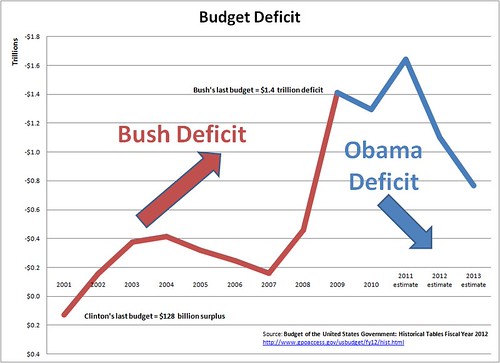
Deficits

Bush-Obama Deficit Chart

Notes, this chart includes Clinton’s last budget year for comparison.

The numbers in these two charts come from Budget of the United States Government: Historical Tables Fiscal Year 2012. They are just the amounts that the government spent and borrowed, period, Anyone can go look then up. People who claim that Obama “tripled the deficit” are either misled or are trying to mislead.

The Stimulus and Jobs

Bush-Obama-Jobs-Chart

In this chart, the RED lines on the left side — the ones that keep doing DOWN — show what happened to jobs under the policies of Bush and the Republicans. We were losing lots and lots of jobs every month, and it was getting worse and worse.The BLUE lines — the ones that just go UP — show what happened to jobs when the stimulus was in effect. We stopped losing jobs and started gaining jobs, and it was getting better and better. The leveling off on the right side of the chart shows what happened as the stimulus started to wind down: job creation leveled off at too low a level.

It looks a lot like the stimulus reversed what was going on before the stimulus.

Conclusion: THE STIMULUS WORKED BUT WAS NOT ENOUGH!

More False Things

These are just three of the false things that everyone “knows.” Some others are (click through): Obama bailed out the banks, businesses will hire if they get tax cuts, health care reform cost $1 trillion, Social Security is a Ponzi Scheme or is “going broke”, government spending “takes money out of the economy.”

Why This Matters

These things really matter. We all want to fix the terrible problems the country has. But it is so important to know just what the problems are before you decide how to fix them. Otherwise the things you do to try to solve those problems might just make them worse. If you get tricked into thinking that Obama has made things worse and that we should go back to what we were doing before Obama — tax cuts for the rich, giving giant corporations and Wall Street everything they want — when those are the things that caused the problems in the first place, then we will be in real trouble.

Emphasis Mine

see:http://www.alternet.org/story/152201/3_reality-based_charts_your_right-wing_relatives_will_have_a_hard_time_ignoring?akid=7484.123424.OxQ7x8&rd=1&t=12

Understand the Right’s Attack on Social Security

The Social Security program is entirely self-funded, separate from the way that the government taxes and spends for other programs.Social Security does not contribute to the deficit in any way.

From Alternet, by: Dave Johnson, Campaign for America’s Future

“You hear over and over that Social Security is “in trouble” or that we “can’t afford it.” This is as far from true as can be, and the idea behind this is to convince people to just give up on defending the program and let the haters have their way. The people who hate Social Security the most are the ones who say they want to make these changes to “save” it.

Well Bernie Sanders loves the program and has introduced a bill that actually will save it.

The Haters

Conservatives have hated Social Security from the start, because it is a program that demonstrates once and for all the value of progressive governance. Social Security is as clear an example of We, the People watching out for and taking care of each other as there ever was. It has made a huge difference n the lives of older people, and their/our families. It works, is cost-effective and requires minimal overhead to keep it going. So they hate it.

A very recent example of conservative hatred for Social Security came from Senator Marco Rubio of Florida, who said, that We, the People helping each other makes us weak,

“These programs actually weakened us as a people. … All of a sudden, for an increasing number of people in our nation, it was no longer necessary to worry about saving for security because that was the government’s job.”

Substitute the words “We, the People” or “each other” for “government” in Rubio’s statement and you’ll get the point: people don’t have to worry so much because we’re taking care of each other. He says that makes us weak. Yikes!

Decades Of Attacks

For decades conservatives who hate Social Security have been using every trick in the book to turn people against the program. Over and over you hear, “It’s a Ponzi scheme.” “It won’t be there for you.” This latest attack is that it “makes us weak.” And of course the old classic: “Social Security is broke.”

The “it’s going broke” and “won’t be there for you” attack strategy goes back to a 1983 Cato Institute Journal document, “Achieving a Leninist Strategy” by Stuart Butler of Cato and Peter Germanis of the Heritage FoundationThe document is still available at Cato, and select quotes are available at Plotting Privatization? from Z Magazine. If you have time it is worth reading the entire document (in particular the section “Weakening the Opposition”) to more fully understand the strategy that has been unfolding in the years since. But if you can’t, the following quotes give you an idea:

“Lenin recognized that fundamental change is contingent upon … its success in isolating and weakening its opponents. … we would do well to draw a few lessons from the Leninist strategy.”

” construct … a coalition that will … reap benefits from the IRA-based private system … but also the banks, insurance companies, and other institutions that will gain from providing such plans to the public.”

“The first element consists of a campaign to achieve small legislative changes that embellish the present IRA system, making it in practice a small-scale private Social Security system.

“The second main element … involves what one might crudely call guerrilla warfare against both the current Social Security system and the coalition that supports it.”

“The banking industry and other business groups that can benefit from expanded IRAs …” “… the strategy must be to propose moving to a private Social Security system in such a way as to … neutralize … the coalition that supports the existing system.”

“The next Social Security crisis may be further away than many people believe. … it could be many years before the conditions are such that a radical reform of Social Security is possible. But then, as Lenin well knew, to be a successful revolutionary, one must also be patient and consistently plan for real reform.”

Here is what to take away from this: Every time you hear that “Social Security is going broke” you are hearing a manufactured propaganda point that is part of a decades-old strategy. Every time you hear that “Social Security is a Ponzi scheme” you are hearing that strategy in operation. Every time you hear that “Social Security won’t be there for me anyway” ” you are witnessing that strategy unfold.

The Problem

The Social Security program is entirely self-funded, separate from the way that the government taxes and spends for other programs. People set aside money in their working years, they get a monthly amount when they retire. (The program also has other benefits including disability benefits, survivors funds and others.) Social Security does not contribute to the deficit in any way.

You never hear that the huge, vast, bloated, enormous, mammoth military budget is “going broke” or “won’t be there for you.” But year after year you hear that Social Security is “in trouble.”

Currently the program has built up a huge trust fund — over $2.5 trillion. This is invested in US Treasury Bonds, and is earning interest. But there are projections that this trust fund will be depleted in approx. 2037, and if this happens the program will have to cut payouts by as much as 25%. (Hey. when does the military budget Trust Fund run down?)

One big reason for this shortfall is that the last time the programs was comprehensively adjusted (1983, Greenspan Commission) certain economic growth and income projections were used to decide how much “payroll tax” to take out of people’s paychecks. They increased the amount taken out of paychecks, and set up an increasing “cap” on the income that would be taxed. Right now 6.2% (temporarily reduced to 4.2%) is taken out of paychecks, and employers kick in another 6.2%, on income up to a “cap” of $106,800. There is no “payroll tax” on amounts above that “cap.”

But something changed between 1983 and nowalmost all the income gains have gone to a few at the very top. Instead of people who mostly were under that “cap” getting raises, thereby increasing the amount they pay into the fund, the raises went to people who already pass that amount, so the increased income is not contributing to the program. So that money that was calculated would go into the Social Security Trust Fund instead went to the top few. As a result the program is no longer bringing in enough money to keep the trust fund fully-funded past 2037.

Sen. Sanders’ Solution

Senator Bernie Sanders is introducing a bill to the Senate to fix this, once and for all. In simple terms, this bill will start taxing income above $250,000 a year to cover this Social Security shortfall. So instead of just “raising the cap” it lets that cap stay, and then takes it off again on income above $250,000. In effect it means there will be a gap between the current top income that is taxed, and $250K.

Get the money from where the money went: So because much of the real Social Security problem is that so much income is now going to just a few at the top, this gets the money to fix the problem from those top-level incomes.

Here is Sanders, talking about his bill:

“When [Social Security] was developed, 50 percent of seniors lived in poverty. Today, poverty among seniors is too high, but that number is ten percent. Social Security has done exactly what it was designed to do!”


Emphasis Mine

see:http://www.truth-out.org/understand-rights-attack-social-security/1314537823

GOP’s Debt Solution: Soak the Poor

A single mother struggling to keep a roof over her child’s head would probably love to trade places with a six-figure earner and bear the burden of paying federal income tax on a comfortable salary.

By Carl Gibson, Reader Supported News

magine a bulky schoolyard bully routinely holding you and your classmates upside-down by your shoes and pocketing the money that falls out, using the amount gained from his extortion to buy a new bike at the end of each semester. Now imagine enduring this process every day, all year, throughout each grade of school.

What if one day, the bully actually complained that you weren’t bringing enough lunch money to school because he wanted a nicer bike? Would you comply and let him rob you of a larger amount, or would you and your fellow classmates surround the teacher and demand the bully return the money he stole?

Despite billionaire Warren Buffett‘s pleas to reduce the deficit by shifting the tax burden to the super-rich, Republican members of Congress have officially come out in favor of raising taxes on the poor, while fiercely protecting trillions in tax handouts for billionairesbig oil and corporate jet owners. Right-wing politicians and corporate-media pundits have now set their sights on “lucky duckies,” or the bottom half of Americans who don’t pay federal income taxes. As law professor Edward Kleinbard noted, this statement is misleading and ignores the need for meaningful reform of our tax code.

Jon Stewart creatively dismantled the poor-people-don’t-pay-taxes argument on The Daily Show, highlighting conservatives who dismissed the $700 billion in revenue gained from ending the Bush tax cuts for the wealthy in 2010. According to Stewart’s calculations, taking exactly half of everything owned by the bottom 50% of Americans would also generate $700 billion, exactly as much revenue as increasing the tax rate for the richest Americans by a modest 3%. Stewart sarcastically suggested Republicans trim the deficit by seizing all assets owned by the bottom half of Americans.

It’s incredibly audacious for the rich to ask the poor to pay more in taxes in order to protect theirbudget-busting tax breaks, especially considering America’s wealth disparity. The gap between the richest and everyone else has grown to levels even greater than on the eve of the crash that triggered the great depression, with the top .001% of Americans now owning 976 times more than the bottom 90%. In 1928, the richest only owned 892 times more than the bottom 90%.

And of course, those accusing the working poor of freeloading ignore the fact that 1 in 4 American jobs don’t even pay poverty wages, or that the federal income tax is inherently designed to avoid hitting the poor, the elderly and working families with children. Such bold accusations also ignore the reality that all of the aforementioned groups still pay roughly one-third of their income in sales, property, payroll and excise taxes.

A single mother struggling to keep a roof over her child’s head would probably love to trade places with a six-figure earner and bear the burden of paying federal income tax on a comfortable salary. But would a six-figure earner be willing to work three part-time minimum wage jobs and still worry about how the rent is going to be paid at the end of the month? Would he really be eager to forgo paying federal income tax if it meant he had to scrape quarters together to buy beans, lentils and ramen noodles for dinner?

Big oil doesn’t need $4 billion per year in taxpayer subsidies – they’re making record profits. Excessive tax cuts for millionaires and billionaires won’t create jobs – the unemployment rate doubledafter ten years of the Bush tax cuts. And corporate jet owners don’t need a tax break while public employees nationwide are losing their jobs to budget cuts.

America needs to surround our teacher before recess and make a strong statement together – the bullies don’t need to rob us of our lunch money to continue their excessive lifestyles. Let’s stop subsidizing wealth for the sake of wealth, and leave struggling middle-class families alone.


Carl Gibson, 24, of Lexington, Kentucky, is a spokesman and organizer for US Uncut, a nonviolent, creative direct-action movement to stop budget cuts by getting corporations to pay their fair share of taxes. He graduated from Morehead State University in 2009 with a B.A. in Journalism before starting the first US Uncut group in Jackson, Mississippi, in February of 2011. Since then, over 20,000 US Uncut activists have carried out more than 300 actions in over 100 cities nationwide. You may contact Carl at carl@rsnorg.org.

Reader Supported News is the Publication of Origin for this work. Permission to republish is freely granted with credit and a link back to Reader Supported News.”

Emphasis Mine

see:http://readersupportednews.org/opinion2/279-82/7202-gops-debt-solution-soak-the-poor