A Generation of Intellectuals Shaped by 2008 Crash Rescues Marx From History’s Dustbin

Source: Tablet

N.B.: About the author: “Goldberg is the author of two books, the first being Kingdom Coming: The Rise of Christian Nationalism (Norton 2006), the second being The Means of Reproduction: Sex, Power, and the Future of the World (Penguin 2009) about “the global battle over women’s rights”.[1] She is a former contributing writer at Salon.com.[2] Her work has been published in the magazines The New RepublicRolling Stone, and Glamour, and in The GuardianThe LA Times, and other newspapers.” – from http://en.wikipedia.org/wiki/Michelle_Goldberg.

Author: Michelle Goldberg

“Eight years ago Jay McInerney, poster boy for a certain kind of glossy 1980s literary chic, anointed Benjamin Kunkel as the voice of a new generation. Writing on the front page of the New York Times Book Review, hehailed Kunkel’s first novel, Indecision, for making “the whole flailing, postadolescent, prelife crisis feel fresh and funny again.” He wasn’t alone; many critics were impressed by Kunkel’s evocation of a privileged young man’s passivity and ennui. They were less sure of what to make of his narrator’s culminating conversion to radical politics in South America. “Explaining socialism to the postironic, ambivalent, hopeful, generous twentysomethings of 2005, I suppose, is what sequels are for,” Michael Agger wrote in Slate.

Next March, Kunkel will release his second book, Utopia or Bust. Though not a sequel to Indecision, it will in fact seek to explain, or at least explore, what socialism means now through a series of essays on contemporary leftist thinkers like Fredric Jameson and David Harvey. After the success of Indecision—a spot on the best-seller list, translations into a dozen languages, a Hollywood option—Kunkel didn’t milk his newfound literary stardom in the manner of, say, Jay McInerney. Instead, after falling into a deep depression, he followed the example of his own narrator, moving to Buenos Aires and immersing himself in anticapitalist political theory. In a draft of the introduction to his new book, he writes, “To the disappointment of friends who would prefer to read my fiction—as well as of my literary agent, who would prefer to sell it—I seem to have become a Marxist public intellectual.”

In a strange way, though, Kunkel hasn’t entirely escaped the zeitgeist business. His new book is emerging at a moment of newly fervent interest in Marx among young writers, activists, and scholars, who have begun, the wake of the financial crisis, to identify capitalism as a problem rather than an inevitability.

It’s too simple to say that Marxism is back, because it never truly went away. In the United States after the fall of the Berlin Wall, though, it was largely confined to university English departments, becoming the stuff of abstruse, inward-looking and jargon-choked cultural critique. Then came the economic crash, Occupy Wall Street, and the ongoing disaster of austerity in Europe. “Around the time of Occupy in particular, a lot of different kinds of lefties, working at mainstream or literary publications, sort of found each other, started talking to each other, and found out who was most interested in class politics,” says Sarah Leonard, the 25-year-old associate editor of Dissent, the social-democratic journal founded almost 60 years ago by Irving Howe. “We have essentially found an old politics that makes sense now.”

In the United States, of course, Marxism remains an intellectual current rather than a mass movement. Certainly, millennials are famously progressive; a much-discussed 2011 Pew pollfound that 49 percent of people between 18 and 29 had a favorable view of socialism, while only 46 percent felt positively about capitalism. It’s hard to say exactly what this means—it’s not as if young people are sending Das Kapital racing up the best-seller lists or reconstituting communist cells. Still, it’s been decades since so many young thinkers have been so engaged in imagining a social order not governed by the imperatives of the market.

The reason why is obvious enough. “Now everything is falling apart,” says Doug Henwood, publisher of the Left Business Observer and mentor to several among the new Marxist thinkers. “Not even the most energetic apologists can say things are going well. The basic premises of American life, about upward mobility and all that, it all seems like a cruel joke now.”

Meanwhile, the end of the Cold War has freed people—especially those too young to remember it—to revisit Marxist ideas without worrying that they’re justifying existing repressive regimes. The Soviet Union always hovered over American intellectual life in the 20th century, especially those sectors of it dominated by Jewish City College graduates like Howe and his ideological counterweight Irving Kristol. There were those who condemned it but held fast to socialist ideals—a position epitomized by Dissent—and those, like Kristol, who came to see such ideals as inescapably entwined with tyranny, becoming neoconservatives. Now that communism is a marginal force in the world, these arguments feel very far away. “I suppose that what’s on our mind is not ’89,” says Leonard. “Our crisis is of a different nature. It’s a capitalist crisis, and we have a useful set of analytic tools.”

***

To cater to the new receptivity to left-wing thought, the radical publishing house Verso—which is co-publishing Kunkel’s new book—recently started issuing a series called Pocket Communism, short, elegantly designed volumes created with addled millennial attention spans in mind. Among them are Alain Badiou’s The Communist Hypothesis and Bruno Bosteel’s The Actuality of Communism. They’re being sold beyond the ordinary outlets—at art galleries, for example. Even when these neo-communists aren’t orthodox Marxists—Badiou is something of a Maoist—Marx necessarily looms large in their work. “People are no longer afraid to go back to the texts themselves and use words that were once taboo,” says Sebastian Budgen, a Verso senior editor. “There’s a mentally emancipatory effect of no longer having to justify using Marx.”

Nowhere is this more true than at Jacobin, the socialist magazine founded by 24-year-old Bhaskar Sunkara, which is co-publishing Utopia or Bust with Verso. A uniquely entrepreneurial Marxist, Sunkara was still an undergraduate when he used part of his student loan to publish the first issue of Jacobin in 2011. He now has about 5,000 subscribers, a small number in the grand scheme of things but an impressive one for a leftist journal, comparable to the reach of Dissent. It’s a readership that is disproportionately young, says Sunkara, and one that’s often new to left-wing publishing. “I think that a lot of our readership aren’t people who are choosing Jacobin over Dissent or The Monthly Review,” he says. “They’re more either disillusioned liberals or young people who weren’t that politicized.”

For its part, Dissent, which is edited by Michael Kazin, has been reinvigorated by young staffers like Leonard. Until recently, it had grown dour, known for its doleful struggle against the irresponsibility of other radicals. In 2002, for example, its former co-editor Michael Walzer criticized the progressive response to 9/11 in an essay titled “Can There Be a Decent Left?” Bemoaning the tendency of left intellectuals to “live in America like internal aliens, refusing to identify with their fellow citizens, regarding any hint of patriotic feeling as politically incorrect,” he seemed to be rehashing an ancient argument between the anti-communist left and the ‘60s counterculture.

These days, though, with the magazine’s four full-time staffers all in their twenties, it feels far livelier and more contemporary—at times, it’s even cheeky. Consider, for example, “Cockblocked by Redistribution,” a piece in the fall issue by Katie J.M. Baker, about the failure of a well-known pickup artist to score in Denmark. As Bakerexplains, Daryush Valizadeh, known as Roosh, is the author of a series of priapic travel guides with names likeBang Ukraine and Bang Brazil. (In the latter, he instructs his acolytes that “poor favela chicks are very easy, but quality is a serious problem.”) In Scandinavia, however, poor Roosh found that things were not very easy at all, prompting him to produce an angry denunciation of that country’s women titled Don’t Bang Denmark. Danish women, Roosh lamented, exhibit a maddening lack of desperation, “because the government will take care of her and her cats, whether she is successful at dating or not.”

Baker—until recently a staff writer at the women’s website Jezebel, part of the Gawker network—analyzed Roosh’s predicament in light of Nancy Holmstrom’s 1984essay “A Marxist Theory of Women’s Nature,” discussing the way material conditions create the vulnerabilities that pickup artists exploit. When the sort of smart, au courant young women who work at Jezebel start casually dropping references to Marxist philosophers, something has shifted in the intellectual environment.

Meanwhile n+1, the journal Kunkel cofounded in 2004, has morphed from a hipster downtown cultural-literary publication feted by The New York Times Magazine to a far more explicitly political one. In the most recent issue, there’s a long essay by Dayna Tortorici arguing for the renewed relevance of the 1970s feminist “Wages for Housework” campaign: “Young people in the West who have spent their formative years in the workforce as freelancers, part-timers, adjuncts, unwaged workers, and interns are beginning to feel … that they’re not compensated for the work that they do. … Under these circumstances, the longstanding critique of the exploitation of mothers, wives, grandmothers is felt with new force, among a much younger and much wider population of women and men, with children and without.”

Naturally, some of those who lived through the first iteration of these arguments—and the subsequent cultural disillusionment with left-wing radicalism—will find all this irritating, if not infuriating. There are, after all, good reasons that Marxist political economy fell out of fashion. And it’s true some of the leftmost communist revivalists are disturbingly blithe about the past; at times one senses a self-satisfied avant-garde delight in making outrageous pronouncements. In The Communist Horizon, part of Verso’s Pocket Communism series, the newly fashionable academic Jodi Dean, a professor of Political Science at Hobart and William Smith Colleges, airily dismisses the “circumscribed imaginary” in which “communism as Stalinism is linked to authoritarianism, prison camps, and the inadmissibility of criticism,” as if such links are a neoliberal fabrication.

In general, though, the young critics who are engaging with Marx are not so glib. Dissentexcoriated The Communist Horizon, and before it was even published, Jacobin took on Dean’s talk of the same name. Sunkara addressed Dean’s contemptuous description of liberals: “[S]he suggests we single out those who ‘think any evocation of communism should come with qualifications, apologies, condemnations of past excess.’ … [W]hat she presents as a good way to identify liberals, is actually a good test of sanity. Here’s a general rule: make no argument in New York that you wouldn’t make in Warsaw.”

These are not, then, apologists for authoritarianism. Rather, they insist that the terrible regimes of the 20th century do not obviate Marx’s essential insights, and that, with the U.S.S.R. gone, it should be possible to apply those insights without a lot of anti-Stalinist throat-clearing.

After all, if the Soviet example casts a pall on Marxism, it’s hardly an advertisement for unbridled capitalism, either. n+1 cofounder Keith Gessen left the Soviet Union as a child, and it was returning there in 1995 at age 20 that pushed him leftward. “I very much went over there as a kind of young liberal who believed that Russia was transitioning, with a lot of problems, to a liberal capitalist state and that was the right way for it to go,” he says. “What I saw there was that property relations were actually based on violence, that the so-called energies of the Russian people that were being liberated after communism were energies to cheat one another and lie to one another and kill one another.”

Back then, one could at least look to the United States to see capitalism triumphant. That, clearly, is no longer the case. After the financial crisis, “you didn’t need to be Karl Marx to see that people were getting kicked out of their homes,” says Gessen. And privileged young people—particularly the kind of who are inclined to read and write essays about political theory—haven’t just been spectators to immiseration. Graduating with student debt loads that make them feel like indentured servants, they’ve had a far harder time than their predecessors finding decent jobs in academia, publishing, or even that old standby law and are thus denied the bourgeois emollients that have helped past generations of college radicals reconcile themselves to the status quo.

If there were a Republican president, they might see hope in electing a Democrat. But Barack Obama already won, and it didn’t help. “If you win something and you are disappointed with the results, in a way that’s more politicizing than just losing and losing and losing over again,” says Sunkara.

So, they’re hungry for a theory that offers a thoroughgoing critique of the system, not just a way to ameliorate its excesses. “[F]or at least a generation now, not only the broad public but many radical themselves have felt uncertain that the left possessed a basic analysis of contemporary capitalism, let alone a program for its replacement,” Kunkel writes in the introduction to Utopia or Bust. Reaching back into the canon, he and others have found, at least, the former.

As for the latter? In the absence of a clear programmatic goal, never mind a party or organization, the new Marxism has a certain weightlessness. No one seems to have even a wisp of an answer to the perennial question: What is to be done? That very openness, though, gives new energy to the work of young thinkers and writers who feel themselves on yet another hinge of history. For intellectuals, this has always been a consolation of crisis: It frees one from the sort of existential lassitude Kunkel described in Indecision, making ideas feel urgent and important.

Kunkel himself is trying to formulate a vision of what might come next in a book he plans to publish after Utopia or Bust. “It’s meant to be a sketch—not a blueprint—of a post-capitalist future,” he told me by Skype from his apartment in Buenos Aires. “What it tries to do is to describe capitalism as something that, as it grew, added one feature after another. And therefore it’s easier to imagine disassembling. If we can picture how it was put together, it’s easier for us to imagine how it might be taken apart.”

This is a significantly more ambitious goal than that of writing another well-received novel. It might seem grandiose, but it also suggests a cultural optimism that’s otherwise in short supply these days. “It was easy to feel in the nineties that everyone knew what was going to happen,” says Kunkel. “Many people thought it already has happened, and now we just wait for McDonalds franchises and liberalized capital markets to spread across the globe.” Now, looking at the Marxist resurgence among young people, he says, “It’s very exciting to me. In a strange way, it also makes me want to live a long time, knock on wood, because I’d like to see what’s going to happen.”

Editor’s note: This story has been updated to reflect that the Bhaskar Sunkara of Jacobinwas writing about Jodi Dean’s talk, “The Communist Horizon,” rather than her book of the same name; and that the journal n+1 was founded in 2004, not 2005.

***

Emphasis Mine

see: http://www.tabletmag.com/jewish-news-and-politics/148162/young-intellectuals-find-marx?utm_source=tabletmagazinelist&utm_campaign=3b37ec765e-10_14_2013&utm_medium=email&utm_term=0_c308bf8edb-3b37ec765e-206691737

The Tea Party Republicans’ Biggest Mistake

Source: Robert Reich’s Blog, via RSN

Author: By Robert Reich

Representative Mo Brooks, Republican of Alabama and a fierce critic of the Affordable Care Act, has just changed his tune. He now says: “My primary focus is on minimizing risk of insolvency and bankruptcy. There are many paths you can take to get there. Socialized medicine is just one of the component parts of our debt and deficits that put us at financial risk.”

Translated: House Republicans are under intense pressure. A new Gallup poll shows the Republican Party now viewed favorably by only 28% of Americans, down from 38% in September. That’s the lowest favorable rating measured for either party since Gallup began asking this question in 1992. The Democratic Party is viewed favorably by 43%, down four percentage points from last month.

So Republicans are desperately looking for a way of getting out of the hole they’ve dug for themselves – and the President has given them one. He told them that if they agree to temporarily fund the government and raise the debt ceiling without holding as ransom the Affordable Care Act or anything else, negotiations can begin on reducing the overall budget deficit.

What’s the lesson here? The radicals who tried to hijack America didn’t understand one very basic thing. While most Americans don’t like big government, Americans revere our system of government. That’s why even though a majority disapprove of the Affordable Care Act, a majority also disapprove of Republican tactics for repealing or delaying it.

Government itself has never been popular in America except during palpable crises such as war or deep depression. The nation was founded in a revolution against an abusive government – that was what the original Tea Party was all about – and that distrust is in our genes. The Constitution reflects it. Which is why it’s hard for government to do anything very easily. (I’ve never been as frustrated as when I was secretary of labor – continuously running into the realities of separation of power, checks and balances, and the endless complications of federal, state, and local levels of authority. But frustration goes with the job.)

No one likes big government. If you’re on the left, you worry about the military-industrial-congressional complex that’s spending zillions of dollars creating new weapons of mass destruction, spying on Americans, and killing innocents abroad. And you don’t like government interfering in your sex life, telling you how and when you can have an abortion, whom you can marry. If you’re on the right, you worry about taxes and regulations stifling innovation, out-of-control bureaucrats infringing on your freedom, and government deficits as far as the eye can see.

So when Tea Party Republicans, bankrolled by a handful of billionaires, began calling the Affordable Care Act a “wholesale takeover of American health care,” many Americans were inclined to believe them. Health care is such a huge and complicated system, affecting us and our families so intimately, that our inherent distrust of government makes us instinctively wary. It’s no accident we’re still the only advanced nation not to have universal health care. FDR decided against adding it to his plan for Social Security because he didn’t want to jeopardize the rest of the program; subsequent presidents never got close, at least until Obama.

The best argument for the Affordable Care Act is that our current healthcare system is so dysfunctional – the most expensive in the world with the least healthy outcomes (highest infant mortality, shortest life spans, worst rates of chronic disease) of any advanced nation – that we had no choice but to try to fix it. Even so, it’s a typical American fix: It’s still based on private health providers and private insurers. All government does is subsidize the poor, require insurers to take in people with pre-existing health problems, and pay for it by requiring everyone to be insured.

The Tea Party Republicans’ mistake was to assume that Americans’ distrust of big government, and, by extension, the Affordable Care Act, would allow them to ride roughshod over the process we have for making laws.

Their double-barreled threat to shut down the government and cause the United States to default on its obligations if the Affordable Care Act isn’t repealed or at least delayed is a direct assault on our system of government: If even unpopular laws can be gutted by a majority in one house of Congress holding the rest of government hostage, there’s no end to it. No law on the books will be safe. (Their retort that Congress holds the “purse strings” and can therefore decide to de-fund what it dislikes is bunk; appropriation bills have to be agreed to by both houses and signed into law by the president, like any other legislation.)

While most of us distrust government, we’re indelibly proud of our system of government. We like to think it’s just about the best system in the world. We don’t much like politicians but we canonize the Founding Fathers, the Framers of the Constitution. And we revere the fading parchment on which the Constitution is written. When we pledge allegiance to the United States we bind ourselves to that system of government. Anyone who seeks to overthrow or undermine that system is deemed a traitor.

And that’s exactly what some Tea Partiers have begun sounding like – traitors to the system, radicals for whom the end they seek justifies whatever means they think necessary to achieve it. As such, they began losing support even among Americans who had bought their view of the Affordable Care Act.

So they’ve had to back down, and soon, hopefully, we can move to the next stage – negotiating over the size of government. That should be stronger ground for the Tea Partiers. But the President, Democrats, and any moderate Republican who dares show his face can still gain ground by framing the question properly: The size of government isn’t the real issue. It’s who government is for. The best way to reduce future budget deficits is to ensure it’s for all of us and not just a privileged few.

That means revenues should be raised from the wealthy, who have never been wealthier – limiting their deductions and tax credits, closing loopholes like “carried interest,” and taxing financial transactions. Spending should be cut by ending corporate welfare – terminating tax subsidies to oil and gas, ballooning payments to agribusiness, sweetheart deals for military contractors, and the “too big to fail” subsidy for Wall Street’s biggest banks. Future health-care costs should be contained by using the government’s bargaining leverage over providers (through Medicare, Medicaid, and the Affordable Care Act) to force a shift from fee-for-service to payments-for-healthy-outcomes. And we should spend more on high-quality education and infrastructure for everyone.

Americans distrust big government, and always will. There’s ample reason – especially given the huge sums now bankrolling politicians, coming from a relative handful of billionaires, big corporations, and Wall Street. But we love our system of government. That’s what must be strengthened.

By using tactics perceived to violate that system, the Tea Partiers have overplayed their hand. If they don’t stop their recklessness, they’ll be out of the game.


Robert B. Reich, Chancellor’s Professor of Public Policy at the University of California at Berkeley, was Secretary of Labor in the Clinton administration. Time Magazine named him one of the ten most effective cabinet secretaries of the last century. He has written thirteen books, including the best sellers “Aftershock” and “The Work of Nations.” His latest is an e-book, “Beyond Outrage.” He is also a founding editor of the American Prospect magazine and chairman of Common Cause.

Emphasis Mine

see:http://readersupportednews.org/opinion2/277-75/19833-focus-the-tea-party-republicans-biggest-mistake


Obamacare’s real danger for the GOP is that it will succeed

Source: Washington Post

Author: Eugene Robinson

” To understand the crisis in Washington, tune out the histrionics and look at the big picture: Republicans are threatening to shut down the federal government — and perhaps even refuse to let the Treasury pay its creditors — in a desperate, last-ditch attempt to keep millions of Americans from getting health insurance.

Seriously. That’s what all the yelling and screaming is about. As my grandmother used to say, it’s hard to know whether to laugh or cry.

The GOP has tried its best to make Obamacare a synonym for bogeyman and convince people that it’s coming in the night to snatch the children. In fact, and I know this comes as a shock to some, Obamacare is not a mythical creature. It is a law, incorporating what were originally Republican ideas, that will make it possible for up to 30 million people now lacking health insurance to obtain it.Officially, the law in question is the Patient Protection and Affordable Care Act. Republicans intended the term “Obamacare” to be mocking, which is perhaps why President Obama started using it with pride.It is, indeed, an achievement of which the nation can be proud. About 48 million individuals in this country lacked health insurance in 2012, according to the Census Bureau, representing about 15 percent of the population. Other industrialized nations provide universal health care — and wonder if this is what we mean when we talk about American exceptionalism.

About 25 percent of people in households with annual incomes below $25,000 are uninsured, compared with just 8 percent in households earning more than $75,000. Do the working poor not deserve to have their chronic medical conditions treated as punishment for not making enough money?

Other rich countries provide truly universal care through single-payer systems of various kinds. Obama chose instead to model the Affordable Care Act after a program implemented on the state level by the Republican governor who became Obama’s opponent in the 2012 presidential election. Yes, before Obamacare there was Romneycare, a private-sector, free-market solution designed to be in accord with the GOP’s most hallowed principles.

But in the years between Mitt Romney’s tenure in Massachusetts and his presidential run, the Republican Party lost its way, or perhaps its mind.

The party shows no serious interest in finding a GOP-friendly way to provide the uninsured with access to health care. Rather, it pursues two goals at any cost: opposing Obama no matter what he does, and making people see Obamacare as a failure.

For the radical far right, making health care more widely available through the existing network of insurers, most of them for-profit companies, is a giant leap toward godless socialism. These extremists hold outsize power in the GOP — enough to make sane Republican officials fear, with some reason, that anything short of massive resistance to Obamacare could lead to a primary challenge and a shortened career.

Some of Obamacare’s provisions are already in force and seem to be having the intended effect. For example, young adults are now allowed to stay on their parents’ health insurancepolicies until age 26. In 2009, 29.8 percent of those 19 through 25 were uninsured; in 2012, 27.2 percent lacked insurance, a modest but significant decline.

Now the central provisions of the Affordable Care Act are set to come into effect — the individual mandate, the insurance exchanges, the guarantee of coverage for those with preexisting conditions. Republicans scream that Obamacare is sure to fail. But what they really fear is that it will succeed.

That’s the reason for all the desperation. Republicans are afraid that Obamacare will not prove to be a bureaucratic nightmare — that Americans, in fact, will find they actually like it. The GOP fears that Obamacare will even be credited with slowing the rise of health-care costs to a more manageable rate. There are signs, in fact, that this “bending of the curve” is already taking place: Medical costs are still rising much faster than inflation but at the slowest rate in decades.

Keeping premiums under control will require persuading lots of young, healthy people to buy insurance — and thus, in effect, subsidize those who are older and sicker. That is why a group called Generation Opportunity, funded by the ultraconservative Koch brothers, plans to tour college campuses with disgusting ads in which a creepy Uncle Sam subjects a young woman to a pelvic examination.

The GOP message: Whatever you do, don’t buy health insurance. It may be — shudder — good for you.”

Read more from Eugene Robinson’s archivefollow him on Twitter or subscribe to his updates on Facebook. You can also join him Tuesdays at 1 p.m. for a live Q&A.

Emphasis Mine

see: http://www.washingtonpost.com/opinions/eugene-robinson-obamacare-the-gop-nightmare/2013/09/23/fd29187a-246a-11e3-b75d-5b7f66349852_story.html?wpisrc=nl_opinions

Here are the 43% of americans who dont pay federal income tax

Source: Business Insider, via  Portside

Author: Mandi Woodruff

N.B.: this article uses the TLA ‘TCP’ where it appears TPC would be correct.

“Of the 43% of households owing no federal income tax this year, about half simply earned too little income to qualify, including many retired workers who live on Social Security. The remaining households likely qualify for breaks via the Earned Income Tax Credit and the Child Tax Credit.
Mandi Woodruff
September 6, 2013

Since 2009, the percentage of Americans who pay no federal income taxes has fallen from 47% to 43%, according to a recent report by the Tax Policy Center. The catalyst for the drop is due to two factors — federal tax cuts that expired after the Great Recession and an improving economy.

These charts from the TCP  break down exactly who the 43% are:

Last year, TPC’s 2009 estimate might have been the nail in the coffin for Mitt Romney‘s ill-fated bid for the Presidency after he criticized the “47%” of Americans who don’t pay federal income taxes at a fundraiser.

Like Romney, a lot of people assumed that these households were getting off tax-free across the board. That wasn’t the case then and it’s certainly not the case now.

“The notoriety of the 47 percent figure has come largely from a misunderstanding—or less charitably, a misrepresentation—of what that number actually means,” writes Robert Williams of the TCP.

Thanks to payroll taxes, it’s nearly impossible to get away completely tax-free today. In fact, “just 14% of households pay neither income nor payroll tax and two-thirds of them are elderly,” according to the TCP. And then there are taxes closer to home to consider. You’d be hard-pressed to find households who don’t get hit with state or local income, sales, and property taxes.

Of the 43% of households owing no federal income tax this year, about half simply earned too little income to qualify, including many retired workers who live on Social Security. The remaining households likely qualify for breaks via the Earned Income Tax Credit and the Child Tax Credit.

This year, the TCP put together a helpful video breaking down the 43%:

Looking ahead, the TCP estimates that the number of workers who pay no federal income taxes will continue to fall, reaching just 33% by the year 2024.”

Mandi Woodruff edits the personal finance vertical for Business Insider. Before joining BI, she covered breaking legal news for Law360.com, was a research editor at Reader’s Digest, and reported on education in her home state of Georgia.

Posted by Portside on September 6, 2013

– See more at: http://portside.org/2013-09-07/here-are-43-americans-who-dont-pay-federal-income-tax#sthash.F4Acp11u.dpuf

Emphasis Mine

See: http://portside.org/2013-09-07/here-are-43-americans-who-dont-pay-federal-income-tax

Ranks of part-time workers still high. Obamacare not to blame, experts say

Source: http://www.cleveland.com

Author: Oliveria Perkins

“Megan Conway’s part-time waitressing job was great for extra money when she was a college student, but now with a degree and $40,000 in student loans, she thought she would have a full-time, professional job by now.

Conway is considered an involuntary part-time worker, or someone who really wants full-time work.

Recessions often give rise to more involuntary part-timers as employers cut back workers’ hours and on hiring of  full-timers. But during recoveries, the ranks of such workers usually drop. However, during this recovery, their numbers have remained stubbornly high, though the unemployment rate has dropped.

“It has definitely made me a little angry,” Conway said of being unable to land a full-time professional job. “I feel that I did everything right. I networked. I even took an unpaid internship to get experience. I am a hard worker.”

At least two issues have pushed the plight of part-timers into the foreground. One is the discussion about whether the  Affordable Care Act, or ACA, also know as Obamacare, is leading to more part-time workers. The act requires employers  to provide health care to many employees averaging at least 30 hours a week. Critics of ACA say employers are only hiring part-timers as well as reducing the hours of an increasing number already on their payrolls  to avoid providing medical insurance.

The second issue has to do with the proliferation of part-time jobs. Three out of four jobs created between December 2012 and July 2013 were part time, according to the federal Current Population Survey. The Labor Department defines part-time as working fewer than 35 hours per week. Some of these part-timers, like Conway, are recent college graduates who have had to resort to working menial jobs. She has been looking to work in the nonprofit sector since graduating in 2009 with a degree in that field. However, Conway is happy to have her job at a chain restaurant. Since she has been there several years, Conway makes more than minimum wage, and she has benefits.

Even more of these involuntary part-timers are those who once held full-time jobs, said Rebecca Glauber, a University of New Hampshire professor who recently published a paper on the topic.

“A lot of people lost their jobs during the recession, and if they were finding jobs, they were only finding part-time jobs,” she said.

Glauber found that the involuntary part-time employment rate more than doubled between 2007 and 2012. For women, it rose from 3.6 percent to 7.8 percent. For men, it went from 2.4 to 5.9 percent.

She found it was the largest five-year increase in involuntary part-time employment since the 1970s.

The share of the employed working part time was about 17 percent in 2007, said Rob Valletta, research advisor at the Federal Reserve Bank of San Francisco, who just co-authored an Economic Letter about the increase in part-time work. By 2009, that figure had increased to nearly 20 percent, and has remained at that level. The recession began in December 2007 and ended in June 2009.

While the share has remained constant, the demographics of these workers have changed. Valletta said they — like Conway — are now more apt to be the “prime” working age group of 25-to-54-year-olds. In the past, part-timers were more likely to come from the smaller pool of 16-to-24-year-olds.

“Many in the pool of prime workers, perhaps are very experienced and can only find part-time work,” he said. “Many have families to support, creating a source of hardship. One can argue that this shift can be obscured because the overall amount of part-time work occurring in the economy has been stable.”

Frederick “Rick” King worked about a decade at the family-owned chain of local music stores where he sold software and keyboards until the business closed about five years ago. He now works part-time at a chain drug store, a position he has held about a year.

“Most of the jobs being generated in this economy aren’t for adults like me with a decent work history,” King said. “I’m almost 50 years old, I don’t want to wait tables. That is for someone in high school or college who can survive on a part-time job.”

Most of the jobs created during the economy have either been higher paying ones, like nursing or other professions requiring specialized degrees or training, or they have been lower-paying jobs, like many in food service and retail that often are part-time.

“There has been a hollowing out of the middle,” Glauber said. “Involuntary part-time employment appears to be strongly correlated with economic vulnerability and hardship.”

Glauber found that in 2012, one in four of these workers lived in poverty; while only one in 20 of full-time workers did.

King said he doesn’t make enough to support his family. They are only making it because his check is combined with that of his 23-year-old son, also a part-time worker and a disability check a younger son receives. He said a disability keeps his wife from working.

King’s hopes rose recently when he applied for a full-time position at his company. The job went to someone else.
Structural or short-term changes?

More than 8.2 million people were considered involuntary part-time workers in July, virtually unchanged from a year earlier, according to the Labor Department. Nearly 2.6 million wanted full-time work, but couldn’t find it. The remaining became part-timers after employers cut back their hours.

The combined trends of the ranks of part-time workers not dwindling, 75 percent of the newly created jobs being part-time and the economy creating relatively few mid-level jobs, have caused many to question whether structural changes are occurring to the labor market. Will part-time work supplant a substantial number of full-time jobs?
“There may be a structural component to elevated part-time employment, but it is still too soon to tell,” Valletta said.
He believes lasting changes are unlikely. Valletta said such high rates of part-time workers have occurred before. In 1983, the share of people working part-time was slightly higher than the most recent peak, which fell back then as the economy improved.

“No one would argue that the labor market is anywhere recovered,” he said of the current recovery. “The elevated level of part-time work is just a reflection of this, and will likely get reversed over the next few years.”

Valletta said part-time employment had dropped among some demographic groups, including married women between 25 and 54, with more than a high school diploma. Less educated workers haven’t seen the same decreases.

Glauber also believes an improved economy is essential to lowering involuntary part-time work. But she said that will only happen for many of these workers if the recovery revs up instead of just creeps along as it has been doing.

The case of adjunct faculty may offer a point to ponder about the proliferation of part-time employment. Long before the recession, colleges and universities began hiring adjuncts in lieu of creating tenure track positions. On many campuses they make up a substantial portion of the teaching staff.

David Wilder, an adjunct art history and art professor, is a committee co-chair in the Ohio Part-time Faculty Association, an advocacy group. Since the recession, college enrollment has increased, but he said that hasn’t led to more permanent opportunities for these part-timers. He said reversing the trend of colleges favoring the creation of more part-time positions, has been difficult to reverse. Having even a chance at tenure has become an elusive goal for these instructors.

“It is said that the longer you spend teaching as an adjunct, the less chances you have of full-time employment,” Wilder said.

“A perverse moral system seems to have been fostered that views with suspicion those who’ve gone a long time without being hired on a full-time basis,” he said. “This is despite the fact that a few decades ago, faculty acquiring tenure was fairly common.”

Obamacare appears to be a factor in adjuncts at some institutions getting fewer hours. In April, the University of Akron decided to limit part-time instructors to eight credit hours per semester to avoid increasing health care costs. Officials said about 400 part-time faculty were typically teaching more than eight credit hours, and providing health care to them would be nearly $4 million.

Is Obamacare leading to more part-timers?

Several experts say what happened at the University of Akron doesn’t appear to be the norm.

Dean Baker, co-director of the Center for Economic and Policy Research in Washington, D.C., analyzed the number of hours people worked for the first half of this year  to determine if employers were cutting workers back to under 30 hours to avoid paying health care.

He and Helene Jorgensen found that the percentage of workers putting in 25 to 29 hours was up, but so were those putting in 30 or more hours. The only drop was in those working 20 hours or fewer.

“There is some rise in the share of workers working 25 to 29 hours,” Baker said. “The reason is not that they are being cut from longer hours. The reason is there is a gain in the 25 to 29 category at the expense of workers working shorter hours.”

Linda Blumberg, a senior fellow in the Health Policy Center at the Urban Institute in Washington, D.C., said it is premature for employers to make decisions now about cutting workers’ hours to avoid penalties, since implementation of that provision of the ACA has been put off until 2015.

“There is a lot of complexity to this law, and there is a lot of misinformation,” she said. “A lot of employers don’t understand what is going on.”

Employers who don’t provide health care for employees working an average of 30 hours per week or more could be subject to a $2,000 fine, but only if certain conditions are met.

For example, the law only applies to employers with at least 50 employees. Companies that don’t now offer coverage to these 30-hour-plus workers are the only ones that might be affected. Blumberg said the “vast majority” of larger companies now offer coverage to at least some of their workers, and many already offer  coverage to many part-timers. For the most part, a company would only incur penalties for not providing coverage to employees between 138 and 400 percent of poverty. And only if at least one of the employees in that income group gets subsidized coverage through the new insurance marketplaces, or exchanges.

Blumberg said the many media reports and blog posts that have focused on Obamacare leading to more part-time work miss a key issue about running a business.

Tiffani Lanier went to Millennia Cos. in Independence believing  that she had only signed on for a temporary assignment helping to reorganize files. Still, she was conscientious.

Cheryl Wszeborowski, the human resources and payroll director at the housing management company, took notice.

“We are a growing company, creating new positions frequently,” she said. “So when I find someone who has a great attitude and who is willing to learn, I will work hard to find a full-time position in our company for them.”

Lanier was permanently hired as an accounting clerk. She wanted full-time work when she took the temporary assignment. Lanier said she is glad she didn’t turn it down.

“Even if it is a part-time or temporary position, there is nothing wrong with trying it,” she said. “If I hadn’t accepted it, I wouldn’t be where I am now.”
Valletta of the San Francisco Fed said high numbers in the part-time pool often point to a skills mismatch between job seekers and available openings.

King, the drug store part-timer, said that after being laid off from the music store he got an Associates degree in graphic arts, but hasn’t been able to get a job in the field because of limited openings. He still holds out hope that he will.

Conway, the part-time waitress, said she still has a passion for nonprofit management. However, after dozens  of interviews and no job, it was time to reconsider her career choice. Conway remembers being upbeat when she got an interview for a part-time volunteer coordinator’s position. She was told 400 people had applied.

She didn’t get the job.

“It was kind of getting ridiculous,” she said of the several jobs for which she was a finalist. “I kept being told: ‘You’re a great candidate,’ but I wasn’t getting hired.”

Conway is now studying to become a registered nurse.
“I know only two people my age who have like amazing jobs — and they are in health care,” she said. “Everybody else is struggling.”

Emphasis Mine

see: http://www.cleveland.com/business/index.ssf/2013/09/ranks_of_part-time_workers_sti.html

The conservative crackup: How the Republican Party lost its mind

Source: Salon.com

Author: Kim Messick

“In a recent article, I argued that the Republican Party has been captured by a faction whose political psychology makes it highly intransigent and uninterested in compromise. That article focused on the roots of this psychology and how it shapes the Tea Party’s view of its place in American politics. It did not pursue the question of exactly how this capture took place — of how a major political party, once a broad coalition of diverse elements, came to be so dependent on a narrow range of strident voices. This is the question I propose to explore below.

In doing so, we should keep in mind three terms from political science (and much political journalism) — “realignment,” “polarization” and “gridlock.” These concepts are often bandied about as if their connections are obvious, even intuitive. Sometimes, indeed, a writer leaves the impression that they are virtually synonymous. I think this is mistaken, and that it keeps us from appreciating just how strange our present political moment really is.

“Realignment,” for instance, refers to a systematic shift in the patterns of electoral support for a political party. The most spectacular recent example of this is the movement of white Southerners from the Democratic to the Republican Party after the passage of major civil rights laws in the mid-1960s. Not coincidentally, this event was critically important for the evolution of today’s Republican Party.

After the Civil War and the collapse of Reconstruction in the 1870s, the identification of white Southerners as Democrats was so stubborn and pervasive as to make the region into the “solid South” – solidly Democratic, that is. Despite this well-known fact, there is reason to suspect that the South’s Democratic alliance was always a bit uneasy. As the Gilded Age gave way to the first decades of the 20th century, the electoral identities of the two major parties began to firm up. Outside the South, the Democrats were the party of the cities, with their polyglot populations and unionized workforces. The Republicans drew most of their support from the rural Midwest and the small towns of the North. The Democrats’ appeal was populist, while Republicans extolled the virtues of an ascendant business class: self-sufficiency, propriety, personal responsibility.

It will be immediately evident that the Republican Party was in many ways a more natural fit for the South, which at the time was largely rural and whose white citizens were overwhelmingly Anglo-Saxon Protestants. The South’s class structure, less fluid than that of the industrial and urban North, would have chimed with the more hierarchical strains of Republican politics, and Southern elites had ample reason to prefer the “small government” preached by Republican doctrine. But the legacy of Lincoln’s Republicanism was hard to overcome, and the first serious stirrings of disillusion with the Democratic Party had to wait until 1948. That year, South Carolina Gov. Strom Thurmond, enraged by President Truman’s support for some early civil rights measures, led a walkout of 35 Southern delegates from the Democratic Convention. Thurmond went on to become the presidential nominee of a Southern splinter group, the States’ Rights Democratic Party (better known as “Dixiecrats”), and won four states in the deep South.

The first Republican successes in the South came in the elections of 1952 and 1956, when Dwight Eisenhower won five and eight states, respectively*. These victories, however, were only marginally related to racial politics; Eisenhower’s stature as Supreme Commander of Allied Forces in World War II had a much larger role, as did his party’s virulent anti-communism. Nixon held only five of these states in 1960.

The real turning point came in 1964. After passage of the Civil Rights Act, Barry Goldwater’s conservative campaign, with its emphasis on limited government and states’ rights, carried five Southern states, four of which had not been won by a Republican in the 20th century. No Democratic presidential candidate has won a majority of Southern states since, with the single exception of former Georgia Gov. Jimmy Carter’s 1976 campaign. The South is now the most reliably Republican region of the country, and supplies the party with most of its Electoral College support.

The South’s realignment explains a lot about our politics. But it doesn’t, in itself, explain one very important fact: why the post-civil rights Republican Party went on to become the monolithically conservative party we have today. We can put this point as a question: Why didn’t the Republican Party end up looking more like the pre-realignment Democrats, with a coalition of Northern moderates and liberals yoked to conservative Southerners? (And the Midwest along for the ride.) In effect, we’re asking how realignment is related to “polarization” — the ideological sorting out that has led to our present party system, in which nearly all moderates and liberals identify as Democrats and nearly all conservatives as Republicans.

It’s important to ask this question for at least two reasons. First, because it highlights the fact that realignment and polarization are analytically distinct concepts — a point often passed over in discussions of this subject. The sudden migration of Southern whites into Republican ranks is obviously connected with polarization; what we need to know is exactly how and why. Which brings us to the second reason. Because the answer we’re led to is so refreshingly old-fashioned and therefore, in today’s intellectual culture, completely counterintuitive: They are connected through the agency of political actors.

Kim Messick lives and writes in North Carolina. He’s working on a novel.


Walmart sues activist for standing up for exploited workers

Source: People’s world

Author: Stewart Acuff

“The world’s largest and most oppressive corporation in the world, Walmart, has sued Gene Lantz, a retired union activist, for standing up for the victims of Walmart, some of the most oppressed workers in the world.

Lantz, the United Food and Commercial WorkersOUR Walmart, and Jobs With Justice have been sued by Walmart for civil trespassing for crossing their parking lots.

We’ve noted in this space before how thin-skinned and controlling the world’s largest global corporations can be. Walmart and others who drive global poverty and the economic race to the bottom can spend huge resources trying to control people in a free society for crossing a parking lot they don’t even own.

I’ve known Gene Lantz for about 20 years through Jobs With Justice. He is a very committed human rights and workers rights activist. His human rights activism goes back to 1967. His workers rights activism goes back to 1984 when he organized fellow workers who had been fired for standing up for a good union contract.

Gene hosts a Saturday morning radio show called Workers Beat at 9 am central on Dallas radio KNON, which is podcast and broadcast on YouTube.

He says that the Walmart lawsuit is part of their “game” to make themselves look like victims – a rich bit of irony since they may have created more economic victims than any other force in the world today. Gene says he doesn’t know if the lawsuit will work.

Walmart is the lowest of the low in corporate exploitation. Their heavy-handed intimidation won’t work on him.

Gene was greeted as a hero by fellow union members, and Jobs With Justice did an action within a week of the filing of the lawsuit.

But the stakes in this fight are high for those who work at Walmart. They fired at least 10 workers the same time they filed suit.

Gene has been making videos of public officials supporting Walmart workers and posting on them YouTube. He believes this may be a key tactic in the long strategy to hold Walmart accountable.”

This article was reposted from Stewart Acuff’s blog.


Emphasis Mine

See: http://www.peoplesworld.org/walmart-sues-activist-for-standing-up-for-exploited-workers/


The 10 most important legal fights on abortion in the U.S.

Source: Wash Post

Author: Juliet Elperin

As court fights have become increasingly critical in shaping the nation’s abortion laws, here’s a look at 10 of the most important cases pending right now in state and federal court.

1. Wisconsin. The American Civil Liberties Union and Planned Parenthood have challenged a law requiring every physician who performs an abortion at a clinic to have staff privileges at a local hospital, arguing that the measure would force two of the state’s four abortion clinics to close.In Wisconsin. A federal judge issued a temporary restraining order against the law, which Gov. Scott Walker (R) signed on July 5; the judge will hold a hearing on the case this week.

2. North Dakota. The state’s Gov. Jack Dalrymple (R) garnered national attention in late March when he signed into law a bill restricting abortions as soon as a heartbeat is detectable, which can be as early as six weeks. But he has also signed off on bills prohibiting abortion based on sex selection and genetic abnormalities, barring non-surgical abortions and requiring hospital admitting privileges for abortion doctors. The Center for Reproductive Rights is challenging all of these bills, some in state court and some in federal court. The fetal heartbeat bill takes effect on Aug. 1, so there is a chance the federal judge overseeing that challenge would issue a preliminary injunction that would prevent it from taking effect in the state.

3. Virginia. NOVA Women’s Healthcare, the state’s busiest abortion clinicjust closed because its operators said it could not afford to comply with new regulationsrequiring costly upgrades in order to meet strict, hospital-like standards. A separate clinic, the Falls Church Healthcare Center, filed an administrative appeal petition in the Arlington Circuit Court in June challenging the new rules imposed by the Virginia State Board of Health. The Commonwealth has responded, so the case is going forward.

4. Arkansas. The ACLU, the Arkansas ACLU and the Center for Reproductive Rights are challenging a law barring abortions starting 12 weeks after fertilization, which was adopted after the Arkansas legislature overrode Democratic Gov. Mike Beebe’s veto of the law. In May the judge overseeing the case temporarily blocked the law, which was set to take effect in July.

5. Kansas. The Center for Reproductive Rights has challenged a sweeping anti-abortion bill. Last month the center got a preliminary injunction blocking two provisions of the measure, ones requiring providers to endorse specific literature on abortion provided to patients and redefining what constitutes a medical emergency for a woman seeking an abortion.

6. Arizona. The ACLU, the NAACP and the National Asian Pacific American Women’s Forum filed suit in May against an Arizona law that bans abortion on the basis of gender and race selection, arguing that it is based on stereotypes about Asian Americans and African Americans.

7. Alabama. The ACLU, the ACLU of Alabama, Planned Parenthood Federation of America and Planned Parenthood Southeast are challenging a law requiring abortion providers to obtain admitting privileges at nearby hospitals. The judge in that case issued a temporary restraining order late last month against the measure, just as a federal judge had blocked a 2012 Mississippi law challenged by the Center for Reproductive Rights that requires any physician performing abortions in the state be a board certified or eligible obstetrician-gynecologist with admitting privileges at an area hospital.

8. TexasPlanned Parenthood President Cecile Richards said Saturday that her group was “evaluating litigation options” regarding the just-passed Texas abortion bill, which would not only bar abortions starting 20 weeks after fertilization but would impose an admitting privileges requirement and other operating requirements for abortion rules. Gov. Rick Perry (R) has pledged to sign the bill, but has not done so yet.

9. Oklahoma. The Center for Reproductive Rights has challenged both a law restricting non-surgical abortions and one requiring an ultrasound before a woman has an abortion. In both cases, the state supreme court has permanently blocked them. The U.S. Supreme Court agreed to consider both cases, though it sent back a few questions to the Oklahoma Supreme Court regarding the suit involving medication abortions.

10. North Carolina. The Center for Reproductive Rights, the ACLU and Planned Parenthood have challenged a 2011 measure requiring abortion providers to show an ultrasound image to a pregnant woman, describe the features of the fetus and offer her a chance to listen to its heartbeat. A federal judge issued a preliminary injunction in the case in October 2011, and the case is still pending. Both the House and Senate in North Carolina have both recently passed more sweeping anti-abortion bills, and the governor has said he would sign the House version of that legislation. If signed, that bill could spark its own legal challenge.

Emphasis Mine

see: http://www.washingtonpost.com/blogs/the-fix/wp/2013/07/15/the-top-10-legal-fights-over-abortion-in-the-u-s/?wpisrc=nl_pmpol

A Forum on Church/State Separation:Listening, Asking, Networking, and Noshing!

An Evening to Remember

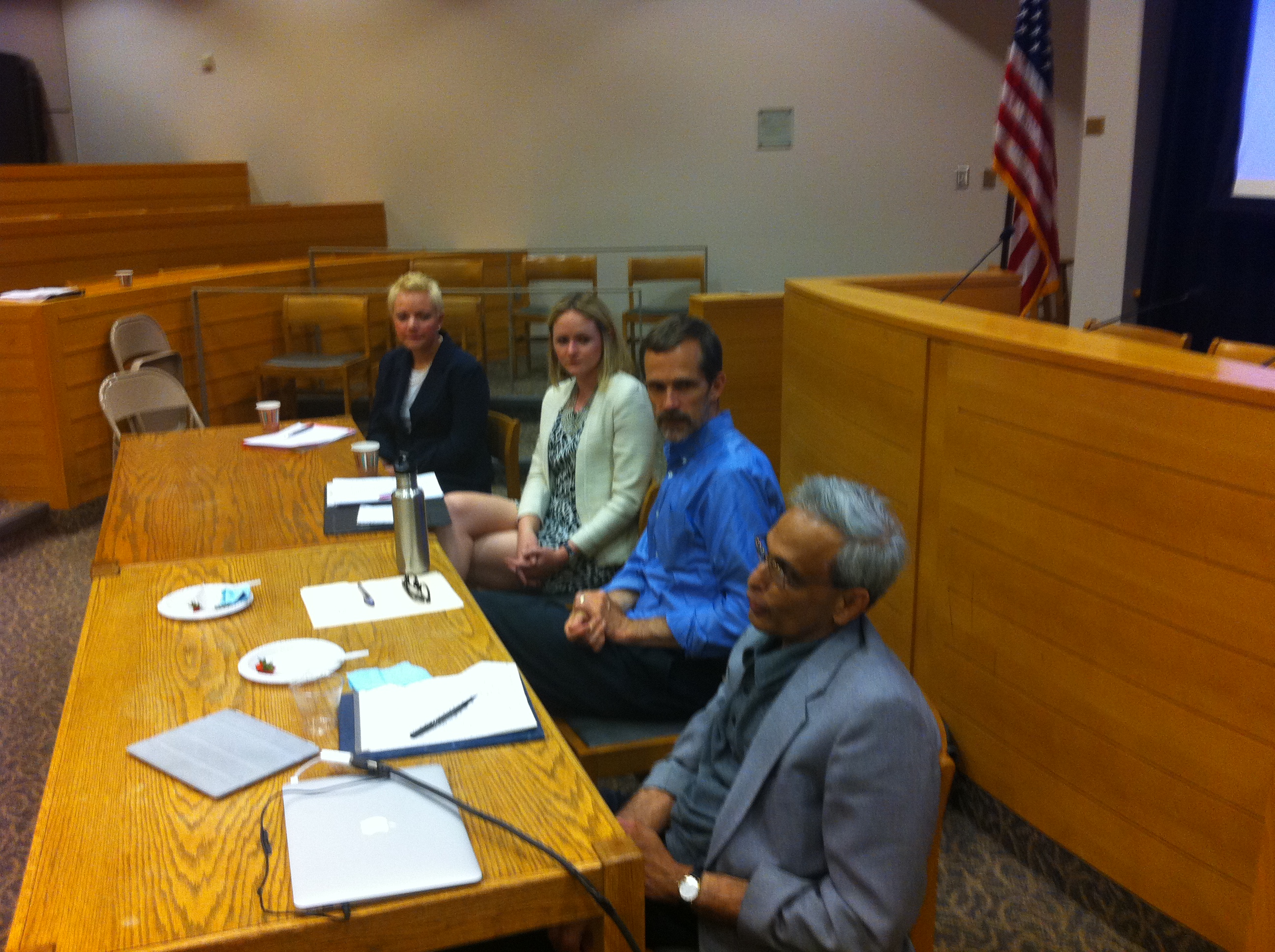
On July 10th the NorthEast Ohio Chapter of Americans United for Separation of Church and State (AU) held a Forum – in the moot court room at CWRU School of law – titled: “Why the Failure to keep Religion out of Politics Hurts us all.”

We began and ended this classy event with a nice catered spread in the rotunda.

In the Rotundra : Prof Singham,Matt Marshall, Elise Helgesen, and Mallory Ullman.

The premise of our Forum was that protecting the Establishment Clause means more than merely keeping sectarian prayer out of City Council meetings and nativity scenes off of city property: religion has been and is currently used against science, gay rights, contraception, and to impose religion in public schools.

Speakers included:

Prof. Mano Singham — Dept of Physics, CWRU – why actual science is important in legislation.
Piet van Lier — Policy Matters Ohio – impact of charter schools on educational funding.
Elise Helgesen Aguilar — Americans United DC Office – who we are, what we do, and why we are important.
Mallory McMaster Ullman — NARAL Pro Choice Ohio – the egregious anti-women legislation in Ohio.

Ms Ullman, Ms. Helgesen. Mr. van Lier, and Prof Singham

.IMG_2899

Ms. Helgesen spoke first, presenting on who AU is, what we do, what we have done, and what we aren’t – an anti-religious organization.

Mr. van Lier covered the aspects of education vouchers in Cleveland and in Ohio.  He noted that test results do not show charter schools out performing public schools (in similar demographics).

Prof. Singham – demonstrated the egregious intrusion of dogma on legislation –  played several clips from US House hearings in which several of our election officials asserted that the Bible was superior to science.  E.G.:  “No need to be concerned with Climate Change – the world will end when god decides so”.

Ms. Ullman detailed some of the recent  legislation signed into law by Gov. Kasich impacts the availability of contraception and abortion availability, and legislates how physicians practice ob/gyn procedures.

Ms Helgesen then summarized the presentations, and a fruitful and informative question and answer session followed.

258436812

We then talked and finished the food: networking and noshing.

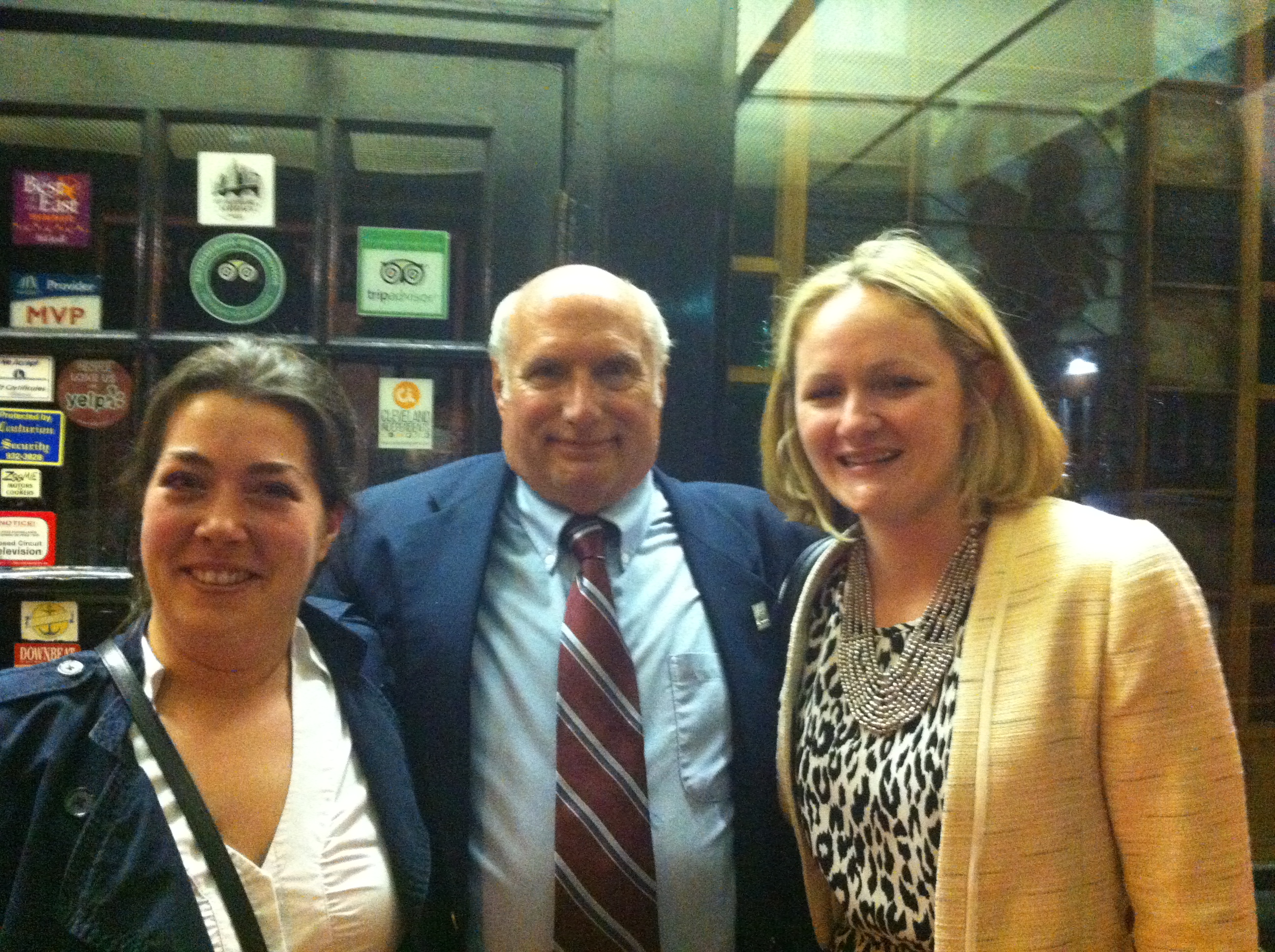
To demonstrate that we are not all dullards, some of us continued at NightTown.

IMG_2905

IMG_2911

IMG_2908

A big thank you to all who attended, to all our speakers, to CWRU for making the room available, and to the AU National Office for making Elise available (we provided a lot of hospitality)  – and to all of our speakers. Perhaps the weather kept attendance  down, but for those who came, it was indeed ,an Evening to Remember.

(N.B.: Several of the photos are courtesy of the Cleveland Free Thinkers.)

Concept of “Limited Government” Is Right-Wing Bunk: Try to Find Anything Remotely Like It in the Constitution

Right-wingers claim the country was founded on “limited government” — It’s totally bogus.

Source: Consortium news, via Alternet

Author: Jada Thacker

The Cato Institute’s Handbook for Policy Makers says, “The American system was established to provide limited government.” The American Enterprise Institute states its purpose to “defend the principles” of “limited government.” The Heritage Foundation claims its mission is to promote “principles of … limited government.” A multitude of Tea Party associations follow suit.

At first glance the concept of “limited government” seems like a no-brainer. Everybody believes the power of government should be limited somehow. All those who think totalitarianism is a good idea raise your hand. But there is one problem with the ultra-conservatives’ “limited government” program: it is wrong. It is not just a little bit wrong, but demonstrably false.

The Constitution was never intended to “provide limited government,” and furthermore it did not do so. The U.S. government possessed the same constitutional power at the moment of its inception as it did yesterday afternoon.

This is not a matter of opinion, but of literacy. If we want to discover the truth about the scope of power granted to federal government by the Constitution, all we have to do is read what it says.

The Constitution’s grant of essentially unlimited power springs forth in its opening phrases: “We the People of the United States, in Order to form a more perfect Union, establish Justice, insure domestic Tranquility, provide for the common defence, promote the general Welfare, and secure the Blessings of Liberty to ourselves and our Posterity, do ordain and establish this Constitution for the United States of America.”

As might be expected in a preamble to a founding document, especially one written under supervision of arch-aristocrat Gouverneur Morris, the terms are sweeping and rather grandiose. But the point is crystal clear: “to form a more perfect Union.” If the object of the Constitution were to establish “limited government,” its own Preamble must be considered a misstatement.

Enumerated Powers

Article I establishes Congress, and Section 8 enumerates its powers. The first clause of Article I, Section 8 repeats the sweeping rhetoric of the Preamble verbatim. While it provides for a measure of uniformity, it does not so much as hint at a limit on the federal government’s power to legislate as it sees fit:

“The Congress shall have Power To lay and collect Taxes, Duties, Imposts and Excises, to pay the Debts and provide for the common Defence and general Welfare of the United States; but all Duties, Imposts and Excises shall be uniform throughout the United States…”

No attempt is made here, or at any other place in the Constitution, to define “general Welfare.” This oversight (if that is what it was) is crucial. The ambiguous nature of the phrase “provide for the…general Welfare” leaves it open to widely divergent interpretations.

Making matters worse for federal government power-deniers is the wording of the last clause of Article I, the so-called “Elastic Clause”: Congress shall have power “To make all Laws which shall be necessary and proper for carrying into Execution the foregoing Powers, and all other Powers vested by this Constitution in the Government of the United States, or in any Department or Officer thereof.”

Thus the type, breadth and scope of federal legislation became unchained. When viewed in light of the ambiguous authorization of the Article’s first clause, the importance of the “necessary and proper” clause truly is astonishing. Taken together, these clauses – restated in the vernacular – flatly announce that “Congress can make any law it feels is necessary to provide for whatever it considers the general welfare of the country.”

Lately there has been an embarrassingly naïve call from the Tea Party to require Congress to specify in each of its bills the Constitutional authority upon which the bill is grounded. Nothing could be easier: the first and last clauses of Article I, Section 8 gives Congress black-and-white authority to make any law it so desires. Nor was this authority lost on the Founders.

Limited government” advocates are fond of cherry-picking quotes from The Federalist Papers to lend their argument credibility, but an adverse collection of essays called the Anti-federalist Papers unsurprisingly never gets a glance. Here is a sample from New Yorker Robert Yates, a would-be founder who walked out of the Philadelphia convention in protest, written a month after the Constitution had been completed:

“This government is to possess absolute and uncontrollable power, legislative, executive and judicial, with respect to every object to which it extends. … The government then, so far as it extends, is a complete one. … It has the authority to make laws which will affect the lives, the liberty, and the property of every man in the United States; nor can the constitution or the laws of any state, in any way prevent or impede the full and complete execution of every power given.”

Yates, it must be emphasized, took pains to identify the “necessary and proper” clause as the root of the “absolute power” inherent in the Constitution well over a year before ratification.

The Tenth Amendment

A particular darling of secession-prone, far-Right Texas Gov. Rick Perry, the Tenth Amendment is often claimed as the silver-bullet antidote for the powers unleashed by the “general welfare” and “elastic clauses.” Here is the text of the Amendment in its entirety: “The powers not delegated to the United States by the Constitution, nor prohibited by it to the States, are reserved to the States respectively, or to the people.”

Superficially, the Tenth seems to mean “since certain powers are not delegated to the federal government, then those powers are reserved to the states or the people.” This would seem to be good news for champions of limited government. But this is not the case.

The Tenth does not say that important powers remain to be delegated to the United States. It merely says that powers “not [yet] delegated” are “reserved” to the states or the people. This sounds like a terrific idea – until we realize, of course, that all the important powers had already been delegated in 1787, four years before the Tenth Amendment was ratified.

As we have seen, the first and last clauses of Article I, Section 8 made the Tenth Amendment a lame-duck measure even as James Madison composed its words in 1791 – and so it remains today. The sweeping powers “to make all laws necessary and proper” in order to “provide for the general welfare,” had already been bestowed upon Congress. The Johnny-come-lately Tenth Amendment closed the constitutional pasture gate after the horses had been let out.

This apparently has never occurred to the likes of Gov. Rick Perry and his far-Right cohorts who believe a state may reclaim power by withdrawing its consent, in effect repossessing their previously delegated power through state legislation. Superficially, the logic of this position seems sound: if the states had the legal authority to delegate power, then they may use the same authority to “un-delegate” it by law.

But a close re-reading of the Tenth’s wording nixes such reasoning. Oddly, the Tenth Amendment does not say thestates delegated their powers to the federal government – although it may be argued that it probably ought to have said so. It says “The powers not delegated to the United States by the Constitution … are reserved to the States. …”

Thus, according to the Tenth Amendment, the Constitution itself delegated the power to the federal government. States, in other words, now have no standing to “reserve-back” what they had never “delegated-away” in the first place.

Had it been possible to “un-delegate” the powers of the United States by invoking the Tenth, the Old South would have simply done so and spared itself the bother of secession – not to mention the bother of being annihilated by a series of subsequent Northern invasions. The fact that the South did not even attempt such a strategy attests to the toothlessness of the Tenth Amendment.

No other instance in law would be a better example that we should choose our votes carefully. For in ratifying the Bill of Rights, which included the Tenth Amendment, the American people endorsed the legal fiction that the Constitution – not the original 13 states, or “We the People” – authorized the power of the United States because the Constitution itself said so. If the Constitution has an Orwellian twist, this is it – no matter which side of the aisle you’re on.

The states and the people may amend the Constitution. But they may not do so by nullification (according to the logic inherent in the wording of the Tenth Amendment), or by the judgment of state courts (according to the “supremacy clause” of Article VI), nor may any Amendment be made without the participation of the federal government, itself (according to Article V.) If the Founders had meant to
ensure “limited government,” there is no trace of such intent here.

Paucity of Rights

If the Constitution were intended to provide “limited government,” we might expect it to be chock full of guarantees of individual rights. This is what Tea Partiers may fantasize – but this is not really true. In fact, the Constitution is amazingly stingy in reference to “rights.”

–The word “right” is mentioned only once in the Constitution as ratified. (Art. I, Sec. 8 allows Congress to award copyrights/patents to ensure their holders “… Right to their respective Writings and Discoveries.”)

The word “right” – somewhat counter-intuitively – appears only six times in the ten Amendments called the “Bill of Rights.”

Almost a century later, the first of seven other rights were added under pressure from Progressive activists – almost all of which were intended to create and extend democratic participation in self-government.

–Amendment XIV (sanctions against states denying suffrage); XV (universal male suffrage); XIX (women’s suffrage); XXIV (denial of poll tax); and XXVI (18 year-old suffrage); and twice in Amendment XX, which gives Congress the “right of choice” in presidential succession.

–In grand total, the word “right” appears only 14 times in the entire Constitution, as it exists today (including the two rights conferred to government).

Did we all notice that the “Constitution of the Founders” did not include the “right” for anybody at all to vote? Notable, too, is the absence of language implying that any “rights” are “unalienable” or “natural” or “endowed by their Creator.” All such phraseology belongs to the Declaration of Independence, which – apparently unbeknownst to Tea Partiers everywhere – bears no force of law.

The word “power,” by the way, occurs 43 times in the Constitution, each time referring exclusively to the prerogative of government, not right-wingers. Since “individual” rights are mentioned only 12 times, this yields a ratio of about 4:1 in favor of government power over individual rights. Without the efforts of those pesky, democracy-mongering Progressives, who fought for universal voting rights, the ratio would be more than 6:1 today – or 50 percent higher.

This statistical factoid is not as trivial as it may appear. Expressed in practical terms, Michele Bachmann, Sarah Palin or Clarence Thomas would almost certainly never have achieved public office had they lived under the “limited government” designed by the Founders they so revere.

The Bill of Rights

So what exactly are our non-patent/copyright “rights,” under so-called “limited government?”

–Amendment I – the right of people “peaceably to assemble, and to petition the government for redress of grievances”

–Amendment II – the right “to keep and bear arms, shall not be infringed”

–Amendment IV – the right “to be secure…against unreasonable searches or seizures”

–Amendment VI – the right “to a speedy and public trial”

–Amendment VII – the right “of a trial by jury”

–Amendment IX – enumeration “of certain rights” shall not deny “others retained by the people”

That’s it. What happened to the famous rights of free speech, religion or press? The way the First Amendment is worded does not enumerate these as positive rights that people possess, but rather as activities the government may not infringe upon. If Bill of Rights author James Madison had meant to stipulate them as positive “rights” all he had to do was write it that way, but he did not.

Bear in mind Madison (then a federalist) wrote the Bill of Rights under political duress. Since anti-federalists (recall the skepticism of Robert Yates) flatly refused to ratify the Constitution unless it guaranteed something, Madison had to write something. In effect, the amendments were the pig the anti-federalists had bought in the poke, three years after ratification had paid for it.

Madison, at the time of writing, had little incentive to take pains with what he wrote because federalists did not believe a Bill of Rights was necessary, or even good idea (with Alexander Hamilton arguing a Bill of Rights would be “dangerous.”) This may account for the fact that some of what Madison wrote seems vague, or even ambiguous, as in the case of Amendment II.

Amendment IX, for example, actually makes little sense, which may account for the fact nobody ever seems to mention it: “The enumeration in the Constitution, of certain rights, shall not be construed to deny or disparage others retained by the people.”

This sounds “righteous” enough, until we recall the Constitution to which this Amendment pertains had “enumerated” only a single right in the first place! Even if Amendment IX applies to the Bill of Rights (to include itself), then all it says is “the people may have more rights than the half dozen mentioned so far, but we’re not going to tell you what they are.” (So if Amendment X is Orwellian, Amendment IX verges on Catch-22.)

Of course the idea was to calm suspicions that people would possess only the half-dozen rights enumerated in the Bill of Rights (plus patents!) and no others. Even so, Amendment IX did not guarantee any un-enumerated rights; it just did not peremptorily “deny or disparage” any.

And what sense should we make of the crucial Amendment V – one of the four Bills of Rights not actually containing the word “right” at all?

“No person shall be held to answer for a capital, or otherwise infamous crime, unless on a presentment or indictment of a Grand Jury, except in cases arising in the land or naval forces, or in the Militia, when in actual service in time of War or public danger; nor shall any person be subject for the same offence to be twice put in jeopardy of life or limb; nor shall be compelled in any criminal case to be a witness against himself, nor bedeprived of life, liberty, or propertywithout due process of law; nor shall private property be taken for public use, without just compensation.” [Emphasis supplied]

Thus, life, liberty and property are not expressly granted status as fundamental “rights,” but only as personal possessions that may be deprived or taken according to “due process.” The crucial implication is that Amendment V exists in order to stipulate how the government may deny an individual claim to life, liberty or property. With due process, you life, liberty and property may be toast. That is what it plainly says.

It is interesting, too, that the Bill of Rights does not speak to the origin of rights, but only to their existence. Moreover, the Constitution never speaks of granting rights, but only protecting them. There is a good reason for this: excepting the Progressive suffrage Amendments, none of the guaranteed rights were American inventions, but had for centuries been considered the rights of the English nobility.

For those who want to believe in “American Exceptionalism” as the basis of “limited government,” this is not encouraging news. Moreover, the Constitution, including the Bill of Rights, hardly includes any “right” that had not already been recognized at one time or another by medieval English monarchs or in ancient Rome and Greece.

Property Rights and ‘Republic’

The strict libertarians among us claim the sole legitimate power of government is that which is necessary to protect private property rights. On this score, however, the “limited government” of the Founders is practically mute. Except for the aforementioned Article I, Section 8 provision for patents and copyrights, private “property” is only mentioned twice in the Constitution, both times in a single sentence of the “right”-less Amendment V quoted above:

“No person shall … be deprived of life, liberty or property without due process of law; nor shall private propertybe taken for public use, without just compensation.” [Emphasis supplied]

Once again, Amendment V fails to guarantee personal immunity from the power of the state, but rather details the way state power may be used to dispossess individuals of their property. And we must bear in mind these words were not penned by Marxists, socialists, or Progressives.

Whether by design or happenstance, the original “Constitution of the Founders,” or the Bill of Rights, or even the Constitution with all its Amendments does not grant any irrevocable “right of possession” to property. Even the Second Amendment’s “right to keep” arms, is subject to the terms by which property may be taken under terms of Amendment V, and it always has been.

Tellingly, the word “democracy” does not appear in the Constitution. This intentional oversight is often smugly celebrated by anti-democrats among us, who insist that the United States of America was founded as a “republic.” No doubt this is true, given that the Constitution was written by an exclusive, hand-picked cadre of oligarchs, whose number did not include a single woman, person of color, or wage-earner.

Unfortunately for the pro-republic “limited government” crowd, the Constitution does not contain the word “republic” either. The word does appear as an adjective, but only once, (Article IV, Section 4): “The United States shall guarantee to every State in this Union a Republican Form of Government, and shall protect each of them from Invasion…”

Typically for the Constitution, which defines few of its terms, the word “Republican” also remains unexplained. The ambiguity of the term turned out to be handy, however, as Radical Republicans continuously and egregiously violated Article IV, Sec. 4 from 1865-1877 as they enforced blatantly unconstitutional military occupation of former Confederate states during the gross misnomer of “Reconstruction.”

It should be obvious that the “Constitution of our Founders,” including the Bill of Rights, may not protect as many rights as many wish to believe. Moreover, we have already noted the Constitution dropped all revolutionary talk of “unalienable” rights and “Creator endowed” liberty. This was not an oversight.

The revolutionary bit about “consent of the governed” posed an especially delicate problem for the Founders. Almost all owned slaves or were masters of property-less tenants or domestic servants, including their wives – none of whom could offer their legal consent even if they wished to do so. Thus the Founders shrewdly considered it unnecessary to include any voting rights in the new republic they planned to rule, uncontested by the disenfranchised lower castes.

Did this result in the land of the free, with liberty and justice for all? Let’s see.

Under the U.S. Constitution, Americans were sentenced to death for protesting unfair taxes; journalists and citizens imprisoned for criticizing government officials; citizens’ property seized illegally; workers murdered by government agents; thousands jailed without the “privilege” of habeas corpus; entire states deprived of civilian courts; untold numbers of American Indians defrauded of  liberty and property; debt-peonage and debtors’ prisons flourished, as did slavery and child labor; and the majority of the public was denied the vote.

All this was considered constitutional by the Founders. None of these outrages, please note, was the result of “progressivism,” which had yet to be articulated, and all were common prior to the New Deal and the advent of so-called Big Government. Was this the face of “limited government?”

No, it was not. The concept of a democratically “limited government” was not for a moment entertained by our Founders, nor is it by those who idolize them today. With few exceptions, the Founders were Eighteenth Century patricians who took a revolutionary gamble meant chiefly to perpetuate their privileges, free from English colonial overlord-ship. It should come as no surprise these elitists drafted a Constitution that posed no threat to aristocracy.

‘Limited Government’ as Act of Faith

The original Constitution of the United States of America was just so much ink on paper. The Constitution, as it stands today, is just a lot more ink on paper.

But the Constitution’s ink is important and deserves respect because it represents nothing less than the collective civic conscience of the American people. A great many Americans have dedicated their lives in trust to that conscience – on battlefields, in classrooms, in everyday civic life, and even a few in the halls of power.

It is evident that most of the Amendments to the original Constitution – as well as the Supreme Court’s decisions interpreting its scope and purpose – were made because the document had over the course of time been found wanting by the American people, whose common interests it was not originally intended to serve. As the collective civic conscience of the people changed, so too did their interpretation of self-government.

But the entire concept of social evolution (much less biological evolution) is something the ultra-Conservative rank-and-file likely does not comprehend and it is not something their leaders encourage them to consider. The reason for this may have less to do with politics than with fundamentalist faith.

An anecdote in point: the editor-in-chief at Random House once asked the extremist libertarian Ayn Rand if she would consider revising a passage in one of her manuscripts. She reportedly replied, “Would you consider revising the Bible?”

Ergo, that which is sacrosanct neither requires nor will tolerate change – to include the fantasized “limited government” of the immortalized “Founding Fathers.” The fact that Rand was a noted atheist only underscores the point that fundamentalist faith is not restricted to any particular brand of fanaticism.

Yet the Constitution’s conception was anything but immaculate. It was not carted down from the Mount in tablets of stone, nor is it the product of some mysterious Natural Law interpretable only by libertarian gurus. And whether its meaning is best exemplified by the Tea Party flag depicting a talking snake (“Don’t Tread on Me”), perhaps only Eve could judge with authority.

The Constitution is not a holy book, and there is no good reason for anybody to treat it like one. The men who wrote it were not prophets, nor were they particularly virtuous, though some could turn a pretty phrase. In fact, the Constitution’s most unholy-book characteristic is its most welcomed attribute: its readers are not required to believe in its infallibility in order for it to make sense to them.

But we are required to read the Constitution if we want to know what it says. The ultra-conservatives’ obsession with a constitutionally “limited government,” which has never actually existed, suggests they do not understand the Constitution as much as they merely idolize it.

These constitutional fundamentalists – along with the American public in general – would do better to pick the document up and read it sometime, not fall on bended knee before it and expect the rest of us to follow their example.

Jada Thacker, Ed.D is a Vietnam veteran and author of Dissecting American History. He teaches U.S. History at a private institution in Texas. Contact: jadathacker@sbcglobal.net

Jada Thacker, Ed.D is a Vietnam veteran and author of Dissecting American History. He teaches U.S. History at a private institution in Texas. Contact: jadathacker@sbcglobal.net

Emphasis Mine

see: http://www.alternet.org/exposed-why-right-wings-interpretation-constitution-can-only-be-believed-if-you-havent-read-it?akid=10671.123424.gMWqCs&rd=1&src=newsletter866005&t=7