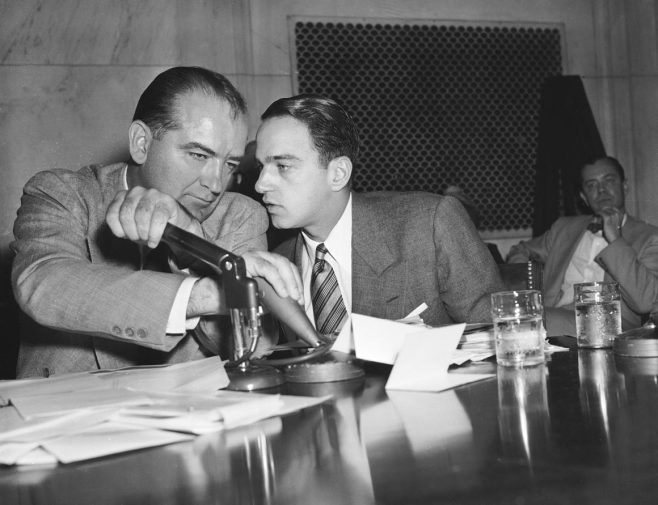
Trump Advisor Roy Cohn

 Sen. Joseph McCarthy covers the microphones with his hands while having a whispered discussion with Roy Cohn, his chief counsel, during a committee hearing on April 26, 1954, in Washington. | AP Photo

Sen. Joseph McCarthy covers the microphones with his hands while having a whispered discussion with Roy Cohn, his chief counsel, during a committee hearing on April 26, 1954, in Washington. | AP Photo

Source:Politico.com

Author: Michael Kruse

Emphasis Mine

The reporter from the Washington Post didn’t ask Donald Trump about nuclear weapons, but he wanted to talk about them anyway. “Some people have an ability to negotiate,” Trump said, of facing the Soviet Union. “You either have it or you don’t.”

He wasn’t daunted by the complexity of the topic: “It would take an hour and a half to learn everything there is to learn about missiles,” he said.

It was the fall of 1984, Trump Tower was new, and this was unusual territory for the 38-year-old real estate developer. He was three years away from his first semi-serious dalliance with presidential politics, more than 30 years before the beginning of his current campaign—but he had gotten the idea to bring this up, he said, from his attorney, his good friend and his closest adviser, Roy Cohn.

That Roy Cohn.

Roy Cohn, the lurking legal hit man for red-baiting Sen. Joe McCarthy, whose reign of televised intimidation in the 1950s has become synonymous with demagoguery, fear-mongering and character assassination. In the formative years of Donald Trump’s career, when he went from a rich kid working for his real estate-developing father to a top-line dealmaker in his own right, Cohn was one of the most powerful influences and helpful contacts in Trump’s life.

Over a 13-year-period, ending shortly before Cohn’s death in 1986, Cohn brought his say-anything, win-at-all-costs style to all of Trump’s most notable legal and business deals. Interviews with people who knew both men at the time say the relationship ran deeper than that—that Cohn’s philosophy shaped the real estate mogul’s worldview and the belligerent public persona visible in Trump’s presidential campaign.

“Something Cohn had, Donald liked,” Susan Bell, Cohn’s longtime secretary, said this week when I asked her about the relationship between her old boss and Trump.

By the 1970s, when Trump was looking to establish his reputation in Manhattan, the elder Cohn had long before remade himself as the ultimate New York power lawyer, whose clientele included politicians, financiers and mob bosses. Cohn engineered the combative response to the Department of Justice’s suit alleging racial discrimination at the Trumps’ many rental properties in Brooklyn and Queens. He brokered the gargantuan tax abatements and the mob-tied concrete work that made the Grand Hyatt hotel and Trump Tower projects. He wrote the cold-hearted prenuptial agreement before the first of his three marriages and filed the headline-generating antitrust suit against the National Football League. To all of these deals, Cohn brought his political connections, his public posturing and a simple credo: Always attack, never apologize.

“Cohn just pushed through things—if he wanted something, he got it. I think Donald had a lot of that in him, but he picked up a lot of that from Cohn,” Bell said.

“Roy was a powerful force, recognized as a person with deep and varied contacts, politically as well as legally,” Michael Rosen, who worked as an attorney in Cohn’s firm for 17 years, told me. “The movers and shakers of New York, he was very tight with these people—they admired him, they sought his advice. His persona, going back to McCarthy … and his battles with the government certainly attracted clients.”

It was a long, formidable list that included the executives of media empires, the Archbishop of New York and mafia kingpin Fat Tony Salerno, and there, too, near the top, was budding, grasping Donald John Trump.

“He considered Cohn a mentor,” Mike Gentile, the lead prosecutor who got Cohn disbarred for fraud and deceit not long before he died, said in a recent interview.

People who knew Cohn and know Trump—people who have watched and studied both men—say they see in Trump today unmistakable signs of the enduring influence of Cohn. The frank belligerence. The undisguised disregard for niceties and convention. The media manipulation clotted with an abiding belief in the potent currency of celebrity.

Trump did not respond to a request from Politico to talk about Cohn. In the past, though, when he has talked about Cohn, Trump has been clear about why he collaborated with him, and admired him.

“If you need someone to get vicious toward an opponent, you get Roy,” he told Newsweek in 1979.

A year later, pressed by a reporter from New York magazine to justify his association with Cohn, he was characteristically blunt: “All I can tell you is he’s been vicious to others in his protection of me.”

He elaborated in an interview in 2005. “Roy was brutal, but he was a very loyal guy,” Trump told author Tim O’Brien. “He brutalized for you.”

Trump, in the end, turned some of that cold calculation on his teacher, severing his professional ties to Cohn when he learned his lawyer was dying of AIDS.

Cohn and Trump, according to Trump, met in 1973 at Le Club, a members-only East Side hangout for social-scene somebodies and those who weren’t but wanted to be.

By then Cohn had been in the public eye for 20 years. As chief counsel to McCarthy, he led secretive investigations of people inside and outside the federal government whom he and McCarthy suspected of Communist sympathies, homosexuality or espionage. Over a period of several years, McCarthy’s crusade destroyed dozens of careers before a final 36-day, televised hearing brought his and Cohn’s often unsubstantiated allegations into the open, leading to McCarthy’s censure in the Senate. Cohn, disgraced by association, retreated to his native New York.

There, through the ‘60s and into the ‘70s, Cohn embraced an unabashedly conspicuous lifestyle. He had a Rolls-Royce with his initials on a vanity plate and a yacht called Defiance. He was a singular nexus of New York power, trafficking in influence and reveling in gossip. He hung on the walls of the East 68th Street townhouse, that doubled as the office of his law firm, pictures of himself with politicians, entertainers and other bold-face names. He was a tangle of contradictions, a Jewish anti-Semite and a homosexual homophobe, vehemently closeted but insatiably promiscuous. In 1964, ’69 and ’71, he had been tried and acquitted of federal charges of conspiracy, bribery and fraud, giving him—at least in the eyes of a certain sort—an aura of battle-tested toughness, the perception of invincibility. “If you can get Machiavelli as a lawyer,” he would write in The Autobiography of Roy Cohn, “you’re certainly no fool of a client.”

Trump was 27. He had just moved to Manhattan but was still driving back to his father’s company offices in Brooklyn for work. He hadn’t bought anything. He hadn’t built anything. But he had badgered the owners of Le Club to let him join, precisely to get to know older, connected, power-wielding men like Cohn. He knew who he was. And now he wanted to talk.

He and his father had just been slapped with Department of Justice charges that they weren’t renting to blacks because of racial discrimination. Attorneys had urged them to settle. Trump didn’t want to do that. He quizzed Cohn at Le Club. What should they do?

“Tell them to go to hell,” Cohn told Trump, according to Trump’s account in his book The Art of the Deal, “and fight the thing in court.”

That December, representing the Trumps in United States v. Fred C. Trump, Donald Trump and Trump Management, Inc., Cohn filed a $100-million countersuit against the federal government, deriding the charges as “irresponsible” and “baseless.”

The judge dismissed it quickly as “wasting time and paper.”

The back-and-forth launched more than a year and a half of bluster and stalling and bullying—and ultimately settling. But in affidavits, motions and hearings in court, Cohn accused the DOJ and the assisting FBI of “Gestapo-like tactics.” He labeled their investigators “undercover agents” and “storm troopers.” Cohn called the head of DOJ down in Washington and attempted to get him to censure one of the lead staffers.

The judge called all of it “totally unfounded.”

By June of 1975, the judge had had it with the Trumps’ attorney. “I must say, Mr. Cohn,” he said in a hearing, “that this case seems to be plagued with unnecessary problems, and I think the time has come when we have to bite the bullet.”

They hashed out the details of a consent decree. The Trumps were going to have to rent to more blacks and other minorities and they were going to have to put ads in newspapers—including those targeted specifically to minority communities—saying they were an “equal housing opportunity” company. Trump and his father, emboldened by Cohn, bristled at the implication of wrongdoing—even, too, at the cost of the ads.

“It is really onerous,” Trump complained.

At one point, flouting the formality of the court, Trump addressed one of the opposing attorneys by her first name: “Will you pay for the expense, Donna?”

Trump and Cohn seemed most concerned with managing the media. They squabbled with the government attorneys over the press release about the disposition. First they wanted no release. Impossible, said the government. Then they wanted “a joint release.” A what? A public agency, it was explained to them, had a public information office, on account of the public’s right to know.

Cohn didn’t want to hear it.

“They will say what they want,” he told the judge, and everybody else in the courtroom, “and we will say what we want.”

The government called the consent decree “one of the most far reaching ever negotiated.”

Cohn and Trump? They called it a victory.

Case 73 C 1529 was over. The relationship between Cohn and Trump had just begun.

“Though Cohn had ostensibly been retained by Donald to handle a single piece of litigation,” Wayne Barrett, an investigative journalist for New York’s Village Voice, would write in his 1992 book about Trump, “he began in the mid-‘70s to assume a role in Donald’s life far transcending that of a lawyer. He became Donald’s mentor, his constant adviser on every significant aspect of his business and personal life.”

Michael Kruse is a senior staff writer for Politico.

Donald Trump isn’t empathetic. Is that a problem?

“He has spent his life in a bubble, surrounded by hired yes men and women who have never told his inner child to grow up.”

Source: Washpost

Author: Chris Cillizza

Emphasis Mine

Donald Trump has cleared every electoral hurdle before him in this presidential race. He went from 1 percent, literally, to the top of the polls. He beat 16 other people for the Republican nomination. He finds himself in a statistical dead heat with likely Democratic nominee Hillary Clinton. And, he has done it all by being himself: brash, bold, controversial and unapologetic.

As the nation turns its eyes to the general election, I have one question that continues to nag at me as I think about the possibility of Trump in the White House: Can he be empathetic? Like, at all? And does he need to be?

“Ultimately, I think a lack of empathy is just one piece of a portrait of a person who is unbalanced and damaged,” said Stuart Stevens, a Republican consultant who has long vocally opposed Trump. “He has spent his life in a bubble, surrounded by hired yes men and women who have never told his inner child to grow up.” 

The race to be president is unlike other races for elected office. No one turns to a senator, a member of Congress or a governor when there is a mass shooting, or when a tornado devastates a community. (The Joplin tornado, which killed 158 people, hit the Missouri town five years ago Sunday.)

They do turn to a president. A president is expected to do many things in office, but perhaps the most important is to be both a cheerleader and a shoulder to cry on when moments of great joy and great sadness affect the entire body politic.

The fracturing of the media, our tendency to self-sort into silos of sameness and all manner of other factors have lessened the number of national moments — my seminal one was the explosion of the Space Shuttle Challenger in 1986 — that we experience. Still, there remain moments (the murders at Sandy Hook Elementary School in Connecticut being one recent example) in which the nation looks to its highest elected leader for solace and strength.

Those are the moments in which you realize that politics — at the presidential level, at least — is about much more than policy positions. Voters pick politicians who they think understand them and their values at some level. It’s an emotional connection far more than an issue-driven one. And, it’s also much more powerful than simply an agreement on those policy positions.

 All of which brings me to the current state of the presidential race and, specifically, Trump. For all of his successes to date (and there have been many), Trump has consistently struggled on questions tied to empathy.Asked which candidate “better understands the problems of people like you,” 47 percent of registered voters in a new Washington Post-ABC News poll chose Clinton, while just 36 percent named Trump. On the question of who better represents “your personal values,” 48 percent chose Clinton, and 37 percent went with Trump.

That’s far from an outlier. Two-thirds of voters in a CBS News-New York Times national poll released last week said that Trump did not share their values. Seven in 10 said he did not have the right temperament to be president.

It’s worth noting that Clinton is no great shakes on these questions of empathy, either. Sixty percent of respondents in the CBS-Times poll said Clinton did not share their values. Forty-nine percent said she did not have the right temperament to be president. (Forty-eight percent said she did.) But, on virtually every measure, she outperforms Trump on the palette of questions aimed at testing how empathetic voters believe a candidate to be.

The question going forward for Trump is two-fold: (1) Can he change the perception of himself as a strong leader but not one you can imagine traveling to the site of a natural disaster and delivering a speech to help heal a country’s raw wound? (2) Does he need to?

The answer to the second question is, if past is prologue, yes. Voters — especially swing voters — in a presidential election often make a “feel” vote, meaning that the person they choose is as much about a set of personality traits as it is about a set of policy positions.

If you believe that Trump needs to show a softer — or at least a more understanding — side, the simplest way for him to do that is to put his family more front and center in the general-election campaign. Even people who loathe Trump give him some credit for the family he has raised. Trump as doting father is an image that could go part of the way to softening some of his sharpest edges as a candidate.

Trump could also talk more openly, and candidly, about his relationship with his father and how he dealt with the death of his older brother.

There is, of course, the possibility that the answer to the “does he need to” question posed above is no. That would go against virtually everything we think we know about how modern politics — and voters’ psyches — work. But how different would that be from everything that has propelled Trump so far?

At every turn, he has run the anti-campaign, and voters have loved it. Maybe this is an election in which tough and unapologetic is the new soft and empathetic. With Trump, nothing surprises me anymore.

(N.B.: make that some voters rather than the voters have loved it.)

Chris Cillizza writes “The Fix,” a politics blog for the Washington Post. He also covers the White House.

See:https://www.washingtonpost.com/politics/one-question-about-trump-nags-at-me-does-he-need-to-be-empathetic/2016/05/22/b1fadd22-203c-11e6-aa84-42391ba52c91_story.html?wpmm=1&wpisrc=nl_politics


A New National Progressive Movement Is Emerging in the Shadows of the Sanders Campaign

As Sanders fights for a California primary season finale, activists look ahead.

Source: Alternet

Author:Steven Rosenfeld

Emphasis Mine

The sun was hot. The shade was sparse. Yet they kept coming. For three-plus hours on Wednesday morning, several thousand Bernie Sanders believers of every stripe—college students cutting class, older retirees and labor activists, parents with teenage kids—wearing every imaginable Bernie pin, tee-shirt and baseball cap packed the dusty field at the Santa Clara fairground near San Jose, California. They more than eagerly awaited his arrival.

“He’s the best candidate ever,” one man blurted out. “Feel the Bern! Feel the Bern!” people spontaneously chanted. The sound system played Bob Marley, Neil Young, John Lennon and Steve Earle, who growled “The revolution starts now…” As they waited 1960s folk superstar Joan Baez took the stage and sang, “The opposition candidate is stirring up a fuss. She’s got the billionaires, he’s got us…”

Behind the bleachers stood a young man from nearby Santa Cruz, Jonathon Lachlan-Hache, handing out postcard-size flyers. “This is a new tool for local organizing,” he said repeatedly, giving out cards that urged people to use a website he created. Bernforce.com lets activists put in locations and find and post campaign-related events, discussions, organizing—including for other progressive candidates. “I am absolutely determined” to keep the campaign’s energy going, he said. “The nomination happens at the convention. This is a close race still.”

Lachlan-Hache handed out 1,200 postcards. As he pulled out his smartphone to show some Sanders volunteers how to use his website, the campaign’s advance men were handing out orange wristbands to the most exuberant supporters so they could fill the bleachers behind the podium. Nobody associated with the campaign wanted to talk about anything other than the necessary steps to win big in California on June 7, where 475 delegates are at stake.

But at every Sanders event large and small—such as voter registration drives on university campuses—there are a range of people who are looking past the 2016 primaries and focusing on building a progressive movement. In some ways it’s an awkward moment for them, because Sanders and his very disciplined team is telling his supporters that they can win—even if media, academics, Democratic loyalists and others all say the odds are not there. He told the San Jose crowd that he’s beaten expectations all along, that he’s the best candidate to take on Trump, and he can take California, “the most important primary in the whole nominating process.”

But that hasn’t stopped many people from not just asking the obvious question, “Where does the progressive movement go from here?” but from taking new steps and actions even while the presidential drama unfolds. At every California Sanders event attended by AlterNet, there have been individuals like Lachlan-Hache who are doing what they believe is needed to build a new and sustainable movement—as they support the ongoing Sanders campaign.

Some are acting on their own. Some are part of online networks with dozens of volunteers and thousands of followers. Some are recently laid off Sanders campaign staffers who are creating what they hope will be national stages and tools for progressives to take back Congress. Some are planting the seeds for what they hope will be a new political party that will quickly become bigger than the Green Party. These are not the well-known public intellectuals of the progressive firmament who also are convening a People’s Summit in mid-June to discuss what’s next.

“We’re basically proposing a way to fix Congress in one fell swoop,” said Saikat Chakrabarti, a former Sanders’ staffer and Brand New Congress co-founder. “A big reason people don’t vote in midterms is that it currently feels very futile—at best, you get one or two progressive candidates to win, but those people won’t be able to do much in a Congress that is largely run by the current establishment. We are instead presenting a plan to put in a whole slate of progressive candidates at once, so voters will have a real option for big change.”

“We think for the first time in 100 years, and not because we’re special or smarter, but because of the situation with the Bernie movement, the United Progressive Party could be the first third party going from minor party status to major party status,” said UPP founder Justin Renquist. “We could see 30 to 50 percent of the Democratic Party, progressives, be so disgusted with this whole process and just leave… We are a populist leftist reformist movement that needs to come together. Let’s be the big tent party that the Democrats said they were, but are not.”

From the Bottom Up

Sanders and his most ardent followers have repeatedly said that change only comes when the people demand it. Ironically, the campaign itself is a very traditional top-down institution, where the messaging is tightly scripted and the millions raised equally tightly held. The campaign has not endorsed many candidates running for federal office and has mostly told volunteers to cover the costs of creating their campaign materials. On one hand, they are very disciplined—almost no one affiliated with the campaign or volunteering says they are free to talk to reporters. But their fiscal stinginess has also unleashed a remarkable army of self-starters whose efforts are creating a new foundation for an emerging and growing progressive movement.

The campaign, of course, believes that anyone under age 30 who they register to vote will likely support them. So late last week, they set up a San Francisco Bay Area voter registration tour of surrogate speakers—led by young hip Hollywood actors—that stopped at the major campuses. Like many campaign events, the first to appear were not these insiders, but the outside activists. That was the case at Stanford University, where Jay Blas Jacob Cabrera, who is also running for state Assembly, appeared with a variety of handouts: cards telling people how to register, voting options, and endorsements of other local progressive candidates.

“I am working every day to build the movement,” he said. “It is a movement. It is a thing in and of itself. If you listen to the people and listen to Bernie, it is getting government back to the people. The Bernie campaign is a subset of the people’s movement. It has been going on for decades. It is Occupy. It is Black Lives Matter. It is getting greedy corporations and oppressive systems out of people’s lives… We’re calling it the Bernie Movement and trying to build a Bernie Party.” Cabrera is energetic, deeply committed and typical of the people often drawn to campaigns—very one-minded. But the resources he has marshaled are remarkable. He described himself as a builder of networks. Beyond the website he created calling for a new political party in Sanders’ name,BernieParty.net, or being endorsed in his long-shot legislative race by other like-minded groups not officially affiliated with the campaign, he has assembled online lists of progressives running for office across the country that rivals what’s on established websites like Democracy for America or Bold Progressives—nationally known campaign organizations.

It can be dizzying to hear him reel off websites, Facebook pages and other resources that he is working with and tapping to nurture a larger network. There are BernieThinkers, Berniecrats, SandersDemocrats, Expats for Bernie,SandersForPresident on Reddit (which Lachlan-Hache is part of), an offshoot called Grassroots Select that’s trying to help 2016 candidates, and more. To be sure, these groups and others are all doing what they think is needed to create a lasting movement, even if their efforts can be similar, overlap or exist in small bubbles.

Cabrera’s optimism is punctuated by fears that people might give up if Sanders doesn’t get the nomination. He’s discovered it can be lonely on the campaign trail as he runs for the Assembly. And he is a bit frustrated that the movement and networks he deeply wants to see emerge are sidelined as Sanders keeps pushing for a big California win on June 7. “The only reason I am involved in this is [because] Bernie talked about a movement. No other mainstream candidate has said that,” he said, saying that he ran as an Occupy candidate for Congress in 2014. “But now he is not supporting a movement. He is supporting his campaign.”

Bigger Circles

But unlike past presidential years, social media and the internet have drawn people like Cabrera into larger virtual communities. One such effort is called Grassroots Select and began through Reddit. Ian Boyd, its executive director, who lives in Kansas City, said that his group has 21,000 followers and a core of several dozen-to-100 active volunteers. The niche they wanted to fill was helping down-ballot candidates. Others groups, such as SandersDemocrats.org, asked for help in their grading and assessing progressive candidates, he said, to ensure they were adhering to Sanders’ agenda and values and not inauthentically riding on his coattails. “That is why we like them a lot,” Boyd said. That led to creating teams for research, writing, outreach and more. Where they are now is focusing on a handful of ongoing 2016 congressional primaries.

“There are these wonderful candidates that still need all this help,” he said, pointing to Alex Law, a 25-year-old running for New Jersey’s first House district with a June 7 primary, and Tim Canova, running against Democratic National Committee chairwoman and Rep. Debbie Wasserman Schultz in Florida’s August primary. “Alex, who is 25 years old, is running an amazing campaign,” he said. “We’re trying to get donations, awareness, volunteers. We are trying to use Alex Law as this pure grassroots candidate that can stop corruption… There also is so much excitement about getting Debbie Wasserman Schultz out.”

Boyd said the progressive movement-building front is a bit splintered right now. He cited his co-director who was running VoteforBernie.org and was “very busy” with Oregon and California. The movement-building role of the online community “has been filling out the narrative of what the Bernie campaign is,” he said, but added that many activists were waiting to see what unfolds with the nomination. “A lot of groups are trying to plan based on the results that happen. That narrative will change based on what will happen in Philadelphia.”

Grassroots Select didn’t want to do that, Boyd said. “We didn’t attach ourselves to Bernie’s campaign because we didn’t want to get hung up by the waiting that a lot of people are doing. We recognize Bernie’s accomplishments. We are not officially a Bernie group, but all of us are huge Bernie supporters.”

Brand New Congress?

Many of the activists now shifting their focus to building an enduring progressive movement were buried in the day-to-day, week-to-week, state-to-state Bernie campaign. That changed abruptly in late April when, after losing the New York primary, the campaign laid off scores of paid staffers who, in turn, then had to decide what they could do to keep working on a cause they so deeply believe in. One of the first and most impressive efforts to arise is called Brand New Congress, which is a new federal political action committee created just weeks ago that raised more than $40,000 from nearly 3,500 donors. Their goal is to garner support for hundeds of progressives running for the U.S. House and Senate in 2018 in a campaign that feels like Sanders’ campaign, co-founder Saikat Chakrabarti said.

“Our plan is to actually recruit these candidates (who will largely not already be politicians) and have them run under one plan and as a single unified campaign that looks a lot like a presidential campaign,” he explained by email. “So we’re talking here about recruiting and running over 400 candidates, creating a campaign infrastructure of probably at least a thousand volunteers and staff, building out a platform, creating grassroots offices in every congressional district, and creating a massive voter contact program (much like the one we saw on Bernie’s campaign) to try to contact every voter in every district that we are primarying.”

“It’s a fairly large undertaking,” Chakrabarti said. “It’s too late to do something this big for 2016 (many of the primaries for 2016 are already done and we don’t have enough time to build up such a large organization). In fact, we are already working quite a bit to get things set up for 2018 and recruit our candidates by early 2017. However, a lot of us will be working with existing groups focused on 2016 and we totally support efforts to back progressive candidates running this year.”

In an approach that’s not that dissimilar from Grassroots Select, he said the project will not just rely on small donors, but that they hope to provide campaign infrastructure elements so “our candidates will actually be able to spend all their time on the campaign talking to people and about the issues. Also, once elected, they won’t have to spend half their time fundraising like Congresspeople do currently since they will have been funded entirely by small dollar contributions on the web, just like Bernie Sanders.”

United Progressive Party

All of these movement-focused activists that AlterNet met, spoke to, or emailed with in the past week after attending several of Sanders’ events were in their 20s or 30s. It is truly remarkable that the Sanders campaign has become an epicenter for so many people who are dedicated to recasting the structures that underlie the political system. It very well may be that Sanders will win California on the same day that Hillary Clinton wins in New Jersey and declares herself the nominee. But even if that happens, Sanders will head to the Democratic National Convention in Philadelphia with many more delegates than any Democratic challenger in a generation—far more than Jerry Brown in 1992 and Jesse Jackson in 1986.

In contrast to these youthful enterprises on the campaign trail, the steering committee of the United Progressive Party and their 12,000 members nationwide have been working for years on various progressive campaigns. They say they are quietly laying the legal and organizational foundation to launch a new national party that can be a non-dogmatic “big tent” that quickly can emerge after Philadelphia. Founder Justin Renquist, 50, said that it appears that Sanders’ bid to reshape the Democratic Party from the inside doesn’t look like it is going to work—as evidenced by the growing demands from party stalwarts backing Hillary Clinton to stop campaigning now.

Renquist said that UPP has to respect the voters who haven’t cast ballots in primaries yet and the Sanders campaign’s effort to finish the nominating season, which means waiting until after Philadelphia to step forward. He said they have hundreds and hundreds of volunteers ready to create chapters in many states. But beyond those nuts and bolts, he paints an intriguing picture of the need for a broad and inclusive new progressive party to emerge. In sum, he believes the Democrats would never let Sanders and his wing take over the party.

That tension was beneath the brusque treatment of Sanders delegates in Nevada’s ongoing nominating process last weekend. Even Sanders, in his speech in San Jose on Wednesday, when listing the establishment structures that his campaign had taken on, said, “In every state that we have run in, we have taken on the Democratic establishment. And in state after state, the people have stayed up and helped defeat the establishment.”

So where will Sanders’ voters go? In 2014, Renquist said the nation had 190 million registered voters: roughly 47 percent were independents, 30 percent Democrats, 23 percent Republicans. He said that the leading progressive alternative to the Democrats, the Green Party, was far too uncompromising, while other third parties like the Justice Party were too narrowly focused.

The idea is to get the fractured left onto one big umbrella and get people to set aside arguments that you are not purist enough,” he said. And depending on whether Clinton faces federal charges for using a private email server while Secretary of State, and how Sanders and his delegates are treated in Philadelphia, a great many voters could leave the party, Renquist said. “That independent portion of the 190 million could become larger than the Republican and Democratic voters put together. That creates a compelling case for a viable third party.”

A Growing Progressive Movement

Renquist’s reading of Sanders’ achievements, a shifting electorate, the Democratic Party’s internal dynamics and shortcomings of other third-party efforts could prove to be true—no matter which progressive organization grabs the mantle of creating a new party. Even the Green Party this week sent out a release saying that they would welcome Sanders’ supporters.

But back on the ground at Sanders events, it seems that the people who had the clearest view of the future of building a sustainable progressive movement were the young and accomplished activists who have been deeply involved in the campaign for the past year. They weren’t held up by or following the older templates and models for running campaigns—waiting for permission, endorsements and directions. They were creating new tools, new networks, new fundraising models and forging ahead fortified by their experience and knowledge from the campaign.

As Bernforce.com creator Jonathon Lachlan-Hache said while handing out his flyers, the quick launch of Brand New Congress was “really impressive.” He especially liked their “one campaign, one plan, 535 candidates” focus. “The simplicity of their message is fabulous,” he said. “They have done a really good job of doing that, running a whole collection of local campaigns but having a presidential feel to it. And that’s how they explained it to me.”

His determination, like the passion of many others—individual networkers like Jay Cabrera, new group leaders like Grassroots Select’s Ian Boyd and Brand New Congress’ Saikat Chakrabarti, or world-be political party founders like Justin Renquist—all suggest a historic new progressive movement is emerging. “Waiting to be born—that’s a very good way to put it,” said Renquist.

Steven Rosenfeld covers national political issues for AlterNet, including America’s retirement crisis, democracy and voting rights, and campaigns and elections. He is the author of “Count My Vote: A Citizen’s Guide to Voting”

See:http://www.alternet.org/election-2016/new-national-progressive-movement-emerging-shadows-sanders-campaign?akid=14280.123424.zK3Bw7&rd=1&src=newsletter1056814&t=2

The Conservative Crackup: How Progressives Can Exploit the GOP’s Implosion and Attain an ‘Earthquake Election’

Could Trump be a godsend for the Democrats?

Source: AlterNet

Author: Heather Digby parton/Salon

Emphasis Mine

It’s fair to say that most Democrats and a good many Republicans are still in a state of shock over the fact that a narcissistic, know-nothing, billionaire demagogue is actually going to be on the ballot this November as the GOP nominee for president. Democrats are nervous that this outrageous character is going to be normalized over the next few months and there are signs that the media is on board with that project. Many Republicans worry that he spells the end of their party altogether. And everyone aside from his fanatical following is desperately worried about what could happen if he actually manages to win the most powerful office on earth.

Take, for example, the comments by GOP strategist Mike Murphy on MSNBC earlier this week:

I think he is a stunning ignoramus on foreign policy issues and national security, which are the issues I care most about. And he’s said one stupid, reckless thing after another, and he’s shown absolutely no temperament to try to learn the things that he doesn’t know, and he doesn’t know just about everything. …The guy has a chimpanzee-level understanding of national security policy.

When he’s right he’s right. And it’s not just foreign policy where Trump shows a pan troglodyte level of understanding. Just Thursday night Trump appeared at a Chris Christie fundraiser and said to the audience of big donors, “Look, a lot of you don’t know the world of economics and you shouldn’t even bother. Just do me a favor, leave it to me.” He talked up his proposal for a 35 percent tariff on imports if an American company moves its manufacturing out of the country without clearing it with him first:

“At least the United States is going to make a hell of a lot of money. And these dummies say, ‘Oh well that’s a trade war.’”

“Trade war? We’re losing $500 billion in trade with China. Who the hell cares if there’s a trade war?”

Apparently the Donald is unaware that trade wars have been known to lead to shooting wars. Or, at the very least, they tend to result in some very unpleasant economic fallout.  But then, knowing his history, these would be features, not bugs. Is it any wonder there’s a growing sense of panic among sane members of both parties?

Right now polls are showing that Republicans are consolidating around him and it looks like a cage match in the works with Trump and the likely Democratic nominee Hillary Clinton in a close fought cage match. However, Trump is probably getting a post clinch bump while the two Democrats are still involved in an intense contest with their partisans still in their corners so these numbers aren’t actually all that meaningful.

In fact, , looked beyond that superficial snapshot to the underlying structure of the electorate in the wake of Trump. In a memo he titles “The GOP Crash and the Historic Moment for Progressives” Greenberg writes:

We are witnessing the crash of the Republican Party as we know it, and progressives should dramatically change their strategy to maximize conservative losses and move the stalled progressive reform agenda in the election’s aftermath.

Rightfully shaken by off-year losses, low base turnout and Trump’s appeal to some union members, progressive strategy has been cramped by worst-case assumptions and by the goal of stopping the GOP from expanding their Electoral College map. That caution risks missing the opportunity to magnify GOP losses, expand the Democratic map and targets, shift control of states and legislatures, break the gridlock and create momentum for reform.

Greenberg narrows the Conservative Crackup down to what he calls a three-front civil war. The first front is between Trump and his Tea party followers against the Republican establishment. He characterizes their agenda as a “nationalist economic appeal” that attacks immigrants, trade deals and “disloyal” American corporations. Trump’s basically appealing to a large faction that is upset with diversity and “political correctness”. (I would just add that Trump’s status as the King of the birthers made him a true hero to this crowd.)

The second front in the civil war is between the religious conservatives who are angry that the establishment failed to stop social progress under the Obama administration.  Their sense of betrayal over the failure to stop marriage equality is profound. This group is the reason why Ted Cruz came in second.

Both of those fronts in the GOP civil war are well-known by now. Plenty of pundits and analysts have looked at these splits to determine if they are fatal to the GOP’s hope for any kind of national electoral success going forward. They do portend some major problems for the party but it’s hard to see how it benefits the Democrats unless these folks just stay home or run third party candidates. It’s the third front where Greenberg sees that opportunity and it’s one to which nobody is paying much attention:

Third and just as important, moderate Republicans are deeply alienated from a GOP establishment that views them as illegitimate. This third front in the civil war has not been covered by the media, in part because no GOP candidate has been willing to seek their votes on the issues that matter to them.

None of the pundits have speculated that the silence on their agenda has anything to do with the primary or what will happen in the election ahead. The moderates are a stunning 31 percent of the party base, and they are heavily college-educated and socially liberal. They are conservatives on immigration, regulation, taxes and national security, but as a college educated majority, they accept the science and urgency of addressing climate change. And most importantly, they are the one bloc that accepts the sexual revolution. That changes everything.

I find that number of 31% very surprising. From what we see and hear in the media, the moderate Republican is as extinct as the dodo. I know a few who live in California, people I think of as “Disco-Republicans”, who are essentially ideologically center-left but can’t stand being associated with liberals for social/tribal reasons.  They refused to vote for Jeb and Rubio because they felt they were pandering too much to the conservatives! Greenberg thinks these people are getable for the Democrats; his polling shows that 10% are willing to vote for Clinton over Trump.

The question is what it will take to get them to vote for Democrats in this election, and perhaps, more importantly, to demonstrate to the Republicans that it’s in their best interest to cooperate after the election on certain issues. They are already socially liberal so there no need to try to appease anyone on those important issues. Where Greenberg sees an opening is in national investment, bank regulation and corporate governance which dovetails nicely with the populist agenda coming from the left wing of the party as well.

But Greenberg believes that to maximize progressive gains, the party also needs to intensely focus on turning out certain voters “who now know the stakes.” That would be the “Rising American Electorate” we’ve all heard so much about:

Our new poll on behalf of WVWVAF shows a 10-point surge in the highest measure of voter interest among Democrats, key parts of the Rising American Electorate (specifically, the unmarried women and minorities), and college-educated women, a key part of the Democratic coalition. Our focus groups for the Roosevelt Institute and WVWVAF showed us that millennials and unmarried women are closely following the GOP primary battles, the GOP’s hatred of Obama and Donald Trump’s xenophobia and sexism. They now understand the stakes like no time before.

He says that African Americans and Hispanics see their communities as being under attack and despite their suspicion of Clinton, millennials understand their values are at stake as well.

Finally, there’s the working class vote. Their polling shows that working class voters respond well to demands to “level the playing field.”  Obviously, much of the working class are people of color and are already among the most loyal members of the Democratic Party. But Greenberg’s polling shows that the right messaging can attract certain members of the white working class as well, particularly millennials and financially pressed unmarried women, both groups of which have already been successfully courted by Bernie Sanders and Hillary Clinton. Greenberg concludes:

Trump’s chauvinism and hostility to America’s diversity has cost him electorally and led to the early consolidation of the Rising American Electorate. But the primaries also show we have a new opportunity to achieve an earthquake election and win strongly among both the RAE, and the working class (where Democrats have lagged) if they strategize to win the big economic argument.

It’s hard to see a bizarre election such as this one as an opportunity to do anything but survive it. Trump is a wild card and the Republicans are like cornered animals right now, unpredictable and dangerous. But these situations do present opportunities as well and if Greenberg is right and the Democrats pay attention and all the stars align, we could come out of this with a big progressive win, setting the stage for a fertile time of renewal and progress. Maybe Trump’s crazy campaign will end up having been a positive influence on America after all.


Heather Digby Parton, also known as “Digby,” is a contributing writer to Salon. She was the winner of the 2014 Hillman Prize for Opinion and Analysis Journalism.

See:http://www.alternet.org/election-2016/progressives-can-exploit-gops-implosion?akid=14280.123424.zK3Bw7&rd=1&src=newsletter1056814&t=12

The ‘Madman Theory’ of Donald Trump: What’s the GOP Supposed to Do About a Lying, Authoritarian Demagogue?

Nixon used to say he wanted his enemies to think him a “madman.” For Trump, the problem is everyone thinks he’s mad.

Source: AlterNet

Author: Heather Digby Parton/Salon

Emphasis Mine

Back in the day, liberals used to always wonder why Warren Beatty didn’t run for president. Nowadays, you’ll hear the same thing about George Clooney. After all, these are people with 100 percent name recognition, fabulous good looks, brains, charisma, money and political contacts. They have an obvious knowledge and interest in government and achieved the very highest pinnacle of success as actors, directors and producers.

The reason they won’t do it is simple. As world-class movie stars, they understand fame in a way that a mediocre tabloid star cannot and they know that the glare of the press is unrelenting and brutal when you reach a certain level. They opted to pursue politics as private citizens because they were smart enough to know that every detail of their lives would be seen through a different prism if they ran for office and that many things people accept in a celebrity will look different in a politician. (Just ask Arnold Schwarzenegger who would probably be a U.S. senator right now if not for his sex scandals catching up to him.)

Donald Trump clearly isn’t that smart.

Over the weekend we had a storm of Trump tabloid news—from the fallout over the revelation that he had been a sock-puppet public relations man back in the ’90s who pimped his own sexual exploits to reporters and tabloids under the pseudonym “John Miller”; to his white supremacist butler; to a front page story in the New York Times about his years of sexually harassing women; to using the same pseudonyms to cheat illegal immigrants out of their wages. This was on top of his continued refusal to show his tax returns amidst rumors that it’s because his fortune is vastly over stated.

It was quite a run of personal news about the The Donald, and he seemed uncharacteristically off-balanceHe snapped at George Stephanopoulos for pressing him about his taxes. He blatantly lied when confronted with a recording of himself pretending to be his own PR person, even though he’d previously admitted doing itHe hung up on reporters when they brought it up later. He wasn’t even his usual swashbuckling self on Twitter over the weekend, merely taking a few flaccid swipes at the New York Times and retweeting a couple of women who say they like him. As he himself would put it, he “had a tough weekend.”

There has been some talk that this sock-puppet charge could be one that sticks to him more than others, because it denotes someone who is mentally unstable. Personally, I think it’s been fairly obvious from the beginning that the man has some serious issues of temperament and judgment that make him unfit for the job. Indeed, after hearing Trump’s alter ego on tape going on about his prowess with the opposite sex, the first thing that came to mind was the letter his physician allegedly dictated but suspiciously seems to have been written by a very grandiose layman instead:

To Whom My [sic] Concern:

I have been the personal physician of Mr. Donald J. Trump since 1980. His previous physician was my father Dr. Jacob Bornstein. Over the past 39 years, I am pleased to report that Mr. trump has had no significant medical problems. Mr Trump has had a recent complete medical examination that showed only positive results. Actually, his blood pressure, 110/65 and laboratory test results were astonishingly excellent.

Over the past twelve months he has lost at least fifteen pounds. Mr Trump takes 81 mg of aspirin daily and a low dose of a statin. His PSA test score is 0.15 (very low). His physical strength and stamina are extraordinary.Mr Trump has suffered no form of cancer, has never had a hip, knee or shoulder replacement or any other orthopedic surgery. His only surgery was an appendectomy at age ten. His cardiovascular status is excellent. He has no history of ever using alcohol or tobacco products.

If elected, Mr Trump, I can state unequivocally, will be the healthiest individual ever elected to the presidency.

Dr. Bornstein does exist, unlike Trump alter ego “John Miller.” But his style certainly bears more than a passing resemblance to his patient’s.

Whether his “issues” are of a clinical nature or are a matter of character is unknown, but it really doesn’t matter. He’s got issues. And if he thought he wouldn’t be under a much more intense spotlight as a presidential candidate than he ever was as a mediocre TV celebrity and rich playboy, he was extremely naive. In fact, in some ways, he’s almost childlike about it, which makes RNC chairman Reince Priebus’s statement to the AP on Friday even weirder than it seems at first glance:

  • “He’s been trying very hard to be presidential and gracious and I think he’s actually done a nice job of that lately. I expect him to continue working at it an getting the job done.”That’s not the kind of comment you expect to hear about someone who is running for the most important job on the planet. It’s the comment you see on a third grader’s report card.

    On “Face the Nation” yesterday, former Bush official Michael Gerson tried to grapple with this problem. After listening to various GOP officials twist themselves into pretzels trying to explain what it is Trump has to do to gain their favor, Gerson wonders if Trump can properly represent the United States at all:

    I think politicians are used to dealing with splitting differences on issues. They’re used to their best of, you know, two bad alternatives. But the question is here whether the Republican candidate for president is fit to be president. Whether he has pursued a division, a nativism at the center of American politics that could really change our public life in destructive ways, fundamental and destructive ways? And under those circumstances, you’re not talking about this issue or that issue. You’re talking about fitness. You’re talking about, can this man represent America in the world? Can he represent all our citizens in—in—in this process. And those are open questions right now given the way that he has gotten to this point.

    That’s not an open question. Of course he is unfit. He is an authoritarian demagogue who lies as a matter of course. The day he becomes president, the world will view the United States as a rogue superpower bound by no rules or norms or law. He seems to sincerely believe that “unpredictability” is a positive attribute in an American leader.

    He isn’t the first, of course. Richard Nixon famously told his lieutenant Bob Haldeman:

    “I call it the Madman Theory, Bob. I want the North Vietnamese to believe I’ve reached the point where I might do anything to stop the war. We’ll just slip the word to them that, “for God’s sake, you know Nixon is obsessed about communism. We can’t restrain him when he’s angry—and he has his hand on the nuclear button” and Ho Chi Minh himself will be in Paris in two days begging for peace.”

    As it turned out, Nixon may not have technically been a “madman” but he was a pathological liar with a whole bundle of issues that made him make some extremely destructive decisions. It would be a tragic mistake to elect another one.

    Heather Digby Parton, also known as “Digby,” is a contributing writer to Salon. She was the winner of the 2014 Hillman Prize for Opinion and Analysis Journalism.

See:http://www.alternet.org/election-2016/madman-theory-donald-trump-whats-gop-supposed-do-about-lying-authoritarian-demagogue?akid=14267.123424.lmSQ_w&rd=1&src=newsletter1056631&t=8

Conservatives make a deal with the devil

Source: WashPo

Author: Michael  Gerson

Emphasis Mine

In the category of credit where credit is due, Donald Trump has been exactly right in one important respect. He attacked the Republican establishment as low-energy, cowering weaklings. Now Republican leaders are lining up to surrender to him — like low-energy, cowering weaklings. The capitulation has justified the accusation.

It would be impolite to name names. So I should not mention that former Texas governor Rick Perry, who now angles for Trump’s vice presidential nod, once said: “He offers a barking carnival act that can be best described as Trumpism: a toxic mix of demagoguery, mean-spiritedness and nonsense that will lead the Republican Party to perdition if pursued. Let no one be mistaken — Donald Trump’s candidacy is a cancer on conservatism, and it must be clearly diagnosed, excised and discarded.” I should resist the temptation to recall how Rep. Peter King (N.Y.), who now (reluctantly) backs Trump, once asserted he is “not fit to be president, morally or intellectually.”

Singling out individuals is unfair in so great a company. One by one, Republican senators have made their peace with a Trump nomination. Many in the House GOP leadership and caucus have urged Speaker Paul D. Ryan (Wis.) to get it over with and endorse the presumptive Republican nominee. It is humorous — in a sad, bitter, tragic sort of way — to see Republican leaders, and some conservative commentators, try to forget or minimize Trump’s history of odious proposals and statements. The argument seems to be: “I say tomato. You say Mexican immigrants are rapists. What’s the big difference?”

And all this has taken place without (apparently) securing any concessions or guarantees from Trump himself. He now knows that he can violate any Republican or conservative principle and still get a round of crisp salutes, even from his strongest opponents. This is the white flag of ideological surrender.

I understand the short-term political calculation. Better to have Trump, who is ideologically unpredictable, make Supreme Court nominations than Hillary Clinton, who is reliably liberal. Better to have Trump rather than Clinton make all those plum executive-branch appointments. Besides, if Trump is a liar, Clinton is a worse one. If Trump is a misogynist, well, consider Clinton’s husband. This justification has a few flaws. The first is reductio ad Trumpism. If Clinton is the ultimate evil, would anyone be better than she is? How about Trump’s ex-butler, who threatened President Obama on Facebook? How about Trump supporter Phil Robertson of “Duck Dynasty”? Of course not, a Republican would angrily respond. A prospective president needs to be morally and intellectually fit for the office. He or she can’t be guilty of demagoguery or mean-spiritedness, or talk nonsense all the time.

But this is exactly the issue. Were Perry and King correct in their initial diagnoses of Trump? If so, we are not dealing with the normal give-and-take of policy and politics. We have left the realm of half-a-loaf and you-scratch-my-back. We are dealing with a question of fitness for the highest office in the land. It is not enough for GOP partisans to assert Trump’s superiority to Clinton on this issue or that. They must justify that Trump has the experience, knowledge, temperament, judgment and character to be president of the United States. That is a more difficult task.

This leads to a second objection. Pursuing the short-term interests of the GOP, gained by unity, may damage or destroy the party in the longer term by confirming a series of destructive stereotypes. Republicans stand accused of disdaining immigrants; their nominee proposes to round up and deport 11 million people. Republicans are accused of religious bigotry; their nominee proposes to stop all Muslims at the border. Republicans are accused of a war on women; the Republican nominee, if a recent New York Times exposé is accurate, Trump is the cave-man candidate.

All this is a particular blow to conservatives, among whom I count myself. Conservatives latched on to the GOP as an instrument to express their ideals. Now loyalty to party is causing many to abandon their ideals. Conservatism is not misogyny. Conservatism is not nativism and protectionism. Conservatism is not religious bigotry and conspiracy theories. Conservatism is not anti-intellectual and anti-science. For the sake of partisanship — for a mess of pottage — some conservatives are surrendering their identity. It is a very bad deal.

See:https://www.washingtonpost.com/opinions/conservatives-cave-to-the-cave-man/2016/05/16/314bbf6e-1b89-11e6-9c81-4be1c14fb8c8_story.html?wpmm=1&wpisrc=nl_opinions

The Prophet and Trump

The unfathomable harbinger of doomsday? Or just a political blip?

Source: Tablet

Author:Paul Berman

Emphasis Mine

An old man banged a cane on the sidewalk and announced:

Donald Trump’s political successes reflect a cultural crisis, and nothing else. His successes do not reflect a crisis over immigration. There is no such crisis. Nor is there a crisis of unemployment. Among white Americans the unemployment rate is 4.3 percent. Nor is some kind of right-wing ideological triumph taking place. Nor do Trump’s successes reflect a political split in the Republican Party. Ted Cruz stood for something. Trump stands for himself. He proposes to be the savior of the nation. The nation does not need a savior.”

My face radiated skepticism. The old man, unfazed:

“Yes, a cultural crisis. Every serious journalist in America understands this crisis—understands it by personal experience. The disappearance of one newspaper after another, and the shrinking of the magazines, and the fact that news depends on fewer and fewer reporters—these are more than business facts. Here is the cultural collapse. Worse: The surviving newspapers and political magazines, understaffed and underfunded, have lost their professional edge, not in every respect but in many respects; and everybody knows it. Does the collapse of the book-review supplements and the slimming of the magazines seem to you meaningless? Maybe you figure that people never bothered with books, anyway. You are wrong. The supplements and magazines survived in the past, didn’t they?

Television news: another sad story. The decline of the trade unions: sadder yet. In days gone by, people used to get a political orientation from their unions, which was reality-based, too.

“Disembowelment by Internet—of course, that is the explanation. And yet the cultural collapse is also an event in the history of ideas. The collapse of music education and the symphony orchestras is part of it. The fate of humanities education, a larger part. The literature professors devote themselves to policing the literature of the past for its racist and imperialist political crimes, and the humanities students devote themselves to persecuting transgressors and promoting the higher cause of flaying the Zionists. But, I grant you, the universities are not the center of the problem. Nor is classical music the center.”

I said, “Where is the center, then?”

“Center? There is no center. The problem is somehow in the air. It is a cumulus cloud, in which the fog-puff cumulations are variously right-wing conspiracy theorists, left-wing theorists, old-school racists, populist anti-elitists who inveigh against highbrow culture, and highbrow professors who likewise inveigh against highbrow culture—the enemies of intellect, high and low, right and left. The effect is to leave huge portions of the population rudderless as to making political decisions—deprived of reliable political reporting, addicted to the cyber-hysterias of their electronic devices, deprived of leadership by institutional systems, deprived of a sense of history and of American political tradition, and incapable of judging any longer who is worthy of respect and who is not. People today are incapable even of identifying the simple quality that is known as presidential.”

I said, “Oh, none of this is new.”

It is new,” he said. “The first sign of it within the world of politics took place in 2008, which is practically yesterday. John McCain understood that Sarah Palin was unfit for high office. Palin was unable to tell Katie Couric what magazines she reads!

Everyone knew why: Sarah Palin does not read magazines. She was already the modern personality: a proud barbarian, confident in her illiteracy. But McCain understood that, in order to have any chance to win, he needed to motivate the party base, which he himself could never do, nor could any other leader of the Republican party. So, he gambled on barbarism’s appeal. It was unprincipled of him, it was scandalous, but it was a matter of political survival.

“In this way, McCain, who represents the best of the Republican party, paved the way for Trump, who is not even the worst of the Republican tradition but comes from outside of it. Trump: a figure without precedent in the Republican party. It is no small thing to consider that, from the days of John C. Frémont, Lincoln’s predecessor, until Mitt Romney, the Republicans never once awarded their presidential nomination to someone visibly unqualified. Sen. Joseph J. McCarthy was a drunkard and a liar, but, at least, in those days the Republican party preferred to nominate Dwight Eisenhower.”

I interjected: “Circumstances explain everything—isn’t that a law of politics?”

The old man:

“Trump’s triumph is terrifying because it resists explanation. No large or powerful group or faction is responsible for his successes. Bernie Sanders’ railings against Wall Street and banks and Citizens United tell us nothing about what has happened. And Trump’s success is terrifying because it is not obvious what can prevent similar developments from taking place in other versions.

“If masses of Republican voters have lost the ability to make the most obvious of judgments, why shouldn’t parallel developments take place among their Democratic counterparts? Democrats may be chortling right now, and yet one day they, too, may wake up to discover that entire blocs of voters in their party’s base, the young people whom everybody loves, have decided, on the basis of information gleaned from Twitter, to nominate a guitar hero or a talk-show star. And if this can happen to the world’s most venerable democracy, why not to the newer and shakier ones?

“Here is a crisis that absolutely no one anticipated. In this one respect, though not in any other respect (thank heaven!), the successes of Donald Trump share something with the rise of the Islamic State. These are outbreaks of Proudhon’s ‘fecundity of the unpredictable.’ A characteristic of a viral age.”

“No,” I said. “You are just another prophet of the decline of civilization. Something is indeed predictable, and it is the gloomy nattering of doomsayers like you.”

“ ‘Even paranoids have enemies,’ said Delmore Schwartz,” he replied. “Today we are learning that doomsayers have dooms.”

***

To read more of Paul Berman’s essays and criticism for Tablet magazine, click here.


See: http://www.tabletmag.com/jewish-news-and-politics/200929/the-prophet-and-trump?utm_source=tabletmagazinelist&utm_campaign=292b2bc358-Sunday_May_15_20165_13_2016&utm_medium=email&utm_term=0_c308bf8edb-292b2bc358-206691737

How Trump Brought the Republican Establishment to Its Knees

As Trump nears the nomination, GOP leaders are running out of ways to stop or control him.

Source:AlterNet

Author:Robert Kuttner/American Prospect

Emphasis Mine

We keep hearing that the Republican Party is on track to suffer an epic split over the presumed nomination of Donald Trump. But what exactly does this mean? What happens once the 2016 election is over?

On one side are traditional business conservatives, devoted to government-bashing, low taxes, and pro-corporate globalization—coupled with dog-whistle appeals to racism. This establishment has delivered all recent GOP nominees, despite the Tea Party takeover of much of the congressional Republican Party—until this year when the party elite was upended.

Since Reagan, the business right has papered over the cracks in a coalition that used social conservatism to win votes of a suffering working class. Now, Trump has demolished that phony alliance. Over the weekend, Trump made it clear that he was not interested in any deal with House Speaker Paul Ryan and suggested that he might challenge his roles as convention chairman—and Ryan said Monday that he’d respect Trump’s wishes.

Trump’s brand of right-wing populism is anti-tax but not anti-government, and is occasionally anti-business. In place of government-bashing, Trump substitutes a crude form of political and economic nationalism. He has turned voter wrath against the financial elites in the GOP who have been calling the shots.

But what recourse do traditional conservatives have if they want to trump Trump? For starters, they could just withhold their support, as the Bush family is doing. Or they could withhold money.

The trouble, however, is that this is the year when the usual suspects have been revealed as politically impotent. The Bushes are history. It doesn’t matter to most conservative voters that the Bushes aren’t backing Trump. If it did matter, Jeb Bush would not have performed so pitifully.

As for the billionaires, some, like Sheldon Adelson, are already sucking up to Trump. There are so many very rich people involved in politics today that Trump is likely to get all the money he needs, even if he’s too cheap to dig into his own (somewhat exaggerated) fortune.

Some Republican leaders will even go so far as to vote for Hillary Clinton. And there is also talk of some kind independent conservative Republican insurgency, as a kind of ad hoc third party to divert votes from Trump.

Technically, an independent could still qualify for ballot listing in all states, according to Richard Winger of Ballot Access News. The deadlines are as early as June in some states and as late as September in others. But all require petitions with thousands of signatures, and a campaign would need to get its act together soon.

A traditional conservative might also try to run with the Libertarian Party, as a way of getting on the ballot. However, former New Mexico Republican governor Gary Johnson—a genuine libertarian—already has that ballot spot and would be difficult if not impossible to dislodge in favor of an orthodox conservative.

The Libertarian Party convention meets in just three weeks, over Memorial Day weekend. Its delegates tend to be purists; they are libertarians because they reject the traditional GOP. They are not about to help the Republican elite out of a jam.

As part of his libertarian creed, Johnson not only supports legalization of marijuana—he’s a pot entrepreneur and former CEO of a startup called Cannabis Sativa. Smoke that, Karl Rove!

This leaves the rather pathetic alternative of a write-in campaign. That would divert a few votes from Trump—maybe a few million votes—and increase the likelihood of a Clinton win.

But this may be just what lot of Republican leaders want. A write-in effort will allow them to help Hillary without having to endorse her. Then, when Trump goes down in flames, they (and not he) can pick up the pieces of their party.

Just as the GOP in Congress relentlessly blocked Obama at every turn, they will try to make Clinton look like a failed president. And just as the Republicans gained large numbers of seats in both houses two years into Obama’s first term in 2010, the Republicans can hope for big pickups in 2018, setting them up to take back the White House in 2020.

Unfortunately for the Democrats, fully 22 Democratic Senate seats are in play in 2018, many of them in usually red states, such as Indiana, Missouri, North Dakota, and West Virginia. So even if Democrats take back the Senate in 2016, they could well lose it two years later.

So my bet is that there will be no coming together between the Republican establishment and Trump, and that efforts by Republican leaders to block Trump’s election to the presidency will only intensify.

However, the story does not end there. Even if Hillary Clinton is the next president, the emergence of Trump (and Sanders) in 2016 reflects vast unease and legitimate pocketbook grievances in America. There is no sign of that abating.

The scale of change it will take to restore the economic prospects of the young and the working class makes Bernie Sanders’s proposals look puny. If Clinton fails to make real progresswhether due to Republican blockage or the limits of her own imagination—the anger will only fester and grow.

Trump may well be blocked in 2016, but we haven’t seen the last of Trumpism.

Robert Kuttner is co-editor of The American Prospect and a visiting professor at Brandeis University’s Heller School. His latest book is Debtors’ Prison: The Politics of Austerity Versus Possibility.


See:http://www.alternet.org/election-2016/how-trump-brought-republican-establishment-its-knees?akid=14263.123424.vQa75H&rd=1&src=newsletter1056516&t=16

Trump Embraces Blunt Sexism: His Supporters Love the Absurd Idea That Even the Smartest Woman Isn’t as Good as a Man

His constant slams on women works with his ardent backers—but it will destroy him in November.

Source: AlterNet

Author: Amanda Marcotte/Salon

Emphasis Mine

Donald Trump never met a preposterous statement he wasn’t willing to stand by, and so it is with his apparent belief that women are unfairly advantaged over men in our societyOn Fox News on Sunday, Chris Wallace asked Trump why he would say that Hillary Clinton is a talentless hack who is coasting on the “woman card,” i.e. the unearned privilege he believes women enjoy over men, and Trump defended himself by pulling his P.C.-police-suppress-the-truth card.

“Well, I’m my own strategist and I like that—what I said and it’s true,” Trump said. “I only tell the truth and that’s why people voted for me.”

The audacity of it is stunning, of course. If he hadn’t been born a white man in a wealthy family, Trump would be a used car salesman in Des Moines who spends his weekends on desultory Match. com dates with divorcees who never call him again. Meanwhile, a huge amount of Clinton’s appeal is that she’s a smart and talented woman who has overcome a huge amount of sexist abuse in order to get as far as she has.

But Trump’s bleating about the “woman card” epitomizes the appeal he has to his supporters, even as he manages to alienate everyone else in the country. There’s a certain logic to his argument if you believe, as most conservatives do, that sexism is a thing of the past and that feminists are just making up stories to “play the victim” and earn the sweet, sweet cash they supposedly get from saying sexism still exists.

The problem with the “sexism is over” argument is that women in this country are still not equal. There’s a persistent pay gap. Women are underrepresented in congress and no woman has ever been the president. While women graduate from college at greater rates than menthey are less likely to get plum jobs and promotions.

Looking over the statistics, there’s really only two ways to explain the inequities: Either women are being treated unfairly or women are simply inferior to men. Feminists stand by the first argument, pointing out multiple studies that show that sexist beliefs about women and systematic discrimination holds women back.

Conservatives, however, reject the notion that sexism is still a thingforcing them to argue that women fall behind because they’re simply not as good as men. There are a lot of euphemisms for this argument—they usually say it’s because of women’s “choices” instead of bluntly claiming that women are inferior—but the gist is there: It’s not sexism, it’s that women aren’t good/smart/ambitious enough.

Once you buy into the argument that women’s inequality is due to women’s inferiority, it’s not much of a leap to start assuming that any woman who does go far must be getting some unfair advantage. For Trump and the sexist men who support him, it’s easier to believe that Clinton’s success is due to a feminist conspiracy to promote women over more deserving men than to admit that there are women out there that are smarter and more capable than they are. It’s the same mentality that led Trump and the folks who support him to embrace “birther” theories about Barack Obama. It was easier to believe he was installed by a shadowy cabal than accept the possibility that an African-American man could be a legitimately elected official.

Trump’s simplistic sexism has become déclassé in mainstream conservative circles. Instead, the trend has been to accept some women into leadership positions, as long as they remain firmly in the minority and don’t ever rise to the tippy-top positions reserved for men. This simultaneously props up the argument that conservatives aren’t sexist while maintaining a belief in female inferiority. The gist of things is that while a small handful of exceptional women are good enough to compete with men, most are not. And even those who are smart enough will never be quite as good as the men at the top.

Ted Cruz’s selection of Carly Fiorina as his running mate is a perfect illustration of the delicate dance that conservatives are performing with gender politics. On one hand, he’s trying to show off how non-sexist he supposedly is by picking a woman. On the other hand, he went out of his way to pick someone who isn’t as smart as he is, as evidenced by her long history of professional and political failures. The pick allows him to appear to respect women while reinforcing conservative beliefs that women aren’t quite as capable as men. If anything, by picking someone who isn’t very good, Cruz is subtly reaffirming the belief that women in leadership are incompetents who get a leg up not because of talent but because of “political correctness.”

John McCain did the same thing in 2008 with his selection of Sarah Palin as his running mate. Now there is a hack who only got as far as she did because powerful men wanted to be seen as the kind of people who promote women. She was a bad pick for his campaign, but a good pick for pushing the belief that women aren’t as smart as men and can only really get far because of their supposed female privilege.

Under the circumstances, it’s easy to see why so many voters prefer Trump. He doesn’t play these complicated games of pretending to respect women while rejecting the possibility that women really can be equal to men. His belief systems are far more straightforward: He doesn’t think women are smart and any woman’s success that challenges him will be waved away as a gimme handed to her because of “political correctness.” For those who are sick of pretending to believe things they don’t want to believe, such as in the possibility that women can be smart, the Trump method is far more appealing than the elaborate systems of B.S. that other conservatives have built.

That, plus it’s always thrilling to misogynists to hear that, simply by virtue of being male, they are better than a woman who was her class valedictorian, an accomplished lawyer, a senator and the secretary of state. But odds are low Trump will get far with the general electorate by suggesting that even the smartest woman somehow pales in comparison to a mediocre man.

Amanda Marcotte is a politics writer for Salon. She’s on Twitter @AmandaMarcotte. 

See:http://www.alternet.org/election-2016/trump-embraces-blunt-sexism-his-supporters-love-absurd-idea-even-smartest-woman-isnt?akid=14217.123424.vApA3m&rd=1&src=newsletter1055746&t=8

Who’s Afraid of Communism?

The story of communism’s struggle against fascism and white supremacy has been repressed for generations, but this grip on our collective memory is slipping fast.

Source: New Republic

Author: Malcom Harris

Emphasis Mine

With the Berlin Wall barely a memory and Airbnb in Havana, American anti-communism is probably at its historical nadir. Bernie Sanders has proven the word “socialism” doesn’t scare the next generation; a lot of us even seem to like the idea. Hillary Clinton, on the other hand, remembers a different time, when griping about the Reds was an American hobby. She writes fondly about it in her memoir Living History: “We sometimes ice-skated on the Des Plaines River while our fathers warmed themselves over a fire and talked about how the spread of communism was threatening our way of life.”

During the April Democratic primary debate, the candidates were asked about NATO, and a curious thing happened. Donald Trump had called for European nations to contribute more to the organization’s budget; Bernie Sanders more or less agreed. But when it came her turn, Hillary Clinton praised NATO, calling it “the most successful military alliance in probably human history.” Neither the moderators or Sanders pressed her on this point, but it’s a bizarre assertion, on par with some of Trump’s goofier statements. In its 67-year history, NATO has conducted a handful of major military operations, all centered on the breakup of Yugoslavia or the (disastrous) American-led War on Terror. The most powerful? Maybe. The most successful? Not a chance. 

The only way anyone could possibly think of NATO as among the most successful military alliances in human history is if they thought NATO won World War II. But NATO was formed in 1949, and World War II ended in 1945. Still, weren’t the Allies a sort of proto-NATO? For millennials in particular, that makes a lot of sense: Forged in the victory over Nazi Germany, the story goes, a group of Western democracies (led by the U.S., U.K., and France) formed a mutual-defense pact to prevent the same thing from happening again. World War I gave us the UN, and its sequel gave us NATO. But anyone over 35 should know this story’s wrong; there’s a character missing.

The Soviet Union didn’t just help win World War II; they were, by most metrics, the most important player. They lost the most people, 50 times as many as America did. But even in formerly occupied territory, the memory of the USSR’s role seems to be fading along with its monuments. In a post about this particular lapse in historical recollection at Vox—tellingly titled “The successful 70-year campaign to convince people the USA and not the USSR beat Hitler”—Dylan Matthews cites the French blogger Olivier Berruyer’s analysis of poll data. Asked to choose from the U.S., the U.K., and the USSR, 58 percent of French citizens credited America with doing the most to defeat Germany, while 20 percent picked the Soviets. In 1945, with the liberation just complete, those numbers were reversed. 

I imagine that if you asked the average young American what army liberated Auschwitz, they would say ours. Which is wrong, but it’s hard to blame them: Capitalism won, and we’ve moved on to new bogeymen. If you don’t need to warn innocent children away from Soviet seduction, there isn’t much need to tell them about communism at all. We can fill the gaps in the history books with patriotism. 

Ignoring history, however, won’t make it go away. Without the Soviet threat, the anti-communist barricades are a little understaffed. And with faulty censors, who will stop the culture industry from making communism seem cool? The two most famous Soviets right now are probably Elizabeth and Philip Jennings, the KGB spy stars of the critically acclaimed F/X show The Americans. Despite having been created by a former CIA agent and set in the 1980s, Elizabeth and Philip aren’t the bad guys. They’re the good ones. In Nicaragua, in El Salvador, in South Africa, in Afghanistan, the American government’s policies are portrayed as worth fighting against by any means necessary. It’s a more honest description of the history than Clinton’s, in her memoir. “In the past,” she writes of the Cold War in the Western Hemisphere, “American policy in the region led to the funneling of foreign aid to military juntas that opposed communism and socialism but sometimes repressed their own citizens.”

Anti-communism has been a powerful force within American politics and culture for over 150 years. In their book The American Slave Coast, Ned and Constance Sublette date its inauguration to the 1850 Nashville convention on Southern secession, when Langdon Cheves, former Speaker of the House and South Carolina congressman, denounced abolitionists as communists:

What we call the rights of man, or the admission of great masses to the power of self-government, has brought into action the minds of persons utterly unqualified to judge of the subject practically, who have generated the wildest theories…. This agitation has recently reached the United States…, and has brought under its delusions the subject of African slavery in the Southern States. It is of the family of communism, it is the doctrine of Proudhon, that property is a crime.

Cheves’s speech, the Sublettes write, was no fluke: “Proslavery writers formulated the first generation of American anticommunist rhetoric.” Cheves and co. weren’t wrong: Communists (including Karl Marx) really did want to destroy slavery, but patriotic American history books don’t have room for left-wing internationalism. Anyone involved in creating one of those textbooks grew up in a time when Marxists were the Bad Guys and people who questioned that got in trouble.  

You might not know it from the history books, but American communism has always been racialized. When Jim Crow laws banned interracial organization, the Communist Party was the only group that dared to flout the rule. In 1932, when the Birmingham, Alabama police went to shut down a Party meeting, a present national guardsman wrote his superior: “The police played their only trump by enforcing a city ordinance for segregation which, of course, is contrary to Communist principles.” Now we tell the story of the Civil Rights Movement within liberal parameters, but everyone who fought for black liberation was called a communist at one time or another, and not always inaccurately. 

This legacy might be largely forgotten in the United States, but it isn’t gone. President Obama’s deputy national security adviser Ben Rhodes told The Atlantic that the rapprochement with Cuba began at the funeral for Nelson Mandela, where Obama shared the stage with Raul Castro:

We had used the black-and-white version of history to justify Cuba policy that didn’t make much sense; that was far past its expiration date. I think that he had enough of an understanding of history to know that whatever we think about the Cuban government’s political system and human-rights practices that, in fact, when it came to the anti-apartheid movement, they had a place on that dais at Nelson Mandela’s memorial service, and he was not going to, essentially, disrespect the legacy of Nelson Mandela by carrying forward that history and snubbing the Cuban president because of our bilateral relationship.

Mandela, in addition to being a hero to American liberals, was most likely a member of the Central Committee of the South African Communist Party. And while America was denying that NATO’s attention to the shipping lanes around the South Atlantic had anything to do with supporting apartheid, tiny Cuba was sending tens of thousands of soldiers to fight against white nationalism in Angola on principle. Many historians credit Cuban intervention with delivering the deathblow to apartheid; at the time, The New York Times Magazine called the Cuban mission “strange.” If Obama wanted to share the stage with Castro, he had to drop decades of American bullshit.  

The story of communism’s struggle against fascism and white supremacy has been repressed for generations, but this grip on our collective memory is slipping fast. David Simon is planning a series about the Abraham Lincoln Brigade—American leftists who fought against fascism in Spain. Steve McQueen is doing a Paul Robeson biopic, whose 1956 testimony before the House Un-American Activities Committee is already the most cinematic thing I’ve ever heard. When asked about his membership in the Party, he invoked the Fifth Amendment (“Loudly”), at great personal cost. “Wherever I’ve been in the world,” he told them, “the first to die in the struggle against fascism were the communists.” 

A new poll of adults under 30 found that 51 percent “do not support capitalism.” Zach Lustbader, a college senior involved in conducting the poll, told The Washington Post: “The word ‘capitalism’ doesn’t mean what it used to.” And if capitalism isn’t the Good Guy, young people might go looking for a more nuanced version of the Cold War narrative. Hollywood might even bring it to us first. Without the anti-communist lid, it’s hard to tell what we’ll find, and how the political landscape will change.

Hillary Clinton’s shoddy but common recollection can’t withstand a tablespoon of earnest scrutiny. As a new generation of Americans starts digging through the records, we’re going to hear a lot more questions.

See:https://newrepublic.com/article/133132/whos-afraid-communism?utm_source=New+Republic&utm_campaign=b08e8b5665-The_Spain_Orwell_Never_Saw4_28_2016&utm_medium=email&utm_term=0_c4ad0aba7e-b08e8b5665-59481477