Republicans In Full Meltdown As Donald Trump Bails On Fox News Debate

Source: PoliticsUSA

Author: Jason Easly

Emphasis Mine

The Republican Party is in the midst of a huge meltdown. After Fox News sent out a press release mocking Trump for whining about Megyn Kelly, the billionaire held a press conference and announced that he is pulling out of the Fox News debate.

The Fox press release stated, “We learned from a secret back channel that the Ayatollah and Putin both intend to treat Donald Trump unfairly when they meet with him if he becomes president — a nefarious source tells us that Trump has his own secret plan to replace the Cabinet with his Twitter followers to see if he should even go to those meetings.”

Trump held a press conference in Iowa and hit the roof.

According to The Hill:

“Most likely I’m not going to do the debate,” Trump said. “I didn’t like the fact that they sent out press releases toying, talking about Putin and playing games. I don’t know what games Roger Ailes is playing or what’s wrong over there. But when they sent out that press release talking about it – I said what are these people, playing games? So most likely I won’t be doing the debate.”

Trump said he had told Fox that he’d do the debate if they donated the proceeds to Wounded Warriors, and so instead on Thursday night, he’ll hold his own event simultaneously that will raise money for the group.

“We’ll do something else where we raise money for the veterans and Wounded Warriors,” he said. “We’re going to do something simultaneously with the debate.”

On her show, Megyn Kelly told Trump that he doesn’t get to control the media, “While he’s made his position clear about me, after that first debate, Roger Ailes made his position clear, too. When Trump started it up again this past Saturday and resumed it again and again and again, he was told repeatedly our debate team is settled and then came that Instagram video he put out today. Trump is not used to not controlling things as the chief executive of a large organization. But the truth is, he doesn’t get to control the media.”

Kelly’s message is true, but she needs to tell that to all of the Republicans. Every Republican thinks that they control the media. Trump is nothing more than the most extreme example of the kind of thin-skinned retreat that exists in the conservative bubble.

Outside of the curiosity factor, debate ratings will certainly decline without Trump. Republican viewership of their debates was already shrinking, so the Fox News debate is likely to continue this trend.

The media has been fed up with Trump’s incessant complaining for a long time. Fox has also been dying to get rid of Trump. By making it seem like Trump is afraid of Fox and Kelly, Roger Ailes has given the rest of the Republican candidates the ammo that they need to crush the myth of the billionaire as a tough guy. The Republican Party is in full meltdown mode. The conservative network is at war with the Republican frontrunner as Fox News is trying to force Donald Trump out of the Republican race.


See: http://www.politicususa.com/2016/01/26/republicans-full-meltdown-donald-trump-bails-fox-news-debate.html

Sarah Palin’s Feel-Bad Politics: The Dark Allure of Right-Wing Nihilism, Self-Pity and Curdled Nostalgia For a Once ‘Great’ America

The American right’s rococo, self-devouring period reached its apex with Sarah Palin’s deranged rant.

Source:  Salon, via AlterNet

Author: Andrew Hehir

Emphasis Mine

“Where have you gone, Joe DiMaggio?” sang Simon & Garfunkel in February of 1968, a year of innocence and chaos. “Our nation turns its lonely eyes to you.” If that line is difficult to parse several generations later — as in, who the hell is Joe DiMaggio? — it confused people back then too. Songwriter Paul Simon was tweaking the nostalgic yearning for a vanished America found among people slightly older than himself, but at least as he explained it 30 years after the fact, the song also shares in that sadness. In a New York Times Op-Ed after DiMaggio’s death in 1999, Simon wrote that in an era of political discord (meaning the Bill Clinton presidency and the Lewinsky scandal), “we grieve for Joe DiMaggio and mourn the loss of his grace and dignity, his fierce sense of privacy, his fidelity to the memory of his wife and the power of his silence.”

That yearning for an imaginary or idealized past is found throughout American culture and American politics. It showed up this week, with Whitmanesque poetic fervor, in the widely celebrated speech delivered by Sarah Palin in Ames, Iowa, where she endorsed Donald Trump’s presidential campaign. (I owe the Whitman reference to my Salon colleague Amanda Marcotte, who may have written the best of all the Palin exegeses thus far.)

(N.B.: her post follows this in http://www.charlog.me).

If Palin’s glorious paean to the “right-wingin’, bitter-clingin’, proud clingers of our guns, our God and our religions and our Constitution” was a gift to legions of late-night comedy hosts, it was also an enlistment in a lengthy American rhetorical tradition. “So we beat on, boats against the current, borne back ceaselessly into the past,” as the most famous ending in American literature puts it.  (N.B.: “The Great Gasby”)

Quite likely Sarah Palin was assigned to read that book, at some point in her peripatetic college career. If she never got around to it she is not alone, but she received the gist of Nick Carraway’s American epiphany because no American can entirely avoid it. Similarly, it does not seem likely that Palin has any clear idea who Joe DiMaggio was, or why he played an important symbolic role in a folk-rock hit released just before the assassinations of Martin Luther King Jr. and Robert F. Kennedy. DiMaggio was born in California and played baseball in New York City, two places that from Palin’s point of view seem only marginally American. She might be perplexed to learn that the parents of this supposed American hero were immigrants who spoke little English and were classified as “enemy aliens” — potential terrorists, as we might say today — during World War II. (They were prohibited from traveling more than five miles from home, and Giuseppe DiMaggio’s fishing boat was confiscated by the government.)

All Palin would need to know about Simon & Garfunkel is that another of the duo’s ‘60s hits, “America,” showed up in a Bernie Sanders campaign ad this week. (Which may tell us more than we wanted to know about the Bern’s degree of pop-culture savvy.) It’s not a tribute to right-wingin’, bitter-clingin’ America, not a celebration of the “Reaganesque power that comes from strength.” How dare those hippies, in fact, use that proper noun? It’s not theirs! But the ache and loss expressed in Simon’s “Mrs. Robinson,” and in “America” too, is closely akin to the spirit Palin was trying to conjure in her torrent of psychotronic free association on Wednesday.

Except that it’s all gone sour: The paradoxical longing for what cannot be recaptured, expressed so beautifully by Simon and by Scott Fitzgerald (and before them by Marcel Proust, for that matter) has turned from sadness to bitterness and anger. As Marcotte argues, there is an almost literary artfulness at work within Palin’s apparently unhinged rambling, especially in the way she evades the traditional responsibility of a political speech (that is, to make some sort of argument and offer points to support it) and goes for pure emotion. But the only emotions available, it seems, are those of uncontained negativity: “Anger is turned into hate is turned into more anger, until it spins off, completely unmoored from any considerations like ‘why’ or ‘how.’”

Instead of the dignity and silence of Joe DiMaggio, or the stoicism of John Wayne, we get only endless complaining and empty, childish, unfulfillable promises — the boastful bloviation of Trump and the “post-argument” imagistic slam poetry of Palin. The American right has reached a rococo, self-devouring period, almost an ironic period. It has become exactly what it has long accused the left of being, not entirely without justification: a bunch of whiners and perennial victims who never shut up about how much they have suffered at the hands of evil but nebulous enemies.

Much as the contemporary Republican Party claims to venerate Ronald Reagan, this represents a dramatic turnabout from the era of Reagan’s ascension, which was built on invariably sunny and upbeat political rhetoric and dedicated to at least the appearance of inclusivity. (Of course Reagan’s policies, which I hated so much at the time, look almost moderate today as well.) Well, it ain’t morning in America anymore, folks. It’s the dark night of the soul; it’s fear and trembling and sickness unto death. Those GOP candidates who began the 2016 campaign with some semblance of an optimistic message — Rand Paul, Rick Santorum, Lindsey Graham, Mike Huckabee and about half of the software package that comprises Jeb Bush — have gotten swamped beneath the unrelenting meanness and hostility of Trump and Ted Cruz. I was going to say that the Palin-Trump contingent does not blame Society or the Establishment or Racism for their ills and afflictions, after the fashion of a stereotypical liberal. But in fact they do exactly that, with some minor differences in nomenclature. Of course it’s disgraceful that in the immediate aftermath of her Trump speech Palin tried to spin the news about her son Track’s arrest on domestic violence charges into an attack on President Obama. But we should be aware of the potential hypocrisy in our response: If I were to suggest that Track Palin may have suffered psychological damage in an unnecessary and destructive war, and that we should not withhold our compassion from his family just because his mom is a right-wing icon, many people in the Salon readership would nod respectfully. Sarah’s argument skips over all of that and goes for a literal bogeyman: Track had a difficult homecoming from Iraq because he had a commander-in-chief who wasn’t quite American enough, if you know what I mean and I think you do.

Amid the pathological context of American politics in 2016, it’s not surprising to learn that middle-aged white people are dying at a disproportionate and alarming rate in our country, and largely of preventable causes like lung cancer or heart disease or suicide. They hate so many things, including themselves, that it’s difficult to go on living. Thanks, Obama! The Palin-Trump demographic feels bad about itself and about America pretty much all the time, and its so-called political movement amounts to little more than a celebration of feeling bad, a collective agreement that once upon a time things were great and now they’re irredeemably screwed up.

From the beginning of the Trump campaign, I have suspected that his supporters were not actually dumb enough to believe that he or any other president could really build an impregnable wall along the Mexican border, or bar all Muslims from entering the country. Those are nihilistic fantasies emerging from the depths of the white American Id, a desire to inflict the pain of alcoholism and obesity and hypertension, along with the paradoxical anguish of a sense of entitlement coupled with relentless downward mobility, on as much of the outside world as possible.

On a larger scale, it’s also possible that the right-wing, pseudo-populist rejection of science and reason and logic is less a matter of not believing that industrial development is destroying the planet, or that unfettered capitalism and the gruesome American diet are literally killing us, than of not caring. It’s a dangerous and in many ways heartbreaking dilemma, and in the end I don’t want to be snarky about it. Many people in our country responded to a promise of permanent prosperity in a great land that was loved and envied around the world. Instead, things kept getting worse and their fellow citizens inexplicably elected a Muslim usurper not once but twice, and the only part of the promise that was kept was the cheap 30-pack at the mini-mart and the wings at TGI Fridays. The squirmish with the American Id has been lost; all that’s left is the politics of feeling bad, the nearness of death, the promise that #NoLivesMatter.

Andrew O’Hehir is a senior writer for Salon.


See: http://www.alternet.org/tea-party-and-right/sarah-palins-feel-bad-politics-dark-allure-right-wing-nihilism-self-pity-and?akid=13911.123424.hwbR_f&rd=1&src=newsletter1049468&t=8

Is Sanders’ Striking Success in New Hampshire a Sign of a National Political Shocker in the Making?

Polling continues to show the more people get to know Bernie, the more popular he becomes; and he whips Trump.

Source: AlterNet

Author:Eric Zuesse

Emphasis Mine

The latest New Hampshire Democratic primary poll indicates not only a current reality in that state, but an underlying and far more important national trend, a trend exhibited in N.H. that has bearing more broadly throughout the country, and that shows U.S. Senator Bernie Sanders already well on the road toward locking up the Democratic nomination, barring any future game-changing disclosures about one or both candidates, which are always possibilities in any political contest, and can never be ruled out. The same poll also shows Sanders performing more strongly against any Republican than Hillary Clinton would. This is not the way things looked to most prognosticators back on April 30th when Sanders started his campaign. On June 1st, I bannered, “My Prediction: Bernie Sanders Will Win the White House,” based upon the early indications being clear, even then, that he would have a higher net-favorability rating from likely Democratic Presidential primary voters than Hillary Clinton. (The same analysis, from many polls, indicated also that Sanders would likely beat any Republican candidate in the general election.) Whereas far more Democrats at that time were familiar with Clinton than with Sanders, and therefore Clinton scored far higher in the national polls then than he did (and so she was presumed to be the contest’s front-runner), the determinant of the future trendline  for any candidate is net-favorability ratings, especially comparing “strongly approve” versus “strongly disapprove,” which ratios tend to be, especially at such an early stage in a contest, a far better predictor of the contest’s ultimate winner than are the sheer poll-numbers at such a time. (N.B.: Nate Silver wrote this week that Bernie has the highest net approval rating (approve – disapprove), and Trump the lowest.) What the latest New Hampshire poll, taken now near the end of the contest in N.H., shows, is that the campaign in New Hampshire, as it is nearing its end, is increasingly displaying a strong edge over Clinton that Sanders has on this most crucial of all ratios, which is propelling him toward a substantial margin of victory in this, the first, primary state.

The CNN/WMUR New Hampshire Primary Poll, sponsored by WMUR-TV and CNN, and conducted by the University of New Hampshire Survey Center, randomly surveyed New Hampshire adults and found 420 who indicated that they intended to vote in the Democratic Presidential primary on February 9th. Here are the results:

More than nine in ten (91%) likely Democratic Primary voters have a favorable opinion of Sanders, only 7% have an unfavorable opinion of him, 2% are neutral, and 1% don’t know enough about him to say. Sanders’ net favorability rating is an almost unheard of +84%. 

Former Secretary of State and 2008 New Hampshire Primary winner Hillary Clinton also continues to be popular in the state – 65% of likely Democratic Primary voters have a favorable opinion of Clinton, 26% have an unfavorable opinion of her, 9% are neutral, and 1% don’t know enough about her to say. Clinton’s net favorability rating is +39%. 

Sanders’ net favorability rating has steadily increased over 2015 from +34% in February to +67% in September to +84% in the most recent poll. Clinton’s has eroded through the same period, from +74% in February to +44% in September, and remaining at +39% in the latest CNN/WMUR poll. 

The trendlines are starkly indicated in the following, from this N.H. poll:

Sanders is the most electable Democrat as measured by net electability, the percentage who support a candidate minus the percentage who would not vote for that candidate under any circumstances. Sanders net electability score is +56%, while Clinton’s net electability score is +19%, and O’Malley’s is -26%. Clinton’s net electability rating has been declining over the past year while Sanders’ has continued to increase.”

What this crucial fact means is: the more that voters get to know about Sanders, the more they approve of him, whereas the more that they get to know about Clinton, the less they approve of her. (As regards O’Malley, voters still can’t see any reason for him to be running, other than self-aggrandizement.)

Regarding the general-election contest in N.H., a later headline that same day, January 20th, was based upon the same poll, but included the results also from Republican voters, the 413 who were planning to vote on February 9th in the Republican primary, and the headline was “WMUR poll: Sanders is New Hampshire’s favorite general election candidate: Vermont Democrat fares better against top Republicans than Hillary Clinton.” That result showed:

In a match-up of the current New Hampshire frontrunners in each party, Sanders leads Republican businessman Donald Trump, 57 percent to 34 percent, with 6 percent favoring another candidate and 3 percent undecided. Independents favor Sanders, 55 percent to 33 percent.

Clinton leads Trump, 48 percent to 39 percent, with 10 percent supporting another candidate and 3 percent undecided. Independents favor Clinton 43 percent to 34 percent.

U.S. Sen. Ted Cruz, who jumped to second place in the latest WMUR/CNN New Hampshire Primary Poll of Republican candidates, trails Sanders, 56 percent to 33 percent, with independents favoring Sanders, 56 percent to 24 percent. Clinton has a much smaller lead over Cruz, 47 percent to 41 percent, with independents slightly favoring Cruz, 39 percent to 33 percent.

Eric Zuesse is the author, most recently, of “They’re Not Even Close: The Democratic vs. Republican Economic Records, 1910-2010” and “Christ’s Ventriloquists: The Event that Created Christianity.”

See:http://www.alternet.org/news-amp-politics/sanders-striking-success-new-hampshire-sign-national-political-shocker-making?akid=13911.123424.hwbR_f&rd=1&src=newsletter1049468&t=2

Why Trump’s Feverish Doom-Talk Makes Literally Zero Sense

The GOP frontrunner is lying to his fans about the state of the economy, something Obama pointed out in his State of the Union address.

Source: AlterNet

Author:Bob Cesca/Salon

Emphasis Mine

The Republicans, and especially the frontrunners for the GOP nomination, really want the economy to suck.  After all, if the economy is strong then all of Donald Trump’s demagoguing about “making America great again” begins to feel a tad unnecessary.

During his final State of the Union address, President Obama made sure to hammer the Republicans on this very point. Said Obama: “The United States of America, right now, has the strongest, most durable economy in the world.” Also: “Anyone claiming that America’s economy is in decline is peddling fiction.”

That second one is especially accurate, as illustrated by a sampling of quotes from one of the recent Republican presidential debates:

Ted Cruz: “From 2008 to today, our economy has grown 1.2 percent a year on average. The Obama economy is a disaster…”

Marco Rubio: “I mean, this economy is nothing like what it was like five years ago, not to mention 15 or 20 years ago.”

Jeb Bush: “My worry is that the real economy has been hurt by the vast overreach of the Obama administration.”

And then there’s serial fiction-peddler Donald Trump, who told CNN:

“We have to take our country back. We’ve lost our jobs, we’ve lost our money. We’re a third world nation and we’re a debtor nation at the same time, you need somebody with the kind of thinking — I built a great company. I have some of the great assets of the world. And I talk about only form- not bragging- I talk about it because that’s the kind of mentality that this country needs. We need that mentality now and we need it fast.”

Plus:

“A lot of people up there can’t get jobs. They can’t get jobs. Because there are no jobs.”

And:

“Last quarter, it was just announced, our gross domestic product -– a sign of strength, right? But not for us. It was below zero. Who ever heard of this? It’s never below zero.” Before we continue, let’s correct the record about, “It’s never below zero.” Whopper lie. Economic growth has dipped below zero many, many times! 42 times since 1946. But Trump is counting on his supporters not paying very close attention to such things.

Finally, here’s Trump on the labor participation rate:

“I saw a chart the other day, our real unemployment — because you have ninety million people that aren’t working. Ninety-three million to be exact.”

It’s all fiction. The reason we know this is because numbers don’t lie. But Trump and the Republicans clearly do.

Let’s take a look by starting with that last quote first, regarding the labor participation rate, which Trump was hamfistedly referencing here. This is an often cited statistic that Obama critics like to wheel out in order to undermine the reality that unemployment has been cut in half under Obama, from more than 10 percent to exactly five percent today. The participation rate measures the number of people who’ve dropped out of the workforce, and the Republicans suggest it’s because they simply can’t find work in Obama’s allegedly disastrous economy.

They’re lying.

Here’s the truth. The labor participation rate has indeed dropped under Obama. Bad news, right? Well, only if you believe what Trump says, and why the hell would you do that? Yes, the number has descended from 65.7 in 2009 to 62 percent today. But let’s suppose it was a larger five percent drop, or a 10 percent drop. Does it matter in terms of evaluating the Obama economy? Not a chance.

FactCheck.org released the site’s most recent scorecard for the Obama’s presidency and noted the following on the labor participation rate:

Contrary to many of Obama’s critics, however, that decline is due mostly to factors outside the control of any president — factors such as the post-World War II baby boomers reaching retirement age. Survey data published by the Bureau of Labor Statistics in December show that those outside the labor force in 2014 said their reasons for not working were retirement (44 percent), illness or disability (19 percent), school attendance (18 percent) or home responsibilities (15 percent). Only 3 percent said they couldn’t find a job, or gave some other reason.

So, sure, Trump might be able to blame three percent of a total 3.7 percent decline in the rate as maybe Obama’s fault. But most of the workers who’ve dropped out of the labor force have done so for reasons other than the state of the economy. Do the math.

Along those lines, Trump also said the “real” unemployment rate is 42 percent with 93 million workers unable to find a job. Again, fiction.

Per the Washington Post:

Trump may have seen a chart, but he misread it. Yes, the BLS shows that there are 93.7 million people “not in the work force,” but the vast majority of those people do not want to work. Most are retired or simply are not interested in working, such as stay-at-home parents.

Here’s more bad news for the Republicans. According to FactCheck.org, the Obama economy has added 9.2 million jobs. For the sake of reference, the Reagan economy added 16 million jobs, but job growth during Obama’s second term, which was more or less untethered from the Great Recession, exceeded Reagan’s first term job growth. Furthermore, the unemployment rate under Obama has declined more rapidly to a lower level than the rate under Reagan. Either way, it’s not the unmitigated disaster Trump’s talking about by any stretch of his bewigged imagination.

Elsewhere, per FactCheck.org, since the beginning of his first term when he inherited an economy strangled by an nearly unprecedented recession, the Obama economy has seen the number of long-term unemployed drop by 614,000 workers. Job openings are up 97 percent. The S&P has grown by 139 percent. Weekly earnings are up (though not up enough, admittedly). Crude oil production is up 87 percent and oil imports are down by 62 percent. Alternative energy sources are up by 273 percent. Exports are up by 31 percent. The number of uninsured Americans has dropped by 15 million, due mainly to the dreaded Obamacare. And federal spending is only up by 11 percent, the lowest rate climb of any modern president. The budget deficit has dropped by more than a trillion dollars. And the economy has grown for 79 consecutive months.

Is everything perfect? No way. But, again, we’re only a few years out from an economic disaster of biblical proportions, and it would’ve been foolish to expect rapid economic growth in the wake of a recession that nearly crushed the world economy.

Just as foolish would be to expect that Donald Trump could do any better. Mark Zandi of Moody’s Analytics observed this week,

“If Trump’s policies were enacted it would be some form of disaster for the economy. If you force 11 million undocumented immigrants to leave in a year, you would be looking at a depression. It would not help the people he is talking to, they would be the first to go down.”

That’s reality. And yet too many Americans think he’s going to “make America great again.”

See:http://www.alternet.org/election-2016/why-trumps-feverish-doom-talk-makes-literally-zero-sense

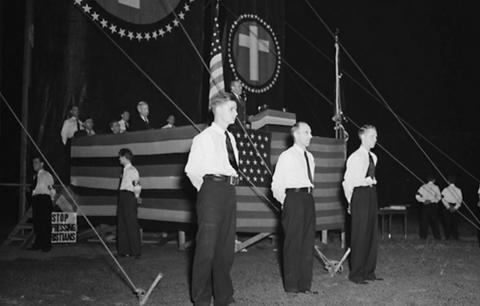
When Fascism Was American

Antisemitic Christian Mobilizers in New York in 1939.

Source: Portside

Author:Joe Allen/Jacobian

Emphasis Mine

(N.B.: Those who cannot remember the past are condemned to repeat it.  George Santayana, The Life of Reason.)

The US hasn’t seen the stirrings of fascist mobilization since the late 1930s when mounting fascist victories in Europe galvanized its adherents in America, chief among them Father Charles Coughlin and his Christian Front. This history has something to offer us today.
Joe Allen

The open racism and xenophobia that have characterized Donald Trump’s presidential campaign, and perhaps provided much of its appeal, has been alarming. For a growing number of people, Trump’s rhetoric is a sign of something deeper and more frightening: the growth of a fascist movement in the United States.

Ohio governor John Kasich — one of Trump’s many rivals for the Republican nomination — produced an anti-Trump video that paraphrases Protestant theologian Dietrich Bonhoeffer’s warning about the Nazis.

For many other commentators, as well, the violence Trump supporters have directed at critics during campaign rallies, along with the candidate’s call for banning Muslims from the United States, are further confirmation that Trump is a Nazi. In the last Democratic presidential debate, former Maryland governor and presidential candidate Martin O’Malley denounced Trump as a “fascist demagogue.”

Yet, on too many of these occasions, the fascist label has been reduced to a vague term of abuse rather than a bridge to a real political analysis of the underlying political forces that could produce a fascist movement in the United States.

The US hasn’t seen the stirrings of fascist mobilization since the late 1930s when mounting fascist victories in Europe galvanized its adherents in America, chief among them Father Charles Coughlin and his Christian Front. This history has something to offer us today.

Our Father

By late 1938, Nazi Germany and fascist Italy had shifted the balance of forces among the world’s major powers, while fascist general Francisco Franco wrestled most of Spain from republican forces. The growing power of fascism was increasingly impacting civilian populations, particularly in Germany. According to historian Warren Grover:

That year [1938] Germany demonstrated to the world that it would move with impunity in Europe and violate Jews’ most basic rights: Jewish community organizations lost their official status and recognition (March); the registration of all Jewish property became compulsory (April); over 1,500 German Jews were arrested and imprisoned in concentration camps (June); Jewish physicians could no longer treat Christians (June); Nazis ordered the destruction of the Great Synagogue in Munich (July); All Jewish men were required to add “Israel” to their name and all Jewish women “Sarah” (August); Jews were barred from practicing law (September); German-Jewish passports were marked with the letter “J” for Jude (October); and finally Kristallnacht (November).

In the United States, the public and the press were virtually unanimous in condemning Kristallnacht, with one poll reporting that nearly 94 percent of Americans disapproved of Germany’s treatment of Jews.

Yet despite Nazism’s unpopularity, one voice took to the airwaves to defend these actions — Father Charles E. Coughlin, a Catholic priest based in Royal Oak, Michigan. Coughlin was a popular radio personality with an audience of millions, largely concentrated in the northeastern United States, and in New York City in particular.

In a highly anticipated broadcast that took place eleven days after Kristallnacht, Coughlin began by posing three questions: “Why is there persecution in Germany today?”; “How can we destroy it?”; and why is “Nazism so hostile to Jewry?”

Coughlin presented a simple answer: Nazism was a “defense mechanism against Communism,” and that the “rising generation of Germans regard Communism as a product not of Russia, but of a group of Jews who dominated the destinies of Russia.”

In the broadcast Coughlin minimized the Nazi “fine” of $400 million on Germany’s Jewish community with the claim that “between these same years not $400 million but $40 billion . . . of Christian property was appropriated by the Lenins and Trotskys . . . by the atheistic Jews and Gentiles” and accused the New York investment bank Kuhn Loeb & Company with helping to finance the Russian revolution and other Communist plots.

Coughlin’s unapologetic Nazi propaganda inspired swift backlash. WMCA, the New York radio station that provided his largest audience, demanded to see his scripts in advance of any future broadcasts, and cancelled his program after he refused. Coughlin later admitted that he used “Nazi sources” in his broadcast.

Following the broadcast the New York Times’ Berlin correspondent reported that Coughlin had become “the new hero of Nazi Germany.” But Coughlin wasn’t only a hero in Berlin; thousands of American supporters responded enthusiastically to his calls for militant action against “atheistic communism.”

Coughlin began broadcasting from his Michigan church, “The Shrine of the Little Flower,” in 1926, when radio represented a novel, thrilling experience for millions of people. With his rich baritone voice, and slight Irish brogue which he employed for great theatrical effect, Coughlin was made for the new medium.

The 1929 Wall Street crash and the ensuing depression impoverished large parts of Coughlin’s working- and lower-middle-class audience. In the wake of the crisis his broadcasts changed from religious sermonizing to political commentary that began with violent attacks on communism. According to historian Alan Brinkley,

[Coughlin] continued to dwell upon his abhorrence of communism, socialism, and “kindred fallacious social and economic theories,” but [his broadcasts] also emphasized other concerns: Coughlin’s fear that the selfish practices of “predatory capitalism” would drive Americans to embrace these pernicious doctrines.

As Coughlin attacked the “banksters” he blamed for the Great Depression, his audience grew massive. By 1933, the network of radio stations that carried his broadcasts reached a potential listenership of forty million.

In November 1934, Coughlin announced that he would organize his followers into a new political organization, the National Union for Social Justice. He denied that it was a third party even though it bore the hallmarks of every traditional American political party, and was organized by congressional districts. Coughlin waited for the right issue to flex the muscles of his new formation and got it in January 1935 when Roosevelt proposed that the United States affiliate to the World Court. – See more at: http://portside.org/2016-01-02/when-fascism-was-american#sthash.ShNLQb0I.dpuf


He denied that it was a third party even though it bore the hallmarks of every traditional American political party, and was organized by congressional districts. Coughlin waited for the right issue to flex the muscles of his new formation and got it in January 1935 when Roosevelt proposed that the United States affiliate to the World Court.

No president since Woodrow Wilson — for fear of provoking an isolationist backlash — had proposed the US make itself accountable to an international institution. A largely symbolic act, it initially appeared that Roosevelt would win the Senate majority needed to ratify the treaty for affiliation.

Coughlin mobilized his forces along with other World Court opponents, including the mighty newspaper chain of arch-reactionary William Randolph Hearst. They overwhelmed Washington with hundreds of telegrams over one crucial weekend and defeated the treaty. A jubilant Coughlin declared that he intended to slay greater dragons. “Our next goal is to clean out the international bankers.”

The phrase “international bankers” was a euphamism for Jews and was widely used in those years by numerous public figures including auto magnate (and fellow Michigander) Henry Ford, who bankrolled the distribution of antisemitic propaganda through his newspaper the Dearborn Independent.

Coughlin made the leap from antisemitism to open fascism after his political ambitions were crushed in the 1936 election. Coughlin had merged his National Union of Social Justice with the remnants of the late Huey Long’s Share Our Wealth clubs, led by the antisemitic preacher Gerald L.K. Smith, and old-age pension activist Francis Townsend, in order to mount a third-party challenge to Roosevelt.

The Union Party nominated North Dakota congressman William Lemke for president. Roosevelt, however, had shifted dramatically to the left during the course of 1935. In the face of failing New Deal policies and a huge upsurge in labor struggle, the president signed into law historic legislation including the Social Security Act and the National Labor Relations Act, the popularity of which undercut any electoral challenge.

As Lemke’s campaign faltered, Coughlin grew increasingly agitated and vitriolic. “When an upstart dictator in the United States succeeds in making this a one-party form of government, then the ballot is useless,” he asserted to an audience of twenty-five thousand supporters in Providence, Rhode Island. Coughlin declared: “I shall have the courage to stand up and advocate the use of bullets” and promised “more bullet holes in the White House than you could count with an adding machine.”

Winning less than nine hundred thousand votes across the country, Lemke went down in crushing defeat while Roosevelt secured one of the biggest presidential landslides in US history. With the election over, Coughlin announced that he would retire from the airwaves. Despondent, he confided to a reporter, “Democracy is doomed. This is our last election . . . It is fascism or communism. We are at a crossroads.”

“What road do you take, Father Coughlin?” the reporter asked.

“I take the road of fascism,” the priest replied.

The Christian Front

In the estimation of biographer Donald Warren, “it would not be until 1938 that [Coughlin] truly was able to recover from defeat.” To an audience diminished but still numbering in the millions, he retook the airwaves emboldened by troubles for Roosevelt at home and the victories of fascism abroad. The short-lived economic recovery of the president’s first term had been wiped out by a dramatic downturn.

The “Roosevelt recession” brought mass unemployment and the forward march of the militant CIO was halted as factories and shipyards closed or laid off much of their workforces. Roosevelt’s bungled effort to pack the Supreme Court with his allies provided Dixiecrats and Republicans cover to sabotage and roll back the New Deal. Meanwhile in Europe, fascism advanced.

Starting in 1936, Coughlin augmented his radio presence with the newspaper Social Justice, sold on the streets of major cities especially in the Midwest and Northeast. As Warren notes, “throughout 1937 and into early 1938, Jewish financial control became a regular theme of Social Justice . . . [Coughlin] printed his own version of the very centerpiece of antisemitic literature at the time, the notorious Protocols of the Elders of Zion.”

Coughlin also attempted to make an alliance with Mussolini, offering the Italian dictator space in Social Justice to defend the racial policies of his government. (He got no reply.) In addition to their fascination with Mussolini, Coughlin and Social Justice were fixated on the Spanish Civil War and General Francisco Franco’s martial aura. They portrayed Franco as a hero defending “Christian civilization” from marauding communists.

The paper published lurid and false stories of Christians massacred by Republican forces, and baited American Jews for supporting the antifascist cause. Six months before Kristallnacht, he told his radio audience:

If every reader of Social Justice formed at once a platoon of 25 or more persons dedicated to opposing Communism in all its forms, a Christian Front of 25,000,000 Americans would already be in action.

Coughlin claimed he was inspired to call for a “Christian Front” by the Communist Party’s support for a Popular Front against fascism, but the call also evoked the “front line” of a war and his use of “platoon” left little room for interpretation. “Rest assured,” he threatened his left-wing enemies in a later radio address, “we will fight you in Franco’s way, if necessary . . . rest assured we will fight you and we will win.”

Following Kristallnacht and the public reaction to Coughlin’s commentary on Nazism, WMCA cancelled his broadcasts. In response, according to Donald Flamm, the owner of the Manhattan station, “several thousand people encircled the block where our studios are located, denounced the WMCA as un-American, and shouted its slogan of ‘Don’t buy from Jews,’ ‘Down with Jews,’ etc.” A memorandum of the American Jewish Council recorded “remarks uttered by the picketers . . . more explicit than the legends on the signs”:

Send refugees to Russia where they can be appreciated!

This is a Christian country. Who isn’t Christian throw them out!

Wait until Hitler comes over here.

Down with Jewish war-mongers.

Heil Hitler!

Determined to punish WMCA, the Christian Fronters demonstrated outside the station weekend after weekend. In an autobiography written two decades later, Wechsler recalled,

The Christian Front hysteria reached its peak in midsummer [1939]. There was a genuine fear that a fascist movement had finally taken root in New York, and that its counterpoint was developing in other areas under the stimulus of Coughlin’s weekly sermons.

The journalist estimated that the Christian Front held thirty rallies a week throughout all of the city’s boroughs, and attracted crowds as large as two thousand supporters. Jewish storeowners in Brooklyn and the Bronx faced regular Christian Front pickets.

Gene Fein, a historian of Christian Front, notes that a typical street meeting began with the proclamation, “For Christ and Country, I open this meeting in the name of the Christian Front! The leader of the Christian Front is Jesus Christ.” Queens Christian Front leader Daniel Kurz held regular public meetings in which he would address crowds with a paranoid mix of anticommunism, antisemitism, and xenophobia.

According to Fein, Kurz denounced the Russian revolution as a plot by Jews that slaughtered “thirty million Christians,” and proclaimed an immediate mortal danger posed by Trotsky in Mexico, where he said the Russian revolutionary was building a secret army, ready to join American comrades and launch a communist revolution while the military was tied up in Europe.

The Christian Front also issued a “Christian index” listing preferred shopkeepers and stores, and street sales of Social Justice by Christian Front members provided an easy excuse to provoke fights or heckle anyone who “looked Jewish.”

The heavily Irish New York Police Department and judiciary provided a supportive backdrop, going easy on Christian Fronters while leaning hard on antifascists. A rally of the Transport Workers Union — led by Mike Quill, the most high profile Irish Communist union official in New York — was attacked and nearly broken up by rightist mobs.

In August 1939, the hysteria spurred by fascist violence in New York reached its height as the Christian Mobilizers, an even more violent splinter of the Christian Front, took to the streets. Harper’s journalist Dale Kramer reported that New York police recorded the Mobilizers holding fifty meetings a week in that month alone, drawing a total audience of more than twenty thousand.

Not to be outdone, the Christian Front called for an August 19 “Manifestation of Christianity” — a march from Columbus Circle to Union Square, well-known as the home of the Communist Party’s national headquarters and many of the city’s most prominent unions. “I was convinced that the so-called parade,” reported John Roy Carlson, who gained fame with his exposé Under Cover: My Four Years in the Nazi Underworld of America, “would serve as the pretext for another bloody riot.”

Coughlin diassociated himself from the demonstration only after intense political pressure was brought to bear from the hierarchy of the Catholic Church and Mayor La Guardia’s office.

Despite spectacular street violence and the Christian Front’s remarkable degree of organization, observers were divided on the meaning of the growing movement. James Wechsler cautioned at the time that “a picture of sustained terrorism blanketing the city would be a wrong one,” and that “the Coughlin movement is still a ‘fringe’ affair; whatever mass sympathy it has evoked is of a passive sort, largely confined to the Catholic Church.”

For a variety of reasons, including the signing of the Hitler-Stalin Pact and the growing threat of a European-wide war, the fascist threat began to subside after the terrible summer of 1939. But the period provides a vivid image of how a powerful, organized fascist movement could emerge in the United States.

Past and Present

There is much to distinguish Coughlin’s United States from Donald Trump’s today. The country is substantively more diverse than it was seventy-five years ago and the traumatic memory of the Holocaust still renders the open embrace of fascism a ticket to the margins of society.

Nevertheless, three decades of inequality and austerity have impoverished large sections of the American working class — along with declining US political prestige, bloody military adventures, and pervasive outrage at corruption in mainstream politics — have made a growing number of Americans more receptive to xenophobic and racist appeals that give voice to the powerlessness they feel in the face of hardship.

Trump has tapped into this anger and sense of powerlessness brilliantly. But is Trump a fascist whose real politics are being revealed drip by drip? Perhaps. His incendiary speeches have certainly drawn comparisons with infamous demagogues of the American past, including Coughlin. But more pressing than the question of which ideological label most precisely applies to Trump is the larger political force he heralds.

Many liberals and Democratic Party strategists are overjoyed at the light in which Trump’s popularity has cast Republican presidential ambitions, and media speculation has focused heavily on his personal beliefs.

The Left should avoid this lazy politics and focus both on the economic and political conditions that have created a massive and growing constituency that enthusiastically supports Trump’s racist, sexist, and xenophobic worldview, and the potential emergence of a strong far-right movement independent of Trump. “We have been awakened,” a far-right activist recently told New Yorker journalist Evan Osnos.

The past shows that the US is not immune to fascism. We must take the current far-right upsurge seriously and use every tool at our disposal to destroy it.

Joe Allen’s latest book is People Wasn’t Made to Burn: A True Story of Race, Murder, and Justice in Chicago.

Jacobin relies on your generous support and subscriptions to keep publishing.

see:http://portside.org/2016-01-02/when-fascism-was-american

Bernie Would Do Better Than Hillary in 2016 Race Against Trump, National Poll Finds

But she would do better against other Republicans.

Source: AlterNet

Author: Steven Rosenfeld

Emphasis Mine

Another nationwide poll this week found Bernie Sanders would not only beat Donald Trump in the race for president, he would do significantly better than Hillary Clinton if he were the Democratic nominee facing Trump.

Trump trails either Democratic candidate, former Secretary of State Hillary Clinton or Sen. Bernie Sanders of Vermont, and 50 percent of American voters say they would be embarrassed to have Trump as president,” said the Quinnipiac University National poll. “American voters back Clinton over Trump 47-40 percent… Sanders tops Trump 51-38 percent.”

But that finding, based on interviews with 1,140 voters last week, also found that Sanders would lose by a few percentage points—just outside the poll’s margin of error—if he faced Sen. Marco Rubio for president, and that he would be tied with Sen. Ted Cruz if the race were held last week.

These hypotheticals don’t mean that much when looking toward voting in November 2016. But they are important signs about momentum and public perceptions going into the first nominating contests early next year, which begin in Iowa in less than six weeks. More than anything, the poll shows that the mainstream media’s lack of coverage of the Sanders campaign is doing a disservice to Democratic voters.

While many Democratic voters overwhelmingly say Clinton has the experience to be president, both she and Trump have the highest negative ratings of the entire 2016 field. Trump’s are worse: 59 percent of all voters polled give him an unfavorable rating overall, whereas that figure is 51 percent for Clinton and 31 percent for Sanders.

The public’s negative perceptions of Clinton and Trump are persistent and comparable, Quinnipiac found, even though two-thirds said she has the experience to be president and about the same percentage president, and that he would be tied with Sen. Ted Cruz if the race were held last week.

“Half of American voters say they’d be embarrassed to have Donald Trump as their Commander in Chief and most Americans think he doesn’t have a good chance in November, but there he is still at the top of the Republican heap,” said Tim Malloy, assistant director of the Quinnipiac University Poll. “Hillary Clinton tops him. Sen. Bernie Sanders hammers him and Sen. Ted Cruz is snapping at his heels. Can a candidate that half the American electorate thinks is an embarrassment win in November?”

Steven Rosenfeld covers national political issues for AlterNet, including America’s retirement crisis, democracy and voting rights, and campaigns and elections. He is the author of “Count My Vote: A Citizen’s Guide to Voting” (AlterNet Books, 2008).

See: http://www.alternet.org/election-2016/bernie-would-do-better-hillary-2016-race-against-trump-national-poll-finds?akid=13804.123424.6uuQ-M&rd=1&src=newsletter1047892&t=2

Bringing Socialism Back: How Bernie Sanders is Reviving an American Tradition – See more at: http://portside.org/2015-12-17/bringing-socialism-back-how-bernie-sanders-reviving-american-tradition#sthash.1nZaohKJ.dpuf

The Sanders campaign is resurrecting socialist electoral politics and paving the way for a more radical public discourse. Only the revival of a decimated labor movement and the rebirth of socialist political parties that can bring them all together could result in the major redistribution of wealth and power that would allow real movement on these individual issues. – See more at: http://portside.org/2015-12-17/bringing-socialism-back-how-bernie-sanders-reviving-american-tradition#sthash.1nZaohKJ.dpuf

Source: Portside

Author: Joseph M. Schwartz

Emphasis Mine

Socialism. For most of recent U.S. history, the word was only used in mainstream discourse as invective, hurled by the Right against anyone who advocated that the government do anything but shrink, as anti-tax advocate Grover Norquist once put it, “to the size where I can drag it into the bathroom and drown it in the bathtub.”
How is it, then, that Sen. Bernie Sanders (I-Vt.), a democratic socialist, has repeatedly drawn crowds in the thousands or tens of thousands in cities and towns throughout the nation and is within striking distance of Hillary Clinton in Iowa and New Hampshire? In a country that’s supposed to be terrified of socialism, how did a socialist become a serious presidential contender?
Young people who came to political consciousness after the Cold War are less hostile to socialism than their elders, who associate the term with authoritarian Communist regimes. In a Pew poll from December 2011, 49 percent of 18-to-29-year-olds in the United States held a favorable view of socialism; only 46 percent had a favorable view of capitalism. A New York Times/CBS News survey taken shortly before Sanders’ Nov. 19, 2015, Georgetown University speech on democratic socialism found that 56 percent of Democratic primary voters felt positively about socialism versus only 29 percent who felt negatively. Most of those polled probably do not envision socialism to be democratic ownership of the means of production, but they do associate capitalism with inequality, massive student debt and a stagnant labor market. They envision socialism to be a more egalitarian and just society.
 
More broadly, a bipartisan consensus has developed that the rich and corporations are too powerful. In a December 2011 Pew poll, 77 percent of respondents (including 53 percent of Republicans) agreed that “there is too much power in the hands of a few rich people and corporations.” More than 40 years of ruling class attacks on working people has revived interest in a political tradition historically associated with the assertion of working class power-socialism.
But at this point in American politics, as right-wing, quasi-fascist populists like Donald Trump, Ted Cruz and others of their Tea Party ilk are on the rise, we also seem to be faced with an old political choice: socialism or barbarism. Whether progressive politicians can tap into the rising anti-corporate sentiment around the country is at the heart of a battle that may define the future of the United States: Will downwardly mobile, white, middle- and working-class people follow the nativist, racist politics of Trump and Tea Partiers (who espouse the myth that the game is rigged in favor of undeserving poor people of color), or lead a charge against the corporate elites responsible for the devastation of working- class communities?

This may be the very audience, however, for whom the term socialism still sticks in the craw. In a 2011 Pew poll, 55 percent of African Americans and 44 percent of Latinos held a favorable view of socialism-versus only 24 percent of whites. One might ask, then: Should we really care that the term “socialism” is less radioactive than it used to be? With so much baggage attached to the word, shouldn’t activists and politicians just call themselves something else? Why worry about a label as long as you’re pursuing policies that benefit the many rather than the few? Is socialism still relevant in the 21st century?

Fear of the `s’ word
To answer this question, first consider how the political establishment uses the word. The Right (and sometimes the Democrats) deploy anti-socialist sentiment against any reform that challenges corporate power. Take the debate over healthcare reform, for example. To avoid being labeled “socialist,” Obama opted for an Affordable Care Act that expanded the number of insured via massive government subsidies to the private healthcare industry-instead of fighting for Medicare for All and abolishing private health insurers. The Right, of course, screamed that the president and the Democratic Party as a whole were all socialists anyway and worked (and continues to work) to undermine efforts to expand healthcare coverage to anyone.
But what if the United States had had a real socialist Left, rather than one conjured up by Republicans, that was large, well-organized and politically relevant during the healthcare reform debate? What would have been different? For one thing, it would have been tougher for the Right to scream “socialist!” at Obama, since actual socialists would be important, visible forces in American politics, writing articles and knocking on doors and appearing on cable news. Republicans would have had to attack the real socialists-potentially opening up some breathing room for President Obama to carry out more progresssive reforms. But socialists wouldn’t have just done the Democrats a favor-they would also demand the party go much further than the overly complicated and insurance company friendly Obamacare towards a universal single-payer healthcare program. The Democrats needed a push from the Left on healthcare reform, and virtually no one was there to give it to them.
What is democratic socialism?
So what do we mean by “democratic socialism“? Democratic socialists want to deepen democracy by extending it from the political sphere into the economic and cultural realms. We believe in the idea that “what touches all should be governed by all.” The decisions by top-level corporate CEOs and managers, for example, have serious effects on their employees, consumers and the general public-why don’t those employees, consumers and the public have a say in how those decisions get made?

Democratic socialists believe that human beings should democratically control the wealth that we create in common. The Mark Zuckerbergs and Bill Gateses of the world did not create Facebook and Microsoft; tens of thousands of programmers, technical workers and administrative employees did-and they should have a democratic voice in how those firms are run.

To be able to participate democratically, we all need equal access to those social, cultural and educational goods that enable us to develop our human potential. Thus, democratic socialists also believe that all human beings should be guaranteed access, as a basic social right, to high-quality education, healthcare, housing, income security, job training and more.
And to achieve people’s equal moral worth, democratic socialists also fight against oppression based on race, gender, sexuality, nationality and more. We do not reduce all forms of oppression to the economic; economic democracy is important, but we also need strong legal and cultural guarantees against other forms of undemocratic domination and exclusion.
What socialism can do for you
The United States has a rich-but hidden-socialist history. Socialists and Communists played a key role in organizing the industrial unions in the 1930s and in building the civil rights movement in the 1950s and 1960s; Martin Luther King Jr. identified as a democratic socialist; Bayard Rustin and A. Philip Randolph, the two key organizers of the 1963 March on Washington for Jobs and Freedom were both members of the Socialist Party. Not only did Socialist candidate Eugene V. Debs receive roughly 6 percent of the vote for president in 1912, but on the eve of U.S. entry into World War I, members of the Socialist Party held 1,200 public offices in 340 cities. They served as mayors of 79 cities in 24 states, including Minneapolis, Milwaukee, Reading, Penn., and Buffalo.
Brutally repressed by the federal government for opposing World War I and later by the Cold War hysteria of the McCarthy era, socialists never regained comparable influence. But as organizers and thinkers they have always played a significant role in social movements. The real legacy of the last significant socialist campaigns for president, those of Eugene V. Debs and Norman Thomas, is how the major parties, especially the Democrats, co-opted their calls for workers’ rights, the regulation of corporate excess and the establishment of social insurance programs.
As the erosion of the liberal and social democratic gains of the post-World War II era throughout the United States, Europe and elsewhere shows, absent greater democratic control over the economy, capital will always work to erode the gains made by working people. This inability to gain greater democratic control over capital may be a contributing factor to why the emerging social movements resisting oligarchic domination have a “flash”-like character. They erupt and raise crucial issues, but as the neoliberal state rarely grants concessions to these movements, they often fade in strength. Winning concrete reforms tends to empower social movements; the failure to improve the lives of their participants usually leads these movements to dissipate.

In the United States, nascent movements like Occupy Wall Street, the Fight for 15, Black Lives Matter and 350.org have won notable reforms. But few flash movements have succeeded in enacting systemic change. Only the revival of a decimated labor movement and the rebirth of governing socialist political parties could result in the major redistribution of wealth and power thatwould allow real change on these issues.

For all their problems-and there are many-this is the promise of European parties like Syriza in Greece and Podemos in Spain. But the Syriza government retreated back to austerity policies, in part because Northern European socialist leaders failed to abandon their support for austerity. The election of Jeremy Corbyn as leader of the British Labour Party may represent the first step in rank-and-file socialists breaking with “third way” neo-liberal leadership.
Is Bernie really a socialist?
For Sanders, “democratic socialism” is a byword for what is needed to unseat the oligarchs who rule this new Gilded Age. In his much-anticipated Georgetown speech, Sanders defined democratic socialism as “a government which works for all of the American people, not just powerful special interests.” Aligning himself with the liberal social welfare policies of Franklin D. Roosevelt and Lyndon B. Johnson, Sanders called for restoring progressive income and strict corporate taxation to fund Medicare for All, paid parental leave, publicly financed child care and tuition-free public higher education.
Yet he backed away from some basic tenets of democratic socialism. He told the audience, “I don’t believe the government should take over the grocery store down the street or own the means of production.” But democratic socialists want to democratize decisions over what we make, how we make it and who controls the social surplus.
In truth, Sanders is campaigning more as a social democrat than as a democratic socialist. While social democrats and democratic socialists share a number of political goals, they also differ on some key questions of what an ideal society would look like and how we can get there. Democratic socialists ultimately want to abolish capitalism; most traditional social democrats favor a government-regulated capitalist economy that includes strong labor rights, full employment policies and progressive taxation that funds a robust welfare state.
So why doesn’t Sanders simply call himself a New Deal or Great Society liberal or (in today’s terms) a “progressive”? In part, because he cannot run from the democratic socialist label that he has proudly worn throughout his political career. As recently as 1988, as mayor of Burlington, Vt., he stated that he desired a society “where human beings can own the means of production and work together rather than having to work as semi-slaves to other people who can hire and fire.

But today, Sanders is running to win, and invoking the welfare state accomplishments of FDR and LBJ plays better with the electorate and the mainstream media than referencing iconic American socialists like Eugene V. Debs. In his Georgetown speech, Sanders relied less on references to Denmark and Sweden; rather, he channeled FDR’s 1944 State of the Union address in which hecalled for an Economic Bill of Rights, saying, “true individual freedom cannot exist without economic security and independence. ‘Necessitous men are not free men.'”

Sanders’ campaign rhetoric does occasionally stray into more explicitly democratic socialist territory, though. He understands the nature of class conflict between workers and the corporate moguls. Unlike most liberals, Sanders recognizes that power relations between the rich and the rest of us determine policy outcomes. He believes progressive change will not occur absent a revival of the labor movement and other grassroots movements for social justice. And while Sanders’ platform calls primarily for government to heal the ravages of unrestrained capitalism, it also includes more radical reforms that shift control over capital from corporations to social ownership: a proposal for federal financial aid to workers’ cooperatives, a public infrastructure investment of $1 trillion over five years to create 13 million public jobs, and the creation of a postal banking system to provide low-cost financial services to people presently exploited by check-cashing services and payday lenders.
 
Harnessing the socialist energy
While Sanders is not running a full bore democratic socialist campaign, socialists must not let the perfect be the enemy of the good. The Sanders campaign represents the most explicit anticorporate, radical campaign for the U.S. presidency in decades. Thus the Democratic Socialists of America (DSA), of which I am a vice-chair, is running an “independent expenditure campaign” (uncoordinated with the official campaign) that aims to build the movement around Sanders-and its “political revolution”-over the long run.
For us, even if Sanders’ platform isn’t fully socialist, his campaign is a gift from the socialist gods. In just six months, Sanders has received campaign contributions from 800,000 individuals, signed up tens of thousands of campaign workers and introduced the term “democratic socialism” and a social democratic program to tens of millions of Americans who wouldn’t know the difference between Trotsky and a tchotchke. Since the start of the Sanders campaign, the number of people joining DSA each month has more than doubled.
 

Though elected to both the House and Senate as an independent, Sanders chose to run in the Democratic presidential primary because he understood he would reach a national audience in the widely viewed debates and garner far more votes in the Democratic primaries than he would as an independent in the general election. The people most vulnerable to wall-to-wall Republican rule (women, trade unionists, people of color) simply won’t “waste” their votes on third-party candidates in contested states in a presidential election.

The mere fact of a socialist in the Democratic primary debates has created unprecedented new conversations. Anderson Cooper’s initial question to Sanders in the first Democratic presidential

debate, in front of 15 million viewers, implicitly tried to red-bait him by asking, “How can any kind of a socialist win a general election in the United States?” The question led to a lengthy discussion among the candidates as to whether democratic socialism or capitalism promised a more just society. When has the capitalist nature of our society last been challenged in a major presidential forum?

Yet without a major shift in sentiment among voters of color and women, Sanders is unlikely to win the nomination. Sanders enthusiasts, who are mostly white, have to focus their efforts on expanding the racial base of the campaign. But, regardless of who wins the nomination, Sanders will leave behind him a transformed political landscape. His tactical decision to run as a Democrat has the potential to further divide Democrats between elites who accommodate themselves to neoliberalism and the populist “democratic” wing of the party.
Today, Democrats are divided between affluent, suburban social liberals who are economically moderate-even pro-corporate-and an urban, youth, black, Latino, Asian American, Native American and trade union base that favors more social democratic policies. Over the past 30 years, the national Democratic leadership-Bill Clinton, Rahm Emanuel, Debbie Wasserman Schultz-has moved the party in a decidedly pro-corporate, free-trade direction to cultivate wealthy donors. Sanders’ rise represents the revolt of the party’s rank and file against this corporate-friendly establishment.
Successful Left independent or third-party candidates invariably have to garner support from the same constituencies that progressive Democrats depend on, and almost all third-party victories in the United States occur in local non-partisan races. There are only a few dozen third-party members out of the nearly 7,400 state legislators in the United States. Kshama Sawant, a member of Socialist Alternative, has won twice in Seattle’s non-partisan city council race, drawing strong backing from unions and left-leaning Democratic activists (and some Democratic elected officials). But given state government’s major role in funding public works, social democracy cannot be achieved in any one city.
The party that rules state government profoundly affects what is possible at the municipal level. My recollection is that in the 1970s and 1980s, DSA (and one of its predecessor organizations, the Democratic Socialist Organizing Committee) had more than 30 members who were elected members of state legislatures or city councils. Almost all of those socialist officials first won Democratic primaries against conservative Democratic opponents. In the seven states (most notably in New York, Connecticut and Oregon) where third parties can combine their votes with major party lines, the Working Families Party has tried to develop an “inside-outside,” “fusion” strategy vis-a-vis the Democrats. But the Democratic corporate establishment will never fear progressive electoral activists unless they are willing to punish pro-corporate Democrats by either challenging them in primaries or withholding support in general elections.
The mere fact of a socialist in the Democratic primary debates has created unprecedented new conversations. Anderson Cooper’s initial question to Sanders in the first Democratic presidential
The tragedy of Jesse Jackson’s 1988 campaign was that despite winning 7 million votes from voters of color, trade unionists and white progressives, the campaign failed to turn its Rainbow Coalition into an electoral organization that could continue the campaign’s fight for racial and economic justice. This lesson is not lost on Sanders; he clearly understands that his campaign must survive his presidential bid.
As In These Times went to press, the Sanders campaign only has official staff in the early primary states of New Hampshire, Iowa, South Carolina and Nevada. Consequently, the Sanders movement is extremely decentralized, and driven by volunteers and social media. Only if these local activists are able to create multi-racial progressive coalitions and organizations that outlast the campaign can Sanders’ call for political revolution be realized.
 
Campaign organizations themselves rarely build democratic, grassroots organizations that persist after the election (see Obama’s Organizing for America). Sanders activists must keep this in mind and ask themselves: “What can we do in our locality to build the political revolution?” The Right still dominates politics at the state and local level; thus, Sanders activists can play a particularly crucial role in the 24 states where Republicans control all three branches of the government.
Embracing the `s’ word
Sanders has captivated the attention of America’s youth. He has generated a national conversation about democratic socialist values and social democratic policies. Sanders understands that to win such programs will take the revival of mass movements for low wage justice, immigrant rights, environmental sustainability and racial equality. To build an independent left that operates electorally both inside and outside the Democratic Party, the Sanders campaign-and socialists-must bring together white progressives with activists of color and progressive trade unionists. The ultimate logic of such a politics is the socialist demand for workers’ rights and greater democratic control over investment.
If Sanders’ call for a political revolution is to be sustained, then his campaign must give rise to a stronger organization of long-distance runners for democracy-a vibrant U.S. democratic socialist movement. Electoral campaigns can mobilize people and alter political discourse, but engaged citizens can spark a revolution only if they build social movements and the political institutions and organizations that sustain political work over the long-term.

And because anti-socialism is the ideology that bipartisan political elites deploy to rule out any reforms that limit the prerogatives of capital, now is the time for socialists to come out of the closet. Sanders running in the Democratic primaries provides an opportunity for socialists to do just that, and for the broad Left to gain strength. If and when socialism becomes a legitimate part of mainstream U.S. politics, only then will the political revolution begin.

Joseph M. Schwartz
[Joseph M. Schwartz is a professor of political science at Temple University. He is a Vice-Chair of Democratic Socialists of America and the author, most recently, of The Future of Democratic Equality: Reconstructing Social Solidarity in a Fragmented U.S. (Routledge, 2009).]
Thanks to the author for sending this to Portside.

– See more at: http://portside.org/2015-12-17/bringing-socialism-back-how-bernie-sanders-reviving-american-tradition#sthash.1nZaohKJ.dpuf

See: http://portside.org/2015-12-17/bringing-socialism-back-how-bernie-sanders-reviving-american-tradition

Trump and the joys of hatred

Source: Tablet.com

Author: Paul Berman

Emphasis Mine

Donald Trump’s supporters turn out to be (as discovered by the statisticians, as reported by the political analysts) 55 percent white working-class, many of them males from age 50 to 64, without college degrees. And, in the analysts’ view, a political logic accounts for these people’s sympathies. The white workers are submerged in economic insecurity, and they blame their circumstances on illegal immigrants from Mexico, and they appreciate their candidate’s forceful anti-immigrant hostility. Nor do they want the United States to accept refugees from Syria. Their feelings on this matter draw them to Trump yet again. Such is the explanation. It makes sense. But I worry about explanations that make too much sense.

The whole phenomenon of people being upset over the Mexican immigration, to begin with—isn’t there something odd in this? We are right now experiencing an unemployment rate nationally of 5.5 percent, which really isn’t bad. Naturally people feel insecure economically, but the grounds for this are multiple: the competition from other countries (e.g., from Mexicans who do not immigrate); the fact that technological advances are always rendering one craft or another obsolete; the likelihood that one of these days the entirely American banks or the stock market will bring about still another financial crisis. And so forth. Why the emphasis on Mexican immigrants, then?

The first of the primaries will take place in a few weeks in New Hampshire, where Trump is said to be doing well. Is there something special to be learned from New Hampshire? Googling about, I discover that, at the University of New Hampshire this past July, the Carsey School of Public Policy issued a report saying that—I quote—“migration from Mexico to the U.S. dropped more than 50 percent in the last five years.” Other reports go further: More Mexicans are returning to Mexico than are coming to the United States. Immigration has mutated into emigration. However terrible the competition from Mexican immigrants may have been in the past (but how terrible was it?), the terribleness appears to be diminishing. You will recall Trump’s much-discussed outburst about Mexico: “They’re sending people that have lots of problems, and they’re bringing those problems to us. They’re bringing drugs. They’re bringing crime. They’re rapists. And some, I assume, are good people!” To judge from the University of New Hampshire report, though, rather a lot of the immigrants are “good people”: “Those migrating tend to have higher socioeconomic status, are older, and are more likely to be women.” The crisis of immigration appears to be, in short, substantially a non-crisis.

The late-middle-aged white workers, then—what do they see in Trump? And what do they make of his proposal for dealing with the not-really-a-crisis? His proposed deportation of 11 million people would amount to the largest mass deportation in world history. You have only to picture for a moment the massed police and immigration agents and National Guard mobilizations to recognize that it is not going to happen. Suppose that a President Trump managed to do it, anyway. It would out-Stalin Stalin. The economic consequences alone would be catastrophic, given the unemployment rate. Entire industries would sink into the underpopulated sands. In my own town, which is New York, the restaurant industry would fall apart in 30 seconds if someone were to issue arrest warrants for the undocumented laborers from the city of Puebla, Mexico, who are toiling in the hellish kitchens. But then, Trump’s idea about deporting the millions is no more preposterous than his other proposal in regard to the Mexican immigration, which is to build a wall between Mexico and the United States and get the Mexican government pay for it. Not a soul on earth believes in the possibility of such a thing.

For that matter, does anyone honestly believe that Trump is going to be elected president? Pollsters tell us that people do believe it. But Trump has never actually tried to present himself as a presidential personality. When he stands in the row along with the all the other Republican debaters, he makes no effort to appear like any of the others. His look is a combination of dapper and bedraggled. The weight of his hair appears to have crushed his face like a pumpkin. He speaks with the peremptory tone of a New York gangster, sometimes with a trace of humor, which is charming, but always with an overtone of threat. Never does he sound like a man trying to assemble a coalition of supporters. Nor does he appear to aspire to be anyone’s second choice, though in a race with 16 candidates, a second-choice candidate has a shot at winning.

His supporters, then, the ones who have been around the block, who know how presidential elections go—what are they dreaming of? I think they support the Donald precisely because he is ridiculous. His impudence is his appeal. They cannot have given any serious thought to the economy or immigration or any of the major issues. They like how he insults his interviewers. Has he mocked a woman journalist’s period? Hah hah!—what other politician would dare do such a thing? Has he insulted John McCain? Here is bravery, given that everyone knows that McCain is a war hero. Has he ordered Jorge Ramos, the Univision news anchorman, to be escorted from the room? All the better! They like the fact that Trump doesn’t give a damn about being respectable or likable or courteous. He burps in your face. They will vote for such a man.

It has to be conceded that Trump is good at being bad. It comes to him naturally, even biologically. According to his biographer Gwenda Blair, Trump’s grandfather was an immigrant from Germany who made a fortune running brothel-restaurants in Seattle and the Canadian Yukon during the Klondike gold rush of the 1890s (where the brothels contained, in each room, a scale for weighing gold dust in payment). And the grandfather knew how, in a feat of reverse alchemy, to turn gold into real estate. Trump’s father expanded the holdings into a real-estate empire in the New York outer boroughs. The Donald himself succeeded in expanding the empire into Manhattan and then into businesses of all sorts: the Miss USA beauty pageant, hotels, golf courses, a gambling casino (which failed), an airline (which he was obliged to sell), men’s clothes, chocolate, restaurants, and more, some of them his own properties, others merely arrangements to license his name. And, with each new acquisition or product, he inscribed that name in ever gaudier letters into the American landscape. “Trump: the Fragrance” was always a joke, along with “Trump,” the vodka (which failed, though my own liquor store stocks it). But the jokes and non-jokes cleverly established a brand, which stands for a combination of good workmanship (Trump has constructed many buildings, none of which have fallen down) and execrable taste. He has also made a point of inhabiting the gossip pages, married to one fashion model or another, or dating this lady or that in a spirit of conquest—Carla Bruni, though he claims to regret having failed to date Princess Diana—which, after a while, led to a television career, where he turns out to be exceptionally talented.

It is because he is a fanatic of his own cause. He is at ease with himself, which makes him easy to watch. He looks absurd spreading his arms to show how absurd is the world, which allows him to make his points and amuse his audiences at the same time. And it was no small thing to come up with The Apprentice, his reality TV show, featuring the cult of his own personality. At its height this show attracted 28 million viewers, which is more than have watched any of the political debates of the campaign season, so far. On The Apprentice, Trump plays Donald J. Trump, who is the tycoon of a business empire. He summons his underlings to a meeting. They grovel. They discuss each other’s faults and failures. He listens. His demeanor appears to be almost kindly. And yet, he makes clear that, unlike all of his employees, he commands insights into the ingredients of business success. He sees what ordinary mortals cannot see. Therefore he sees how lamentable are his employees’ flaws and errors. And he fires someone. Or he fires them all. He does this because he understands how the world works. It is a matter of tragic wisdom. He understands that the world is cruel, even if he himself is not cruel, and he has no choice but to do as the world commands, which is to liquidate those who must be liquidated.

You’re fired”—his most famous phrase—has got to be the ghastliest slogan ever heard from a presidential candidate. The fired employee receives the news in shock. The victim’s face freezes, then quivers. The employee knows there is no appeal. Mr. Trump has spoken. He is a Hollywood Mafia don—the crime chieftain who does not enjoy ordering the murder of his best friend, but who understands that, in the world of crime, there is no forgiveness. Afterward, Mr. Trump, like the Mafia don, is serene, perhaps even slightly pleased at the spectacle of his own competence.

And people like this man! They want to vote for him, yes, they do. It is because Trump is the nihilist candidate. There are people who would like to see Trump become president because, for the next four years, television news would be better even than The Apprentice. Trump’s supporters are losers, and they know they are losers. Trump knows how to be the loser’s idea of a winner. He wallows in the material extravagance of his triumphs, the fame, the leggy women, the television cameras, the gold, the platinum, the lush carpets, the airplanes, the servile workers, the orgy of arrogance that appears to be his life, the bad taste as a display of macho.

And the deeper he wallows, the greater is the freedom that he grants to his followers to wallow in their own fantasies of grandeur. Their own fantasies cannot of course be material. Such is the fate of the working class. But grandeur can be emotional. And so, the followers indulge their urge to hate. The Donald tells them that hatred is OK, and they yield to it. The wonderful thing about hatred is that it does not require a particular object. Any object will do. Sartre made this point in his book Reflections on the Jewish Question. The Mexican immigrants will do perfectly, even if in reality Mexicans are crucial to the American economy and are diminishing in numbers. The Donald tells his followers not to accept the poor refugees from Syria, and the followers feel entitled to shiver in horror and fear. The Donald is right now whipping up a hatred for Muslims in New Jersey. I would imagine that, all over the country, his followers are pounding the table in contemptuous disdain for New Jersey Muslims. Who will it be next week? Probably more Muslims. Trump has discovered that, for him, there is no downside in conjuring hatreds of this sort. The respectable journalists indignantly reveal that his claims vary from the reality, but this merely allows him to display still more disdain for the respectable journalists, who surely figure in his own mind as the true enemy. And so he will continue, and his followers will feel that, during the course of his campaign, they have been able to live life more intensely even than in the glorious times gone by when they used to watch Trump dismiss his flunkies on The Apprentice.

The Trump candidacy ought to remind us of the ancient reality that politics is not necessarily the home of the rational—a truth to be found in the pages of Suetonius. I point to Marx’s The Eighteenth Brumaire of Louis Bonaparte, from 1852. It is a study of the aftermath of the revolution of 1848 in France. Louis Bonaparte was a laughable character, but in the aftermath of the revolution public life was unsettled, and it was not clear what sort of government France was going to have. The laughable character happened to be the great Napoleon Bonaparte’s nephew, and this sufficed to bring him to power. The stupid peasants voted for him. He established a dictatorship. It was absurd, but it happened. The story of Louis Bonaparte was the occasion for Marx’s remark about history taking place twice, the first time as tragedy (Napoleon), the second time as farce (the nephew). Marx wanted to draw from these events a lesson about the class struggle, but I think that he stumbled on a different and eternal truth, which has to do with the place of theater—of tragedy and farce, theatrical genres—in political life. Reality TV, in Trump’s version of it, is our modern farce. There are people who demand their daily farce: This was Marx’s unwitting discovery. They insist on being entertained. About the realities of their own political situation, those people may understand nothing. They understand a personal reality, though. They want to sit in the audience and laugh and cry. Especially they want to shake their fists at villains. They want to boo and hiss. They want to tremble in loathing. If someone comes out on stage who is capable of making them do so, they will clap. It is pathetic.

See: http://www.tabletmag.com/jewish-news-and-politics/195446/trump-and-the-joys-of-hatred?utm_source=tabletmagazinelist&utm_campaign=21d88b6163-Sunday_December_13_201512_11_2015&utm_medium=email&utm_term=0_c308bf8edb-21d88b6163-206691737

GOP Debate Scorecard: The Big Winner Wasn’t Anyone on the Stage, It Was Democrats

Trump comes off as a sniveling bully; Bush as simple-minded; Cruz as maniacal. And that’s good news for Democrats.

Source: AlterNet

Author: Amanda Marcotte/Salon

Emphasis Mine

One thing is certain from Tuesday night’s Republican debate on CNN: Whatever polling data the Republicans are reading, it’s telling them that GOP primary voters are worried that ISIS is sneaking in through the air ducts and that the only thing that will save them now is thumping your chest really hard and repeating, “Radical Islamic terrorism, radical Islamic terrorism, radical Islamic terrorism” until the magical spell works and the baddies go away.

Oh, and bombing someone. Definitely have to bomb someone.

So who won this debate, clearly aimed at people who, like Lindsey Graham, really miss the Bush administration and those carefree days when it seemed that all the world’s problems could be solved by bombing some innocent civilians half a world away? Here’s an examination:

Winner, Untouchable Division: Donald Trump. Trump came across as a sniveling bully and a consummate bullshitter who clearly just says the first thing that pops into his head and then, when confronted, just doubles down on it instead of admitting he was wrong. But that’s never hurt him in the polls before, and it’s unlikely to do so now.

Bonus points: Trump’s “plan” to bar Muslims from traveling into the U.S. became one of the central points of contention in the debate. Trump continues to amaze with his ability to control the narrative just by flapping his loose jaws while other politicians fail to get a word in edgewise with their carefully constructed talking points.

Loser, Conservatives Are A-Skeered DivisionRand Paul. The crowd was definitely not feeling his attempts to be a maverick by rejecting the security state and (some) war. Paul, never the principled libertarian he plays on TV, did his best to pander to the heightened bloodthirst of the conservative crowd by chasing after Rubio on immigration, but ultimately the moment fell flat, flatter than Paul’s poll numbers.

Winner, Impressing The Political Press Division: Jeb Bush.

Bush’s war-mongering and simple-minded posturing would probably not hold up well in a contest with Hillary Clinton. However, he said a couple of things that were true during this debate, such as noting that all this Muslim-bashing is going to undermine our relationships with Muslim allies we need to fight ISIS. This made him look like a foreign policy genius compared to the clowns on stage pretending Syrian orphans are about to go jihad on us, and he’ll probably get a bunch of kudos for it from the political press.

Loser, Actually Getting Anywhere With The Voters Division: Jeb Bush. The audience loved it when Bush said, “Donald, you’re not going to be able to insult your way to the presidency,” but only, oh irony, because Trump has trained them over months to react to every feeble insult like it’s the sickest burn they’ve ever heard. But despite landing a couple of blows during the debate, Bush’s concluding remarks were so limp he got bored with them and trailed off. Voters will soon forget that he’s even in this race.

Winners, Tap-Dancing Around The “How Fascist Are You” Question Division:Carly Fiorina and Marco Rubio. You can’t denounce Trump’s nutty idea of a Muslim travel ban, because you’ll just drive more of your idiot base into his arms. But you can’t endorse it, either, because it’s unconstitutional and seriously a legitimate threat to national security. So both candidates, when faced with the question, rattled off officious-sounding nonsense to run out the clock. Rubio gave us a history of the San Bernardino shooter and Fiorina gave us a history of social media, but both accomplished the main goal of babbling until the buzzer sounded without either of them actually answering the question.

Loser, What’s This Debate About Again Division: Chris Christie. Christie’s Hail Mary pass in the past few months is to paint himself as a “law and order” type, feeding off conservative hostility to the Black Lives Matter movement in hopes of getting some kind of attention. An entire debate dedicated to Syrian politics did not help him in this mission, even though he mentioned that he’s a federal prosecutor roughly 1.2 billion times during the debate.

Winner, Oh God He Might Actually Win DivisionTed Cruz. He was nearly as maniacal as Donald Trump when it comes to racist pandering and was by far the most convincing in the contest to see who is most eager to kill them all and let God sort them out. This is a man who knows how to fight and claw his way to the top of any trash pile you give him, and winning the Republican nomination is what he was born to do. Be afraid, be very afraid.

Loser, Being Able To Sleep At Night Edition: The viewers. Well, at least viewers who still have enough wits about them to know Barack Obama isn’t a secret Muslim and that chemtrails aren’t mind control. Those viewers watched candidates dedicate nearly 2 hours out of a 2 and a half hour debate to the question of Syrian politics and the most immediate takeaway is not a one of them has the first clue about what’s really going on in the unbelievably complex civil war there.

Oh, the candidates know that Bashar al-Assad is on one side and ISIS is on the other and that Vladimir Putin is being a dick, all of which is probably more understanding that the typical Republican voter has regarding the whole thing. But memorizing these little factoids is hardly relevant when you still think the solution to an intricate civil war that mostly isn’t about us at all is to stand around declaring how tough you are.

Winner, General Election Division: The Democrats. The Republicans look for all the world like they’re going to nominate their candidate based on fears about a country most of them can’t find on a map. Better yet, that candidate will not be chosen based on his foreign policy qualifications, but on whether or not he said the nastiest things about Muslims. Either way, it’s going to be fun for the Democrat to run against this impetuous pick 11 months from now, when the issue of Islamic terrorism has faded from the public imagination and journalists have returned to asking questions about issues that are far more immediate to voters than who has a leg up in the Syrian civil war this week.

Amanda Marcotte co-writes the blog Pandagon. She is the author of “It’s a Jungle Out There: The Feminist Survival Guide to Politically Inhospitable Environments.”

See: http://www.alternet.org/news-amp-politics/gop-debate-scorecard-big-winner-wasnt-anyone-stage-it-was-democrats?akid=13782.123424.ZFQd7f&rd=1&src=newsletter1047420&t=4

Trump’s Anti-Muslim Proposal Puts GOP In A Bind

Source:National Memo

Author: Mark Z.Barabak

Emphasis Mine

Donald Trump may be an imperfect candidate — he is coarse, impetuous, antagonistic — but he presents the Republican Party with a perfect dilemma.

For the second straight day, the world of politics was consumed with Trump’s latest provocation, a call for a near-blanket ban on Muslims entering the United States, underscoring the billionaire’s continued sway over his adopted party, its presidential candidates and the GOP agenda.

Many Republican were quick to denounce the proposal though, notably, not its progenitor, fearing a backlash should Trump become the party’s eventual nominee. He, is after all, the leader in opinion polls and a favorite of many voters disgusted with more guarded, standard-issue politicians.

“This is not conservatism. What was proposed yesterday … is not what this party stands for,” House Speaker Paul Ryan, R-Wis., told reporters Tuesday after a meeting with GOP House members on Capitol Hill. “And more importantly, it’s not what this country stands for.”

Other members of the Republican establishment weighed in with criticism as well, including party leaders in three of the earliest-voting states, South Carolina, New Hampshire and Iowa.

“As a conservative who truly cares about religious liberty, Donald Trump’s bad idea and rhetoric send a shiver down my spine,” Matt Moore, head of the South Carolina Republican Party, wrote on Twitter.

Jennifer Horn, leader of the New Hampshire GOP, called Trump’s proposal “un-American” and “un-Republican.”

But the condemnations went only so far, as Ryan, Senate Majority Leader Mitch McConnell, R-Ky., and other Republicans vowed to support Trump, whatever their qualms, should he emerge as the GOP’s standard-bearer.

Even Jeb Bush, who called Trump “unhinged” for proposing a religious test on newcomers as a way to fight terrorism, declined to back off an earlier pledge of support.

“Look, he’s not going to be the nominee,” the former Florida governor insisted when pressed by reporters at a campaign stop in New Hampshire.

What, then, was his message to Trump supporters? “I’d love for them to consider my candidacy,” Bush replied.

The exchange captured the quandary that the GOP and its presidential hopefuls have faced ever since Trump bulldozed his way into the race: How to distance themselves from his inflammatory statements without alienating Trump supporters, or provoking him into a ruinous third-party run should he fall short of the nomination.

“A new poll indicates that 68 percent of my supporters would vote for me if I departed the GOP & ran as an independent,” Trump posted on Twitter, citing a Suffolk University poll, as Tuesday’s chorus of Republican criticism grew.

The message, in characteristic Trump fashion, was as subtle as a kick in the shins.

Unabashed, he seized on the furor he created — and the wall-to-wall cable news coverage that followed — to defend his exclusionary plan and brush aside detractors.

“You’re going to have many more World Trade Centers if you don’t solve it. Many, many more and probably beyond the World Trade Center,” Trump said in a CNN interview, referring to the Sept. 11, 2001, attacks.

On MSNBC, he said barring followers of the Islamic faith from the U.S. would be as easy as authorities asking them at entry points about their religious affiliation “They would say, ‘Are you Muslim?’” Trump explained.

He cited the precedent set during World War II when the U.S. government investigated people of German and Italian ancestry, and ordered those of Japanese descent to be locked away in internment camps.

“You certainly aren’t proposing internment camps?” asked host Joe Scarborough.

“We’re not talking about Japanese internment camp,” Trump responded. “No, not at all.”

Such distinctions aside, Democrats happily piled on the Republican front-runner and his extraordinary response to the terror attacks on Paris and San Bernardino, Calif., a counter to President Barack Obama’s call to avoid targeting all members of the Muslim faith.

Trump’s emergence comes at a critical time for the GOP, which has lost the popular vote in five of the last six presidential elections.

The party’s political base of older whites is aging out of the electorate and Republicans have struggled to appeal to the growing ranks of younger and minority voters, a task that grows more difficult each time Trump gives offense to one ethnic or religious group or another.

While entertaining for some, I and many worry about the long-term damage (among) younger voters, African-American voters, Hispanic voters, working-class voters,” said Scott Reed, a longtime Republican strategist and political adviser to the U.S. Chamber of Commerce. “He’s managing to alienate a little bit of everybody.”

Reed, whose focus is congressional contests, expressed concern that Trump atop the presidential ticket could undermine Republicans senators facing tough races in Nevada, Ohio and New Hampshire, which could determine control of the Senate after 2016.

He is not alone.

In a private memo recently quoted in The Washington Post, the head of the National Republican Senatorial Committee outlined a number of strategies for candidates to follow in the event Trump — “a misguided missile” — won the party’s nomination.

“Let’s face facts,” Ward Baker, the head of the committee, wrote his senior staff. “Trump says what’s on his mind and that’s a problem. Our candidates will have to spend full time defending him if that continues. And that’s a place we never, ever want to be.”

His counsel included urging candidates to mind their campaigns and avoid attacks on Trump, lest they backfire on the GOP.

Not all, however, were given to such restraint.

South Carolina Sen. Lindsey Graham, a presidential hopeful who has frequently tangled with the Republican frontrunner, offered his succinct view in an interview on CNN.

“You know how you make America great again?” Graham said, appropriating his rival’s signature campaign slogan. “Tell Donald Trump to go to hell.”

(Lisa Mascaro and Christi Parsons of the Tribune Washington Bureau and Seema Mehta of the Los Angeles Times contributed to this report.)

©2015 Los Angeles Times. Distributed by Tribune Content Agency, LLC.

See:http://www.nationalmemo.com/trumps-anti-muslim-proposal-puts-gop-in-a-bind/