When Fascism Was American

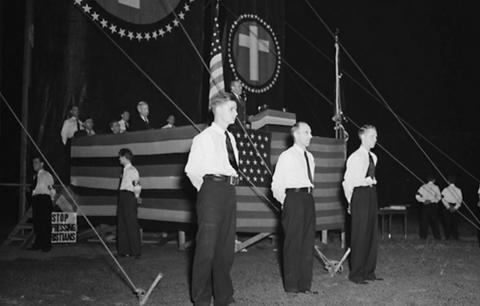
Antisemitic Christian Mobilizers in New York in 1939.

Source: Portside

Author:Joe Allen/Jacobian

Emphasis Mine

(N.B.: Those who cannot remember the past are condemned to repeat it.  George Santayana, The Life of Reason.)

The US hasn’t seen the stirrings of fascist mobilization since the late 1930s when mounting fascist victories in Europe galvanized its adherents in America, chief among them Father Charles Coughlin and his Christian Front. This history has something to offer us today.
Joe Allen

The open racism and xenophobia that have characterized Donald Trump’s presidential campaign, and perhaps provided much of its appeal, has been alarming. For a growing number of people, Trump’s rhetoric is a sign of something deeper and more frightening: the growth of a fascist movement in the United States.

Ohio governor John Kasich — one of Trump’s many rivals for the Republican nomination — produced an anti-Trump video that paraphrases Protestant theologian Dietrich Bonhoeffer’s warning about the Nazis.

For many other commentators, as well, the violence Trump supporters have directed at critics during campaign rallies, along with the candidate’s call for banning Muslims from the United States, are further confirmation that Trump is a Nazi. In the last Democratic presidential debate, former Maryland governor and presidential candidate Martin O’Malley denounced Trump as a “fascist demagogue.”

Yet, on too many of these occasions, the fascist label has been reduced to a vague term of abuse rather than a bridge to a real political analysis of the underlying political forces that could produce a fascist movement in the United States.

The US hasn’t seen the stirrings of fascist mobilization since the late 1930s when mounting fascist victories in Europe galvanized its adherents in America, chief among them Father Charles Coughlin and his Christian Front. This history has something to offer us today.

Our Father

By late 1938, Nazi Germany and fascist Italy had shifted the balance of forces among the world’s major powers, while fascist general Francisco Franco wrestled most of Spain from republican forces. The growing power of fascism was increasingly impacting civilian populations, particularly in Germany. According to historian Warren Grover:

That year [1938] Germany demonstrated to the world that it would move with impunity in Europe and violate Jews’ most basic rights: Jewish community organizations lost their official status and recognition (March); the registration of all Jewish property became compulsory (April); over 1,500 German Jews were arrested and imprisoned in concentration camps (June); Jewish physicians could no longer treat Christians (June); Nazis ordered the destruction of the Great Synagogue in Munich (July); All Jewish men were required to add “Israel” to their name and all Jewish women “Sarah” (August); Jews were barred from practicing law (September); German-Jewish passports were marked with the letter “J” for Jude (October); and finally Kristallnacht (November).

In the United States, the public and the press were virtually unanimous in condemning Kristallnacht, with one poll reporting that nearly 94 percent of Americans disapproved of Germany’s treatment of Jews.

Yet despite Nazism’s unpopularity, one voice took to the airwaves to defend these actions — Father Charles E. Coughlin, a Catholic priest based in Royal Oak, Michigan. Coughlin was a popular radio personality with an audience of millions, largely concentrated in the northeastern United States, and in New York City in particular.

In a highly anticipated broadcast that took place eleven days after Kristallnacht, Coughlin began by posing three questions: “Why is there persecution in Germany today?”; “How can we destroy it?”; and why is “Nazism so hostile to Jewry?”

Coughlin presented a simple answer: Nazism was a “defense mechanism against Communism,” and that the “rising generation of Germans regard Communism as a product not of Russia, but of a group of Jews who dominated the destinies of Russia.”

In the broadcast Coughlin minimized the Nazi “fine” of $400 million on Germany’s Jewish community with the claim that “between these same years not $400 million but $40 billion . . . of Christian property was appropriated by the Lenins and Trotskys . . . by the atheistic Jews and Gentiles” and accused the New York investment bank Kuhn Loeb & Company with helping to finance the Russian revolution and other Communist plots.

Coughlin’s unapologetic Nazi propaganda inspired swift backlash. WMCA, the New York radio station that provided his largest audience, demanded to see his scripts in advance of any future broadcasts, and cancelled his program after he refused. Coughlin later admitted that he used “Nazi sources” in his broadcast.

Following the broadcast the New York Times’ Berlin correspondent reported that Coughlin had become “the new hero of Nazi Germany.” But Coughlin wasn’t only a hero in Berlin; thousands of American supporters responded enthusiastically to his calls for militant action against “atheistic communism.”

Coughlin began broadcasting from his Michigan church, “The Shrine of the Little Flower,” in 1926, when radio represented a novel, thrilling experience for millions of people. With his rich baritone voice, and slight Irish brogue which he employed for great theatrical effect, Coughlin was made for the new medium.

The 1929 Wall Street crash and the ensuing depression impoverished large parts of Coughlin’s working- and lower-middle-class audience. In the wake of the crisis his broadcasts changed from religious sermonizing to political commentary that began with violent attacks on communism. According to historian Alan Brinkley,

[Coughlin] continued to dwell upon his abhorrence of communism, socialism, and “kindred fallacious social and economic theories,” but [his broadcasts] also emphasized other concerns: Coughlin’s fear that the selfish practices of “predatory capitalism” would drive Americans to embrace these pernicious doctrines.

As Coughlin attacked the “banksters” he blamed for the Great Depression, his audience grew massive. By 1933, the network of radio stations that carried his broadcasts reached a potential listenership of forty million.

In November 1934, Coughlin announced that he would organize his followers into a new political organization, the National Union for Social Justice. He denied that it was a third party even though it bore the hallmarks of every traditional American political party, and was organized by congressional districts. Coughlin waited for the right issue to flex the muscles of his new formation and got it in January 1935 when Roosevelt proposed that the United States affiliate to the World Court. – See more at: http://portside.org/2016-01-02/when-fascism-was-american#sthash.ShNLQb0I.dpuf


He denied that it was a third party even though it bore the hallmarks of every traditional American political party, and was organized by congressional districts. Coughlin waited for the right issue to flex the muscles of his new formation and got it in January 1935 when Roosevelt proposed that the United States affiliate to the World Court.

No president since Woodrow Wilson — for fear of provoking an isolationist backlash — had proposed the US make itself accountable to an international institution. A largely symbolic act, it initially appeared that Roosevelt would win the Senate majority needed to ratify the treaty for affiliation.

Coughlin mobilized his forces along with other World Court opponents, including the mighty newspaper chain of arch-reactionary William Randolph Hearst. They overwhelmed Washington with hundreds of telegrams over one crucial weekend and defeated the treaty. A jubilant Coughlin declared that he intended to slay greater dragons. “Our next goal is to clean out the international bankers.”

The phrase “international bankers” was a euphamism for Jews and was widely used in those years by numerous public figures including auto magnate (and fellow Michigander) Henry Ford, who bankrolled the distribution of antisemitic propaganda through his newspaper the Dearborn Independent.

Coughlin made the leap from antisemitism to open fascism after his political ambitions were crushed in the 1936 election. Coughlin had merged his National Union of Social Justice with the remnants of the late Huey Long’s Share Our Wealth clubs, led by the antisemitic preacher Gerald L.K. Smith, and old-age pension activist Francis Townsend, in order to mount a third-party challenge to Roosevelt.

The Union Party nominated North Dakota congressman William Lemke for president. Roosevelt, however, had shifted dramatically to the left during the course of 1935. In the face of failing New Deal policies and a huge upsurge in labor struggle, the president signed into law historic legislation including the Social Security Act and the National Labor Relations Act, the popularity of which undercut any electoral challenge.

As Lemke’s campaign faltered, Coughlin grew increasingly agitated and vitriolic. “When an upstart dictator in the United States succeeds in making this a one-party form of government, then the ballot is useless,” he asserted to an audience of twenty-five thousand supporters in Providence, Rhode Island. Coughlin declared: “I shall have the courage to stand up and advocate the use of bullets” and promised “more bullet holes in the White House than you could count with an adding machine.”

Winning less than nine hundred thousand votes across the country, Lemke went down in crushing defeat while Roosevelt secured one of the biggest presidential landslides in US history. With the election over, Coughlin announced that he would retire from the airwaves. Despondent, he confided to a reporter, “Democracy is doomed. This is our last election . . . It is fascism or communism. We are at a crossroads.”

“What road do you take, Father Coughlin?” the reporter asked.

“I take the road of fascism,” the priest replied.

The Christian Front

In the estimation of biographer Donald Warren, “it would not be until 1938 that [Coughlin] truly was able to recover from defeat.” To an audience diminished but still numbering in the millions, he retook the airwaves emboldened by troubles for Roosevelt at home and the victories of fascism abroad. The short-lived economic recovery of the president’s first term had been wiped out by a dramatic downturn.

The “Roosevelt recession” brought mass unemployment and the forward march of the militant CIO was halted as factories and shipyards closed or laid off much of their workforces. Roosevelt’s bungled effort to pack the Supreme Court with his allies provided Dixiecrats and Republicans cover to sabotage and roll back the New Deal. Meanwhile in Europe, fascism advanced.

Starting in 1936, Coughlin augmented his radio presence with the newspaper Social Justice, sold on the streets of major cities especially in the Midwest and Northeast. As Warren notes, “throughout 1937 and into early 1938, Jewish financial control became a regular theme of Social Justice . . . [Coughlin] printed his own version of the very centerpiece of antisemitic literature at the time, the notorious Protocols of the Elders of Zion.”

Coughlin also attempted to make an alliance with Mussolini, offering the Italian dictator space in Social Justice to defend the racial policies of his government. (He got no reply.) In addition to their fascination with Mussolini, Coughlin and Social Justice were fixated on the Spanish Civil War and General Francisco Franco’s martial aura. They portrayed Franco as a hero defending “Christian civilization” from marauding communists.

The paper published lurid and false stories of Christians massacred by Republican forces, and baited American Jews for supporting the antifascist cause. Six months before Kristallnacht, he told his radio audience:

If every reader of Social Justice formed at once a platoon of 25 or more persons dedicated to opposing Communism in all its forms, a Christian Front of 25,000,000 Americans would already be in action.

Coughlin claimed he was inspired to call for a “Christian Front” by the Communist Party’s support for a Popular Front against fascism, but the call also evoked the “front line” of a war and his use of “platoon” left little room for interpretation. “Rest assured,” he threatened his left-wing enemies in a later radio address, “we will fight you in Franco’s way, if necessary . . . rest assured we will fight you and we will win.”

Following Kristallnacht and the public reaction to Coughlin’s commentary on Nazism, WMCA cancelled his broadcasts. In response, according to Donald Flamm, the owner of the Manhattan station, “several thousand people encircled the block where our studios are located, denounced the WMCA as un-American, and shouted its slogan of ‘Don’t buy from Jews,’ ‘Down with Jews,’ etc.” A memorandum of the American Jewish Council recorded “remarks uttered by the picketers . . . more explicit than the legends on the signs”:

Send refugees to Russia where they can be appreciated!

This is a Christian country. Who isn’t Christian throw them out!

Wait until Hitler comes over here.

Down with Jewish war-mongers.

Heil Hitler!

Determined to punish WMCA, the Christian Fronters demonstrated outside the station weekend after weekend. In an autobiography written two decades later, Wechsler recalled,

The Christian Front hysteria reached its peak in midsummer [1939]. There was a genuine fear that a fascist movement had finally taken root in New York, and that its counterpoint was developing in other areas under the stimulus of Coughlin’s weekly sermons.

The journalist estimated that the Christian Front held thirty rallies a week throughout all of the city’s boroughs, and attracted crowds as large as two thousand supporters. Jewish storeowners in Brooklyn and the Bronx faced regular Christian Front pickets.

Gene Fein, a historian of Christian Front, notes that a typical street meeting began with the proclamation, “For Christ and Country, I open this meeting in the name of the Christian Front! The leader of the Christian Front is Jesus Christ.” Queens Christian Front leader Daniel Kurz held regular public meetings in which he would address crowds with a paranoid mix of anticommunism, antisemitism, and xenophobia.

According to Fein, Kurz denounced the Russian revolution as a plot by Jews that slaughtered “thirty million Christians,” and proclaimed an immediate mortal danger posed by Trotsky in Mexico, where he said the Russian revolutionary was building a secret army, ready to join American comrades and launch a communist revolution while the military was tied up in Europe.

The Christian Front also issued a “Christian index” listing preferred shopkeepers and stores, and street sales of Social Justice by Christian Front members provided an easy excuse to provoke fights or heckle anyone who “looked Jewish.”

The heavily Irish New York Police Department and judiciary provided a supportive backdrop, going easy on Christian Fronters while leaning hard on antifascists. A rally of the Transport Workers Union — led by Mike Quill, the most high profile Irish Communist union official in New York — was attacked and nearly broken up by rightist mobs.

In August 1939, the hysteria spurred by fascist violence in New York reached its height as the Christian Mobilizers, an even more violent splinter of the Christian Front, took to the streets. Harper’s journalist Dale Kramer reported that New York police recorded the Mobilizers holding fifty meetings a week in that month alone, drawing a total audience of more than twenty thousand.

Not to be outdone, the Christian Front called for an August 19 “Manifestation of Christianity” — a march from Columbus Circle to Union Square, well-known as the home of the Communist Party’s national headquarters and many of the city’s most prominent unions. “I was convinced that the so-called parade,” reported John Roy Carlson, who gained fame with his exposé Under Cover: My Four Years in the Nazi Underworld of America, “would serve as the pretext for another bloody riot.”

Coughlin diassociated himself from the demonstration only after intense political pressure was brought to bear from the hierarchy of the Catholic Church and Mayor La Guardia’s office.

Despite spectacular street violence and the Christian Front’s remarkable degree of organization, observers were divided on the meaning of the growing movement. James Wechsler cautioned at the time that “a picture of sustained terrorism blanketing the city would be a wrong one,” and that “the Coughlin movement is still a ‘fringe’ affair; whatever mass sympathy it has evoked is of a passive sort, largely confined to the Catholic Church.”

For a variety of reasons, including the signing of the Hitler-Stalin Pact and the growing threat of a European-wide war, the fascist threat began to subside after the terrible summer of 1939. But the period provides a vivid image of how a powerful, organized fascist movement could emerge in the United States.

Past and Present

There is much to distinguish Coughlin’s United States from Donald Trump’s today. The country is substantively more diverse than it was seventy-five years ago and the traumatic memory of the Holocaust still renders the open embrace of fascism a ticket to the margins of society.

Nevertheless, three decades of inequality and austerity have impoverished large sections of the American working class — along with declining US political prestige, bloody military adventures, and pervasive outrage at corruption in mainstream politics — have made a growing number of Americans more receptive to xenophobic and racist appeals that give voice to the powerlessness they feel in the face of hardship.

Trump has tapped into this anger and sense of powerlessness brilliantly. But is Trump a fascist whose real politics are being revealed drip by drip? Perhaps. His incendiary speeches have certainly drawn comparisons with infamous demagogues of the American past, including Coughlin. But more pressing than the question of which ideological label most precisely applies to Trump is the larger political force he heralds.

Many liberals and Democratic Party strategists are overjoyed at the light in which Trump’s popularity has cast Republican presidential ambitions, and media speculation has focused heavily on his personal beliefs.

The Left should avoid this lazy politics and focus both on the economic and political conditions that have created a massive and growing constituency that enthusiastically supports Trump’s racist, sexist, and xenophobic worldview, and the potential emergence of a strong far-right movement independent of Trump. “We have been awakened,” a far-right activist recently told New Yorker journalist Evan Osnos.

The past shows that the US is not immune to fascism. We must take the current far-right upsurge seriously and use every tool at our disposal to destroy it.

Joe Allen’s latest book is People Wasn’t Made to Burn: A True Story of Race, Murder, and Justice in Chicago.

Jacobin relies on your generous support and subscriptions to keep publishing.

see:http://portside.org/2016-01-02/when-fascism-was-american
The Top Five Attacks On America Committed By Christian Terrorists, Not Muslims

Source: occupy democrats

Author:Colin Taylor

Emphasis Mine

The outpouring of blatant Islamophobia and barely disguised racism coming from the right-wing in the wake of the Paris attacks is utterly despicable. Every time one of these attacks happen, conservatives insist on blaming the world’s 1.6 billion Muslims for their complicity, even though the majority of terrorist attacks are carried out against Muslim. American far right-wingers like Sen. Ted Cruz (R-TX) are calling for religious profiling of incoming refugees, because somehow being a Christian automatically removes the risk of terrorism – even though Christian right-wing terrorists in America have killed more people since 9/11 than Muslim terrorists have.

Republican presidential candidate Mike Huckabee even had the sheer gall to tell conservative blowhard Joe Scarborough that “I don’t know of any other group of people uniquely that are targeting innocent civilians and committing these acts of mayhem.” Warmonger and avowed bigot Ted Cruz said that “there is no meaningful risk of Christians committing acts of terror. If there were a group of radical Christians pledging to murder anyone who had a different religious view than they, we would have a different national security situation.” Since both grifters seem to have severe selective memory problems, let’s take a look at the worst Christian terrorist attacks that our own citizens have perpetrated within our borders.

1. The Knoxville Unitarian Universalist Church Shooting

Jim David Adkisson, a devout Christian and anti-abortion right-winger, walked into a Knoxville church on July 27th, 2008, and began firing a shotgun at children who were performing Annie Jr. He killed two and wounded seven, targeting “the church because of its liberal teachings and his belief that all liberals should be killed because they were ruining the country.”

2. The Campaign of Terror Against Abortion Doctors

In 1993, Dr. Richard Gunn was shot dead by an anti-abortion protester. In 1994, Drs. John Britton and James Barrett were shot to death by Reverend Paul Jennings. In 1998, Dr. Barnett Sleipan was shot dead in his home by a Christian terrorist. In 2009, Dr. George Tiller was shot by Scott Roeder in a church. The ability for Christian right-wingers to justify cold-blooded murder in the name of their pro-life beliefs is a colossal hypocrisy worthy of a terrorist group like ISIS. According to the National Abortion Federation, there have been 17 attempted murders, 383 death threats, 153 incidents of assault or battery, 13 wounded, 100 butyric acid attacks, 373 physical invasions, 41 bombings, 655 anthrax threats, and 3 kidnappings committed against abortion providers since 1977. Terrorist groups like the Taliban and ISIS are very fond of acid attacks and chemical weapons like anthrax; apparently Christian right-wing terrorists share that same preference.

3. The 1995 Oklahoma City Bombings

Timothy McVeigh, America’s most notorious domestic terrorist, was obsessed with the Seventh-Day Aventist splinter group known as the Branch Davidians, who resisted an ATF raid on their citadel at Mount Carmel in 1993. He travelled to Waco, Texas during the Waco Siege and heavily supported the religious extremists within it. Two years later, he detonated a fertilizer bomb at the Alfred P. Murrah Federal Building in Oklahoma City, killing a hundred and sixty-eight people, including nineteen children, and wounded 648 others. This Christian specifically targeted innocent civilians and committed horrific acts of violence to make his political point heard – something Mr. Huckabee believes he should be incapable of, since he’s not a Muslim.

4. Everything The Ku Klux Klan Has Ever Done

Since its creation after the American Civil War, the Ku Klux Klan has been terrorizing Americans in the name of Protestantism and racial purity. Known for their terrifying costumes and hoods, they wrought have fear and violence against blacks, Jews, immigrants, gays, and Catholics for hundreds of years, responsible for countless massacres, lynchings, rapes, and bombings that have killed thousands. In the modern day, it still has a membership of 5,000 to 8,000 terrorists that operate in individual chapters. Just two weeks ago, Frazier Glenn Cross, the leader of the Carolina Knights of the KKK, was sentenced to death by lethal injection for murdering a fourteen year old girl and two seniors outside the Overland Park Jewish Community Center in Kansas City. The man gave the Hitler salute during his trial and declared that “Jews are destroying the white race.” None of his victims were Jewish.

5. The Massacre At Zion Emmanuel AME Church in Charleston, S.C.

On Wednesday, June 17th of this year, a man rose from a pew in the historically black Emanuel AME Church in Charleston, SC, and opened fire with a .45 caliber pistol, killing nine worshipers, including pastor and State Senator Clementa Pickiney. The shooter has been photographed wearing patches representing the racist apartheid regimes in Southwest Africa, had a Confederate license plate on his vehicle. All signs points to this being a hate crime- not only is it the oldest black church in the South, it was a symbol of resistance against slavery, and a survivor reported that the shooter yelled ‘I have to do it. You rape our women and you’re taking over our country. And you have to go.” Roof was a member of a local Lutheran church, yet somehow his baptism didn’t prevent him from gunning down innocent people in a house of worship, defiling a sacred place with hate and murder.

So the next time one of your conservative friends tries to “school” you on the “evils of Islam,” just name a couple items from this list.

See:http://wp.me/p3h8WX-5IR

Nationwide Poll: Majority of Republicans Have Nakedly Racist Worldview—Trump Has Found the Way to Unleash It

GOPers are living in a dangerous right-wing fantasyland—and are just fine with that.

Source: AlterNet

Author: Steven Rosenfeld

Emphasis Mine

A new national poll released Tuesday has found that a majority of the Republican Party is living in a strange and dangerous political fantasyland.

“Our new poll finds that [Donald] Trump is benefiting from a GOP electorate that thinks Barack Obama is a Muslim and was born in another country,” Public Policy Polling’s analysis said. “Sixty-six percent of Trump’s supporters believe that Obama is a Muslim to just 12 percent that grant he’s a Christian. Sixty-one percent think Obama was not born in the United States to only 21 percent who accept that he was.”

Not only did PPP’s analysis find that Trump’s lead was growing—it is now 29 percent—it also found that the second most popular Republican is one who has not criticized other candidates: retired neurosurgeon Ben Carson, who has 15 percent. The rest of the pack is all under 10 percent: Jeb Bush (9 percent), Carly Fiorina (8 percent), Marco Rubio (7 percent), Ted Cruz and John Kasich (6 percent), Scott Walker and Mike Huckabee (5 percent). Walker has fallen the most, compared to last winter when he was leading.

The biggest takeaway from the PPP pollis that a majority of the Republican Party’s base is living in a right-wing bubble where facts don’t matter—and it has become increasingly acceptable to publicly voice racist positions because the leading presidential candidate is modeling that behavior.

Not only did PPP find that a majority of Republicans believe the birther lie—that Obama was not actually born in Hawaii—but 51 percent of all Republicans polled want to amend the Constitution to eliminate birthright citizenship, which is granted to any person born on U.S. soil. Of Trump’s supporters, 63 percent want to eliminate that right, and a majority said undocumented children should be deported.

“I’m not terribly surprised by the birther numbers or the numbers about Obama’s religion,” said Tom Jensen, PPP director. He said the numbers are consistent with what he’s seen in GOP polls in recent years, and matched another new poll from Iowa where about 35 percent of the state’s GOP electorate are “birthers.”

But what is surprising to Jensen is how Trump’s candidacy has made Republicans more willing to publicly admit their xenophobic or racist positions.

Trump has sent a message that it’s okay to be racist,” he said. “So maybe some racist attitudes you previously held, or were not allowed to say in public, now one of the leading presidential candidates is saying them and not apologizing at all.”

The PPP poll also found that Trump was winning his war of words with Fox News’ Megyn Kelly, the on-air host who challenged him in the GOP’s first presidential debate for his history of sexist remarks about women.

“Trump is winning his fight with Megyn Kelly,” the poll’s analysis said. “When we last polled her in December of 2013 her favorability with Republicans nationally was 44/9. Her favorability is in a similar place now at 42% but her negatives have shot up to 20 percent, largely because she’s at 20/43 with Trump’s supporters.”

The poll also found that Carly Fiorina and John Kasich have become more popular with GOP voters. Since their July survey, Fiorina, the ex-Hewlett Packard CEO, has “gone from 4 percent to 8 percent, and her 53/23 favorability rating makes her the most popular GOP candidate other than Carson and Trump,” their analysis said. “Kasich’s gone from 3 percent to 6 percent and is all the way up to double digits at 10 percent with moderate voters, putting him in third place overall with that group.”

The Republican who has fallen the furthest is Scott Walker, “who was in second place at 17 percent last month and is now down all the way to a tie for eighth place at 5 percent. There is a little bit of silver lining for Walker. He’s one of only three Republicans to hit double digits when it comes to voters’ second-place choice.”

Bush is struggling for a variety of reasons, Jensen said. He’s not passionate enough, compared to Trump. His past positions embracing federal education standards and immigration reform rankle right-wing Republicans. And in an anti-establishment year, being a Bush [or a Clinton] is as mainstream and establishment as it gets.

Bernie and Hillary

On the Democratic side, PPP found that Bernie Sanders has a very long way to go to catch up with Hillary Clinton in national polling.

“Last month Hillary Clinton led Bernie Sanders by 35 points and this month she leads him by 35 points again—she’s at 55 percent to 20 pecent for Bernie Sanders, 4 percent for Martin O’Malley, 3 percent for Jim Webb, and 1 percent each for Lincoln Chafee and Lawrence Lessig,” the poll’s analysis said.

This is a striking contrast with Sanders’ numbers in Iowa and New Hampshire, where another PPP poll just last week found he was ahead of Clinton by 7 points. However, looking past those first two contests to the next states, Jensen said that Sanders hasn’t yet made inroads into communities of color.

“I think it’s quite possible he may do very well in Iowa and New Hampshire and not do well anywhere else,” Jensen said. “We found Hillary down in New Hampshire but not nationally.”

However, Jensen said he was “done making predictions” about what was likely to unfold on the GOP side. “There is nothing about this presidential race that anyone has seen before. Most experts expected things to become more normal by now.”

But things have not become normal. As one respected legal blogger wrote Monday, there is a path to the GOP nomination for Trump if he maintains his current standing in the polls, because of the arcane ways Republicans will be allocating delegates in their 2016 primaries.

Meanwhile, the PPP poll confirms that the modern Republican Party has a majority of members who live in a racist political fantasyland: they believe Obama wasn’t born in America, and is a Muslim, not a Christian; and they would revoke the birthright citizenship of the children of undocumented immigrants, and deport them as well.

“Trump’s beliefs represent the consensus among the GOP electorate,” their analysis said. “Fifty-one percent overall want to eliminate birthright citizenship. Fifty-four percent think President Obama is a Muslim. And only 29 percent grant that President Obama was born in the United States. That’s less than the 40 percent who think Canadian-born Ted Cruz was born in the United States.”

Steven Rosenfeld covers national political issues for AlterNet, including America’s retirement crisis, democracy and voting rights, and campaigns and elections. He is the author of “Count My Vote: A Citizen’s Guide to Voting” (AlterNet Books, 2008).

See:http://www.alternet.org/election-2016/nationwide-poll-majority-republicans-have-nakedly-racist-worldview-and-trump-has-found?utm_source=Steven+Rosenfeld%27s+Subscribers&utm_campaign=d25c3f7811-RSS_AUTHOR_EMAIL&utm_medium=email&utm_term=0_2cfcfe7b54-d25c3f7811-107153921

Bigotry Confirmed: 66% of Trump Supporters Believe Pres. Obama Is A Muslim

Source: occupydemocrats.com

Author: Colin White

Emphasis Mine

It really is astonishing just how far a misinformation campaign will go in this country. A recent poll by the Public Policy Polling firm reveals that just under two-thirds, around 66%, of Donald Trump supporters believe that President Obama is a Muslim. On top of that, 61% still believe the President wasn’t born in the United States. This kind of perpetual ignorance represents a deep disconnect with reality, tying into the narcissistic delusions of American exceptionalism that has become mainstream through the incessant trumpeting of FOX News and the right-wing echo chamber.

It symbolizes a fundamental refusal to recognize realities, dismissing rationality and reason in favor of appeals to our most base and primitive emotions- fear of difference and of the unknown. The Republican voting base has been reduced to malleable puppets on a string, rendered a quivering mess from a diet of constant self-righteous infallibility and hyperbolic fear-mongering, torn between two extremes so much that they are left as perpetually exploitable by those with the ability and charisma to manipulate them.

“America is under attack!” cries the right-wing. “Black Americans are murdering police officers and undermining the rule of law! Terrorists are going to attack our nation! Immigrants are coming to take your jobs! Healthcare services are murdering children!” It is the lowest and most despicable form of political manipulation, the kind that causes pogroms and race riots if it gets out of hand. The American people need to wake up and face the facts. Living in fear will get us nowhere. 

See:http://wp.me/p3h8WX-4ZV

W. E. B. Du Bois to Malcolm X: The Untold History of the Movement to Ban the Bomb

corettascottking_dagmar-wilson-womenstrikeSource: Portside

Author:Vincent J. Intondi

Emphasis Mine

In the wake of the Charleston massacre and 70 years after the atomic bombings of Hiroshima and Nagasaki, a scholar argues it is important the textbooks reflect the historic role of African American civil rights leaders as advocates for peace and strong opponents of nuclear weapons. The scarring of war, poverty, and racism that Malcolm X spoke of continues to this day, and the history books should reflect how Black activism has challenged these deadly triplets. –

When the Rev. Martin Luther King Jr. announced his strong opposition to the war in Vietnam, the media attacked him for straying outside of his civil rights mandate. In so many words, powerful interests told him: “Mind your own business.” In fact, African American leaders have long been concerned with broad issues of peace and justice—and have especially opposed nuclear weapons. Unfortunately, this activism is left out of mainstream corporate-produced history textbooks.

On June 6, 1964, three Japanese writers and a group of hibakusha (atomic bomb survivors) arrived in Harlem as part of the Hiroshima/Nagasaki World Peace Study Mission. Their mission: to speak out against nuclear proliferation.

Yuri Kochiyama, a Japanese American activist, organized a reception for the hibakusha at her home in the Harlem Manhattanville Housing Projects, with her friend Malcolm X. Malcolm said, “You have been scarred by the atom bomb. You just saw that we have also been scarred. The bomb that hit us was racism.” He went on to discuss his years in prison, education, and Asian history. Turning to Vietnam, Malcolm said, “If America sends troops to Vietnam, you progressives should protest.” He argued that “the struggle of Vietnam is the struggle of the whole Third World: the struggle against colonialism, neocolonialism, and imperialism.” Malcolm X, like so many before him, consistently connected colonialism, peace, and the Black freedom struggle. Yet, students have rarely heard this story.

With the recent developments in Charleston surrounding the Confederate flag, there is a renewed focus on what should be included in U.S. history textbooks and who should determine the content. Focusing on African American history, too often textbooks reduce the Black freedom movement to the Montgomery Bus Boycott and the March on Washington. Rosa Parks and Dr. King are put in their neat categorical boxes and students are never taught the Black freedom struggle’s international dimensions, viewing slavery, Jim Crow, and the Civil Rights Movement as purely domestic phenomena unrelated to foreign affairs. However, Malcolm X joined a long list of African Americans who, from 1945 onward, actively supported nuclear disarmament. W. E. B. Du Bois, Bayard Rustin, Coretta Scott King, Dr. Martin Luther King Jr., and the Black Panther Party were just a few of the many African Americans who combined civil rights with peace, and thus broadened the Black freedom movement and helped define it in terms of global human rights.

If students learn about Du Bois at all, it is usually that he helped found the National Association for the Advancement of Colored People (NAACP) or that he received a PhD from Harvard. However, a few weeks after the atomic bombings of Hiroshima and Nagasaki, Du Bois likened President Truman to Adolph Hitler, calling him “one of the greatest killers of our day.” He had traveled to Japan and consistently criticized the use of nuclear weapons. In the 1950s, fearing another Hiroshima in Korea, Du Bois led the effort in the Black community to eliminate nuclear weapons with the “Ban the Bomb” petition. Many students go through their entire academic careers and learn nothing of Du Bois’ work in the international arena.

If students ever hear the name Bayard Rustin, it is usually related to his work with the March on Washington. He has been tragically marginalized in U.S. history textbooks, in large part because of his homosexuality. However, Rustin’s body of work in civil rights and peace activism dates back to the 1930s. In 1959, during the Civil Rights Movement, Rustin not only fought institutional racism in the United States, but also traveled to Ghana to try to prevent France from testing its first nuclear weapon in Africa.

These days, some textbooks acknowledge Dr. King’s critique of the Vietnam War. However, King’s actions against nuclear weapons began a full decade earlier in the late 1950s. From 1957 until his death, through speeches, sermons, interviews, and marches, King consistently protested the use of nuclear weapons and war. King called for an end to nuclear testing asking, “What will be the ultimate value of having established social justice in a context where all people, Negro and White, are merely free to face destruction by Strontium-90 or atomic war?” Following the Cuban Missile Crisis in October 1962, King called on the government to take some of the billions of dollars spent on nuclear weapons and use those funds to increase teachers’ salaries and build much needed schools in impoverished communities. Two years later, receiving the Nobel Peace Prize, King argued the spiritual and moral lag in our society was due to three problems: racial injustice, poverty, and war. He warned that in the nuclear age, society must eliminate racism or risk annihilation.

Dr. King’s wife largely inspired his antinuclear stance. Coretta Scott King began her activism as a student at Antioch College. Throughout the 1950s and 1960s, King worked with various peace organizations, and along with a group of female activists, began pressuring President Kennedy for a nuclear test ban. In 1962, Coretta King served as a delegate for Women Strike for Peace at a disarmament conference in Geneva that was part of a worldwide effort to push for a nuclear test ban treaty between the United States and the Soviet Union. Upon her return, King spoke at AME church in Chicago, saying: “We are on the brink of destroying ourselves through nuclear warfare . . . . The Civil Rights Movement and the Peace Movement must work together ultimately because peace and civil rights are part of the same problem.”

Soon, we will commemorate the 70th anniversaries of the atomic bombings of Hiroshima and Nagasaki. Not long after comes the anniversary of the 1963 March on Washington. Students will then return to school and to their history textbooks. However, most will not learn how these issues are connected. They will not learn of all those in the Civil Rights Movement who simultaneously fought for peace. But this must change, and soon. The scarring of war and poverty and racism that Malcolm X spoke of continues. It’s time that students learn about the long history of activism that has challenged these deadly triplets.

[Vincent J. Intondi is an associate professor of history at Montgomery College and director of research for American University’s Nuclear Studies Institute. He is the author of African Americans Against the Bomb: Nuclear Weapons, Colonialism, and the Black Freedom Movement (Stanford University Press, 2015).This article is part of the Zinn Education Project’s If We Knew Our History series.]

– See more at: http://portside.org/2015-08-08/w-e-b-du-bois-malcolm-x-untold-history-movement-ban-bomb#sthash.Prp3K1F7.dpuf


See:http://portside.org/2015-08-08/w-e-b-du-bois-malcolm-x-untold-history-movement-ban-bomb

Dylann Roof Is America

To pretend to be surprised by his crime is to be complicit in it.

Source: AlterNet

Author: Kali Holloway

Emphasis mine

In so many ways, the story of Dylann Roof, the shooting suspect who allegedly killed nine people in an historic South Carolina black church, is a parallel to the story of America itself.

Who, at this point, can feign surprise at this latest massacre when it sits at the nexus of so much that is familiar and perfectly in line with the U.S. that we know? We are a country where mass shootings are weekly news, where gun violence is a fact of daily life, where there is a legacy of terror against black people and communities, where white racists have long targeted black churches, where African-American life is so devalued it can be taken with impunity.

If you are shocked by any aspect of Roof’s story so far—including that he is being described in news outlets as “quiet and soft-spoken” instead of as a terrorist—you are not only willingly obtuse but complicit in his crime. There is a single conclusion to draw in this moment, and it is that we are here again, because this is exactly who we are.

It seems likely to me that Roof had some sense of this, that his own knowledge and recognition of history helped guide him toward committing this horrific crime. Emanuel African Methodist Church is one of the oldest houses of worship in the South, and it has long served—like the institution of the African-American church itself in this country—as a sanctuary and safe haven for black people from white racism. Though the roots of the church stretch back to 1787, its foundation is more firmly pinned to 1816. Six years after its establishment, when a slave rebellion plot was tied to the church in 1822, accused leader Denmark Vesey—a free black man—and five alleged co-conspirators were hanged and the church burned down. The date of that rebellion was to be June 17, also the date Roof walked into Bible study at the church, pretended to worship with parishioners for an hour, and then shot nine people to death.

I would wager that Roof knew not just that bit of history, but understood in his own perverse way what it meant to kill—to literally hunt—black folks in a space they were hopeful enough to believe was safe, and that he recognized his place alongside white racist terrorists like those who carried out the 1963 Birmingham, Alabama, church bombing that killed four black girls. (Not to mention those I’ve just written about, who burned the church itself down nearly two centuries ago.) Roof adorned his car with the same Confederate flag that once flew over slaveholding states and today waves over the South Carolina statehouse. America may be unwilling to face its history, despite a mounting pile of black bodies that forces African Americans to reckon with it daily. But Roof is more honest than those—and there are so many—whose complicity lies in looking the other way, in denying the past, in pretending that each new murder is an isolated anomaly. As long as they are unwilling to admit to our past’s stranglehold on our present, Roof and others like him will continue to draw truth, and strength, from the legacy and reality of white terror and supremacy. The lies white America tells itself cost actual black lives.

Before he pulled the trigger, Roof allegedly said to his victims, “I have to do it.” He continued, “You rape our women and you’re taking over our country. And you have to go.” At 21-years-old, Roof had fully absorbed the message his country has taught him, just like terrorists in every other country, in every other part of the world. He clung to the old American idea that white women are our most precious resource to be protected by any means, and felt it was his right as a white man to protect his birthright—this country and his privilege within it —which he saw as being taken from him. We are guns and violence and race hatred and systemic, codified, state-sanctioned terrorism against people of color and that is who we have always been. While our media is certain to attribute Roof’s heinous acts to mental illness (and the cops were careful to take him alive, which even the most innocent of black folks cannot count on), I consider him a particularly apt pupil. Just the latest of many. Though certainly not the last. 

See: http://www.alternet.org/news-amp-politics/dylann-roof-america?akid=13225.123424.rQeA4e&rd=1&src=newsletter1038053&t=1

Biker Gangs, Tamir Rice, And The Rise Of White Fragility

Source: TPM

Author: Aurin Squir

Emphasis Mine

This scenario has repeated itself too many times to be coincidence. An 8-year-old child shot and killed by officers while she slept, a 17-year-old killed by police in his own home, a 22-year-old immediately shot and killed in a Wal-Mart, and many more cases of unarmed African Americans immediately getting shot down and labeled as menaces. While on the other side of reality, the Aurora shooter, Timothy McVeigh, and many other armed mass killers were arrested without a scratch on them.

The most dangerous uprising that’s threatening America’s stability isn’t black protests in places like Ferguson or Baltimore. It’s taking place among an aging white majority that is losing its bearing on reality and destroying the gears of government, media and public welfare. At its center is an inexplicable, illogical and dangerous fear that some sociologists are now defining as white fragility.

I have witnessed this strange phenomenon intensifying over the last several years, but I first became aware of it immediately after the election of Barack Obama.

On the Wednesday after the 2008 election, I drove from Cleveland to Columbus to catch an afternoon flight back to New York City. Out of curiosity I scanned the AM dials until I found a few conservative political talk shows. The sustained and palpable panic was amusing at first, then outrageously funny, before settling into deeply disconcerting. Despite the fact that virtually every poll had shown Obama as the predicted winner for weeks, the election results felt like a political Pearl Harbor for some.

Conservative callers were predicting the end of democracy, how 2008 might be the last election ever held in America, how the economy was going to be destroyed. In some exchanges the radio host egged on the callers’ conspiracies, while other times he warned listeners to be afraid: Taxes were going to skyrocket for the average working family, gas prices would climb. Rush Limbaugh encouraged everyone to start referring to the economic blight rendered by President George W. Bush’s administration as ‘the Obama economy.” And so they did. He proposed that all the issues in Iraq and Afghanistan were now Obama’s fault. And so they are. He predicted the end of American dream. And so they have worked to see the fulfillment of their prophecy.

These callers were borderline hysterical. Even though I couldn’t see what they looked like, I could make a safe guess as to the age and race of the average listener. As I sat in my rental car listening to the unfolding audio riot of an aging generation, it felt like I was at an unveiling of some absurdly humorous and horrific performance art piece. I was watching the polite mask fall away from a hateful, illogical and destructive mindset that has thrived for hundreds of years and is still going strong today: white fragility. 

White fragility is a termed coined by Robin DiAngelo, an associate professor of education at Westfield State University in Massachusetts. In her 2011 academic pedagogical analysis titled “White Fragility,” DiAngelo goes into a detailed explanation of how white people in North America live in insulated social and media spaces that protect them from any race-based stress. This privileged fragility leaves them unable to tolerate any schism or challenge to a universally accepted belief system. Any shift away from that (like a biracial African-American president) triggers a deep and sustaining panic. Racial segregation, disproportionate representation in the media, and many other factors serve as the columns that support white fragility. Professor DiAngelo said she came up with the term when she was a diversity trainer for the state of Washington.

“The participants were mostly white, working [in] offices that were 98 percent white, living lives of never having to see people of color, and they were incredibly hostile and mean when discussing anything about race,” said DiAngelo, who’s white. “Some guys would pound their fists on the table in fury at being in a room where this discussion was taking place, many sulked silently.”

DiAngelo began reframing the conversation in a more constructive way in order to get participants to see how power structures of racial supremacy work in their lives. The misunderstanding was caused by misidentification of what white privilege and power means. Privilege doesn’t mean automatic wealth and health. What “white privilege” means is that society is rooting for one particular segment of the population to succeed over all others, and has installed a disproportionately high amount of institutional and  psychological helpers every step of the way.

Author and public speaker Tim Wise said he has encountered similar confusion.

Part of white fragility is to assume that when we talk about racism, we are calling someone out as being individually a racist,” he said. “So if you say we’re going to talk about racism, white people think you’re going to call them a name. But for most people of color it’s a system. And we’re talking about dealing with a structure so the real problem is the system.”

When separate groups of people are using the same word with different implied meanings then problems will persist. When it comes to racism and increased segregation, both Wise and DiAngelo noted that there seems to be this rigid unwillingness to address any inequality, because it would upset the very people who are both benefiting from the injustice and refusing to acknowledge its existence.

The fear is that if someone seeks to define and fix racism, many white people feel like they’re being directly attacked. So instead of waiting for the attack, white fragility promotes protection by putting punitive restrictions on “the others.”

The Obama era has been an interesting petri dish of white fragility. On the heels of a moderate economic recovery, we’ve seenvoting righ sweeping new state laws aimed at social issues:voting rights restrictions,, defunding of Planned Parenthood, anti-gay legislation, Stand Your Ground bills, and restrictive union laws to weaken their bargaining power. These laws have resulted in a rollback of rights for minorities, women, the LGBT movement, and the working class.

The marketing angle used for many of these legislations is that the white, straight, Christian status quo is threatened. New voter restrictions have been enacted in over 20 states to address fraud issues that did not and do not exist. But the restrictive laws will hurt minority communities. Stand Your Ground was an NRA boilerplate bill aimed encouraging a shoot-first cowboy mentality of murdering another person simply on the appearance of a threat. Anti-gay marriage amendments are passed to “protect traditional marriage.” The goal of defunding Planned Parenthood is to “protect life.

The strangest thing about white fragility politics is that the detrimental policy results are spread out across race and class. Yet, the political results for the conservative movement priming the pump of white fragility and rage is election victories. And why should they change when they can get large sections of an aging white population to consistently vote for policies proven to statistically hurt their economic chances, personal health, their children’s education, and their very safety?

What do you say to a state like Indiana that rolls back Planned Parenthood for political points based in white fragility and then watches as HIV infection rates explode in the community? What can be said of Kansas Governor Sam Brownback and the legislators who knowingly bankrupt the state’s treasury to promote an economic philosophy of tax cuts to the wealthy that result in fewer services, broken infrastructure, suffering in schools, and—in the long run—more deaths? These are not rational decisions. These are fear-based politics that create avoidable disasters in which all suffer. This new wave of segregation fear is surging across the country. In response to the continued white fragility panic of 2008, conservative political movements are set to capitalize on the cycles of manufactured hysteria.

“We are watching the repeal of the 20th century,” Wise said.

Despite these social rollbacks, economic doomsday predictions under an Obama administration has turned into a fairly strong recovery. The stock market is soaring, unemployment rates are falling, and gas prices are down. The United States stands as one of the few countries to have not only recovered from the Great Recession, but to be somewhat thriving. It would seem like now would be the perfect moment to push the issue of white privilege and fragility forward. After the Ferguson movement and videotapes of countless unarmed black men and women being murdered by police, it seems like this nation might be headed toward some moment of truth: the start of a movement toward greater justice for all.

“I get emails saying ‘you’re a disgusting human being’ and people are just upset,” Di Angelo said. “They’re upset that they have been challenged and they can’t really handle it.”

When I asked Wise and DiAngelo to give me something hopeful for the future, they both gave me a bleak picture. When I suggested that more facts and evidence could sway people, they disagreed.

“People who are deeply committed to a world view don’t change their opinions when confronted with new facts,” Wise said. “Oddly enough, new facts cause them to dig in more deeply.”

Clarification: This post has been updated to reflect that police would have wanted Tamir Rice to be charged for his conduct prior to the shooting. Rice was not actually charged. It was also updated to reflect that it has not yet been established whether the victims in Waco were killed by bikers or police or both.

Aurin Squire is a freelance journalist who lives in New York City. In addition to being a playwriting fellow at The Juilliard School, he has writing commissions and residencies at the Dramatists Guild of America, Brooklyn Arts Exchange, and National Black Theatre.

See: http://talkingpointsmemo.com/cafe/the-rise-of-white-fragility

The fog that blinded the electorate

Election rally in PA

Source: Peoples World

Author: Rick Nagin

Emphasis Mine

There were local and geographical peculiarities, but when an election was as uniformly one-sided as this one was, deeper explanations are required. In the most general sense it can be said that the electorate does not yet recognize or understand that the enemy they face is right wing extremism; that this is the fundamental source of the insecurity they feel as their living standards and democratic rights are besieged. It is the Republicans, not the Democrats, who have blocked programs to create jobs, raise wages, strengthen unions, who have cut taxes on the rich and shifted the burden to working people, who have slashed funds for education, health care and local government services, who have launched an unprecedented assault on the right to vote, on the rights of women, on equality for gay people, on immigration reform and on defending humanity from a climate catastrophe.

All this begs the question as to why the people were not able perceive the mortal danger from the right. The answer to this, I believe, was the ability of the right to unleash unprecedented resources to roll out a dense fog, as thick as pea soup that covered the South, blanketed the Midwest and reached even into the far recesses of New England, a fog that terrified, blinded and paralyzed the Democrats and had them running for cover. It was the fog of racism.

The demonization of President Barack Obama and, by extension, the Democrats who “voted with him,” has been building for years in the nether world of right wing hate talk radio and Fox News and was unleashed full force in this election. Since it is forbidden to mention racism in polite company, the corporate media referred to the GOP strategy as the “nationalization” of the election. Tom Cotton, GOP candidate for senator in Arkansas, avoided state issues but used Obama’s name 79 times in his televised debate with Democratic incumbent Mark Pryor.

The most notorious use of this tactic, as well as the classic capitulation of the liberal Democrats was in Kentucky where Allison Lundergan Grimes responded to Mitch McConnell’s relentless race baiting by first saying she was a “Clinton” (i.e. not an Obama) Democrat,” then by protesting in a debate that “Obama is not on the ballot” and finally by refusing to say whether she had voted for Obama in the presidential election. How different it would have been if, from the beginning she had confronted the issue head on, denounced McConnell’s shameful racist campaign as an insult to the democratic values of the voters and had driven home that it was only because of the Obama health care reform that millions of Kentuckians now had for the first time their very popular health coverage program. It would have been McConnell, not Grimes, who would have been on the defensive and a powerful anti-fogging agent would have been released

But Grimes and Pryor believed the racist fog was unbeatable and, along with Kay Hagan in North Carolina, had prevailed on the President to delay his planned immigration initiatives until after the election, and, of course, to stay as far away from their states as possible. As reward for their cowardice, they all went down to defeat. There was one example in this election demonstrating that the voters are actually better than Grimes, Hagen and Pryor believed. That was in Pennsylvania where Gov. Tom Corbett was unseated after he and the Republicans admitted their election restrictions were an attempt to suppress minority votes and their massive cuts to public education were also directed at urban African Americans. These actions were blasted by victorious gubernatorial Democratic candidate Tom Wolf, and voter participation by minorities and white allies actually increased.

The lesson of this election is clear. Racism is at the core of right wing ideology. The attacks on “government,” Social Security, Medicare, public education, the minimum wage, public employee unions are directed first and foremost at people of color, as the right seeks to convince the white majority that democratic rights and institutions exist primarily to serve minority populations at the expense of the majority. They hope this will carry them to victory in the 2016 presidential election.

In their arrogant statements after the election McConnell and House Speaker John Boehner made clear their war on President Obama would continue unabated. They think they have a good thing going and plan to keep milking it for all it is worth. It is the responsibility of all progressives, of labor and all its grassroots allies to expose and reject these divisive tactics and build a united democratic movement to defeat right-wing extremism.

See: http://peoplesworld.org/the-fog-that-blinded-the-electorate/

Conversatives ‘feeling exposed’ by Cliven Bundy says Joe Scarborough. Paul backs off, video of Bundy

Source: Daily Kos

Author: Houndog

Many conservatives now rush to distance themselves from racist comments by recent Libertarian ranch hero Cliven Bundy after his shocking interview in the New York Times yesterday in a comic parade of reversal.

In Joe Scarborough: Fox News Was ‘Exposed’ By Cliven Bundy Saying That Blacks Are ‘Better Off As Slaves’, The Cajun Boy brings us this YouTube clip and partial transcript of Joe Scarborough saying “I told you so” to conservatives who embrace Clive Bundy despite his warnings.

On MSNBC this morning, Joe Scarborough, who’s been calling bullsh*t on this guy since the get-go and has blasted his fellow Republicans who’ve championed his cause, had some things to say about Bundy’s racist remarks.

“There’s nothing conservative about this man. This is where nihilism about the federal government gets you in trouble every time,” Scarborough noted. “This has happened before. It happened when conservatives raced blindly to put their arms around George Zimmerman, a man who gets in all these troubles. They basically pick their friends based on who their enemies are. In this case, a lot of people in conservative media have raced to this guy’s defense. They must be feeling very exposed this morning.”

It should be noted that 2016 GOP presidential hopeful Rand Paul has also been hailing this guy as some kind of hero. (UPDATE: Paul is now distancing himself from Bundy.) Take it away, Joe…

Former Florida Rep. Joe Scarborough said that the “conservatives” that rallied to Cliven Bundy’s side “must feel very exposed” now that the rancher has used his standoff with the government over illegally grazing his cattle on federal land to pontificate on race.

Mr. Scarborough, a Republican co-host of MSNBC’s “Morning Joe,” suggested that Mr. Bundy’s comments show that he is not the sort of character that conservatives should embrace.

Mr. Bundy said, according to the New York Times, that African-Americans “abort their young children, they put their young men in jail, because they never learned how to pick cotton.”

“I want to tell you one more thing I know about the Negro,” Mr. Bundy said, according to The Times, before talking about a public-housing project in North Las Vegas.

“In front of that government house the door was usually open and the older people and the kids — and there is always at least a half a dozen people sitting on the porch — they didn’t have nothing to do. They didn’t have nothing for their kids to do. They didn’t have nothing for their young girls to do.“And because they were basically on government subsidy, so now what do they do?” he asked. “They abort their young children, they put their young men in jail, because they never learned how to pick cotton. And I’ve often wondered, are they better off as slaves, picking cotton and having a family life and doing things, or are they better off under government subsidy? They didn’t get no more freedom. They got less freedom.”

Adam Nagourney reports Senator Rand Paul’s statement this morning distancing himself from Clive Bundy, in Nevada Rancher Cliven Bundy Makes Ridiculously Racist Comments, Says Blacks Might Have Been ‘Better Off’ As Slaves

Bundy’s case has won support from prominent national conservatives, including Republican Sens. Rand Paul of Kentucky and Dean Heller of Nevada. In a statement provided by a spokesman for Paul to Business Insider on Thursday, Paul denounced Bundy’s comments.

“His remarks on race are offensive and I wholeheartedly disagree with him,” Paul said.

Heller also immediately distanced himself from Bundy’s new controversial remarks.

“Senator Heller completely disagrees with Mr. Bundy’s appalling and racist statements, and condemns them in the most strenuous way,” spokesman Chandler Smith said in an email.

Yes, friends, these leaders are “shocked, truly shocked to discover racism rearing its ugly head in right-wing extremist politics, of all places!” Who could have imagined this? Senators Rand Paul, and Dean Heller must feel so betrayed and duped.

Libertarian Hero Cliven Bundy Shockingly Turns Out to Be Gigantic Racist by JonathanChait, in New Yorker Magazine, provide a philosophical perspective about the links of racism to the core conservative ideological beliefs.

So apparently there’s more to Bundy’s cause than the existence of the federal budget deficit. Or, at least, his views on land rights and individual freedom come attached to a large side order of racism.

As it happens, just the other day, Tuccille expressed outrage over something I wrote. In a longer argument about the future of American politics, I suggested that conservatism in its current incarnation has no future in American politics because “America’s unique brand of ideological anti-statism is historically inseparable … from the legacy of slavery,” and thus will have little natural appeal to an increasingly diverse electorate. Tuccille shot back, “It’s tempting to say ‘what the fuck?’ and take Chait’s argument as an exercise in self-congratulatory lunacy.”

Where we differ is that, I’d argue, it’s not exactly a coincidence that Bundy also turns out to be a gigantic racist. Just like Ron Paul’s longtime ghostwriter turned out to be a neoconfederate white supremacist. And like the way Rand Paul’s ghostwriter also turned out to be a neoconfederate white supremacist. Presumably all these revelations have struck Tuccille as a series of shocking coincidences. Why do all these people with strong antipathy toward the federal government turn out to be racists? Why do all these homosexuals keep sucking my cock?

Well, some of these questions may be hard to answer and  we may have to wait to hear the responses. Clive Bundy certainly has stirred up a hornets nest of discussion.

The Republican’s Karmic Chickens of racist dog whistles are finally coming home to roost. Leaders can distance themselves now all they like, but American voters will remember well how recently many of these same people were perfectly happy to stand by on the sidelines taking advantage of racist diatribes they now wish to renounce.

10:41 AM PT: Please also check out this post from yesterday where Former Chairman of the Congressional Black Caucus provide an inspiring and skillful example for all Democrats on how to confront Republican bullshit head on. He recognized  Paul Ryan’s “culture of inner city unemployed men” statement as an unacknowledged quotation from notorious and vile racist Charles Murray who Cleaver says is famous for “spewing racist sewage” so now Rep. Paul Ryan is going to meet with the Congressional Black Caucus next week for a “consciousness and awareness raising session” on racial sensitivity which I can’t wait to see the press on. Cleaver has some fantastic quotes in here. Please check it out.

Former Con. Black Caucus Chair Cleaver blasts Paul Ryan for quoting Charles Murray’s “racist sewage”

11:04 AM PT: Heres the video of Bundy speaking for himself which has just come out.

http://www.washingtonpost.com/…


Cliven Bundy on blacks: ‘Are they better off as slaves?’


Emphasis Mine

See:http://www.dailykos.com/story/2014/04/24/1294314/-Conversatives-feeling-exposed-by-Clive-Bundy-says-Joe-Scarborough-Rand-Paul-and-others-back-off?detail=email

Why the Racist History of the Charter School Movement Is Never Discussed

Touted as the cure for what ails public education, charter schools have historical roots that are rarely discussed.

From: AlterNet

By:Christopher Bonastia

“As a parent I find it easy to understand the appeal of charter schools, especially for parents and students who feel that traditional public schools have failed them. As a historical sociologist who studies race and politics, however, I am disturbed both by the significant challenges that plague the contemporary charter school movement, and by the ugly history of segregationist tactics that link past educational practices to the troubling present.

The now-popular idea of offering public education dollars to private entrepreneurs has historical roots in white resistance to school desegregation after Brown v. Board of Education (1954). The desired outcome was few or, better yet, no black students in white schools. In Prince Edward County, Virginia, one of the five cases decided in Brown, segregationist whites sought to outwit integration by directing taxpayer funds to segregated private schools.

Two years before a federal court set a final desegregation deadline for fall 1959, local newspaper publisher J. Barrye Wall shared white county leaders’ strategy of resistance with Congressman Watkins Abbitt: “We are working [on] a scheme in which we will abandon public schools, sell the buildings to our corporation, reopen as privately operated schools with tuition grants from [Virginia] and P.E. county as the basic financial program,” he wrote. “Those wishing to go to integrated schools can take their tuition grants and operate their own schools. To hell with ’em.”

Though the county ultimately refused to sell the public school buildings, public education in Prince Edward County was nevertheless abandoned for five years (1959-1964), as taxpayer dollars were funneled to the segregated white academies, which were housed in privately owned facilities such as churches and the local Moose Lodge. Federal courts struck down this use of taxpayer funds after a year. Still, whites won and blacks lost. Because there were no local taxes assessed to operate public schools during those years, whites could invest in private schools for their children, while blacks in the county—unable and unwilling to finance their own private, segregated schools—were left to fend for themselves, with many black children shut out of school for multiple years.

Meanwhile, in less blatant attempts to avoid desegregation, states and localities also enacted “freedom of choice” plans that typically allowed white students to transfer out of desegregated schools, but forced black students to clear numerous administrative hurdles and, not infrequently, withstand harassment from teachers and students if they entered formerly all-white schools. When some segregationists began to acknowledge that separate black and white schools were no longer viable legally, they sought other means to eliminate “undesirables.”

Attorney David Mays, who advised high-ranking Virginia politicians on school strategy, reasoned, “Negroes could be let in [to white schools] and then chased out by setting high academic standards they could not maintain, by hazing if necessary, by economic pressures in some cases, etc. This should leave few Negroes in the white schools. The federal courts can easily force Negroes into our white schools, but they can’t possibly administer them and listen to the merits of thousands of bellyaches.” (Mays vastly underestimated the determination of individual black families and federal officials.)

These nefarious motives may seem a far cry from the desire of many charter school operators to “reinvent” public education for students whom traditional public schools have failed. In theory, these committed bands of reformers come with good intentions: they purport to bring in dedicated teachers who have not been pummeled into complacency; energize their students by creating by a caring, rigorous school environment; and build a parent body that is inspired (in some cases compelled) to become more involved in their children’s education both inside and outside the school. And in some cases, charter schools deliver what they promise. In others, however, this sparkling veneer masks less attractive realities that are too often dismissed, or ignored, as the complaints of reactionaries with a vested interest in propping up our failed system of public education.

The driving assumption for the pro-charter side, of course, is that market competition in education will be like that for toothpaste — providing an array of appealing options. But education, like healthcare, is not a typical consumer market. Providers in these fields have a disincentive to accept or retain “clients” who require intensive interventions to maintain desired outcomes—in the case of education, high standardized test scores that will allow charters to stay in business. The result? A segmented marketplace in which providers compete for the “good risks,” while the undesirables get triage. By design, markets produce winners, losers and unintended or hidden consequences.

Charter school operators (like health insurers who exclude potentially costly applicants) have developed methods to screen out applicants who are likely to depress overall test scores. Sifting mechanisms may include interviews with parents (since parents of low-performing students are less likely to show up for the interview), essays by students, letters of recommendation and scrutiny of attendance records. Low-achieving students enrolled in charters can, for example, be recommended for special education programs that the school lacks, thus forcing their transfer to a traditional public school. (More brazenly, some schools have experienced, and perhaps even encouraged, rampant cheating on standardized tests.)

Operators have clear motives to avoid students who require special services (i.e., English-language learners, “special needs” children and so on) and those who are unlikely to produce the high achievement test scores that form the basis of school evaluations. Whether intended or otherwise, these sifting mechanisms have the ultimate effect of reinscribing racial and economic segregation among the students they educate — as the research on this topic is increasingly bearing out.

A 2010 report by the UCLA-based Civil Rights Project, “Choice without Equity: Charter School Segregation and the Need for Civil Rights Standards,” uncovers some troublesome facts in this regard. “While segregation for blacks among all public schools has been increasing for nearly two decades, black students in charter schools are far more likely than their traditional public school counterparts to be educated in intensely segregated settings. At the national level, 70 percent of black charter school students attend intensely segregated minority charter schools (which enroll 90-100 percent of students from under-represented minority backgrounds), or twice as many as the share of intensely segregated black students in traditional public schools.”

In the first decade of the 2000s, charter school enrollment nearly tripled; today around 2.5 percent of public school students are enrolled in charters. Blacks are overrepresented in charter schools (32 percent vs. 16 percent in the entire public-school population), whites are underrepresented (39 percent versus 56 percent), and Latinos, Asians and American Indians are enrolled in roughly equal proportions in charters and traditional public schools. These snapshots mask considerable variation. In the West and some areas of the South, it appears that charter schools “serve as havens for white flight from public schools,” according to the Civil Rights Project.

There are also preliminary indications that some charter schools under-enroll students qualifying for free lunch and English-language learners, thereby reducing the enrollment of low-income and Latino students, but data is limited in these areas, as it is on non-test-related factors such as graduation rates and college enrollment. How can we compare the performance of charters versus traditional public schools if we don’t know whether they are enrolling the same types of students? At the national and state levels, policymakers are pushing for the rapid expansion of charter schools on the basis of hope rather than evidence.

This points to a larger historical issue. The widespread enthusiasm for and rapid proliferation of charter schools also appears to mirror a persistent issue in American education: expanding new programs before we know if they work, and how successes might be replicated on a larger scale. As the historian Charles M. Payne observed, “Perhaps the safest generalization one can make about urban schools or school districts is that most of them are trying to do too much too fast, initiating programs on the basis of what’s needed rather than on the basis of what they are capable of.” As charter schools face the uncertainty of contract renewal (which occurs typically at the three- to five-year mark), they may be tempted to overlay a multitude of seemingly innovative instructional strategies without sufficient monitoring of effectiveness.

Some schools do adopt approaches that seem to help students make demonstrable gains in achievement tests. (There are ongoing debates about the extent to which increases in test scores reflect authentic hikes in skills and knowledge, as opposed to a mastery of test-taking techniques.) But even when we identify charter schools that appear to improve performance in relation to students with similar characteristics in the public schools, the question becomes one of scaling up. The concept of charter schools is that they will all be distinctive, with different mixes of students, teaching philosophies, school environments and so on. In theory, other schools—traditional public and other charters—will learn what works, and replicate these innovations.

This has proven terribly difficult to do with successful public schools; doing so with a small, idiosyncratic charter school geared toward students who love the cello poses even greater hurdles.  When researchers from the RAND Corporation studied charter schools in Philadelphia, they noted that “with so many interventions under way simultaneously…there is no way to determine exactly which components of the reform plan are responsible for [any] improvement”—though ultimately they found that privately operated schools produced no more successful outcomes than their traditional public counterparts.

As important as applying successful techniques to other schools is an issue at the other end of the spectrum: when to conclude that a charter has failed. Policymakers such as New York Mayor Michael Bloomberg who have sold charters as the route to educational salvation may be reluctant to pull the plug on failures. The Big Apple has closed roughly 4 percent of charters since its first one opened in 1999, well below the national closing rate of 15 percent. The appropriate rate of charter revocation is anyone’s guess.

By all appearances, charters will remain on the educational landscape for the foreseeable future. While charter skeptics can’t merely wish them away, they can push for greater accountability—after all, isn’t this the whole point of charters? Anyone who blindly accepts that competition will improve education for students in charters and traditional public schools alike should remember that other articles of faith about the market—like cutting taxes on the rich will make all of our yachts and rafts rise—have proven illusory.

The market is not a self-regulating mechanism: players need rules to guide their behavior. Educational history offers some valuable lessons to keep in mind. First, when public schools have great influence in selecting their student body, this can either lead to greater diversity and opportunity while retaining choice (as in some magnet schools), or it can exacerbate persistent problems of racial and economic segregation. Businesspeople respond to incentives, and the impetus for charter-school operators is to “skim the cream” and avoid undesirables. Tangible rewards for charter schools to offer free transportation and lunches, and to craft racially and economically diverse student bodies, could be a step in the right direction.

Educational history also teaches us to be wary of the deep and authentic desire to find the “secret sauce” that produces hard-working, high-achieving students and committed teachers.  It is not easy to identify the factors that make a school great, and it is even harder to disseminate these reforms widely. If, for example, we discover that Charter School X produces exemplary outcomes because of exceptionally talented, committed teachers and unusually industrious students, how do we go about replicating that — and at what cost? Are all teachers and students capable of reaching these heights, or is there a limited pool? It would be nice to think the former, but evidence for such optimism is scarce.

There is no magic elixir that will fix our educational system. Of course, we should continue to be open to fresh ideas about improving school organization, teaching and learning. But if we continue to ignore important historical lessons about the dangerous consequences of educational privatization and fail to harness our desire to plunge headlong into unproven reform initiatives, we may discover that the cure we so lovingly embraced has made the patient sicker.

Christopher Bonastia is associate professor of sociology at Lehman College and the CUNY Graduate Center. He is the author of “Southern Stalemate: Five Years without Public Education in Prince Edward County, Virginia” (University of Chicago Press, 2012).

Emphasis Mine

see:http://www.alternet.org/story/154425/why_the_racist_history_of_the_charter_school_movement_is_never_discussed?akid=8410.123424.AjjHE7&rd=1&t=5