Al Gore On Climate Change Deniers: It’s Crucial To ‘Win The Conversation’

from HuffPost, see link below

“former Vice President Al Gore suggests that people today need to “win the conversation” against skeptics of climate change in the same way people stood up to racist comments during the civil rights movement.

Speaking with Climate Reality Project’s Alex Bogusky, Gore argues that in some places, even the words “climate change” have become politically incorrect.

Bogusky explains that it is often difficult to stand up to climate change deniers, but Gore says, “it is no more difficult than it was for Southerners to talk about the evils of racism.”

Gore agrees that explaining the science beyond climate change may be more difficult than confronting racism, but says the moral component is the same.

In the same interview, Gore takes on comments by Texas Governor and presidential hopeful Rick Perry, who has been an outspoken critic of climate change scientists. Perry recently said he believes there are “a substantial number of scientists who have manipulated data so that they will have dollars rolling in to their projects.”

Gore explains that scientists have previously overturned accepted views, so there’s a “natural respect” for a contrarian impulse in the scientific community. But he argues that comments by Perry and others are totally different. He says, “This is an organized effort to attack the reputation of the scientific community as a whole. To attack their integrity, and to slander them with the lie that they are making up the science in order to make money.”

Gore says members of the scientific community did not enter their profession to make money. Nor did they expect to be regularly defending themselves from political attack.

Out of fear of the public supporting “the scientific reality,” Gore contends that:

Powerful polluters … see it as a useful strategy to try to convince the public that the scientists are liars and that they’re greedy and they’re making stuff up. All in the service of their overarching strategy of creating enough doubt to persuade people that there shouldn’t be any sense of urgency about addressing this crisis.

Not all of the candidates for the Republican presidential nomination are as unconvinced of climate change as Perry, however. Former Utah Governor Jon Huntsman tweeted several weeks ago that he “trust[s] scientists on global warming.”

The Huffington Post’s Lynne Peeples reported that, according to some scientists, Hurricane Irenemight be part of a growing trend of extreme weather events that are linked to climate change.

Over the past two weeks, hundreds of people have been arrested in front of the White House for protesting the proposed Keystone XL pipeline. According to Tar Sands Action leader Bill McKibben,it is expected to be “the largest collective act of civil disobedience in the history of the climate movement.”

Emphasis Mine

see:http://www.huffingtonpost.com/2011/08/30/gore-climate-change-deniers_n_940802.html

We’re Not in Lake Wobegon Anymore

“I don’t want to abolish government. I simply want to reduce it to the size where I can drag it into the bathroom and drown it in the bathtub.” Republicans: The No.1 reason the rest of the world thinks we’re deaf, dumb and dangerous.

Written in 2004.

How did the Party of Lincoln and Liberty transmogrify into the party of Newt Gingrich’s evil spawn and their Etch-A-Sketch president, a dull and rigid man, whose philosophy is a jumble of badly sutured body parts trying to walk?

By GARRISON KEILLOR

Something has gone seriously haywire with the Republican Party. Once, it was the party of pragmatic Main Street businessmen in steel-rimmed spectacles who decried profligacy and waste, were devoted to their communities and supported the sort of prosperity that raises all ships. They were good-hearted people who vanquished the gnarlier elements of their party, the paranoid Roosevelt-haters, the flat Earthers and Prohibitionists, the antipapist antiforeigner element. The genial Eisenhower was their man, a genuine American hero of D-Day, who made it OK for reasonable people to vote Republican. He brought the Korean War to a stalemate, produced the Interstate Highway System, declined to rescue the French colonial army in Vietnam, and gave us a period of peace and prosperity, in which (oddly) American arts and letters flourished and higher education burgeoned—and there was a degree of plain decency in the country. Fifties Republicans were giants compared to today’s. Richard Nixon was the last Republican leader to feel a Christian obligation toward the poor.

In the years between Nixon and Newt Gingrich, the party migrated southward down the Twisting Trail of Rhetoric and sneered at the idea of public service and became the Scourge of Liberalism, the Great Crusade Against the Sixties, the Death Star of Government, a gang of pirates that diverted and fascinated the media by their sheer chutzpah, such as the misty-eyed flag-waving of Ronald Reagan who, while George McGovern flew bombers in World War II, took a pass and made training films in Long Beach. The Nixon moderate vanished like the passenger pigeon, purged by a legion of angry white men who rose to power on pure punk politics. “Bipartisanship is another term of date rape,” says Grover Norquist, the Sid Vicious of the GOP. “I don’t want to abolish government. I simply want to reduce it to the size where I can drag it into the bathroom and drown it in the bathtub.” The boy has Oedipal problems and government is his daddy.

The party of Lincoln and Liberty was transmogrified into the party of hairy-backed swamp developers and corporate shills, faith-based economists, fundamentalist bullies with Bibles, shriekChristians of convenience, freelance racists, misanthropic frat boys, shreiking midgets of AM radio, tax cheats, nihilists in golf pants, brownshirts in pinstripes, sweatshop tycoons, hacks, fakirs, aggressive dorks, Lamborghini libertarians, people who believe Neil Armstrong’s moonwalk was filmed in Roswell, New Mexico, little honkers out to diminish the rest of us, Newt’s evil spawn and their Etch-A-Sketch president, a dull and rigid man suspicious of the free flow of information and of secular institutions, whose philosophy is a jumble of badly sutured body parts trying to walk. Republicans: The No.1 reason the rest of the world thinks we’re deaf, dumb and dangerous.

Rich ironies abound! Lies pop up like toadstools in the forest! Wild swine crowd round the public trough! Outrageous gerrymandering! Pocket lining on a massive scale! Paid lobbyists sit in committee rooms and write legislation to alleviate the suffering of billionaires! Hypocrisies shine like cat turds in the moonlight! O Mark Twain, where art thou at this hour? Arise and behold the Gilded Age reincarnated gaudier than ever, upholding great wealth as the sure sign of Divine Grace.

Here in 2004, George W. Bush is running for reelection on a platform of tragedy—the single greatest failure of national defense in our history, the attacks of 9/11 in which 19 men with box cutters put this nation into a tailspin, a failure the details of which the White House fought to keep secret even as it ran the country into hock up to the hubcaps, thanks to generous tax cuts for the well-fixed, hoping to lead us into a box canyon of debt that will render government impotent, even as we engage in a war against a small country that was undertaken for the president’s personal satisfaction but sold to the American public on the basis of brazen misinformation, a war whose purpose is to distract us from an enormous transfer of wealth taking place in this country, flowing upward, and the deception is working beautifully.

The concentration of wealth and power in the hands of the few is the death knell of democracy. No republic in the history of humanity has survived this. The election of 2004 will say something about what happens to ours. The omens are not good.

Our beloved land has been fogged with fear—fear, the greatest political strategy ever. An ominous silence, distant sirens, a drumbeat of whispered warnings and alarms to keep the public uneasy and silence the opposition. And in a time of vague fear, you can appoint bullet-brained judges, strip the bark off the Constitution, eviscerate federal regulatory agencies, bring public education to a standstill, stupefy the press, lavish gorgeous tax breaks on the rich.

There is a stink drifting through this election year. It isn’t the Florida recount or the Supreme Court decision. No, it’s 9/11 that we keep coming back to. It wasn’t the “end of innocence,” or a turning point in our history, or a cosmic occurrence, it was an event, a lapse of security. And patriotism shouldn’t prevent people from asking hard questions of the man who was purportedly in charge of national security at the time.

Whenever I think of those New Yorkers hurrying along Park Place or getting off the No.1 Broadway local, hustling toward their office on the 90th floor, the morning paper under their arms, I think of that non-reader George W. Bush and how he hopes to exploit those people with a little economic uptick, maybe the capture of Osama, cruise to victory in November and proceed to get some serious nation-changing done in his second term.

This year, as in the past, Republicans will portray us Democrats as embittered academics, desiccated Unitarians, whacked-out hippies and communards, people who talk to telephone poles, the party of the Deadheads. They will wave enormous flags and wow over and over the footage of firemen in the wreckage of the World Trade Center and bodies being carried out and they will lie about their economic policies with astonishing enthusiasm.

The Union is what needs defending this year. Government of Enron and by Halliburton and for the Southern Baptists is not the same as what Lincoln spoke of. This gang of Pithecanthropus Republicanii has humbugged us to death on terrorism and tax cuts for the comfy and school prayer and flag burning and claimed the right to know what books we read and to dump their sewage upstream from the town and clear-cut the forests and gut the IRS and mark up the constitution on behalf of intolerance and promote the corporate takeover of the public airwaves and to hell with anybody who opposes them.

This is a great country, and it wasn’t made so by angry people. We have a sacred duty to bequeath it to our grandchildren in better shape than however we found it. We have a long way to go and we’re not getting any younger.

Dante said that the hottest place in Hell is reserved for those who in time of crisis remain neutral, so I have spoken my piece, and thank you, dear reader. It’s a beautiful world, rain or shine, and there is more to life than winning.

  • Help In These Times publish more articles like this. Donate today!
  • Subscribe today and save 46% off the newsstand price!
Garrison Keillor is the host and writer of A Prairie Home Companion, now in its 34th year on the air and a syndicated newspaper columnist.

Emphasis Mine.

see:http://readersupportednews.org/off-site-opinion-section/72-72/7193-were-not-in-lake-wobegon-anymore

3 Reality-Based Charts Your Right-Wing Relatives Will Have a Hard Time Ignoring

Here are some reality-based charts to help knock down absurd right-wing propaganda about the economy

From AlterNet, by RJ Eskow

Problem: Your right-wing brother-in-law is plugged into the FOX-Limbaugh lie machine, and keeps sending you emails about “Obama spending” and “Obama deficits” and how the “Stimulus” just made things worse.

Solution: Here are three “reality-based” charts to send to him. These charts show what actually happened.

Spending

Bush-Obama Spending Chart

Government spending increased dramatically under Bush. It has not increased much under Obama. Note that this chart does not reflect any spending cuts resulting from deficit-cutting deals.

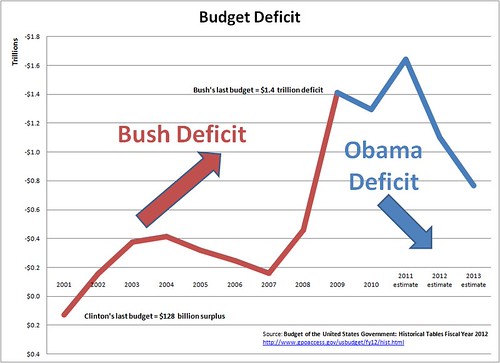
Deficits

Bush-Obama Deficit Chart

Notes, this chart includes Clinton’s last budget year for comparison.

The numbers in these two charts come from Budget of the United States Government: Historical Tables Fiscal Year 2012. They are just the amounts that the government spent and borrowed, period, Anyone can go look then up. People who claim that Obama “tripled the deficit” are either misled or are trying to mislead.

The Stimulus and Jobs

Bush-Obama-Jobs-Chart

In this chart, the RED lines on the left side — the ones that keep doing DOWN — show what happened to jobs under the policies of Bush and the Republicans. We were losing lots and lots of jobs every month, and it was getting worse and worse.The BLUE lines — the ones that just go UP — show what happened to jobs when the stimulus was in effect. We stopped losing jobs and started gaining jobs, and it was getting better and better. The leveling off on the right side of the chart shows what happened as the stimulus started to wind down: job creation leveled off at too low a level.

It looks a lot like the stimulus reversed what was going on before the stimulus.

Conclusion: THE STIMULUS WORKED BUT WAS NOT ENOUGH!

More False Things

These are just three of the false things that everyone “knows.” Some others are (click through): Obama bailed out the banks, businesses will hire if they get tax cuts, health care reform cost $1 trillion, Social Security is a Ponzi Scheme or is “going broke”, government spending “takes money out of the economy.”

Why This Matters

These things really matter. We all want to fix the terrible problems the country has. But it is so important to know just what the problems are before you decide how to fix them. Otherwise the things you do to try to solve those problems might just make them worse. If you get tricked into thinking that Obama has made things worse and that we should go back to what we were doing before Obama — tax cuts for the rich, giving giant corporations and Wall Street everything they want — when those are the things that caused the problems in the first place, then we will be in real trouble.

Emphasis Mine

see:http://www.alternet.org/story/152201/3_reality-based_charts_your_right-wing_relatives_will_have_a_hard_time_ignoring?akid=7484.123424.OxQ7x8&rd=1&t=12

GOP’s Debt Solution: Soak the Poor

A single mother struggling to keep a roof over her child’s head would probably love to trade places with a six-figure earner and bear the burden of paying federal income tax on a comfortable salary.

By Carl Gibson, Reader Supported News

magine a bulky schoolyard bully routinely holding you and your classmates upside-down by your shoes and pocketing the money that falls out, using the amount gained from his extortion to buy a new bike at the end of each semester. Now imagine enduring this process every day, all year, throughout each grade of school.

What if one day, the bully actually complained that you weren’t bringing enough lunch money to school because he wanted a nicer bike? Would you comply and let him rob you of a larger amount, or would you and your fellow classmates surround the teacher and demand the bully return the money he stole?

Despite billionaire Warren Buffett‘s pleas to reduce the deficit by shifting the tax burden to the super-rich, Republican members of Congress have officially come out in favor of raising taxes on the poor, while fiercely protecting trillions in tax handouts for billionairesbig oil and corporate jet owners. Right-wing politicians and corporate-media pundits have now set their sights on “lucky duckies,” or the bottom half of Americans who don’t pay federal income taxes. As law professor Edward Kleinbard noted, this statement is misleading and ignores the need for meaningful reform of our tax code.

Jon Stewart creatively dismantled the poor-people-don’t-pay-taxes argument on The Daily Show, highlighting conservatives who dismissed the $700 billion in revenue gained from ending the Bush tax cuts for the wealthy in 2010. According to Stewart’s calculations, taking exactly half of everything owned by the bottom 50% of Americans would also generate $700 billion, exactly as much revenue as increasing the tax rate for the richest Americans by a modest 3%. Stewart sarcastically suggested Republicans trim the deficit by seizing all assets owned by the bottom half of Americans.

It’s incredibly audacious for the rich to ask the poor to pay more in taxes in order to protect theirbudget-busting tax breaks, especially considering America’s wealth disparity. The gap between the richest and everyone else has grown to levels even greater than on the eve of the crash that triggered the great depression, with the top .001% of Americans now owning 976 times more than the bottom 90%. In 1928, the richest only owned 892 times more than the bottom 90%.

And of course, those accusing the working poor of freeloading ignore the fact that 1 in 4 American jobs don’t even pay poverty wages, or that the federal income tax is inherently designed to avoid hitting the poor, the elderly and working families with children. Such bold accusations also ignore the reality that all of the aforementioned groups still pay roughly one-third of their income in sales, property, payroll and excise taxes.

A single mother struggling to keep a roof over her child’s head would probably love to trade places with a six-figure earner and bear the burden of paying federal income tax on a comfortable salary. But would a six-figure earner be willing to work three part-time minimum wage jobs and still worry about how the rent is going to be paid at the end of the month? Would he really be eager to forgo paying federal income tax if it meant he had to scrape quarters together to buy beans, lentils and ramen noodles for dinner?

Big oil doesn’t need $4 billion per year in taxpayer subsidies – they’re making record profits. Excessive tax cuts for millionaires and billionaires won’t create jobs – the unemployment rate doubledafter ten years of the Bush tax cuts. And corporate jet owners don’t need a tax break while public employees nationwide are losing their jobs to budget cuts.

America needs to surround our teacher before recess and make a strong statement together – the bullies don’t need to rob us of our lunch money to continue their excessive lifestyles. Let’s stop subsidizing wealth for the sake of wealth, and leave struggling middle-class families alone.


Carl Gibson, 24, of Lexington, Kentucky, is a spokesman and organizer for US Uncut, a nonviolent, creative direct-action movement to stop budget cuts by getting corporations to pay their fair share of taxes. He graduated from Morehead State University in 2009 with a B.A. in Journalism before starting the first US Uncut group in Jackson, Mississippi, in February of 2011. Since then, over 20,000 US Uncut activists have carried out more than 300 actions in over 100 cities nationwide. You may contact Carl at carl@rsnorg.org.

Reader Supported News is the Publication of Origin for this work. Permission to republish is freely granted with credit and a link back to Reader Supported News.”

Emphasis Mine

see:http://readersupportednews.org/opinion2/279-82/7202-gops-debt-solution-soak-the-poor

5 Reasons Capitalism Has Failed

The root cause of our recent turmoil is the failure of the dominant economic paradigm — global corporate capitalism.

By Bob Burnett, The Smirking Chimp, via AlterNet

(N.B.: Marx was right, after all…)

We live in interesting times. The global economy is splintering. U.S. voters hate all politicians and there’s political unrest throughout the world. The root cause of this turmoil is the failure of the dominant economic paradigm — global corporate capitalism.

The modern world is ruled by multinational corporations and governed by a capitalistic ideology that believes: Corporations are a special breed of people, motivated solely by self-interest. Corporations seek to maximize return on capital by leveraging productivity and paying the least possible amount for taxes and labor. Corporate executives pledge allegiance to their directors and shareholders. The dominant corporate perspective is short term, the current financial quarter, and the dominant corporate ethic is greed, doing whatever it takes to maximize profit.

Five factors are responsible for the failure of global corporate capitalism. First, global corporations are too big. We’re living in the age of corporate dinosaurs. (The largest multinational is JP Morgan Chase with assets of $2 Trillion, 240,000 employees, and offices in 100 countries.) The original dinosaurs perished because their huge bodies possessed tiny brains. Modern dinosaurs are failing because their massive bureaucracies possess miniscule hearts.

Since the Reagan era global corporations have followed the path of least resistance to profit; they’ve swallowed up their competitors and created monopolies, which have produced humongous bureaucracies. In the short-term, scale helps corporations grow profitable, but in the long-term it makes them inflexible and difficult to manage. Gigantism creates a culture where workers are encouraged to take enormous risks in order to create greater profits; it’s based upon the notion that the corporation is “too big to fail.”

Second, global corporations disdain civil society. They’ve created a culture of organizational narcissism, where workers pledge allegiance to the enterprise. Corporate employees live in a bubble, where they log obscene hours and then vacation with their co-workers. Multinationals develop their own code of ethics and worldview separate from that of any national state. Corporate executives don’t care about the success or failure of any particular country, only the growth and profitability of their global corporation. (Many large corporations pay no U.S. income tax; in 2009 Exxon Mobil actually got a $156 M rebate.)

Third, global corporations are modern outlaws, living outside the law. There is noinvisible hand that regulates multinationals. In 1759 Philosopher Adam Smith argued that while wealthy individuals and corporations were motivated by self interest, an “invisible hand” was operating in the background ensuring that capitalist activities ultimately benefited society. In modern times this concept became the basis for the pronouncements of the Chicago School of Economics that markets were inherently self regulating. However, the last five years have demonstrated that there is no “invisible hand”unregulated markets have spelled disaster for the average person. The “recovery” of 2009-10 ensured that “too big to fail” institutions would survive and the rich would continue to be rich. Meanwhile millions of good jobs were either eliminated or replaced by low-wage jobs with poor or no benefits.

Fourth, global corporations are ruining our natural capital. Four of the top 10 multinational corporations are energy companies, with Exxon Mobil leading the list. But there are many indications that our oil reserves are gone. Meanwhile, other forms of natural capital have been depleted — arable land, water, minerals, forests, fish, and so forth. Multinational corporations have treated the environment as a free resource. When the timberlands of North America began to be depleted, lumber corporations moved to South America and then Asia. Now, the “easy pickings” are gone. Global corporations have ravished the world and citizens of every nation live with the consequences: dirty air, foul water, and pollution of every sort.

Fifth, global corporations have angered the world community. The world GDP is $63 Trillion but multinational corporations garner a disproportionate share — with banks accounting for an estimated $4 trillion (bank assets are $100 trillion). Global black markets make $2 trillion — illegal drugs account for at least $300 billion. In many parts of the world, a worker is not able to earn a living wage, have a bank account or drive a car, but can always obtain drugs, sex, and weapons. And while the world may not be one big village in terms of lifestyle, it shares an image of “the good life” that’s proffered in movies, TV, and the Internet. That’s what teenagers in Afghanistan have in common with teenagers in England; they’ve been fed the same image of success in the global community and they know it’s inaccessible. They are angry and, ultimately, their anger has the same target — multinational corporations (and the governments that support them).

We live in interesting times. The good news is we’re witnessing the failure of global corporate capitalism. The bad news is we don’t know what will replace it.”

(N.B.: Perhaps we do – see peoplesworld.org)

Bob Burnett is a writer and activist in Berkeley, Calif.

Emphasis Mine

see:http://www.alternet.org/story/152118/5_reasons_capitalism_has_failed?page=entire

The Dangerous Reagan Cult

Exclusive: Ronald Reagan’s anti-government philosophy inspires Tea Party extremists to oppose any revenue increase, even from closing loopholes on corporate jets. Democrats try the spin that “even Reagan” showed flexibility on debt and taxes. But Robert Parry says it is the “Reagan cult” that is at the heart of America’s crisis.

From RSN, by Robert Parry

“Exclusive: Ronald Reagan’s anti-government philosophy inspires Tea Party extremists to oppose any revenue increase, even from closing loopholes on corporate jets. Democrats try the spin that “even Reagan” showed flexibility on debt and taxes. But Robert Parry says it is the “Reagan cult” that is at the heart of America’s crisis.

In the debt-ceiling debate, both Republicans and Democrats wanted Ronald Reagan on their side. Republicans embraced the 40th president’s disdain for government and fondness for tax cuts, while Democrats noted that “even Reagan” raised the debt limit many times and accepted some tax increases.

But Reagan – possibly more than any political leader – deserves the blame for the economic/political mess that the United States now finds itself in. He was the patriarch for virtually every major miscalculation that the country has made over the past three decades.

It was Reagan who slashed taxes on the rich to roughly their current level; he opened the flood gates on deficit spending; he accelerated the decline of the middle class by busting unions and slashing support for local communities; he disparaged the value of government regulations; he squandered money on the Pentagon; he pushed more militaristic strategies abroad; and he rejected any thoughtful criticism of past U.S. foreign policies.

Reagan also created what amounted to a “populist” right-wing cult that targeted the federal government as the source of nearly all evil. In his First Inaugural Address, he famously declared that “government is not the solution to our problem; government is the problem.”

It is that contempt for government that today is driving the Tea Party extremists in the Republican Party. Yet, as with many cults, the founder of this one was somewhat more practical in dealing with the world around him, thus explaining some of Reagan’s compromises on the debt ceiling and taxes.

But once the founder is gone, his teachings can become definitive truth to the disciples. Flexibility disappears. No deviation is permitted. No compromise is tolerated.

So, at a time when government intervention is desperately needed to address a host of national problems, members of this Reagan cult apply the teachings of the leader in the most extreme ways. Since “government is the problem,” the only answer is to remove government from the equation and let the corporations, the rich and the magical “market” dictate national solutions.

It is an ironic testament to Ronald Reagan’s enduring influence that America’s most notable “populist” movement, the Tea Party, insists that tax cuts for the wealthy must be protected, even minor ones like tax loopholes for corporate jets. Inside the Tea Party, any suggestion that billionaire hedge-fund managers should pay a tax rate equal to that of their secretaries is anathema.

Possibly never in history has a “populist” movement been as protective of the interests of the rich as the Tea Party is. But that is because it is really a political cult dedicated to the most extreme rendering of Ronald Reagan’s anti-government philosophy.

Astro-Turf ‘Populists’

Granted, the Tea Party also can be viewed as an astro-turf outfit financed by billionaires like the Koch brothers and promoted by billionaire media mogul Rupert Murdoch. But Election 2010 proved that the movement is capable of putting like-minded politicians into office, especially when discouraged elements of the American Left choose to sit on the sidelines.

During the debt-ceiling battle, the GOP’s Tea Party caucus showed it was strong enough to block any compromise that included a revenue increase. The thinking is that the “evil” government must be starved even if that means defending indefensible tax loopholes and shoving the world’s economy to the brink of catastrophe.

The Tea Party’s rabid enforcement of the Reagan orthodoxy instills such fear among top Republicans that every one of the eight presidential hopefuls at a recent Iowa debate vowed to reject a deal that would include just $1 of higher taxes for each $10 in spending cuts. Even supposed moderates like Mitt Romney and Jon Huntsman threw up their hands.

But the Reagan cult reaches far beyond the Republican Party. Last February, a Gallup poll of Americans cited Reagan as the greatest president ever, with a five percentage point lead over Abraham Lincoln.

These days, virtually no one in Washington’s political or media circles dares to engage in a serious critique of Reagan’s very checkered record as president. It’s much easier to align yourself with some position that Reagan took during his long career, much like a pastor selectively picking a Bible passage to support his theological argument.

When negative national trends are cited – such as the decline of the middle class or the widening gap between rich and poor – the self-censorship demands that Reagan’s name not be spoken. Instead, there are references to these problems deepening “over the past three decades,” without mentioning whose presidency got things going big time.

Creating an Icon

And there is a self-interested reason for this hesitancy. The Republicans and the Right have made it a high priority to transform Reagan into an icon and to punish any independent-minded political figure or journalist who resists the group think.

The first step in this process occurred in the late 1980s, with aggressive cover-ups of Reagan’s crimes of state, such as scandals over the Iran-Contra arms-for-hostages affair, Contra-cocaine trafficking, and the Iraq-gate support of dictator Saddam Hussein.

Faced with furious Republican defenses of Reagan and his inner circle, most Democrats and mainstream journalists chose career discretion over valor. By the time Bill Clinton was elected in 1992, the refrain from Democrats and Washington pundits was to “leave that for the historians.”

Those who didn’t go along with the cover-ups – like Iran-Contra special prosecutor Lawrence Walsh – were subjected to ridicule from both the right-wing and mainstream media, from both the Washington Times and the Washington Post. Journalists who challenged the implausible Reagan cover-ups also found themselves marginalized as “conspiracy theorists.”

Leading Democrats decided it made more sense to look to the future, not dwell on the past. Plus, acquiescing to the cover-ups was a way to show their bipartisanship.

However, Republicans had other ideas. Having pocketed the concessions regarding any serious investigations of Reagan and his cohorts, the Republicans soon went on the offensive by investigating the heck out of President Clinton and his administration.

Then, having stirred up serious public doubts about Clinton’s integrity, the Republicans trounced the Democrats in the 1994 congressional elections. With their new majorities, the Republicans immediately began the process of enshrining Reagan as a national icon.

By and large, the Democrats saw these gestures, like attaching Reagan’s name to National Airport, as another way to demonstrate their bipartisanship.

But Republicans knew better. They understood the strategic value of elevating Reagan’s legacy to the status of an icon. If everyone agreed that Reagan was so great, then it followed that the hated “guv-mint” must be that bad.

More Accommodations

Increasingly, Democrats found themselves arguing on Republican ground, having to apologize for any suggestion that the government could do anything good for the country. Meanwhile, the Clinton-era stock market boom convinced more Americans that the “market” must know best.

Going with that flow, President Clinton signed a Republican-sponsored bill that removed Depression-era regulations in the Glass-Steagall Act, which had separated commercial and investment banks. With the repeal, the doors were thrown open for Wall Street gambling.

In the short run, lots of money was made, encouraging more Americans to believe that the government and its “safety net” were indeed anachronisms for losers. People with any gumption could simply day-trade their way to riches.

Reagan, it seemed, was right all along: government was the problem; the “free market” was not only the solution but it could “self-regulate.”

That was the political/media environment around Election 2000 when the wonkish Vice President Al Gore ran against the brash Texas Gov. George W. Bush, who came across to many as another version of Ronald Reagan, someone who spoke simply and disdained big government.

Though Gore could point to the economic successes of the Clinton years, including a balanced federal budget and the prospect of the total elimination of the federal debt, the major media mocked him as a know-it-all nerd who wore “earth-toned sweaters.” Meanwhile, mainstream journalists swooned over Bush, the regular guy.

Still, Gore eked out a narrow victory in the national popular vote and would have carried the key state of Florida if all legally cast votes were counted. But Bush relied on his brother’s administration in Florida and his father’s friends on the U.S. Supreme Court to make sure that didn’t happen. Bush was declared the winner in Florida and thus the new president. [For details, see Neck Deep.]

In retrospect, Election 2000 was a disastrous turning point for the United States, putting into the highest office in the land an unqualified ne’er do well who had lost the election.

But this outrage against democracy was largely accepted because of the muscular right-wing machine, the on-bended-knee mainstream media and the weak-kneed Democrats – a political/media dynamic that Reagan had helped create and had left behind.

The progress that the Clinton administration had made toward putting the U.S. financial house in order was quickly undone as Bush pushed through two massive tax cuts benefiting mostly the rich and waged two open-ended wars financed with borrowed money.

Years of Reaganism also had taken its toll on the government’s regulatory structures. Reagan had consistently appointed regulators who were hostile to the very concept of regulating, such as Anne Gorsuch at the Environmental Protection Agency and James Watt at Interior. He also elevated Alan Greenspan, a “free market” admirer of Ayn Rand, to be chairman of the Federal Reserve Board.

In the 1980s, the looting of America was underway in earnest, but the elites of Washington and New York saw little to protest since they were getting a cut of the plunder. The real losers were the average Americans, especially factory workers who saw their unions broken or their jobs shipped overseas under the banner of “free trade.”

Feeling Good

But many Americans were kept entranced by Reagan’s feel-good magic.

Taking office after a difficult decade of the 1970s, when America’s defeat in Vietnam and the Arab oil price hikes had shaken the nation’s confidence, Reagan simply assured everyone that things would work out just fine and that no excessive sacrifice was in order. Nor should there be any feelings of guilt, Reagan made clear.

By the late 1970s, it was widely accepted even among many Republicans that the Vietnam War had been an abomination. But Reagan simply rebranded it a “noble cause,” no reason for any serious self-reflection on America’s imperial role in the world.

Reagan then allied the United States with “death-squad” regimes all over Latin America and across the Third World. His administration treated the resulting carnage as a public-relations problem that could be managed by challenging the patriotism of critics.

At the 1984 Republican National Convention, Reagan’s United Nations Ambassador Jeane Kirkpatrick labeled Americans who dared criticize U.S. foreign policy as those who would “blame America first.”

To continue this sort of verbal pummeling on those who continued to get in the way, Reagan credentialed a bunch of thuggish intellectuals known as the neoconservatives.

For the rest of the country, there were happy thoughts about “the shining city on a hill” and “morning in America.”

In reality, however, Reagan had set the stage for the tragedies that would follow. When George W. Bush grabbed power in 2001, he simply extended the foreign and economic policies of the Republican cult leader: more tax cuts, more militarism, less regulation, more media manipulation.

Soon, the gap between rich and poor was widening again. Soon, the United States was at open war in two countries and involved in secret wars in many others. Soon, the nation was confronted with new scandals about torture and deception. Soon, the federal budget was flowing with red ink.

And near the end of Bush’s presidency, the de-regulated excesses of Wall Street pushed the country to the brink of a financial cataclysm. Bush supported a bail-out to save the bankers but didn’t do much for the millions of Americans who lost their jobs or their homes.

Second Thoughts?

One might have thought that the financial crack-up in 2008 (plus the massive federal deficits and the botched wars in Iraq and Afghanistan) would have confronted the Reagan cult with an existential crisis of faith. It would seem obvious that Reagan’s nostrums just didn’t work.

However, after only a brief interregnum of Barack Obama, the Republicans seem poised to restore the Reagan cult to full power in the United States. The new apparent GOP frontrunner, Texas Gov. Rick Perry, is already being hailed in the Washington Post as “The Texas Gipper.”

The Washington Times (yes, Rev. Sun Myung Moon’s right-wing propaganda sheet is still around) fairly cooed over Perry’s tough attacks on Obama, depicting America’s first black president as someone who apologizes for America and isn’t deserving of its soldiers in uniform.

“One of the powerful reasons for running for president of the United States is to make sure every man and woman who puts on the uniform respects highly the president of the United States,” Perry said. “We are indignant about a president who apologizes for America.”

As far as Perry is concerned, America has nothing to apologize for.

These are themes right out of Ronald Reagan’s playbook. And it appears likely that Election 2012 will be fought over terrain defined by Reagan, even though he left office in 1989 and died in 2004.

It is already clear that President Obama will be on the defensive, trying to justify a role for the federal government in America and explaining why the Reaganesque policy of low taxes on the rich must finally be reversed. Obama also is certain to shy away from any serious examination of how U.S. foreign policy went so wrong, so as not to be labeled “apologist-in-chief.”

Rick Perry or whatever other Republican gets the party’s nomination will hold the high ground of Reagan’s lofty standing among the American people. The GOP nominee can continue blaming “guv-mint” for the nation’s problems and promising another “morning in America” if only the nation further reduces the size of “guv-mint.”

With Democrats also trying to associate themselves with the “greatest president ever,” it appears doubtful that any serious effort will be made to explain to the American people that the charming Reagan was the pied piper who led them to their current demise.”

[For more on these topics, see Robert Parry’s Secrecy & Privilege and Neck Deep, now available in a two-book set for the discount price of only $19. For details, click here.]

Robert Parry broke many of the Iran-Contra stories in the 1980s for the Associated Press and Newsweek. His latest book,Neck Deep: The Disastrous Presidency of George W. Bush, was written with two of his sons, Sam and Nat, and can be ordered at neckdeepbook.com. His two previous books, Secrecy & Privilege: The Rise of the Bush Dynasty from Watergate to Iraq and Lost History: Contras, Cocaine, the Press & ‘Project Truth’ are also available there.

emphasis mine

Michele Bachmann Was Inspired By My Dad and His Christian Reconstructionist Friends — Here’s Why That’s Terrifying

By Frank Schaeffer, AlterNet
Posted on August 9, 2011,
see:http://www.alternet.org/story/151960/michele_bachmann_was_inspired_by_my_dad_and_his_christian_reconstructionist_friends_–_here%27s_why_that%27s_terrifying

As presidential candidate Michele Bachmann chews up scenery in the GOP primaries, the mainstream media is finally digging into her extremist beliefs in a serious way. In a profile published earlier this week, the New Yorker’s Ryan Lizza talked about Bachmann’s radical right-wing influences, which include the most extremist figures in the history of the religious right movement.

One of these was my evangelical leader father, Francis Schaeffer. Bachmann says in the New Yorker article that she got into politics because she watched a film series I directed called “How Should We Then Live,” written by and featuring my dad.

What the New Yorker article doesn’t do is explain why people like Bachmann, Sarah Palin, et al. turned to the hard reactionary anti-government right. I explain this in my book Sex, Mom and God. I think it’s important to understand this. So let me add what the New Yorker left out.

The Back Story

In 1983 I was the leader of a group of protesters who screamed abuse at Justice Harry Blackmun and made him beat a hasty retreat back into a college building at the University of Nebraska after he’d just been awarded an honorary degree. In the early 1980s my daughter Jessica and I—she was 12—drove into Boston several times to picket abortion clinics, including one where a few years later (in 1994) two people were shot dead and five were seriously wounded by “pro-life” activist John Salvi.

Dad agreed to lead several antiabortion demonstrations, too. He said, “We’re telling everyone else to get out there and picket, and some of our people are getting arrested, so we can’t say no to doing what we’re telling others to do.”

That was then. Today I’m on the “other side.”

America has a problem: It’s filled with people who take the Bible seriously. America has a blessing: It’s filled with people who take the Bible seriously. How does this blessing coexist with the curse derived from the same source: the Bible? The answer is that the Bible is a curse or a blessing depending on who is doing the interpreting. Sometimes belief in the Bible leads to building a hospital. Sometimes it leads to justifying perpetual war and empire building. Same book—different interpretation.

If the history of Christianity proves one thing, it’s that you can make the Bible “say” anything. When you hear words like “We want to take back America for God!” the 21st-century expression of such theocratic ideas can be traced back to some of my old friends: the Reconstructionists.

Most Americans have never heard of the Reconstructionists. But they have felt their impact through the Reconstructionists’ profound (if indirect) influence over the wider (and vast) evangelical community.

Take Michele Bachmann. She is a Reconstructionist schooled – literally – by some of that obscure movement’s leading thinkers, including my father.

The evangelicals have shaped the politics of a secular culture that barely understood the religious right, let alone the forces within that movement that gave it its edge. The Americans inhabiting the wider (and more secular) culture just saw the results of Reconstructionism without understanding where those results had come from—for instance, how the hell George W. Bush got elected and then reelected or why Michele Bachmann was into home schooling long before she was into trying to become president in order to turn America into a homophobic theocracy.

Victimhood

If you feel victimized by modernity, then the Reconstructionists have the answer in their version of biblical interpretation. Reconstructionists want to replace the U.S. Constitution and Bill of Rights with their interpretation of the Bible.

The Reconstructionist worldview is ultra-Calvinist but, like all Calvinism has its origins in ancient Israel/Palestine, when vengeful and ignorant tribal lore was written down by frightened men (the nastier authors of the Bible) trying to defend their prerogatives to bully women, murder rival tribes, and steal land. (These justifications may have reflected later thinking: origin myths used as propaganda to justify political and military actions after the fact, such as the brutality the Hebrews said God made them inflict on others and/or their position as the Chosen People.)

In its modern American incarnation, which hardened into a 20th-century movement in the 1960s and became widespread in the 1970s, Reconstructionism was propagated by people like my father and others I knew and worked with closely when I, too, was both a Jesus Victim and a Jesus Predator claiming God’s special favor.

The Leaders

The leaders of the Reconstructionist movement included the late Rousas Rushdoony (Calvinist theologian, father of modern-era Christian Reconstructionism, patron saint to gold-hoarding haters of the Federal Reserve, haters of the US Government and creator of the modern evangelical home school movement), his son-in-law Gary North (an economist and publisher), and David Chilton (Calvinist pastor and author).

No, the Reconstructionists are not about to take over America, the world, or even most American evangelical institutions. Bachmann – for instance – will likely never be president. But their influence has not abated, however a la Tea Party.

The Reconstructionists have been like a drop of radicalizing flavoring added to a bottle of water: They’ve subtly changed the water’s flavor. And even though most evangelicals, let alone the general public, don’t know the names of the leading Reconstructionist thinkers, the world we live in—where a radicalized, angry government-hating religious right has changed the face of American politics and spun off into movements such as the Tea Party—is a direct result of that “flavoring.”

Anyone who wants to understand American politics, not to mention North American religion, had better get acquainted with the Reconstructionists. For instance these folks just held America hostage in the debt crisis, an attempt to – literally – destroy the government’s ability to function at all a manufactured “crisis” in which Bachmann was a leading proponent of scorched-earth, destroy the system “politics.”

Reconstructionism, also called Theonomism, seeks to reconstruct “our fallen society.” Its worldview is best represented by the publications of the Chalcedon Foundation (which has been classified as an antigay hate group by the Southern Poverty Law Center).

Kill the Gays

According to the Chalcedon Foundation Web site, the mission of the movement is to apply “the whole Word of God” to all aspects of human life: “It is not only our duty as individuals, families and churches to be Christian, but it is also the duty of the state, the school, the arts and sciences, law, economics, and every other sphere to be under Christ the King. Nothing is exempt from His dominion. We must live by His Word, not our own.”

Until Rushdoony, founder and late president of the Chalcedon Foundation, began writing in the 1960s, most American fundamentalists (including my parents) didn’t try to apply biblical laws about capital punishment for homosexuality to the United States. Even the most conservative evangelicals said they were “New Testament Christians.” In other words, they believed that after the coming of Jesus, the harsher bits of the Bible had been (at least to some extent) transformed by the “New Covenant” of Jesus’ “Law of Love.”

By contrast, the leaders of Reconstructionism believed that Old Testament teachings—on everything from capital punishment for gays to the virtues of child-beating—were still valid because they were the inerrant Word and Will of God and therefore should be enforced. Not only that, they said that biblical law should be imposed even on nonbelievers. This theology was the American version of the attempt in some Muslim countries to impose Shariah (Islamic law) on all citizens, Muslims and non-Muslims alike.

It was my old friend, the short, stocky, bearded Armenian American Rousas Rushdoony who in 1973 most thoroughly laid out the far right/religious right agenda in his book The Institutes of Biblical Law. Rushdoony changed the definition of salvation from the accepted evangelical idea that it applies to individuals to the claim that salvation is really about politics. With this redefinition, Rushdoony contradicted the usual reading of Jesus’ words by most Christians to mean that Jesus had not come to this earth to be a political leader: “My kingdom is not of this world” (John 18:36).

According to Rushdoony, all nations on earth should be obedient to the ancient Jewish/Christian version of “God’s Law,” so that the world will experience “God’s blessings.” Biblical salvation will then turn back the consequences of the Fall, and we’ll be on our way to the New Eden. To achieve this “turning back,” coercion must be used by the faithful to stop evildoers, who are, by definition, anyone not obeying all of God’s Laws as defined by the Calvinist and Reconstructionist interpretation of the Bible.

Once Christians are in charge, according to Gary North, rather than turning the other cheek to our enemy, we “should either bust him in the chops or haul him before the magistrate, and possibly both.” North adds, “It is only in a period of civil impotence that Christians are under the rule to ‘resist not evil.’”

How far would the Reconstructionists go? North, writes, “The question eventually must be raised: Is it a criminal offence to take the name of the Lord in vain? When people curse their parents, it unquestionably is a capital crime (Exodus. 21:17). The son or daughter is under the lawful jurisdiction of the family. The integrity of the family must be maintained by the threat of death. Clearly, cursing God (blasphemy) is a comparable crime, and is therefore a capital crime (Leviticus. 24:16).”

How might a Reconstructionist version of the Sermon on the Mount read, inclusive of Reconstructionist “inside” theological/political code words like “Law-Word”? Maybe something like this:

Blessed are those who exercise dominion over the earth: for theirs is the kingdom of heaven. Blessed are those who deport the immigrants: for they shall be comforted. Blessed are those who agree that the significance of Jesus Christ as the ‘faithful and true witness’ is that He not only witnesses against those who are at war against God, but He also executes them: for they shall inherit the earth. Blessed are those who subdue all things and all nations to Christ and His Law-Word: for they shall be filled. Blessed are those who say that those who refuse to submit publicly to the eternal sanctions of God must be denied citizenship: for they shall obtain mercy. Blessed are the Calvinist Christians who are the only lawful heirs to the Kingdom: for they shall see God. Blessed are those who know that turning the other cheek is a temporary bribe paid to evil secular rulers: for they shall be called sons of God if they bust their enemies in the chops. Blessed are those who have taken an eye for an eye: for theirs is the Kingdom of Heaven. Blessed are ye when ye know that the battle for My sake is between the Christian Reconstruction Movement and everyone else. Rejoice, and be exceedingly glad: for great is your reward in heaven. For so we are to make Bible-obeying disciples of anybody who gets in our way, and kill those who resist.

The Movement to ‘Take Back America For God’

I remember first meeting Rushdoony at his home in Vallecito, California, in the late 1970s. (That was where I also met Gary North for the first time.) I was accompanied by Jim Buchfuehrer, who had produced the antiabortion documentary series of films with me that featured my father and Dr. C. Everett Koop. (Koop would become Ronald Reagan’s surgeon general.)

The movie series and book project later got Michele Bachamnn to become an ardent clinic picketer. Whatever Happened to the Human Race? was Koop’s and my brainchild. He had seen my dad’s and my first film series—How Should We Then Live? (the series I directed and that Bachmann says got her into politics and that the New Yorker article describes in detail) —and Koop wanted to team up to expand on the last episodes, in which Dad had denounced the “imperial court” for “stripping the unborn” of their right to life.

The impact of the two film series, as well as their companion books, was to give the evangelical community a frame of reference through which to understand the “secularization of American culture” and to point to the “human life issue” as the watershed between a “Christian society” and a utilitarian, relativistic “post-Christian” future. This has become Bachmann’s agenda, and also the agenda of Fox News as they blast her views over America.

By the time the films had been viewed by millions of American evangelicals, Dad had become the leader of those evangelicals who took a “stand” on the “life issues.” And the films made the Reconstructionists believe that perhaps in Francis Schaeffer and his up-and-coming son they might have found new allies. So I began to get messages that Rushdoony urgently wanted to meet me.

Hating America to ‘Save’ It

When we talked, Rushdoony talked about “secular America” as if it were an enemy state, not our country. He talked about how “we” should all use cash, never credit cards, since cards would make it “easy for the government to track us.” Rushdoony spoke passionately about the virtues of gold, how very soon the conflict between the Soviet Union and America would lead to war. Rushdoony also noted that Vallecito was “well located to survive the next war” given “the prevailing wind directions” and its water supply.

The message of Rushdoony’s work is best summed up in one of his innumerable Chalcedon Foundation position papers, “The Increase of His Government and Peace.” He writes, “The ultimate and absolute government of all things shall belong to Christ.” In his book Thy Kingdom Come—using words that are similar to those the leaders of al Qaida would use decades later in reference to “true Islam”—Rushdoony argues that democracy and Christianity are incompatible: “Democracy is the great love of the failures and cowards of life,” he writes. “One [biblical] faith, one law and one standard of justice did not mean democracy. The heresy of democracy has since then worked havoc in church and state.Christianity and democracy are inevitably enemies.”

The impact of Reconstructionism (often under other names) has grown even though Rushdoony has largely been forgotten even in evangelical circles, let alone the wider world. He made the evangelical world more susceptible to being politicized—and manipulated by some very smart people like Bachmann.

Religious leaders like Jerry Falwell who once had nothing to do with politics per se were influenced by the Reconstructionists. That in turn moved the whole evangelical movement to the right and then into the political arena, where it became “normal” for evangelical leaders to jump head first into politics with little-to-no regard for the separation of church and state.

Extremists For Jesus

Without the work of the Reconstructionists, the next generation of religious activists (trying to use the courts, politics, and/or civil disobedience to impose their narrow theology on the majority of Americans) may have been relegated to some lonely street corner where they could gather to howl at the moon. Instead, the 21st century’s theocrats (though they’d never so identify themselves) enjoyed the backing of Fox News, were tolerated at places like Princeton University, and could be found running many evangelical organizations. And now in Bachmann they have their champion: a full fledged Reconstructionist radical.

From Puritans To Government Haters

The Puritans’ theology of government was formed in the context of an embrace of all Christians’ duty to demand the “public good.” This was exemplified by such unquestioned well-established concepts as the “king’s highway,” a common road system protected by the crown (government) and a common law that applied to all. One’s common duty to others was accepted as the essential message of Christian civilization. Public spaces were defended by government in the early New England settlements, just as they had been in England.

What’s so curious is that in this religion-inflicted country of ours, the same evangelicals, conservative Roman Catholics, and others like George and Bachmann who had been running around post-Roe insisting that America had a “Christian foundation” and demanding a “return to our heritage” and/or more recently trashing health care reform as “communist” ignored the fact that one great contribution of Christianity was a commitment to strong central government. For instance, this included church support for state-funded, or state-church-funded, charities, including hospitals, as early as the fourth century.

Government was seen as part of God’s plan for creating social justice and defending the common good. Christians were once culture-forming and culture-embracing people. Even the humanism preached by the supposedly “anti-Christian” Enlightenment thinkers of the 18th century was, in fact, a Deist/Christian “heresy,” with a value system espousing human dignity borrowed wholesale from the Sermon on the Mount.

In the scorched-earth post-Roe era of the “health care reform debates” of 2009 and beyond, evangelicals seemed to believe that Jesus commanded that all hospitals (and everything else) should be run by corporations for profit, just because corporations weren’t the evil government. The right even decided that it was “normal” for the state to hand over its age-old public and patriotic duties to private companies—even for military operations (“contractors”), prisons, health care, public transport, and all the rest.

The religious right/far right et al. favored private “facts,” too. They claimed that global warming wasn’t real. They asserted this because scientists (those same agents of Satan who insisted that evolution was real) were the ones who said human actions were changing the climate. Worse, the government said so, too!

“Global warming is a left-wing plot to take away our freedom!”

“Amtrak must make a profit!”

Even the word “infrastructure” lost its respectability when government had a hand in maintaining roads, bridges and trains.

In denial of the West’s civic-minded, government-supporting heritage, evangelicals (and the rest of the right) wound up defending private oil companies but not God’s creation, private cars instead of public transport, private insurance conglomerates rather than government care of individuals. The price for the religious right’s wholesale idolatry of private everything was that Christ’s reputation was tied to a cynical political party “owned” by billionaires. It only remained for a far right Republican-appointed majority on the Supreme Court to rule in 2010 that unlimited corporate money could pour into political campaigns—anonymously—in a way that clearly favored corporate America and the superwealthy, who were now the only entities served by the Republican Party.

The evangelical rubes who are Bachmann’s foot soldiers never realized that the logic of their “stand” against government had played into the hands of people who never cared about human lives beyond the fact that people could be sold products. By the 21st century, Ma and Pa No-name were still out in the rain holding an “Abortion is Murder!” sign in Peoria and/or standing in line all night in some godforsaken mall in Kansas City to buy a book by Sarah Palin and have it signed. But it was the denizens of the corner offices at Goldman Sachs, the News Corporation, Exxon, and Halliburton who were laughing.

Frank Schaeffer is the author of “Crazy for God: How I Grew Up As One Of The Elect, Helped Found The Religious Right, And Lived To Take All (Or Almost All) Of It Back.”

© 2011 Independent Media Institute. All rights reserved.
View this story online at: http://www.alternet.org/story/151960/

[w1]

Americans Don’t Realize Just How Badly We’re Getting Screwed by the Top 0.1 Percent Hoarding the Country’s Wealth

With an unprecedented sum of wealth held within the top one-tenth of one percent of the US population, we now have the most severe inequality of wealth in US history.

N.B.: An oft disdained 19th century philosopher would hardly be surprised!

From AmpedStaus  – via AlterNet – by David Degraw

“With an unprecedented sum of wealth, tens of trillions of dollars, held within the top one-tenth of one percent of the US population, we now have the most severe inequality of wealth in US history. Not even the robber barons of the Gilded Age were as greedy as the modern-day economic elite.

As American philosopher John Dewey said, “There is no such thing as the liberty or effective power of an individual, group, or class, except in relation to the liberties, the effective powers, of other individuals, groups or classes.”

In my report, The Economic Elite vs. the People, I reported on the strategic withholding of wealth from 99 percent of the US population over the past generation. Since the mid-1970s, worker production and wealth creation has exploded. As the statistics throughout this report prove, the dramatic increase in wealth has been almost entirely absorbed by the economic top one-tenth of one percent of the population, with most of it going to the top one-hundredth of one percent.

If you are wondering why a critical mass of people desperately struggling to make ends meet are still not fighting back with overwhelming force and running the mega-wealthy aristocrats out of town, let’s consider two significant factors:

1) People are so busy trying to maintain their current standard of living that their energies are consumed by holding onto the little they have left.

2) People have very little understanding of how much wealth has been consolidated within the top economic one-tenth of one percent.

Considering the first factor, it is obvious that people have become beaten down psychologically and financially. A report in the Guardian titled, “Anxiety keeps the super-rich safe from middle-class rage,” suggests that people are so desperate to hold onto what they have that they are too busy looking down to look up: “As psychologists will tell you, fear of loss is more powerful than the prospect of gain. The struggling middle classes look down more anxiously than they look up, particularly in recession and sluggish recovery.”

Considering the second factor, people do not understand how much wealth has been withheld from them. The average person has never personally experienced or seen the excessive wealth and luxury that the mega-rich live in. Wealth inequality has grown so extreme and the wealthy have become so far removed from average society, it is as if the rich exist in some outer stratosphere beyond the comprehension of the average person. As the Guardian report states:

“… having little daily contact with the rich and little knowledge of how they lived, they simply didn’t think about inequality much, or regard the wealthy as direct competitors for resources. As the sociologist Garry Runciman observed: ‘Envy is a difficult emotion to sustain across a broad social distance.’… Even now most underestimate the rewards of bankers and executives. Top pay has reached such levels that, rather like interstellar distances, what the figures mean is hard to grasp.”

In fact, the average American vastly underestimates our nation’s severe wealth disparity. This survey, featured in the NY Times, reveals that Americans think our society is far more equal than it actually is:

“In a recent survey of Americans, my colleague Dan Ariely and I found that Americans drastically underestimated the level of wealth inequality in the United States. While recent data indicates that the richest 20 percent of Americans own 84 percent of all wealth, people estimated that this group owned just 59 percent – believing that total wealth in this country is far more evenly divided among poorer Americans.

What’s more, when we asked them how they thought wealth should be distributed, they told us they wanted an even more equitable distribution, with the richest 20 percent owning just 32 percent of the wealth. This was true of Democrats and Republicans, rich and poor – all groups we surveyed approved of some inequality, but their ideal was far more equal than the current level.”

This chart shows the survey’s results:

The overwhelming majority of the US population is unaware of the vast wealth at hand. An entire generation of unprecedented wealth creation has been concealed from 99 percent of the population for over 35 years. Having never personally experienced this wealth, the average American cannot comprehend what is possible if even a fraction of the money was used for the betterment of society.

Given modern technology and wealth, American citizens should not be living in poverty. The statistics demonstrate that we now live in a neo-feudal society. In comparison to the wealthiest one-tenth of one percent of the population, who are sitting on top of tens of trillions of dollars in wealth, we are essentially propagandized peasants.

The fact that the overwhelming majority of Americans are struggling to get by, while tens of trillions of dollars are consolidated within a small fraction of the population, is a crime against humanity.

The next time you are stressed out, struggling to make ends meet and pay off your debts, just think about the trillions of dollars sitting in the obscenely bloated pockets of the financial elites. I still cling to the hope that once enough people become aware of this fact, we can have the non-violent revolution we so urgently need. Until then, the rich get richer as a critical mass with increasingly dire economic prospects desperately struggles to make ends meet.

emphasis mine

see:http://www.alternet.org/story/152010/americans_don%27t_realize_just_how_badly_we%27re_getting_screwed_by_the_top_0.1_percent_hoarding_the_country%27s_wealth?page=entire

Don’t Fall for the GOP Lie

Don’t fall for the GOP lie: There is no budget crisis. There’s a job and growth crisis.

By Robert Reich, Robert Reich’s Blog

Don’t fall for the GOP lie: There is no budget crisis. There’s a job and growth crisis.

“A friend who’s been watching the absurd machinations in Congress asked me “what happens if we don’t solve the budget crisis and we run out of money to pay the nation’s bills?”

It was only then I realized how effective Republicans lies have been. That we’re calling it a “budget crisis” and worrying that if we don’t “solve” it we can’t pay our nation’s bills is testament to how successful Republicans have been distorting the truth.

The federal budget deficit has no economic relationship to the debt limit. Republicans have linked the two, and the Administration has played along, but they are entirely separate. Republicans are using what would otherwise be a routine, legally technical vote to raise the debt limit as a means of holding the nation hostage to their own political goal of shrinking the size of the federal government.

In economic terms, we will not “run out of money” next week. We’re still the richest nation in the world, and the Federal Reserve has unlimited capacity to print money.

Nor is there any economic imperative to reach an agreement on how to fix the budget deficit by Tuesday. It’s not even clear the federal budget needs that much fixing anyway.

Yes, the ratio of the national debt to the total economy is high relative to what it’s been. But it’s not nearly as high as it was after World War II – when it reached 120 percent of the economy’s total output.

If and when the economy begins to grow faster – if more Americans get jobs, and we move toward a full recovery – the debt/GDP ratio will fall, as it did in the 1950s, and as it does in every solid recovery. Revenues will pour into the Treasury, and much of the current “budget crisis” will be evaporate.

Get it? We’re really in a “jobs and growth” crisis – not a budget crisis.

And the best way to get jobs and growth back is for the federal government to spend more right now, not less – for example, by exempting the first $20,000 of income from payroll taxes this year and next, recreating a WPA and Civilian Conservation Corps, creating an infrastructure bank, providing tax incentives for small businesses to hire, expanding the Earned Income Tax Credit, and so on.

But what happens next week if Congress can’t or won’t deliver the President a bill to raise the debt ceiling? Remember: This is all politics, mixed in with legal technicalities. Economics has nothing to do with it.

One possibility, therefore, is for the Treasury to keep paying the nation’s bills regardless. It would continue to issue Treasury bills, which are our nation’s IOUs. When those IOUs are cashed at the Federal Reserve Board, the Fed would do what it has always done: Honor them.

How long could this go on without the debt ceiling being lifted? That’s a legal question. Republicans in Congress could mount a legal challenge, but no court in its right mind would stop the Fed from honoring the full faith and credit of the United States.

The wild card is what the three big credit-rating agencies will do. As long as the Fed keeps honoring the nation’s IOUs, America’s credit should be deemed sound. We’re not Greece or Portugal, after all. We’ll still be the richest nation in the world, whose currency is the basis for most business transactions in the world.

Standard & Poor’s has warned it will downgrade the nation’s debt from a triple-A to a double-A rating if we don’t tend to the long-term deficit. But, as I’ve noted, S&P has no business meddling in American politics – especially since its own non-feasance was partly responsible for the current size of the federal debt (had it done its job the debt and housing bubbles wouldn’t have precipitated the terrible recession, and the federal outlays it required).

As long as we pay our debts on time, our global creditors should be satisfied. And if they’re satisfied, S&P, Moody’s, and Fitch should be, too.

Repeat after me: The federal deficit is not the nation’s biggest problem. The anemic recovery, huge unemployment, falling wages, and declining home prices are bigger problems. We don’t have a budget crisis. We have a jobs and growth crisis.

The GOP has manufactured a budget crisis out of the Republicans’ extortionate demands over raising the debt limit. They have succeeded in hoodwinking the public, including my friend.”


Robert Reich is Chancellor’s Professor of Public Policy at the University of California at Berkeley. He has served in three national administrations, most recently as secretary of labor under President Bill Clinton. He has written thirteen books, including “The Work of Nations,” “Locked in the Cabinet,” “Supercapitalism” and his latest book, “AFTERSHOCK: The Next Economy and America’s Future.” His ‘Marketplace’ commentaries can be found on publicradio.com and iTunes.

Emphasis mine

see:http://www.readersupportednews.org/opinion2/277-75/6813-dont-fall-for-the-gop-lie

Why Progressives Get No Respect.

“One of the biggest problems facing the Democrats going into this election is that they’re getting absolutely zero respect for everything they’ve done for the average American over the past two years. Tax cuts, health care reform, financial reform, expanded veterans’ benefits, direct funding of student loans

The Myth Of The Self-Made American: Why Progressives Get No Respect

“One of the biggest problems facing the Democrats going into this election is that they’re getting absolutely zero respect for everything they’ve done for the average American over the past two years. Tax cuts, health care reform, financial reform, expanded veterans’ benefits, direct funding of student loans — the list is long, and one that, by rights, should get the Democrats re-elected handily.

The problem is that the average voter has no idea that any of this ever happened. In fact, if you ask most Americans (even a lot of Democrats), they’ll tell you that Obama raised their taxes.

This ignorance is on full display at your average Tea Party gathering, which is full of people who will proudly insist that they’re entirely self-made. “I did it all myself,” they’ll snarl, quivering in spittle-flecked outrage. “I didn’t get any government handouts. Nobody ever did anything for me — so why are all my tax dollars going to support those shiftless welfare cheats who aren’t willing to work like I did?”

The magnitude of the self-delusion is gobstopping. Did Mr. Self-Made Man grow up in a VA or FHA-funded house? Attend a public school or college? Go to school on the GI Bill, Pell Grants, or student loans? Does he claim a mortgage interest tax deduction every year? Does he support his retired parents out of pocket, or does Social Security do it for him? Does his employer get government contracts or subsidies that make his paycheck possible? Does his business depend on a sound currency, enforceable contracts, or reliable transportation systems?

It’s like his rich Uncle Sam, the benefactor whose generous bequests paid his way into the middle class, has been written totally out of his entire life story. Forget gratitude; these social contract deniers insist loudly that none of that ever happened. At all. They pay taxes; but they’ve never seen a cent returned to them for anything. And they write their “self-made” myths accordingly.

Unfortunately, this is just a symptom of a much larger problem, one that progressives need to resolve if we are to prevail in the future. The bizarre fact is that most Americans who’ve made it into the middle class got there with the help of seriously life-changing government investments and subsidies — and yet, ironically, if you ask them if they’ve ever used a government program in their lives, they’re very likely to tell you: Nope. Never. I did it all on my own.

Suzanne Mettler, a professor at Cornell, actually documented this effect in a 2008 study. She asked people who’d been the beneficiaries of 19 specific government programs — including some of the most popular and widespread programs in the country — whether or not they’d ever used a government social program. Here’s what she found:

Pct. of program beneficiaries who report they have not used a government program

There it is, in black and white. Sixty percent of people who get home mortgage interest deductions (one of the most important and lucrative middle-class subsidies going) don’t see this as a form of government help to their households, even though many of them wouldn’t be homeowners at all without it. Fifty-three percent of the people who got through college on student loans — and 40 percent of GI Bill beneficiaries — also think they’ve paid their own freight. And 44 percent of Social Security recipients don’t think that Social Security is a government program — which comes as no surprise to those of us who remember the ubiquitous calls during last year’s health care fight to “get your fllthy government hands off my Social Security.”

What’s going on here? How can so many people receive so much, and yet remain in such obstinate denial about where it all came from?

A big part of the problem, says Mettler, is that some government programs are simply more visible to the average voter than others. The visible ones tend to be the ones that are administered directly by a government agency, and show up in the budgets as clear line items. In particular, the programs that benefit the poor are often right out there on the table, where voters can see them and activists can ignite them into political issues: welfare, food stamps, government subsidized housing, education, Head Start.

But these programs are just a small fraction of America’s overall social spending. The bulk of our tax money goes to other programs — such as the mortgage interest deduction, student loan programs, and military spending — that are hidden from easy public view in what Mettler calls “the submerged state.” This spending is usually done in ways that are not directly visible to voters. A lot of it is corporate welfare, designed to prop up favored industries that are so powerful that no change is possible unless they’re somehow bought off with new profit opportunities or subsidies. These industries have a strong interest in keeping this spending out of the public eye and off the political table, where it might be challenged. An important subcategory includes government-funded programs that are run through private companies, like prisons or pre-reform student loans (or, for that matter, Obamacare). The money comes straight out of Uncle Sam’s pocket, but the beneficiaries never see his hand directly.

The big disconnect occurs because so many of the programs that benefit the middle class fall into this category. Take the mortgage interest deduction. This is, in effect, a subsidy that keeps America’s real estate and building trades sectors in business — and, as we’ve painfully discovered, was also of huge interest to the banks as well. But even though every homeowner in America profits handsomely from this subsidy, most Americans don’t understand very much about it. It’s just a line item on their income taxes. And there’s strong pressure to keep it that way. If the magnitude of this subsidy somehow moved into general awareness, it might be challenged. It would be subject to political debate. And that’s the last thing the builders and bankers want.

The 58 percent of our federal spending that goes to defense is almost certainly the biggest skeleton in the “submerged state” closet. A lot of that spending goes to businesses, large and small, around the country. If you’re a Congress member protecting jobs in your district (including your own), there is absolutely no upside to making an issue out of this. And, again, the beneficiaries are largely middle-class households, who fail to see the very real connection between these “government programs” and their own paychecks.

Mettler argues that any real reform that involves these hidden non-state actors must begin with explicitly making the invisible visible to the eyes of the public. It takes time and effort to bring the machinery of the submerged state up into the light of day, but it’s necessary — and effective. Obama’s effort to restore direct federal funding of student loans was a good example of this. The banks were making billions each year off this program, at the expense of millions of students who should have been getting that money instead. He was able to pull this off because activists and journalists had already spent several years hauling the ugly wreck of a policy up into public view, which weakened the ability of banking lobbyists to defend their position. By the time Obama arrived, they were weak enough that he could demand — and get — a complete end to this lucrative subsidy.

Making the invisible visible is also essential if we’re going to counter the Tea Party‘s self-serving, denial-wracked narratives, and open the way for Democrats and progressives to get the credit they deserve for the good that they do. We need to start pointing out, loudly and often, all the covert-but-effective ways that government investment and intervention has made the middle class possible.

Specifically, we need to drive home the fact that anybody who calls themselves an American cannot, in the same breath, declare that they are in any sense entirely “self-made.” This is indeed the land of opportunity. But those opportunities exist only as long as we work together to create them; and willfully denying that is an insult to every other American who sacrificed to make your opportunities possible. It’s like saying your parents had nothing to do with raising you. You’d expect them to be hurt, offended, and angry at your lack of gratitude. The rest of us who contributed to your success aren’t wrong to feel insulted, too.

Progressives know the truth: Nobody in America ever did it alone, for themselves. For the past 220 years, we’ve done it together, for each other. Bringing that interdependence back out into the light and putting at the center of our politics shifts the entire dialogue in ways that can help the progressives over the long haul, in at least three ways.

First, it reaffirms the democratic social contract. From the arrogant Wall Street bankers who still think they deserve bonuses for tanking the economy to the furious white men of the Tea Party, people who’ve convinced themselves that nobody ever gave them anything are justified (at least in their own minds) in deciding that they don’t owe anything to anyone else, either. And as long as they can keep the “self-made” lie going, they’ll also go on believing that they’re totally exempt from the whole social contract on which a democracy runs.

Second: It calls the conservatives’ politics-of-rage game. The self-made myth allows the conservative movement to keep feeding on the fury of aggrieved people who falsely think they’re getting nothing for something, even while they’re standing on a pile of wealth that we helped put under their feet. Setting the record straight on exactly what they did get for their tax dollars removes a lot of the justification for this outrage, and makes them look like the tantrum-throwing spoiled brats they are.

Third: It demands that people give credit where credit is due. Nothing changes until those of us who’ve paid our share of taxes, worked hard and played by the rules, struggled to raise sound families and build decent communities, and served our country at home and abroad start demanding acknowledgment, respect, and a proper “Thank you” for everything we’ve each contributed to make so much mutual success possible. And the real patriot is the one who always makes sure that Uncle Sam himself is the very first one to stand for applause.

Putting the lie to the “self-made” myth is critical to restoring the progressive ideas of common wealth, common sense, and the common good to a central place in our political story. It’s time to hand the country’s real “entitlement classes” the full, complete, annotated bill for everything they’ve received from the government’s hand — and demand that they never again forget to thank the 300 million of us who made it all possible.

see: http://ourfuture.org/blog-entry/2010104329/myth-self-made-american-why-progressives-get-no-respect

Emphasis Mine