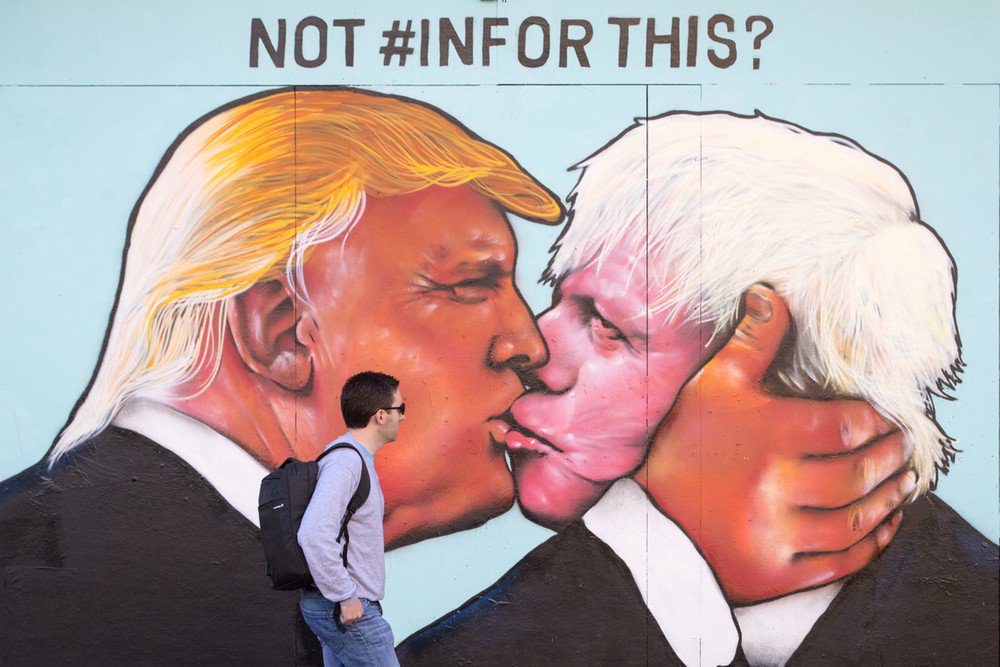
The Revolt of the Banana Repubicans

The travesty that unfolded in Cleveland…

Source: Tablet Magazine

Author: James Kirchick

Emphasis Mine

Sitting with me in the van to the airport on my way to Cleveland was a German family. Our driver turned the radio on, and a top-of-the-hour news update rehearsed the familiar litany of American woe. First, an excerpt from a somber speech by President Barack Obama discussing the latest episode of gun violence, this time in Baton Rouge. Next, a reply from Donald Trump, days away from receiving the presidential nomination of the Republican Party, who attacked the president on Twitter for turning the country into “a divided crime scene.” Rounding it out was an item about the Cleveland Police Department’s worry that demonstrators outside the Republican National Convention would take advantage of Ohio’s concealed carry law by arming themselves to the teeth. Listening in the back seat of the van to this recitation of carnage and absurdism, my thoughts drifted immediately to a friend of mine, the Washington correspondent for a major German daily, with whom I had been emailing earlier in the week. He could make a name for himself as a sort of reverse William Shirer, I would tell him, only half-jokingly, chronicling for a German readership the rise of fascism in America.

July 19, 2016, should go down in history as the date the Republican Party deservedly died—“political Jonestown” as the novelist Thomas Mallon called it earlier this month. For that was when the GOP finally nominated Donald Trump for president, officially sanctioning the idea that the fate of the free world ought to be entrusted to an aspiring authoritarian reality television show host. Mallon is an ingenious novelist of historical American political fiction, but I doubt even he could have dreamed up a scenario so bleak as the travesty that unfolded in Cleveland last week, one that, as an agitated observer of the Trump phenomenon, I felt compelled to witness from the floor of the Quicken Loans Arena, or “the Q,” as it is affectionately called.

My sojourn into the madness of Trumplandia began with a Monday noon foray to the “America First Unity Rally” held on the banks of the Cuyahoga River just a few blocks from the convention center. Organized by the conspiracy theory-spouting radio host Alex Jones (whose usual fare consists of claims like juice boxes are part of a government plot to make children gay or that the “chemtrails” from jetliners are elements of a giant mind-control experiment) and Nixon-era political operative Roger Stone, the event had the feel of a Guns ‘n Roses concert put on by the John Birch Society. Over the course of several hours, a motley cast of characters addressed a crowd of about 200 people, all united by grievance toward “the establishment,” a pathological hatred of Hillary Clinton, and an abiding belief that Donald Trump will single-handedly fix America’s problems. The mother of a man murdered by an illegal immigrant shared the heartbreaking story of her son’s death. A black Tea Party activist and perpetual congressional candidate from Maryland reassured the audience that Trump (“an outsider like myself”) is no racist, and closed out his pep talk with a put-down of the “disgusting, disgusted, and busted” presumptive Democratic presidential nominee. Musical interludes were provided by a low-rent, right-wing Stevie Nicks lookalike and a 16-year-old Russian immigrant who sang her own song titled “Political Correctness.” John McCain’s Tea Party challenger in the Arizona Republican senate primary railed against a “global tuxedo club” of elitist overlords and declared herself ready and able to “mix the mortar to fix the border.” Offering muscle for the afternoon was “Bikers for Trump,” the leader of which boasted that “we’ve got guys all over the city” to “do whatever’s necessary” to keep the peace.

There exists a vast academic literature on the sociological composition of American voters (at the demonstration, graduate students from a nearby university passed out questionnaires to attendees as part of a research project on the attitudes and backgrounds of Trump supporters). Reams of articles have been written on Trump’s appeal to downscale whites, who appeared to compose the majority of people at the riverside rally (far from all Trump supporters are working class, however; the median income of his voters is $72,000). But there are elements of a candidate’s support base that are unmeasurable, common characteristics that no sociological study or series of polls can reveal. This is particularly true of Trump’s more high-profile backers and official surrogates. Indeed, the degree to which supporters of Donald Trump reflect the candidate in temperament, style, and even diction, across subgroups like gender, race, sexual orientation and class, is remarkable.

The Donald Trump for President campaign has become a fly-trap for seemingly every American dimestore huckster, grifter, scrounger, has-been and wannabe. The roll call of D-list celebrities and politicians who spoke at the convention, along with the raft of lesser-known opportunists and frauds who decided to become Trumpkins so as to get on TV, resembles a list of fictional characters from the collected works of Billy Joel. Scott Baio, Antonio Sabato Jr., and Robert Davi embody the distinctly bridge and tunnel, alpha-male thuggishness of Trump’s “celebrity” support. Scott Brown, whose political career crashed and burned years ago after a brief stint as senator from Massachusetts, enlisted himself with Trump in hopes of escaping life as a hawker of diet supplements, ironically the perfect preparation for a snake-oil dispensing presidential campaign. (Brown, unsurprisingly, brought along to the convention his aging local news anchor wife and daughter, a former contestant on American Idol and budding starlet.)

The porcine duo of Newt Gingrich and Dick Morris, both of whom waddled past me on the convention’s first day, are physical manifestations of what the Republican Party has become under Trump, whose fleshy jowls at times render him indistinguishable from a bullfrog. Unlike the fit and trim House Speaker Paul Ryan, a visibly reluctant Trump supporter who clearly would have rather spent the entirety of last week in a dentist’s chair, Gingrich and Morris are engorged, mercenary, and utterly lacking in self-control, as willing to stick whole plates of food down their gullets or reach for the nearest “beautiful piece of ass” (or prostitute’s toe) as they are ready to adapt their principles to the moment. Listen to Eric Trump talk about his father’s future cabinet and you get the gist of the intellectually hollow, wise-guy chutzpah that exists in place of a governing ideology or worldview for those who’ve chosen to degrade themselves by supporting Trump. “If we’re going to have the biggest deals in the world, which are trade deals, why not have the best guys negotiate this?” he told The Hill, as if taking a sip from his tall boy on the LIRR. “Why not have the Carl Icahns or the top guys of Wall Street? It’s why they’re worth millions and billions of dollars. It’s because they’re tough and they’re shrewd.”

Reflecting the outsider status of its sponsors Jones and Stone, the “America First” rally initially seemed to be a gathering of people too wacky to speak from the convention stage. But it became readily apparent Monday evening that the themes of this “shadow” convention would, in fact, be parroted by the ostensibly more respectable delegates inside the Q.

The night began with a benediction from Brooklyn priest Kieran Harrington, who, head bowed, made reference to “deliberations,” declared “we stand before you, contrite,” and asked the Lord to “bless those who endured torture,” sentiments completely at odds with those expressed by the man about to receive the crowd’s enthusiastic nomination for president. Following that uncharacteristically humble opening, the message of the evening proceeded as follows: Mexicans and Muslims want to rape and kill you. Relatives of people murdered by illegal immigrants joined people like Pat Smith, mother of a foreign service officer killed in the 2012 Benghazi terrorist attack, in a festival of fear and loathing.

It would have been one thing if this shameless retailing of victimhood (something conservatives usually blame liberals for doing) was limited to tales of self-pity. What made it truly terrifying were the calls for blood. At the “America First” rally earlier in the day, I had seen dozens of people sporting “Hillary for Prison” T-shirts, what I took at the time to be nothing more than a token of Roger Stone’s virulent mischief. Inside the hall, I was appalled to hear, repeatedly and on every night of the convention, delegates cry “Lock her up!” whenever Clinton’s name was mentioned. It was an exhortation issued directly from the stage. Darryl Glenn, a senate candidate in Colorado, declared that Clinton should be outfitted in a “bright orange jumpsuit.” Pat Smith, who, in the exploitation of her grief the right has fashioned into its own Cindy Sheehan, insisted that the former secretary of state “deserves to be in stripes.”

The degeneration of the Republicans into banana Republicans reached its apotheosis on Wednesday evening, when Chris Christie, apparently worried that his reputation as a fat creep hadn’t yet taken hold within the minds of a majority of Americans, led the crowd in a call-and-response show trial-cum-lynch mob. Going through a laundry list of Hillary Clinton’s alleged crimes, the former federal prosecutor ended each accusation with the question, “Guilty or not guilty?” Most of Christie’s charge sheet consisted of political initiatives like the Russian reset and opening to Cuba, which, whatever their wisdom (and I, for what it’s worth, think they lacked it), had not the faintest whiff of criminality. But none of this mattered to the Jersey boy play-acting as Red Army hanging judge.

On the surface, the proliferation of anti-Hillary revenge fantasies smelled like the work of Paul Manafort. Trump’s roguishly handsome campaign manager spent years working as a consultant to former strongman president of Ukraine and Vladimir Putin ally Viktor Yanukovych, who in addition to stealing vast amounts of money from the public purse, was also famous for locking up his major political opponent. If Clinton weren’t imprisoned under a Trump regime, I cynically speculated, she might become the victim of dioxin poisoning, the fate that mysteriously befell Yanukovych’s other main rival.

But the single-minded obsession with throwing Clinton behind bars is an organic malady rather than a Manafortian import. It’s but one of many fixations that used to exist on the right-wing fringe but which the GOP decided to place front and center as part of its policy agenda. Last week’s convention saw an entire alternative media and political ecosystem (a potpourri of websites, podcasts, radio talk shows, and personalities like Milo Yiannopoulos and Ann Coulter) take control of the party apparatus and dictate its own version of reality. Trump’s followers inhabit an America in which “SJWs” (social justice warriors) make life intolerable for white men, where unsuspecting individuals are forced to watch a feminist Ghostbustersmovie like Alex was subjected to audiovisual torture in A Clockwork Orange, and everyone must dodge a proliferating number of Mexican and Muslim rapists and murderers. When Uday and Qusay Trump ceremoniously announced the votes of the New York delegation, and the light board in the rafters flashed “OVER THE TOP!” it was more than just a literal description of Trump’s campaign.

***

With the ritualized incantations of approved slogans, resolute messaging from the dais and deification of the candidate, political party conventions are the closest America comes to the one-party state. In this respect, the Donald did not disappoint. A biographical video that was more “Lifestyles of the Rich and Famous” than “Mr. Smith Goes to Washington” praised him for “dominating” the world of real estate and, now, politics. As an image flashed by of Trump in a ridiculously oversized top coat waving his hands at a crew of actors posing as hard-hatted construction workers, I was reminded of the parody website “Kim Jong Un Looking at Things,” which features photos of the North Korean dictator hectoring generals and inspecting random objects like an airport lounge table or processed food machinery.

With Trump, however, the authoritarian milieu extends beyond the mere aesthetic. It’s not unusual for a presidential candidate to showcase his attractive family. But never before has the nominee’s progeny played a more crucial role in a campaign, with the promise that they will play a crucial role in the future administration—the sort of dynastic nepotism one expects in a Third World country. I’ve lost track of the number of Trump supporters who cite his children as a chief reason for their support of the man; Maureen Reagan, Meghan McCain, and the five Romney boys never inspired such fawning.

Supporting Trump is an inherently masochistic act, and not only because one must surrender his conscience to do so. It is a form of intellectual and moral surrender. “Nobody knows the system better than me, which is why I alone can fix it,” Trump declared, in the most chilling and terrifying line of his acceptance speech. Trump’s tacit admission of corruption was paired with the implication that, if elected, he would be corrupt on behalf of the American people. This, I believe, is why the never-ending stream of stories attesting to his gross deceit and venality has done, and will do, nothing to dissuade his hypnotized supporters. Buddy Cianci, the tough guy former mayor of Providence, had a similar appeal, earning high approval ratings not in spite of, but because of his corruption: Citizens thought he was greasing the wheels to “get things done” for their city. A pair of political scientists even wrote a research paper on the phenomenon, titled “Popular Rogues.” But even if Trump could boast Cianci’s record of achievement in public office, which he can’t, his sins are far greater than those of the racketeering ex-mayor of the Renaissance City.

Overpromising is nothing new in politics, but Trump takes it to another level. He is a political alchemist whose followers longingly see him as a Rumpelstiltskin ready to spin their hay into gold. “Come January 17, all things will be possible again,” promised the alluring and attractive Ivanka Trump, sounding (and looking) nothing so much like one of those models in a television ad for a phone-sex line (and curiously choosing the date three days before the inauguration as that of America’s salvation). When Trump took the stage, his promises repeatedly brought the audience to its feet. “The crime and violence that today afflicts our nation will soon come to an end,” he declared. “Beginning on January 20, 2017, safety will be restored.”

“I am going to turn our bad trade agreements into great ones.”

“I am not going to let companies move to other countries, firing their employees along the way, without consequences.”

“I’m going to make our country rich again.”

I, I, I. But nothing about how.

Hours before Trump’s address, Manafort tried to explain how his candidate would appeal to women. “They can’t afford their lives,” he told MSNBC. “Their husbands can’t afford paying the family bills.” A similar explanation has been offered for President Vladimir Putin’s popularity with Russian women, many of whom lack a father figure or reliable husbands, having lost them to the bottle. Trump’s repeated avowals of being a singularly transformative figure (“I alone”) make his predecessor’s prediction of lowered sea levels upon his own election look tame by comparison. A party that spent the past eight years lambasting Obama’s expansion of executive powers lost all credibility as I stood among a sea of people imploring an aspiring authoritarian to “Keep us safe!”

There is an unspoken social contract in democratic politics: Candidates should not overtly appeal to citizens’ basest instincts. As citizens in the world’s oldest constitutional democracy, we place a great deal of faith in the judgment of individuals, trusting that they would never willingly elect a tyrant to power. And thankfully, there are multiple, mediating institutions in our system of republican government to prevent a single individual or movement from assuming absolute control. But what if a totally unscrupulous demagogue—one with undeniable charisma and mass media appeal—comes along and decides that the unspoken social contract, like every other rule he has ever encountered, does not apply to him?

That is what Donald Trump has done: He has broken the social contract between the American people and their political leaders by banking on the assumption that unvarnished nativism, bigotry, and ignorance will win him the presidency.

Even worse, Trump has been rewarded by purportedly responsible and reasonable people, people whom I once respected and had to watch barking like seals as this madman and would-be tyrant brought them up to their feet again and again with his empty promises of salvific national recovery. When the delegates cheered him, did they think about the time he ridiculed John McCain for being “captured?” For me, like many others, that was the first moment I thought, “it’s over” for Trump. How many insults, stunning professions of ignorance, and outrageous revelations ago was that “gaffe”?

As they rose to hoot and holler, did the Republicans in Cleveland remember, even in the distant recesses of their minds, when he mocked a physically handicapped reporter? Did they recall the many loathsome remarks he made about women, or the praise he offered the Chinese communists for running their tanks over people in Tiananmen Square, or the encouragement he bestowed—just a day prior—upon Turkish President Recep Tayyip Erdogan’s ruthless purge? The morning after accepting their nomination, when Trump—citing a supermarket tabloid—once again speculated that Ted Cruz’s father had been involved in the JFK assassination, did they reflect upon what enabling a plainly demented individual says about their patriotism? Did these latter-day Pontius Pilates, many of whom pridefully advertise themselves as adherents of Judeo-Christian faith, pause a moment to consider what their ancient texts say about the weak and the strong, the rich and the poor, about those who lust for power at the expense of everything else? I hope they did, and that they felt at least a pang of guilt at their participation in this moral obscenity masking itself as an exercise in American democracy.

*** You can help support Tablet’s unique brand of Jewish journalism. Click here to donate today

See:http://www.tabletmag.com/jewish-news-and-politics/208990/revolt-of-the-banana-republicans?utm_source=tabletmagazinelist&utm_campaign=f8847ae5a9-July_25_20167_25_2016&utm_medium=email&utm_term=0_c308bf8edb-f8847ae5a9-206691737

The Progressive Platform Gains Are Significant – But The Political Revolution Isn’t Stopping There

Now that Sanders has declared his support for Clinton, a senior Sanders campaign advisor maps the road ahead. The platform is likely the most progressive ever. The future of the political revolution, however, goes far beyond the platform, rules, convention or even the 2016 election. In the next two weeks, Bernie Sanders will begin to describe how his massive organization of millions can function beyond this moment and help build a movement for social and economic change.

Source:In these Times via Portside

Author:Larry Cohen

Emphasis Mine

A few hours ago, Bernie Sanders announced his support for Hillary Clinton for Democratic presidential nominee. It’s a moment both to take stock of our gains and to think ahead. Sanders’ insurgent campaign has made a remarkable impact, but the political revolution it started is far from over.

This weekend, the 187-member Democratic Platform Committee cleaned up some sections of the draft platform, but there is no mistaking the results for the political revolution.

The clean-up was significant, improving language on climate change, trade policy and healthcare reform. Most significantly, the demands now include Sanders’ calls for a public option, a $15 minimum wage, and free tuition at public universities for families with incomes under $125,000 a year.

Not that the initial version, produced by the 15-member Platform Drafting Committee on June 25, lacked good points. It included planks on ensuring voting rights and getting money out of politics, expanding the post office to check cashing and other financial services, and passing a modern Glass-Steagall Act to separate investment and commercial banking. The drafters also called for significant investment in infrastructure and renewable energy, the abolition of the death penalty, and expanding rather than cutting Social Security benefits (though they were vague on how to pay for that).

After a year on the road with Bernie’s campaign, I am proud of all of this, but yearn for what may have been: not just a better platform but the political revolution writ large as Sanders vs. Trump, a working-class candidate versus a billionaire.

While the platform is likely the most progressive ever, with enormous thanks to Bernie and his supporters, it will likely stop short of satisfying the tens of thousands who campaigned for him and the 12 million who voted for him.  There is no proposal to end fracking; Medicare for all was voted down; and the platform does not support an end to new Israeli settlements in Gaza or the West Bank. 

The section on trade is in many ways the most disappointing. Unlike the other platform goals, which require a progressive Congress—at best years away—trade is initiated by the president. Right now, that president is a Democrat who is counting on the Republicans to provide most of the votes for his Trans-Pacific Partnership (TPP) trade deal, which will cost millions of American jobs and accelerate the global race to the bottom.

Increasingly it seems that President Obama, determined to pass TPP as part of his legacy despite overwhelming opposition from Democrats and skepticism from the American public, sees the post-election lame duck session of Congress as his best chance. Fast-track for the TPP, passed a year ago by the Republican Congress, allows President Obama discretion to send it to Congress and then requires an up or down vote in the Senate and the House within 90 days. That gives Obama two options: If he sends the TPP to Congress in early September, Congress will be required to vote before adjournment at the end of the year. If he waits until November, it will be up to the Republican leaders to bring it to a vote in lame duck or let the clock run out.

At this critical time, Bernie Sanders and his platform committee appointees, were determined that the Democratic Party platform explicitly express opposition to the TPP. As it turned out, the Clinton campaign honored the demands of the White House and vigorously pressured its platform committee appointees to support the president and avoid outright opposition to the TPP.  Public employee union leaders led that effort despite universal labor opposition to the TPP including that of their own unions.

While the trade language adopted on Saturday is far better than that in the initial platform draft, including general opposition to corporate-oriented trade, the failure to explicitly oppose the TPP means the president will be able to lobby Democrats to vote for the TPP without violating his own party’s platform. Since some Republicans oppose the TPP, those Democratic votes could be decisive in securing lame duck passage. Meanwhile Donald Trump can claim that his opposition to the TPP is clear and that Hillary Clinton is only talking about opposing the deal and not acting when it counts.

The Sanders delegation will now pivot from the platform to the Democratic Party rules—issues like eliminating the nominating power of “super” delegates.  The Rules Committee meets next week, and once again the debate will be about change vs. continuity and the populist moment vs. the party establishment.

The future of the political revolution, however, goes far beyond the platform, rules, convention or even the 2016 election.  In the next two weeks, Bernie Sanders will begin to describe how his massive organization of millions can function beyond this moment and help build a movement for social and economic change.  Bernie’s revolution has brought us much further than anyone expected. Who would have ever believed the stated objectives of the Democratic Party would include a public option or free tuition? The question for millions of Bernie supporters is how to keep this going both inside and outside of the party, in the Congress and state legislatures, but also in the streets.  

[Larry Cohen is the past president of the Communications Workers of America and a senior adviser to the Sanders campaign.]

Reprinted with permission from In These Times. All rights reserved.  Portside is proud to feature content from In These Times, a publication dedicated to covering progressive politics, labor and activism. To get more news and provocative analysis from In These Times, sign up  for a free weekly e-newsletter or subscribe to the magazine at a special low rate.


Republicans’ Benghazi goose chase comes up empty

Source: Washington Post

Author: Editorial Board

Emphasis Mine

ON THE night of Sept. 11 and morning of Sept. 12, 2012, U.S. diplomats and intelligence officers in Benghazi, Libya, came under attack by terrorists armed with automatic weapons, mortars and fuel to start fires. By the next morning, four brave Americans lay dead — Ambassador J. Christopher Stevens; his aide, Sean Smith; and two former Navy SEALs providing security, Tyrone S. Woods and Glen Doherty. It was a horrific crime whose perpetrators remain for the most part unidentified and unpunished — and a setback for U.S. foreign policy in the wider Middle East.

As if all of that weren’t bad enough, the Benghazi attacks mutated into yet another of the partisan dramas that U.S. politicians — in this case Republican politicians — generate in lieu of constructive policymaking. Unable to turn the events to their advantage when they occurred, during the 2012 election campaign, Republicans have persisted in attempting to milk the “scandal” for the past four years. They have done so even though repeated previous investigations — including by a GOP-led House intelligence panel — found nothing to contradict the Obama administration’s basic account. Diplomatic security, intelligence and other preparation were inadequate in hindsight; but the violence in Benghazi was over before any effective U.S. military intervention could have been organized. Government failures before, during and after the attacks, such as they were, resulted from a combination of understandable confusion and good-faith mistakesnot conspiracy, coverup, politics or deliberate “abandonment” of U.S. personnel, as the Republican right has so often and so feverishly insinuated.

And now, after two years and $7 million, comes Tuesday’s final report of a Republican-led House select committee, which adds exactly nothing substantial to the story. It’s true that the panel’s investigation did, along the way, help trigger the revelation of then-Secretary of State Hillary Clinton’s private email server, which is a real issue. On the most sensitive point, however — Ms. Clinton’s personal culpability for what happened in Benghazi — the committee came up empty. Its report contains dozens of pages on the now-famous early statements from the administration implying the attacks were motivated by Arab-world reaction to an anti-Islamic video on the Internet. But even this exhaustive review produces no proof that this messaging resulted from a politically motivated attempt to play down terrorism, as opposed to a genuine factual dispute among State Department and CIA officials, compounded by faulty verbal formulations by then-Ambassador to the United Nations Susan Rice and other hastily briefed administration spokesmen.

There’s much to be learned from the fiasco in Benghazi and from the wider breakdown in Libya that followed the U.S.-aided overthrow of Moammar Gaddafi in 2011. President Obama did contribute to this mess by his refusal to support the new post Gaddafi government’s attempt to build security; he and his administration, Ms. Clinton included, can rightly be held accountable for this mistaken policy. Yet for reasons best known only to themselves, Republicans have insisted on pursuing their own more inflammatory and conspiratorial version of events. Maybe someone should investigate that.

See: https://www.washingtonpost.com/opinions/republicans-benghazi-goose-chase-comes-up-empty/2016/06/28/b70addfc-3d5c-11e6-84e8-1580c7db5275_story.html?wpisrc=nl_opinions&wpmm=1

How Brexit Will Hit America

Three American scholars of the EU explain what Americans should be prepared for after Britain’s vote.

love at most recent sight

Source: The New Republic

Authors: TERRENCE GUAY, MABEL BEREZIN, AND PETER HARRIS

  • The UK has voted to leave the European Union, 51.9 to 48.1 percent
  • Prime Minister David Cameron announced early Friday that he will step downin three months time.
  • Unwinding the union will be a messy process that will take months, if not years, and have broad political and financial impacts.
  • The pound dropped in value on the London exchange early Friday morning.
  • Presumptive Republican presidential candidate Donald Trump called the Brexit “a great thing.”

We asked three American scholars of the EU to tell us what Americans should know about the vote.

Mabel Berezin, Cornell University: Brexit: Neo-Nationalism wins, Europe loses

Britain voted to leave the EU by a slim margin – but not as slim as one would expect. The headlines are already blaring with words such as “surprising,” “shocking,”and “earthquake.”

Should we be surprised?

Only if we look at Britain without comparing it to its European neighbors.

Up until 2014, Britain was relatively free of the Neo-Nationalist parties that were gaining traction across the continent. It had its flirtation with right wing parties but they had virtually no electoral salience. But then the UK Independence Party (UKIP) led by Nigel Farage made Euroskepticism its calling card. It had support from movements such as Britain First which took up the anti-migration theme and left UKIP to speak mainly about Europe. In the spring 2015 European Parliamentary elections, UKIP was the leading party.

However, if we look comparatively across the continent, the results are less surprising. National referenda have not been kind to the EU.

In 2005, both France and the Netherlands voted to reject the proposed European constitution. Greece voted in summer 2015 to reject a debt re-structuring plan proposed by the EU. In spring 2016, the Dutch voted in a minor referendum against extending trade benefits to the Ukraine.

Citizens of European states do not like the EU. They have not been pro-Europe for at least the last 10 years — if ordinary citizens ever were.

The triple crises of 2015 — debt, refugees, and security –hit the continent hard.

British citizens were surely looking at their neighbors across the channel and not liking what they saw. Given this context, David Cameron’s decision to put membership in the EU to a popular vote was an extreme and foolish political miscalculation.

The ultimate cost may be the collapse of EU. Marine Le Pen, National Front leader in France has been calling for Frexit for a long time. Other countries may follow Britain’s lead.

Analysts argued that the Brexit campaign revealed a chasm between locals and cosmopolitans. They saw two Britains – a highly educated and mobile group and an older place-bound group left behind by globalization. Ironically, this vote will only reinforce that division in the UK and across Europe.

Mabel Berezin is a Professor of Sociology at Cornell University. She is the co-editor ofEurope without Borders: Remapping Territory, Citizenship, and Identity in a Transnational Age and the author of Illiberal Politics in Neoliberal Times: Culture, Security and Populism in the New Europe.

Terrence Guay, Pennsylvania State University:Britain’s summer of discontent reflects worst of times

The Brexit outcome is, to those who voted “remain,” a Shakespearean tragedy.

The UK’s relationship with the institution created by its European neighbors has long been fraught with seeds of discontent. Squabbles over payments to the EU’s budget, complaints by small businesses about regulations emanating from Brussels, opposition to the expansion of policy-making beyond trade, worries about handling financial crises, and anger over immigration both from other member states and lands beyond finally delivered the result that the “leave” campaign sought .

While virtually every analyst expected a close outcome, the result is shocking financial markets and companies. Eventually the dust will settle, currency and stock markets will stabilize, and a “negotiated divorce” will take place over the next two years.

This will be an important time for U.S. companies to reassess their European strategy and operations. U.S. companies have $588 billion dollars invested in the UK. That represents 23 percent of U.S. corporate investment in the EU. Now the UK is likely to see its position diminish as a favored launching pad to enter the European market. With trade barriers, mainly tariffs, likely to rise for products exported from the UK to the 27 other EU countries, the UK will be a less desirable location for U.S. firms.

Perhaps more important will be the disappearance of London’s voice in EU matters that are of concern to U.S. commercial and foreign policy interests.

London’s position on financial services regulations issues more closely match Washington’s than that of any other European country. These include the imposition of sanctions on Russia, relations with the Middle East, and the still-under-negotiation Transatlantic Trade and Investment Partnership – which is now almost certainly dead as a result of the Brexit vote.

It is all but certain that the UK will be a less reliable ally to U.S. interests, not just in Europe, but globally. By the end of President Clinton’s or Trump’s second term in the White House, the phone number for 10 Downing St. will be further down on the president’s call list.

Terrence Guay is clinical professor of international business at the Smeal College of Business at Pennsylvania State University. This year he published European Competition Policy and Globalization with co-author Chad Damro.

Peter Harris, Colorado State University: With Brexit, new challenges for U.S. grand strategy

U.S. grand strategy has just been dealt a double whammy.

Not only has America’s strongest ally in Europe just voted to relinquish its seat at the table in Brussels, but the new reality of Brexit means that decision-makers in Washington will now be having to fight fires in Europe instead of catering to more pressing geopolitical exigencies.

The U.S. has long depended on a united, strong, and vibrant Europe to help anchor the rules-based international order that it hopes will persist long into the 21st century. And since joining the European Economic Community in 1973, Britain has been an effective ally in the service of this goal, always a reliable proponent of an enlarged European Union organized around liberal economic principles.

Without London as an interlocutor, the U.S. will have to undertake the costly endeavor of shifting its diplomatic footprint from London to Berlin, Paris, or Brussels. How to push through the free trade deal between the U.S. and EU? How to make sure that Europe does not bend in the face of Russian predation? Britain is now far less able to help deliver on such issues.

Even more worrying from the U.S. perspective, however, is the possibility that more EU nations will begin to contemplate leaving the organization. This danger should not be underestimated: the EU has malcontents across the continent, and even pro-EU leaders can find themselves consenting to plebiscites against their better judgment. After all, David Cameron only pledged a referendum on Brexit in January 2013 as a gambit – ill-judged, it now seems – to placate restive Eurosceptics within his party.

All of this comes at an incredibly bad time for U.S. strategic planners, who are in the midst of an ambitious “pivot” to Asia that they see as critical to safeguarding the international security architecture of the Western Pacific and the wider world. For them, disunity in Europe is an unwanted, costly, and tragically unnecessary distraction.

Peter Harris is an assistant professor of political science at Colorado State University. He recently published All Brexit is Local in National Interest magazine.

The Conversation

This article was originally published on The Conversation. Read the original article.


See:https://newrepublic.com/article/134602/brexit-will-hit-america

Brexit-is-not-a-warning-about-an-advent-of-Trump-and-the-reason-is-Barack-Obama

Source:DailyKos

Author: Laurence Lewis

Emphasis Mine

You’re going to be reading a lot of stories about the Brexit vote being a warning that Donald Trump can win. Those stories will be wrong.

Brexit apparently has won, and the primary reason is the economic turmoil wrought by the greed and at times open cruelty of British austerity, as imposed by David Cameron and George Osborne. Labour didn’t run against austerity in the last British election, and was punished for it. The British people were punished with more austerity. A brutal economy always feeds extremism, and that is how Britain got Brexit. The irony was that Cameron and Osborne had to fight desperately against the consequences of their own policies. And if you think I’m ignoring Labour leader Jeremy Corbyn, that’s because he was almost invisible during the Remain campaign, and his support was tepid if not feigned. Britain has austerity and no credible national leaders. Hence Brexit.

While much of Europe was electing right wing governments that imposed austerity, the United States was electing Barack Obama. The Obama stimulus was a starkly different approach from European austerity. A larger stimulus would have done more to fuel a robust recovery, but the stimulus that was enacted stopped the economic free fall, and got the United States back on the right track. More needs to be done, and will be done, but the difference with Europe and particularly Britain is obvious. The extremism fueling the Trump campaign is neither as broad or deep as the extremism fueling Brexit. Because President Obama and Congressional Democrats ensured that the United States did not end up with the sort of brutal economic program the Republicans would have imposed, and that Cameron and Osborne in Britain did impose.

Simply put, the extremism fueling Brexit does not have the same resonance in the United States. Because our economy is not suffering the way Britain’s economy is suffering. And the economic agenda of Hillary Clinton is very deliberately designed to build on the success of the Obama economic agenda. The United States has alternatives that Britain did not have. And the United States will not follow Britain’s path into extremism because it hasn’t been on a parallel economic path.

See:http://www.dailykos.com/story/2016/06/24/1541945/-Brexit-is-not-a-warning-about-an-advent-of-Trump-and-the-reason-is-Barack-Obama

November is fast becoming what the GOP fears: A referendum on Trump

Source: WashPo

Author: Dan Baltz

Emphasis Mine

The hole that Donald Trump has dug for himself keeps getting deeper. On nearly every front, his position continues to deteriorate. Unless he reverses course, Republicans are heading toward a wrenching week at their convention in Cleveland next month, and potentially worse in November.

National polls alone provide an incomplete picture of the current state of the presidential race, but the shifts over the past few weeks should make Republicans beyond nervous.

What looked like a tight contest between Trump and presumptive Democratic nominee Hillary Clinton in late May has morphed into a Trump deficit that cannot be wished away.

The RealClearPolitics poll average now gives Clinton a lead of almost six percentage points over Trump, a marked shift from a month ago. Perhaps even more telling is that every poll on the RCP list that was conducted entirely in June showed Clinton leading. That’s a change from May, when several polls showed Trump leading narrowly.

Given the terrible two weeks Trump has gone through, it is no surprise that the trend line also indicates that Clinton’s lead is widening. The last four polls on the list — all completed in the past week — put her lead at 12, nine, five and six points. Four polls completed earlier in June showed her with leads of three, four, eight and three points. Clinton is not approaching 50 percent in any of these head-to-head polls. With one exception, she is below 45 percent, hardly impressive. But Trump has not broken 40 percent in any of the past seven polls listed on the RCP average. Overall, the average of the recent polls puts Clinton at 44 percent and Trump at 38 percent.

More and better polls from key states will help to clarify the depth of Trump’s problems. Viewed from the angle of the electoral map, the question is: Which states that Mitt Romney lost in 2012 can Trump actually win? And: Are there states Romney won that now could go to Clinton?

One caveat worth noting is that a significant percentage of the population remains undecided, or at least undeclared, in the current polls. A Washington Post-ABC News survey released last week pointed to the reasons. The survey measured only the favorability ratings for the two presumptive nominees, and it was another bleak indicator of the unhappy choice Americans see before them.

Clinton’s favorable rating was just 43 percent — about the same number she is drawing in a ballot test — while her unfavorable rating was 55 percent. Trump’s favorable rating was a crippling 29 percent, with 70 percent of the public saying they have an unfavorable view of him. A majority of adults — 56 percent — said they have a strongly unfavorable view of him, including one-fifth of Republicans.

When the electorate is divided into different population groups, it is even clearer how much trouble Trump has created for himself. Trump’s base during the primaries was among white, working-class voters. But it has become apparent that his real base is among white men. Among white men without a college degree, he’s in positive territory. Among white women without a college degree, he’s not.

Overlooked, perhaps, is Clinton’s image deficit among whites, particularly among white men. Just 23 percent of white men view her favorably, compared with 75 percent unfavorable. But she counters with strongly positive numbers among nonwhites, who are 2-to-1 positive about her.

All of this has put Republicans on edge about November. Trump is frustrated that leading Republicans have not all coalesced behind his candidacy, but without some change on his part, he could be an island of his own in November. Fear of a Clinton presidency remains the lone rationale for many Republicans who otherwise recoil from remarks Trump has made lately.

House Speaker Paul D. Ryan (R-Wis.), who has endorsed but not truly embraced Trump, now says this is a decision of conscience for Republican elected officials. That’s a green light to scatter. The Bush family remains on the sidelines. Ohio Gov. John Kasich, who lost out to Trump for the GOP nomination, says he is not ready to endorse and might be a permanent holdout, even though he will be the host governor at the Cleveland convention. Maryland Gov. Larry Hogan said last week that he would not support Trump.

Some of Trump’s supporters have grown weary trying to defend him. Others who put Trump on notice after he attacked on racial grounds the federal judge overseeing the lawsuit against Trump University have found little since to convince them that the presumptive nominee will meet the standard they would like to see. In fact, after Trump’s attack on Muslims in the aftermath of last Sunday’s mass shooting at the Pulse nightclub in Orlando, he seems further than ever from meeting that test.


The GOP’s Senate majority is at risk. Republicans hope they can insulate vulnerable Senate incumbents from the Trump effect, but that is no easy task. Only a clean break with the presumptive nominee will give those senators the freedom to campaign on their own. Even the most tepid of endorsements would leave them answerable to everything he might say or do over the next four-plus months.

Despite the obvious weaknesses of Clinton as a candidate, her campaign operation is now far better prepared to wage a general-election campaign than is Trump’s. The New York billionaire is looking to outsource many of the mechanics of the campaign to the Republican National Committee. But the fundraising needed to underwrite those operations has been slow. State Republican parties could find themselves strapped for money in the fall.

Republican National Committee Chairman Reince Priebus has been urging holdouts to clamber aboard the Trump train, although he has had limited success in persuading Trump to change his ways. At some point, Priebus may be under pressure to cut loose the candidate at the top of the ticket to save others down the ballot, just as happened in the closing days of the 1996 campaign when the RNC jettisoned presidential nominee Robert Dole in a successful effort to preserve the GOP’s House and Senate majorities.

All of this awaits the two conventions in July. Trump will have the opportunity to stage a successful convention, and party leaders will hope to come out of that week more united than today and with a nominee who looks and sounds more presidential. But Trump prides himself on being politically incorrect and thinks, not without some merit, that he made the experts look foolish during the nominating contest and should continue to trust his instincts.

Under normal conditions, the general election would be a choice between the two major-party nominees — in this case two unpopular nominees. Instead, it looks increasingly as if it could become a referendum on Donald Trump, and right now, that’s the last thing Republicans want this fall.
Dan Balz is Chief Correspondent at The Washington Post. He has served as the paper’s National Editor, Political Editor, White House correspondent and Southwest correspondent.

See: https://www.washingtonpost.com/politics/november-is-fast-becoming-what-the-gop-fears-a-referendum-on-trump/2016/06/18/f942ddd2-34dd-11e6-8758-d58e76e11b12_story.html?wpisrc=fl_election

Trump is a blessing. Together we should trample his candidacy and rebuild the Democratic Party

“He’s not moving a party to the left,” Volpe said, he’s “moving a generation to the left.”

We The people
We The people

Source: Daily Kos

Author: Meteor Blades

Emphasis Mine

I voted for Bernie Sanders this morning in the California primary. Come November I will vote for Hillary Clinton in the general election. That doesn’t mean I’m giving up on the “political revolution.” On the contrary.

That revolution is not the blood-in-the-streets kind that some stubborn anti-Sanders critics claim is the only kind there is, but rather a non-violent upheaval, a transformation that frees our system of billionaire, white-supremacist governance from the bottom up. Non-violent but never passive. Peaceful but not non-confrontational.

Bernie Sanders will presumably continue to be an important part of that transformation. Nobody, not even Sanders, expected he would succeed as amazingly as he has. Yet he will arrive in Philadelphia with more delegates than any insurgent campaign in a very long time. His campaign’s list of backers contains the names of 2.4 million people who have contributed more than $200 million to his campaign. On social media, he has some 9 million supporters. That’s a potentially powerful base, especially if those on it who were not already politically engaged before the campaign can be persuaded to stay engaged.

But Sanders didn’t initiate the transformation. And it certainly will not end when his candidacy ends, either tonight or next Tuesday in D.C. or in Philadelphia after the formal vote on the nominee is taken at the Democratic Convention.

Occupy Wall Street, Black Lives Matter, LGBTQ activists, 350.org, the Fight for 15, nurses and teachers organizing, the Moral Monday Movement, and Moveon.org arejust a few of the many movement elements of that transformation—some successful, some not, all of them feeling their way along, smeared by media narratives, hindered by internal divisions, and tactically flawed—though their various critics, left and right, have different views on what the specific flaws actually are.

These movement organizations are a big part of transforming both attitudes and policies and thereby the breadth of the national conversation. Without them, Sanders’ candidacy would not have been possible. The campaign built on their hard work, drawing volunteers and staffers from their ranks.

Since the issues that brought forth those movement organizations have not been resolved, they and other newly formed organizations will continue to mobilize people to fight for systemic change. Because the Democratic Party has for so long been moving in a bad direction in several matters, the fight to transform it will continue as well.

But for the next five months, we Sanders, Clinton, O’Malley and none-of-the-above activists have a golden opportunity. Because Donald Trump’s sketchy candidacy can turbocharge our efforts to knock Republicans out of office and reform our own party. However, we’ll have to suppress some of our differences, chill our internecine partisanship, and bite our tongues temporarily to make it happen.

After 50 years of moving the Republican Party ever more rightward, ever more whiteward, the logical extreme has been reached. Donald Trump, carnival barker and snake oil salesman, the first major party candidate about which The New York Times felt the need to discuss the “f” word—fascism—will be the GOP nominee unless he decides he’s tired of the act he’s been performing for the past year and abandons the party at the convention door.

Fascism is not a word to be used lightly. In the 1960s, some on the left practically made a joke of the label, promiscuously attaching it to anybody or any policy they disagreed with. So I’ve always applied it with extreme caution. Nonetheless, while Trump may not mesh perfectly with definitions of fascism, there’s more than a whiff of the brownshirt in his public pronouncements. Those along with his relentless lying, misogyny, racism, anti-Semitism, and general know-nothingism make him a rich target for the kind of devastation Clinton and Elizabeth Warren have dished out recently. A full-bore crushing of his candidacy could inflict collateral damage on the GOP all the way down the ballot.

With wealthy donors saying they won’t support Trump, leading Republicans saying they won’t vote for him, and the candidate’s continual dissing of groups of people from which he might otherwise get at least a few votes, Trump faces an uphill battle against Clinton despite the high percentage of Americans who view her unfavorably.

With that in mind, supporters of Clinton and Sanders and O’Malley should join not merely in defeating but in demolishing Donald Trump’s candidacy and, in the process, damaging the Republican Party in Congress and the state legislatures by hanging the man’s contradictory statements around the necks of every candidate who says they support him. Defeating Republicans who might not otherwise be vulnerable this year can open doors for those desperately needed Democratic Party changes.

Bernie and those of us who support him can do a lot to help deliver this victory.

The senator should spend the months after the convention barnstorming in support of the best candidates, including the dozens that berniecrats.net has identified as being transformationally minded.

Each Sanders supporter should “adopt” a down-ballot candidate, a transformative person running for, say, a state legislative seat. We need to build that deep bench of experience in governing at the local and state levels anyway, and a presidential year like this one could mean significant gains in those arenas. These candidates should get our time, our money, or whatever support we can provide.

Sanders should continue to deliver his galvanizing, vital, and yes, angry message about the perniciousness of concentrated economic power. While Bernie has supporters in all age groups, the most avid are young people, including women and young people of color. If anyone can, he can persuade them not to make the mistake of staying home on election day even if that means many of them feel they must vote with a clothespin firmly in place.

All that, plus Sanders’ effort to get platform concessions passed or promised at the convention, is the inside strategy.

But as reformers have known from the time the Quakers went to Congress in 1790 seeking to end slavery, transformational change requires both an inside and an outside strategy.

Despite the “democratic socialist” label and an endorsement from the Democratic Socialists of America—an organization (full disclosure) of which I have been a member since 1982—Sanders himself is not a socialist, as many observers here and elsewhere have noted for the past year. He is  a social democrat and not even a radical one. The ideas he has pressed forward, like universal health care, paid leave, free college tuition, and a more substantive social welfare system are only radical in the United States.

Those ideas and others have resonated particularly with young people. A Harvard Poll taken in April concluded that political attitudes of American youth have changed in just the past year. John Della Volpe, the polling director, says Sanders is a big reason. “He’s not moving a party to the left,” Volpe said, he’s “moving a generation to the left.”

Several organizations hope to capitalize on that leftward movement and do some moving of their own. Included among them are the Occupy Democrats, the Brand New Congress, the Working Families Party and the People’s Summit, an alliance of National Nurses United and People for Bernie,  which will gather in Chicago June 17 to 19.

On July 23, the day before the Democratic Convention begins, the People’s Convention will get underway in Philadelphia. The organization is developing and ratifying a People’s Platform that Sanders’ delegates will present to the Democratic National Convention. On the group’s website is laid out the intent:

The People’s Convention in Philadelphia [is] a grassroots attempt to reclaim our democracy by uniting behind a common policy framework, rather than a personality or party. Leading up to our first People’s Convention this summer, grassroots organizers from around the country will work together to formulate a People’s Platform: a unifying set of ideas, beliefs, and values that will help define the movement.

This platform will also serve as a critical mechanism to hold elected officials accountable; public representatives who pledge to uphold this platform, but fail to do so through their votes and other public behaviors, will no longer be eligible to seek endorsement or support from The People’s Revolution.

D.D. Guttenplan at The Nation wrote about the Brand New Congress:

Brand New Congress aims to give people a choice—in every district in the country. “Let’s run one campaign to replace Congress all at once (except those already on board) that whips up the same enthusiasm, volunteerism and money as Bernie’s presidential campaign,” says the group’s website. Zack Exley, who was the Wikimedia Foundation’s chief revenue officer before he started traveling the country to lead “Bernie Barnstorms” that trained thousands of volunteers for the Sanders campaign, is one of the group’s founders. They’re targeting the 2018 midterms because, Exley told me, “it takes a while to build the infrastructure to win elections—especially against entrenched incumbents.” The plan is to “recruit a full slate of candidates from people who are not politicians. People who never considered running for office. The majority will be women. A disproportionate number will be people of color. These will be people who are really good at what they do—nurses, engineers, teachers. People who have chances to sell out—but didn’t.”

That prompts lots of questions, beginning with how Brand New Congress can possibly win with progressive candidates in deep-red districts. Exley says the strategy is still up for discussion. And while the group may have set a hugely ambitious goal, I’ve met too many accomplished Sanders organizers in too many states who told me their only contact with campaign headquarters was “a visit from this guy Zack Exley” to dismiss the effort out of hand.

Ramon Ryan, a former organizer for the American Federation of State, County and Municipal Employees who’s been working for Sanders in Nashville, said the campaign taught him “how effective we can be organizing ourselves in our own communities.” Tennessee was another tough environment for Sanders supporters, and after the primary “a lot of us have been struggling to figure out where we fit in,” Ryan says. For him, Brand New Congress—which aims to build on the Sanders network, letting local campaigns run their own show while giving them access to a unified national campaign and national online fund-raising—offers an alternative to surrender or a return to marginality. “We’ve seen how the nature of presidential campaigns has changed from Dean to Obama to Sanders,” Ryan tells me. “We want to take this model and apply it to Congress. I love the simplicity of being able to use one campaign to effect so much change.”

One big argument among left-of-center activists for what seems like millennia has been whether inside or outside strategy is the better approach. To reiterate, they both are essential. Both working in tandem has been the way almost all transformational reforms have been achieved.

Working together now to trample Trump’s campaign and spread the pain to down-ballot Republicans doesn’t mean the struggle to bend the Democratic Party in a better direction is over. That fight is existential, so it will continue.

But calling a truce while we pulverize the Trump candidacy benefits all of us. A Trump victory will harm us all. And not just a little bit. We should deploy this gift Republicans have given us like the wrecking ball it is.


See:http://www.dailykos.com/story/2016/06/07/1534536/-Trump-is-a-blessing-Together-we-should-trample-his-candidacy-and-rebuild-the-Democratic-Party?detail=email&link_id=16&can_id=d57025b8908d671dcc8edc84e5855f8f&source=email-gracefirst-major-anti-trump-ad-is-out-and-it-is-devastating-2&email_referrer=gracefirst-major-anti-trump-ad-is-out-and-it-is-devastating-2&email_subject=grace-first-major-anti-trump-ad-is-out-and-it-is-devastating

Robert Reich: Hillary Needs to Win Over Bernie’s Voters Because Trump Is a ‘Menace to Society’

“It’s hard for me to imagine what appeal Donald Trump has for anybody, quite frankly.”

Source: AlterNet

Author: Tom Boggloni/raw story

emphasis mine

Appearing on MSNBC, former Clinton-era Labor Secretary Robert Reich cautioned that Hillary Clinton is going to need to do something to attract Bernie Sanders’ voters if she has any chance to beat Donald Trump, whom he called the “most dangerous presidential candidate we’ve had.”

“At the end of the day, there has got to be a unified Democratic Party, ” Reich told host Steve Kornacki. “But there is still a way to go to the convention, and even if Hillary Clinton is assumed or presumed candidate, if her polls keep falling, if her polls show Bernie Sanders is much stronger against Donald Trump, well, we don’t know. There are so many Bernie Sanders supporters who tell me, who’ve been trying to tell them [the superdelegates] to support the nominee, whoever the nominee is, that they’re not going to vote for Hillary Clinton, then Hillary Clinton is going to definitely do something to get the Bernie Sanders voters.”

Asked if Sanders voters would “see any appeal” in voting for Trump instead, Reich dismissed the idea but added that they might avoid Clinton too.

“It’s hard for me to imagine what appeal Donald Trump has for anybody, quite frankly,” Reich replied. “I think he is a menace to society. I think he’s the most dangerous presidential candidate we’ve had proposed by any major political party in American history. And yet, I’m reading these emails, I get a huge number of emails and Facebook mentions of notices of people, and a lot of Bernie supporters tell me they will not, under any circumstances, vote for Hillary Clinton.”

“I think they’re wrong,” he continued. “But I think, to me, that is just evidence that Hillary Clinton is going to have to work very, very hard to get Bernie supporters behind her. And she’s got to get Bernie supporters behind her if she’s going to win this thing.”

See:http://www.alternet.org/election-2016/robert-reich-hillary-needs-win-over-bernies-voters-because-trump-menace-society?akid=14323.123424.W5XUWf&rd=1&src=newsletter1057755&t=27


Donald Trump isn’t empathetic. Is that a problem?

“He has spent his life in a bubble, surrounded by hired yes men and women who have never told his inner child to grow up.”

Source: Washpost

Author: Chris Cillizza

Emphasis Mine

Donald Trump has cleared every electoral hurdle before him in this presidential race. He went from 1 percent, literally, to the top of the polls. He beat 16 other people for the Republican nomination. He finds himself in a statistical dead heat with likely Democratic nominee Hillary Clinton. And, he has done it all by being himself: brash, bold, controversial and unapologetic.

As the nation turns its eyes to the general election, I have one question that continues to nag at me as I think about the possibility of Trump in the White House: Can he be empathetic? Like, at all? And does he need to be?

“Ultimately, I think a lack of empathy is just one piece of a portrait of a person who is unbalanced and damaged,” said Stuart Stevens, a Republican consultant who has long vocally opposed Trump. “He has spent his life in a bubble, surrounded by hired yes men and women who have never told his inner child to grow up.” 

The race to be president is unlike other races for elected office. No one turns to a senator, a member of Congress or a governor when there is a mass shooting, or when a tornado devastates a community. (The Joplin tornado, which killed 158 people, hit the Missouri town five years ago Sunday.)

They do turn to a president. A president is expected to do many things in office, but perhaps the most important is to be both a cheerleader and a shoulder to cry on when moments of great joy and great sadness affect the entire body politic.

The fracturing of the media, our tendency to self-sort into silos of sameness and all manner of other factors have lessened the number of national moments — my seminal one was the explosion of the Space Shuttle Challenger in 1986 — that we experience. Still, there remain moments (the murders at Sandy Hook Elementary School in Connecticut being one recent example) in which the nation looks to its highest elected leader for solace and strength.

Those are the moments in which you realize that politics — at the presidential level, at least — is about much more than policy positions. Voters pick politicians who they think understand them and their values at some level. It’s an emotional connection far more than an issue-driven one. And, it’s also much more powerful than simply an agreement on those policy positions.

 All of which brings me to the current state of the presidential race and, specifically, Trump. For all of his successes to date (and there have been many), Trump has consistently struggled on questions tied to empathy.Asked which candidate “better understands the problems of people like you,” 47 percent of registered voters in a new Washington Post-ABC News poll chose Clinton, while just 36 percent named Trump. On the question of who better represents “your personal values,” 48 percent chose Clinton, and 37 percent went with Trump.

That’s far from an outlier. Two-thirds of voters in a CBS News-New York Times national poll released last week said that Trump did not share their values. Seven in 10 said he did not have the right temperament to be president.

It’s worth noting that Clinton is no great shakes on these questions of empathy, either. Sixty percent of respondents in the CBS-Times poll said Clinton did not share their values. Forty-nine percent said she did not have the right temperament to be president. (Forty-eight percent said she did.) But, on virtually every measure, she outperforms Trump on the palette of questions aimed at testing how empathetic voters believe a candidate to be.

The question going forward for Trump is two-fold: (1) Can he change the perception of himself as a strong leader but not one you can imagine traveling to the site of a natural disaster and delivering a speech to help heal a country’s raw wound? (2) Does he need to?

The answer to the second question is, if past is prologue, yes. Voters — especially swing voters — in a presidential election often make a “feel” vote, meaning that the person they choose is as much about a set of personality traits as it is about a set of policy positions.

If you believe that Trump needs to show a softer — or at least a more understanding — side, the simplest way for him to do that is to put his family more front and center in the general-election campaign. Even people who loathe Trump give him some credit for the family he has raised. Trump as doting father is an image that could go part of the way to softening some of his sharpest edges as a candidate.

Trump could also talk more openly, and candidly, about his relationship with his father and how he dealt with the death of his older brother.

There is, of course, the possibility that the answer to the “does he need to” question posed above is no. That would go against virtually everything we think we know about how modern politics — and voters’ psyches — work. But how different would that be from everything that has propelled Trump so far?

At every turn, he has run the anti-campaign, and voters have loved it. Maybe this is an election in which tough and unapologetic is the new soft and empathetic. With Trump, nothing surprises me anymore.

(N.B.: make that some voters rather than the voters have loved it.)

Chris Cillizza writes “The Fix,” a politics blog for the Washington Post. He also covers the White House.

See:https://www.washingtonpost.com/politics/one-question-about-trump-nags-at-me-does-he-need-to-be-empathetic/2016/05/22/b1fadd22-203c-11e6-aa84-42391ba52c91_story.html?wpmm=1&wpisrc=nl_politics


The Conservative Crackup: How Progressives Can Exploit the GOP’s Implosion and Attain an ‘Earthquake Election’

Could Trump be a godsend for the Democrats?

Source: AlterNet

Author: Heather Digby parton/Salon

Emphasis Mine

It’s fair to say that most Democrats and a good many Republicans are still in a state of shock over the fact that a narcissistic, know-nothing, billionaire demagogue is actually going to be on the ballot this November as the GOP nominee for president. Democrats are nervous that this outrageous character is going to be normalized over the next few months and there are signs that the media is on board with that project. Many Republicans worry that he spells the end of their party altogether. And everyone aside from his fanatical following is desperately worried about what could happen if he actually manages to win the most powerful office on earth.

Take, for example, the comments by GOP strategist Mike Murphy on MSNBC earlier this week:

I think he is a stunning ignoramus on foreign policy issues and national security, which are the issues I care most about. And he’s said one stupid, reckless thing after another, and he’s shown absolutely no temperament to try to learn the things that he doesn’t know, and he doesn’t know just about everything. …The guy has a chimpanzee-level understanding of national security policy.

When he’s right he’s right. And it’s not just foreign policy where Trump shows a pan troglodyte level of understanding. Just Thursday night Trump appeared at a Chris Christie fundraiser and said to the audience of big donors, “Look, a lot of you don’t know the world of economics and you shouldn’t even bother. Just do me a favor, leave it to me.” He talked up his proposal for a 35 percent tariff on imports if an American company moves its manufacturing out of the country without clearing it with him first:

“At least the United States is going to make a hell of a lot of money. And these dummies say, ‘Oh well that’s a trade war.’”

“Trade war? We’re losing $500 billion in trade with China. Who the hell cares if there’s a trade war?”

Apparently the Donald is unaware that trade wars have been known to lead to shooting wars. Or, at the very least, they tend to result in some very unpleasant economic fallout.  But then, knowing his history, these would be features, not bugs. Is it any wonder there’s a growing sense of panic among sane members of both parties?

Right now polls are showing that Republicans are consolidating around him and it looks like a cage match in the works with Trump and the likely Democratic nominee Hillary Clinton in a close fought cage match. However, Trump is probably getting a post clinch bump while the two Democrats are still involved in an intense contest with their partisans still in their corners so these numbers aren’t actually all that meaningful.

In fact, , looked beyond that superficial snapshot to the underlying structure of the electorate in the wake of Trump. In a memo he titles “The GOP Crash and the Historic Moment for Progressives” Greenberg writes:

We are witnessing the crash of the Republican Party as we know it, and progressives should dramatically change their strategy to maximize conservative losses and move the stalled progressive reform agenda in the election’s aftermath.

Rightfully shaken by off-year losses, low base turnout and Trump’s appeal to some union members, progressive strategy has been cramped by worst-case assumptions and by the goal of stopping the GOP from expanding their Electoral College map. That caution risks missing the opportunity to magnify GOP losses, expand the Democratic map and targets, shift control of states and legislatures, break the gridlock and create momentum for reform.

Greenberg narrows the Conservative Crackup down to what he calls a three-front civil war. The first front is between Trump and his Tea party followers against the Republican establishment. He characterizes their agenda as a “nationalist economic appeal” that attacks immigrants, trade deals and “disloyal” American corporations. Trump’s basically appealing to a large faction that is upset with diversity and “political correctness”. (I would just add that Trump’s status as the King of the birthers made him a true hero to this crowd.)

The second front in the civil war is between the religious conservatives who are angry that the establishment failed to stop social progress under the Obama administration.  Their sense of betrayal over the failure to stop marriage equality is profound. This group is the reason why Ted Cruz came in second.

Both of those fronts in the GOP civil war are well-known by now. Plenty of pundits and analysts have looked at these splits to determine if they are fatal to the GOP’s hope for any kind of national electoral success going forward. They do portend some major problems for the party but it’s hard to see how it benefits the Democrats unless these folks just stay home or run third party candidates. It’s the third front where Greenberg sees that opportunity and it’s one to which nobody is paying much attention:

Third and just as important, moderate Republicans are deeply alienated from a GOP establishment that views them as illegitimate. This third front in the civil war has not been covered by the media, in part because no GOP candidate has been willing to seek their votes on the issues that matter to them.

None of the pundits have speculated that the silence on their agenda has anything to do with the primary or what will happen in the election ahead. The moderates are a stunning 31 percent of the party base, and they are heavily college-educated and socially liberal. They are conservatives on immigration, regulation, taxes and national security, but as a college educated majority, they accept the science and urgency of addressing climate change. And most importantly, they are the one bloc that accepts the sexual revolution. That changes everything.

I find that number of 31% very surprising. From what we see and hear in the media, the moderate Republican is as extinct as the dodo. I know a few who live in California, people I think of as “Disco-Republicans”, who are essentially ideologically center-left but can’t stand being associated with liberals for social/tribal reasons.  They refused to vote for Jeb and Rubio because they felt they were pandering too much to the conservatives! Greenberg thinks these people are getable for the Democrats; his polling shows that 10% are willing to vote for Clinton over Trump.

The question is what it will take to get them to vote for Democrats in this election, and perhaps, more importantly, to demonstrate to the Republicans that it’s in their best interest to cooperate after the election on certain issues. They are already socially liberal so there no need to try to appease anyone on those important issues. Where Greenberg sees an opening is in national investment, bank regulation and corporate governance which dovetails nicely with the populist agenda coming from the left wing of the party as well.

But Greenberg believes that to maximize progressive gains, the party also needs to intensely focus on turning out certain voters “who now know the stakes.” That would be the “Rising American Electorate” we’ve all heard so much about:

Our new poll on behalf of WVWVAF shows a 10-point surge in the highest measure of voter interest among Democrats, key parts of the Rising American Electorate (specifically, the unmarried women and minorities), and college-educated women, a key part of the Democratic coalition. Our focus groups for the Roosevelt Institute and WVWVAF showed us that millennials and unmarried women are closely following the GOP primary battles, the GOP’s hatred of Obama and Donald Trump’s xenophobia and sexism. They now understand the stakes like no time before.

He says that African Americans and Hispanics see their communities as being under attack and despite their suspicion of Clinton, millennials understand their values are at stake as well.

Finally, there’s the working class vote. Their polling shows that working class voters respond well to demands to “level the playing field.”  Obviously, much of the working class are people of color and are already among the most loyal members of the Democratic Party. But Greenberg’s polling shows that the right messaging can attract certain members of the white working class as well, particularly millennials and financially pressed unmarried women, both groups of which have already been successfully courted by Bernie Sanders and Hillary Clinton. Greenberg concludes:

Trump’s chauvinism and hostility to America’s diversity has cost him electorally and led to the early consolidation of the Rising American Electorate. But the primaries also show we have a new opportunity to achieve an earthquake election and win strongly among both the RAE, and the working class (where Democrats have lagged) if they strategize to win the big economic argument.

It’s hard to see a bizarre election such as this one as an opportunity to do anything but survive it. Trump is a wild card and the Republicans are like cornered animals right now, unpredictable and dangerous. But these situations do present opportunities as well and if Greenberg is right and the Democrats pay attention and all the stars align, we could come out of this with a big progressive win, setting the stage for a fertile time of renewal and progress. Maybe Trump’s crazy campaign will end up having been a positive influence on America after all.


Heather Digby Parton, also known as “Digby,” is a contributing writer to Salon. She was the winner of the 2014 Hillman Prize for Opinion and Analysis Journalism.

See:http://www.alternet.org/election-2016/progressives-can-exploit-gops-implosion?akid=14280.123424.zK3Bw7&rd=1&src=newsletter1056814&t=12