No longer the land of opportunity

From: Washington Post

By: Harold Meyerson.

““Over the past three years, Barack Obama has been replacing our merit-based society with an Entitlement Society,” Mitt Romney wrote in USA Today last month. The coming election, Romney told Wall Street Journal editors last month, will be “a very simple choice” between Obama’s “European social democratic” vision and “a merit-based opportunity society — an American-style society — where people earn their rewards based on their education, their work, their willingness to take risks and their dreams.”

Romney’s assertions are the centerpiece of his, and his party’s, critique not just of Obama but of American liberalism generally. But they fail to explain how and why the American economy has declined the past few decades — in good part because they betray no awareness that Europe’s social democracies now fit the description of “merit-based opportunity societies” much more than ours does.

The best way to measure a nation’s merit-based status is to look at its intergenerational economic mobility: Do children move up and down the economic ladder based on their own abilities, or does their economic standing simply replicate their parents’? Sadly, as the American middle class has thinned out over recent decades, the idea of America as the land of opportunity has become a farce. As a paper by Julia Isaacs of the Brookings Institution has shown, sons’ earnings approximate those of their fathers about three times more frequently in the United States than they do in Denmark, Norway and Finland, and about 11 / 2 times more frequently than they do in Germany. The European social democracies — where taxes, entitlements and the rate of unionization greatly exceed America’s — are demonstrably more merit-based than the United States.

That’s hardly the only measure by which Europe’s social democracies demonstrate more dynamism than our increasingly sclerotic plutocracy. Unemployment rates in Northern European nations — as of October, Germany’s unemployment rate was 6.5 percent; the Netherlands, 4.8 percent; Sweden 7.4 percent — are substantially lower than ours (9 percent then). Denmark, Sweden, Finland and Germany in particular have sizable trade surpluses, while the United States runs the largest trade deficits in human history.

There are, of course, a multitude of reasons the nations of Northern Europe are outperforming us. But if entitlements and social democracy were anywhere near the impediments to enterprise that Romney claims, Germany would hardly be the most successful economy in the advanced industrial world, with those of Scandinavia close behind.

The secrets of social democracy’s successes are in plain view. In Scandinavia, government commitment to worker retraining and job relocation mean that there is no major political pressure to keep failing firms in business; it’s a policy that favors innovative start-ups. In Germany, management and unions cooperate to upgrade their products and their processes — partly because corporate boards consist of equal numbers of management and worker representatives. Germany’s surge in exports may be partly attributable to its union workers agreeing to hold their wages flat (at levels still well above those of their U.S. counterparts). But their workers’ willingness to sacrifice in order to stay competitive is surely increased by the fact that their CEOs on average make just 11 times as much as their workers. In the United States, chief executives make roughly 200 to 300 times (choose your survey) as much as their average employees’ salary.

Which brings us back to Romney’s characterization of our country as a merit-based society and his failure to notice the huge changes in economic rewards over the past three decades. During the 30 years after World War II, the average American family’s income doubled, while chief executives’ income was restrained, increasing by less than 1 percent annually, according to a 2010 paper by economists Carola Frydman and Raven Saks. Beginning around 1980, however, as unions were smashed, industry moved offshore and executive pay skyrocketed, the incomes of most Americans began to flatten or decline, while financiers and corporate leaders were able to claim more and more of the nation’s income for themselves.

Corporate leaders have been rewarded with huge payouts even when their corporation’s performance has been disappointing. Conversely, millions of Americans have maintained or upgraded their skills yet seen their jobs shipped abroad or downgraded. Is this a description of a merit-based society? How does it compare with that of mid-century America, when the rewards for work were distributed more broadly?

Romney and his Bain Capital buddies may view their wealth as the just rewards endemic to successful people in a merit-based society. But why are so few Americans sharing in those rewards today while so many Americans shared in them 40 years ago? Are most Americans no longer meritorious? Or has our country ceased to reward any but the rich and powerful?

meyersonh@washpost.com

Emphasis Mine

see:http://www.washingtonpost.com/opinions/no-longer-the-land-of-opportunity/2012/01/02/gIQAOJVDZP_story.html?wpisrc=nl_opinions

Could the GOP Collapse on the Payroll Tax be a Turning Point Moment?

“The Republican leadership’s collapse in the battle over extending the payroll tax holiday and unemployment benefits could also be a turning point moment that shifts the political momentum just as we enter the pivotal 2012 election year.

From: HuffPost

By: Robert Creamer

“In recent American politics, every major shift in political momentum has resulted from an iconic battle.

In 1995 the tide of the 1994 “Republican Revolution” was reversed when Speaker Newt Gingrich and his new Republican House majority shut down the government in a battle over their attempts to cut Medicare to give tax breaks to the rich (sound familiar). The shutdown ended with – what pundits universally scored — as a victory for President Clinton. That legislative victory began Clinton’s march to overwhelming re-election victory in 1996.

In 2010, Democrats passed President Obama’s landmark health care reform. But they lost the battle for public opinion – and base motivation. That turned the political tide that had propelled President Obama to victory in 2008 and ultimately led to the drubbing Democrats took in the 2010 mid terms.

The Republican leadership’s collapse in the battle over extending the payroll tax holiday and unemployment benefits could also be a turning point moment that shifts the political momentum just as we enter the pivotal 2012 election year.

Here’s why:

1). Since the President launched his campaign for the American Jobs Act, he has driven Congressional Republicans into a political box canyon with very few avenues of escape. The jobs campaign has made it clearer and clearer to the voters that the “do nothing Republican Congress” bears responsibility for preventing the President from taking steps that would create jobs.

Until the payroll tax/unemployment victory, the President had failed to persuade the Republican dominated Congress to pass any provision of the bill – save one aimed at helping veterans. But the polling shows that the public has become more and more disgusted by Congressional intransigence. Since 64% of Americans believe that Congress is run entirely by the Republicans (and from the stand point of stopping legislation itis managed entirely by Republicans), the overall unhappiness with Congress has translated into distain for the “do nothing Republican Congress”.

Congress now has lower approval ratings (11% in the latest poll) than at any time in modern history. Senator Michael Bennett presented data on the Senate floor that showed that Congress is less popular than BP during the gulf oil spill. It is way less popular than Nixon during Watergate. About the same number of Americans have a positive view of Congress as support America becoming a Communist nation. That makes it the worst time imaginable for House Republicans to throw a political tantrum that threatened to increase the tax burden of everyday Americans by $40 per paycheck — $1,000 next year – right after Christmas.

Last weekend, the Senate Republican Leader thought he had blazed a path for Republicans that led out of that political box canyon – at least in so far as the extension of the payroll tax holiday and unemployment. The bi-partisan agreement to temporarily extend the payroll tax holiday and unemployment insurance seemed to give Republicans a face saving option that – at least temporarily — took them off the political hook. But Tea Party stalwarts in the House threatened to mutiny if Boehner went along – and all week – there the House Republicans sat, at the bottom of that canyon with no escape.

House Republicans bet that the President and Democrats were desperate enough to extend the payroll tax and unemployment that they could hold those provisions hostage the way they had held hostage the debt ceiling in August. In an act of unfathomable political ineptitude, they failed to appreciate that this time, Democrats occupied vastly higher political ground.

Failure to continue the payroll tax holiday would have immediately decreased the take home pay of 160 million Americans. By refusing to agree to the compromise that had passed the Senate with an overwhelming bi-partisan majority, House Republicans made it certain that they would have been held responsible.

They might as well have hung out a huge flashing sign in Times Square that said: “Republicans are responsible for cutting your take home pay and eliminating your unemployment benefits.”

Even the conservative editorial page of the Wall Street Journal called on them to throw in the towel.

Democrats had every incentive to hang tough. In the end by refusing to take the escape hatch opened for them by McConnell, the nation watched House Republicans dragged kicking and screaming to support the President’s popular payroll and unemployment extensions.

The outcome of the battle was unambiguous. No one could doubt who stood up for the economic interests of the middle class and who did not. And no one could doubt who won and who lost.

National Journal reported that:

House Republicans on Thursday crumpled under the weight of White House and public pressure and have agreed to pass a two-month extension of the 2 percent payroll-tax cut, Republican and Democratic sources told National Journal.

In the end, Republican intransigence transformed a moment that would have been a modest win for President Obama into an iconic victory.

2). Strength and victory are enormous political assets. Going into the New Year, they now belong to the President and the Democrats.

One of the reasons why the debt ceiling battle inflicted political damage on President Obama is that it made him appear ineffectual – a powerful figure who had been ensnared and held hostage by the Lilliputian pettiness of hundreds of swarming Tea Party ideological zealots.

In the last few months — as he campaigned for the American Jobs Act — he has shaken free of those bonds. Now voters have just watched James Bond or Indiana Jones escape and turn the tables on his adversary.

Great stories are about a protagonist who meets and overcomes a challenge and is victorious. The capitulation of the House Tea Party Republicans is so important because it feels like the beginning of that kind of heroic narrative.

Even today most Americans believe that George Bush and the big Wall Street Banks – not by President Obama — caused the economic crisis. Swing voters have never lost their fondness for the President and don’t doubt his sincerity. But they had begun to doubt his effectiveness. They have had increasing doubts that Obama was up to the challenge of leading them back to economic prosperity.

The narrative set in motion by the events of the last several weeks could be a turning point in voter perception. It could well begin to convince skeptical voters that Obama is precisely the kind of leader they thought he was back in 2008 – a guy with the ability to lead them out of adversity – a leader with the strength, patience, skill, will and resoluteness to lead them to victory.

That now contrasts with the sheer political incompetence of the House Republican Leadership that allowed themselves to be cornered and now find themselves in political disarray. And it certainly contrasts with the political circus we have been watching in the Republican Presidential primary campaign.

3). This victory will inspire the dispirited Democratic base.

Inspiration is the feeling of empowerment – the feeling that you are part of something larger than yourself and can personally play a significant role in achieving that goal. It comes from feeling that together you can overcome challenges and win.

Nothing will do more to inspire committed Democrats than the sight of their leader — President Obama – out maneuvering the House Republicans and forcing them into complete capitulation.

The events of the last several weeks will send a jolt of electricity through the Progressive community.

The right is counting on Progressives to be demoralized and dispirited in the coming election. The President’s victory on the payroll tax and unemployment will make it ever more likely that they will be wrong.

4). When you have them on the run, that’s the time to chase them.

The most important thing about the outcome of the battle over the payroll tax and unemployment is that it shifts the political momentum at a critical time. Momentum is an independent variable in any competitive activity – including politics.

In a football or basketball game you can feel the momentum shift. The tide of battle is all about momentum. The same is true in politics. And in politics it is even more important because the “spectators” are also the players – the voters.

People follow – and vote — for winners. The bandwagon effect is enormously important in political decision-making. Human beings like to travel in packs. They like to be at the center of the mainstream. Momentum shifts affect their perceptions of the mainstream.

For the last two years, the right wing has been on the offensive. Its Tea Party shock troops took the battle to Democratic Members of Congress. In the Mid-Terms Democrats were routed in district after district.

Now the tide has turned. And when the tide turns -when you have them on the run – that’s the time to chase them.

We won’t know for sure until next November whether this moment will take on the same iconic importance as Clinton’s battle with Gingrich in 1995. But there is no doubt that the political wind has shifted. It’s up to Progressives to make the most of it.”

Robert Creamer is a long-time political organizer and strategist, and author of the book: Stand Up Straight: How Progressives Can Win, available on Amazon.com. He is a partner in Democracy Partnersand a Senior Strategist for Americans United for Change. Follow him on Twitter @rbcreamer.


Emphasis Mine

see:http://www.huffingtonpost.com/robert-creamer/why-gop-collapse-on-the-p_b_1167491.html

The Great GOP Primary Crash and Burn: 5 Republican Would-Be Saviors Flame Out in Hilarious Ways

The GOP’s “anyone but Romney” strategy has backfired.

From AlterNet, by Brad Reed

“In a normal democracy, a competent opposition party would have no difficulty in defeating Barack Obama next year.

After all, unemployment is still around 9 percent, economic growth is sluggish at best and the Democratic base feels disenchanted with the hope and change they voted into office a mere three years ago. A competent opposition party shouldn’t have to nominate a superlative candidate in this environment; instead it can win by simply nominating someone with decent hair, who can string together words in a language vaguely resembling English and who has no obvious debilitating mental illnesses.

For Republicans, this generic good-hair, able-to-talk, not-overtly-insane candidate is Mitt Romney. But there’s just one problem with this scenario: The Republican base hates Mitt Romney. The reasons for this are pretty obvious since Romney’s work establishing a universal health care system in Massachusetts provided the main blueprint for Obamacare, the healthcare law passed in 2010 that the GOP base feels is the ultimate symbol of an overreaching and tyrannical government. And that’s in addition to Romney’s assorted flip-flops on issues such as abortion and gay rights that have given social conservatives fits over the years. In fact, Multiple Choice Mitt is such a notorious opportunist that his entire political career can be summed up by paraphrasing a classic Snoop Dogg song: “Take a stance when it’s popular, but drop it when it’s not, drop it when it’s not.”

So the Republican base has spent the past year looking for someone, anyone, who can be the anti-Mitt Romney in the GOP primary. The problem is that the GOP has been unable to find even one half-normal human to stand in against him. The result has been a hysterical roller-coaster of a primary season where new candidates rise rapidly as GOP “front runners” for a month before flaming out in spectacular and hilarious ways. In this article we’ll chronicle the assorted saviors that Republican voters have fallen in love with for brief periods of time before quickly recoiling in horror upon realizing they’ve become smitten with a unelectable lunatic.

Failed Savior #1: Donald Trump.

How he rose: Ugh. Remember this? Trump’s major appeal to the GOP base was akin to G.G. Alin’s appeal to teenage boys: They loved him because he would say whatever the hell he wanted no matter how many media squares would get offended. Want to publicly question the validity of Barack Obama’s birth certificate? Trump went there. Want to speculate that Obama was hiding his birth certificate because it listed him as a Muslim? Yeah, that was Trump territory, too. Want to imply that Obama only got accepted into Columbia and Harvard Law due to the dread specter of affirmative action? Trump was your guy.

The result was that Trump depressingly surged to the head of the GOP pack in April, according to a CNN poll. But the Donald’s rapid rise in the polls was only matched by his epic crash less than two weeks later.

How he fell: It became more difficult for Trump to publicly crow about his birther credentials after Obama actually released his long-form birth certificate. Making matters worse, the release of Obama’s birth certificate came just days before Trump attended the White House correspondents’ dinner where he was roasted relentlessly both by the president and by comedian Seth Meyers.

This sort of public humiliation took away a lot of Trump’s mojo since he was no longer viewed as an all-American bad boy with the guts to speak truth to power. Instead he was seen, correctly, as a clown. He announced that he was not going to run for the presidency shortly afterward.

Failed Savior #2: Newt Gingrich

How he rose: The very idea of Newt Gingrich being a legit presidential candidate should be enough to violate at least 23 different laws of quantum mechanics and collapse our universe into a tiny puddle of cosmic gloop. But the GOP field in 2011 is a warped incarnation of Andy Warhol’s vision of the future where every has-been right-wing crank is allowed to nationally humiliate himself for 15 minutes.

At any rate, Newt’s entire appeal, if it can be called that, was that he’s supposed to be a “man of ideas.” It doesn’t matter that most of his ideas involved going to war with Iran or privatizing Medicare — in the current GOP field anyone who put on shoes without causing themselves critical bodily harm is considered a visionary. So Newt was to be the primary race’s leading intellectual, which is about as useful an honor as being named the world’s most well-hung eunuch.

How he fell: He was Newt. That’s pretty much all there was to it and it was entirely predictable to anyone who knows his history.

Let’s go over the grisly recap: Newt got in trouble during the very first week of his campaign when he sought to flash his “Man of Ideas” credentials by critiquing Paul Ryan’s Satanic Randroid plan to boot seniors off Medicare and force them into the private insurance market. For many conservatives this was like standing up in the middle of a church and shouting out, “Man, this Jesus dude ain’t all that, people.”

Newt had to backtrack pretty quickly after this heresy and he did indeed back away from his statements in the only way he knows how: Through shameless bullshitting. You see Newt can never just say he’s sorry and be done with it. No, that’s something that shows weakness and if people start thinking Newt is weak then dark-skinned foreigners all over the world will start pointing and laughing at him and implying that he is lacking in the manhood department. So instead of apologizing, Newt went on the attack against the media by saying it was now out of bounds to accurately quote his criticism of Ryan’s plan.

No, seriously, he actually said this: “Any ad which quotes what I said on Sunday is a falsehood, because I have said publicly those words were inaccurate and unfortunate.”

And just as the nation had stopped laughing about this, Gingrich flack Rick Tyler added insult to injury by putting out a statement portraying Newt as a noble paragon in the style of Ulysses and William Wallace who would lead America to its former standard of greatness through the sheer force of his magical ideas.

“A lesser person could not have survived the first few minutes of the onslaught,” wrote Tyler of the torrent of mockery directed at his boss. “But out of the billowing smoke and dust of tweets and trivia emerged Gingrich, once again ready to lead those who won’t be intimidated by the political elite and are ready to take on the challenges America faces.”

Whoooa, slow down there, Homer. I don’t recall the part in the Odyssey where Ulysses decides to divorce Penelope when she’s struck with an illness so he can go shack up with a hot young Siren.

N,B.: As of 17 Nov, he is still surviving – see below.

Failed Savior #3: Michele Bachmann

How she rose: Ah, why not? With Trump and Gingrich out of the picture, Bachmann was there to fill the “anyone-but-Romney” void for a brief time. Bachmann had all the credentials the base was looking for: A born-again Christian who supported outlandish conspiracy theories and who called Obama anti-American before it was cool. So over the summer Bachmann got her brief period in the spotlight and regularly came in second place in many national polls.

As I said, why not?

How she fell: There was no real defining moment that marked Bachmann’s slide in the polls, which leads me to believe that the GOP faithful slowly started getting spooked about Bachmann’s electability. To be fair, this is a very legitimate concern since she comes off as a cross between Dana Carvey’s Church Lady character and Charles Manson. You see, many people generally like politicians who talk about their religious faith because it makes them feel as though their leaders identify with them culturally. But if a candidate seems convinced that she’s actually receiving messages from God about whom to appoint to her campaign staff, voters start to get concerned.

While Bachmann has been known to say a lot of loopy things over the years, she first really started to freak out the normals when she attacked Rick Perry because he mandated girls in Texas schools get HPV vaccinations to prevent them from contracting cervical cancer. Although Bachmann could have reasonably attacked this policy as a prime example of Perry’s crony capitalism, she decided to go Full Metal Wingnut and suggest that the vaccine could be responsible for causing mental retardation in children. The medical community was quick to condemn Bachmann’s remarks since they had precisely zero basis in reality.

“There are people out there who, because of this kind of misinformation, aren’t going to get their daughter immunized,” said Dr. Kenneth Alexander, a pediatric infectious disease expert at the University of Chicago Medical Center, during an interview with Rueters. “As a result, there will be more people who die from cervical cancer.”

To sum up: If you watch enough Michele Bachmann, you can legitimately see her starting a war with the entire Middle East in an attempt to kickstart the Rapture.

Failed Savior #4: Rick Perry

How he rose: For a wee bit it looked as though Rick Perry was the perfect Republican candidate: He was a three-term governor of deep-red Texas, he’d executed lots and lots and lots of people, he wrote a book describing Social Security as a Ponzi scheme, and to top it off, he had good hair. Perry’s entrance into the race in August immediately shook up the field and he surged to the head of national polls, topping Mitt Romney by more than 10 points in late August.

But then something bad happened to Perry: He began to talk.

How he fell: As evidenced by George W. Bush, Republican voters don’t put too much stock in being articulate. At the same time, a candidate should be able to put words together in such a manner that people can at least guess the type of language he’s trying to speak. Sadly, this task has proven to be far too difficult for Perry to handle.

For example: At this point in the campaign season, anyone over the age of five can come up with a stinging critique of Mitt Romney’s serial flip-flops over the years. Hell, just point out that he’s running against Obamacare despite signing a law in Massachusetts that was essentially the same piece of legislation. It’s not at all difficult.

But when Perry tried to execute this extremely simple maneuver he… well, I’ll just let the man himself say it:

“I think Americans just sometimes don’t know which Mitt Romney they’re dealing with. Is it the Mitt Romney that was on the side of against the Second Amendment before he was for the Second Amendment? Was it before he was before the social programs from the standpoint of he was for standing up for Roe versus Wade before he was against verse, uh, Roe versus Wade? He was for Race to the Top, he’s, uh, for Obamacare and now he’s against it.”

And there are other problems for Perry as well: When asked what he’d do if terrorists within Pakistan acquired nuclear weapons he said he’d call India to “make sure they know they’re an ally of the United States.” Yeah, I’m sure the first things the Indian government would want in that situation is a friendly pick-me-up phone call. Perry also said that “sharing a border with Mexico” was the primary reason his state has one of the lowest high school graduation rates in the country. And unlike Perry, we’ll never forget the time he couldn’t remember which three federal agencies he’d abolish upon becoming president.

Even in our currently debased political culture that sort of thing just won’t cut it. Americans may not like voting for high-fallutin’ intellectuals much, but we thankfully still have enough sense to support candidates that are marginally smarter than ficus plants.

Savior #5: Herman Cain

How he rose: As a Tea Party favorite who has never held political office, Herman Cain can credibly claim to be a Washington outsider who has never taken part in the dirty profession of governing. And it must be said, the former CEO of Godfather’s Pizza and the National Restaurant Association has a certain goofy charm to him at first. He comes across as a lighthearted guy with a good sense of humor and he has a knack for catchy slogans. Let’s face it, his “9-9-9” tax plan, as absurdly regressive and unworkable as it is, rolls off the tongue much easier than, say, the Patient Protection and Affordable Care Act.

How he fell: Well, four women have accused Cain of sexually harassing them. That’s never a good thing. Nor was it good when Cain said he was unaware if the National Restaurant Association had paid out any settlements to two of his accusers despite the fact that they both received settlements of roughly a year’s pay. It was also not good when Cain quickly backtracked and said that he knew there was an agreement between the association and his accusers, but that the agreement was not the same thing as a settlement.

“When I first heard the word ‘settlement,’ I thought legal settlement,” Cain said. “My recollection later is that there was an agreement. So, I made an assumption about the word ‘settlement’ that was legal. I didn’t think there was a legal settlement, but an agreement. Remember, this happened 12 years ago.”

And, uh, OK.

But alleged sexual improprieties aren’t Cain’s only problem. He also apparently never dreamed that he’d be considered a GOP frontrunner and thus has never bothered to read very much about current events. When asked about Obama’s war in Libya recently, Cain replied thusly: “Okay, Libya. President Obama supported the uprising, correct? President Obama called for the removal of Gaddafi? Just want to make sure we’re talking about the same thing before I say yes, I agree, or no, I didn’t agree. I do not agree with the way he handled it for the following reason. Nope, that’s a different one. I’ve got to go back, and see. Got all this stuff twirling around in my head.”

Watching the video of this answer almost made me feel sorry for Cain until I remembered that he’s not a hungover frat boy getting picked on by a professor at an 8am history class but is, in fact, a grown man running for president of the United States. Holy Mother of God.

Failed Savior #6: Newt Gingrich

How he rose: The very idea of Newt Gingrich being a legit presidential candidate should be enough to violate at least 23 different laws of quantum mech… Wait a minute, didn’t I already write this part? Yes, I did. But I had to write it again because after his initial implosion this past summer Newt is apparently getting a second look and has surged in the polls.

There’s no point in writing anymore about this because you know he’ll screw it up and GOP voters will soon be reduced to begging Alan Keyes to hop in the race. So at this point, I’d like to announce my candidacy for the Republican nomination for president of the United States. As president I will repeal Obamacare, cut taxes for job creators and reassert America’s military might. And sure, these positions might not gel with positions I once held as recently as this morning, but c’mon Republicans: At least I’m not Mitt Romney.”

Brad Reed is a writer living in Boston. His work has previously appeared in the American Prospect Online, and he blogs frequently at Sadly, No!.

Emphasis Mine

see:http://www.alternet.org/story/153097/the_great_gop_primary_crash_and_burn%3A_5_republican_would-be_saviors_flame_out_in_hilarious_ways?akid=7864.123424.JYduCI&rd=1&t=2
Progressive Victories in Ohio, Mississippi, Maine, Arizona Provide Seven Key Lessons for 2012

The 99% versus the 1% frame is critical to making clear that the problem with our economy has nothing to do with how much teachers, or firefighters, or steel workers, or home care workers, or Social Security recipients make for a living. It has everything to do with growing economic inequality, the exploding financial sector, and an unproductive class of speculators and gamblers who don’t make anything of value but siphon off all of our increased productivity.

From:HuffPost

By:Robert Creamer.

“A year ago the Empire struck back. Right Wing money capitalized on anger at the economic stagnation that their own policies caused just two years before. They brought a halt to the hard-won progressive victories that marked the first two years of Barack Obama’s presidency.

Last night the progressive forces tested some of the weapons and tactics they will use in next year’s full-blown counter offensive. They worked very, very well.

Progressives won key elections in Ohio, Maine, Mississippi, and Arizona.

The importance of yesterday’s labor victory in Ohio cannot be overstated. It could well mark a major turning point in the history of the American labor movement -and the future of the American middle class.

The people of Ohio rejected right wing attempts to destroy public sector unions by an astounding 61% to 39%. Progressives in Ohio won 82 out of 88 counties.

In his “concession,” the author of the union-stripping bill, Governor John Kasich, looked like a whipped dog. He was.”

from the Plain Dealer 9.11.11

“Last night’s victory will have a direct and immediate impact on the livelihoods of thousands of middle class state employees in Ohio. It will stall similar attempts to destroy unions in other states. It will turbo-charge the campaign to oust Wisconsin Governor Scott Walker who jammed a union-stripping measure through his own legislature. And it will massively weaken Kasich and other Republicans in Ohio.

But last night’s victory also carried critical lessons for the progressive forces throughout America as we prepare for the crossroads, defining battle of 2012.

Lesson #1: Creating a Movement. The industrial state labor battles that culminated in last night’s overwhelming Ohio success transformed the image of unions from a large bureaucratic “special interest” that negotiates for workers and are part of the “establishment” — into a movement to protect the interests of the American Middle Class.

The Republican Governors who began these battles hoped to make a bold move to destroy union power. In fact, they have succeeded in creating their worst nightmare — the rebirth of a labor movement.

That is critically important for the future of unions – which by any measure provide the foundation of progressive political power in the United States. It also provides an important lesson for every element of the Progressive community.

These battles put the “movement” back in “labor movement.”

And the importance of “movement” can’t be overstated. Particularly at a time when people are unhappy with the direction of the country and desperately want change — they don’t want leaders who appear to be embedded parts of the status quo. They want to be part of movements for change.

Movements have three critical characteristics:

    • They make people feel that they are part of something bigger than themselves.
    • They make people feel that they themselves can play a significant role in bringing about that larger goal.
  • They involve “chain reactions” –– they go viral. You don’t have to only engage people in movements one by one or one or group by group. They begin to engage each other.

Because they make people feel that they are part of something larger than themselves — and that they can personally be a part of achieving that larger goal — movements inspire and empower. And for that reason they give people hope.

To win, Progressives must turn the anger and dissatisfaction with the present into inspiration and hope for the future.

The labor movement turned the battle in Ohio into a fight for the future of America’s middle class. It turned the battle into a fight over the dignity of everyday working people — and their right to have a say in their future. Instead of being about “contracts,” it was about “freedom.”

Lesson #2: It’s much easier to mobilize people to protect what they have than to fight for something to which they aspire.

Every one of the big victories yesterday involved battles that had been framed as attempts by the Right — or their allies on Wall Street – to take away the rights of everyday Americans.

In Ohio, it was the right to collectively bargain about their future. In Maine, it was the right to same-day voter registration. In Mississippi it was the right to use contraceptives –– once it became clear that the so-called “personhood” amendment was not just about abortion, but ultimately about a woman’s right to use birth control. In Arizona, it was the rights of Latino Americans.

And of course, that’s why the Republicans’ plan to privatize Social Security and eliminate Medicare are so toxic for them in the election next year.

Among referenda yesterday, the one progressive setback came in the largely symbolic vote — once again in Ohio — against the Health Care Reform Act’s mandate to buy insurance. The very same people who had voted against taking away the rights of their neighbors to join a union — also voted against being “forced” to buy health insurance.

The whole issue of the “mandate” is the major card the Right has played against the critically important Health Care Reform Act. Of course the whole issue could have been framed differently. The “mandate” to start paying Medicare premiums when you’re sixty-five isn’t framed as a “mandate.” People do it, both because they really want to get on Medicare, and because if they wait to pay premiums until they need it, their premiums go way up.

That’s why a Public Option was so popular with the voters. You got to choose to join something you wanted. But it’s also the way we should have framed the overall “mandate” to get insurance — with premium penalties if you fail to “opt in.”

Once the health care law becomes a fact on the ground that benefits ordinary people, every day, it will certainly become very popular. But that will wait until 2014 when most of its provisions go into effect. Once it does goes into effect, if they try to take away those benefits and the Right will run into a firestorm of opposition.

Of course if Romney is the Republican candidate next year, we don’t have to worry about the “mandate” issue at all. In fact, our attitude should be “go ahead, make my day.” It will be simple to neutralize any attack by Romney or Super-Pacs on Democrats about “mandates” by simply pointing out that the entire question is just one more example of how Romney has no core values — since he authored and passed the Massachusetts health care law built around “mandates.” In the end, Romney’s lack of core values is a much more powerful message than anything having to do with “mandates.”

Lesson #3: Framing the battle is key. In every one of these issue referenda, Progressives won the framing battle.

In Ohio, Progressives made the fight into a battle for the rights of the middle class — part of the overarching battle between the 99% and the 1%.

In Maine, Progressives made the battle into a fight over the right to register to vote. Of course the right wing frame was that eliminating same-day registration provided protection against “voter fraud.” That was pretty hard to sustain given the fact that there had been exactly two instances of “voter fraud” involving same-day registration in 28 years.

The Mississippi “personhood amendment” was framed as a battle over the rights of women to use birth control – not to make “miscarriage” a crime.

Lesson #4: Turnout is king. In Virginia, a Republican candidate leads his Democratic opponent by only 86 votes, so a recount will determine whether the Republicans there take control of the State Senate.

Turnout in the Virginia contests was low.

In Ohio, by contrast, 400,000 more voters went to the polls yesterday than in the elections in 2010. That’s one big reason why Progressives won.

And it wasn’t just inspiration and great messaging that turned them out. Rank and file union members and Progressives of all sorts conducted massive get out the vote efforts in every corner of the state.

After all, victory isn’t just about great strategy, mostly it’s about nuts and bolts — it’s about great execution. In Ohio they had both.

In Arizona, the Latino community mobilized to defeat the author of Arizona’s “papers please” law, State Senator Russell Pearce. He lost a recall election, by seven points, 52.4% to 45.4%. The Pearce defeat is just one more example of how the Republicans play the “immigration” card at their peril — and how important the Latino vote will be to the outcome next year in critical states like New Mexico, Nevada, Colorado, Florida — and Arizona.

Pearce didn’t count on Latinos going out to vote. They did.

Lesson #5: Progressives win when we stand up straight. We won last night where we stood proudly for progressive values — planted the flag — mobilized our forces and took the offensive.

People in America are not looking for leaders who apologize for their progressive beliefs or are willing to compromise those principles even before they enter the fight. They want leaders who will fight for the middle class, and fight for change; who stand up against the big Wall Street banks and the CEO class that they believe – correctly – have siphoned off the nation’s wealth, and whose greed has caused the economy to collapse.

People are willing to compromise when it seems to advance the common good — but only after their leaders have done everything in their power to defend their interests — and have mobilized them to defend theirown interests.

Lesson #6: The face of the battle in Ohio was your neighbor.

The Republicans bet that they could make public employees the “Welfare Queens” of our time. They bet that they could make public employees the scapegoats for all that has gone wrong with the American economy — that they could divide the middle class against itself.

They bet wrong.

Turned out to be impossible to convince everyday Americans that firefighters, cops, and teachers were greedy villains. Normal voters recognized them as their neighbors — as people just like themselves.

The 99% versus the 1% frame is critical to making clear that the problem with our economy has nothing to do with how much teachers, or firefighters, or steel workers, or home care workers, or Social Security recipients make for a living. It has everything to do with growing economic inequality, the exploding financial sector, and an unproductive class of speculators and gamblers who don’t make anything of value but siphon off all of our increased productivity.

Lesson #7: Progressives win when we frame the issue as a moral choice.

In Ohio, Progressives did not frame the debate as a choice between two sets of policies and programs. They posed the question as a choice between two different visions of the future.

It was a choice between an America with a strong, vibrant, empowered middle class, where every generation can look forward to more opportunity than the one that went before – or, a society with a tiny wealthy elite and a massive population of powerless workers who do their bidding.

It was posed as a choice between a society where we’re all in this together –– where we look out for each other and take responsibility for our future as a country — or as a society where we’re all in this alone — where only the strong, or the clever, or the ruthless can thrive.

If given a clear, compelling choice, Americans will chose a progressive vision of the future every time.”

Robert Creamer is a long-time political organizer and strategist, and author of the book: Stand Up Straight: How Progressives Can Win, available on Amazon.com. He is a partner in Democracy Partnersand a Senior Strategist for Americans United for Change. Follow him on Twitter @rbcreamer.


Emphasis Mine

see:

Economist: Idea That Deregulation Leads To Jobs ‘Just Made Up’

“Republicans favor tax cuts for the wealthy and corporations, but these had no stimulative effect during the George W. Bush administration, and there is no reason to believe that more of them will have any today,” writes Bruce Bartlett. He’s an economist who worked for Republican congressmen and in the administrations of Presidents Ronald Reagan and George H.W. Bush.

From HuffPost – see link below

N.B. If deregulation created jobs, we would have had a labor shortage by 2008.

WASHINGTON — Key proposals from the Republican presidential candidates might make for good campaign fodder. But independent analyses raise serious questions about those plans and their ability to cure the nation’s ills in two vital areas, the economy and housing.

Consider proposed cuts in taxes and regulation, which nearly every GOP candidate is pushing in the name of creating jobs. The initiatives seem to ignore surveys in which employers cite far bigger impediments to increased hiring, chiefly slack consumer demand.

“Republicans favor tax cuts for the wealthy and corporations, but these had no stimulative effect during the George W. Bush administration, and there is no reason to believe that more of them will have any today,” writes Bruce Bartlett. He’s an economist who worked for Republican congressmen and in the administrations of Presidents Ronald Reagan and George H.W. Bush.

As for the idea that cutting regulations will lead to significant job growth, Bartlett said in an interview, “It’s just nonsense. It’s just made up.

Government and industry studies support his view.

The Bureau of Labor Statistics, which tracks companies’ reasons for large layoffs, found that 1,119 layoffs were attributed to government regulations in the first half of this year, while 144,746 were attributed to poor “business demand.”

Mainstream economic theory says governments can spur demand, at least somewhat, through stimulus spending. The Republican candidates, however, have labeled President Barack Obama’s 2009 stimulus efforts a failure. Instead, most are calling for tax cuts that would primarily benefit high-income people, who are seen as the likeliest job creators.

“I don’t care about that,” Texas Gov. Rick Perry told The New York Times and CNBC, referring to tax breaks for the rich. “What I care about is them having the dollars to invest in their companies.”

Many existing businesses, however, have plenty of unspent cash. The 500 companies that comprise the S&P index have about $800 billion in cash and cash equivalents, the most ever, according to the research firm Birinyi Associates.

The rating firm Moody’s says the roughly 1,600 companies it monitors had $1.2 trillion in cash at the end of 2010. That’s 11 percent more than a year earlier.

Small businesses rate “poor sales” as their biggest problem, with government regulations ranking second, according to a survey by the National Federation of Independent Businesses. Of the small businesses saying this is not a good time to expand, half cited the poor economy as the chief reason. Thirteen percent named the “political climate.”

More small businesses complained about regulation during the administrations of Bill Clinton and George H.W. Bush, according to an analysis of the federation’s data by the liberal Economic Policy Institute.

Such findings notwithstanding, further cuts in taxes and regulations remain popular with GOP voters. A recent Associated Press-GfK poll found that most Democrats and about half  of independents think “reducing environmental and other regulations on business” would do little or nothing to create jobs. But only one-third of Republicans felt that way.

The GOP’s presidential hopefuls are shaping their economic agendas along those lines.

Former Massachusetts Gov. Mitt Romney says his 59-point plan “seeks to reduce taxes, spending, regulation and government programs.”

Businessman Herman Cain would significantly cut taxes for the wealthy with his 9 percent flat tax plan. Rep. Michele Bachmann of Minnesota said in a recent debate, “It’s the regulatory burden that costs us $1.8 trillion every year. … It’s jobs that are lost.”

The candidates have said little about another national problem: depressed home prices, as well as the high numbers of foreclosures and borrowers who owe more than their houses are worth.

After the Oct. 18 GOP debate in Las Vegas, a center of foreclosure activity, editors of the AOL Real Estate site wrote, “We didn’t hear any meaningful solutions to the housing crisis. That’s no surprise, considering that housing has so far been a ghost issue in the campaign.”

To the degree the candidates addressed housing, they mainly took a hands-off approach. “We need to get government out of the way,” Cain said. “It starts with making sure that we can boost this economy and then reform Dodd-Frank,” which is a law that regulates Wall Street transactions.

Bachmann, in an answer that mentioned “moms” six times, said foreclosures fall most heavily on women who are “losing their nest for their children and for their family.” She said Obama “has failed you on this issue of housing and foreclosures. I will not fail you on this issue.” Bachmann offered no specific remedies.

Romney told editors of the Las Vegas Review-Journal: “Don’t try and stop the foreclosure process. Let it run its course and hit the bottom. Allow investors to buy homes, put renters in them, fix the homes up and let it turn around and come back up.”

Perry spokesman Mark Miner said the Texas governor’s “immediate remedy for housing is to get America working again. … Creating jobs will address the housing concerns that are impacting communities throughout America.”

Bartlett, whose books on tax policy include “The Benefit and the Burden,” recently wrote in the New York Times: “People are increasingly concerned about unemployment, but Republicans have nothing to offer them.”

The candidates and their supporters dispute this, of course. A series of scheduled debates may give them chances to explain why their proposals would hit the right targets.

Emphasis Mine

see:http://www.huffingtonpost.com/2011/10/31/gop-candidates-plans-on-economy-housing_n_1066949.html

Fact checking the GOP debate of 7.9.11

From The Washington Post

By Glenn Kessler

“…

“It is a monstrous lie. It is a Ponzi scheme to tell our kids that are 25 or 30 years today you’re paying into a program that’s going to be there.”

— Gov. Perry

Perhaps the governor does not know the dictionary definition of a Ponzi scheme. Here’s what Merriam-Webster says: “An investment swindle in which some early investors are paid off with money put up by later ones in order to encourage more and bigger risks.”

This is a frequent mistake politicians make when talking about Social Security. It is not an investment vehicle; it is intended to provide income security as well disability and life insurance. Just more than 60 percent of the 54 million beneficiaries are retired workers; the rest are disabled workers, dependents or survivors.

Social Security is a pay-as-you-go system, which means that payments collected today are immediately used to pay benefits. Until recently, more payments were collected than were needed for benefits. So Social Security loaned the money to the U.S. government, which used it for other things. In exchange, Social Security received interest-bearing Treasury securities. The value of those bonds is now about $2.6 trillion. (We have written about this at length.)

In any case, Perry is wrong to label Social Security a Ponzi scheme. Ponzi schemes ultimately go bust and everyone (except possibly early investors) generally loses their money. Social Security faces a long-term funding issue, but one that most experts say is manageable. After all, the Social Security actuary says that Social Security’s shortfall is 0.7 percent of the gross domestic product over the next 75 years.

“Obamacare is killing jobs. We know that from the nonpartisan Congressional Budget Office.”

— Rep. Michele Bachmann (Minn.)

Bachmann won’t give up on this factoid, even though we debunked it seven months ago and said it was worth three Pinocchios. It’s just not correct, and remains a perfect example of how politicians twist the facts.

The Congressional Budget Office in August 2010 estimated that the new health care law over the next decade would reduce the number of overall workers in the United States by one-half of 1 percent, which translates into 800,000 people. But that’s not the same as saying it would “kill” that many jobs.

In dry economic language, the CBO essentially said that some people who are now in the workforce because they need health insurance would decide to stop working because the health care law guaranteed they would have access to health care. (As an example, think of someone who is 63, a couple of years before retirement, who is still in a job only because he or she is waiting to get on Medicare at age 65.)

These jobs would disappear, not to be replaced, so there is an intellectually defensible argument one could make that this is bad for the economy; others, however, might argue that this is a small price worth paying for universal health care.

But in any case, the CBO did not say the health law was killing jobs.

“We’ve had requested for years at the Health and Human Services agencies to have that type of flexibility, where we could have menus, where we could have co-pays. And the federal government refuses to give us that flexibility.”

— Perry

Perry gives a misleading account of this application for a waiver on Medicaid rules. The George W. Bush administration rejected the application in 2008, saying it was incomplete and riddled with problems. As far as we can tell, the state has not resubmitted the waiver.

“Obamacare took over one-sixth of the American economy… . If we fail to repeal Obamacare in 2012, it will be with us forever and it will be socialized medicine.”

— Bachmann

“In our state, our plan covered 8 percent of the people, the uninsured. His plan has taken over a 100 percent of the people.”

— Romney

It is simply not true, no matter how often candidates say that the Obama health care law represents socialized medicine or took over one-sixth of the economy. Socialized medicine is a single-payer system, in which the government pays the bills and controls costs (much like Medicare.)

Obama’s law was modeled closely on the law passed by Romney when he was governor of Massachusetts — an inconvenient fact that Romney tries hard to run away from. His comparison here is misleading, since both plans try to deal with the problem of the uninsured by requiring an individual mandate.

“For the president of the United States to go to El Paso, Texas, and say that the border is safer than its ever been, either he has some of the poorest intel of a president in the history of this country, or he was an abject liar to the American people. It is not safe on that border.”

— Perry

Perry is referring to a speech that Obama gave May 10, in which he did some boasting that earned the president a Pinocchio. Obama did not put it quite as bluntly as Perry suggests, and calling the president an “abject liar” seems over the top for the politically tinged comments Obama actually made.

“He only went along with the Libyan mission because the United Nations told him to.”

— Former Sen. Rick Santorum (Pa.)

Actually, Santorum has it backwards. The United States requested the U.N. resolution to gain international backing for the NATO-led intervention in the Libyan uprising.

“The idea that we would put Americans’ economy in jeopardy based on scientific theory that’s not settled yet to me is just — is nonsense. I mean, it — I mean, and I told somebody, I said, just because you have a group of scientists that have stood up and said, here is the fact — Galileo got outvoted for a spell.”

— Perry

(N.B.: Galileo?  Never ‘outvoted’ by scientists, only by the Roman Church)

We previously awarded Perry Four Pinocchios for his comments suggesting scientists were increasingly saying climate change was a fiction. We will note he repeatedly did not answer the question at the debate about whether he could name a scientists he thought was credible on the issue.

“As a matter of fact, what he’s done is, he’s said in fact to Israel that they need to shrink back to their indefensible 1967 borders.”

— Bachmann

Obama never said this. The president in May did give a controversial speech, in which he said the de facto border of 1967 should be a starting point for negotiations between the Israelis and Palestinians, with agreed swaps of territory. A few days later, he further clarified his comments to make clear he was not saying the lines should be Israel’s border, to the point that he was thanked by the Israeli prime minister in a speech to Congress.

We’ve given Bachmann Four Pinocchios for making a similar claim in the past.


Emphasis Mine

see:http://www.washingtonpost.com/blogs/fact-checker/post/fact-checking-the-gop-debate-at-the-reagan-library/2011/09/07/gIQAFrz5AK_blog.html?wpisrc=nl_politics

The Definitive Guide to Racism, Sexism, and Homophobia in the 2012 Republican Primaries (So Far)

The Republican field for 2012 is pretty competitive–when it comes to regressive statements and bigotry, that is.

From AlterNet, by Sally Kohn

“There is a reflecting pool between the Washington Monument and the Lincoln Memorial in our nation’s capital. Stretched out between the memories of two presidents, the water reminds us that politics are merely a reflection of American society, for better or worse. The best of our society was on display 48 years ago when hundreds of thousands of Americans stood in scenic unity along the reflecting pool in support of civil rights. Today, the 2012 presidential elections reflect a nation still plagued by bias and inequality. Troubled and ugly waters indeed.

The following is a guide to use when you consider casting a vote for one of the 2012 Republican presidential candidates. You may be among the Americans who have lost faith in Obama or the Democratic Party and pondering a step to the right. Faulty as the Democrats may be, read this guide and remember that liberals still believe abolishing slavery was a good idea and that women should not be confined to the kitchen—which is not something you can say about all of the Republican contenders.

Rick Santorum, Former Senator from Pennsylvania

In 2003, then-Sen. Santorum conflated being gay with bigamy, incest and having sex with farm animals, then said, “That’s not to pick on homosexuality.” Really?

Later, Sen. Santorum actually copped to his prejudices, but spun them as a positive trait. “You can say I’m a hater, but I would argue I’m a lover,” Santorum said. “I’m a lover of traditional families and of the right of children to have a mother and father…. I would argue that the future of America hangs in the balance.” Sounds like a hater to me.

In 2008, Santorum tried to manufacture liberal angst about then-candidate Barack Obama, saying Democrats feared Obama “may go to Indonesia and bow to more Muslims.” That’s not to pick on Muslims, right? Still, the one thing I can say about Santorum is at least he’s openly and consistently bigoted. There’s something oddly old fashioned about that.

Michele Bachmann, Representative from Minnesota

Bachmann signed the infamous “black kids were better off under slavery” pledge and ushered in a real high point in the campaign season as pundits struggled in-artfully to talk about the nation’s ugly racial history. Then Bachmann demeaned President Obama’s economic policies by alleging he’s tying the U.S. economy to Zimbabwe.

But Bachmann is not all rhetoric—she takes it to the streets. In 2006, then State Sen. Bachmann hid behind a bush to spy on a gay rights rally, crouching with her husband Marcus who runs a cure-away-the-gay reparative therapy organization of which she is “extremely proud.”

Speaking of her husband, Bachmann’s gender does not make her a feminist. She once told wives “to be submissive to your husbands” like she was when Marcus told her to go to grad school and run for Congress. “I was going to be faithful to what I felt God was calling me to do through my husband,” Bachmann said.

Herman Cain, Former CEO of Godfather’s Pizza

I hate to suggest that an otherwise ridiculously under-qualified black conservative is only a contender for the Republican nod because mildly self-aware conservative voters think they can cover up their profound racial resentment toward the current black president by endorsing Cain. So I won’t suggest it.

Rick Perry, Governor of Texas

Gov. Perry has some extreme beliefs. “Social Security is a Ponzi scheme,” and “Medicare needs to be changed or potentially abolished” are two that have gotten lots of attention since he joined the race. But it’s his constant embrace of “states’ rights” that has me most worried, given that “state’s rights” was a pro-segregation refrain when white southerners wanted to preserve the right to own slaves. And taking “state’s rights” to a whole new creepy level, Perry has actually endorsed the idea of Texas seceding to become a separate nation. Maybe the Confederate flag can be re-appropriated?

There’s more. Activists and bloggers are now digging into Perry’s relationship with David Barton, a pseudo-historian and close ally of Glenn Beck who has argued that the California wildfires and Hurricane Katrina were “God’s punishment for tolerating gays.” Barton also argued that Martin Luther King, Jr., doesn’t deserve credit for civil rights because “only majorities can expand political rights“—in other words, Barton thinks white people in power should get all the credit. If Obama got flack for his ties to Jeremiah Wright, Perry should be scrutinized for his embrace of Barton and his extremism.

Ron Paul, Representative from Texas

The libertarian member of Congress has said plainly that he would have voted against the 1964 Civil Rights Act. And a newsletter Paul published in 1992 says the Los Angeles riots only stopped when blacks went to “pick up their welfare checks.” Another Paul newsletter alleged that black children “are trained to hate whites, to believe that white oppression is responsible for all black ills, to ‘fight the power,’ to steal and loot as much money from the white enemy as possible.” Paul has denied authoring these newsletters, though they were published by him and called “The Ron Paul Political Report.” Perhaps for Paul—or whoever he let write under his name—libertarianism means government shouldn’t stop people like him from being racist.

Mitt Romney, Former Governor of Massachusetts

In April of this year, Romney said conservatives have to hang something called the Obama Misery Index “around [the President’s] neck.” In the same speech, Romney tried to step it back, saying “We’re going to hang him—uh, so to speak, metaphorically—with, uh, with, uh—you have to be careful these days, I’ve learned that.” It was either an idiotic choice of metaphors or a revealing slip of the noose—I mean tongue. In the past, Romney has used the racial epithet “tar baby” to demean government programs.

And if Obama has Jeremiah Wright and Rick Perry has David Barton, some wonder whether Romney should have to answer for the racist history of the Mormon Church, which until 1978 did not allow blacks to become priests or lead certain ordinances. In 1963, Joseph Smith, the founder of Mormonism, was quoted in Life Magazine defending his religion’s racism, saying, “Darkies are wonderful people.”

Meanwhile, Mitt Romney was for marriage equality before he was against it. Now, to prove his homophobic bona fides, he’s signed an anti-gay marriage pledge by the National Organization for Marriage. Santorum and Bachmann have also signed.

Jon Huntsman, Former Governor of Utah and Ambassador to China

Last but not least, there’s Jon Huntsman. But the fact is he is far too knowledgeable, experienced and, above all, reasonable to have a shot at winning with the increasingly fringe Republican base. Huntsman has far too few overt or even veiled racist, sexist or homophobic rants under his belt to gain popularity with today’s influential right wing voters.

Oh, and I’ve skipped Newt Gingrich, because he’s a joke even to Republicans.

+++

Whether it’s a reflection of actual values or of the values that GOP candidates feel they must project, all the people above oppose abortion rights. All except Ron Paul favor amending the United States Constitution to prevent two men from getting married. All have engaged in feverish anti-immigrant rhetoric and complained that the Obama administration, which has deported more Americans than the Republican president before him, isn’t doing enough to persecute immigrants.

Republican voters say that jobs are their number one concern. Do they think aborted fetuses and gay couples are stealing their jobs along with blacks and immigrants? How else can we explain such persistent pandering to manufactured culture wars, even in the midst of very real and ominous economic disaster that is affecting all of us?

A friend told me that the reflecting pool on the Mall rippled during last week’s earthquake. Unlike Michele Bachmann, I don’t think it was a message from ananti-government God, but I do think the symbolism is stunning in the context of these candidates—all of whom have a shot at becoming the next president. The ripples in the reflecting pool were not ripples of hope and change that echoed from 1963 all the way to the election of Barack Obama. Rather, they were ripples of fear emanating from the GOP candidates and targeting our nation’s most vulnerable communities.

The recent earthquake also cracked the Washington Monument. It was as though, already destabilized by centuries of racism and bias, the tremors of politics unearthed the structural cracks. If we brush off hateful views as political theater, we face a deepening of the cracks that threaten to fracture our entire political system and society.

Then again, as Mitt Romney said, one has to be careful with metaphors.”

Sally Kohn, Chief Agitation Officer of the Movement Vision Lab, is a community organizer, writer and political commentator. You can read more about her work at:http://movementvision.org.

emphasis mine

see:http://www.alternet.org/story/152244/the_definitive_guide_to_racism%2C_sexism%2C_and_homophobia_in_the_2012_republican_primaries_%28so_far%29?page=entire

3 Reality-Based Charts Your Right-Wing Relatives Will Have a Hard Time Ignoring

Here are some reality-based charts to help knock down absurd right-wing propaganda about the economy

From AlterNet, by RJ Eskow

Problem: Your right-wing brother-in-law is plugged into the FOX-Limbaugh lie machine, and keeps sending you emails about “Obama spending” and “Obama deficits” and how the “Stimulus” just made things worse.

Solution: Here are three “reality-based” charts to send to him. These charts show what actually happened.

Spending

Bush-Obama Spending Chart

Government spending increased dramatically under Bush. It has not increased much under Obama. Note that this chart does not reflect any spending cuts resulting from deficit-cutting deals.

Deficits

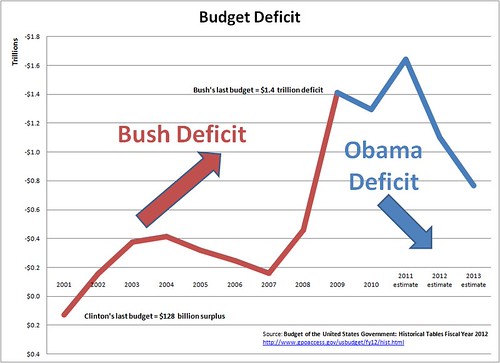
Bush-Obama Deficit Chart

Notes, this chart includes Clinton’s last budget year for comparison.

The numbers in these two charts come from Budget of the United States Government: Historical Tables Fiscal Year 2012. They are just the amounts that the government spent and borrowed, period, Anyone can go look then up. People who claim that Obama “tripled the deficit” are either misled or are trying to mislead.

The Stimulus and Jobs

Bush-Obama-Jobs-Chart

In this chart, the RED lines on the left side — the ones that keep doing DOWN — show what happened to jobs under the policies of Bush and the Republicans. We were losing lots and lots of jobs every month, and it was getting worse and worse.The BLUE lines — the ones that just go UP — show what happened to jobs when the stimulus was in effect. We stopped losing jobs and started gaining jobs, and it was getting better and better. The leveling off on the right side of the chart shows what happened as the stimulus started to wind down: job creation leveled off at too low a level.

It looks a lot like the stimulus reversed what was going on before the stimulus.

Conclusion: THE STIMULUS WORKED BUT WAS NOT ENOUGH!

More False Things

These are just three of the false things that everyone “knows.” Some others are (click through): Obama bailed out the banks, businesses will hire if they get tax cuts, health care reform cost $1 trillion, Social Security is a Ponzi Scheme or is “going broke”, government spending “takes money out of the economy.”

Why This Matters

These things really matter. We all want to fix the terrible problems the country has. But it is so important to know just what the problems are before you decide how to fix them. Otherwise the things you do to try to solve those problems might just make them worse. If you get tricked into thinking that Obama has made things worse and that we should go back to what we were doing before Obama — tax cuts for the rich, giving giant corporations and Wall Street everything they want — when those are the things that caused the problems in the first place, then we will be in real trouble.

Emphasis Mine

see:http://www.alternet.org/story/152201/3_reality-based_charts_your_right-wing_relatives_will_have_a_hard_time_ignoring?akid=7484.123424.OxQ7x8&rd=1&t=12