We’re Not in Lake Wobegon Anymore

“I don’t want to abolish government. I simply want to reduce it to the size where I can drag it into the bathroom and drown it in the bathtub.” Republicans: The No.1 reason the rest of the world thinks we’re deaf, dumb and dangerous.

Written in 2004.

How did the Party of Lincoln and Liberty transmogrify into the party of Newt Gingrich’s evil spawn and their Etch-A-Sketch president, a dull and rigid man, whose philosophy is a jumble of badly sutured body parts trying to walk?

By GARRISON KEILLOR

Something has gone seriously haywire with the Republican Party. Once, it was the party of pragmatic Main Street businessmen in steel-rimmed spectacles who decried profligacy and waste, were devoted to their communities and supported the sort of prosperity that raises all ships. They were good-hearted people who vanquished the gnarlier elements of their party, the paranoid Roosevelt-haters, the flat Earthers and Prohibitionists, the antipapist antiforeigner element. The genial Eisenhower was their man, a genuine American hero of D-Day, who made it OK for reasonable people to vote Republican. He brought the Korean War to a stalemate, produced the Interstate Highway System, declined to rescue the French colonial army in Vietnam, and gave us a period of peace and prosperity, in which (oddly) American arts and letters flourished and higher education burgeoned—and there was a degree of plain decency in the country. Fifties Republicans were giants compared to today’s. Richard Nixon was the last Republican leader to feel a Christian obligation toward the poor.

In the years between Nixon and Newt Gingrich, the party migrated southward down the Twisting Trail of Rhetoric and sneered at the idea of public service and became the Scourge of Liberalism, the Great Crusade Against the Sixties, the Death Star of Government, a gang of pirates that diverted and fascinated the media by their sheer chutzpah, such as the misty-eyed flag-waving of Ronald Reagan who, while George McGovern flew bombers in World War II, took a pass and made training films in Long Beach. The Nixon moderate vanished like the passenger pigeon, purged by a legion of angry white men who rose to power on pure punk politics. “Bipartisanship is another term of date rape,” says Grover Norquist, the Sid Vicious of the GOP. “I don’t want to abolish government. I simply want to reduce it to the size where I can drag it into the bathroom and drown it in the bathtub.” The boy has Oedipal problems and government is his daddy.

The party of Lincoln and Liberty was transmogrified into the party of hairy-backed swamp developers and corporate shills, faith-based economists, fundamentalist bullies with Bibles, shriekChristians of convenience, freelance racists, misanthropic frat boys, shreiking midgets of AM radio, tax cheats, nihilists in golf pants, brownshirts in pinstripes, sweatshop tycoons, hacks, fakirs, aggressive dorks, Lamborghini libertarians, people who believe Neil Armstrong’s moonwalk was filmed in Roswell, New Mexico, little honkers out to diminish the rest of us, Newt’s evil spawn and their Etch-A-Sketch president, a dull and rigid man suspicious of the free flow of information and of secular institutions, whose philosophy is a jumble of badly sutured body parts trying to walk. Republicans: The No.1 reason the rest of the world thinks we’re deaf, dumb and dangerous.

Rich ironies abound! Lies pop up like toadstools in the forest! Wild swine crowd round the public trough! Outrageous gerrymandering! Pocket lining on a massive scale! Paid lobbyists sit in committee rooms and write legislation to alleviate the suffering of billionaires! Hypocrisies shine like cat turds in the moonlight! O Mark Twain, where art thou at this hour? Arise and behold the Gilded Age reincarnated gaudier than ever, upholding great wealth as the sure sign of Divine Grace.

Here in 2004, George W. Bush is running for reelection on a platform of tragedy—the single greatest failure of national defense in our history, the attacks of 9/11 in which 19 men with box cutters put this nation into a tailspin, a failure the details of which the White House fought to keep secret even as it ran the country into hock up to the hubcaps, thanks to generous tax cuts for the well-fixed, hoping to lead us into a box canyon of debt that will render government impotent, even as we engage in a war against a small country that was undertaken for the president’s personal satisfaction but sold to the American public on the basis of brazen misinformation, a war whose purpose is to distract us from an enormous transfer of wealth taking place in this country, flowing upward, and the deception is working beautifully.

The concentration of wealth and power in the hands of the few is the death knell of democracy. No republic in the history of humanity has survived this. The election of 2004 will say something about what happens to ours. The omens are not good.

Our beloved land has been fogged with fear—fear, the greatest political strategy ever. An ominous silence, distant sirens, a drumbeat of whispered warnings and alarms to keep the public uneasy and silence the opposition. And in a time of vague fear, you can appoint bullet-brained judges, strip the bark off the Constitution, eviscerate federal regulatory agencies, bring public education to a standstill, stupefy the press, lavish gorgeous tax breaks on the rich.

There is a stink drifting through this election year. It isn’t the Florida recount or the Supreme Court decision. No, it’s 9/11 that we keep coming back to. It wasn’t the “end of innocence,” or a turning point in our history, or a cosmic occurrence, it was an event, a lapse of security. And patriotism shouldn’t prevent people from asking hard questions of the man who was purportedly in charge of national security at the time.

Whenever I think of those New Yorkers hurrying along Park Place or getting off the No.1 Broadway local, hustling toward their office on the 90th floor, the morning paper under their arms, I think of that non-reader George W. Bush and how he hopes to exploit those people with a little economic uptick, maybe the capture of Osama, cruise to victory in November and proceed to get some serious nation-changing done in his second term.

This year, as in the past, Republicans will portray us Democrats as embittered academics, desiccated Unitarians, whacked-out hippies and communards, people who talk to telephone poles, the party of the Deadheads. They will wave enormous flags and wow over and over the footage of firemen in the wreckage of the World Trade Center and bodies being carried out and they will lie about their economic policies with astonishing enthusiasm.

The Union is what needs defending this year. Government of Enron and by Halliburton and for the Southern Baptists is not the same as what Lincoln spoke of. This gang of Pithecanthropus Republicanii has humbugged us to death on terrorism and tax cuts for the comfy and school prayer and flag burning and claimed the right to know what books we read and to dump their sewage upstream from the town and clear-cut the forests and gut the IRS and mark up the constitution on behalf of intolerance and promote the corporate takeover of the public airwaves and to hell with anybody who opposes them.

This is a great country, and it wasn’t made so by angry people. We have a sacred duty to bequeath it to our grandchildren in better shape than however we found it. We have a long way to go and we’re not getting any younger.

Dante said that the hottest place in Hell is reserved for those who in time of crisis remain neutral, so I have spoken my piece, and thank you, dear reader. It’s a beautiful world, rain or shine, and there is more to life than winning.

  • Help In These Times publish more articles like this. Donate today!
  • Subscribe today and save 46% off the newsstand price!
Garrison Keillor is the host and writer of A Prairie Home Companion, now in its 34th year on the air and a syndicated newspaper columnist.

Emphasis Mine.

see:http://readersupportednews.org/off-site-opinion-section/72-72/7193-were-not-in-lake-wobegon-anymore

3 Reality-Based Charts Your Right-Wing Relatives Will Have a Hard Time Ignoring

Here are some reality-based charts to help knock down absurd right-wing propaganda about the economy

From AlterNet, by RJ Eskow

Problem: Your right-wing brother-in-law is plugged into the FOX-Limbaugh lie machine, and keeps sending you emails about “Obama spending” and “Obama deficits” and how the “Stimulus” just made things worse.

Solution: Here are three “reality-based” charts to send to him. These charts show what actually happened.

Spending

Bush-Obama Spending Chart

Government spending increased dramatically under Bush. It has not increased much under Obama. Note that this chart does not reflect any spending cuts resulting from deficit-cutting deals.

Deficits

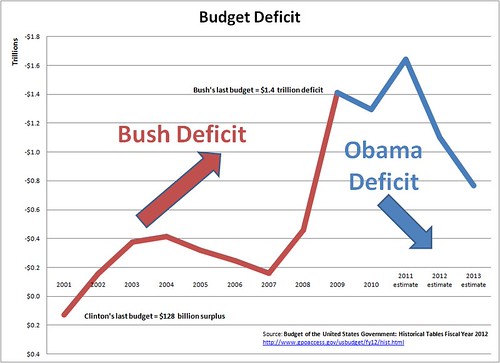
Bush-Obama Deficit Chart

Notes, this chart includes Clinton’s last budget year for comparison.

The numbers in these two charts come from Budget of the United States Government: Historical Tables Fiscal Year 2012. They are just the amounts that the government spent and borrowed, period, Anyone can go look then up. People who claim that Obama “tripled the deficit” are either misled or are trying to mislead.

The Stimulus and Jobs

Bush-Obama-Jobs-Chart

In this chart, the RED lines on the left side — the ones that keep doing DOWN — show what happened to jobs under the policies of Bush and the Republicans. We were losing lots and lots of jobs every month, and it was getting worse and worse.The BLUE lines — the ones that just go UP — show what happened to jobs when the stimulus was in effect. We stopped losing jobs and started gaining jobs, and it was getting better and better. The leveling off on the right side of the chart shows what happened as the stimulus started to wind down: job creation leveled off at too low a level.

It looks a lot like the stimulus reversed what was going on before the stimulus.

Conclusion: THE STIMULUS WORKED BUT WAS NOT ENOUGH!

More False Things

These are just three of the false things that everyone “knows.” Some others are (click through): Obama bailed out the banks, businesses will hire if they get tax cuts, health care reform cost $1 trillion, Social Security is a Ponzi Scheme or is “going broke”, government spending “takes money out of the economy.”

Why This Matters

These things really matter. We all want to fix the terrible problems the country has. But it is so important to know just what the problems are before you decide how to fix them. Otherwise the things you do to try to solve those problems might just make them worse. If you get tricked into thinking that Obama has made things worse and that we should go back to what we were doing before Obama — tax cuts for the rich, giving giant corporations and Wall Street everything they want — when those are the things that caused the problems in the first place, then we will be in real trouble.

Emphasis Mine

see:http://www.alternet.org/story/152201/3_reality-based_charts_your_right-wing_relatives_will_have_a_hard_time_ignoring?akid=7484.123424.OxQ7x8&rd=1&t=12

Understand the Right’s Attack on Social Security

The Social Security program is entirely self-funded, separate from the way that the government taxes and spends for other programs.Social Security does not contribute to the deficit in any way.

From Alternet, by: Dave Johnson, Campaign for America’s Future

“You hear over and over that Social Security is “in trouble” or that we “can’t afford it.” This is as far from true as can be, and the idea behind this is to convince people to just give up on defending the program and let the haters have their way. The people who hate Social Security the most are the ones who say they want to make these changes to “save” it.

Well Bernie Sanders loves the program and has introduced a bill that actually will save it.

The Haters

Conservatives have hated Social Security from the start, because it is a program that demonstrates once and for all the value of progressive governance. Social Security is as clear an example of We, the People watching out for and taking care of each other as there ever was. It has made a huge difference n the lives of older people, and their/our families. It works, is cost-effective and requires minimal overhead to keep it going. So they hate it.

A very recent example of conservative hatred for Social Security came from Senator Marco Rubio of Florida, who said, that We, the People helping each other makes us weak,

“These programs actually weakened us as a people. … All of a sudden, for an increasing number of people in our nation, it was no longer necessary to worry about saving for security because that was the government’s job.”

Substitute the words “We, the People” or “each other” for “government” in Rubio’s statement and you’ll get the point: people don’t have to worry so much because we’re taking care of each other. He says that makes us weak. Yikes!

Decades Of Attacks

For decades conservatives who hate Social Security have been using every trick in the book to turn people against the program. Over and over you hear, “It’s a Ponzi scheme.” “It won’t be there for you.” This latest attack is that it “makes us weak.” And of course the old classic: “Social Security is broke.”

The “it’s going broke” and “won’t be there for you” attack strategy goes back to a 1983 Cato Institute Journal document, “Achieving a Leninist Strategy” by Stuart Butler of Cato and Peter Germanis of the Heritage FoundationThe document is still available at Cato, and select quotes are available at Plotting Privatization? from Z Magazine. If you have time it is worth reading the entire document (in particular the section “Weakening the Opposition”) to more fully understand the strategy that has been unfolding in the years since. But if you can’t, the following quotes give you an idea:

“Lenin recognized that fundamental change is contingent upon … its success in isolating and weakening its opponents. … we would do well to draw a few lessons from the Leninist strategy.”

” construct … a coalition that will … reap benefits from the IRA-based private system … but also the banks, insurance companies, and other institutions that will gain from providing such plans to the public.”

“The first element consists of a campaign to achieve small legislative changes that embellish the present IRA system, making it in practice a small-scale private Social Security system.

“The second main element … involves what one might crudely call guerrilla warfare against both the current Social Security system and the coalition that supports it.”

“The banking industry and other business groups that can benefit from expanded IRAs …” “… the strategy must be to propose moving to a private Social Security system in such a way as to … neutralize … the coalition that supports the existing system.”

“The next Social Security crisis may be further away than many people believe. … it could be many years before the conditions are such that a radical reform of Social Security is possible. But then, as Lenin well knew, to be a successful revolutionary, one must also be patient and consistently plan for real reform.”

Here is what to take away from this: Every time you hear that “Social Security is going broke” you are hearing a manufactured propaganda point that is part of a decades-old strategy. Every time you hear that “Social Security is a Ponzi scheme” you are hearing that strategy in operation. Every time you hear that “Social Security won’t be there for me anyway” ” you are witnessing that strategy unfold.

The Problem

The Social Security program is entirely self-funded, separate from the way that the government taxes and spends for other programs. People set aside money in their working years, they get a monthly amount when they retire. (The program also has other benefits including disability benefits, survivors funds and others.) Social Security does not contribute to the deficit in any way.

You never hear that the huge, vast, bloated, enormous, mammoth military budget is “going broke” or “won’t be there for you.” But year after year you hear that Social Security is “in trouble.”

Currently the program has built up a huge trust fund — over $2.5 trillion. This is invested in US Treasury Bonds, and is earning interest. But there are projections that this trust fund will be depleted in approx. 2037, and if this happens the program will have to cut payouts by as much as 25%. (Hey. when does the military budget Trust Fund run down?)

One big reason for this shortfall is that the last time the programs was comprehensively adjusted (1983, Greenspan Commission) certain economic growth and income projections were used to decide how much “payroll tax” to take out of people’s paychecks. They increased the amount taken out of paychecks, and set up an increasing “cap” on the income that would be taxed. Right now 6.2% (temporarily reduced to 4.2%) is taken out of paychecks, and employers kick in another 6.2%, on income up to a “cap” of $106,800. There is no “payroll tax” on amounts above that “cap.”

But something changed between 1983 and nowalmost all the income gains have gone to a few at the very top. Instead of people who mostly were under that “cap” getting raises, thereby increasing the amount they pay into the fund, the raises went to people who already pass that amount, so the increased income is not contributing to the program. So that money that was calculated would go into the Social Security Trust Fund instead went to the top few. As a result the program is no longer bringing in enough money to keep the trust fund fully-funded past 2037.

Sen. Sanders’ Solution

Senator Bernie Sanders is introducing a bill to the Senate to fix this, once and for all. In simple terms, this bill will start taxing income above $250,000 a year to cover this Social Security shortfall. So instead of just “raising the cap” it lets that cap stay, and then takes it off again on income above $250,000. In effect it means there will be a gap between the current top income that is taxed, and $250K.

Get the money from where the money went: So because much of the real Social Security problem is that so much income is now going to just a few at the top, this gets the money to fix the problem from those top-level incomes.

Here is Sanders, talking about his bill:

“When [Social Security] was developed, 50 percent of seniors lived in poverty. Today, poverty among seniors is too high, but that number is ten percent. Social Security has done exactly what it was designed to do!”


Emphasis Mine

see:http://www.truth-out.org/understand-rights-attack-social-security/1314537823

GOP’s Debt Solution: Soak the Poor

A single mother struggling to keep a roof over her child’s head would probably love to trade places with a six-figure earner and bear the burden of paying federal income tax on a comfortable salary.

By Carl Gibson, Reader Supported News

magine a bulky schoolyard bully routinely holding you and your classmates upside-down by your shoes and pocketing the money that falls out, using the amount gained from his extortion to buy a new bike at the end of each semester. Now imagine enduring this process every day, all year, throughout each grade of school.

What if one day, the bully actually complained that you weren’t bringing enough lunch money to school because he wanted a nicer bike? Would you comply and let him rob you of a larger amount, or would you and your fellow classmates surround the teacher and demand the bully return the money he stole?

Despite billionaire Warren Buffett‘s pleas to reduce the deficit by shifting the tax burden to the super-rich, Republican members of Congress have officially come out in favor of raising taxes on the poor, while fiercely protecting trillions in tax handouts for billionairesbig oil and corporate jet owners. Right-wing politicians and corporate-media pundits have now set their sights on “lucky duckies,” or the bottom half of Americans who don’t pay federal income taxes. As law professor Edward Kleinbard noted, this statement is misleading and ignores the need for meaningful reform of our tax code.

Jon Stewart creatively dismantled the poor-people-don’t-pay-taxes argument on The Daily Show, highlighting conservatives who dismissed the $700 billion in revenue gained from ending the Bush tax cuts for the wealthy in 2010. According to Stewart’s calculations, taking exactly half of everything owned by the bottom 50% of Americans would also generate $700 billion, exactly as much revenue as increasing the tax rate for the richest Americans by a modest 3%. Stewart sarcastically suggested Republicans trim the deficit by seizing all assets owned by the bottom half of Americans.

It’s incredibly audacious for the rich to ask the poor to pay more in taxes in order to protect theirbudget-busting tax breaks, especially considering America’s wealth disparity. The gap between the richest and everyone else has grown to levels even greater than on the eve of the crash that triggered the great depression, with the top .001% of Americans now owning 976 times more than the bottom 90%. In 1928, the richest only owned 892 times more than the bottom 90%.

And of course, those accusing the working poor of freeloading ignore the fact that 1 in 4 American jobs don’t even pay poverty wages, or that the federal income tax is inherently designed to avoid hitting the poor, the elderly and working families with children. Such bold accusations also ignore the reality that all of the aforementioned groups still pay roughly one-third of their income in sales, property, payroll and excise taxes.

A single mother struggling to keep a roof over her child’s head would probably love to trade places with a six-figure earner and bear the burden of paying federal income tax on a comfortable salary. But would a six-figure earner be willing to work three part-time minimum wage jobs and still worry about how the rent is going to be paid at the end of the month? Would he really be eager to forgo paying federal income tax if it meant he had to scrape quarters together to buy beans, lentils and ramen noodles for dinner?

Big oil doesn’t need $4 billion per year in taxpayer subsidies – they’re making record profits. Excessive tax cuts for millionaires and billionaires won’t create jobs – the unemployment rate doubledafter ten years of the Bush tax cuts. And corporate jet owners don’t need a tax break while public employees nationwide are losing their jobs to budget cuts.

America needs to surround our teacher before recess and make a strong statement together – the bullies don’t need to rob us of our lunch money to continue their excessive lifestyles. Let’s stop subsidizing wealth for the sake of wealth, and leave struggling middle-class families alone.


Carl Gibson, 24, of Lexington, Kentucky, is a spokesman and organizer for US Uncut, a nonviolent, creative direct-action movement to stop budget cuts by getting corporations to pay their fair share of taxes. He graduated from Morehead State University in 2009 with a B.A. in Journalism before starting the first US Uncut group in Jackson, Mississippi, in February of 2011. Since then, over 20,000 US Uncut activists have carried out more than 300 actions in over 100 cities nationwide. You may contact Carl at carl@rsnorg.org.

Reader Supported News is the Publication of Origin for this work. Permission to republish is freely granted with credit and a link back to Reader Supported News.”

Emphasis Mine

see:http://readersupportednews.org/opinion2/279-82/7202-gops-debt-solution-soak-the-poor

5 Reasons Capitalism Has Failed

The root cause of our recent turmoil is the failure of the dominant economic paradigm — global corporate capitalism.

By Bob Burnett, The Smirking Chimp, via AlterNet

(N.B.: Marx was right, after all…)

We live in interesting times. The global economy is splintering. U.S. voters hate all politicians and there’s political unrest throughout the world. The root cause of this turmoil is the failure of the dominant economic paradigm — global corporate capitalism.

The modern world is ruled by multinational corporations and governed by a capitalistic ideology that believes: Corporations are a special breed of people, motivated solely by self-interest. Corporations seek to maximize return on capital by leveraging productivity and paying the least possible amount for taxes and labor. Corporate executives pledge allegiance to their directors and shareholders. The dominant corporate perspective is short term, the current financial quarter, and the dominant corporate ethic is greed, doing whatever it takes to maximize profit.

Five factors are responsible for the failure of global corporate capitalism. First, global corporations are too big. We’re living in the age of corporate dinosaurs. (The largest multinational is JP Morgan Chase with assets of $2 Trillion, 240,000 employees, and offices in 100 countries.) The original dinosaurs perished because their huge bodies possessed tiny brains. Modern dinosaurs are failing because their massive bureaucracies possess miniscule hearts.

Since the Reagan era global corporations have followed the path of least resistance to profit; they’ve swallowed up their competitors and created monopolies, which have produced humongous bureaucracies. In the short-term, scale helps corporations grow profitable, but in the long-term it makes them inflexible and difficult to manage. Gigantism creates a culture where workers are encouraged to take enormous risks in order to create greater profits; it’s based upon the notion that the corporation is “too big to fail.”

Second, global corporations disdain civil society. They’ve created a culture of organizational narcissism, where workers pledge allegiance to the enterprise. Corporate employees live in a bubble, where they log obscene hours and then vacation with their co-workers. Multinationals develop their own code of ethics and worldview separate from that of any national state. Corporate executives don’t care about the success or failure of any particular country, only the growth and profitability of their global corporation. (Many large corporations pay no U.S. income tax; in 2009 Exxon Mobil actually got a $156 M rebate.)

Third, global corporations are modern outlaws, living outside the law. There is noinvisible hand that regulates multinationals. In 1759 Philosopher Adam Smith argued that while wealthy individuals and corporations were motivated by self interest, an “invisible hand” was operating in the background ensuring that capitalist activities ultimately benefited society. In modern times this concept became the basis for the pronouncements of the Chicago School of Economics that markets were inherently self regulating. However, the last five years have demonstrated that there is no “invisible hand”unregulated markets have spelled disaster for the average person. The “recovery” of 2009-10 ensured that “too big to fail” institutions would survive and the rich would continue to be rich. Meanwhile millions of good jobs were either eliminated or replaced by low-wage jobs with poor or no benefits.

Fourth, global corporations are ruining our natural capital. Four of the top 10 multinational corporations are energy companies, with Exxon Mobil leading the list. But there are many indications that our oil reserves are gone. Meanwhile, other forms of natural capital have been depleted — arable land, water, minerals, forests, fish, and so forth. Multinational corporations have treated the environment as a free resource. When the timberlands of North America began to be depleted, lumber corporations moved to South America and then Asia. Now, the “easy pickings” are gone. Global corporations have ravished the world and citizens of every nation live with the consequences: dirty air, foul water, and pollution of every sort.

Fifth, global corporations have angered the world community. The world GDP is $63 Trillion but multinational corporations garner a disproportionate share — with banks accounting for an estimated $4 trillion (bank assets are $100 trillion). Global black markets make $2 trillion — illegal drugs account for at least $300 billion. In many parts of the world, a worker is not able to earn a living wage, have a bank account or drive a car, but can always obtain drugs, sex, and weapons. And while the world may not be one big village in terms of lifestyle, it shares an image of “the good life” that’s proffered in movies, TV, and the Internet. That’s what teenagers in Afghanistan have in common with teenagers in England; they’ve been fed the same image of success in the global community and they know it’s inaccessible. They are angry and, ultimately, their anger has the same target — multinational corporations (and the governments that support them).

We live in interesting times. The good news is we’re witnessing the failure of global corporate capitalism. The bad news is we don’t know what will replace it.”

(N.B.: Perhaps we do – see peoplesworld.org)

Bob Burnett is a writer and activist in Berkeley, Calif.

Emphasis Mine

see:http://www.alternet.org/story/152118/5_reasons_capitalism_has_failed?page=entire

The Dangerous Reagan Cult

Exclusive: Ronald Reagan’s anti-government philosophy inspires Tea Party extremists to oppose any revenue increase, even from closing loopholes on corporate jets. Democrats try the spin that “even Reagan” showed flexibility on debt and taxes. But Robert Parry says it is the “Reagan cult” that is at the heart of America’s crisis.

From RSN, by Robert Parry

“Exclusive: Ronald Reagan’s anti-government philosophy inspires Tea Party extremists to oppose any revenue increase, even from closing loopholes on corporate jets. Democrats try the spin that “even Reagan” showed flexibility on debt and taxes. But Robert Parry says it is the “Reagan cult” that is at the heart of America’s crisis.

In the debt-ceiling debate, both Republicans and Democrats wanted Ronald Reagan on their side. Republicans embraced the 40th president’s disdain for government and fondness for tax cuts, while Democrats noted that “even Reagan” raised the debt limit many times and accepted some tax increases.

But Reagan – possibly more than any political leader – deserves the blame for the economic/political mess that the United States now finds itself in. He was the patriarch for virtually every major miscalculation that the country has made over the past three decades.

It was Reagan who slashed taxes on the rich to roughly their current level; he opened the flood gates on deficit spending; he accelerated the decline of the middle class by busting unions and slashing support for local communities; he disparaged the value of government regulations; he squandered money on the Pentagon; he pushed more militaristic strategies abroad; and he rejected any thoughtful criticism of past U.S. foreign policies.

Reagan also created what amounted to a “populist” right-wing cult that targeted the federal government as the source of nearly all evil. In his First Inaugural Address, he famously declared that “government is not the solution to our problem; government is the problem.”

It is that contempt for government that today is driving the Tea Party extremists in the Republican Party. Yet, as with many cults, the founder of this one was somewhat more practical in dealing with the world around him, thus explaining some of Reagan’s compromises on the debt ceiling and taxes.

But once the founder is gone, his teachings can become definitive truth to the disciples. Flexibility disappears. No deviation is permitted. No compromise is tolerated.

So, at a time when government intervention is desperately needed to address a host of national problems, members of this Reagan cult apply the teachings of the leader in the most extreme ways. Since “government is the problem,” the only answer is to remove government from the equation and let the corporations, the rich and the magical “market” dictate national solutions.

It is an ironic testament to Ronald Reagan’s enduring influence that America’s most notable “populist” movement, the Tea Party, insists that tax cuts for the wealthy must be protected, even minor ones like tax loopholes for corporate jets. Inside the Tea Party, any suggestion that billionaire hedge-fund managers should pay a tax rate equal to that of their secretaries is anathema.

Possibly never in history has a “populist” movement been as protective of the interests of the rich as the Tea Party is. But that is because it is really a political cult dedicated to the most extreme rendering of Ronald Reagan’s anti-government philosophy.

Astro-Turf ‘Populists’

Granted, the Tea Party also can be viewed as an astro-turf outfit financed by billionaires like the Koch brothers and promoted by billionaire media mogul Rupert Murdoch. But Election 2010 proved that the movement is capable of putting like-minded politicians into office, especially when discouraged elements of the American Left choose to sit on the sidelines.

During the debt-ceiling battle, the GOP’s Tea Party caucus showed it was strong enough to block any compromise that included a revenue increase. The thinking is that the “evil” government must be starved even if that means defending indefensible tax loopholes and shoving the world’s economy to the brink of catastrophe.

The Tea Party’s rabid enforcement of the Reagan orthodoxy instills such fear among top Republicans that every one of the eight presidential hopefuls at a recent Iowa debate vowed to reject a deal that would include just $1 of higher taxes for each $10 in spending cuts. Even supposed moderates like Mitt Romney and Jon Huntsman threw up their hands.

But the Reagan cult reaches far beyond the Republican Party. Last February, a Gallup poll of Americans cited Reagan as the greatest president ever, with a five percentage point lead over Abraham Lincoln.

These days, virtually no one in Washington’s political or media circles dares to engage in a serious critique of Reagan’s very checkered record as president. It’s much easier to align yourself with some position that Reagan took during his long career, much like a pastor selectively picking a Bible passage to support his theological argument.

When negative national trends are cited – such as the decline of the middle class or the widening gap between rich and poor – the self-censorship demands that Reagan’s name not be spoken. Instead, there are references to these problems deepening “over the past three decades,” without mentioning whose presidency got things going big time.

Creating an Icon

And there is a self-interested reason for this hesitancy. The Republicans and the Right have made it a high priority to transform Reagan into an icon and to punish any independent-minded political figure or journalist who resists the group think.

The first step in this process occurred in the late 1980s, with aggressive cover-ups of Reagan’s crimes of state, such as scandals over the Iran-Contra arms-for-hostages affair, Contra-cocaine trafficking, and the Iraq-gate support of dictator Saddam Hussein.

Faced with furious Republican defenses of Reagan and his inner circle, most Democrats and mainstream journalists chose career discretion over valor. By the time Bill Clinton was elected in 1992, the refrain from Democrats and Washington pundits was to “leave that for the historians.”

Those who didn’t go along with the cover-ups – like Iran-Contra special prosecutor Lawrence Walsh – were subjected to ridicule from both the right-wing and mainstream media, from both the Washington Times and the Washington Post. Journalists who challenged the implausible Reagan cover-ups also found themselves marginalized as “conspiracy theorists.”

Leading Democrats decided it made more sense to look to the future, not dwell on the past. Plus, acquiescing to the cover-ups was a way to show their bipartisanship.

However, Republicans had other ideas. Having pocketed the concessions regarding any serious investigations of Reagan and his cohorts, the Republicans soon went on the offensive by investigating the heck out of President Clinton and his administration.

Then, having stirred up serious public doubts about Clinton’s integrity, the Republicans trounced the Democrats in the 1994 congressional elections. With their new majorities, the Republicans immediately began the process of enshrining Reagan as a national icon.

By and large, the Democrats saw these gestures, like attaching Reagan’s name to National Airport, as another way to demonstrate their bipartisanship.

But Republicans knew better. They understood the strategic value of elevating Reagan’s legacy to the status of an icon. If everyone agreed that Reagan was so great, then it followed that the hated “guv-mint” must be that bad.

More Accommodations

Increasingly, Democrats found themselves arguing on Republican ground, having to apologize for any suggestion that the government could do anything good for the country. Meanwhile, the Clinton-era stock market boom convinced more Americans that the “market” must know best.

Going with that flow, President Clinton signed a Republican-sponsored bill that removed Depression-era regulations in the Glass-Steagall Act, which had separated commercial and investment banks. With the repeal, the doors were thrown open for Wall Street gambling.

In the short run, lots of money was made, encouraging more Americans to believe that the government and its “safety net” were indeed anachronisms for losers. People with any gumption could simply day-trade their way to riches.

Reagan, it seemed, was right all along: government was the problem; the “free market” was not only the solution but it could “self-regulate.”

That was the political/media environment around Election 2000 when the wonkish Vice President Al Gore ran against the brash Texas Gov. George W. Bush, who came across to many as another version of Ronald Reagan, someone who spoke simply and disdained big government.

Though Gore could point to the economic successes of the Clinton years, including a balanced federal budget and the prospect of the total elimination of the federal debt, the major media mocked him as a know-it-all nerd who wore “earth-toned sweaters.” Meanwhile, mainstream journalists swooned over Bush, the regular guy.

Still, Gore eked out a narrow victory in the national popular vote and would have carried the key state of Florida if all legally cast votes were counted. But Bush relied on his brother’s administration in Florida and his father’s friends on the U.S. Supreme Court to make sure that didn’t happen. Bush was declared the winner in Florida and thus the new president. [For details, see Neck Deep.]

In retrospect, Election 2000 was a disastrous turning point for the United States, putting into the highest office in the land an unqualified ne’er do well who had lost the election.

But this outrage against democracy was largely accepted because of the muscular right-wing machine, the on-bended-knee mainstream media and the weak-kneed Democrats – a political/media dynamic that Reagan had helped create and had left behind.

The progress that the Clinton administration had made toward putting the U.S. financial house in order was quickly undone as Bush pushed through two massive tax cuts benefiting mostly the rich and waged two open-ended wars financed with borrowed money.

Years of Reaganism also had taken its toll on the government’s regulatory structures. Reagan had consistently appointed regulators who were hostile to the very concept of regulating, such as Anne Gorsuch at the Environmental Protection Agency and James Watt at Interior. He also elevated Alan Greenspan, a “free market” admirer of Ayn Rand, to be chairman of the Federal Reserve Board.

In the 1980s, the looting of America was underway in earnest, but the elites of Washington and New York saw little to protest since they were getting a cut of the plunder. The real losers were the average Americans, especially factory workers who saw their unions broken or their jobs shipped overseas under the banner of “free trade.”

Feeling Good

But many Americans were kept entranced by Reagan’s feel-good magic.

Taking office after a difficult decade of the 1970s, when America’s defeat in Vietnam and the Arab oil price hikes had shaken the nation’s confidence, Reagan simply assured everyone that things would work out just fine and that no excessive sacrifice was in order. Nor should there be any feelings of guilt, Reagan made clear.

By the late 1970s, it was widely accepted even among many Republicans that the Vietnam War had been an abomination. But Reagan simply rebranded it a “noble cause,” no reason for any serious self-reflection on America’s imperial role in the world.

Reagan then allied the United States with “death-squad” regimes all over Latin America and across the Third World. His administration treated the resulting carnage as a public-relations problem that could be managed by challenging the patriotism of critics.

At the 1984 Republican National Convention, Reagan’s United Nations Ambassador Jeane Kirkpatrick labeled Americans who dared criticize U.S. foreign policy as those who would “blame America first.”

To continue this sort of verbal pummeling on those who continued to get in the way, Reagan credentialed a bunch of thuggish intellectuals known as the neoconservatives.

For the rest of the country, there were happy thoughts about “the shining city on a hill” and “morning in America.”

In reality, however, Reagan had set the stage for the tragedies that would follow. When George W. Bush grabbed power in 2001, he simply extended the foreign and economic policies of the Republican cult leader: more tax cuts, more militarism, less regulation, more media manipulation.

Soon, the gap between rich and poor was widening again. Soon, the United States was at open war in two countries and involved in secret wars in many others. Soon, the nation was confronted with new scandals about torture and deception. Soon, the federal budget was flowing with red ink.

And near the end of Bush’s presidency, the de-regulated excesses of Wall Street pushed the country to the brink of a financial cataclysm. Bush supported a bail-out to save the bankers but didn’t do much for the millions of Americans who lost their jobs or their homes.

Second Thoughts?

One might have thought that the financial crack-up in 2008 (plus the massive federal deficits and the botched wars in Iraq and Afghanistan) would have confronted the Reagan cult with an existential crisis of faith. It would seem obvious that Reagan’s nostrums just didn’t work.

However, after only a brief interregnum of Barack Obama, the Republicans seem poised to restore the Reagan cult to full power in the United States. The new apparent GOP frontrunner, Texas Gov. Rick Perry, is already being hailed in the Washington Post as “The Texas Gipper.”

The Washington Times (yes, Rev. Sun Myung Moon’s right-wing propaganda sheet is still around) fairly cooed over Perry’s tough attacks on Obama, depicting America’s first black president as someone who apologizes for America and isn’t deserving of its soldiers in uniform.

“One of the powerful reasons for running for president of the United States is to make sure every man and woman who puts on the uniform respects highly the president of the United States,” Perry said. “We are indignant about a president who apologizes for America.”

As far as Perry is concerned, America has nothing to apologize for.

These are themes right out of Ronald Reagan’s playbook. And it appears likely that Election 2012 will be fought over terrain defined by Reagan, even though he left office in 1989 and died in 2004.

It is already clear that President Obama will be on the defensive, trying to justify a role for the federal government in America and explaining why the Reaganesque policy of low taxes on the rich must finally be reversed. Obama also is certain to shy away from any serious examination of how U.S. foreign policy went so wrong, so as not to be labeled “apologist-in-chief.”

Rick Perry or whatever other Republican gets the party’s nomination will hold the high ground of Reagan’s lofty standing among the American people. The GOP nominee can continue blaming “guv-mint” for the nation’s problems and promising another “morning in America” if only the nation further reduces the size of “guv-mint.”

With Democrats also trying to associate themselves with the “greatest president ever,” it appears doubtful that any serious effort will be made to explain to the American people that the charming Reagan was the pied piper who led them to their current demise.”

[For more on these topics, see Robert Parry’s Secrecy & Privilege and Neck Deep, now available in a two-book set for the discount price of only $19. For details, click here.]

Robert Parry broke many of the Iran-Contra stories in the 1980s for the Associated Press and Newsweek. His latest book,Neck Deep: The Disastrous Presidency of George W. Bush, was written with two of his sons, Sam and Nat, and can be ordered at neckdeepbook.com. His two previous books, Secrecy & Privilege: The Rise of the Bush Dynasty from Watergate to Iraq and Lost History: Contras, Cocaine, the Press & ‘Project Truth’ are also available there.

emphasis mine

Americans Don’t Realize Just How Badly We’re Getting Screwed by the Top 0.1 Percent Hoarding the Country’s Wealth

With an unprecedented sum of wealth held within the top one-tenth of one percent of the US population, we now have the most severe inequality of wealth in US history.

N.B.: An oft disdained 19th century philosopher would hardly be surprised!

From AmpedStaus  – via AlterNet – by David Degraw

“With an unprecedented sum of wealth, tens of trillions of dollars, held within the top one-tenth of one percent of the US population, we now have the most severe inequality of wealth in US history. Not even the robber barons of the Gilded Age were as greedy as the modern-day economic elite.

As American philosopher John Dewey said, “There is no such thing as the liberty or effective power of an individual, group, or class, except in relation to the liberties, the effective powers, of other individuals, groups or classes.”

In my report, The Economic Elite vs. the People, I reported on the strategic withholding of wealth from 99 percent of the US population over the past generation. Since the mid-1970s, worker production and wealth creation has exploded. As the statistics throughout this report prove, the dramatic increase in wealth has been almost entirely absorbed by the economic top one-tenth of one percent of the population, with most of it going to the top one-hundredth of one percent.

If you are wondering why a critical mass of people desperately struggling to make ends meet are still not fighting back with overwhelming force and running the mega-wealthy aristocrats out of town, let’s consider two significant factors:

1) People are so busy trying to maintain their current standard of living that their energies are consumed by holding onto the little they have left.

2) People have very little understanding of how much wealth has been consolidated within the top economic one-tenth of one percent.

Considering the first factor, it is obvious that people have become beaten down psychologically and financially. A report in the Guardian titled, “Anxiety keeps the super-rich safe from middle-class rage,” suggests that people are so desperate to hold onto what they have that they are too busy looking down to look up: “As psychologists will tell you, fear of loss is more powerful than the prospect of gain. The struggling middle classes look down more anxiously than they look up, particularly in recession and sluggish recovery.”

Considering the second factor, people do not understand how much wealth has been withheld from them. The average person has never personally experienced or seen the excessive wealth and luxury that the mega-rich live in. Wealth inequality has grown so extreme and the wealthy have become so far removed from average society, it is as if the rich exist in some outer stratosphere beyond the comprehension of the average person. As the Guardian report states:

“… having little daily contact with the rich and little knowledge of how they lived, they simply didn’t think about inequality much, or regard the wealthy as direct competitors for resources. As the sociologist Garry Runciman observed: ‘Envy is a difficult emotion to sustain across a broad social distance.’… Even now most underestimate the rewards of bankers and executives. Top pay has reached such levels that, rather like interstellar distances, what the figures mean is hard to grasp.”

In fact, the average American vastly underestimates our nation’s severe wealth disparity. This survey, featured in the NY Times, reveals that Americans think our society is far more equal than it actually is:

“In a recent survey of Americans, my colleague Dan Ariely and I found that Americans drastically underestimated the level of wealth inequality in the United States. While recent data indicates that the richest 20 percent of Americans own 84 percent of all wealth, people estimated that this group owned just 59 percent – believing that total wealth in this country is far more evenly divided among poorer Americans.

What’s more, when we asked them how they thought wealth should be distributed, they told us they wanted an even more equitable distribution, with the richest 20 percent owning just 32 percent of the wealth. This was true of Democrats and Republicans, rich and poor – all groups we surveyed approved of some inequality, but their ideal was far more equal than the current level.”

This chart shows the survey’s results:

The overwhelming majority of the US population is unaware of the vast wealth at hand. An entire generation of unprecedented wealth creation has been concealed from 99 percent of the population for over 35 years. Having never personally experienced this wealth, the average American cannot comprehend what is possible if even a fraction of the money was used for the betterment of society.

Given modern technology and wealth, American citizens should not be living in poverty. The statistics demonstrate that we now live in a neo-feudal society. In comparison to the wealthiest one-tenth of one percent of the population, who are sitting on top of tens of trillions of dollars in wealth, we are essentially propagandized peasants.

The fact that the overwhelming majority of Americans are struggling to get by, while tens of trillions of dollars are consolidated within a small fraction of the population, is a crime against humanity.

The next time you are stressed out, struggling to make ends meet and pay off your debts, just think about the trillions of dollars sitting in the obscenely bloated pockets of the financial elites. I still cling to the hope that once enough people become aware of this fact, we can have the non-violent revolution we so urgently need. Until then, the rich get richer as a critical mass with increasingly dire economic prospects desperately struggles to make ends meet.

emphasis mine

see:http://www.alternet.org/story/152010/americans_don%27t_realize_just_how_badly_we%27re_getting_screwed_by_the_top_0.1_percent_hoarding_the_country%27s_wealth?page=entire

The Failure of The Free Market…

After all, the threat to a healthy democracy from concentrated wealth had been known to American leaders for generations.

From Alternet, By Robert Parry

If Ayn Rand and the Free Market Fetishists Were Right, We’d be Living in a Golden Age — Does This Look Like a Golden Age to You?

The lavish rewards flowing to the titans of industry have not exactly transformed society into a vibrant force for beneficial progress.

If the “free-market” theories of Ayn Rand and Milton Friedman were correct, the United States of the last three decades should have experienced a golden age in which the lavish rewards flowing to the titans of industry would have transformed the society into a vibrant force for beneficial progress.

After all, it has been faith in “free-market economics” as a kind of secular religion that has driven U.S. government policies – from the emergence of Ronald Reagan through the neo-liberalism of Bill Clinton into the brave new world of House Republican budget chairman Paul Ryan.

By slashing income tax rates to historically low levels – and only slightly boosting them under President Clinton before dropping them again under George W. Bush – the U.S. government essentially incentivized greed or what Ayn Rand liked to call “the virtue of selfishness.”

Further, by encouraging global “free trade” and removing regulations like the New Deal’s Glass-Steagall separation of commercial and investment banks, the government also got out of the way of “progress,” even if that “progress” has had crushing results for many middle-class Americans.

True, not all the extreme concepts of author/philosopher Ayn Rand and economist Milton Friedman have been implemented – there are still programs like Social Security and Medicare to get rid of – but their “magic of the market” should be glowing by now.

We should be able to assess whether laissez-faire capitalism is superior to the mixed public-private economy that dominated much of the 20th Century.

The old notion was that a relatively affluent middle class would contribute to the creation of profitable businesses because average people could afford to buy consumer goods, own their own homes and take an annual vacation with the kids. That “middle-class system,” however, required intervention by the government as the representative of the everyman.

Beyond building a strong infrastructure for growth – highways, airports, schools, research programs, a safe banking system, a common defense, etc. – the government imposed a progressive tax structure that helped pay for these priorities and also discouraged the accumulation of massive wealth.

After all, the threat to a healthy democracy from concentrated wealth had been known to American leaders for generations.

A century ago, it was Republican President Theodore Roosevelt who advocated for a progressive income tax and an estate tax. In the 1930s, it was Democratic President Franklin Roosevelt, who dealt with the economic and societal carnage that under-regulated financial markets inflicted on the nation during the Great Depression.

With those hard lessons learned, the federal government acted on behalf of the common citizen to limit Wall Street’s freewheeling ways and to impose high tax rates on excessive wealth.

So, during Dwight Eisenhower’s presidency of the 1950s, the marginal tax rate on the top tranche of earnings for the richest Americans was about 90 percent. When Ronald Reagan took office in 1981, the top rate was still around 70 percent.

Discouraging Greed

Greed was not simply frowned upon; it was discouraged.

Put differently, government policy was to maintain some degree of egalitarianism within the U.S. political-economic system. And to a remarkable degree, the strategy worked.

The American middle class became the envy of the world, with otherwise average folk earning enough money to support their families comfortably and enjoy some pleasures of life that historically had been reserved only for the rich.

Without doubt, there were serious flaws in the U.S. system, especially due to the legacies of racism and sexism. And it was when the federal government responded to powerful social movements that demanded those injustices be addressed in the 1960s and 1970s, that an opening was created for right-wing politicians to exploit resentments among white men, particularly in the South.

By posing as populists hostile to “government social engineering,” the Right succeeded in duping large numbers of middle-class Americans into seeing their own interests – and their “freedom” – as in line with corporate titans who also decried federal regulations, including those meant to protect average citizens, like requiring seat belts in cars and discouraging cigarette smoking.

Amid the sluggish economy of the 1970s, the door swung open wider for the transformation of American society that had been favored by the likes of Ayn Rand and Milton Friedman, putting the supermen of industry over the everyman of democracy.

Friedman tested out his “free-market” theories in the socio-economic laboratories of brutal military dictatorships in Latin America, most famously collaborating with Chile’s Gen. Augusto Pinochet who crushed political opponents with torture and assassinations.

Ayn Rand became the darling of the American Right with her books, such asAtlas Shrugged, promoting the elitist notion that brilliant individuals represented the engine of society and that government efforts to lessen social inequality or help the average citizen were unjust and unwise.

The Pied Piper

Yet, while Rand and Friedman gave some intellectual heft to “free-market” theories, Ronald Reagan proved to be the perfect pied piper for guiding millions of working Americans in a happy dance toward their own serfdom.

In his first inaugural address, Reagan declared that “government is the problem” – and many middle-class whites cheered.

However, what Reagan’s policies meant in practice was a sustained assault on the middle class: the busting of unions, the export of millions of decent-paying jobs, and the transfer of enormous wealth to the already rich. The tax rates for the wealthiest were slashed about in half. Greed was incentivized.

Ironically, the Reagan era came just as technology – much of it created by government-funded research – was on the cusp of creating extraordinary wealth that could have been shared with average Americans. Those benefits instead accrued to the top one or two percent.

The rich also benefited from the off-shoring of jobs, exploiting cheap foreign labor and maximizing profits. The only viable way for the super-profits of “free trade” to be shared with the broader U.S. population was through taxes on the rich. However, Reagan and his anti-government true-believers made sure that those taxes were kept at historically low levels.

The Ayn Rand/Milton Friedman theories may have purported to believe that the “free market” would somehow generate benefits for the society as a whole, but their ideas really represented a moralistic frame which held that it was somehow right that the wealth of the society should go to its “most productive” members and that the rest of us were essentially “parasites.”

Apparently, special people like Rand also didn’t need to be encumbered by philosophical consistency. Though a fierce opponent of the welfare state, Rand secretly accepted the benefits of Medicare after she was diagnosed with lung cancer, according to one of her assistants.

She connived to have Evva Pryor, an employee of Rand’s law firm, arrange Social Security and Medicare benefits for Ann O’Connor, Ayn Rand using an altered spelling of her first name and her husband’s last name.

In 100 Voices: An Oral History of Ayn Rand, Scott McConnell, founder of the Ayn Rand Institute’s media department, quoted Pryor as justifying Rand’s move by saying: “Doctors cost a lot more money than books earn and she could be totally wiped out.” Yet, it didn’t seem to matter much if “average” Americans were wiped out.

Essentially, the Right was promoting the Social Darwinism of the 19th Century, albeit in chic new clothes. The Gilded Age from a century ago was being recreated behind Reagan’s crooked smile, Clinton’s good-ole-boy charm and George W. Bush’s Texas twang.

Whenever the political descendants of Theodore and Franklin Roosevelt tried to steer the nation back toward programs that would benefit the middle class and demand greater sacrifice from the super-rich, the wheel was grabbed again by politicians and pundits shouting the epithet, “tax-and-spend.”

Many average Americans were pacified by reminders of how Reagan made them feel good with his rhetoric about “the shining city on the hill.”

The Rand/Friedman elitism also remains alive with today’s arguments from Republicans who protest the idea of raising taxes on businessmen and entrepreneurs because they are the ones who “create the jobs,” even if there is little evidence that they are actually creating American jobs.

Rep. Paul Ryan, R-Wisconsin, who is leading the fight to replace Medicare with a voucher system that envisions senior citizens buying health insurance from profit-making companies, cites Ayn Rand as his political inspiration.

A Land for Billionaires

The consequences of several decades of Reaganism and its related ideas are now apparent. Wealth has been concentrated at the top with billionaires living extravagant lives that not even monarchs could have envisioned, while the middle class shrinks and struggles, with one everyman after another being shoved down into the lower classes and into poverty.

Millions of Americans forego needed medical care because they can’t afford health insurance; millions of young people, burdened by college loans, crowd back in with their parents; millions of trained workers settle for low-paying jobs; millions of families skip vacations and other simple pleasures of life.

Beyond the unfairness, there is the macro-economic problem which comes from massive income disparity. A healthy economy is one where the vast majority people can buy products, which can then be manufactured more cheaply, creating a positive cycle of profits and prosperity.

With Americans unable to afford the new car or the new refrigerator, American corporations see their domestic profit margins squeezed. So they are compensating for the struggling U.S. economy by expanding their businesses abroad in developing markets, but they also keep their profits there.

There are now economic studies that confirm what Americans have been sensing in their own lives, though the mainstream U.S. news media tends to attribute these trends to cultural changes, rather than political choices.

For instance, the Washington Post published a lengthy front-page article on June 19, describing the findings of researchers who gained access to economic data from the Internal Revenue Service which revealed which categories of taxpayers were making the high incomes.

To the surprise of some observers, the big bucks were not flowing primarily to athletes or actors or even stock market speculators. America’s new super-rich were mostly corporate chieftains.

As the Post’s Peter Whoriskey framed the story, U.S. business underwent a cultural transformation from the 1970s when chief executives believed more in sharing the wealth than they do today.

The article cites a U.S. dairy company CEO from the 1970s, Kenneth J. Douglas, who earned the equivalent of about $1 million a year. He lived comfortably but not ostentatiously. Douglas had an office on the second floor of a milk distribution center, and he turned down raises because he felt it would hurt morale at the plant, Whoriskey reported.

However, just a few decades later, Gregg L. Engles, the current CEO of the same company, Dean Foods, averages about 10 times what Douglas made. Engles works in a glittering high-rise office building in Dallas; owns a vacation estate in Vail, Colorado; belongs to four golf clubs; and travels in a $10 million corporate jet. He apparently has little concern about what his workers think.

“The evolution of executive grandeur – from very comfortable to jet-setting – reflects one of the primary reasons that the gap between those with the highest incomes and everyone else is widening,” Whoriskey reported.

“For years, statistics have depicted growing income disparity in the United States, and it has reached levels not seen since the Great Depression. In 2008, the last year for which data are available, for example, the top 0.1 percent of earners took in more than 10 percent of the personal income in the United States, including capital gains, and the top 1 percent took in more than 20 percent.

“But economists had little idea who these people were. How many were Wall Street financiers? Sports stars? Entrepreneurs? Economists could only speculate, and debates over what is fair stalled. Now a mounting body of economic research indicates that the rise in pay for company executives is a critical feature in the widening income gap.”

Jet-Setting Execs

The Post article continued: “The largest single chunk of the highest-income earners, it turns out, are executives and other managers in firms, according to a landmark analysis of tax returns by economists Jon Bakija, Adam Cole and Bradley T. Heim. These are not just executives from Wall Street, either, but from companies in even relatively mundane fields such as the milk business.

The top 0.1 percent of earners make about $1.7 million or more, including capital gains. Of those, 41 percent were executives, managers and supervisors at non-financial companies, according to the analysis, with nearly half of them deriving most of their income from their ownership in privately-held firms.

“An additional 18 percent were managers at financial firms or financial professionals at any sort of firm. In all, nearly 60 percent fell into one of those two categories. Other recent research, moreover, indicates that executive compensation at the nation’s largest firms has roughly quadrupled in real terms since the 1970s, even as pay for 90 percent of America has stalled.”

While these new statistics are striking – suggesting a broader problem with high-level greed than might have been believed – the Post ducked any political analysis that would have laid blame on Ronald Reagan and various right-wing economic theories.

In a follow-up editorial on June 26, the Post lamented the nation’s growing income inequality but shied away from proposing higher marginal tax rates on the rich or faulting the past several decades of low tax rates. Instead, the Post suggested perhaps going after deductions on employer-provided health insurance and mortgage interest, tax breaks that also help middle-class families.

It appears that in Official Washington and inside the major U.S. news media the idea of learning from past presidents, including the Roosevelts and Dwight Eisenhower, is a non-starter. Instead there’s an unapologetic embrace of the theories of Ayn Rand and Milton Friedman, an affection that can pop out at unusual moments.

Addressing a CNBC “Fast Money” panel last year, movie director Oliver Stone was taken aback when one CNBC talking head gushed how Stone’s “Wall Street” character Gordon Gecko had been an inspiration, known for his famous comment, “Greed is good.” A perplexed Stone responded that Gecko, who made money by breaking up companies and eliminating jobs, was meant to be a villain.

However, the smug attitude of the CNBC stock picker represented a typical tribute to Ronald Reagan’s legacy. After all, greed did not simply evolve from some vague shift in societal attitudes, as the Post suggests. Rather, it was stimulated – and rewarded – by Reagan’s tax policies.

Reagan’s continued popularity also makes it easier for today’s “no-tax-increase” crowd to demand only spending cuts as a route to reducing the federal debt, an ocean of red ink largely created by the tax cuts of Ronald Reagan and George W. Bush.

Tea Partiers, in demanding even more cuts in government help for average citizens and even more tax cuts for the rich, represent only the most deluded part of middle-class America. A recent poll of Americans rated Reagan the greatest U.S. president ever, further enshrining his anti-government message in the minds of many Americans, even those in the battered middle class.

When a majority of Americans voted for Republicans in Election 2010 – and with early polls pointing toward a likely GOP victory in the presidential race of 2012 – it’s obvious that large swaths of the population have no sense of what’s in store for them as they position their own necks under the boots of corporate masters.

The only answer to this American crisis would seem to be a reenergized and democratized federal government fighting for average citizens and against the greedy elites. But – after several decades of Reaganism, with the “free market” religion the new gospel of the political/media classes – that seems a difficult outcome to achieve.

see:http://www.alternet.org/media/151426/why_do_people_believe_stupid_stuff%2C_even_when_they%27re_confronted_with_the_truth/

Siding With the Billionaires: How the Right Is Waging a Class War Against All But the Wealthiest Americans

the Right’s default position is to side with the billionaires – and to show little or no regard for the fate of anyone else, whether NFL players or sick senior citizens.

From Alternet:

If American football fans end up facing a fall without NFL games, they probably won’t blame George W. Bush and other Republican presidents for packing the federal courts with right-wing judges, but it was two Bush appointees who reversed a District Court ruling that would have ended the lockout of players.

The Appeals Court judgment encouraged the NFL’s hardline billionaire owners to resist making the kinds of compromises that a few less intransigent owners recognize could easily resolve the impasse.

Now, the hardliners simply assume that Republican judges will keep siding with the NFL owners and thus enable them to beat down the players, eventually assuring the billionaire owners a bigger piece of the revenue pie – even if that means losing some or all of the 2011 season.

What many average Americans, especially white guys, don’t seem to understand is that whatever the populist-styled rhetoric of Fox News or Rush Limbaugh, the Right’s default position is to side with the billionaires – and to show little or no regard for the fate of anyone else, whether NFL players or sick senior citizens.

Still, one must give the Right credit for having worked hard refining how to phrase its arguments. Right-wingers even have turned the term “class warfare” against the Left by shouting the phrase in a mocking fashion whenever anyone tries to blunt the “class warfare” that the billionaires have been waging against the middle class and the poor for decades.

On right-wing TV and talk radio across the country, there are tag teams of macho men pretending that ”class warfare” exists only in the fevered imagination of the Left. But billionaire investor Warren Buffett has acknowledged the truth: “There’s class warfare, all right, but it’s my class, the rich class, that’s making war, and we’re winning.”

The right-wing propagandists further earn their keep by disparaging science as “elitist.” So, even as the dire predictions from climate-change experts that global warming will generate more extreme weather seem to be coming true, many Americans who have listened to the “climate-change-deniers” for years still reject the scientific warnings.

While no single weather event can be connected to the broader trend of climate change, the warnings about what might happen when the earth’s atmosphere heats up and absorbs more moisture seem to be applicable to the historic flooding in some parts of the world, droughts in others, and the outbreak of particularly violent storms.

Heat and moisture are especially dangerous ingredients for hurricanes and tornadoes.

Ironically, the parts of the United States hardest hit by this severe weather are those represented predominately by Republicans who have been at the forefront of obstructing government efforts to address the global-warming crisis.

Flooding, hurricanes and tornadoes have inflicted horrendous damage on Mississippi, Alabama, Louisiana, Texas, Tennessee, Missouri and Oklahoma – all part of the Republican base.

God’s Punishment?

If televangelist Pat Robertson were a left-winger instead of a right-winger, he might be saying that God is punishing these “red states” for doubting the science of global warming.

However, even as the U.S. news obsesses over the violent weather, mainstream media stars have steered clear of whether global warming might be a factor. It’s as if they know that they’d only be inviting career-damaging attacks from the Right if they did anything to connect the dots.

The Right also is not eager to explain how these catastrophes will require emergency funding and rebuilding assistance from the federal government. After all, you don’t want Republican voters to understand that sometimes “self-reliance” alone doesn’t cut it; sometimes, we all need helpand the government must be part of that assistance.

In the case of the killer tornado that devastated Joplin, Missouri, House Republicans, without a hint of irony, are extracting the funds for disaster relief from green energy programs, which remain a favorite GOP target since many Republicans still insist there is no such thing as global warming.

At both state and national levels, Republican leaders have lined up behind climate-change deniers, with former Minnesota Gov. Tim Pawlenty just the latest GOP presidential hopeful to apologize for his past support of a cap-and-trade system aimed at reducing global-warming gases.

Any serious move toward alternative energies would, of course, be costly to the giant oil companies and their billionaire owners, like David Koch of Koch Industries who has spent millions of dollars funding right-wing organizations, such as the Tea Party. The Right’s media/political operatives know better than to bite the hand that feeds them.

GOP orthodoxy also disdains tax increases on the rich or even elimination of tax breaks for the oil industry. The Republican insistence on low tax rates for the wealthy, in turn, has forced consideration of other policy proposals to achieve savings from services for average Americans.

That is why congressional Republicans have targeted Medicare with a plan that would end the current health program for the elderly and replace it with a scheme that would give subsidies to senior citizens who would then have to sign up for health insurance from private industry, which has proven itself far less efficient in providing health care than the government.

The GOP budget, drafted by House Budget Committee Chairman Paul Ryan of Wisconsin, would impose the Medicare changes on seniors beginning in 10 years.

Most attention on the Ryan plan has focused on estimates that it would cost the average senior citizen more than $6,000 extra per year, but the proposal also has the effect of privatizing Medicare, meaning that the government would make direct “premium support” payments to profit-making insurance companies whose interest is in maximizing profits, not providing the best possible care for old people.

While the Ryan plan would achieve budget “savings” by shifting the burden of health-care costs onto the elderly, Ryan’s budget also would lower tax ratesfor the wealthiest Americans even more, from 35 percent to 25 percent. Partly because of that tax cut, Ryan’s budget would still not be balanced for almost three decades.

Class Warfare

Thus, the battle lines of America’s “class warfare” are getting more sharply drawn. The conflict is now over the Right’s determination to concentrate even more money and power in the hands of the rich by hobbling any government capability to protect the people’s general welfare.

If the Right wins, individual Americans will be left essentially defenseless in the face of unbridled corporate power.

Ryan’s Medicare plan may be just the most striking example because it envisions sick old people trying to pick their way through a thicket of private insurance plans with all their confusing language designed to create excuses for denying coverage. It is not an exaggeration to say that Ryan’s tight-fisted Medicare plan could consign millions of Americans to a premature death.

The Right’s priorities hit home at a town hall meeting held by Rep. Rob Woodall, R-Georgia, when he chastised one of his constituents who worried that Ryan’s plan would leave Americans like her, whose employer doesn’t extend health benefits to retirees, out of luck.

“Hear yourself, ma’am. Hear yourself,” Woodall lectured the woman. “You want the government to take care of you, because your employer decided not to take care of you. My question is, ‘When do I decide I’m going to take care of me?’”

However, another constituent noted that Woodall accepted government-paid-for health insurance for himself.

“You are not obligated to take that if you don’t want to,” the woman said. “Why aren’t you going out on the free market in the state where you’re a resident and buy your own health care? Be an example. …

“Go and get it in a single-subscriber plan, like you want everybody else to have, because you want to end employer-sponsored health plans and government-sponsored health plans. … Decline the government health plan and go to Blue Cross/Blue Shield or whoever, and get one for yourself and see how tough it is.”

Woodall answered that he was taking his government health insurance “because it’s free. It’s because it’s free.”

Self-reliance, it seems, is easier to preach to others than to practice yourself.

Woodall’s explanation recalled the hypocrisy of free-market heroine Ayn Rand, whom Rep. Ryan has cited as his political inspiration. In her influential writings, Rand ranted against social programs that enabled the “parasites” among the middle-class and the poor to sap the strength from the admirable rich, but she secretly accepted the benefits of Medicare after she was diagnosed with lung cancer.

A two-pack-a-day smoker, Rand had denied the medical science about the dangers of cigarettes, much as her acolytes today reject the science of global warming. However, when she developed lung cancer, she connived to have Evva Pryor, an employee of Rand’s law firm, arrange Social Security and Medicare benefits for Ann O’Connor, Ayn Rand using her husband’s last name.

In 100 Voices: An Oral History of Ayn Rand, Scott McConnell, founder of the Ayn Rand Institute’s media department, quoted Pryor as saying: “Doctors cost a lot more money than books earn and she could be totally wiped out.”

So, when push came to shove, even Ayn Rand wasn’t above getting help from the “despised government.” However, her followers, including Rep. Ryan, now want to strip those guaranteed benefits from other Americans of more modest means than Ayn Rand.

It seems it’s okay for average Americans to be wiped out.

Hypocrisy, Hypocrisy

While the Right’s penchant for hypocrisy is well-known (note how many Republicans involved in the impeachment of President Bill Clinton had their own extra-marital affairs), the bigger mystery is why so many average-guy Americans volunteer to fight for the rich in the trenches of the Right’s class warfare.

Clearly, the Right’s propaganda with its endless repetition is very effective, especially given the failure of the American Left to invest significantly in a competing message machine. The Right also has adopted the tone of populism, albeit in support of a well-to-do economic elite.

Yet, perhaps most importantly, the Right has stuck with its battle plan for rallying a significant percentage of middle-class Americans against their own interests.

Four decades ago, President Richard Nixon and his subordinates won elections by demonizing “hippies,” “welfare queens” and the “liberal media.”

Then, in the late 1970s, a tripartite coalition took shape consisting of the Republican Establishment, neoconservatives and the leaders of the Christian Right. Each group had its priorities.

The rich Republicans wanted deep tax cuts and less business regulation; the neocons wanted big increases in military spending and a freer hand to wage wars; and the Christian Right agreed to supply political foot soldiers in exchange for concessions on social issues, such as abortion and gay rights. Ultimately, each part of the coalition got a chunk of what it wanted.

From Ronald Reagan to George W. Bush, the rich got their taxes slashed, saw regulations rolled back and gained a larger share of the nation’s wealth and political power. The neocons got massive military spending and the chance to dispatch U.S. soldiers to kill Israel’s Muslim enemies. The Christian Right got help in restricting abortions and punishing gays.

But what did the American middle-class get?

Over those three decades, the middle-class has stagnated or slipped backward. Labor unions were busted; jobs were shipped overseas; personal debt soared; education grew more expensive, along with medical care. People were working harder and longer – for less. Or they couldn’t find jobs at all.

With today’s Tea Party and the Ryan budget, the Right’s coalition is staying on the offensive. If the House budget were passed in total, tax rates for the rich would be reduced another 10 percentage points; military spending would remain high to please the neocons (who foresee a possible war with Iran); and Planned Parenthood and other pet targets of the Christian Right would be zeroed out.

Yet, with the proposed elimination of traditional Medicare, the Ryan budget has lifted the curtain on what the Right’s “free market” has in mind for most average Americans, who could expect to find their lives not only more brutish but shorter.

The real-life-and-death consequences of the Right’s tax cuts, military spending and culture wars are finally coming into focus. If you’re not rich – and can’t afford to pick up the higher tab on health care – you’re likely to die younger. Or your kids might have to dig into their pockets to help you out.

Less extreme but still troubling, another consequence of the Right’s remarkable success over the past three decades might become apparent on your TV screens this fall.

Thanks to all those right-wing judges packed onto federal appeals courts by Reagan and the two Bushes, American football fans might not have the NFL to watch.

The NFL’s lockout of its players seemed to be ending several weeks ago when a lower-court judge ruled against the billionaire owners, but the NFL’s lawyers confidently filed an appeal to a three-judge panel on the Eighth Circuit, knowing that they would surely get one dominated by Republican judges.

They did. Steven Colloton and Duane Benton, two Republicans appointed by George W. Bush, constituted the majority on the panel and reflexively sided with the NFL’s owners.

The ruling should have surprised no one. After all, the Right’s default position is almost always to side with the billionaires.

[For more on these topics, see Robert Parry’s Secrecy & Privilege and Neck Deep, now available in a two-book set for the discount price of only $19. For details, click here.]

Robert Parry broke many of the Iran-Contra stories in the 1980s for the Associated Press and Newsweek. His latest book, Neck Deep: The Disastrous Presidency of George W. Bush, was written with two of his sons, Sam and Nat, and can be ordered at neckdeepbook.com. His two previous books, Secrecy & Privilege: The Rise of the Bush Dynasty from Watergate to Iraq and Lost History: Contras, Cocaine, the Press & ‘Project Truth’ are also available there. Or go to Amazon.com

emphasis mine

see:http://www.alternet.org/story/151138/siding_with_the_billionaires%3A_how_the_right_is_waging_a_class_war_against_all_but_the_wealthiest_americans?akid=7039.123424.rXHQHd&rd=1&t=5

Three of the Biggest Lies ever told: thanks to Ayn Rand.

Oliver Wendell Holmes, Jr., “Taxes are what we pay for civilized society.”
to understand humans we must first understand human evolution

From: AlterNet / By Catherine Burke

3 Fatal Flaws in Ayn Rand’s Perverse ‘Moral Philosophy’

N.B.: This post demonstrates the principle that to understand humans we must first understand human evolution!
Ayn Rand lived in a world of fiction, and it shows in her social analysis.

“It is astonishing that a 54-year-old book, based upon three patently false premises, has suddenly been resurrected. The Chair of the House Budget Committee requires his staff to read Atlas Shrugged. On April 19, 2011 it ranked 17th on Amazon’s list of best sellers. It is said to be a favorite among Tea Party activists. It’s even been made into an independent movie, albeit omitting some of the steamier sex – one woman and three men?

The first error is the assertion that we humans, at least the best of us, are autonomous individuals who have no need for other human beings other than as useful tools. The second error is to perpetuate the libertarian idea that no social goal justifies “forcing” an individual to be a resource for others. In other words,  taxation is theft from “producers” to benefit “parasites.” The third error is that markets are “free” in the sense of operating best without any rules or regulation…

It is easy to counter the argument that humans are autonomous, isolated entities with no need for relationships with other humans. To the contrary, we are, and always have been, social creatures, relianton others for our lives, our development and our survival. When our species started to evolve in Africa, about 300,000 years ago, the world was filled with predators that had sharper teeth, stronger claws, could run faster and overall physically outmatch our tiny, hairy ancestors. The question is, how did our predecessors survive and procreate allowing me to write this essay and you to read it?

If we observe herds of, say, antelope today, we observe that predators go after the slowest and weakest member of the herd, who quickly becomes a meal. Antelopes survive because they procreate rapidly, and the loss of a single animal does not threaten the herd.

Humans, however, take considerably longer to bear a child, and that child requires considerable care over several years in order to survive. It is obvious that a pregnant female would, in the later stages of gestation, be the slowest member of the herd. Later her infant or toddler would also be slow and neither mother nor child would long survive without the support of a family or clan. Thus humans would not have survived as a species had they not been able to cooperate with each other and to form and maintain social groups. Humans hadto evolve as social animals.  

As social animals we needed (and still need) a way that allows us to function as productive members of a social group. Without such a method, the species will fail. This is true of all social species. For example, the social insects have specific complex chemicals that allow individual insects to function as productive members of a very coherent social group (beehive or ant colony). These chemicals are their operating methodology.

To function as a productive member of a human social group, we rely on six core values that bind human beings one to another. Based on our evolutionary development, all people, societies and organizations actually share the same set of core values. You can argue if these are the “real” core values, but these six appear to encompass what is necessary for the continuing existence of human social groups. Each of these can be thought of as being on a scale from positive to negative. Behavior at the positive end of the scale strengthens the social group; behavior at the negative end weakens, and eventually will destroy it.  Mostof a member’s behavior must be at the positive end of the scale in order for him or her to be accepted and relied upon by others. Without such positive reliable behavior social groups must fail. The following table shows the core values on which all societies are based according to research conducted with Ian Macdonald and Karl Stewart in the U.S., England, Australia, South Africa, Papua New Guinea, and Denmark.

The basic propositions are:

1. If a group of people are to maintain a productive relationship that lasts, then the members of that group must demonstrate behavior that exemplifies the positive end of the scales of the core values.

  1. If a member of that group demonstrates behavior that is judged by the other group members to be at the negative end of the scales of core values, the person will eventually be excluded (although attempts to change the behavior may be made prior to exclusion).
  1. If several people exhibit behaviors that are similar but judged by the rest of the group to be at the negative end of the scales of core values, then the group will break into factions or separate groups.

Values, per se, cannot be observed and therefore cannot be determined directly. We can and do observe what people say and how they behave. All of us interpret behavior and draw conclusions about the values that an individual’s behavior demonstrates. Often we have to wait for confirmation that our conclusions are correct, and sometimes we may be left in doubt. In some cases we may disagree with others as to how particular behavior should be interpreted. In general, however, within a coherent social group, agreement is gained in time, often very quickly.

In essence, values are the ground against which we assess our own worth and the worth of others. We argue that because humans evolved as social animals, all humans use these values as the basis for judging the worth of others as they observe and interpret their behavior.

Consider a situation that might happen in any group. Imagine a group of people of which you are a member and that you believe one of the other members has behaved in at least one of the following ways: told lies, stolen something, made fun of a less attractive member, has been indifferent to another’s serious misfortune, regularly failed to keep promises, demanded more than his or her share, or consistently avoided difficult situations. Is it possible for this person to maintain membership of the group if he or she fails to change their behavior?

We cannot maintain a productive relationship with someone we cannot trust, or someone who is dishonest, cowardly, disrespectful, indifferent to our feelings or unfair. It is likely that we and other members of the group will seek to point out the negative behavior, but if it persists, the person will be actively excluded from the group. This reflects the basic need of any group or society.

This basic requirement for a social group to continue is that members must demonstrate their ability to understand “the other.” That is, to be able to see the world from another’s point of view. This differentiates the adult world from the egocentric world of infancy and early childhood where the other’s needs are not seriously considered except to satisfy the self. It is also a classic condition of psychopathy where others are manipulated for personal gain. It is the antithesis of productive co-existence.

Rand states that the superior individual can live and work only for him or herself. Although on casual reading her characters are initially attractive, they actually are sociopaths who do not recognize their use of others to achieve their power and riches. They are indifferent to their impact upon others as they pursue their own selfish interests. Rand glorifies selfishness and sociopaths, yet her heroes and heroine succeed as much because of the work of others as of themselves. They had schooling, and even if it was private, the teachers had to be schooled, probably in a school provided by society. They rely on an educated workforce, on pilots, nurses, mechanics, plumbers, doctors, most of whom learned their skills in a public school.

From prehistoric times until the present, human beings have had to find ways to cooperate and work together in order to survive. Today, much of this cooperative behavior is supported by public services. Consider our need for education from kindergarten through universities, a stable monetary system, laws that protect property, courts to adjudicate disputes, rules to provide an even playing field in markets, hospitals, roads, airports, bridges, defense from predators whether criminal or military, development costs for technological innovations such as the Internet and modern medicines, libraries, parks and clean beaches.

None of the goods provided through government come free. They must be paid for, and the fairest way we have found to pay these costs is to tax everyone at a “reasonable” rate. I realize there are great differences regarding what is “reasonable,”and that our existing tax system has many injustices, but that does not mean we can simply say no more taxes, or suggest as Rand does that taxation is theft. Oliver Wendell Holmes, Jr., “Taxes are what we pay for civilized society.”

Rand puts forward the libertarian principle that no social purpose justifies forcing an individual to be a resource for another. In other words, taxation for the public good is wrong. There is no recognition that her heroes in Atlas Shrugged are rich and powerful and thus are able to dictate the terms on which others work for them; in other words they can “force” their workers to become a resource for them. Thus libertarianism has, at its core, a fundamental contradiction. Coercion by government is bad; but coercion by the rich and powerful “producers” is good.

The rich and powerful also rely on society for many of the goods of civilization, which are created through the cooperative efforts of all. Despite the arguments of Rand and the libertarians none of us can opt out of our need for society and its governing institutions.

Although most people agree that certain items such as airports, roads, bridges, armies, a legal system, must be socialized because no individual could buy these items due to cost and the requirement that their uses be shared, there is often disagreement as to what goods should be paid for by the public at large, socialized if you will, and what goods should be purchased by individuals in the market, e.g. privatized. Clearly many things are best handled in a market where individual buyers and sellers agree on goods and prices, for example, groceries, iPads, an automobile, the latest in fashion shoes or suits.

There is also a middle ground where sometimes we provide a good privately and sometimes publicly depending upon the area served, for example electric power. It is provided by shareholder owned, though heavily regulated utilities, as well as municipal utilities which, interestingly, are far less regulated.

We are still debating the best way to handle health care. We don’t even agree if everyone should have access to adequate health care. Most of our health care is provided through a market-like system that is largely controlled by insurance companies. If you are rich or well-insured, you get access to the best care the world can offer. If you lack money or insurance, you may get government supported Medicaid or emergency services at a public hospital. You are also more likely to die from a treatable illness.

In addition to the private system, we already provide two types of “socialized” medicine. There is single-payer health care with private hospitals and doctors through Medicare similar to the Canadian system where the term Medicare was coined. It provides care to the disabled and elderly who were refused coverage by the insurance industry – too costly, not profitable. There is also government-run health care as in Britain (for which the dreaded term “socialized medicine” was created) through our military and veterans facilities.

The services that can only be provided by society as a whole, must be paid for. These payments are called taxes. They are not “theft” — they are essential for our long-term survival.

Rand and other libertarians argue that markets are, and must be, “free.” Yet no market has ever existed without rules and referees, any more than you can have a football game without rules and referees. In the earliest markets in small, lightly populated villages, the rules were usually set by social custom. Someone who cheated would be ostracized, even exiled, if they did not pay back the person they had cheated and promise not to do it again.

As markets became larger and more regional, for example in the Middle Ages in Europe, guilds of tradesmen were organized to set rules regarding quality and prices. As the modern industrialized world emerged, a variety of abuses threatened its development. The muckrakers of the early 20th century exposed dreadful practices in food, meat-packing and patent medicines. Monopolies in railroads threatened the livelihoods of farmers and small towns. Other monopolies threatened competition and the market itself. Financial panics and depressions demonstrated the need to regulate banks and the stock market. Thus regulations at the state and federal level were instituted, not to destroy the markets but to make them viable and acceptable.

Granted, some of the rules were badly drawn; some gave special advantages to powerful interests; there was conflict among competing regulations and some of them were plain silly. None of this, however, negates the need for “rules of the road,” though ongoing reform is essential. Technical innovations, new knowledge, better ways of organizing production may require adjustments, but without regulation the thieves and thugs take over – witness the end of the Soviet Union in the early 1990s.

Even what appears to be the most unregulated market today –street corner sales of heroin – has its own rules and regulations. These are largely informal, but the rules are strictly enforced, largely with guns. Violators face severe punishment, often death.

Rand and her acolytes seem not to have looked at the human condition. Every business is a social system, and the values that bind humans together are necessary if the business is to thrive and prosper. Every community is a social system that requires humans to work together and cooperate.

Some would argue that, contrary to what I have proposed, it is clear among different social groups that we have quite different values. This confuses, for example, the underlying value of fairness, with the behaviors we perceive as fair. Different social groups will see the same behavior as either fair or unfair depending upon the stories (mythologies) embedded in that group. Mythologies are stories that may or may not be factually true, but they demonstrate a fundamental truth about human behavior – what is courageous and what is cowardly, what shows respect and what shows lack of respect, what is fair and what is unfair. People who share common mythologies are said to have a common culture.

In some groups telling lies to outsiders is not dishonest; it simply reflects the group’s lack of concern for others. Telling lies within the group is, however, punished. There are other groups where telling a lie indicates dishonesty, no matter to whom one lies. Thus both groups accept the core value of honesty, but the behavior that demonstrates honesty is different.

When it comes to taxes, some groups believe a progressive system where everyone pays the same up to a certain amount, then more for earnings above the base, and so on until the rate on earnings, say over a million dollars, is taxed at the highest rate. Others believe everyone should pay the same percentage of their income in taxes.

However we demonstrate the core values, human beings are not, and cannot be isolated and survive. We are moral beings with a strong sense of what is fair, honest, trustworthy, courageous, loving and respectful of human dignity. Our survival and continuation as a species depends upon others. As David Brooks has written, cooperation is built into our DNA. Rand is wrong, and those who follow her have created policies that have been destructive of our economy and our nation.

Catharine Burke is an associate professor at USC’s School of Public Policy and Planning.


Emphasis mine.

see: http://www.alternet.org/story/150971/3_fatal_flaws_in_ayn_rand%27s_perverse_%27moral_philosophy%27?page=entire