5 Reasons the Religious Right Should Stop Whining About Being Persecuted

For decades Christian conservatives have claimed persecution. Their powerful hold on Washington tells a different story.

From: AlterNet

By: Rob Boston

“I’ve been writing about the Religious Right for nearly 25 years now, and one thing that never ceases to amaze me is when the leaders or supporters of these organizations claim they are being persecuted. Really? In a country that has a strong Christian culture and where at least 75 percent of the population professes some form of Christianity, it would seem odd that Christians would be persecuted. Yet the claim is made, constantly.

A new study on the power of religious advocacy groups in Washington by the Pew Forum on Religion & Public Life show yet again how absurd that claim is. Pew researchers examined 212 religious groups on the right and the left that engage in advocacy work in the nation’s capital. Their findings are illuminating. Anyone who believes the old saw that conservative Christians don’t have a voice in D.C. should take a look.  With that thought in mind, here are five reasons why the Religious Right should stop complaining about persecution:

1. Of the 10 largest religious advocacy groups in Washington, seven take the Religious Right line on most issues. 

Five of the top-10 groups (Family Research Council, Concerned Women for America, Home School Legal Defense Fund, Focus on the Family’s Citizenlink and the Traditional Values Coalition) are Religious Right organizations. The two other groups are the U.S. Catholic Conference of Catholic Bishops, which marches in lock step with the Religious Right on issues like abortion, same-sex marriage and taxpayer funding of religion, and the National Right to Life Committee, a more narrowly focused group that shares the Religious Right’s views on abortion. Marginalized movements don’t have this much representation in Washington.

2. These organizations raise a ton of money. 

The Pew report lists budget figures for each group examined. The numbers are staggering. In 2008, the Family Research Council, which, since the demise of the Christian Coalition has become the leading D.C.-based Religious Right group, took in more than $14 million. Concerned Women for America collected $12.5 million. Even the Traditional Values Coalition – a less prominent outfit run by gay-bashing minister Louis P. Sheldon and his daughter – raised $9.5 million. The figure for the Catholic bishops is even more impressive: $26.6 million. (Of course, not all of this money is spent on direct lobbying because these organizations advocate for their views in many ways.) Smaller Religious Right outfits didn’t make the top 10 but still raise considerable sums: the National Organization for Marriage brought in $8.5 million, and the American Life League raised $6.6 million. Remember anti-Equal Right Amendment crusader Phyllis Schlafly? Her Eagle Forum still exists. It raised $2.2 million in 2009.

If you add up the budgets of the seven conservative religious advocacy groups in the top 10, the figure tops $95 million. As infomercial pitchmen are fond of saying, “But wait, there’s more!” If you include budget figures for a few of the leading fundamentalist ministries (such as Pat Robertson’s Christian Broadcasting Network and the empire created by the late Jerry Falwell), many of which are overtly political, and add in a handful of the top Religious Right legal groups, the numbers reach the stratosphere, exceeding $1 billion annually. No political movement that has control of that much cash can claim to be persecuted.

3. These organizations enjoy incredible access to legislators. 

Most advocacy groups woo lawmakers with money (through allied political action committees) or by implying that there are votes to be had among their respective constituencies. Some far-right religious groups can offer both. The Family Research Council, for example, runs several PACs, including a new super-PAC that, thanks to the Supreme Court, can raise unlimited funds to pour into races. Do politicians take notice? You bet. At last month’sValues Voter Summit” sponsored by the Family Research Council in Washington, both House Speaker John Boehner and Majority Leader Eric Cantor took time out to address the crowd, and every major GOP presidential candidate was there as well.

Religious groups that can’t or don’t sponsor PACs trade on their generally good image. Most Americans think well of religion but not so well of politicians. Savvy political leaders know that granting broad access to clerics just makes good sense. Some of that goodwill may rub off. If conservative Christians were being persecuted or were considered pariahs, politicians would hardly be tripping over themselves to be seen with them, would they?

4. Religious groups get special breaks when it comes to lobbying. 

Non-profit groups, whether on the left or the right, must abide by federal regulations that curb the amount of lobbying tax-exempt entities can do. They must also file disclosure reports that are available to the public, so it’s possible to see how much they are spending on attempts to influence legislators. But the purely religious groups – the denominations and church offices – are exempt from this rule. Thus, the Catholic bishops can drop a quarter of a billion or more on Capitol Hill without accounting for a dime.

Other denominations follow suit. Pew reports that the Southern Baptist Convention’s D.C. public policy office had a budget of $3.2 million in 2008. How much of that was spent on lobbying? No one knows because they aren’t required to say. A secular group that refused to disclose this information would quickly find itself in hot water with the federal government. Far from being persecuted, religious groups actually receive preferential treatment in this area.

5. Some religious groups have played the bigotry card to their advantage.

Religious Right groups have mastered the art of intimidating their opponents. Thus, anyone who dares to criticize groups for their anti-gay views is labeled a bigot who doesn’t believe in religious freedom. Anyone who offers spirited opposition to a right-wing religious group’s policy planks is accused of trying to keep that group from speaking out. This skillful manipulation of the language of victimology comes not from a truly oppressed minority but from those who have so much power that they’ve learned to game the system as a way of shutting down the opposition.

To these groups, religious freedom has a curious definition: It’s the right to force you to live by their religion. They have been wildly successful in putting across the idea that to speak against their political agenda is the same as speaking against their religion. No truly persecuted movement is this savvy in the game of politics.

Right-wing religious groups may claim persecution, but the numbers tell a different story. If you doubt this, just spend a day shadowing their employees in Congress, where, increasingly, they are greeted with warm smiles and open arms.

A final note in the spirit of full disclosure: The organization I work for, Americans United for Separation of Church and State, is number 15 on Pew’s list – even though we don’t consider ourselves a religious group. (AU is non-sectarian; some of our members are people of faith, but others are non-believers.) Our advocacy takes many forms – working with legislators, litigating in the courts and educating the public, to name a few. Sometimes we win battles, and sometimes we don’t. When we lose, we regroup to fight another day. We don’t whine that we’re being persecuted.

Rob Boston is senior policy analyst at Americans United for Separation of Church and State.


Emphasis Mine

see:http://www.alternet.org/story/153207/5_reasons_the_religious_right_should_stop_whining_about_being_persecuted?page=entire

The Definitive Guide to Racism, Sexism, and Homophobia in the 2012 Republican Primaries (So Far)

The Republican field for 2012 is pretty competitive–when it comes to regressive statements and bigotry, that is.

From AlterNet, by Sally Kohn

“There is a reflecting pool between the Washington Monument and the Lincoln Memorial in our nation’s capital. Stretched out between the memories of two presidents, the water reminds us that politics are merely a reflection of American society, for better or worse. The best of our society was on display 48 years ago when hundreds of thousands of Americans stood in scenic unity along the reflecting pool in support of civil rights. Today, the 2012 presidential elections reflect a nation still plagued by bias and inequality. Troubled and ugly waters indeed.

The following is a guide to use when you consider casting a vote for one of the 2012 Republican presidential candidates. You may be among the Americans who have lost faith in Obama or the Democratic Party and pondering a step to the right. Faulty as the Democrats may be, read this guide and remember that liberals still believe abolishing slavery was a good idea and that women should not be confined to the kitchen—which is not something you can say about all of the Republican contenders.

Rick Santorum, Former Senator from Pennsylvania

In 2003, then-Sen. Santorum conflated being gay with bigamy, incest and having sex with farm animals, then said, “That’s not to pick on homosexuality.” Really?

Later, Sen. Santorum actually copped to his prejudices, but spun them as a positive trait. “You can say I’m a hater, but I would argue I’m a lover,” Santorum said. “I’m a lover of traditional families and of the right of children to have a mother and father…. I would argue that the future of America hangs in the balance.” Sounds like a hater to me.

In 2008, Santorum tried to manufacture liberal angst about then-candidate Barack Obama, saying Democrats feared Obama “may go to Indonesia and bow to more Muslims.” That’s not to pick on Muslims, right? Still, the one thing I can say about Santorum is at least he’s openly and consistently bigoted. There’s something oddly old fashioned about that.

Michele Bachmann, Representative from Minnesota

Bachmann signed the infamous “black kids were better off under slavery” pledge and ushered in a real high point in the campaign season as pundits struggled in-artfully to talk about the nation’s ugly racial history. Then Bachmann demeaned President Obama’s economic policies by alleging he’s tying the U.S. economy to Zimbabwe.

But Bachmann is not all rhetoric—she takes it to the streets. In 2006, then State Sen. Bachmann hid behind a bush to spy on a gay rights rally, crouching with her husband Marcus who runs a cure-away-the-gay reparative therapy organization of which she is “extremely proud.”

Speaking of her husband, Bachmann’s gender does not make her a feminist. She once told wives “to be submissive to your husbands” like she was when Marcus told her to go to grad school and run for Congress. “I was going to be faithful to what I felt God was calling me to do through my husband,” Bachmann said.

Herman Cain, Former CEO of Godfather’s Pizza

I hate to suggest that an otherwise ridiculously under-qualified black conservative is only a contender for the Republican nod because mildly self-aware conservative voters think they can cover up their profound racial resentment toward the current black president by endorsing Cain. So I won’t suggest it.

Rick Perry, Governor of Texas

Gov. Perry has some extreme beliefs. “Social Security is a Ponzi scheme,” and “Medicare needs to be changed or potentially abolished” are two that have gotten lots of attention since he joined the race. But it’s his constant embrace of “states’ rights” that has me most worried, given that “state’s rights” was a pro-segregation refrain when white southerners wanted to preserve the right to own slaves. And taking “state’s rights” to a whole new creepy level, Perry has actually endorsed the idea of Texas seceding to become a separate nation. Maybe the Confederate flag can be re-appropriated?

There’s more. Activists and bloggers are now digging into Perry’s relationship with David Barton, a pseudo-historian and close ally of Glenn Beck who has argued that the California wildfires and Hurricane Katrina were “God’s punishment for tolerating gays.” Barton also argued that Martin Luther King, Jr., doesn’t deserve credit for civil rights because “only majorities can expand political rights“—in other words, Barton thinks white people in power should get all the credit. If Obama got flack for his ties to Jeremiah Wright, Perry should be scrutinized for his embrace of Barton and his extremism.

Ron Paul, Representative from Texas

The libertarian member of Congress has said plainly that he would have voted against the 1964 Civil Rights Act. And a newsletter Paul published in 1992 says the Los Angeles riots only stopped when blacks went to “pick up their welfare checks.” Another Paul newsletter alleged that black children “are trained to hate whites, to believe that white oppression is responsible for all black ills, to ‘fight the power,’ to steal and loot as much money from the white enemy as possible.” Paul has denied authoring these newsletters, though they were published by him and called “The Ron Paul Political Report.” Perhaps for Paul—or whoever he let write under his name—libertarianism means government shouldn’t stop people like him from being racist.

Mitt Romney, Former Governor of Massachusetts

In April of this year, Romney said conservatives have to hang something called the Obama Misery Index “around [the President’s] neck.” In the same speech, Romney tried to step it back, saying “We’re going to hang him—uh, so to speak, metaphorically—with, uh, with, uh—you have to be careful these days, I’ve learned that.” It was either an idiotic choice of metaphors or a revealing slip of the noose—I mean tongue. In the past, Romney has used the racial epithet “tar baby” to demean government programs.

And if Obama has Jeremiah Wright and Rick Perry has David Barton, some wonder whether Romney should have to answer for the racist history of the Mormon Church, which until 1978 did not allow blacks to become priests or lead certain ordinances. In 1963, Joseph Smith, the founder of Mormonism, was quoted in Life Magazine defending his religion’s racism, saying, “Darkies are wonderful people.”

Meanwhile, Mitt Romney was for marriage equality before he was against it. Now, to prove his homophobic bona fides, he’s signed an anti-gay marriage pledge by the National Organization for Marriage. Santorum and Bachmann have also signed.

Jon Huntsman, Former Governor of Utah and Ambassador to China

Last but not least, there’s Jon Huntsman. But the fact is he is far too knowledgeable, experienced and, above all, reasonable to have a shot at winning with the increasingly fringe Republican base. Huntsman has far too few overt or even veiled racist, sexist or homophobic rants under his belt to gain popularity with today’s influential right wing voters.

Oh, and I’ve skipped Newt Gingrich, because he’s a joke even to Republicans.

+++

Whether it’s a reflection of actual values or of the values that GOP candidates feel they must project, all the people above oppose abortion rights. All except Ron Paul favor amending the United States Constitution to prevent two men from getting married. All have engaged in feverish anti-immigrant rhetoric and complained that the Obama administration, which has deported more Americans than the Republican president before him, isn’t doing enough to persecute immigrants.

Republican voters say that jobs are their number one concern. Do they think aborted fetuses and gay couples are stealing their jobs along with blacks and immigrants? How else can we explain such persistent pandering to manufactured culture wars, even in the midst of very real and ominous economic disaster that is affecting all of us?

A friend told me that the reflecting pool on the Mall rippled during last week’s earthquake. Unlike Michele Bachmann, I don’t think it was a message from ananti-government God, but I do think the symbolism is stunning in the context of these candidates—all of whom have a shot at becoming the next president. The ripples in the reflecting pool were not ripples of hope and change that echoed from 1963 all the way to the election of Barack Obama. Rather, they were ripples of fear emanating from the GOP candidates and targeting our nation’s most vulnerable communities.

The recent earthquake also cracked the Washington Monument. It was as though, already destabilized by centuries of racism and bias, the tremors of politics unearthed the structural cracks. If we brush off hateful views as political theater, we face a deepening of the cracks that threaten to fracture our entire political system and society.

Then again, as Mitt Romney said, one has to be careful with metaphors.”

Sally Kohn, Chief Agitation Officer of the Movement Vision Lab, is a community organizer, writer and political commentator. You can read more about her work at:http://movementvision.org.

emphasis mine

see:http://www.alternet.org/story/152244/the_definitive_guide_to_racism%2C_sexism%2C_and_homophobia_in_the_2012_republican_primaries_%28so_far%29?page=entire

3 Reality-Based Charts Your Right-Wing Relatives Will Have a Hard Time Ignoring

Here are some reality-based charts to help knock down absurd right-wing propaganda about the economy

From AlterNet, by RJ Eskow

Problem: Your right-wing brother-in-law is plugged into the FOX-Limbaugh lie machine, and keeps sending you emails about “Obama spending” and “Obama deficits” and how the “Stimulus” just made things worse.

Solution: Here are three “reality-based” charts to send to him. These charts show what actually happened.

Spending

Bush-Obama Spending Chart

Government spending increased dramatically under Bush. It has not increased much under Obama. Note that this chart does not reflect any spending cuts resulting from deficit-cutting deals.

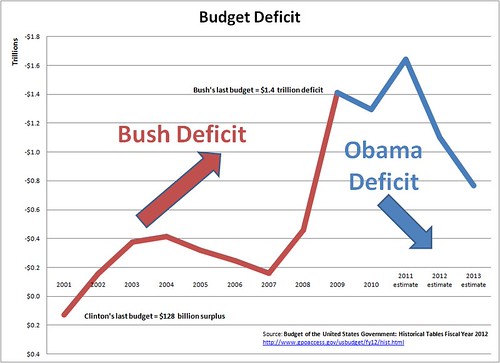
Deficits

Bush-Obama Deficit Chart

Notes, this chart includes Clinton’s last budget year for comparison.

The numbers in these two charts come from Budget of the United States Government: Historical Tables Fiscal Year 2012. They are just the amounts that the government spent and borrowed, period, Anyone can go look then up. People who claim that Obama “tripled the deficit” are either misled or are trying to mislead.

The Stimulus and Jobs

Bush-Obama-Jobs-Chart

In this chart, the RED lines on the left side — the ones that keep doing DOWN — show what happened to jobs under the policies of Bush and the Republicans. We were losing lots and lots of jobs every month, and it was getting worse and worse.The BLUE lines — the ones that just go UP — show what happened to jobs when the stimulus was in effect. We stopped losing jobs and started gaining jobs, and it was getting better and better. The leveling off on the right side of the chart shows what happened as the stimulus started to wind down: job creation leveled off at too low a level.

It looks a lot like the stimulus reversed what was going on before the stimulus.

Conclusion: THE STIMULUS WORKED BUT WAS NOT ENOUGH!

More False Things

These are just three of the false things that everyone “knows.” Some others are (click through): Obama bailed out the banks, businesses will hire if they get tax cuts, health care reform cost $1 trillion, Social Security is a Ponzi Scheme or is “going broke”, government spending “takes money out of the economy.”

Why This Matters

These things really matter. We all want to fix the terrible problems the country has. But it is so important to know just what the problems are before you decide how to fix them. Otherwise the things you do to try to solve those problems might just make them worse. If you get tricked into thinking that Obama has made things worse and that we should go back to what we were doing before Obama — tax cuts for the rich, giving giant corporations and Wall Street everything they want — when those are the things that caused the problems in the first place, then we will be in real trouble.

Emphasis Mine

see:http://www.alternet.org/story/152201/3_reality-based_charts_your_right-wing_relatives_will_have_a_hard_time_ignoring?akid=7484.123424.OxQ7x8&rd=1&t=12

5 Reasons Capitalism Has Failed

The root cause of our recent turmoil is the failure of the dominant economic paradigm — global corporate capitalism.

By Bob Burnett, The Smirking Chimp, via AlterNet

(N.B.: Marx was right, after all…)

We live in interesting times. The global economy is splintering. U.S. voters hate all politicians and there’s political unrest throughout the world. The root cause of this turmoil is the failure of the dominant economic paradigm — global corporate capitalism.

The modern world is ruled by multinational corporations and governed by a capitalistic ideology that believes: Corporations are a special breed of people, motivated solely by self-interest. Corporations seek to maximize return on capital by leveraging productivity and paying the least possible amount for taxes and labor. Corporate executives pledge allegiance to their directors and shareholders. The dominant corporate perspective is short term, the current financial quarter, and the dominant corporate ethic is greed, doing whatever it takes to maximize profit.

Five factors are responsible for the failure of global corporate capitalism. First, global corporations are too big. We’re living in the age of corporate dinosaurs. (The largest multinational is JP Morgan Chase with assets of $2 Trillion, 240,000 employees, and offices in 100 countries.) The original dinosaurs perished because their huge bodies possessed tiny brains. Modern dinosaurs are failing because their massive bureaucracies possess miniscule hearts.

Since the Reagan era global corporations have followed the path of least resistance to profit; they’ve swallowed up their competitors and created monopolies, which have produced humongous bureaucracies. In the short-term, scale helps corporations grow profitable, but in the long-term it makes them inflexible and difficult to manage. Gigantism creates a culture where workers are encouraged to take enormous risks in order to create greater profits; it’s based upon the notion that the corporation is “too big to fail.”

Second, global corporations disdain civil society. They’ve created a culture of organizational narcissism, where workers pledge allegiance to the enterprise. Corporate employees live in a bubble, where they log obscene hours and then vacation with their co-workers. Multinationals develop their own code of ethics and worldview separate from that of any national state. Corporate executives don’t care about the success or failure of any particular country, only the growth and profitability of their global corporation. (Many large corporations pay no U.S. income tax; in 2009 Exxon Mobil actually got a $156 M rebate.)

Third, global corporations are modern outlaws, living outside the law. There is noinvisible hand that regulates multinationals. In 1759 Philosopher Adam Smith argued that while wealthy individuals and corporations were motivated by self interest, an “invisible hand” was operating in the background ensuring that capitalist activities ultimately benefited society. In modern times this concept became the basis for the pronouncements of the Chicago School of Economics that markets were inherently self regulating. However, the last five years have demonstrated that there is no “invisible hand”unregulated markets have spelled disaster for the average person. The “recovery” of 2009-10 ensured that “too big to fail” institutions would survive and the rich would continue to be rich. Meanwhile millions of good jobs were either eliminated or replaced by low-wage jobs with poor or no benefits.

Fourth, global corporations are ruining our natural capital. Four of the top 10 multinational corporations are energy companies, with Exxon Mobil leading the list. But there are many indications that our oil reserves are gone. Meanwhile, other forms of natural capital have been depleted — arable land, water, minerals, forests, fish, and so forth. Multinational corporations have treated the environment as a free resource. When the timberlands of North America began to be depleted, lumber corporations moved to South America and then Asia. Now, the “easy pickings” are gone. Global corporations have ravished the world and citizens of every nation live with the consequences: dirty air, foul water, and pollution of every sort.

Fifth, global corporations have angered the world community. The world GDP is $63 Trillion but multinational corporations garner a disproportionate share — with banks accounting for an estimated $4 trillion (bank assets are $100 trillion). Global black markets make $2 trillion — illegal drugs account for at least $300 billion. In many parts of the world, a worker is not able to earn a living wage, have a bank account or drive a car, but can always obtain drugs, sex, and weapons. And while the world may not be one big village in terms of lifestyle, it shares an image of “the good life” that’s proffered in movies, TV, and the Internet. That’s what teenagers in Afghanistan have in common with teenagers in England; they’ve been fed the same image of success in the global community and they know it’s inaccessible. They are angry and, ultimately, their anger has the same target — multinational corporations (and the governments that support them).

We live in interesting times. The good news is we’re witnessing the failure of global corporate capitalism. The bad news is we don’t know what will replace it.”

(N.B.: Perhaps we do – see peoplesworld.org)

Bob Burnett is a writer and activist in Berkeley, Calif.

Emphasis Mine

see:http://www.alternet.org/story/152118/5_reasons_capitalism_has_failed?page=entire

Why the Mainstream Media Are Clueless About the Religious Right

Though it has shaped American politics for the last 40 years, the religious right still baffles reporters.

N.B.: Keep Separation of religion and government.

From AlterNet, by Adele M. Stan

“Every four years, just as a presidential campaign kicks up, legions of media types who make their living outside the right-wing echo chamber emerge as a militia of Margaret Meads, descending on flyover country, trying to make sense of that exotic phenomenon, the religious right. In the end, those who actually get it are few.
From the attitudes shown by media toward the religious right, you’d never know that more than one-quarter of the U.S. population identify as evangelicals, according to a 2007 survey by the Pew Forum on Religion and Public Life, and among white self-identified evangelicals, 62 percent told Pew in 2006 that they believe the Bible to be the literal word of God.

These, by and large, are the people who determine the outcome of the Republican presidential primary, thanks to the early stacking of states heavily populated by evangelicals, and the propensity of most evangelicals to align with the Republican Party. And yet, we who cover these races often know very little about the voters whose person-on-the-street interviews they’re recording, except to know that these people are very different from us in their view of the world. So as everyday doctrines come to light in one or another campaign incident, the media either find themselves aghast at the implications, or simply choose to ignore them.

Surprise

Take, for instance, Rep. Michele Bachmann‘s profession of the doctrine of “wifely submission.” When a 2006 video of Bachmann surfaced showing her at a church gathering professing her submission to her husband, media types grew quite excited. At the Fox News debate in Ames, Iowa, last week, Washington Examiner columnist Byron York asked Bachmann, “As president, would you be submissive to your husband?” Before Bachmann could speak, York’s question was met with a round of boos and hisses from the audience, whose members likely heard in his question a challenge to one of their fundamental doctrines. (Bachmann, aware that she was playing to a national television audience, dodged the question, saying that she and her husband respected each other.)

The doctrine of wifely submission is common to a number of evangelical faiths, espoused by faithful who range from dour fundamentalists who forbid dancing to writhing, tongues-speaking Pentecostals. The largest among these denominations is the Southern Baptist Convention, the second largest religious body in the United States. York was certainly entitled to his question, and the people of the United States were entitled to a better reply than that which Bachmann gave them. But what we in the media are not entitled to is any sense of shock that a conservative Christian such as Bachmann believes such things. Such surprise simply means we haven’t been paying attention.

Denial

When media types aren’t expressing surprise at the everyday beliefs of the ordinary Americans who comprise the Republican primary electorate, they often turn to denial. Take the curious case of Rep. Ron Paul, Texas, who came within 200 votes of Michele Bachmann’s first-place finish in the Ames, Iowa, straw poll. Paul’s perennial, quixotic presidential campaign (the 2012 contest marks his third run for the nomination) has clearly had a profound impact on the ideology expressed by all of the GOP presidential candidates, but Paul, even after winning the presidential straw poll at the Conservative Political Action Conference for a second year in a row, is just another Rodney Dangerfield to the media. The man just can’t get no respect.

Yet, in consistently putting forward themes derived directly and indirectly from the doctrines of Christian Reconstructionists and the John Birch Society, Paul has made it safe for Texas Gov. Rick Perry to name as “treason” the printing of money by Fed, for former Massachusetts Gov. Mitt Romney to spout off about states’ rights and the 10th amendment, and for former Pennsylvania Sen. Rick Santorum to espouse a no-exceptions anti-abortion position.

While mainstream media dismiss Paul as a quirky, secular libertarian, progressive reporters sometimes express a certain affection for Paul because of his anti-war stance. But Paul’s anti-war position stems from his far-right isolationist views, as expressed in such documents as the Institutes of Biblical Law, by Christian Reconstructionist founder Rousas John Rushdoony, and the platform of the Constitution Party, which, despite its secular-sounding name, seeks to implement “God’s law” in the United States. (Constitution Party founder Howard Phillips is a follower of the late Rushdoony.)

Paul’s 2008 shadow convention to the Republican National Convention in Minneapolis featured Phillips and John Birch Society President John McManusas speakers, and Paul is part Phillips’ coalition against the non-existent North American Union (one of the far right’s favorite conspiracy theories).

The fact is, if you lift up the covers on Ron Paul’s beliefs and associates, it’s all a bit creepy. Paul’s ideology and apparent theological links to Reconstructionism represent nothing new in American politics; the ideology can be traced back to the backers of 1964 campaign of Barry Goldwater. But you’d never know that from reading the mainstream media.

The mainstream media — and to an extent, the progressive media, as well — are made up of elites, people who went to good schools, most of them raised on either the east or west coasts. To these elites, the thought of someone espousing the sort of frightening beliefs that Paul embodies having a serious impact on American politics is just too much to bear, so denial becomes the default position. It’s not conscious — not a deliberate attempt to cover something up, just something too weird and awful to be true, so the notion is simply dismissed. Yet if you look at Paul’s positions and look at how successive GOP fields have moved closer to them (with the exception of the anti-war stance) over the last three election cycles, his impact is clear.

And the notion that regular Americans would buy into an ideology that seeks to implement biblical law as the law of the land really shouldn’t come as a surprise to reporters. The Pew 2006 survey found that nearly one-third of Americans said they felt the law of the Bible should outweigh citizen preferences in the formation of civil law.

Differences Blurred

To mainstream reporters, Rick Perry’s big prayer rally in Houston earlier this month looked like just another religious-right gathering. To their eyes, what made it unusual was that a sitting governor had used his official gubernatorial letterhead and Web site to promote it.

The greater departure, however, was the way in which the gathering represented a coming together of the New Apostolic Reformation, a far-right charismatic movement that seeks to defeat what its followers believe to be real-life demons located in certain geographical areas with the old-line organizations of the religious right, such as the American Family Association. Even James Dobson, the Focus on the Family founder who rarely makes public appearances anymore, appeared on Perry’s stage, lending credence and political power to the demon-chasers. (If mainstream reporters view the doctrine of wifely submission with incredulity and surprise, the NAR doctrine, as described for AlterNet by Rachel Tabachnik, could cause apoplexy.)

In the New York Times‘ coverage of the rally, the name, New Apostolic Reformation, never appeared, even though one of the movement’s more controversial organizations, the International House of Prayer, was among the event’s organizers. (Although IHOP was named as an organizer by reporter Manny Fernandez, nothing about its place in the NAR was mentioned in the article. To his credit, though, Fernandez did note that the American Family Association has been named an anti-gay hate group by the Southern Poverty Law Center.) But this enlargement of the religious-right coalition to include elements once deemed “fringe” even by fellow evangelicals is a major story, especially given the 50-state, cell-based “prayer networks” that are part of the NAR infrastructure.

Meanwhile, at the Washington Post, Jacques Berlinerblau, writing in the paper’s “On Faith” section, tsk-tsk’d Perry for talking about Jesus too much, reading too much scripture and generally being unecumenical.

“If he intends on using the religion card effectively beyond the Iowa and South Carolina caucuses and primaries,” wrote Berlinerblau, “Governor Perry will have to come up with something more inclusive than this.”

Yes, but first he has to win the nomination — and that will require the votes of millions of Americans who believe that biblical law should supplant the will of the people, and who think the Bible is the literal truth. Right now, they’re the ones who matter. And no reporter should be surprised by that.

As a nation, we’ve been headed down this path for more than 40 years. As the economic fortunes of the U.S. turn downward, we should expect the attraction of right-wing religion, especially its more charismatic and viscerally-felt forms, to expand. Anyone who doesn’t just hasn’t been paying attention.”

Adele M. Stan is AlterNet’s Washington bureau chief. Follow her on Twitter:www.twitter.com/addiestan

emphasis mine

see: http://www.alternet.org/story/152053/why_the_mainstream_media_are_clueless_about_the_religious_right?akid=7419.123424.qJ7Z66&rd=1&t=5

How the Political Right Bullied the US Government Into Ignoring the Threat of Right-Wing Extremism

After right-wingers freaked out about a report detailing the rise in right-wing extremism, Homeland Security effectively dismantled a unit tasked with tracking it.

From AlterNet, by Rania Khalek

“In the wake of the terrorist attack in Norway by right-wing Christian extremist Anders Breivik, conservative media pundits rushed to vilify anyone who brought up the underlying far-right ideology that fueled Breivik’s violence.

The uproar that follows any suggestion that right-wing extremism is on the rise works to silence the conversation about the danger of right-wing militancy. According to disturbing revelations by a former Homeland Security Intelligence Analyst, the consequences of this dynamic extend to the highest branches of the US government.

For six years, Darryl Johnson headed a Department of Homeland Security team tracking domestic extremist groups. Now Johnson, who is no longer with DHS, says that conservative furor over the report’s findings pressured Homeland Security to abandon reporting on and monitoring the rising threat of right-wing extremism for the past two years.

In April 2009, DHS issued an intelligence assessment, co-authored by Johnson, titled “Rightwing Extremism: Current Economic and Political Climate Fueling Resurgence in Radicalization and Recruitment.” The document was one of many threat assessments shared between DHS and state and local law enforcement agencies to keep them apprised of potential and looming threats, and warned of a surge in right-wing extremism due to the election of the country’s first black president and the economic recession.

Although the report was intended only for distribution to law enforcement agencies, it was immediately leaked to the media causing a political firestorm among conservativepundits, who wrongly suggested that it labeled all conservatives as potential terrorists.

DHS initially defended the report, but within days caved to political pressure and practically disowned it, with Secretary Napolitano apologizing to the American Legion for the report’s mention of military veterans. But DHS did more than just publicly buckle under the political weight of conservative critics. According to Johnson, the department effectively dismantled his intelligence team following the right’s uproar.

In an in-depth interview published in the Southern Poverty Law Center’sIntelligence Report, Johnson reveals the level of sway the political right had in thwarting intelligence work on right-wing extremism. He says DHS deliberately mischaracterized the report as unauthorized, even though it had passed through proper channels and instituted restrictive policies that brought the important work of his unit to a virtual standstill. As a result, Johnson left DHS in dismay and was followed by almost all the members of his team, leaving a single analyst where there had been six. In comparison, there are at least 25 analysts devoted to tracking Islamic terrorism.

When questioned about Johnson’s claims — which have been confirmed by current and former department officials in the Washington Post – DHS officials, speaking on condition of anonymity, have repeatedly disputed his account and insist that the level of activity by right-wing extremist groups has remained consistent over the past few years. In addition, they claim the perception of increased extremist activity may be due to increased awareness of the threat by the government and the public. But the numbers beg to differ.

Right Wing Extremism on the Rise

Johnson’s report was consistent with data from the Southern Poverty Law Center, which finds that hate groups topped 1,000 for the first time since SPLC began counting such groups in the 1980s. The most dramatic growth was seen in antigovernment “Patriot” groups — militias and other extremist organizations that see the federal government as their enemy — which came roaring back to life over the past year after more than a decade out of the limelight. SPLC’s Intelligence Project identified 824 anti-government “Patriot” groups that were active in 2010, up from just 149 in 2008.

According to Mark Potok, director of SPLC’s Intelligence Project, these groups are driven by resentment over changing racial demographics, which he describes as, “The idea that the country is becoming less white every day and in fact the prediction by the census bureau that whites will lose their majority about the year 2050 in the United States is very important. Virtually every white supremacist in America knows that date.” Other drivers include frustration over the economy, and the mainstreaming of conspiracy theories and propaganda aimed at various minorities.

Potok told AlterNet that events following the 2009 DHS report have proved it to be prescient. 

In May 2009, just one month after the report’s release, an anti-abortion zealot murdered Dr. George Tiller in Kansas. In June 2009, neo-Nazi James von Brunn murdered a security guard at the U.S. Holocaust Memorial Museum. In March 2010, nine members of a Michigan militia were charged with seditious conspiracy and attempted use of weapons of mass destruction in connection with an alleged plot to murder police officers.

On May 20, 2010, two West Memphis Arkansas police officers were shot to death during a routine traffic stop by a father-son duo of “sovereign citizens,” a group of US residents who believe the government has no authority over them. West Memphis Police Chief Bob Paudert, whose son was one of the officers killed, told me that prior to the loss of his son, he had never heard of sovereign citizens, nor had any other law enforcement officials he spoke to about the matter. After some digging and research he discovered that his son’s murder was not an isolated incident, and in fact sovereign citizens were responsible fordozens of police officer deaths around the country.

Paudert was particularly surprised to learn that the Sovereign movement is estimated at 300,000 people strong and growing, which is why he was disappointed in the federal government’s failure to alert state and local law enforcement that such a threat existed. Paudert says he is absolutely positive that had they been alerted and trained to recognize sovereign citizens, “my son would still be alive today.”

Conservatives Throw a Temper Tantrum

The loudest outcry came from the right-wing shock jocks like Rush Limbaugh, who claimed that Janet Napolitano and Barack Obama were “portraying standard, ordinary, everyday conservatives as posing a bigger threat to this country than al-Qaeda terrorists or genuine enemies of this country like Kim Jong-Il.”  Sean Hannity warned his Fox News viewers that “if you have a pro-life bumper sticker on your car, if you have an ‘America is overtaxed’ bumper sticker, if you have a pro-Second Amendment bumper sticker, they’re viewing you potentially as a radical.”

In possibly the most deranged interpretation, conservative blogger Michelle Malkin wrote that the report was a “hit job on conservatives” and “one of the most embarrassingly shoddy pieces of propaganda I’d ever read out of DHS. I couldn’t believe it was real….the piece of crap report issued on April 7 is a sweeping indictment of conservatives.”

In a sad sort of irony, Johnson told SPLC that the conservative media personalities who misinterpreted and attacked his report “would have been shocked to know that I personify conservatism. I’m an Eagle Scout. I’m a registered Republican. I’m Mormon. In fact, I was helping the Boy Scouts with a fundraiser when I heard the report being attacked on the news.”

Outrage over the report’s findings quickly spread to Congress, where several conservative lawmakers demanded the ouster of DHS Secretary Janet Napolitano. Among them was Rep. John Carter, R-Tex., who remarked, “We shouldn’t even give her the respect of letting her resign. She should be fired by the administration for accusing honest, American citizens — because of their political beliefs — of being domestic terrorists.”

The self-described conservative and Christian non-profit Thomas More Law Center went even further and filed a lawsuit against Secretary Napolitano on behalf a Michigan-based anti-abortion group, claiming the DHS report was all part of a conspiracy between the Obama administration and liberal groups to violate their constitutional rights.

The section of the report that stirred the most controversy referred to “disgruntled military veterans” and cautioned that “rightwing extremists would attempt to recruit and radicalize returning veterans to boost their violent capabilities.”

This did not sit well with David Rehbein, the commander of the veterans’ organization American Legion, who wrote in a letter to Secretary Napolitano, “To continue to use McVeigh as an example of the stereotypical disgruntled military veteran is as unfair as using Osama bin Laden as the sole example of Islam.” Had Rehbein actually read the full report he would have discovered that this specific concern was based on factual data collected by the FBI.

The DHS assessment cited a July 2008 report by the FBI’s Counterterrorism Division under the Bush administration, titled “White Supremacist Recruitment of Military Personnel since 9/11.” Based on its findings the 2008 FBI report observed that “some returning military veterans from the wars in Iraq and Afghanistan have joined extremist groups,” and that “military experience is found throughout the white supremacist extremist movement as the result of recruitment campaigns by extremist groups and self-recruitment by veterans sympathetic to white supremacist causes.” Furthermore, based on analysis of FBI case files from October 2001 to May 2008, the report identified 203 military personnel or veterans who were active members in white supremacist organizations during that period.

It’s not surprising that conservatives threw a fit. What’s disturbing is that these conservative complaints prompted DHS to withdraw the report.

Pretending the Threat Doesn’t Exist

I spoke with Johnson, who has been following right-wing extremism in a professional capacity since the early ‘90s. Upon the Democratic nomination for president of then Senator Obama, Johnson says that based on his experience and expertise, he immediately recognized that “this would be a huge recruiting tool for groups like white supremacists, militia extremists, sovereign citizen extremists, those extremists groups that are on the fringes of the right of the political spectrum, which we refer to as right-wing extremists in the counterterrorism community.”

When it was clear that Barack Obama would win, Johnson became worried about the “potential radicalization factor” that would ensue following the election of America’s first black president. “It would agitate people to go beyond their mainstream and law-abiding protest activity to more criminal activity and violence because people would see that these ‘enemies’ so to speak, these minorities in America are actually integrated in society and they’re actually fulfilling the American dream.”

All of this prompted the drafting of the report in the early months of the Obama administration.

He chose to go public because “the conditions that existed back in 2008 and 2009 when we drafted this document still persist today….the climate in this country from a political standpoint and economic standpoint has not changed. The economy is still sluggish, unemployment’s still flirting with 10 percent, and there’s this anti-government sentiment and agitation out there in this country. That’s one thing that concerns me is that we’ve had two years now where these people have been boiling in this environment that could possibly agitate somebody to carry out a violent act.” 

Mark Potok told AlterNet that DHS’s handling of the report’s criticism was “nothing more than an act of political cowardice,” but it doesn’t change the report’s disturbing accuracy.

The Southern Poverty Law Center keeps a detailed and unsettling list of major terrorist plots and racist rampages that have emerged from the American radical right in the years since Oklahoma City, a pattern Potok says continues to this day. That prompted SPLC’s president, J. Richard Cohen, to send a letter to DHS Secretary Janet Napolitano two months ago, urging her to reassess the level of resources that DHS is devoting to the threat of non-Islamic domestic terrorism.

The letter highlights several recent examples of thwarted attacks, one of which occurred this past January, when a neo-Nazi activist was arrested for planting a bomb along an MLK Day parade route in Spokane, Washington. That same month, another neo-Nazi was arrested on his way to the Arizona-Mexico border and later charged with possessing explosive devices packed with ball bearings – to “maximize human carnage,” as a federal prosecutor put it. In March, authorities arrested five members of a militia in Alaska and charged them with plotting to murder or kidnap police officers and judges if their leader, who was then fleeing prosecution on weapons charges, were arrested or killed. Unfortunately, Secretary Napolitano has yet to respond to SPLC’s letter.

That the right’s outrage over the report managed to influence the Department of Homeland Security should raise alarm bells for anyone who is concerned about homegrown extremism. It’s frightening that the US government bowed to political pressure. The atrocity that took place in Norway is a reminder of the brutality that ideological extremists are capable of dishing out.

According to Johnson, Anders Breivik “was under the radar, he acquired relatively unsophisticated weaponry and was able to go and target people that he opposed because of his ideology and beliefs and was able to kill close to 80 people, and it was done effortlessly. He didn’t go to some place in Pakistan and learn how to build a bomb.  He learned how to do this on the Internet, and he was able to acquire these materials legally. And I know for a fact that that is going on here in this country, people are stockpiling weaponry.”

Potok believes the right’s ability to silence the conversation about right-wing extremism will have fatal consequences, warning, “The danger of pretending this movement doesn’t exist is that it will grow more and more deeply entrenched in our society and more dangerous. There’s an immediate criminal danger. Timothy McVeigh murdered 168 men women and children in 15 seconds. It absolutely could happen again. It hasn’t because we are lucky and because law enforcement has done a fine job overall.”

Similarly, Daryl Johnson fears that, “These incidents are starting to add up. Yet our legislators, politicians and national leaders don’t appear too concerned about this. So my greatest fear is that domestic terrorists in this country will somehow become emboldened to the point of carrying out a mass-casualty attack, because they perceive that no one is being vigilant about the threat from within. This is what keeps me up at night.”

Rania Khalek is a progressive activist. Check out her blog Missing Pieces or follow her on Twitter @Rania_ak. You can contact her at raniakhalek@gmail.com.

Emphasis Mine

see:http://www.alternet.org/story/152033/how_the_political_right_bullied_the_us_government_into_ignoring_the_threat_of_right-wing_extremism?akid=7406.123424.6GLo_-&rd=1&t=5