Health Insurance for Millions Threatened; Republicans Celebrate

But what actually had them so pleased is the possibility that millions of Americans will lose their health insurance.

Source: American Prospect

Author: Paul Waldman

If they’re wondering why Americans think their party is cruel and unfeeling, well here you go. And will the news media tell these people’s stories? When news broke this morning of the decision by a three-judge panel from the D.C. Circuit Court of Appeals in Halbig v. Burwell, which states that because of a part of one sentence in the Affordable Care Act that was basically a typo, millions of Americans should lose the federal subsidies that allowed them to buy health insurance, I’m pretty sure a similar scene played out all around Washington. As word spread through the offices of conservative think-tanks, advocacy groups, and members of Congress, people gathered around TVs or computer screens, quickly taking in the decision. And there were smiles, laughter, maybe even a few high-fives and fist-pumps.

Not long after, a second appeals court handed down an opposite ruling on the same question. (If you feel like you don’t understand the issue, the rulings, and the implications, I’d recommend Ian Millhiser’s explanation.) We won’t know for some time whether the Supreme Court will hear these cases and. if it does, it’s hard to predict what the justices will decide. But back to those conservatives: What they were so excited about was, in a narrow sense, that they had seemingly won a victory over the villainous Barack Obama and his freedom-destroying Affordable Care Act. But what actually had them so pleased is the possibility that millions of Americans will lose their health insurance.

Am I being unfair? Well here’s a challenge. Let’s see if anybody can point me to a single prominent conservative—member of Congress, movement figure, media figure—whose response to that decision is not just what they’re all saying (some variant of “This just shows what a terrible law Obamacare is”) but also something like, “Of course, we don’t want anyone to lose their health coverage, so if this decision is upheld we should pass a law correcting the drafting error that gave rise to this case and making sure those millions of Americans can keep getting the subsidies that make it possible for them to buy private insurance.”  If they really cared about those millions of Americans and their fate, they’d want to do something about it, now that the lawsuit they filed threatens to take away that health coverage. So what are they going to do? The answer is, nothing. There will be precisely zero conservatives who propose to actually help those people. And if you ask the lawsuit’s supporters what should happen to them, none will have anything resembling a practical suggestion. At best, they’ll say that the millions who would lose their insurance if the decision stands were snookered by that con man Obama into thinking they could have affordable health coverage, so it’s really all his fault.

The next time Republicans are wondering why so many people think their party is cruel and uncaring and will gladly crush the lives of ordinary people if it means gaining some momentary partisan advantage, they might think back to this case. They might remind themselves that the problem isn’t that Americans just don’t fully comprehend the majesty of Republican philosophy. It’s that they see it quite well.

And while we’re at it, here’s a question for the news media. Remember when people got those letters from their insurance companies saying their old plans would be cancelled, and you went into a frenzy of ill-informed and misleading coverage telling their alleged tales of woe? I know, you feel bad for not doing any follow-ups showing how most of them ended up with coverage that was more comprehensive, less expensive, or both. But here’s your chance for redemption! How about you do an equal number of stories—oh, who am I kidding?—how about you do half as many stories telling the tales of people who got coverage because of the subsidies, and would lose it if the Halbig decision stands?

You wouldn’t have to work too hard to find them—after all, almost nine out of every ten people who bought insurance on the exchange got a subsidy, and their premiums were reduced by an average of 76 percent. If you’re in Washington, just go to Virginia, which used the federal exchange, and you can find plenty of people who would lose their coverage if Halbig stands; if you’re in New York, hop across the river to New Jersey. Those stories are out there waiting to be told, and showing how things like court decisions affect regular people is part of your job, not just when it makes the administration look bad, but even if it supports their position. Right?

Emphasis Mine

See:http://prospect.org/article/health-insurance-millions-threatened-republicans-celebrate

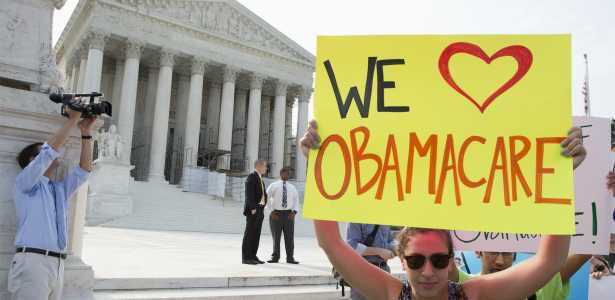
Turns Out, Republicans Love Obamacare!?!

WeLoveObamacare2Source: Think Progress

Author: Igor Volsky

Conservative groups have invested millions of dollars in opposing the Affordable Care Act, but they appear to have had little success in turning Americans against the law. In fact, according to a new poll from the Commonwealth Fund, individuals and families who enroll in Obamacare — including the overwhelming majority of Republicans — are satisfied with the product:

Overall, 73 percent of people who bought health plans and 87 percent of those who signed up for Medicaid said they were somewhat or very satisfied with their new health insurance. Seventy-four percent of newly insured Republicans liked their plans. Even 77 percent of people who had insurance before — including members of the much-publicized group whose plans got canceled last year — were happy with their new coverage.

The study also found that the percentage of uninsured has dropped, from 20 percent to 15 percent, after the first open enrollment period, with 9.5 million fewer people now uninsured. Latinos, the most likely of any racial group to lack health insurance, are seeing the biggest gains in coverage. “The percent uninsured fell from 36 percent in July–September 2013 to 23 percent in April–June 2014,” Commonwealth reports.

Moreover, states that expanded their Medicaid programs experienced the biggest drop in uninsurance rates for low-income citizens. In the 25 states and the District of Columbia that implemented coverage expansion for poorer residents, the average uninsured rate for people living below the poverty level fell to 17 percent from 28 percent. The 26 states that have rejected Medicaid expansion continue to see the uninsured rate among low income individuals hover at 36 percent.

The number of uninsured young adults dropped the most, the survey found, from 28 percent to 18 percent.

Commonwealth Fund conducted the survey from a July-to-September 2013 period, before Americans began enrolling in the Affordable Care Act, and then again from April-to-June 2014, following the end of open enrollment.

Update

Significantly, the survey also found that more than half of adults — 58 percent — “with new insurance said they were better off now than they were before.”

Emphasis Mine

See:http://thinkprogress.org/health/2014/07/10/3458577/even-republicans-are-satisfied-with-the-new-obamacare-coverage-poll-finds/

Independence Day Special: Thirteen Facts About America Conservatives Would Like You to Forget

Source: Daily Kos

Author Richard Riis

1. Conservatives opposed the Founding Fathers, the American Revolution and a lot of other righteous stuff as well.

By definition a conservative is one who wishes to preserve and/or restore traditional values and institutions, i.e. to “conserve” the established order. No surprise then that 18th century American conservatives wanted no part of breaking away from the British Empire and the comforting bonds of monarchical government. Those anti-revolutionary conservatives were called Tories, the name still used for the conservative party in England. The Founding Fathers? As radically left-wing as they came in the 1770s. The Boston Tea Party? The “Occupy Wall Street” of its day.

Some of the other “traditional” values supported by conservatives over the course of American history have included slavery (remember that the Republican Party was on the liberal fringe in 1860), religious persecution, the subjugation of women and minorities, obstacles to immigration, voter suppression, prohibition and segregation.  Conservatives started off on the wrong side of American history, and that’s where they’ve been ever since.

2. The United States is not a Christian nation, and the Bible is not the cornerstone of our law.

Don’t take my word for it. Let these Founding Fathers speak for themselves:

John Adams: “The government of the United States of America is not in any sense founded on the Christian religion.” (Treaty of Tripoli, 1797)

Thomas Jefferson:Christianity neither is, nor ever was, a part of the common law.” (Letter to Dr. Thomas Cooper, February 10, 1814)

James Madison: “The civil government … functions with complete success … by the total separation of the Church from the State.” (Writings, 8:432, 1819)

George Washington: “If I could conceive that the general government might ever be so administered as to render the liberty of conscience insecure, I beg you will be persuaded, that no one would be more zealous than myself to establish effectual barriers against the horrors of spiritual tyranny, and every species of religious persecution.” (Letter to the United Baptist Chamber of Virginia, May 1789)

You can find a multitude of similar quotes from these men and most others who signed the Declaration of Independence and/or formulated the United States Constitution. These are hardly the words of men who believed that America should be a Christian nation governed by the Bible, as a disturbing fundamentalist trend today would have it be.

3. Long before the United States even existed, it was drawing “problem” immigrants.

After being pretty much run out of England as anti-government radicals, the religious dissidents we know today as the Pilgrims settled in Leiden, Holland, where they set about making themselves that nation’s immigrant problem. Sticking to themselves and refusing to “blend in” with their new homeland, the Pilgrims grew alarmed by the unpalatable ideas to which their children were being exposed, such as religious tolerance (good for the Pilgrims, bad for everyone else) and national service (like all Dutch residents, the Pilgrims were eligible for the draft). When their children began picking up the Dutch language, the Pilgrims had had enough. By then the Dutch had, too. Next stop: Plymouth Rock.

4. Those Pilgrims were commies… and it saved their lives.

Governor William Bradford’s memoirs confirm that the first thing the settlers did upon arrival in the Plymouth Colony was to set up a textbook communist system of production and distribution. Every resident of the colony was expected to share, to the extent of his or her ability, the chores of hunting, farming, cooking, building, making clothing, etc., and, in exchange, everyone shared the products of that communal labor.

That commie-pinko economy sustained the Pilgrims through their first brutal year in the New World, after which it was decided that the colony was sufficiently stable to allow householders their own plot of land on which to grow crops they were free to keep for themselves. The fact that the colonists’ productivity increased exponentially with their own land begs the question: were the Pilgrims working harder now that they got to keep the product of their own labor or, conversely, were they prone to slacking off when the goods came whether they worked hard or not?

I guess you could say the Pilgrims were the kind of lazy, shiftless “takers” that conservatives are always railing against.

5. One of the Founding Fathers, Thomas Jefferson, hated Thanksgiving.

In fact, Thomas Jefferson once called a national day of Thanksgiving “the most ridiculous idea” he’d ever heard of.

Despite being first proclaimed by George Washington in 1789, Jefferson believed a national day of thanksgiving was not consistent with the principle of separation of church and state and refused to recognize the holiday in any of the eight years in which he was president of the United States. “Every one must act according to the dictates of his own reason,” Jefferson once wrote, “and mine tells me that civil powers alone have been given to the President of the United States, and no authority to direct the religious exercises of his constituents.”

For the record, Presidents Andrew Jackson and Zachary Taylor refused to issue Thanksgiving Day proclamations during their administrations, too. Can you imagine what Fox News Channel would have made of these administrations’ “War on Thanksgiving”?

6. The Pledge of Allegiance was written by a socialist.

The Pledge was written in 1892 for public school celebrations of the 400th anniversary of Columbus’ arrival in the Americas. Its author was Francis Bellamy, a Baptist minister, Christian socialist and cousin of socialist utopian novelist Edward Bellamy. Christian socialism maintains, among other ideas, that capitalism is idolatrous and rooted in greed, and the underlying cause of much of the world’s social inequity. Kinda puts the red in the ol’ red, white and blue, doesn’t it?

7. Roe v. Wade was a bipartisan decision made by a predominantly Republican-appointed Supreme Court.

Technically, Roe v. Wade did not make abortion legal in the United States, the Supreme Court merely found that the state of Texas’ prohibition on abortion violated the 14th Amendment Due Process Clause and that states could exercise varying degrees of discretion in regulating abortion, depending upon the stage of pregnancy. The Court also held the law violated the right to privacy under substantive due process.
That being said, the landmark 1973 ruling that conservatives love to hate, was decided on a 7-2 vote that broke down like this:

Majority (for Roe): Chief Justice Warren Burger (conservative, appointed by Nixon), William O. Douglas (liberal, appointed by FDR), William J. Brennan (liberal, appointed by Eisenhower), Potter Stewart (moderate, appointed by Eisenhower), Thurgood Marshall (liberal, appointed by LBJ), Harry Blackmun (author of the majority opinion and a conservative who eventually turned liberal, appointed by Nixon), Lewis Powell (moderate, appointed by Nixon). Summary: 3 liberals, 2 conservatives, 2 moderates.

Dissenting (for Wade): Byron White (generally liberal/sometimes conservative, appointed by JFK), William Rehnquist (conservative, appointed by Nixon). Summary: 1 liberal, 1 conservative.

By ideological orientation, it was an across-the-board decision for Roe: conservatives 2-1, liberals 3-1, moderates 2-0; by party of presidential appointment: Republicans 5-1, Democrats 2-1. No one can rightly say that this was a leftist court forcing its liberal beliefs on America.

8. Conservative icon Ronald Reagan once signed a bill legalizing abortion.

The Ronald Reagan conservatives worship today is more myth than reality. Reagan was a conservative for sure, but also a practical politician who understood the necessities of compromise. In the spring of 1967, four months into his first term as governor of California, Ronald Reagan signed a bill that, among other provisions, legalized abortion for the vaguely-defined “well being” of the mother. Reagan may have been personally pro-life, but in this instance he was willing to compromise in order to achieve other ends he considered more important. That he claimed later to regret signing the bill doesn’t change the fact that he did. As Casey Stengel liked to say, “You could look it up.”

9. Reagan also raised federal taxes eleven times.

Okay, Ronald Reagan cut tax rates more than any other president – with a big asterisk. Sure, the top rate was reduced from 70% in 1980 all the way down to 28% in 1988, but while Republicans typically point to Reagan’s tax-cutting as the right approach to improving the economy, Reagan himself realized the resulting national debt from his revenue slashing was untenable, so he quietly raised other taxes on income – primarily Social Security and payroll taxes – no less than eleven times. Most of Reagan’s highly publicized tax cuts went to the usual handout-takers in the top income brackets, while his stealth tax increases had their biggest impact on the middle class. These increases were well hidden inside such innocuous-sounding packages as the Tax Equity and Fiscal Responsibility Act of 1982, the Deficit Reduction Act of 1984 and the Omnibus Budget Reconciliation Act of 1987. Leave it to a seasoned actor to pull off such a masterful charade.

10. Barry Goldwater was pro-choice, supported gay rights, deeply despised the Religious Right, and – gasp! – liked Hillary Clinton.

It’s a measure of just how much farther right contemporary conservatism has shifted in just a generation or two that Barry “Mr. Conservative” Goldwater, the Republican standard-bearer in 1964, couldn’t buy a ticket into a GOP convention in 2014.

There’s no debating Goldwater’s deeply conservative bona fides, but check these pronouncements from the man himself:

“I am a conservative Republican, but I believe in democracy and the separation of church and state.  The conservative movement is founded on the simple tenet that people have the right to live life as they please as long as they don’t hurt anyone else in the process.” (Interview, Washington Post, July 28, 1994)

A woman has a right to an abortion. That’s a decision that’s up to the pregnant woman, not up to the pope or some do-gooders or the Religious Right.” (Interview, Los Angeles Times, 1994)

“The big thing is to make this country… quit discriminating against people just because they’re gay. You don’t have to agree with it, but they have a constitutional right to be gay. … They’re American citizens.” (Interview, Washington Post, July 28, 1994)

“Politics and governing demand compromise. But these Christians believe they are acting in the name of God, so they can’t and won’t compromise. I know; I’ve tried to deal with them. Just who do they think they are? And from where do they presume to claim the right to dictate their moral beliefs to me? And I am even more angry as a legislator who must endure the threats of every religious group who thinks it has some God-granted right to control my vote on every roll call in the Senate. I am warning them today: I will fight them every step of the way if they try to dictate their moral convictions to all Americans in the name of ‘conservatism.’” (Congressional Record, September 16, 1981)

“If [Bill Clinton] let his wife run business, I think he’d be better off. … I just like the way she acts. I’ve never met her, but I sent her a bag of chili, and she invited me to come to the White House some night and said she’d cook chili for me.” (Interview, Washington Post, July 28, 1994)

11. The first president to propose national health insurance was a Republican.

He was also a trust-busting, pro-labor, Nobel Peace Prize-winning environmentalist. Is there any wonder why Theodore Roosevelt, who first proposed a system of national health insurance during his unsuccessful Progressive Party campaign to retake the White House from William Howard Taft in 1912, gets scarce mention at Republican National Conventions these days?

12. Those “job-killing” environmental regulations? Republican things.

Sometimes being conservative can be a good thing, like when it applies to conserving America’s clean air and water, endangered wildlife and awesome natural beauty. Many of Theodore Roosevelt’s greatest accomplishments as president were in the area of conserving America’s natural environment. In 1905, Roosevelt formed the United States Forestry Service. Under his presidential authority, vast expanses of American real estate were declared off limits for private development and reserved for public use. During Roosevelt’s time as president, forest reserves in the United States went from approximately 43 million acres to about 194 million acres. Talk about big government land grabs!

The United States Environmental Protection Agency, arch-enemy of polluters in particular and government regulation haters in general, was created by that other well-known GOP tree hugger, Richard Nixon. In his 1970 State of the Union Address, Nixon proclaimed the new decade a period of environmental transformation. Shortly thereafter he presented Congress an unprecedented 37-point message on the environment, requesting billions for the improvement of water treatment facilities, asking for national air quality standards and stringent guidelines to lower motor vehicle emissions, and launching federally-funded research to reduce automobile pollution. Nixon also ordered a clean-up of air- and water-polluting federal facilities, sought legislation to end the dumping of wastes into the Great Lakes, proposed a tax on lead additives in gasoline, and approved a National Contingency Plan for the treatment of petroleum spills. In July 1970 Nixon declared his intention to establish the Environmental Protection Agency, and that December the EPA opened for business. Hard to believe, but had it not been for Watergate, we might remember Richard Nixon today as the “environmental president”.

Oh, yes – conservatives would rather forget that Nixon was an advocate of national health insurance, too.

13. President Obama was not only born in the United States, his roots run deeper in American history than most conservatives’ – and most other Americans’ – do.

The argument that Barack Obama was born anywhere but at Kapiolani Maternity and Gynecological Hospital in Honolulu, Hawaii, is not worth addressing; the evidence is indisputable by any rational human being. But not even irrational “birthers” can dispute Obama’s well-documented family tree on his mother’s side. By way of his Dunham lineage, President Obama has at least 11 direct ancestors who took up arms and fought for American independence in the Revolutionary War and two others cited as patriots by the Daughters of the American Revolution for furnishing supplies to the colonial army. This star-spangled heritage makes Obama eligible to join the Sons of the American Revolution, and his daughters the Daughters of the American Revolution. Not bad for someone some conservatives on the lunatic fringe still insist is a foreigner bent on destroying the United States of America.

Tags

Emphasis Mine

See:
Bad News For Republicans: Obamacare Still NOT A Job Killer As 217,000 Jobs Added In May, Healthcare Adds The Most


Source: Addicting Info

Author: Stephan D. Foster, Jr.

On March 31, 2014, the Obamacare open enrollment deadline passed. Over 8 million Americans successfully enrolled and gained health insurance coverage. Over six million more gained coverage through Medicaid expansion. Despite Republican claims that the sky would fall and send the US job market into a death spiral, it did not fall and it still hasn’t.

For the fourth consecutive month, the economy added more than 200,000 jobs, and healthcare led the way in creating those jobs. According to a report from the Bureau of Labor Statistics, 217,000 jobs were added in May. Healthcare was responsible for approximately 55,000 of those jobs. And that’s not the only good news.

The jobs report is even sweeter because it means the United States has finally recovered all of the jobs lost when the economy crashed during the Bush Administration in 2008. It also marks the first time that the economy has added 200,000 jobs for four straight months since 1999-2000, when another Democrat, Bill Clinton, occupied the White House. Additionally, the unemployment rate still stands at 6.3 percent, which is a six year low since the rate peaked at 10 percent in 2009 just after Obama took office.

Even though Republicans have crusaded against President Obama’s signature healthcare law all these years by claiming it to be a job killer, the evidence clearly shows that they’re totally wrong. In fact, Obamacare actually creates jobs. The job creation power of Obamacare even goes beyond the healthcare sector. Implementing a healthcare system that will handle an influx of millions of people demands the growth of many fields, including many outside of healthcare. Not just doctors, nurses, and physician assistants, but also jobs in payroll services, computer programming, attorneys, medical bill coders, consultants, customer service, human resources, occupational therapy, and educators. A system that is expected to help way more than 14 million Americans simply cannot do its job unless more workers are hired to fill the increased need.

This isn’t the only bad news the GOP has received about Obamacare in recent months. A recent poll indicates that uninsured rates have fallen across the board throughout the nation, especially among African-Americans and Hispanics. Furthermore, a separate poll reveals that Americans now support Obamacare and a report from the Congressional Budget Office predicts that the law will save an additional $104 billion in costs. It looks like conservatives are all out of doomsday claims about Obamacare.

Obamacare has not only strengthened America’s healthcare system, it has strengthened the economy as well. Hundreds of thousands of jobs are being added every month now and millions of people are gaining access to health insurance. That’s a victory for President Obama on two fronts of domestic policy: the economy and healthcare. It’s fantastic news for Democrats and terrible news for Republicans as the country heads toward the 2014 midterm election in November. Just make sure to remember which party brought you a better healthcare system and an improved economy and which one openly attempted to sabotage both.


Emphasis Mine


See: http://www.addictinginfo.org/2014/06/06/bad-news-for-republicans-obamacare-still-not-a-job-killer-as-217000-jobs-added-in-may-healthcare-adds-the-most/

New Polls Show Democrats Are Doing Better In Races Across The Country, Including The South

Source: Addicting info

Author: Alan J. Mostravick

“Even just a couple of months ago, the word around the campfire was that this November was going to suck and suck hard for Democrats. Polls showed them hobbling into election season with poor jobs numbers, a flawed and failing Obamacare and a congressional delegation unable to draw their Republican counterparts into any type of consensus.

When, on May 2, the Bureau of Labor Statistics released their report that the unemployment rate had fallen another .4 points to a 6 year low 6.3 percent, the argument that Obama and the Democrats were bad for the economy began to ring hollow. Just imagine how much better that figure could have been and sooner had it not been for the completely obstructionist Boehner-led House of Representatives.

For months after the botched website launch, conservative pundits and lawmakers reveled in what they predicted would be the abject failure of the President’s signature healthcare reform law. First, there was no way the program was going to reach it’s necessary 7 million enrollees. But the chorus of criticism didn’t stop when Obamcare managed to sign up an estimated 10 million individuals through the program and expanded state medicaid programs. With a creative bit of goalpost movement, they then gleefully doubted those who signed up would actually pay their premiums. The insurance companies have debunked that silliness by reporting upwards of 85-90 percent of premiums. Another conservative talking point hoisted by its own petard.

As far as working with the ‘Party of No’? The Republicans have shown absolutely no proof that they intend to play nice across the aisle and work for the good of the country. So, perhaps what needs to happen is a big win for Democrats in the upcoming elections. And now we have several polls (even by notoriously conservative-leaning firms) that show this could no be a distinct possibility.

Both Fox News and the Rasmussen Reports have many Democrats in a statistical dead heat or even leading in their mid-term races, even in the rabidly Republican south. This is good news for many candidates but it is particularly good for southern Democratic Senate candidates Mark Pryor (AR), Allison Lundergan-Grimes (KY) and Michelle Nunn (GA), whose eventual victories will keep the Democratic majority in the Senate and will, in one instance, unseat a particularly vitriolic minority leader.

Many Democratic consultants are urging candidates to run on, (rather than run away from), issues like Obamacare and the economy. With the recent and continual good news on those fronts, that is cogent advice that should be heeded. With a big enough win in the elections, perhaps the Republicans in the House will understand that the country is tired of the petty politics of #Bengazi, Repeal and Replace, and the other obstructionist tactics currently being employed by that party.”

Emphasis Mine

See:http://www.addictinginfo.org/2014/05/16/democrats-polling-well/

The Uninsurance Rate Is Dropping Among People Who Need Health Care the Most

Thinkprogress via RSN

Author: Tara Culp-Ressler

The uninsurance rate continues to drop to record lows, according to polling from Gallup — and it’s declining the fastest among the communities who have historically lacked adequate access to health care. The data suggests that Obamacare is effectively expanding coverage to the people who need it the most.

Among U.S. adults, the uninsurance rate declined to 13.4 percent in April, hitting the lowest rate since Gallup began tracking the monthly data in 2008. The sharp decline in the number of people without insurance coincided with Obamacare’s first open enrollment period between October and April:

Although the uninsurance rate fell across all demographic groups, the researchers noted that it dropped particularly significantly among non-white and lower-income Americans. Those are the groups that were expected to benefit the most from the provisions in the Affordable Care Act, since they’ve traditionally suffered from higher rates of uninsurance. Compared to the fourth quarter of 2013, the uninsurance rate among black adults fell by 7.1 percentage points, the biggest drop among any group. Among Hispanics, the rate is down 5.5 points. And among Americans with an annual household income of less than $36,000, the rate also dropped by 5.5 points.

But the recent gains aren’t being dispersed equally across states. More than 20 GOP-led states continue to resist Obamacare’s optional Medicaid expansion, a move that’s denying health care from millions of the working poor. Refusing to expand Medicaid disproportionately harms low-income people of color. Furthermore, the states resisting Medicaid already had higher uninsurance rates to begin with, and are home to people who tend to be poorer and sicker than the residents in other states.

Unsurprisingly, previous research conducted by Gallup has found that the uninsurance rate is falling the fastest in the states that have embraced Obamacare, including its expansion of Medicaid. Meanwhile, the red states that have refused to lift a finger to further health reform have effectively ensured that residents there don’t know as much about their options under the law.


emphasis Mine

see:readersupportednews.org/news-section2/318-66/23511-the-uninsurance-rate-is-dropping-among-people-who-need-health-care-the-most

The 3 Lessons Of Sebelius: Don’t Panic, Never Give Up, Ignore Pundits

source: ourfuture.org

Author: Bill Scher

Health and Human Services Secretary Kathleen Sebelius will finish her five-year tenure having implemented the biggest expansion of health insurance in 50 years. What should we learn from her success story? Three key lessons:

1. Don’t Panic

Yes, HealthCare.gov flopped at the start. But as anyone within earshot of my voice in the past six months knows, rough beginnings are typical for big projects, in both the public sector and the private sector.

Problems occur not necessarily because of rank incompetence, but because doing new things is hard and learning from mistakes is how people and institutions get smarter and sharper.

So when something goes wrong, there’s no need to panic. It’s just an unfortunate part of the process.

Figure out what your current team can still do to fix the problem, decide if some fresh eyes could also help. But panic firings only satisfy armchair generals. Serious governing requires more calm and trust.

This is the philosophy of President Obama, as reported by the National Journal earlier this month:

During the darkest days of the website meltdown, Obama made it clear to those who asked that it was crucial for him not to fire any high-ranking administration officials. Sebelius and McDonough both reasonably feared they would be shown the door.

Numerous business executives, even those who wish Obama well, criticized Obama publicly and privately for failing to “hold someone accountable” and using the power of a bureaucratic beheading to demonstrate his fury. Whether this is a sign of strength or weakness, it is characteristically Obama.

Holding a maligned, self-doubting team together in moments of peril is too often oversimplified by the phrase “No Drama Obama.” It’s more complex than that. Obama has convinced himself that scaring people with a ceremonial firing deepens fear, turns allies against one another, makes them risk-averse, and saps productivity. At no time was this distillation of presidential power put to more strenuous administration-wide test…

2. Ignore Pundits

Of course, panic firings is just what the pundit class, not to mention the army of Republican naysayers, was demanding.

Ezra Klein declared “Obama Needs to Fire Some People”, arguing that “It wasn’t just the technical challenges of HealthCare.gov that the administration managed poorly. The White House was completely unprepared for the furor over canceled insurance plans; that’s a political problem that Sebelius, a former insurance regulator, should’ve seen coming.”

The Daily Show’s Jon Stewart basically called Sebelius a liar after he wasn’t satisfied with her responses to his obtuse question that failed to grasp the difference between the individual mandate – the linchpin of the entire law that cannot be delayed without delaying the entire program – and the mandate on large employers – which has a very narrow impact and can be delayed to help businesses transition without undermining the program.

But being a pundit punching bag didn’t mean Sebelius couldn’t do her job. And since nothing succeeds like success, pundits will eventually shift with the wind. In fact just yesterday, Klein was singing a different tune: “…there was too much to be done to fire one of the few people who knew how to finish the job. Sebelius would stay. The White House wouldn’t panic in ways that made it harder to save the law. The evidence has piled up in recent weeks that the strategy worked.”

Pundits like to demand accountability from others. But being a pundit is the least accountable profession in the world. Those who govern have to take a longer view, and take in a wider range of feedback, to persevere.

3. Never Give Up

Less known is how Sebelius salvaged the Medicaid expansion component of Obamacare. The Supreme Court weakened it by giving states the ability to refuse federal funds to expand Medicaid, and many Republican governors were more interested in undercutting Obama than helping their citizens get health care.

It would have been easy to dismiss all the Republican governors as a lost cause. But as ThinkProgress’ Igor Volsky recounts, Sebelius did not give up on them.

Sebelius traveled the country, urging Republican governors to reconsider. As of today, eight GOP-controlled states have approved expansion — in no small part because of the flexibility Sebelius and her team provided.

To convince political opponents like Iowa Gov. Terry Branstad (R) or Arkansas’ Republican-controlled legislature to adopt one of Obamacare’s most significant coverage provisions, HHS approved alternative proposals that allowed states to use federal funding to cover their low-income uninsured populations with private insurance. Similarly, Sebelius permitted Oklahoma to continue using federal Medicaid dollars to subsidize private health insurance for low-income workers and extended to Indiana a one-year extension of its pilot Medicaid program, which provides coverage for low-income residents. Michigan’s Republican Gov. Rick Snyder also signed a Medicaid expansion bill into law after receiving a federal waiver for cost-sharing provisions for Medicaid beneficiaries from the federal government

The solutions became politically tenable to Republican lawmakers because they could claim that they were covering their residents on their own terms, using unique state-tailored solutions that rejected the “one-size-fits all” prescription of Obamacare. Sebelius’ policy flexibility provided conservatives with enough political cover to implement key parts of the law.

This is another reason why a panic firing would have been dumb. Maybe Obama didn’t need Sebelius to fix code, but he needed her for other aspects of the program. As a former governor from a red state, Sebelius brought unique perspective to those negotiations that would have been lost had she been sacked.

I wrote previously that “Obamacare’s Troubles Will Be Good For Liberalism” in part because “we will not only be pleased with the final result, but we will also be better conditioned to tolerate a degree of initial imperfection, knowing that our government has the capacity to work through it.”

Sebelius is the personification of that lesson. Let’s treat the next government official in her position better.

Emphasis Mine

see: http://ourfuture.org/20140411/the-3-lessons-of-sebelius-dont-panic-never-give-up-ignore-pundits?utm_source=pmupdate&utm_medium=email&utm_campaign=20140411

GOP Grapples With The Unsettling Fear That Obamacare May Succeed

Happy Days are Here Again!

Source: TPM

Author: Sahil Kapur

Kristol argued that it would cast Democrats as protectors of the middle class and “strike a punishing blow” to GOP ideals about the evils of government.

“[T]he long-term political effects of a successful Clinton health care bill will be even worse — much worse,” Kristol wrote. “It will relegitimize middle-class dependence for ‘security’ on government spending and regulation. It will revive the reputation of the party that spends and regulates, the Democrats, as the generous protector of middle-class interests. And it will at the same time strike a punishing blow against Republican claims to defend the middle class by restraining government.”

Two decades later, Democrats have achieved their century-long dream, defeating the GOP’s revived Kristol-esque strategy to destroy health care reform at all costs. Obamacare unexpectedly crossed its first big milestone last week with 7 million sign-ups on the exchanges. While the law still faces many challenges, conservatives who broadly predicted it would collapse under its own weight are forced to reckon with the unsettling fear that health care reform might succeed.

Few understood the dilemma better than Senate Minority Leader Mitch McConnell (R-KY), who made it his personal mission to kill health care reform from its inception in 2009. His aggressive whip operation led to unanimous GOP opposition to the effort and a variety of scorched-earth tactics aimed at scuttling it. But the bill passed anyway. And in a cruel twist, it is performing especially well in his home state, cutting Kentucky’s uninsured rate by 40 percent. But McConnell, who faces re-election this year, isn’t relenting: upon news of the 7 million signups, he maintained that the law was a “catastrophe.”

Conservative policy wonks are more shaken, conceding that the law appears able to sustain itself and warning that simply repealing it is no longer feasible because it would strip away benefits from up to millions of Americans. Variations of that argument have been made by the New York Times columnist Ross Douthat, conservative health care consultant Avik Roy, National Review senior editor Ramesh Ponnuru and Kristol himself, who is now the editor of the Weekly Standard.

These conservatives are confronting the realities of Obamacare, which include roughly 7 million signed up on the exchanges, 3 million new Medicaid enrollees and 3 million young adults on their parent’s plan. They argue that the benefits are popular and can’t simply be taken away without a political backlash. But elected Republicans now face a difficult choice: rescind these benefits or demoralize their right-wing base, which remains animated for total destruction of the health law. And so GOP lawmakers haven’t flinched in their quest for repeal as reporters force them to confront the impracticality of undoing Obamacare.

“I don’t buy that for a second,” said House Budget Chair Paul Ryan (R-WI), maintaining that “the architecture of this law is so fundamentally flawed that I think it’s going to collapse under its own weight.” Speaker John Boehner (R-OH) said Obamacare “continues to wreak havoc on American families” and vowed that House Republicans “will continue to work to repeal this law.”

The GOP’s political inclination to dig in runs deeper than keeping conservatives energized for the November congressional elections. It’s about preserving their party’s brand. Even minor concessions of Obamacare’s potential for success would gravely damage their credibility after relentless warnings for years that the law was fatally flawed, irreparably damaging to the health care system and ruinous to economic freedom. They don’t have a good option other than to stay the course and keep highlighting Obamacare’s downsides and flaws — of which there are plenty — at least through the 2014 election, where the fundamentals so strongly favor them that they’re unlikely to pay a price.

Indeed, Obamacare remains a vulnerability for Democrats in the mid-terms, threatening to damage incumbent senators in red states where the law remains unpopular. Republicans have cushioned the near-term blow by uniting against Obamacare in an unparalleled way, which has kept their base voters animated.

The long-run, however, is a different story. By 2016, the political cost of repeal will skyrocket as Obamacare is projected to cover 30 million Americans. Republicans were somewhat fortunate that Social Security and Medicare — which they also fought tooth and nail at the time, echoing rhetoric they use against Obamacare — weren’t named after a Democratic president. If the Affordable Care Act succeeds, the public will know who to attribute it to.

Kristol didn’t respond to a request for comment on this article. His 1993 memo emphasized the political potency of health care reform for Democrats.

“‘Health care will prove to be an enormously healthy project for Clinton… and for the Democratic Party.’ So predicts Stanley Greenberg, the president’s strategist and pollster,” he wrote. “If a Clinton health care plan succeeds without principled Republican opposition, Mr. Greenberg will be right.”


Emphasis Mine

See:

5 Things Conservatives Lie Shamelessly About

Source: AlterNet

Author: Amanda Marcotte

Mark Twain once famously said, “A lie can travel halfway around the world while the truth is putting on its shoes.” Twain wasn’t praising lies with this comment, of course, but modern-day conservatives seem to think he was dishing out advice instead of damning the practice of dishonesty. Conservatives have figured out a neat little rhetorical trick: One lie is easy for your opponents to debunk. Tell one lie after another, however, and your opponent’s debunkings will never catch up. By the time the liberal opposition has debunked one lie, there’s a dozen more to take its place.

Science educator Eugenie Scott deemed the technique the “Gish Gallop,” named for a notoriously sleazy creationist named Duane Gish. The Urban Dictionary defines the Gish Gallop as a technique that “involves spewing so much bullshit in such a short span on that your opponent can’t address let alone counter all of it.” Often users of the Gish Gallop know their arguments are nonsense or made in bad faith, but don’t particularly care because they are so dead set on advancing their agenda. Unfortunately, the strategy is so effective that it’s been expanding rapidly in right-wing circles. Here are just a few of the most disturbing examples of the Gish Gallop in action.

1. Creationism. It’s no surprise creationists inspired the coining of the term Gish Gallop, as they have perfected the art of making up nonsense faster than scientists can refute it. The list of false or irrelevant claims made by creationists, as chronicled by Talk Origins, numbers in the dozens, perhaps even hundreds, and more are always being spun out. Trying to argue with a creationist, therefore, turns into a hellish game of Whack-A-Mole. Debunk the lie that the speed of light is not constant, and you’ll find he’s already arguing that humans co-existed with dinosaurs. Argue that it’s unconstitutional to put the story of Adam and Eve in the science classroom, and find he’s pretending he was never asking for that and instead wants to “teach the controversy.”

“Teaching the controversy” is a classic Gish Gallop apology. The conservative wants to make it seem like he’s supporting open-minded debate, but instead he just wants an opportunity to dump a bunch of lies on students with the knowledge that they’ll never have the time and attention to carefully parse every debunking.

2. Climate change denialism.This strategy worked so well for creationism it makes perfect sense that it would be imported to the world of climate change denialism. Climate change denialists have many changing excuses for why they reject the science showing that human-caused greenhouse gases are changing the climate, but what all these reasons have in common is they are utter nonsense in service of a predetermined opposition to taking any action to prevent further damage.Skeptical Science, a website devoted to debunking right-wing lies on this topic, has compiled a dizzying list of 176 common claims by climate denialists and links to why they are false. Some of these lies directly contradict each other. For instance, it can’t both be true that climate change is “natural” and that it’s not happening at all. No matter, since the point of these lies is not to create a real discussion about the issue, but to confuse the issue so much it’s impossible to get any real momentum behind efforts to stop global warming.

3. The Affordable Care Act. It’s not just science where conservatives have discovered the value in telling lies so fast you simply wear your opposition out. When it comes to healthcare reform, the lying has been relentless. There are the big lies, such as calling Obamacare “socialism,” which implies a single-payer system, when in fact, it’s about connecting the uninsured with private companies and giving consumers of healthcare a basic set of rights. In a sense, even the name “Obamacare” is a lie, as the bill was, per the President’s explicit wishes, written by Congress.

But there are also the small lies: The ACA funds abortion. Under the ACA, old people will be forcibly euthanized. Obamacare somehow covers undocumented immigrants. Congress exempted itself from Obamacare (one of the lies that doesn’t even make sense, as it’s not a program you could really get exempted from). Healthcare will add a trillion dollars to the deficit.

The strategy of just lying and lying and lying some more about the ACA has gotten to the point where Fox News is just broadcasting lies accusing the Obama administration of lying. When it was reported that the administration was going to hit its projections for the number of enrollments through healthcare.gov, a subculture of “enrollment truthers” immediately sprang up to spread a variety of often conflicting lies to deny that these numbers are even real. It started soft, with some conservatives suggesting that some enrollments shouldn’t count or arguing, without a shred of evidence, that huge numbers of new enrollees won’t pay their premiums. Now the lying is blowing up to the shameless level, with “cooking the books” being a common false accusation or, as with Jesse Watters on Fox, straight up accusing the White House of making the number up. Perhaps soon there will be demands to see all these new enrollees’ birth certificates.

4. Contraception mandate.The ACA-based requirement that insurance plans cover contraception without a copay has generated a Gish Gallop so large it deserves its own category. Jodi Jacobson of RH Reality Check chronicled 12 of the biggest lies generated by the right-wing noise machine in just the past couple of years since the mandate was even announced. It is not “free” birth control, nor is it “paid for” by employers. The birth control coverage is paid for by the employees, with benefits they earn by working. The mandate doesn’t cover “abortifacients,” only contraception. No, birth control doesn’t work by killing fertilized eggs, but by preventing fertilization. It’s simply false that the prescriptions in question can all be replaced with a $9-a-month prescription from Walmart, as many women’s prescriptions run into the hundreds and even thousands a year. No, it’s not true that the contraception mandate is about funding women’s “lifestyle”, because statistics show that having sex for fun instead of procreation is a universal human behavior and not a marginal or unusual behavior as the term “lifestyle” implies.

5. Gun safety. The gun lobby is dishonest to its core. Groups like the NRA like to paint themselves like they are human rights organizations, but in fact, they are an industry lobby whose only real goal is to protect the profit margins of gun manufacturers, regardless of the costs to human health and safety. Because their very existence is based on a lie, is it any surprise that gun industry advocates are experts at the Gish Gallop, ready to spring into action at the sign of any school shooting or report on gun violence and dump so many lies on the public that gun safety advocates can never even begin to address them all?

A small sampling of the many, many lies spouted by gun industry advocates: That guns prevent murder, when in fact more guns correlates strongly with more murders. That gun control doesn’t work. That gun control is unpopular.  That any move to make gun ownership safer is a move to take away your guns. That a gun in the home makes you safer when it actually puts your family at more risk. That guns protect against domestic violence, when the truth is that owning a gun makes abuse worse, not better. Even the standard line “guns don’t kill people, people kill people” is a distracting bit of dishonesty, since most gun deaths aren’t murders but suicides.

How do you fight the Gish Gallop, when trying to debunk each and every lie is so overwhelming? There are a few tactics that help, including creating websites and pamphlets where all the lies can be aggregated in one place, for swift debunking. (Bingo cards and drinking games are a humorous version of this strategy.) A critical strategy is to avoid lengthy Lincoln-Douglas-style debates that allow conservatives to lie-dump rapidly during their speaking period, leaving you so busy trying to clean up their mess you have no time for positive points of your own. Better is a looser style of debate where you can interrupt and correct the lies as they come. I’ve also found some luck with setting an explicit “no lies” rule that will be strictly enforced. The first lie receives a warning, and the second lie means that the debate is immediately terminated. This helps prevent you from having to debunk and instead makes the price of participation a strict adherence to facts.

Amanda Marcotte co-writes the blog Pandagon. She is the author of “It’s a Jungle Out There: The Feminist Survival Guide to Politically Inhospitable Environments.”

Emphasis Mine

See: http://www.alternet.org/5-things-conservatives-lie-shamelessly-about?akid=11677.123424.pmD4Yc&rd=1&src=newsletter978221&t=2

The Koch Brothers Are Accidentally Advertising the Benefits of Obamacare

Source: New Republic

Author: Jonathan Cohn

Some new advertisements attacking the Affordable Care Act actually show why the law is working.

The ads are running in Colorado and Louisiana, two states where incumbent Democratic senators face difficult reelection fights. They come from Americans for Prosperity, the conservative organization backed by the Koch Brothers. And in the spots, a woman makes some fairly sweeping claims about how Obamacare is hurting average Americans: “Millions of people have lost their health insurance, millions of people can’t see their own doctors, and millions are paying more and getting less.”

The statements leave out critical context, as Politifact has observed. But the interesting thing about the ads is their style. The narrator isn’t claiming these things happened to her or, for that matter, to any particular person. It’s all very broad and unspecific.

That’s a change and it’s probably because so few “Obama-scare” stories have held up to media scrutiny. Remember “Bette in Spokane”? House Republicans claimed she had to pay twice as much for her new coverage. Reporter David Wasson, a local reporter with the Spokesman-Review, tracked her down and determined that Bette could actually save money if she bought Obamacare coverage on Washington state’s online marketplace. Then there was Whitney Johnson, a 26-year-old with multiple sclerosis, who claimed that she’d have to pay $1,000 a month for her new insurance in Texas. That didn’t sit quite right with journalist and policy expert Maggie Mahar. Mahar dug into the details and, in an article for healthinsurance.org, revealed that Johnson had actually found coverage for about $350 a month—what Johnson had been paying previously. Maybe the best-known story is the one of Julie Boonstra, a Michigan cancer patient who said that her new insurance policy was “unaffordable.” A series of reporters, first at the Washington Post and then at the Detroit News, determined that Boonstra is probably saving money because of Obamacare—all while keeping the physicians who provide her cancer care.

The conservatives’ struggle to find more airtight stories might seem mystifying, given that there’s no shortage of people with real and serious complaints about the Affordable Care Act. Quite a few Americans, probably numbering in the low millions, lost their old policies and are now paying more for replacements—usually because the old plans lacked benefits like maternity and mental health or because insurers can no longer avoid the sickest and most expensive beneficiaries. You’ve read about some of those people in these pages. These people are not happy and it’s easy to see why: The president and his allies promised that everybody who liked their olds plans could keep them. But, as Los Angeles Times columnist Michael Hiltzik has observed, these stories inevitably have a lot of nuance. These are people who, almost by definition, are healthy enough to have gotten cheap insurance before or make enough money that they don’t qualify for the Affordable Care Act’s insurance discounts. That makes their tales less dramatic.

(Read More: How Obamacare Is Changing Health Insurance Premiums)

A better subject for future conservative advertisements might be people with serious, even life-threatening diseases who need access to very specific specialists or hospitals—and are now having difficulty, because their new plans have very narrow networks of providers. But even these stories have mitigating circumstances that media attention would reveal. Most of these people can find their way to comparable, albeit different, doctors and hospitals—and at least some can keep the old ones if they’re able and willing to pay more for it. Also, this kind of thing was a problem long before Obamacare came along. And that’s not to mention the fact that, previously, many of these people lived in fear of losing their insurance altogether.

In short, these stories may generate sympathy but they are rarely the stuff of tragedy. And that’s because of the protections Obamacare provides—which is to say, the very things that Koch-funded right-wingers want to gut.

After all, it’s Obamacare that sets a minimum standard for insurance, so that all policies include comprehensive benefits and set limits on out-of-pocket spending. It’s Obamacare that puts coverage within financial reach of many more people than before, by offering those subsidies and then, for some people, reducing out-of-pocket expenses even more. In the old days, it wasn’t so hard to find tear-jerker anecdotes: People without insurance or with inadequate insurance were filing for bankruptcy, losing their homes, and missing out on essential medicine. Now those stories are less common and, for the most part, they are among people who had these same problems previously. Telling the stories of these people would be a rationale for expanding the Affordable Care Act, not repealing it.

At some point, conservatives will find some tragic stories that are real. It’s a big country, and a complex law, and there are bound to be a few people for whom the new changes work out really badly. But there are also good news stories—lots of them. And while those stories inevitably have complications of their own, some are pretty dramatic. Democrats may not have figured out the politics of Obamacare. But it looks increasingly like they got the policy right.

Emphasis Mine

See: