Danger on the right

Donald Trump is a distraction from the fact that the mainstream media has pretended the GOP is a normal party with values just to the right.

Source: AlterNet

Author:Neal Gabler/Moyers and Co

Emphasis Mine

As incendiary and dangerous as he is—and he is very dangerous—and as much of a main event as he has been in this election season, Donald Trump is largely a distraction from what really ails our political discourse. Long after he is gone from the scene, the Republican Party that engendered him, facilitated him, and now supports him—despite a severe case of buyer’s remorse—will no doubt still thrive, booting up for a future candidacy of Ted Cruz or Marco Rubio or Paul Ryan. And the media will still act as if Trump were an aberration, a departure from so-called “sensible” conservatism. If so, it will be yet another act of media dereliction.

In fact, worse than dereliction, because the Republican Party, with its history of dog-whistle racism, sexism, homophobia, nativism, and gun addiction, salted now by incipient fascism, has been legitimized by the mainstream media (MSM) for years. One could say that the GOP and MSM have operated in collusion to the great detriment of this country. One could say that and not even be a liberal, just a commonsensical American.

The MSM continue to treat the Republican Party as if it were just another constellation of ideology and policy—another way of governing the country, even though this campaign season, if not the last 30 years, should have disabused journalists of that notion. Today’s GOP is closer to a religious cult than a political institution. It operates on dogma, sees compromise as a moral failing, views enemies as pagans who must be vanquished, and considers every policy skirmish another Götterdämmerung.

That isn’t politics; it’s a modern version of the medieval Crusades, and as the ancient Crusades did to Europe, it has inflicted untold damage on our country. Because it is deep in the bones of the Republicans, it won’t end with Trump, who is a non-believer himself when it comes to conservative orthodoxy. It can only end with the extinction of the party itself as presently constituted—Cruz, Ryan, Rubio, McConnell, et al.—and the rise of a new conservative party, not a cult.

You won’t hear that in the MSM, in large part because, partisan organs like Fox News and MSNBC aside, it tries to maintain that deadly and deadening balance so often discussed and decried by media critics like me. This is a practice that requires a tit for every tat, so that blame can never be leveled against one party unless the media immediately level it against the other as well. Political equipoise, as it were.

Part of this is laziness. Part is fear. The press knows that if it were to come right out and criticize the GOP for its denial of climate change, its campaign to deny the LGBT community its civil rights, its efforts to strip food stamps from children and health insurance from the poor, its systematic attempts to suppress minority voters, its recent howl to protect the Second-Amendment rights of suspected terrorists while at the same time calling for greater surveillance of us all, there would be hell to pay from the right wing, which would invoke the mythical and dreaded “liberal media.” The historian and columnist Eric Alterman calls this “working the refs,” and the MSM fall for it every time.

But there is another reason why the MSM haven’t called out the Republican Party, despite its egregious behavior, and this one is especially relevant in this election: The media simply won’t discuss the Republican Party’s values, as values are the third rail of political journalism. You just don’t talk about values, because when you do so, you can’t fake balance. We all know that there is a big difference between Republicans and Democrats, and it isn’t just a matter of philosophy-cum-policy. It is a matter of what values underlie the parties’ philosophies. And, if I may be blunt, Republican values just aren’t very consistent with what most of us think when we think of good values.

So the GOP’s blatant contradictions, its hate disguised as individual rights and its disdain for the weakest among us, largely go unexamined. Indeed, our media state of affairs is so sad that it largely has fallen to comedians to be our primary truth tellers about what one of our two major parties really stands for—among them, Jon Stewart in his day, Stephen ColbertJohn Oliver, and Samantha Bee, whose recent broadcasts on Orlando and guns and on Republican racism have torn the so-called “principled ideological” veil off the GOP and exposed it for what it is: a cult of cranks.

By rousing the hatefulness within the GOP rank and file, Donald Trump has emboldened a few intrepid MSM journalists to rip off the veil, too—even journalists who treat Paul Ryan as if he were a first-rate intellect. Andrew Rosenthal, the departing editorial page editor atThe New York Times, wrote a blistering takedown of the GOP’s refusal to denounce Trump, and Times columnist and Iraq War apologist Thomas Friedman, the very definition of a cautious Big-Foot pundit who slavishly creates and follows the conventional wisdom, called for a reconstituted Republican Party on the basis of “moral bankruptcy.” It is a terrific column. Read it.

Of course, two larks don’t an exaltation make, and in any case, both Rosenthal and Friedman are primarily print journalists. Television news still has the longest national reach, and it will never call out the Republican Party no matter what it does, much less examine its values. Instead, we get endless horse-race coverage that turns the election into a long sporting event in which nothing seems to matter except who’s winning. We all know that now, and despite the yowls of protest, we also know that it is not likely to change. Political journalists are like sports writers, tracking a team’s game plans and checking the score—or, as we call it in politics, the polls.

But what we may fail to notice is that, with all its blather about what states are in play or whose field operation is better or which internecine battles presently engage the candidates’ staffs, this kind of coverage is not only a way to juice the political narrative; it’s also a way to avoid touching that third rail. So long as we are talking about strategy or who is winning, we don’t have to talk about policy (borrrrrrrring!!!) or about values.

Avoiding talking about values is one of the reasons we find ourselves in our current political situation. Doing so might have stopped the threat of Donald Trump. Thirty years ago, it might even have stopped the march of the current Republican Party; its values could have been exposed as indefensible, which could have shamed them (and us) into changing. There is a reason the Republicans contrived the slogan “compassionate conservatism.” It was because even they knew their compassion was dubious. It would have been nice to have the MSM examine that, though, of course, it would have required both the courage to buck the right-wing, who would howl, and the seriousness to discuss just how important values are in our politics. In some measure, because we never got that discussion, for three decades the GOP has gotten off scot-free.

Now the MSM routinely rebuke Trump, but that easy critique allows them not to have to rebuke the Republican Party itself, whose values, if not his often-changing policy pronouncements, are virtually identical with Trump’s, minus his oft-changing policy pronouncements. It is the politesse of a Paul Ryan that Trump lacks in expressing his hostility, and it is that politesse that has conned a gullible, frightened media.

When Trump’s candidacy first began taking hold, we were told in the media that Republicans had a Trump problem. As he rose to the top of the GOP presidential heap and rank-and-file Republicans supported him—because of his hateful rhetoric, and not in spite of it—we realized the Republicans had a Republican problem, though, again, the media dare not say it. Now that Trump is the party’s presumptive nominee and Republicans are falling into line just as conservatives did in Germany in 1933, we have come to a much graver realization: America has a Republican problem.

This isn’t about whom we elect as president. It goes much deeper. This is about who we want to be as a people. For three decades, the MSM have been collaborators with the GOP, pretending the cult is a normal party with values just to the right of center. The result is the proto-fascist Donald Trump and an institution that continues to legitimize what is worst in us.

Neal Gabler is the author of five books and the recipient of two LA TImes Book Prizes, Time magazine’s non-fiction book of the year, and USA Today’s biography of the year. He is a senior fellow at the Lear Center for the Study of Entertainment and Society.

See: http://www.alternet.org/right-wing/america-has-republican-problem-and-media-blame?akid=14377.123424.G1plnU&rd=1&src=newsletter1058867&t=8
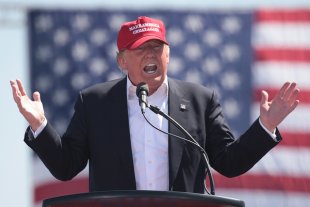

November is fast becoming what the GOP fears: A referendum on Trump

Source: WashPo

Author: Dan Baltz

Emphasis Mine

The hole that Donald Trump has dug for himself keeps getting deeper. On nearly every front, his position continues to deteriorate. Unless he reverses course, Republicans are heading toward a wrenching week at their convention in Cleveland next month, and potentially worse in November.

National polls alone provide an incomplete picture of the current state of the presidential race, but the shifts over the past few weeks should make Republicans beyond nervous.

What looked like a tight contest between Trump and presumptive Democratic nominee Hillary Clinton in late May has morphed into a Trump deficit that cannot be wished away.

The RealClearPolitics poll average now gives Clinton a lead of almost six percentage points over Trump, a marked shift from a month ago. Perhaps even more telling is that every poll on the RCP list that was conducted entirely in June showed Clinton leading. That’s a change from May, when several polls showed Trump leading narrowly.

Given the terrible two weeks Trump has gone through, it is no surprise that the trend line also indicates that Clinton’s lead is widening. The last four polls on the list — all completed in the past week — put her lead at 12, nine, five and six points. Four polls completed earlier in June showed her with leads of three, four, eight and three points. Clinton is not approaching 50 percent in any of these head-to-head polls. With one exception, she is below 45 percent, hardly impressive. But Trump has not broken 40 percent in any of the past seven polls listed on the RCP average. Overall, the average of the recent polls puts Clinton at 44 percent and Trump at 38 percent.

More and better polls from key states will help to clarify the depth of Trump’s problems. Viewed from the angle of the electoral map, the question is: Which states that Mitt Romney lost in 2012 can Trump actually win? And: Are there states Romney won that now could go to Clinton?

One caveat worth noting is that a significant percentage of the population remains undecided, or at least undeclared, in the current polls. A Washington Post-ABC News survey released last week pointed to the reasons. The survey measured only the favorability ratings for the two presumptive nominees, and it was another bleak indicator of the unhappy choice Americans see before them.

Clinton’s favorable rating was just 43 percent — about the same number she is drawing in a ballot test — while her unfavorable rating was 55 percent. Trump’s favorable rating was a crippling 29 percent, with 70 percent of the public saying they have an unfavorable view of him. A majority of adults — 56 percent — said they have a strongly unfavorable view of him, including one-fifth of Republicans.

When the electorate is divided into different population groups, it is even clearer how much trouble Trump has created for himself. Trump’s base during the primaries was among white, working-class voters. But it has become apparent that his real base is among white men. Among white men without a college degree, he’s in positive territory. Among white women without a college degree, he’s not.

Overlooked, perhaps, is Clinton’s image deficit among whites, particularly among white men. Just 23 percent of white men view her favorably, compared with 75 percent unfavorable. But she counters with strongly positive numbers among nonwhites, who are 2-to-1 positive about her.

All of this has put Republicans on edge about November. Trump is frustrated that leading Republicans have not all coalesced behind his candidacy, but without some change on his part, he could be an island of his own in November. Fear of a Clinton presidency remains the lone rationale for many Republicans who otherwise recoil from remarks Trump has made lately.

House Speaker Paul D. Ryan (R-Wis.), who has endorsed but not truly embraced Trump, now says this is a decision of conscience for Republican elected officials. That’s a green light to scatter. The Bush family remains on the sidelines. Ohio Gov. John Kasich, who lost out to Trump for the GOP nomination, says he is not ready to endorse and might be a permanent holdout, even though he will be the host governor at the Cleveland convention. Maryland Gov. Larry Hogan said last week that he would not support Trump.

Some of Trump’s supporters have grown weary trying to defend him. Others who put Trump on notice after he attacked on racial grounds the federal judge overseeing the lawsuit against Trump University have found little since to convince them that the presumptive nominee will meet the standard they would like to see. In fact, after Trump’s attack on Muslims in the aftermath of last Sunday’s mass shooting at the Pulse nightclub in Orlando, he seems further than ever from meeting that test.


The GOP’s Senate majority is at risk. Republicans hope they can insulate vulnerable Senate incumbents from the Trump effect, but that is no easy task. Only a clean break with the presumptive nominee will give those senators the freedom to campaign on their own. Even the most tepid of endorsements would leave them answerable to everything he might say or do over the next four-plus months.

Despite the obvious weaknesses of Clinton as a candidate, her campaign operation is now far better prepared to wage a general-election campaign than is Trump’s. The New York billionaire is looking to outsource many of the mechanics of the campaign to the Republican National Committee. But the fundraising needed to underwrite those operations has been slow. State Republican parties could find themselves strapped for money in the fall.

Republican National Committee Chairman Reince Priebus has been urging holdouts to clamber aboard the Trump train, although he has had limited success in persuading Trump to change his ways. At some point, Priebus may be under pressure to cut loose the candidate at the top of the ticket to save others down the ballot, just as happened in the closing days of the 1996 campaign when the RNC jettisoned presidential nominee Robert Dole in a successful effort to preserve the GOP’s House and Senate majorities.

All of this awaits the two conventions in July. Trump will have the opportunity to stage a successful convention, and party leaders will hope to come out of that week more united than today and with a nominee who looks and sounds more presidential. But Trump prides himself on being politically incorrect and thinks, not without some merit, that he made the experts look foolish during the nominating contest and should continue to trust his instincts.

Under normal conditions, the general election would be a choice between the two major-party nominees — in this case two unpopular nominees. Instead, it looks increasingly as if it could become a referendum on Donald Trump, and right now, that’s the last thing Republicans want this fall.
Dan Balz is Chief Correspondent at The Washington Post. He has served as the paper’s National Editor, Political Editor, White House correspondent and Southwest correspondent.

See: https://www.washingtonpost.com/politics/november-is-fast-becoming-what-the-gop-fears-a-referendum-on-trump/2016/06/18/f942ddd2-34dd-11e6-8758-d58e76e11b12_story.html?wpisrc=fl_election

Most Women Are Crystal Clear About Trump: He Is Their Worst Nightmare

Millions of women see through him, even if the media don’t.

"For the apparel oft proclaims the man,"
“For the apparel oft proclaims the man,”

Source:AlterNet

Author: Ann Jones/Tom Dispatch

Emphasis Mine

Last fall, when presidential wannabe Donald Trump famously boasted on CNN that he would “be the best thing that ever happened to women,” some may have fallen for it. Millions of women, however, reacted with laughter, irritation, disgust, and no little nausea.  For while the media generate a daily fog of Trumpisms, speculating upon the meaning and implications of the man’s every incoherent utterance, a great many women, schooled by experience, can see right through the petty tyrant and his nasty bag of tricks.

By March, the often hard-earned wisdom of such women was reflected in a raft of public opinion polls in which an extraordinary number of female voters registered an “unfavorable” or “negative” impression of the Republican Party’s presumptive nominee.  Reporting on Trump’s “rock-bottom ratings” with prospective women voters, Politico termed the unfavorable poll numbers—67% (Fox News), 67% (Quinnipiac University), 70% (NBC/Wall Street Journal), 73% (ABC/Washington Post)—“staggering.” In April, the Daily Wire labeled similar results in a Bloombergpoll of married women likely to vote in the general election “amazing.” Seventy percent of them stated that they would not vote for Trump.

(N.B.: this continues in mid june – see http://www.alternet.org/election-2016/new-poll-shows-70-percent-voters-hold-unfavorable-opinion-trump?akid=14352.123424.ieuKQ6&rd=1&src=newsletter1058386&t=2)

His campaign manager, Corey Lewandowski, seemed untroubled by such polls, claiming that “women don’t vote based on gender” but on “competency,” apparently convinced that it was only a matter of time before female voters awoke to the dazzling competency of his candidate.

Think again, Mr. Lewandowski. Since at least the 1970s, women have been voting on the basis of gender—not that of the presidential candidates (all men), but their own.  Historically, women and children have been more likely than men to benefit from the sorts of social welfare programs generally backed by Democrats, including Aid to Families with Dependent Children.  Even after, in the 1990s, both parties connived to scale back or shut down such programs, a majority of women stayed with Democrats who advocated positions like equal pay for equal work, reproductive rights, improved early childhood education, affordable health care, universal child care, and paid parental leave—programs of special interest to families of all ethnic groups and, with rare exceptions, opposed by Republicans.

A majority of women have remained quite consistent since the 1970s in the policies (and party) they support. (Among women, loyalty to the Republican Party seems to have fallen chiefly to white Christian evangelicals.) It’s men who have generally been the fickle flip-floppers, switching parties, often well behind the economic curve, to repeatedly vote for “change” unlike the change they voted for last time. The result is a gender gap that widens with each presidential election.

Still, the 2016 version of that gap is a doozy, wider than it’s ever been and growing. Add in another factor: huge numbers of women with “negative” opinions of Donald Trump don’t simply dislike him, but loathe him in visceral ways.  In other words, something unusual is going on here beyond party or policy or even politics — something so obvious that most pundits, busy fielding Trump’s calls and reporting his bluster on a daily basis, haven’t stepped back and taken it in.

Even Hillary Clinton, when she comes out swinging, politely refrains from spelling it out.  In her recent speech on foreign policy, she declared Trump temperamentally unfit to be president: too thin-skinned, too angry, too quick to employ such “tools” as “bragging, mocking, and sending nasty tweets.”  Admittedly, she did conjure up a scary, futuristic image of an erratic bully with a thumb on the nuclear button, describing as well his apparent fascination with and attraction to autocrats like Vladimir Putin and Kim Jong-un.  But she stopped short of connecting the Trumpian dots when she concluded: “I will leave it to the psychiatrists to explain his affection for tyrants.”

In truth, most women don’t need psychiatrists to explain the peculiar admiration of an aspiring autocrat for his role models. Every woman who has ever had to deal with a Trump-style-tyrant in her own home or at her job already has Trump’s number.  We recognize him as a bloated specimen of the common garden variety Controlling Man, a familiar type of Household Hitler.

In fact, Donald J. Trump perfectly fits the profile of an ordinary wife abuser—with one additional twist.  Expansive fellow that he is, Trump has not confined his controlling tactics to his own home(s).  For seven years, he practiced them openly for all the world to see on The Apprentice, his very own reality show, and now applies them on a national stage, commanding constant attention while alternately insulting, cajoling, demeaning, embracing, patronizing, and verbally beating up anyone (including a“Mexican” judge) who stands in the way of his coronation.

Let me be clear.  I’m not suggesting that Donald Trump beats his wife (or wives).  I’m only observing that this year the enormous gender gap among voters can be partially explained by the fact that, thanks to their own personal experience, millions of American women know a tyrant when they see one.

Coercion Codified

The tactics of such controlling men, used not on women but on other men, were first studied intensively decades ago.  In the wake of the Korean War, sociologist Albert Biderman, working for the U.S. Air Force, explored the practices used by Chinese communist thought-reformers to try to break (“brainwash”) American prisoners of war. (Think The Manchurian Candidate.)

He reported his findings in “Communist Attempts to Elicit False Confessions From Air Force Prisoners of War,” a 1957 article that caused the Air Force to change its training tactics.  Following Biderman’s report, that service chose to give its high-risk personnel a taste of those tactics and thereby steel them against the pressure, if captured, of “confessing” to whatever their interrogators wanted. The Air Force program, known as SERE(for survival, evasion, resistance, escape), was extended during the war in Vietnam to special forces in the other U.S. military services.

In 1973, Amnesty International used Biderman’s article, augmented by strikingly similar accounts from political prisoners, hostages, and concentration camp survivors, to codify achart of coercion.”  Organizers in the battered women’s movement immediately recognized the tactics described and applied them to their work with women effectively held hostage in their own homes by abusive husbands or boyfriends. They handed that chart out in support groups at women’s shelters, and battered women soon came up with countless homespun examples of those same methods of coercion in use behind closed doors right here in the U.S.A.

The great feminist organizer Ellen Pence and the staff of the Domestic Abuse Intervention Project (DAIP) in Duluth, Minnesota, worked with battered women to refine and summarize those coercive tactics on a handy circular chart they named the Power and Control Wheel.  Since its creation in 1984, that chart has been translated into at least 40 languages, and DAIP has become the international model for community-based work against domestic violence.

It’s probably fair to say that sometime in the last 30 years just about every survivor of domestic violence in the United States — about one of every three American women — has come across that “wheel.” That works out to more than 65 million women, 21 or older (a figure that doesn’t include millions of young adults who also have been targeted by controlling partners, pimps, traffickers, and the like).

Such survivors of violence against women have taught us a lot more about coercive techniques and their insidious use in what appears to be “normal” life.  We know, for one thing, that a controlling man almost always has a charming, seductive side, which he uses to entice his targeted victims and later displays from time to time, between abusive episodes, to keep them in thrall.

More important, we know that when such controlling tactics are skillfully applied to targeted victims, no violent physical coercion is necessary.  None.  The mind can be bent without battering the body. Hence the term “brainwashing.” When a controlling man inflicts physical force or sexual violence on his victim, the act is a demonstration of the control he has already gained through less visible, more insidious tactics of coercion.

Knowing that, it seems reasonable to assume that plenty of men also recoil from Trump’s tactics for the very reasons women do.  After all, such tactics have also been systematically used by men to control men and when applied to an intimate relationship they may have the same destructive impact on men that battered women report. Men, too, get charmed, coerced, beaten, and raped. In this country, one man out of every seven has been a victim of sexual or physical assault by an intimate partner.  But this is no battle of the sexes.  Whether the victim is female or male, the controlling assailant is almost always a man.

The Tyrant’s Toolkit

So how does a Controlling Man operate?  First, according to Amnesty International’s chart on the “methods of coercion,” he isolates the victim.  That’s easy enough to do if the victim is a prisoner or wife. You’d think it would be harder if the controlling figure is running for president and targeting millions of voters, but television reaches into homes, in effect isolating individuals.  Each of them voluntarily attends to the words and antics of the clownish performer who, with his orangey bouffant do and dangling red tie, stands out so flamboyantly from all the bland suits.  Those prospective voters may have tuned in seeking information about the candidates (or even for entertainment), but what they let themselves in for is a blast of head-on Trumpian coercion.

Second, the controller monopolizes the perception” of the targeted victims; that is, he draws all attention to himself. He strives to eliminate any distractions competing for the viewers’/victims’ attention (think: Jeb, John, Chris, Ted, Carly, and crew), and he behaves with enough inconsistency to keep his potential victims off-balance, focused on him alone, and — whether they know it or not — seeking to comply.

Trump has used such tactics gleefully.  The TV networks, like the media generally, and the Republican establishment thought his candidacy was a joke, yet in the process of publicizing that joke, they gave him an estimated $2 billion in free air time.  Often in those months, as in his post-primary “press conferences,” he was not challenged but awarded endless time to rant and ramble on, monopolizing the perceptions of viewers and networks alike. To justify their focus on him and their relative neglect of all other candidates, the networks cited the bottom line. Trump, they said, made them a lot of money. And they made him a daily inescapable presence in our lives.

All of this Trumpianism can be electrifying, exhausting, and undoubtedly mentally debilitating, which not so coincidentally is the third coercive tactic on Amnesty International’s list. The relentlessness and incoherence of the controller’s harangues tend to weaken a victim’s (or viewer’s) will to resist, and thanks to the media, Trump is everywhere—the big man at the podium always talking at us, always looking at us, always watching us. After that, the rest is easy. Amnesty International lists the tools: threats, degradation, trivial demands, occasional indulgences (a flash of charm, for example, or a bit of the feigned reasonableness that keeps Republican bigwigs imagining that Trump’s demeanor will turn “presidential”). The Power and Control Wheel identifies similar tactics with specific examples of each: using threats, intimidation, emotional abuse, especially put-downs and humiliation (think: low-energy Jeb, little Marco, lyin’ Ted, crooked Hillary), minimizing, denying, and blaming (“I never said that!”), and using male privilege; that is, acting like the master of the castle, and being the one to define men’s and women’s rolesas in “Hillary doesn’t look presidential.”

The battered women who have faced such tactics and survived to tell the tale have taught us this: the controlling man knows exactly what he is doing—even when, or especially when, he appears to be out of control or “unpredictable.” Think of the good cop/bad cop routines you see in any police procedural. The skilled controller plays both parts. One moment he’s Mister Nice Guy: generous, charming, ebullient, entertaining.  The next, he’s blowing his stack, and then denying what’s just happened, or claiming he’s been “misconstrued,” and making nice again. (Think: the saga of “bimbo” Megyn Kelly.)

That seemingly unpredictable behavior is toxic because once you’ve felt an incendiary blast of wrath and scorn, you’re likely to do almost anything to avoid “setting him off” again. But it wasn’t you who triggered him. In fact, the controller sets himself off when it serves his purposes, not yours, and he leaves you scrambling to figure out how to deal with him without setting him off again. (Think of Ted Cruz, Marco Rubio, and Jeb Bush rolling out new approaches at every debate only to be clobbered and humiliated yet again.)

We’ve witnessed so much of this, seen so many coercive tools flung about and so many competitors slinking away that such conduct now passes for normal “political” exchange.  In the current extraordinary electoral process, we have been spectators at the performances of a man skilled in the sort of coercive tactics designed to control prisoners and hostages, and ruthlessly applied to the criminal abuse of women. We have watched that man put those tactics to use in plain sight to vanquish his opponents and force to his side the battered remnants of a major political party and a significant part of the electorate.

Trump has been at it for months on national television — and no journalist, no politician, no Republican Party leader, no contender has named his behavior for what it is. Nobody has called him out—except in the public opinion polls where women voters, millions of whom know the tyrant’s playbook by heart, have spoken. And they said: no.

Ann Jones is a journalist, photographer (Getty Images), and the author of eight books of nonfiction, most recently, They Were Soldiers: How the Wounded Return from America’s Wars—The Untold Story. She writes regularly for the Nation and TomDispatch.com.

See: http://www.alternet.org/election-2016/women-see-through-donald-trumps-act?akid=14353.123424.aGan4V&rd=1&src=newsletter1058409&t=2

Trump is a blessing. Together we should trample his candidacy and rebuild the Democratic Party

“He’s not moving a party to the left,” Volpe said, he’s “moving a generation to the left.”

We The people
We The people

Source: Daily Kos

Author: Meteor Blades

Emphasis Mine

I voted for Bernie Sanders this morning in the California primary. Come November I will vote for Hillary Clinton in the general election. That doesn’t mean I’m giving up on the “political revolution.” On the contrary.

That revolution is not the blood-in-the-streets kind that some stubborn anti-Sanders critics claim is the only kind there is, but rather a non-violent upheaval, a transformation that frees our system of billionaire, white-supremacist governance from the bottom up. Non-violent but never passive. Peaceful but not non-confrontational.

Bernie Sanders will presumably continue to be an important part of that transformation. Nobody, not even Sanders, expected he would succeed as amazingly as he has. Yet he will arrive in Philadelphia with more delegates than any insurgent campaign in a very long time. His campaign’s list of backers contains the names of 2.4 million people who have contributed more than $200 million to his campaign. On social media, he has some 9 million supporters. That’s a potentially powerful base, especially if those on it who were not already politically engaged before the campaign can be persuaded to stay engaged.

But Sanders didn’t initiate the transformation. And it certainly will not end when his candidacy ends, either tonight or next Tuesday in D.C. or in Philadelphia after the formal vote on the nominee is taken at the Democratic Convention.

Occupy Wall Street, Black Lives Matter, LGBTQ activists, 350.org, the Fight for 15, nurses and teachers organizing, the Moral Monday Movement, and Moveon.org arejust a few of the many movement elements of that transformation—some successful, some not, all of them feeling their way along, smeared by media narratives, hindered by internal divisions, and tactically flawed—though their various critics, left and right, have different views on what the specific flaws actually are.

These movement organizations are a big part of transforming both attitudes and policies and thereby the breadth of the national conversation. Without them, Sanders’ candidacy would not have been possible. The campaign built on their hard work, drawing volunteers and staffers from their ranks.

Since the issues that brought forth those movement organizations have not been resolved, they and other newly formed organizations will continue to mobilize people to fight for systemic change. Because the Democratic Party has for so long been moving in a bad direction in several matters, the fight to transform it will continue as well.

But for the next five months, we Sanders, Clinton, O’Malley and none-of-the-above activists have a golden opportunity. Because Donald Trump’s sketchy candidacy can turbocharge our efforts to knock Republicans out of office and reform our own party. However, we’ll have to suppress some of our differences, chill our internecine partisanship, and bite our tongues temporarily to make it happen.

After 50 years of moving the Republican Party ever more rightward, ever more whiteward, the logical extreme has been reached. Donald Trump, carnival barker and snake oil salesman, the first major party candidate about which The New York Times felt the need to discuss the “f” word—fascism—will be the GOP nominee unless he decides he’s tired of the act he’s been performing for the past year and abandons the party at the convention door.

Fascism is not a word to be used lightly. In the 1960s, some on the left practically made a joke of the label, promiscuously attaching it to anybody or any policy they disagreed with. So I’ve always applied it with extreme caution. Nonetheless, while Trump may not mesh perfectly with definitions of fascism, there’s more than a whiff of the brownshirt in his public pronouncements. Those along with his relentless lying, misogyny, racism, anti-Semitism, and general know-nothingism make him a rich target for the kind of devastation Clinton and Elizabeth Warren have dished out recently. A full-bore crushing of his candidacy could inflict collateral damage on the GOP all the way down the ballot.

With wealthy donors saying they won’t support Trump, leading Republicans saying they won’t vote for him, and the candidate’s continual dissing of groups of people from which he might otherwise get at least a few votes, Trump faces an uphill battle against Clinton despite the high percentage of Americans who view her unfavorably.

With that in mind, supporters of Clinton and Sanders and O’Malley should join not merely in defeating but in demolishing Donald Trump’s candidacy and, in the process, damaging the Republican Party in Congress and the state legislatures by hanging the man’s contradictory statements around the necks of every candidate who says they support him. Defeating Republicans who might not otherwise be vulnerable this year can open doors for those desperately needed Democratic Party changes.

Bernie and those of us who support him can do a lot to help deliver this victory.

The senator should spend the months after the convention barnstorming in support of the best candidates, including the dozens that berniecrats.net has identified as being transformationally minded.

Each Sanders supporter should “adopt” a down-ballot candidate, a transformative person running for, say, a state legislative seat. We need to build that deep bench of experience in governing at the local and state levels anyway, and a presidential year like this one could mean significant gains in those arenas. These candidates should get our time, our money, or whatever support we can provide.

Sanders should continue to deliver his galvanizing, vital, and yes, angry message about the perniciousness of concentrated economic power. While Bernie has supporters in all age groups, the most avid are young people, including women and young people of color. If anyone can, he can persuade them not to make the mistake of staying home on election day even if that means many of them feel they must vote with a clothespin firmly in place.

All that, plus Sanders’ effort to get platform concessions passed or promised at the convention, is the inside strategy.

But as reformers have known from the time the Quakers went to Congress in 1790 seeking to end slavery, transformational change requires both an inside and an outside strategy.

Despite the “democratic socialist” label and an endorsement from the Democratic Socialists of America—an organization (full disclosure) of which I have been a member since 1982—Sanders himself is not a socialist, as many observers here and elsewhere have noted for the past year. He is  a social democrat and not even a radical one. The ideas he has pressed forward, like universal health care, paid leave, free college tuition, and a more substantive social welfare system are only radical in the United States.

Those ideas and others have resonated particularly with young people. A Harvard Poll taken in April concluded that political attitudes of American youth have changed in just the past year. John Della Volpe, the polling director, says Sanders is a big reason. “He’s not moving a party to the left,” Volpe said, he’s “moving a generation to the left.”

Several organizations hope to capitalize on that leftward movement and do some moving of their own. Included among them are the Occupy Democrats, the Brand New Congress, the Working Families Party and the People’s Summit, an alliance of National Nurses United and People for Bernie,  which will gather in Chicago June 17 to 19.

On July 23, the day before the Democratic Convention begins, the People’s Convention will get underway in Philadelphia. The organization is developing and ratifying a People’s Platform that Sanders’ delegates will present to the Democratic National Convention. On the group’s website is laid out the intent:

The People’s Convention in Philadelphia [is] a grassroots attempt to reclaim our democracy by uniting behind a common policy framework, rather than a personality or party. Leading up to our first People’s Convention this summer, grassroots organizers from around the country will work together to formulate a People’s Platform: a unifying set of ideas, beliefs, and values that will help define the movement.

This platform will also serve as a critical mechanism to hold elected officials accountable; public representatives who pledge to uphold this platform, but fail to do so through their votes and other public behaviors, will no longer be eligible to seek endorsement or support from The People’s Revolution.

D.D. Guttenplan at The Nation wrote about the Brand New Congress:

Brand New Congress aims to give people a choice—in every district in the country. “Let’s run one campaign to replace Congress all at once (except those already on board) that whips up the same enthusiasm, volunteerism and money as Bernie’s presidential campaign,” says the group’s website. Zack Exley, who was the Wikimedia Foundation’s chief revenue officer before he started traveling the country to lead “Bernie Barnstorms” that trained thousands of volunteers for the Sanders campaign, is one of the group’s founders. They’re targeting the 2018 midterms because, Exley told me, “it takes a while to build the infrastructure to win elections—especially against entrenched incumbents.” The plan is to “recruit a full slate of candidates from people who are not politicians. People who never considered running for office. The majority will be women. A disproportionate number will be people of color. These will be people who are really good at what they do—nurses, engineers, teachers. People who have chances to sell out—but didn’t.”

That prompts lots of questions, beginning with how Brand New Congress can possibly win with progressive candidates in deep-red districts. Exley says the strategy is still up for discussion. And while the group may have set a hugely ambitious goal, I’ve met too many accomplished Sanders organizers in too many states who told me their only contact with campaign headquarters was “a visit from this guy Zack Exley” to dismiss the effort out of hand.

Ramon Ryan, a former organizer for the American Federation of State, County and Municipal Employees who’s been working for Sanders in Nashville, said the campaign taught him “how effective we can be organizing ourselves in our own communities.” Tennessee was another tough environment for Sanders supporters, and after the primary “a lot of us have been struggling to figure out where we fit in,” Ryan says. For him, Brand New Congress—which aims to build on the Sanders network, letting local campaigns run their own show while giving them access to a unified national campaign and national online fund-raising—offers an alternative to surrender or a return to marginality. “We’ve seen how the nature of presidential campaigns has changed from Dean to Obama to Sanders,” Ryan tells me. “We want to take this model and apply it to Congress. I love the simplicity of being able to use one campaign to effect so much change.”

One big argument among left-of-center activists for what seems like millennia has been whether inside or outside strategy is the better approach. To reiterate, they both are essential. Both working in tandem has been the way almost all transformational reforms have been achieved.

Working together now to trample Trump’s campaign and spread the pain to down-ballot Republicans doesn’t mean the struggle to bend the Democratic Party in a better direction is over. That fight is existential, so it will continue.

But calling a truce while we pulverize the Trump candidacy benefits all of us. A Trump victory will harm us all. And not just a little bit. We should deploy this gift Republicans have given us like the wrecking ball it is.


See:http://www.dailykos.com/story/2016/06/07/1534536/-Trump-is-a-blessing-Together-we-should-trample-his-candidacy-and-rebuild-the-Democratic-Party?detail=email&link_id=16&can_id=d57025b8908d671dcc8edc84e5855f8f&source=email-gracefirst-major-anti-trump-ad-is-out-and-it-is-devastating-2&email_referrer=gracefirst-major-anti-trump-ad-is-out-and-it-is-devastating-2&email_subject=grace-first-major-anti-trump-ad-is-out-and-it-is-devastating

Trump Panic on the Right: They’ve Created This Monster—and Some Are Getting More Desperate to Find a Way Out

Hugh Hewitt wants to derail Trump by changing convention rules—but few are brave enough to join his fight.

Photo Credit: DonkeyHotey / Flickr

Source: AlterNet

Author: Heather Digby Parton/Salon

Emphasis Mine

It seems odd that after an overwhelming litany of crude, demagogic insults over the course of the last year, Republican leaders have suddenly recognized that Donald Trump is a racist whose reckless rhetoric is likely to destroy the Republican Party. Evidently, the “Mexicans are rapists” comments in his announcement speech a year ago didn’t ring any alarm bells. But better late than never. Party leaders Mitch McConnell and Paul Ryan both decided they needed to denounce his blatant bigotry, although they made clear it wasn’t a deal breaker. Better an unfit, racist, authoritarian megalomaniac than a Democrat in the White House. You go to Hades with the devil you have, not the devil you wished you had.

There have been a few prominent Republicans who have publicly withdrawn their endorsementsSenator Mark Kirk said he could no longer support Trump because he doesn’t have the temperament to be commander in chief. This has also been obvious for the last 12 months, but again, it’s to his credit that he’s belatedly decided that it’s a disqualifying characteristic. He’s decided to write in the name of General David Petraeus, which he may want to re-think considering the news this week that Petraeus was not only found guilty of “mishandling” classified information by sharing it with his mistress, he also shared Top Secret information with reporters. It’s really tough finding a decent Republican to vote for these days.

Other GOP officials are in various stages of panic, and Trump tried to calm them with his stiff, unconvincing speech on Tuesday night without much success. But he was unrepentant and unimpressed. Before he gave the speech he let the New York Times know exactly what he thinks of his fellow Republicans:

“Politicians are so politically correct anymore, they can’t breathe,” Mr. Trump said in an interview Tuesday afternoon as fellow Republicans forcefully protested his ethnically charged criticism of a federal judge overseeing a lawsuit against the defunct Trump University.

“The people are tired of this political correctness when things are said that are totally fine,” he said during an interlude in a day of exceptional stress in the Trump campaign. “It is out of control. It is gridlock with their mouths.”

All of this has led to a new sense of urgency in the #NeverTrump camp, even though the pipe dream of knocking Trump off his recently acquired throne is as unlikely as ever. Joe Scarborough, formerly a huge Trump booster, was nearly hysterical on Wednesday, saying:

“Donald, guess what, I’m not going to support you until you get your act together. You’re acting like bush-league loser, you’re acting like a racist, you’re acting like a bigot … Until you … prove to me you’re not a bigot and you don’t take my party down in the ditch, you don’t have my endorsement.

It is in your hands on whether you are going to prove to the Republican Party and me personally that you’re not a bigot. Don’t use Hillary Clinton as an excuse, as your blank check to say racist things about [a judge] born in Indiana. No, Donald, you don’t get to play it that way.”

Radio and TV pundit Hugh Hewitt was one of the first right-wing media personalities to expose Trump’s gross lack of knowledge about world affairs when he asked him about the Iranian Quds force on his radio show and Trump clearly had no clue what he was talking about. Nonetheless, Hewitt promised to support Trump if he became the nominee and has stuck with him as he demonstrated his unfitness for office over and over again. But the racist attack on the federal judge has put him over the edge and he is now suggesting that the GOP must do something drastic: change the rules of the convention and give the nomination to someone else. He was so overwrought he exploded with crazed mixed metaphors on Wednesday saying, “it’s like ignoring stage-four cancer. You can’t do it, you gotta go attack it. And right now the Republican Party is facing—the plane is headed towards the mountain after the last 72 hours.”

Trump supporters were not amused…

But if they don’t ban Hewitt from the convention and take his suggestion seriously, which some people seem to be doing, who could possibly step inPaul Ryan, everybody’s favorite blue-eyed dream boat, has said he will not do it. And as noted, he doesn’t believe Trump’s racism—or any other of his pathological personality characteristics—are deal breakers in the first place, so he’s out. Jay Cost of the Weekly Standard wrote an open letter to Mitt Romney to run as an independent, but there’s little reason to think he’d go along with seizing the Republican nomination from Trump at the convention and even less reason to think the delegates would want him to. But there is one possibility that has the political world aflutter: the Great Whitebread Hope himself, Wisconsin Governor Scott Walker. There was a time when he was lauded as the most formidable Republican in the land, a Harley driving, union busting, tax cutting superman destined for the White House. Then he ran for president and showed himself to be a dud of epic proportions. He proved himself to be uninformed, boring and amateurish and ran through his millions in big donor money in record time. By the end of September he was gone, the first of the “Deep Bench” superstars to drop out. Apparently, he’s tanned, rested and ready to rumble. After months of tweeting his lunch orders and informing his followers he got a haircut, he’s back in the game:

And this comment to a Wisconsin radio station sent a frisson of anticipation through the Never Trumpers:

He’s not yet the nominee. Officially that won’t happen until the middle of July, and so for me that’s kind of the timeframe. In particular I want to make sure that he renounces what he says, at least in regards to this judge.

Or else what?

The problem with this scenario is that these elite Republicans are failing to take something very important into consideration: their voters. It’s certainly possible that they are in danger of losing some faction of the party over Trump’s repugnant behavior. But there is little reason to believe it’s a majority. This week, millions of them went to the polls and voted for him even though he had already won the nomination. Granted, he’s not the electoral juggernaut he pretends to be, but he is the legitimate winner of the Republican nomination and his voters will not take kindly to having their wishes ignored.

Moreover, the Republican rank and file doesn’t agree with the premise that Trump is out of bounds in the first place. This YouGov survey done after Trump made his bigoted comments about the judge show 81 percent of Democrats and 44 percent of independents believe they were racist. But only 22 percent of Republicans agree. In other words, 78 percent of GOP voters are just fine with Trump and seem to agree with his statement that “people are tired of this political correctness when things are said that are totally fine.”

Scott Walker’s ill-fated campaign fizzled so early in the primary process that he never faced the voters. His performances in the debates were rated dead last in every poll. The fact that Republicans are contemplating pulling him out of mothballs in the vain hope that he, of all people, will be able to vanquish Trump at the convention is so desperate you almost have to feel sorry for them. But then you remember that they created this monster and deserve what they’re getting. Let’s just hope they don’t somehow manage to take the rest of us down with them.

Heather Digby Parton, also known as “Digby,” is a contributing writer to Salon. She was the winner of the 2014 Hillman Prize for Opinion and Analysis Journalism.


See: http://www.alternet.org/election-2016/trump-panic-right-republicans-try-change-convention-rules?akid=14335.123424.QjsjgV&rd=1&src=newsletter1058084&t=8

How Donald Trump’s Doublespeak Really Works—and Is Highly Calculated

We should dispense with the Republican candidate’s myth of spontaneity.

Source:AlterNet

Author:Mark Peysha

Emphasis Mine

Donald Trump’s speaking style is said to be off the cuff and spontaneous. Far from it. He’s actually using a very sophisticated doublespeak.

One of the obligations of a candidate is to commit to policy solutions. You review a public problem, decide what you will do when in office, and report in detail how you will address the problem. You make yourself accountable for your position.

Instead of doing this, Trump practices what one might call “multiple-choice communication.” Whenever he speaks on a given topic, he gives multiple options on what he might mean.

For instance, at a recent rally in Fresno, Trump stated that, despite five years of low rainfall in California, “There is no drought. They turn the water into the ocean. If I win, believe me, we’re going to start opening up the water so that you can have your farmers survive.”

Now, this is a very confusing statement. What could he mean? Go ahead and choose your answer to this multiple-choice problem. Does Trump mean that:

  1. There never was a drought (perhaps the drought was a myth?)
  2. There was a drought, but it has ended naturally.
  3. There was a drought, but somebody’s fixed it.
  4. There is no drought, because what others call a drought is simply their inability to drain the Sacramento River Delta and use its water for farming.
  5. There is drought, but as president of the United States, Trump will singlehandedly change California water policy. The fact that a huge engineering project, like draining the Sacramento River Delta, is theoretically possible, is the same as there never having been a drought in the first place.

Do you see how many options Trump gives us to believe? Which answer did you choose?

Now imagine some attendees at Trump’s rally. They get to choose their own answers, just like you. Some people simply feel reassured by Trump’s words there is no drought. Whew! What a relief.

Some are farmers who hear Trump say he will send them water. Thank you, Donald Trump!

Some are anti-government and are happy that climate change is a myth. No further government intervention needed. Amen!

Some are pro-government and welcome a huge engineering project. This would destabilize the ecology, the water table, real estate values, and would have countless other consequences. If you want this option, you want heavy government intervention.

These different listeners at the Trump rally are not in agreement on what needs to be done. However, because the speech is given in multiple-choice format, each hears a different promise. It may seem they’re cheering together, but they’re cheering for different results.

Back in the Republican primaries, Trump got massive media coverage by making extreme promises about immigration, trade and religious discrimination. This won him the loyalty of political extremists such as anti-foreigners and white supremacists. At this point in the campaign, Trump needs to expand his share of the American voter base by appealing to more moderate voters. How does he appeal to moderates without losing his early extremist fans? Multiple-choice communication. This enables him to speak separately to the different listeners without changing his tune. He still speaks to the racists. But he now he’s also speaking to the moderates.

Here’s how it works.

At a rally in San Diego Trump spoke publicly about a judge presiding over a lawsuit against Trump University. After calling him a “very hostile judge” and a “hater,” Trump adds, “What happens is the judge, who happens to be, we believe, Mexican, which is great. I think that’s fine.”

In fact, the judge, Gonzalo Curiel, was born in Indiana.

So let’s do the multiple-choice. Which of these is Trump saying?

  1. Anyone who gets in my way, I can single them out in a speech and focus the crowd’s hate on them.
  2. I can single out any American at any time and bring public focus on their ethnic or religious heritage.
  3. I can describe any American as foreign (as “Mexican”) rather than as an American.
  4. My racist fans may follow my lead and also single out other Americans based on their ethnic, cultural or religious heritage.
  5. Judge Curiel’s professional behavior may be based on his being Mexican.
  6. Judge Curiel’s ethnic heritage is up to my approval, and I think it’s great that he is Mexican (even though he’s not Mexican).
    Let’s imagine how this sounds to the different listeners.Say one of the people in the audience is a man named Tim, who is a white supremacist. As he listens, he hears Trump say that this American-born judge is essentially a “Mexican.” Tim thinks, “I can’t believe Trump can say this out loud! A candidate after my own heart.”

    Another listener, Maria, hears this: Anyone who gets in Trump’s way might suddenly be singled out and labeled as a non-American. Especially if you’re “Mexican.” You could lose your citizenship rights. Scary! Keep your head down.

    A third listener, Steve, is a moderate independent who came because he was curious. When he hears Trump saying, “it’s great to be Mexican” he thinks “Gosh, I was worried Trump was a racist. But he says Mexicans are great. I guess he’s not racist.”

    You see, if Trump communicated his proposed policies (build the wall, deport, ban Muslims) like a normal candidate, we would be seeing him as an extremist and as a cruel man. That would not be very fun and would not win more voters. It’s smarter for Trump to court moderates and undecided voters by confusing them with multiple-choice statements.

    Multiple-choice communication is not unique to Donald Trump. You may also have seen it in advertisements, especially when the advertiser doesn’t intend to deliver on their promises. For instance, you may see shampoos that promise men “thicker hair.” Men buy it thinking they will solve their hair loss. Nope. The shampoos make your individual hairs thicker, but don’t stop hair from falling out. The shampoo maker knows customers will make this mistake, but it’s not false advertising. You simply heard the wrong option.

    The problem, of course, is that people at a Trump rally each leave having heard a different promise. And if Trump should become president, there is no way he can fulfill all of those different expectations. Which reminds us that the people who would be most let down by a Trump presidency are the people who believe in what he says.


    Mark Peysha is CEO and cofounder of the Center for Strategic Intervention.

    Judge Curiel’s professional behavior may be based on his being Mexican.Judge Curiel’s ethnic heritage is up to my approval, and I think it’s great that he is Mexican (even though he’s not Mexican).

See:http://www.alternet.org/election-2016/how-donald-trumps-doublespeak-really-works-and-highly-calculated?akid=14327.123424.GhGgOG&rd=1&src=newsletter1057871&t=2

Trump’s Massive Mendacity: How Fox News and the Right Gutted the Truth for ‘The Donald’

Mendacity
Mr. Mendacity


Source: AlterNet

Author:Paul Rosenberg

Emphasis Mine

With Donald Trump’s ascension as the GOP’s presidential nominee, we’ve clearly entered a new stage, and as usual this election cycle, it’s happening much more rapidly and in ways that have caught media and political elites by surprise. But how we got here and what lies ahead share much more in common than most are willing to admit, most pointedly, the extent to which the media and the GOP have created the Trump candidacy—despite all their professions of dismay—by decades of devaluing objective reality.

A classic book on this subject is Mark Hertsgaard’s On Bended Knee: The Press and the Reagan Presidency. In an early passage about the GOP’s role in the abandonment of reality, he wrote:

Leslie Janka, a deputy White House press secretary, who resigned in protest after the administration excluded the press from the Grenada invasion, went so far as to say, “The whole thing was PR. This was a PR outfit that became President and took over the country. And to the degree then which the Constitution forced them to do things like make a budget, run a foreign policy and all that, they sort of did. But their first, last and overarching activity was public relations.

As for the media’s role, Hertsgaard interviewed more than 150 journalists and news executives, most of whom “rejected the idea that Ronald Reagan had gotten a free ride from U.S. news organizations,” he noted, “But this self-absolution by members of the press was contradicted by none other than the Reagan men themselves…. ‘I think a lot of the Teflon came because the press was holding back,’ said [Reagan’s Director of Communications] David Gergen. ‘I don’t think they wanted to go after him that toughly.’”

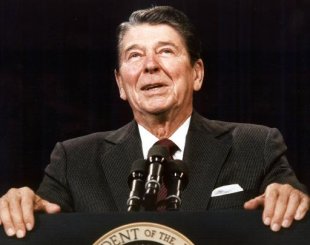
The book presents wide-ranging evidence of precisely how this came about. A classic example was Reagan’s Star Wars missile defense program, which he claimed would render nuclear weapons “impotent and obsolete,” an example of “politics as theater taken beyond the absurd…. Had Reagan bothered to ask he would have found that not one of his senior advisers shared his simple minded faith that SDI would protect American people and cities from nuclear ruin. Reagan’s dream of a leakproof nuclear umbrella was a fantasy, and all the King’s men knew it.” Yet, to this very day, the media has never accurately reported how utterly impossible the Star Wars promise was.

But that was three decades ago. In the years since—from the imaginary Whitewater scandal during the Clinton Administration to Iraq’s imaginary WMDs during Bush—the GOP and the media together have created the perfect environment for Trump, a man for whom “everything is negotiable” applies quite literally to the very notion of objective reality itself.

Some in the media understand that something is wrong. Last December, PolitiFact noted that, “In considering our annual Lie of the Year, we found our only real contenders were Trump’s — his various statements also led our Readers’ Poll. But it was hard to single one out from the others. So we have rolled them into one big trophy” and thus awarded is “2015 Lie of the Year” to “the campaign misstatements of Donald Trump.”

And Factcheck.org’s year-end roundup reached a similar conclusion, designating Trump “King of Whoppers,” as it explained:

It’s been a banner year for political whoppers — and for one teller of tall tales in particular: Donald Trump.

In the 12 years of FactCheck.org’s existence, we’ve never seen his match.

He stands out not only for the sheer number of his factually false claims, but also for his brazen refusals to admit error when proven wrong….

In past years, we’ve not singled out a single claim or a single person, and have left it to readers to judge which whoppers they consider most egregious.

But this year the evidence is overwhelming and, in our judgment, conclusive. So, for the first time, we confer the title “King of Whoppers.”

More recently,  in late March, the Washington Post’s fact check editor, Glenn Kessler, collected all of Trumps “four Pinocchio” lies in one place, expressing a similar sentiment:

There’s never been a presidential candidate like Donald Trump — someone so cavalier about the facts and so unwilling to ever admit error, even in the face of overwhelming evidence. At last count, 67 percent (26 of 39) of our rulings of his statements turned out to be Four Pinocchios, our worst rating. By contrast, most politicians tend to earn Four Pinocchios 10 to 20 percent of the time. (Moreover, most of the remaining ratings for Trump are Three Pinocchios.)

As a reader service, here’s a running list of our Four Pinocchio rulings. Since Trump never takes anything back — and often repeats the same false claims — voters are likely to hear these time and again during the campaign season.

The problem with all this recognition of Trump’s mendacity is just how little difference it seems to make—and how clueless the press itself remains regarding what to do about it. They seem to understand little or nothing about how the situation came about over time, what they are doing wrong right now, or what they ought to be trying to achieve going forward.

Trying to knock down Trump’s lies one at a time is a fool’s errand. It’s like trying to cut the head off of the hydra; for every lie you chop down, two new ones take its place. You have to step back and grasp the full magnitude of his lying, how he kneads together a whole multitude of lies into a single narrative, one which he then quickly casts off the moment it becomes advantageous to abandon it in favor of something else—possibly even the exact opposite of what he had been arguing the moment before.

Perhaps the best way to understand him is simply as a salesman. There are no objective facts where he comes from, just selling points. And the only thing he’s really ever selling is himself.  Whatever dream or desire you may have, he is the answer to what you want. As I argued back in December, he does not lie so much as bullshit, in the sense of H.G. Frankfurt’s book “On Bullshit”:

[B]ullshitters seek to convey a certain impression of themselves without being concerned about whether anything at all is true. They quietly change the rules governing their end of the conversation so that claims about truth and falsity are irrelevant.

That doesn’t mean he doesn’t lie, however. He’s simply indifferent to whether what he says is true or not. Which is why he lies so easily and excessively, even without concern if the lie has already been publicly debunked. The ideal bullshitter could pass a lie-detector test no matter what he said, which seems to capture Trump perfectly.  It can help, of course, to recognize his lies. But it’s much more useful to recognize what he’s trying to accomplish with them—or with the sprinkling of truths he freely intermingles with them. First, he’s trying to free himself of any possible accountability to anyone else: If facts themselves are negotiable, no one can call him to account for lying; he is free to define reality in any way that suits him. Second, the ultimate purpose of freeing himself, and defining reality as he wishes, is to establish dominance over everyone else: He is interested in power, pure and simple.  Some examples can help to clarify both of these goals.

When it comes to freeing himself of accountability, it’s useful to think of some of Trump’s common verbal tropes, such as “hearing” that Obama wants to confiscate guns, or to admit 200,000 Syrian refugees, or making vague claims about sourcing advice, praise or even resentful admiration from “experts” or “really smart people”—for example, falsely claiming that “Many of the great scholars say that anchor babies are not covered” by the 14th Amendment, or his widely reported, but nonexistent investigative team he sent to Hawaii to research Obama’s birth certificate. “I have people that have been studying it and they cannot believe what they’re finding,” Trump told Today Show‘s Meredith Vieira on April 7, 2011. On April 25 he told CNN’s Anderson Cooper that “somebody” he refused to identify told him “it’s not there and it doesn’t exist.” Two days later, Obama released his long-form birth certificate, and we never heard of Trump’s “investigation” again. Why? Because it never existed. It was all bullshit, from top to bottom. But it was always phrased in a way to free Trump of ever having to prove anything. The flip side of Trump’s imaginary experts and investigators is his habit of saying “nobody knows” about things that actually are well known — such as whether our nuclear arsenal works (it does), or who Syrian refugees are, perhaps even ISIS! (actually we do), or where Obama was before his public life, expanding on his trademarked birtherism. “He grew up and nobody knew him. You know? …. Nobody knows who he his until later in his life. It’s very strange,” Trump said. “The people that went to school with him, they never saw him, they don’t know who he is. It’s crazy.” Except, they do. From grade school through college. It’s Trump who is crazy—100 percent wrong about everything.

Similarly, Trump likes to say that various good or bad things “never happened before,” such as his winning 66 of 67 counties in the Florida primary (Bush and Gore both swept the state in 2000), or having GDP growth under zero (which has happened 42 times since WWII). No doubt he has “experts” who research these things for him, too!

Trump’s entire existence is one of ceaseless exaggeration, which appears repeatedly in these sorts of statements, often overshadowed by other considerations—the fact checks above focus on the 14th Amendment, or the nuclear arsenal, rather than on Trump’s imaginary “great scholars” or who Trump was talking about when he said, “They don’t know if it works.” Cogent—if mistaken—arguments could be made on any of these subjects, based on genuine, specifically cited expert testimony, for example, or specific individuals who could credibly contradict Obama’s life story, or a list of past county-level election results. But Trump is not even remotely interested in making such arguments. He holds them in contempt. However, he is interested in having people take him seriously, because if they all laugh, he can never gain power—which is why we ought to be paying attention to his routine reliance on wild overgeneralizations and hyperbolic, anonymously sourced claims and accusations that go along with them. They represent the soft underbelly of all his extravagant lying. Just imagine an 8-year-old saying these same sorts of things. You’d immediately spot him as a bullshitter, regardless the specifics he was talking about.

Trump’s interest in being taken seriously is only a means to an end, of course. And that end is power, pure and simple. Trump’s politics may have morphed dramatically over time, but his interest in power has not. The core of what he’s up to is a struggle for personal power, and all his lies, all his bullshitting are most fundamentally explicable when viewed in terms of who he’s going after and why. Focusing on the lies themselves, rather the purpose that Trump is pursuing, will only generate longer and longer lists of things that Trump and his supporters will ignore. If they can ignore 30 things, then why not 300? Or 3,000? But if you look to what his game is, then you’ve got a chance to get a foothold in confronting him in terms of that very same game.

Take, for example, Trump’s recent refusal to release his taxes, on the grounds that he’s being audited. “I would love to give the tax returns. But I can’t do it until I’m finished with the audit,” he said on Meet the Press. But this claim is utterly bogus, as the IRS pointed out back in February: the IRS can’t so much as comment, but there’s no reason Trump needs to hold back anything. If he’d love to give his tax returns, go right ahead! Then Buzzfeed reminded everyone of another lie baked into this little charade: Trump had promised to release his taxes in 2011—and tied that promise to Obama releasing his birth certificate. Of course, Obama did release his birth certificate shortly after that, and Trump, being Trump, never did release his taxes—though he did promise to release them “at the appropriate time,” another habitual Trump obfuscation.

We could go deep into the detail of how Trump is lying about releasing his taxes—in fact, I’m about to say a bit more about that. But the most important thing is to keep focused on his struggle for power: Why is he lying, rather than simply releasing his taxes, like everyone else? The two most sensible points to make are (1) he’s got something to hide—very low tax rates, unsavory associations, whatever—which he thinks would be very damaging, and (2) he thinks he’s better than anyone else, so he doesn’t have to play by the rules. These are important points to focus on because they deal with his obsession for power.

We can see that obsession in action if we take a closer look back at that earlier episode Buzzfeed called attention to. Trump’s promise then emerged as part of a series of Trump-imagined tests of strength and dominance, which he sketched out over the course of a few minutes in an interview with George Stephanopoulos, first versus NBC, then versus President Obama, and finally versus Mitt Romney. While Buzzfeed linked to a condensed presentation on The View, the full interview in context [transcript] allows us to see how Trump strings together this series of different bullshit narratives, each of which served him well in the moment, which is all he seemed to care about. He lied repeatedly—but always in the service of portraying himself in command.

Stephanopoulos first asked about Trump’s plans to announce if he’d run for president, and Trump responded by chest-thumping over how distressed this was making NBC, as a way to build himself up while simultaneously explaining away his refusal to commit:

I have the number one show on NBC. The Apprentice, The Celebrity Apprentice. And they are not happy about it. And I’ll be honest with you, NBC wants to renew anything I want to do. They’ll do anything for me. Anything….

So, the head of NBC and all of the people at NBC are working very, very hard on me. “Donald, we’ll give you anything. We’ll do anything you want to do. One year, two years, three years. Please, whatever you want to do.”

Not exactly. Celebrity Apprentice was NBC’s fifth-rated show that season so far (#44 overall and #36 in the 18-49 demographic), and was way past its peak popularity. The initial incarnation of The Apprentice ranked 7th, 11th and 15th its first three seasons, and then dropped out of the top 30, never to return. It fell to 75th in  2006-07, after which it was replaced by Celebrity Apprentice, which ranked 48th in 2007-2008, and in the 50s the next two seasons. It was ranking modestly better in 2011, but after all Trump’s pretense of magnanimity for NBC in delaying his decision, his grandstanding and taunting of President Obama helped drag the show’s ratings down. At the end, it was reported:

Pulling in a rather paltry 2.9/7 share in the coveted 18-49 demo, the episode proved to be the lowest spring finale ever for The Apprentice, Celebrity or otherwise.

Next comes the tax returns-for-birth-certificate quid pro quo, sandwiched between this initial act of preening vis-à-vis NBC and another act of preening vs. Mitt Romney. Here’s how Trump presented it:

Trump: … I give up a lot if I run. A thing like that, I also give up a lot of my free, private life. I have a great company. I’ve done a great job. Which if I run, you’ll see what a great job. Because I’ll do a full disclosure of finances.

(OVERTALK) [Stephanopoulos: Including your tax returns?]

Trump:We’ll look at that. Maybe I’m going to do the tax returns when Obama does his birth certificate. I may tie my tax returns. I’d love to give my tax returns. I may tie my tax returns into Obama’s birth certificate.

Note how Trump says two directly contradictory things, back to back. First, that he’d “ love to give my tax returns,” and then that he “may tie my tax returns into Obama’s birth certificate.” So which is it? Something he’d love to do? Or something he’ll do only in exchange for something else?

It’s an absurd offer on its face. Every presidential candidate in the post-Watergate era has disclosed their tax returns. It’s what you do. No president had ever been asked to produce a long-form birth certificate. Trump asserts his dominance over Obama by making an absurd demand, and insisting that it be taken seriously as a normal political transaction. He even pretends he’s being generous, further posturing himself as superior to Obama. For Trump, the promise of releasing his tax returns only matters as part of this mini-drama. Once the drama is finished, it’s on to the next one.

After a brief interlude of preening and self-praise for building “a great company,” “a strong company,” “an under-levered company,” with “tremendous net worth, far greater than even numbers that you’ve read,” Trump turns to contrasting himself with Mitt Romney, after prompting from the host:

Stephanopoulos: You took on Mitt Romney, you said it [Trump’s net worth] was bigger than Mitt Romney’s.

Trump: Well, it’s many times bigger, but that’s nothing bad about him. By the way, I have respect for Mitt Romney. I don’t know him, but I have respect for him. The fact that my net worth is many, many, many times greater, I’m not knocking him. You know, it comes off like it’s a knock. It’s not a knock. I have respect for Mitt Romney.

Of course Trump is knocking Romney!  Why else make the comparison in the first place? And by claiming that he’s not knocking him, Trump only twists the knife even further. That’s just how he rolls. It’s all about finding the right angle to attack someone, and then building layer upon layer on the original attack. Facts have no more role in the matter than they do in a schoolyard fight.

Which is why Trump really doesn’t seem the least bit concerned that as part of this series of put-downs he said, “I’d love to give my tax returns,” or that he proposed tying their release to Obama’s birth certificate. Whatever he said yesterday—or even a minute ago—forget about it. Five years ago? You’ve got to be kidding! Facts are negotiable, like everything else. Power is the only thing that matters.

This is what Trump is. This is how he operates. It’s why he ran the sort of primary campaign he did—a campaign characterized by a series of vicious attacks on other candidates as they appeared to pose a threat to his advancement. Facts do not matter to him—why should they? They only get in his way. They are perhaps his most persistent enemies. But facts matter enormously to the health and survival of a democratic republic. Without them, ruination is assured. There is no such thing as a post-truth republic. It’s time that the press woke up from its decades-long slumber that began with Ronald Reagan. They’ve got a lot of lost ground to make up, before it’s too late.

Paul Rosenberg is a California-based writer/activist, senior editor for Random Lengths News, and a columnist for Al Jazeera English. Follow him on Twitter at @PaulHRosenberg.

see:http://www.alternet.org/election-2016/trumps-massive-mendacity-how-fox-news-and-right-gutted-truth-donald?akid=14285.123424._F2ujT&rd=1&src=newsletter1056976&t=10

Robert Reich: Hillary Needs to Win Over Bernie’s Voters Because Trump Is a ‘Menace to Society’

“It’s hard for me to imagine what appeal Donald Trump has for anybody, quite frankly.”

Source: AlterNet

Author: Tom Boggloni/raw story

emphasis mine

Appearing on MSNBC, former Clinton-era Labor Secretary Robert Reich cautioned that Hillary Clinton is going to need to do something to attract Bernie Sanders’ voters if she has any chance to beat Donald Trump, whom he called the “most dangerous presidential candidate we’ve had.”

“At the end of the day, there has got to be a unified Democratic Party, ” Reich told host Steve Kornacki. “But there is still a way to go to the convention, and even if Hillary Clinton is assumed or presumed candidate, if her polls keep falling, if her polls show Bernie Sanders is much stronger against Donald Trump, well, we don’t know. There are so many Bernie Sanders supporters who tell me, who’ve been trying to tell them [the superdelegates] to support the nominee, whoever the nominee is, that they’re not going to vote for Hillary Clinton, then Hillary Clinton is going to definitely do something to get the Bernie Sanders voters.”

Asked if Sanders voters would “see any appeal” in voting for Trump instead, Reich dismissed the idea but added that they might avoid Clinton too.

“It’s hard for me to imagine what appeal Donald Trump has for anybody, quite frankly,” Reich replied. “I think he is a menace to society. I think he’s the most dangerous presidential candidate we’ve had proposed by any major political party in American history. And yet, I’m reading these emails, I get a huge number of emails and Facebook mentions of notices of people, and a lot of Bernie supporters tell me they will not, under any circumstances, vote for Hillary Clinton.”

“I think they’re wrong,” he continued. “But I think, to me, that is just evidence that Hillary Clinton is going to have to work very, very hard to get Bernie supporters behind her. And she’s got to get Bernie supporters behind her if she’s going to win this thing.”

See:http://www.alternet.org/election-2016/robert-reich-hillary-needs-win-over-bernies-voters-because-trump-menace-society?akid=14323.123424.W5XUWf&rd=1&src=newsletter1057755&t=27


Conservative David Frum Perfectly Explains How the Disintegration of the GOP Has Created Trump

David Frum unravels how rot within the GOP allowed Donald to break norms of behavior democracy needs to function.

Source:AlterNet

Author: Heather Digby Parton/Salon

Emphasis Mine

The Trump phenomenon is presenting Republicans with one of those once in a lifetime gut checksdo you fall in line behind someone who is obviously unfit for the office of president or do you tell the truth as you see it and risk the disapprobation of your peers and the possible banishment to political Siberia? Even though the truth of the matter is obvious, I don’t think it’s fair to say that it would be easy for anyone. To lose your place in the political ecosystem can be emotionally painful and professional very risky. The path of least resistance is to go with the flow. If Trump loses you will have a lot of company. If he wins, well, you’ll have to live with your own conscience as to the consequences. But either way, the people who stood against him will always be resented for their courage by those who went along.

There are mainstream Republicans who are opting out, more than people may realize. The Stop Trump Movement boasts some major players in the GOP scene, people like Mitt Romney, George Will, Erick Erickson, David Brooks and Glenn Beck to name just a few. Some are attempting to salvage their futures by contending that Trump is unacceptable only because he is a traitor to conservatism, which he is in some ways although that is hardly the primary case against him. The more valiant among them take the threat of Trump seriously and are willing to admit the truth, such as Bret Stephens of the Wall Street Journal who told Fareed Zakaria over the weekend:

“I most certainly will not vote for Donald Trump. I will vote for the least left wing opponent to Donald Trump and I will want to make a vote that will make sure he is the biggest loser in presidential history since Alf Landon or going back further. It’s important that Donald Trump and what he represents, this ‘ethnic conservatism or populism’ be so decisively rebuked that the Republican party and Republican voters will forever learn their lesson that they cannot nominate a man so manifestly unqualified to be president in any way shape or form.”

Stephens is a traditional ideological conservative who could rail against Trump’s defense of Social Security or his anti-free trade tirades if he chose to. But except for a passing reference to “populism” Stephens indicts Trump on the right grounds: his manifest unfitness for the job. Finally, here’s something that

liberals and conservatives can agree upon.

There are a few conservatives who saw the disintegration of their party coming for quite a while, notably conservative writer and former Bush speechwriter David Frum who has been committing apostasy for several years now. He wrote a thought-provoking piece for The Atlantic this week in which he documents how Donald Trump has broken seven standards and norms of behavior that make it possible for democracy to function.

The first broken norm is the most obvious. The idea that America’s presidents should behave with maturity and self-restraint is a standard that most of us take for granted. Sure, they have all had different personalities but basic respect for the office and basic civility has been a given. For instance, presidential candidates have not, up until now, called their rivals pussies on the stump. Frum refers to Mitt Romney’s righteous rant against Trump from several months ago in which he said, “think of Donald Trump’s personal qualities, the bullying, the greed, the showing off, the misogyny, the absurd third grade theatrics…” That’s Trump to a T. And until now that would not have been a constellation of personality characteristics that one would think of as presidential.

He next points out Trump’s unusual untrustworthiness making a very important point in the process. He notes that the GOP base holds establishment leaders in contempt for their alleged failure to fulfill the mandate they were given when they won a majority in the two midterm elections. Frum writes:

“As one unfriendly critic noted, the Republican rank-and-file weren’t exactly innocent victims of elite deception. Republican voters … wanted everything, and, after all, GOP leaders promised them that it was possible—even though those same leaders knew it was not.

Place the blame for that failure where you will, however, the results were glaring: radical Republican rejection of the trustworthiness of their leaders—all their leaders.What, then, was one liar more—especially if that liar were more exciting than the others, more willing to say at least some of the things that Republicans wanted said?”

They are responding to a man who says:

“Politicians have used you and stolen your votes. They have given you nothing. I will give you everything. I will give you what you’ve been looking for for 50 years. I’m the only one.”

The next norm that’s been broken is “the expectation that a potential president should possess deep—or at least adequate—knowledge of public affairs.” It goes without saying that Donald Trump winning the GOP nomination proves that this is no longer considered necessary by a majority of Republican voters. He is, as was pointed out above, manifestly unqualified and has absolutely no intention of learning anything because he doesn’t need to.

Frum next points out that the Republican ideological standard has completely evaporated which is of greater concern for conservatives than the rest of us but his analysis of how this happened is quite interesting:

“The ideology guardrail snapped because so much of the ideology itself had long since ceased to be relevant to the lives of so many Republican primary voters. Instead of a political program, conservatism had become an individual identity. What this meant, for politicians, was that the measure of your ‘conservatism’ stopped being the measures you passed in office—and became much more a matter of style, affect, and manner.”

No one exemplified this better than Frum’s old boss George W. Bush, the man everyone celebrated as presidential perfection because he was the kind of guy you wanted to have a beer with. But Trump has proved that ideology no longer matters at all to most Republicans, which does come as something of a surprise. Even the social conservatives seem to have completely given up the ghost.

Another shattered norm, and it’s a big one, is the blithe acceptance of Trump’s total lack of coherent national security worldview. The fact that he is not a familiar neocon or a practitioner of Real Politic would be disorienting for Republicans regardless, but calling his turn to belligerent nationalism “America First” is downright hallucinatory.

Frum believes Trump has broken the norm against intolerance and it’s true that his crusade against “political correctness” and the open racism and religious bigotry are at levels we haven’t seen in decades. After surveying all the data which shows that the white ethnic tribalism we’re seeing on the right at the moment is a result of backlash against changing demographics, he writes:

“Trump is running not to be president of all Americans, but to be the clan leader of white Americans. Those white Americans who respond to his message hear his abusive comments, not as evidence of his unfitness for office, but as proof of his commitment to their tribe.”

Finally, Frum bemoans the harsh partisanship that leads otherwise normal people like Marco Rubio, after having denounced Trump for months as a vulgar con man, cozy up to Trump using the ludicrous rationale that he’s “even more scared about her [Clinton] being in control of the U.S. government.” That’s ridiculous and on some level Rubio knows this. Clinton is fully in the mainstream of American politics along with Barack Obama, both Bushes and Bill Clinton. Trump is not. But as is their wont, the right wing is projecting their own extreme deviation from the norm on to their opposition and their leaders are dutifully following along.

Frum’s trying to figure all this out and he’s digging deeply to do it. In fact, he’s been doing this for some time as one of the few insiders who have been clear-eyed about the destruction of the conservative movement and the Republican Party over the past few years even before the appearance of Donald Trump. And he’s right about all of this. This disconcerting breaking of the norms that make democratic governance possible has reached a critical stage.

What started with the cynical propaganda projects of Newt Gingrich to the ’90s witchhunts and the dubious tactics of the long election of 2000 metastasized into the Tea Party which was born out of a belief that Barack Obama was an illegitimate president and anything he proposed was therefore invalid. Donald Trump was in the middle of that as the King of the Birthers, the man who mainstreamed the formerly fringe conspiracy theory that the president wasn’t born in America. And now that man is the Republican nominee for president.

In order for democracy to function you cannot depend entirely on the laws to enforce it. It requires a common understanding and acceptance of the rules and norms developed over a long period that guarantee a certain level of civilized interaction. We’re losing them and the consequences could be very serious. Trump may lose this election and there will be some kind of reset. But even if he does, these rules and norms are very difficult to put back in place once they’ve been tossed aside. It may not happen, which raises the rather chilling question of what will be left in his wake.”

Heather Digby Parton, also known as “Digby,” is a contributing writer to Salon. She was the winner of the 2014 Hillman Prize for Opinion and Analysis Journalism.


See:http://www.alternet.org/election-2016/how-disintegration-gop-created-trump?akid=14316.123424.3WWhU9&rd=1&src=newsletter1057551&t=10


Trump Advisor Roy Cohn

 Sen. Joseph McCarthy covers the microphones with his hands while having a whispered discussion with Roy Cohn, his chief counsel, during a committee hearing on April 26, 1954, in Washington. | AP Photo

Sen. Joseph McCarthy covers the microphones with his hands while having a whispered discussion with Roy Cohn, his chief counsel, during a committee hearing on April 26, 1954, in Washington. | AP Photo

Source:Politico.com

Author: Michael Kruse

Emphasis Mine

The reporter from the Washington Post didn’t ask Donald Trump about nuclear weapons, but he wanted to talk about them anyway. “Some people have an ability to negotiate,” Trump said, of facing the Soviet Union. “You either have it or you don’t.”

He wasn’t daunted by the complexity of the topic: “It would take an hour and a half to learn everything there is to learn about missiles,” he said.

It was the fall of 1984, Trump Tower was new, and this was unusual territory for the 38-year-old real estate developer. He was three years away from his first semi-serious dalliance with presidential politics, more than 30 years before the beginning of his current campaign—but he had gotten the idea to bring this up, he said, from his attorney, his good friend and his closest adviser, Roy Cohn.

That Roy Cohn.

Roy Cohn, the lurking legal hit man for red-baiting Sen. Joe McCarthy, whose reign of televised intimidation in the 1950s has become synonymous with demagoguery, fear-mongering and character assassination. In the formative years of Donald Trump’s career, when he went from a rich kid working for his real estate-developing father to a top-line dealmaker in his own right, Cohn was one of the most powerful influences and helpful contacts in Trump’s life.

Over a 13-year-period, ending shortly before Cohn’s death in 1986, Cohn brought his say-anything, win-at-all-costs style to all of Trump’s most notable legal and business deals. Interviews with people who knew both men at the time say the relationship ran deeper than that—that Cohn’s philosophy shaped the real estate mogul’s worldview and the belligerent public persona visible in Trump’s presidential campaign.

“Something Cohn had, Donald liked,” Susan Bell, Cohn’s longtime secretary, said this week when I asked her about the relationship between her old boss and Trump.

By the 1970s, when Trump was looking to establish his reputation in Manhattan, the elder Cohn had long before remade himself as the ultimate New York power lawyer, whose clientele included politicians, financiers and mob bosses. Cohn engineered the combative response to the Department of Justice’s suit alleging racial discrimination at the Trumps’ many rental properties in Brooklyn and Queens. He brokered the gargantuan tax abatements and the mob-tied concrete work that made the Grand Hyatt hotel and Trump Tower projects. He wrote the cold-hearted prenuptial agreement before the first of his three marriages and filed the headline-generating antitrust suit against the National Football League. To all of these deals, Cohn brought his political connections, his public posturing and a simple credo: Always attack, never apologize.

“Cohn just pushed through things—if he wanted something, he got it. I think Donald had a lot of that in him, but he picked up a lot of that from Cohn,” Bell said.

“Roy was a powerful force, recognized as a person with deep and varied contacts, politically as well as legally,” Michael Rosen, who worked as an attorney in Cohn’s firm for 17 years, told me. “The movers and shakers of New York, he was very tight with these people—they admired him, they sought his advice. His persona, going back to McCarthy … and his battles with the government certainly attracted clients.”

It was a long, formidable list that included the executives of media empires, the Archbishop of New York and mafia kingpin Fat Tony Salerno, and there, too, near the top, was budding, grasping Donald John Trump.

“He considered Cohn a mentor,” Mike Gentile, the lead prosecutor who got Cohn disbarred for fraud and deceit not long before he died, said in a recent interview.

People who knew Cohn and know Trump—people who have watched and studied both men—say they see in Trump today unmistakable signs of the enduring influence of Cohn. The frank belligerence. The undisguised disregard for niceties and convention. The media manipulation clotted with an abiding belief in the potent currency of celebrity.

Trump did not respond to a request from Politico to talk about Cohn. In the past, though, when he has talked about Cohn, Trump has been clear about why he collaborated with him, and admired him.

“If you need someone to get vicious toward an opponent, you get Roy,” he told Newsweek in 1979.

A year later, pressed by a reporter from New York magazine to justify his association with Cohn, he was characteristically blunt: “All I can tell you is he’s been vicious to others in his protection of me.”

He elaborated in an interview in 2005. “Roy was brutal, but he was a very loyal guy,” Trump told author Tim O’Brien. “He brutalized for you.”

Trump, in the end, turned some of that cold calculation on his teacher, severing his professional ties to Cohn when he learned his lawyer was dying of AIDS.

Cohn and Trump, according to Trump, met in 1973 at Le Club, a members-only East Side hangout for social-scene somebodies and those who weren’t but wanted to be.

By then Cohn had been in the public eye for 20 years. As chief counsel to McCarthy, he led secretive investigations of people inside and outside the federal government whom he and McCarthy suspected of Communist sympathies, homosexuality or espionage. Over a period of several years, McCarthy’s crusade destroyed dozens of careers before a final 36-day, televised hearing brought his and Cohn’s often unsubstantiated allegations into the open, leading to McCarthy’s censure in the Senate. Cohn, disgraced by association, retreated to his native New York.

There, through the ‘60s and into the ‘70s, Cohn embraced an unabashedly conspicuous lifestyle. He had a Rolls-Royce with his initials on a vanity plate and a yacht called Defiance. He was a singular nexus of New York power, trafficking in influence and reveling in gossip. He hung on the walls of the East 68th Street townhouse, that doubled as the office of his law firm, pictures of himself with politicians, entertainers and other bold-face names. He was a tangle of contradictions, a Jewish anti-Semite and a homosexual homophobe, vehemently closeted but insatiably promiscuous. In 1964, ’69 and ’71, he had been tried and acquitted of federal charges of conspiracy, bribery and fraud, giving him—at least in the eyes of a certain sort—an aura of battle-tested toughness, the perception of invincibility. “If you can get Machiavelli as a lawyer,” he would write in The Autobiography of Roy Cohn, “you’re certainly no fool of a client.”

Trump was 27. He had just moved to Manhattan but was still driving back to his father’s company offices in Brooklyn for work. He hadn’t bought anything. He hadn’t built anything. But he had badgered the owners of Le Club to let him join, precisely to get to know older, connected, power-wielding men like Cohn. He knew who he was. And now he wanted to talk.

He and his father had just been slapped with Department of Justice charges that they weren’t renting to blacks because of racial discrimination. Attorneys had urged them to settle. Trump didn’t want to do that. He quizzed Cohn at Le Club. What should they do?

“Tell them to go to hell,” Cohn told Trump, according to Trump’s account in his book The Art of the Deal, “and fight the thing in court.”

That December, representing the Trumps in United States v. Fred C. Trump, Donald Trump and Trump Management, Inc., Cohn filed a $100-million countersuit against the federal government, deriding the charges as “irresponsible” and “baseless.”

The judge dismissed it quickly as “wasting time and paper.”

The back-and-forth launched more than a year and a half of bluster and stalling and bullying—and ultimately settling. But in affidavits, motions and hearings in court, Cohn accused the DOJ and the assisting FBI of “Gestapo-like tactics.” He labeled their investigators “undercover agents” and “storm troopers.” Cohn called the head of DOJ down in Washington and attempted to get him to censure one of the lead staffers.

The judge called all of it “totally unfounded.”

By June of 1975, the judge had had it with the Trumps’ attorney. “I must say, Mr. Cohn,” he said in a hearing, “that this case seems to be plagued with unnecessary problems, and I think the time has come when we have to bite the bullet.”

They hashed out the details of a consent decree. The Trumps were going to have to rent to more blacks and other minorities and they were going to have to put ads in newspapers—including those targeted specifically to minority communities—saying they were an “equal housing opportunity” company. Trump and his father, emboldened by Cohn, bristled at the implication of wrongdoing—even, too, at the cost of the ads.

“It is really onerous,” Trump complained.

At one point, flouting the formality of the court, Trump addressed one of the opposing attorneys by her first name: “Will you pay for the expense, Donna?”

Trump and Cohn seemed most concerned with managing the media. They squabbled with the government attorneys over the press release about the disposition. First they wanted no release. Impossible, said the government. Then they wanted “a joint release.” A what? A public agency, it was explained to them, had a public information office, on account of the public’s right to know.

Cohn didn’t want to hear it.

“They will say what they want,” he told the judge, and everybody else in the courtroom, “and we will say what we want.”

The government called the consent decree “one of the most far reaching ever negotiated.”

Cohn and Trump? They called it a victory.

Case 73 C 1529 was over. The relationship between Cohn and Trump had just begun.

“Though Cohn had ostensibly been retained by Donald to handle a single piece of litigation,” Wayne Barrett, an investigative journalist for New York’s Village Voice, would write in his 1992 book about Trump, “he began in the mid-‘70s to assume a role in Donald’s life far transcending that of a lawyer. He became Donald’s mentor, his constant adviser on every significant aspect of his business and personal life.”

Michael Kruse is a senior staff writer for Politico.