Education, Not Income, Predicted Who Would Vote For Trump

Source: 538

Author: Nate Silver

Emphasis Mine

Sometimes statistical analysis is tricky, and sometimes a finding just jumps off the page. Here’s one example of the latter.

I took a list of all 981 U.S. counties1 with 50,000 or more people2 and sorted it by the share of the population3 that had completed at least a four-year college degree. Hillary Clinton improved on President Obama’s 2012 performance in 48 of the country’s 50 most-well-educated counties. And on average, she improved on Obama’s margin of victory in these countries by almost 9 percentage points, even though Obama had done pretty well in them to begin with.

COUNTY COLLEGE DEGREE MEDIAN HOUSEHOLD INCOME OBAMA 2012 CLINTON 2016 SHIFT
Average 51.4% $77,768k +17.3 +25.9 +8.5
Arlington, VA 72.0 105,120 +39.8 +60.1 +20.3
Alexandria, VA 61.5 87,319 +43.5 +59.0 +15.5
Howard, MD 60.4 110,133 +22.0 +33.5 +11.5
New York, NY 59.3 71,656 +68.8 +77.2 +8.4
Fairfax, VA 59.2 112,102 +20.5 +36.2 +15.7
Boulder, CO 58.2 69,407 +41.8 +48.7 +6.9
Loudoun, VA 58.0 123,966 +4.5 +16.8 +12.3
Montgomery, MD 57.4 98,704 +43.9 +55.6 +11.7
Orange, NC 56.2 57,261 +42.2 +51.0 +8.8
Douglas, CO 55.9 102,626 -25.8 -18.1 +7.7
Hamilton, IN 55.6 84,635 -34.3 -19.6 +14.7
Marin, CA 54.8 91,529 +51.3 +62.8 +11.5
Williamson, TN 54.1 91,743 -46.5 -35.5 +11.0
District of Columbia 53.4 69,235 +83.6 +88.7 +5.1
San Francisco, CA 52.9 78,378 +70.5 +75.7 +5.2
Johnson, KS 52.1 75,017 -17.4 -2.7 +14.7
Albemarle, VA 52.1 67,958 +12.0 +25.0 +13.0
Somerset, NJ 52.0 100,903 +5.6 +12.5 +6.9
Washtenaw, MI 51.8 60,805 +35.9 +41.5 +5.6
Johnson, IA 51.7 54,985 +35.5 +38.2 +2.7
Benton, OR 51.4 49,338 +28.5 +33.8 +5.3
Middlesex, MA 51.3 83,488 +27.1 +38.9 +11.8
Delaware, OH 51.1 91,936 -23.2 -16.1 +7.1
Morris, NJ 50.6 99,142 -10.8 -4.4 +6.4
Tompkins, NY 50.3 52,836 +40.6 +42.1 +1.5
Norfolk, MA 49.9 86,469 +15.2 +31.6 +16.4
Broomfield, CO 49.5 80,430 +6.0 +14.1 +8.1
Douglas, KS 49.4 50,732 +24.6 +32.7 +8.1
Collin, TX 49.4 84,233 -31.5 -17.0 +14.5
Chester, PA 48.8 86,093 -0.2 +9.3 +9.5
Fulton, GA 48.6 56,642 +29.8 +42.1 +12.3
Story, IA 48.5 51,270 +13.8 +12.2 -1.6
Hunterdon, NJ 48.3 106,519 -17.8 -13.8 +4.0
Wake, NC 48.3 66,579 +11.4 +20.5 +9.1
Chittenden, VT 48.0 64,243 +41.6 +47.4 +5.8
Boone, MO 47.7 49,059 +3.1 +5.9 +2.8
Dane, WI 47.6 62,303 +43.5 +48.0 +4.5
Santa Clara, CA 47.3 93,854 +42.9 +52.3 +9.4
Eagle, CO 47.3 73,774 +14.9 +19.9 +5.0
King, WA 47.1 73,035 +40.6 +50.5 +9.9
DuPage, IL 46.7 79,016 +1.1 +14.1 +13.0
Gallatin, MT 46.7 54,298 -5.0 +1.0 +6.0
Ozaukee, WI 46.4 75,643 -30.3 -19.3 +11.0
Hennepin, MN 46.4 65,033 +27.0 +35.3 +8.3
Madison, MS 46.3 63,156 -15.7 -16.0 -0.3
Montgomery, PA 46.2 79,926 +14.3 +21.1 +6.8
James City, VA 46.1 76,705 -12.0 -5.1 +6.9
Bergen, NJ 46.1 83,686 +11.3 +12.0 +0.7
Westchester, NY 46.0 83,422 +25.1 +32.8 +7.7
Durham, NC 45.6 52,038 +52.8 +60.4 +7.6
Clinton’s margin surged in the 50 most-educated counties

Sources: American Community Survey, U.S. Election Atlas, ABC News

Although they all have highly educated populations, these counties are otherwise reasonably diverse. The list includes major cities, like San Francisco, and counties that host college towns, like Washtenaw, Michigan, where the University of Michigan is located. It also includes some upper-middle-class, professional counties such as Johnson County, Kansas, which is in the western suburbs of Kansas City. It includes counties in states where Clinton did poorly: She improved over Obama in Delaware County, Ohio, for example — a traditionally Republican stronghold outside Columbus — despite her numbers crashing in Ohio overall. It includes extremely white counties like Chittenden County, Vermont (90 percent non-Hispanic white), and more diverse ones like Fulton County, Georgia, where African-Americans form the plurality of the population. If a county had high education levels, Clinton was almost certain to improve there regardless of the area’s other characteristics.

Now here’s the opposite list: The 50 counties (minimum population of 50,000) where the smallest share of the population has bachelor’s degrees:

COUNTY COLLEGE DEGREE MEDIAN HOUSEHOLD INCOME OBAMA 2012 CLINTON 2016 SHIFT
Average 13.3% $41,108 -19.3 -30.5 -11.3
Liberty, TX 8.8 47,722 -53.3 -58.0 -4.7
Starr, TX 9.6 25,906 +73.3 +60.1 -13.2
Acadia, LA 9.9 37,684 -49.8 -56.7 -6.9
Apache, AZ 10.1 32,396 +34.3 +36.9 +2.6
Duplin, NC 10.4 34,787 -11.6 -19.2 -7.6
Walker, AL 10.7 36,712 -52.8 -67.5 -14.7
Edgecombe, NC 10.7 33,892 +36.2 +32.2 -4.0
St. Mary, LA 11.1 41,956 -18.8 -27.6 -8.8
DeKalb, AL 11.3 37,977 -54.7 -69.4 -14.7
Anderson, TX 11.3 42,511 -52.1 -58.1 -6.0
McKinley, NM 11.4 29,812 +46.9 +39.5 -7.4
Henry, VA 11.5 34,344 -14.7 -29.2 -14.5
Putnam, FL 11.6 32,714 -24.5 -36.6 -12.2
Darke, OH 11.6 43,323 -44.4 -61.2 -16.8
Halifax, NC 11.9 32,834 +32.3 +26.9 -5.4
Laurel, KY 11.9 35,746 -63.6 -69.1 -5.5
Sampson, NC 12.1 35,731 -10.9 -16.7 -5.8
Maverick, TX 12.1 32,536 +58.1 +55.8 -2.3
Mohave, AZ 12.2 38,456 -42.1 -51.5 -9.4
Blount, AL 12.3 44,409 -73.9 -81.4 -7.5
Robeson, NC 12.4 30,581 +17.4 -4.8 -22.2
Kings, CA 12.5 47,341 -14.9 -17.4 -2.5
Talladega, AL 12.5 35,896 -16.0 -25.5 -9.5
Pike, KY 12.5 32,571 -50.5 -62.7 -12.2
Marion, OH 12.5 42,904 -6.4 -34.4 -28.0
Lea, NM 12.6 55,248 -49.8 -48.3 +1.5
Columbus, NC 12.7 34,597 -7.8 -22.1 -14.3
Terrebonne, LA 12.9 49,932 -41.2 -48.4 -7.2
Wilkes, NC 12.9 32,157 -42.4 -55.2 -12.8
Jackson, AL 12.9 36,874 -41.8 -62.5 -20.7
Le Flore, OK 12.9 35,970 -41.1 -58.7 -17.6
Merced, CA 13.0 43,066 +8.7 +7.9 -0.8
Hawkins, TN 13.0 37,432 -46.9 -63.4 -16.5
Vermilion, LA 13.0 47,344 -52.8 -59.6 -6.8
St. Landry, LA 13.1 33,928 -4.3 -11.9 -7.6
Rockingham, NC 13.1 38,946 -21.1 -30.0 -8.9
Huron, OH 13.1 49,315 -8.3 -36.4 -28.1
Clearfield, PA 13.2 41,510 -28.9 -49.5 -20.6
Tulare, CA 13.3 42,863 -15.0 -16.2 -1.2
Rusk, TX 13.3 46,924 -51.1 -56.6 -5.5
Ashtabula, OH 13.4 40,304 +12.8 -19.0 -31.8
Imperial, CA 13.4 41,772 +32.0 +41.8 +9.7
Bullitt, KY 13.4 56,199 -35.7 -49.8 -14.1
Caldwell, NC 13.4 34,853 -35.5 -50.6 -15.1
Montcalm, MI 13.4 40,739 -8.6 -34.0 -25.4
Madera, CA 13.5 45,490 -17.1 -17.3 -0.2
Dickson, TN 13.5 45,056 -28.4 -45.7 -17.3
Tuscola, MI 13.5 44,017 -10.8 -38.0 -27.2
Pearl River, MS 13.5 40,997 -59.3 -66.7 -7.4
Columbiana, OH 13.6 43,707 -11.8 -41.6 -29.8
Clinton collapsed in the 50 least-educated counties

Sources: American Community Survey, U.S. Election Atlas, ABC News, Alaska Division of Elections

These results are every bit as striking: Clinton lost ground relative to Obama in 47 of the 50 counties — she did an average of 11 percentage points worse, in fact. These are really the places that won Donald Trump the presidency, especially given that a fair number of them are in swing states such as Ohio and North Carolina. He improved on Mitt Romney’s margin by more than 30 points (!) in Ashtabula County, Ohio, for example, an industrial county along Lake Erie that hadn’t voted Republican since 1984.

And this is also a reasonably diverse list of counties. While some of them are poor, a few others — such as Bullitt County, Kentucky, and Terrebonne Parish, Louisiana — have average incomes. There’s also some racial diversity on the list: Starr County, Texas, is 96 percent Hispanic, for example, and Clinton underperformed Obama there (although she still won it by a large margin). Edgecombe County, North Carolina, is 57 percent black and saw a shift toward Trump.

How do we know that education levels drove changes in support — as opposed to income levels, for example? It’s tricky because there’s a fairly strong correlation between income and education.4 Nonetheless, with the whole country to pick from, we can find some places where education levels are high but incomes are average or below average. If education is the key driver of changes in the electorate, we’d expect Clinton to hold steady or gain in these counties. If income matters more, we might see her numbers decline.

As it happens, I grew up in one of these places: Ingham County, Michigan, which is home to Michigan State University and the state capital of Lansing, along with a lot of auto manufacturing jobs (though fewer than there used to be). The university and government jobs attract an educated workforce, but there aren’t a lot of rich people in Ingham County. How did Clinton do there? Just fine. She won it by 28 percentage points, the same as Obama did four years ago, despite her overall decline in Michigan.

And in most places that fit this description, Clinton improved on Obama’s performance. I identified 22 counties5 where at least 35 percent of the population has bachelor’s degrees but the median household income is less than $50,0006 and at least 50 percent of the population is non-Hispanic white (we’ll look at what happened with majority-minority counties in a moment, so hang tight). Clinton improved on Obama’s performance in 18 of the 22 counties, by an average of about 4 percentage points:

COUNTY COLLEGE DEGREE MEDIAN HOUSEHOLD INCOME OBAMA 2012 CLINTON 2016 SHIFT
Average 40.2% $43,862 +4.8 +8.8 +4.0
Brazos, TX 38.3 39,060 -35.3 -23.6 +11.7
Champaign, IL 42.5 46,680 +7.0 +18.4 +11.4
Clarke, GA 39.3 33,430 +28.8 +38.0 +9.2
Harrisonburg, VA 35.6 38,807 +13.4 +21.9 +8.5
Fayette, KY 40.2 48,667 +1.0 +9.4 +8.4
Riley, KS 45.5 44,522 -12.0 -4.5 +7.5
Davidson, TN 36.5 47,434 +18.6 +26.0 +7.4
Benton, OR 51.4 49,338 +28.5 +33.8 +5.3
Alachua, FL 40.8 42,045 +17.4 +22.6 +5.2
Watauga, NC 38.0 35,491 -3.1 +1.5 +4.6
Monroe, IN 44.2 41,857 +19.1 +23.7 +4.6
Boone, MO 47.7 49,059 +3.1 +5.9 +2.8
Buncombe, NC 35.1 45,642 +12.5 +14.6 +2.1
Montgomery, VA 44.3 44,810 -0.3 +1.3 +1.6
Leon, FL 44.3 46,620 +23.6 +25.1 +1.5
Lafayette, MS 36.9 41,343 -15.3 -14.8 +0.5
New Hanover, NC 37.2 49,582 -4.6 -4.1 +0.5
Payne, OK 36.4 37,637 -28.4 -28.3 +0.1
Ingham, MI 36.5 45,278 +27.8 +27.7 -0.1
Monongalia, WV 38.8 46,166 -9.5 -10.4 -0.9
Tippecanoe, IN 35.2 44,474 -3.6 -5.7 -2.1
Missoula, MT 40.2 47,029 +17.8 +15.7 -2.1
High-education, medium-income white counties shifted to Clinton

Counties shown have a population of at least 50,000. At least 50 percent of residents are non-Hispanic whites, at least 35 percent of the age-25-and-older population has a bachelor’s degree or higher, and the median household income is below $50,000.

Sources: American Community Survey, U.S. Election Atlas, ABC News

Are these so-called “white working-class” counties? You could argue for it: They’re mostly white, and they have average or below-average incomes. But, of course, “class” is a slippery term, and definitions vary. It is worth noting that many of the counties on the list are home to major colleges or universities, although there are some exceptions. Clinton made substantial gains in Nashville, Tennessee (Davidson County), and modest gains in Asheville, North Carolina (Buncombe County), for instance, and both places have reputations as intellectual and cultural havens but aren’t really college towns.7

There are also some counties where incomes are high but residents aren’t particularly well-educated. Take Suffolk County, New York, for instance, which comprises the eastern three-quarters of Long Island. The median household income there is around $88,000, but only about a third of the population has college degrees (as compared to a national average of around 30 percent). Suffolk County turned into Trump Territory, voting for him by 8 percentage points after Obama had won it by 4 points in 2012. Trump made even larger gains in Staten Island, New York (Richmond County), winning it by 17 points after Obama won it by 3 points in 2012.

Long Island and Staten Island might be peculiar cases because voters there may have a cultural affinity with Trump, who grew up in Queens. Even so, they reveal something about how cultural and educational fault lines can mean more than economic circumstances. Clinton improved over Obama’s performance in suburban Westchester County, New York, for instance, which has broadly similar income levels to Long Island and Staten Island but higher education levels and a different mix of occupations.8 (Staten Island is famous for its large population of police and firefighters, but you’ll meet a lot more journalists who have homes in Westchester.9)

Trump improved on Romney’s performance in 23 of 30 counties where median incomes are $70,000 or higher but less than 35 percent of the population have college degrees and the majority of the population is white. For example, Trump won by a much larger margin than Romney in Calvert County, Maryland, which has some commonalities with Long Island.10 And he substantially improved on Romney’s performance in Chisago County, Sherburne County and Wright County in the Minneapolis exurbs, even though Clinton made major gains in Minneapolis’ Hennepin County. There’s probably some degree of cultural self-sorting at play here. These communities have plenty of nice homes and good schools — they’re not cheap to live in — but they have fewer cultural amenities or pretensions (think big-box retail as opposed to boutiques) than you usually find in nearer-in suburbs and small towns such as those in Westchester County.

COUNTY COLLEGE DEGREE MEDIAN HOUSEHOLD INCOME OBAMA 2012 CLINTON 2016 SHIFT
Average 30.4% $76,701 -11.0 -15.8 -4.8
Richmond, NY 30.6 74,043 +2.6 -16.8 -19.4
Chisago, MN 21.5 70,223 -12.6 -30.6 -18.0
Sherburne, MN 26.2 73,621 -22.0 -37.1 -15.1
Litchfield, CT 33.7 72,068 -3.6 -16.0 -12.3
Orange, NY 28.6 70,794 +5.7 -6.4 -12.1
Suffolk, NY 33.5 88,323 +3.7 -8.2 -11.9
Wright, MN 27.4 73,085 -21.7 -33.2 -11.5
Gloucester, NJ 28.7 76,213 +10.8 -0.5 -11.3
Calvert, MD 29.3 95,425 -7.5 -18.4 -10.9
Warren, NJ 29.5 70,934 -15.5 -25.6 -10.1
St. Mary’s, MD 29.8 88,190 -14.8 -24.6 -9.8
Sussex, NJ 33.1 87,397 -21.4 -30.2 -8.8
Dutchess, NY 33.4 72,471 +7.5 -1.1 -8.6
Anoka, MN 27.3 70,464 -2.6 -9.7 -7.1
Livingston, MI 33.0 73,694 -23.3 -29.6 -6.3
St. Croix, WI 32.4 70,313 -12.1 -18.4 -6.3
Harford, MD 33.4 81,016 -18.4 -24.5 -6.1
Spotsylvania, VA 28.3 78,505 -11.5 -16.8 -5.3
Fauquier, VA 34.3 92,078 -19.9 -24.7 -4.8
Carroll, MD 32.7 85,532 -32.9 -36.9 -4.0
Chesapeake, VA 29.4 70,176 +1.0 -1.3 -2.3
Ascension, LA 25.8 70,207 -34.3 -36.0 -1.7
Elko, NV 17.5 72,280 -53.2 -54.7 -1.5
Will, IL 32.6 76,142 +5.5 +5.6 +0.1
McHenry, IL 32.2 76,345 -8.8 -8.0 +0.8
Kendall, IL 34.3 83,844 -3.3 -1.5 +1.8
Plymouth, MA 34.0 75,816 +4.2 +10.1 +5.9
Napa, CA 31.9 70,925 +28.7 +35.3 +6.6
Kane, IL 31.8 70,514 +1.1 +9.0 +7.9
Davis, UT 34.6 70,388 -61.9 -22.9 +39.0
High-income, medium-education white counties shifted to Trump

Counties shown have a population of at least 50,000. At least 50 percent of residents are non-Hispanic whites, less than 35 percent of the age-25-and-older population has a bachelor’s degree or higher, and the median household income is above $70,000.

Sources: American Community Survey, U.S. Election Atlas, ABC News

Education levels are also increasingly dividing majority-minority communities from one another. For example, let’s look at a set of counties that were a sweet spot for the Obama coalition — those that are both diverse and highly educated. In particular, there are 24 counties (minimum population 50,000) in the U.S. where at least 35 percent of the population has college degrees and less than half the population is non-Hispanic white. Obama did really well in these counties in 2012, winning them by an average of 41 percentage points. But Clinton did even better, winning them by 47 points, on average. The only two such counties that Obama had lost, Clinton won: Fort Bend County, Texas, in suburban Houston, which voted for a Democrat for the first time since 1964, and Orange County, California, which hadn’t voted Democratic since 1936.

COUNTY COLLEGE DEGREE NON-HISPANIC WHITE OBAMA 2012 CLINTON 2016 SHIFT
Average 42.9% 41.9% +41.2 +47.5 +6.3
Fort Bend, TX 42.3 35.5 -6.8 +6.6 +13.4
Fulton, GA 48.6 40.6 +29.8 +42.1 +12.3
Montgomery, MD 57.4 47.4 +43.9 +55.6 +11.7
Orange, CA 37.3 42.9 -6.2 +5.2 +11.4
San Mateo, CA 45.0 41.2 +46.7 +57.2 +10.5
San Diego, CA 35.1 47.5 +7.6 +17.1 +9.5
Santa Clara, CA 47.3 34.1 +42.9 +52.3 +9.4
New York, NY 59.3 47.4 +68.8 +77.2 +8.4
Yolo, CA 38.3 48.8 +34.0 +42.1 +8.1
DeKalb, GA 40.3 29.7 +56.8 +64.7 +7.9
Suffolk, MA 41.0 47.1 +56.7 +64.6 +7.9
Contra Costa, CA 39.4 46.6 +35.2 +42.9 +7.7
Durham, NC 45.6 42.1 +52.8 +60.4 +7.6
Mecklenburg, NC 41.5 49.6 +22.4 +29.9 +7.5
Richmond, VA 35.4 39.7 +57.3 +63.8 +6.5
San Francisco, CA 52.9 41.4 +70.5 +75.7 +5.2
District of Columbia 53.4 35.4 +83.6 +88.7 +5.1
Prince William, VA 38.1 47.0 +16.0 +20.1 +4.1
Alameda, CA 42.1 33.3 +60.7 +64.4 +3.7
Cook, IL 35.3 43.4 +49.4 +53.0 +3.6
Richland, SC 36.2 44.6 +32.0 +32.9 +0.9
Santa Fe, NM 39.9 43.4 +51.1 +50.8 -0.3
Hudson, NJ 36.8 29.6 +56.1 +51.9 -4.2
Middlesex, NJ 40.7 47.0 +27.6 +19.7 -7.9
Highly educated majority-minority counties shifted toward Clinton

Counties on this list have a population of at least 50,000. Less than 50 percent of residents are non-Hispanic whites and at least 35 percent of the age-25-and-older population has a bachelor’s degree or higher.

Sources: American Community Survey, U.S. Election Atlas, ABC News

By contrast, Clinton struggled (relatively speaking) in majority-minority communities with lower education levels. Among the 19 majority-minority countries where 15 percent or less of the population has a bachelor’s degree, she won by an average of only 7 percentage points, less than Obama’s 10-point average margin of victory in 2012. We need to be slightly careful here because of the potential ecological fallacy — it’s not clear if minority voters shifted away from Clinton in these counties or if the white voters who live there did. Still, Trump probably gained overall among Latino and black voters compared to Romney, and it’s worth investigating divisions within those communities instead of treating their votes as monolithic.

COUNTY COLLEGE DEGREE NON-HISPANIC WHITE OBAMA 2012 CLINTON 2016 SHIFT
Average 12.8% 30.3% +10.1 +7.0 -3.1
Robeson, NC 12.4 26.7 +17.4 -4.8 -22.2
Cumberland, NJ 13.8 49.0 +24.2 +5.3 -18.9
Starr, TX 9.6 3.4 +73.3 +60.1 -13.2
McKinley, NM 11.4 10.1 +46.9 +39.5 -7.4
Crittenden, AR 14.6 44.7 +14.9 +8.9 -6.0
Halifax, NC 11.9 39.3 32.3 26.9 -5.4
Edgecombe, NC 10.7 37.2 +36.2 +32.2 -4.0
San Patricio, TX 14.8 41.0 -20.7 -24.0 -3.3
Kings, CA 12.5 34.5 -14.9 -17.4 -2.5
Maverick, TX 12.1 3.1 +58.1 +55.8 -2.3
Tulare, CA 13.3 31.3 -15.0 -16.2 -1.2
Merced, CA 13.0 30.5 +8.7 +7.9 -0.8
Madera, CA 13.5 36.8 -17.1 -17.3 -0.2
Navajo, AZ 14.5 43.0 -7.8 -7.9 -0.1
Lea County, NM 12.6 40.6 -49.8 -48.3 +1.5
Apache, AZ 10.1 19.6 +34.3 +36.9 +2.6
Yuma, AZ 14.0 34.0 -12.6 -5.5 7.1
Ector, TX 14.3 38.3 -48.9 -40.6 +8.3
Imperial, CA 13.4 13.0 +32.0 +41.8 +9.7
Low-education majority-minority counties shifted toward Trump

Counties shown have a population of at least 50,000. Less than 50 percent of residents are non-Hispanic whites and less than 15 percent of the age-25-and-older population has a bachelor’s degree or higher.

Sources: American Community Survey, U.S. Election Atlas, ABC News

In short, it appears as though educational levels are the critical factor in predicting shifts in the vote between 2012 and 2016. You can come to that conclusion with a relatively simple analysis, like the one I’ve conducted above, or by using fancier methods. In a regression analysis at the county level, for instance, lower-income counties were no more likely to shift to Trump once you control for education levels.11 And although there’s more work to be done, these conclusions also appear to hold if you examine the data at a more granular level, like by precinct or among individual voters in panel surveys.

But although this finding is clear in a statistical sense, that doesn’t mean the interpretation of it is straightforward. It seems to me that there a number of competing hypotheses that are compatible with this evidence, some of which will be favored by conservatives and some by liberals:

  • Education levels may be a proxy for cultural hegemony. Academia, the news media and the arts and entertainment sectors are increasingly dominated by people with a liberal, multicultural worldview, and jobs in these sectors also almost always require college degrees. Trump’s campaign may have represented a backlash against these cultural elites.
  • Educational attainment may be a better indicator of long-term economic well-being than household incomes. Unionized jobs in the auto industry often pay reasonably well even if they don’t require college degrees, for instance, but they’re also potentially at risk of being shipped overseas or automated.
  • Education levels probably have some relationship with racial resentment, although the causality isn’t clear. The act of having attended college itself may be important, insofar as colleges and universities are often more diverse places than students’ hometowns. There’s more research to be done on how exposure to racial minorities affected white voters. For instance, did white voters who live in counties with large Hispanic populations shift toward Clinton or toward Trump?
  • Education levels have strong relationships with media-consumption habits, which may have been instrumental in deciding people’s votes, especially given the overall decline in trust in the news media.
  • Trump’s approach to the campaign — relying on emotional appeals while glossing over policy details — may have resonated more among people with lower education levels as compared with Clinton’s wonkier and more cerebral approach.

So data like this is really just a starting point for further research into the campaign. Nonetheless, the education gap is carving up the American electorate and toppling political coalitions that had been in place for many years.

Nate Silver is the founder and editor in chief of FiveThirtyEight.

See:https://fivethirtyeight.com/features/education-not-income-predicted-who-would-vote-for-trump/?ex_cid=newsletter-top-stories

The Rise and Fall of the American Working Class Exactly Parallels the Rise and Fall of Labor Unions

Source: RSN

Author: Robert Reich – his FaceBook Page

Emphasis Mine

The rise and fall of the American working class exactly parallels the rise and fall of American labor unions. Here are 5 reasons why Trump’s victory could be the death knell for labor unions, and therefore the end of the working class:

1. Since the 2010 elections, Indiana, Michigan and Wisconsin — all previously strong union states — have all effectively eliminated collective bargaining rights for public employees. Under Trump and Republican governors and legislatures, more states will follow.

2. These three states have also subjected private-sector unions to “right-to-work” laws that enable workers to benefit from union contracts and representation without having to pay their union any dues – a back-door way to kill off unions. With Trump as president, and Republicans in charge of more states, expect more such laws.

3. Trump will almost certainly repeal Obama’s Labor Department rules extending eligibility for overtime pay to millions of salaried employees making more than $22,000 a year, and compelling federal contractors to offer paid sick leave to their employees.

4. Ditto for National Labor Relations Board rulings that employers cannot indefinitely delay union representation elections once their employees have petitioned for a vote, and that university graduate students who work as teaching and research assistants are employees who can elect to unionize, will probably be undone.

5. Once a Trump-appointed conservative wins confirmation to the Supreme Court, the Court is likely to do what it was poised to do before Antonin Scalia’s death — ruling that public employee unions no longer have the right to collect partial dues payments from the nonmembers they represent in disputes with employers and for whom they bargain contracts. This will help destroy public employee unions.

Trump campaigned as the savior of the American working class. He will be its final undoing.

What do you think?

See: http://readersupportednews.org/opinion2/277-75/40488-the-rise-and-fall-of-the-american-working-class-exactly-parallels-the-rise-and-fall-of-labor-unions

There’s Already a Big Gap Between Trump’s Promises to the Middle Class and His Policies

Now that more plans and potential cabinet appointments are coming into focus, it looks worse than many of us thought even before the election.

Source: AlterNet

Author:Josh Bivens/Economic Policy Institute

Emphasis Mine

During his campaign, President-elect Donald Trump promised that he would take the side of American workers against economic elites when evaluating policy. Yet, the policy proposals he put forth during the campaign had nothing in them that would actually help working- and middle-class Americans. Now that more plans and potential cabinet appointments are coming into focus, it looks worse than many of us thought even before the election. Across a broad range of crucial issues, the incoming Trump administration appears likely to betray the promises he made to the American middle class. Here’s a rough sketch of how.

Taxes

Trump’s tax policy proposals are crystal clear about who will benefit the most—and it’s not working- or middle-class families. Despite crowing during the campaign about raising taxes on “hedge fund guys,” the tax plan Trump released raises one small tax on hedge fund guys (eliminating the so-called carried interest loophole), and then gives them a hundred times more back in the form of lower taxes everywhere else. The top 1 percent will get 47 percent of the total benefits in the Trump tax plan, while the bottom 60 percent will get just 10 percent. Worse, large numbers of working-class taxpayers will see tax increases under Trump. Yes, increases. Because that money is needed to make sure that private equity managers can see their top tax rates moved down to 15 percent.

House Speaker Paul Ryan—who many (not least Speaker Ryan himself) think will end up crafting most of the actual policy to come out of the Trump administration—has a competing tax proposal. Apparently, he thinks it’s important to give an even higher share of tax cuts to the top. The Ryan plan lavishes 76 percent of its total tax benefits onto the top 1 percent of households (the top 0.1 percent, or the top 1/1000th of households, gets more than 47 percent). In the Ryan plan, the bottom 60 percent get less than 5 percent of the total benefits.

A very large tax cut that delivers an enormous share of the benefits to the richest Americans—with an average cut of at least $1,100,000 to the richest 0.1 percent—will be one of the top priorities of both Trump and the incoming Congress. This should raise a clear red flag about just how much Trump actually cares about the bottom 90 percent.

People really can’t claim they didn’t see this coming. In the town hall debate with Hillary Clinton, an audience member asked how the candidates would ensure that the richest Americans paid their fair share. Trump’s response? He said he would cut the corporate income tax rate from 35 to 15 percent. Given that the corporate income tax is one of the most progressive parts of our tax code, cutting it absolutely does not hurt rich households.

Wall Street

Trump has also promised to end crony capitalism and “drain the swamp,” which might sound to most Americans like he wants to take on Wall Street. If by “take on” you mean “give them everything they want,” then this sounds about right. He has been forthright about repealing Dodd-Frank, which as passed in the wake of the 2008 financial crisis to rein in the risk of big banks and prevent the need for future bailouts. There are criticisms to be made of Dodd-Frank, but the Trump criticism is that it’s just too tough on banks.

This view is shared by the men mentioned as potential Treasury secretaries in the Trump administration. One name is Jamie Dimon, whose investment bank JPMorgan Chase received a 2008 bailout. In recent years JPMorgan traders have been found guilty of rigging foreign exchange markets. And yet Dimon claims that “banks are under assault” by regulators and that such oversight is essentially un-American.

Another name that’s been floated for Treasury secretary is Anthony Scaramucci, who thinks that there has been an “irrational demonization of Wall Street over the past 8 years,” and that Wall Street is “filled with integrity.” As for the financial crash of 2008, Scaramucci is clear who is to blame—mostly not Wall Street. The culprit who needs more blame cast upon them, he says, is “frankly, Main Street. Many people overreached in their homes because there was easy money and easy credit.” He hopes the “nonsense” that Wall Street bears primary responsibility for the 2008 financial crash ends with the Trump administration. And he makes it clear that his personal opinion is that Dodd-Frank restricts banking risk excessively (making banking “too, too safe”) and should be repealed.

Finally, the frontrunner for Treasury seems to be Steve Mnuchin, a Goldman Sachs alum who distinguished himself during the financial crash by buying up the crashed California bank IndyMac, renaming it, and then being found by regulators to have run “unsafe” and “unsound” foreclosure practices as he seized people’s homes.

If you want an administration where apologists for Wall Street behavior are in charge of regulating banks, then the next four years looks great. If you were hoping for an administration that would be on your side against the banks, then less so. And if you doubt my analysis of how Wall Street-friendly a Trump administration is likely to be, just check out the reaction of banks’ stock prices following the Trump win.

Medicare and Medicaid

Americans value Medicare and Medicaid very highly, and rightly so. Millions rely on these programs for health care during tough times (Medicaid) and in retirement (Medicare), and about 40 percent of long-term care in the country is provided by Medicaid. During the campaign, Trump made clear promises to protect these programs from budget cuts. The question going forward, however, is did we elect President Donald Trump or President Paul Ryan?

Ryan has wanted to voucherize Medicare and radically cut Medicaid for years. He tries to dress up his plans in technocratic language and frame them as “reforms,” but, they’re cuts, period. One would think that the more than 60 times the House has voted to repeal the Medicaid expansions that are part of the Affordable Care Act would provide sufficient proof of this.

It may be that Trump really does not want to cut these programs. But the question is whether or not he’s attentive and shrewd enough to stop congressional Republicans from doing so.

The president-elect recently claimed (through a tweet, of course) that he personally convinced Ford to keep one of its production facilities in the United States. This boast has been debunked. But compared to the rest of his trade policy, the efficacy of picking up the phone and calling his CEO friends actually doesn’t look so bad.

We at EPI have been consistent for years in opposing corporate-driven trade agreements. But Trump’s agenda on trade agreements is nothing more than a vague claim he’ll be able to negotiate “better” trade agreements. His other proposals indicate strongly that he won’t, because he doesn’t know how.

He might slap large, arbitrary tariffs on imports from countries he doesn’t seem to much like, but this will do little to improve American competitiveness. In fact, if such tariffs encourage foreign producers to set up facilities in the United States to avoid tariffs, create economic weakness in our trading partners, and/or encourage retaliatory tariffs, they will increase America’s trade deficit. A prediction: presuming the economy does not enter recession in the next four years (and there’s no reason it should, absent a huge fumble by the Trump policymaking team), the American trade deficit will be larger, not smaller by 2020.

The overall economy

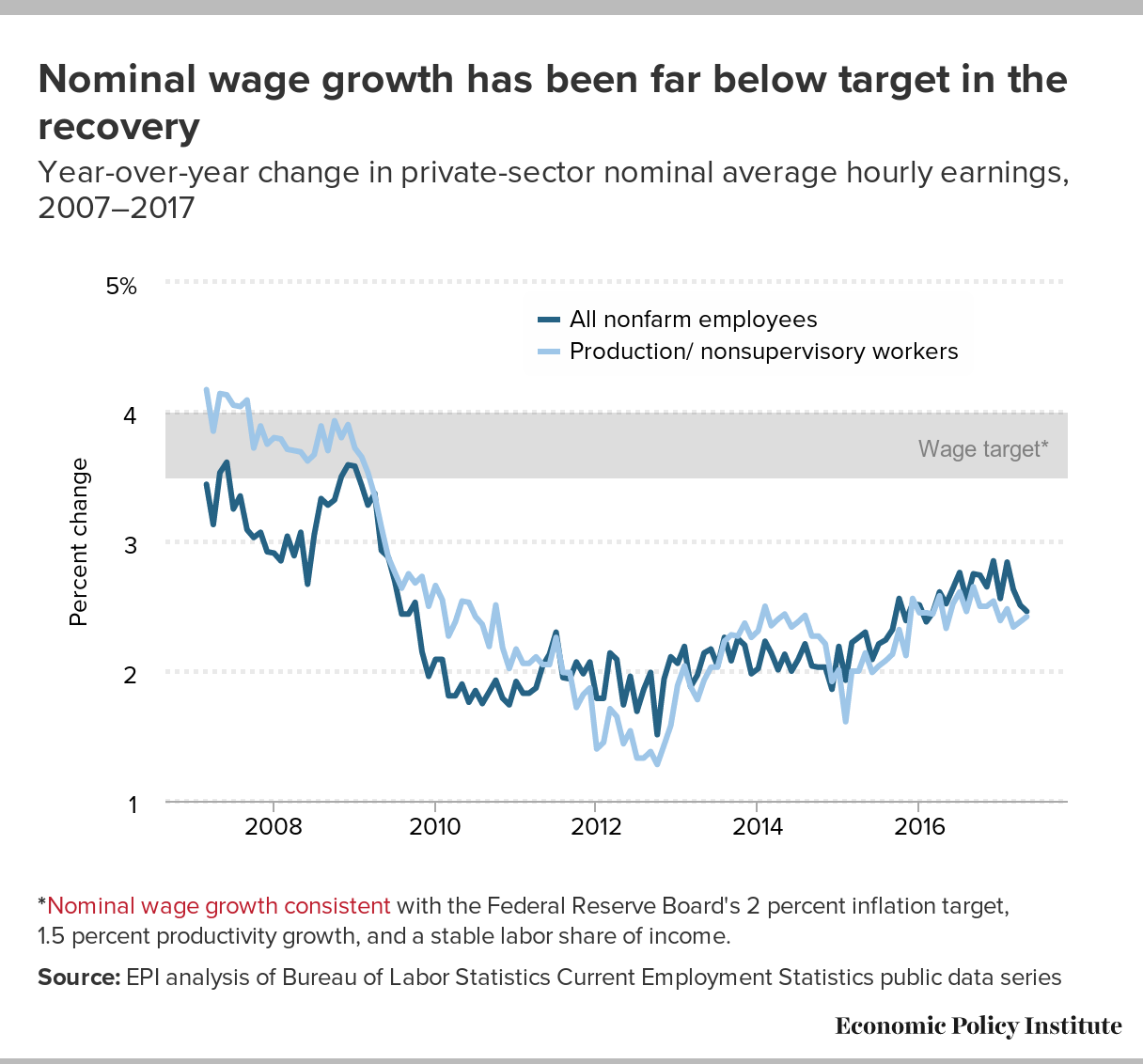
Finally, I should note that Trump is once again in his life inheriting an extraordinarily valuable gift. This time it’s a stable economy that has been sailing steadily towards full employment for years. The unemployment rate has been halved since its post-Great Recession peak. The labor force participation rate stopped falling and has actually nudged up in the past year even as natural demographic changes (retiring Baby Boomers) have been pulling it down. The last year has also seen some evidence of an uptick in wage growth.

No, we’re not at full employment today—largely because Republicans in Congress and in statehouses around the country have starved the economy of normal levels of spending during the recovery. Without this austerity, we would have reached full employment years ago. But even with no help at all from tax cuts or spending increases, the economy is projected to reach 4.6 percent unemployment or lower by the end of 2017.

And now that Republicans are in charge, the austerity they forced on the American people will undoubtedly stop. A huge tax cut will add to purchasing power and demand growth in the economy. It will do so incredibly inefficiently, creating about one job for every four that could be created if this money was spent more intelligently. But job creation has to take a back seat as a goal to maximizing the take of the top 1 percent, so, tax cuts for rich households it is. Inefficient stimulus, but lots of it.

A possible infrastructure plan would also boost growth, so long as its effectiveness was not compromised by the crony capitalism and poor targeting that would result from the Trump proposal’s very odd structure of giving tax credits to private investors, rather than just having state and local governments direct and finance projects. For those hoping that the Trump infrastructure plan would be aimed at helping struggling areas, it is worth noting that a key source of efficiency gains hoped for by the plan’s authors is that private investors are much more willing to cut off necessary services to households in economic distress. They approvingly note that privately-owned water and electrical utilities are much quicker and more willing to turn off services when households cannot pay bills than publicly-owned utilities.

All in all, the hopes that a Trump administration will stand up to elites on behalf of the broad middle class look well on their way to being dashed. Republicans first priority is cutting $1.1 million tax rebate checks to the top 0.1 percent. A secondary priority is giving away tax credits to private developers while hoping that they might build something useful without the whole endeavor becoming a nest of corruption. A key question is whether or not Trump will be willing to devote the energy and effort needed to stand behind his own words about defending Medicare and Medicaid in the face of the Republican Congress. Their trade plans are pure bluster and as likely to raise as lower the trade deficit. And every single potential appointment floated to run the regulation of banks and Wall Street is on record as arguing that the big problem today is that people and governments are too mean to virtuous financial professionals.

Maybe I’m wrong (I sure hope so), but the wedge between implied promises and delivered reality to working-class households already looks awfully large, and will likely just grow over time.

Josh Bivens is the Research and Policy Director at the Economic Policy Institute (EPI).


See:http://www.alternet.org/labor/already-big-gap-between-trumps-promises-middle-class-and-his-policies?akid=14911.123424.RtIMmY&rd=1&src=newsletter1067774&t=14

As Trump Builds His Authoritarian Presidency, Echoes of 1930s Germany and 1950s McCarthyism Abound

Domestic crackdowns. Militarism abroad?

Source: AlterNet

Author: Steven Rosenfeld

Emphasis Mine

When Richard Spencer, a leading alt-right white power ideologue finished his speech at Saturday’s day-long “Become Who We Are” summit at Washington’s Ronald Reagan Building, someone yelled, “Heil the people!” and the room shouted back, “Heil victory.”

It wasn’t the evening’s first Nazi reference nor most brazen. Soon after Spencer started slamming the mainstream media, overlooking how it gave the president-elect endless free coverage, he jeered, “Perhaps we should refer to them in the original German?” The crowd shouted back, “Lügenpresse,” a Nazi-era word for “lying press.” Spencer continued, to cheers, that white power was rising. “America was, until this last generation, a white country designed for ourselves and our posterity… It is our creation, it is our inheritance, and it belongs to us.”

America under Donald Trump is entering an uncharted authoritarian era. Whether apt historical precedents are in the first months of Hitler’s rule in 1933 in Germany or closer to the 1950s anti-Communist witch hunts led by Sen. Joseph McCarthy remains to be seen. But there are myriad events that everyone is seeing and unfolding behind closed doors that are forming a prologue to Trump’s authoritarian rule.

Looking backward, people always ask if the course of history could have been changed. Many people would like to dismiss some of the recent events as bad dreams that will vanish if ignored—like last weekend’s neo-Nazi rally in a federal office complex in the Capital; to Trump taking to twitter to denounce the cast of the musical, Hamilton, for closing a performance by openly imploring the vice-president-elect, Tim Pence, in attendance, to honor America’s diversity.

But that becomes harder to do when the president-elect is appointing scarily intolerant men, propagandists and war mongers to top White House posts. It doesn’t just look like Trump is posed to deport millions of migrants, roll back civil rights and go after his critics—by appointing race-baiting propagandist Stephen K. Bannon as a top adviser; Alabama Sen. Jeff Sessions as Attorney General; and Lt. Gen. Michael Flynn as top national security advisor—a man who supports racial profiling by police and has lied that Islamic law is spreading across America. It also looks like Trump is relishing his unfolding role as an American strongman, as evidenced by his Sunday tweet: “General James “Mad Dog” Mattis, who is being considered for Secretary of Defense, was very impressive yesterday. A true General’s General!”

The question is how far will Trump go to achieve his objectives at home and abroad, including putting the country on a path toward war. Historic comparisons are both useful and imprecise. Yet there are enough echoes of Trump’s ascension to Germany in 1933, the year Adolph Hitler became the country’s newly appointed chancellor. Then and now were periods seen by some as a brutal darkening and others as a great national revival. (My most recent book is set in Holland during the war).

Like Hitler’s earliest days in power, we are seeing increases in race-based hate crimes. Back then, it was targeting communists, socialists and Jews. Now it is targeting muslims. Trump’s advisors are pointing to a much-criticized World War II-era Supreme Court ruling, Korematsu v. United States, to allow creation of a national muslim registry. That ruling held that wartime detention was constitutional.

Where today parts with the past, at least so far, is we haven’t seen how Trump would expand the federal policing and deportation apparatus. People forget that President Obama oversaw the arrest and deportation of 2 million immigrants before signing executive orders suspending deportation of 40 percent of the 11 million undocumented migrants here. It’s an open question what Trump would do accelerate and ramp up the federal police state. In Germany, Nazi-supporting paramilitary groups created their own arrest, detention and torture stations during the first year of Hitler’s rule. The authorities didn’t stop them, and most of the American journalists stationed there at the time didn’t want to conclude that paramilitary violence was part of a larger societal trend.

What those outside targeted circles in Germany didn’t see at that time were the steps being taken to start transforming a democratic republic to authoritarian rule. (The military buildup and dictatorship followed). In short, the tell-tale signs were the increasing control that the government exerted over all aspects of society, but especially the civil rights of the officially loathed minorities. It started with national registries, moved to what jobs could and could not be held, and then declaring and forfeiting property and assets.

What is the contemporary parallel? On immigration, visa-less detainees have virtually no legal rights. Until Obama issued his executive orders suspending deportations in his second term, undocumented people arrested for traffic stops would be turned over by local police to ICE—federal immigration authorities—and disappear into a deportation treadmill. Trump and the GOP have threatened to ramp up that process, including the prospect of blocking all federal aide to any municipality or state that acts as a sanctuary state. There’s also been talk about seizing the international wire transfers of money sent by migrants here to families in Central America. What’s clear is that this is uncharted territory, domestically speaking, on this issue.

What happens with the Muslim registry, with segments of police forces resurrecting racial profiling, with crackdowns against protesters and dissent, are all open questions. But the president-elect and his top advisors, like most of the anti-Communist crusaders from the 1950s McCarthy era, have shown little tolerance of dissent and a willingness to go after critics. In California, people at anti-Trump protests talk about opening their homes to people fleeing federal police sweeps. The last time that was heard was in the 1980s when refugees fled Ronald Reagan’s Central American wars and hid from U.S. authorities here.

During the first months of Hitler’s rule, German authorities told foreign journalists and diplomats that attacks by fascist thugs were outliers and would soon end. There were even official denunciations by the government, but it didn’t stop. There even were a handful of Americans who were assaulted, after being in the wrong place at the wrong time. But most of the foreign press corps, visiting tourists and even diplomats didn’t grasp the emerging character of the new regime. And those who did see it for what it was—after witnessing violence firsthand—and tried to talk about it, were, frequently dismissed as too political, prejudiced and shrill.

Some people will shrug and say that upheaval and random victims always accompany every revolution—including what’s in store as Trump strives to “make America great.” Others will respond that people must speak out against dark forces when the future hangs in a balance and those accumulating power are silently gathering their forces. What’s certain about Trump’s America is the country is heading into an authoritarian time. How wide, how deep and how destructive that wave will be is unknown.

As Richard Spencer, who led the neo-Nazi chants last weekend at the white power gathering in Washington told the New York Times, his movement and Trump shared many values. “I do think we have a psychic connection, or you can say a deeper connection, with Donald Trump in a way that we simply do not have with most Republicans.”


Steven Rosenfeld covers national political issues for AlterNet, including America’s retirement crisis, democracy and voting rights, and campaigns and elections. He is the author of “Count My Vote: A Citizen’s Guide to Voting” (AlterNet Books, 2008).

See:http://www.alternet.org/election-2016/trump-builds-his-authoritarian-presidency-echoes-1930s-germany-and-1950s-mccarthyism?akid=14902.123424.cBnOxt&rd=1&src=newsletter1067620&t=2

This Wasn’t a Working-Class Revolt—It Was a White Revolt

In their anger and their desire for change, Trump voters elected a racist and sexist president.

Source:AlterNet

Author:Tamara Draut/BillMoyers.com

Emphasis Mine

Resentment won this election. It was a middle-finger, throw-caution-to-the-wind, damn-the-consequences vote — cast overwhelmingly by white people.

Only white people had the luxury and the safety to ignore Trump’s promises to restore law and order, to deport millions of immigrants and to endanger Americans who practice the world’s second most popular religion. His phony economic populism was the icing on the cake — the cherry on top of the dog-whistle sundae. It was not the driving motivation behind Trump voters.

A quarter of Trump voters said he was not qualified to be president, yet still voted for him to lead the country. Trump was as likely to win affluent voters — individuals making more than $100,000 — as Clinton. This wasn’t a working-class revolt. It was a white revolt.

Did Democrats do something wrong? Absolutely, but not just in this election. For the last three decades, the party has abandoned pocketbook issues and working-class people in favor of business leaders and Wall Street titans. The Republican Party never had an economic platform for the working class, just its effective Southern strategy: blame African-Americans (and now immigrants, too) for white struggle, and position government as the finger on the scale tipping the advantage to people of color.

A full-throttle Democratic commitment to once again being the party of the working class — the janitors, home health aides, housekeepers and what’s left of our factory workers — might have provided a bulwark against white resentment. In fact, Clinton won the votes of people we’d consider working-class — those with yearly incomes below $50,000.  Clinton won the votes of people who are fighting to protect hard-fought gains but still waiting for equity: people of color and women with college degrees. Clinton also won the votes of millennials, those under the age of 30, who more than any other generation are bearing the burden of our failed economic paradigms.

So what comes next? Every indication is that the Democrats will engage in soul-searching. We’re all trying to figure out “what went wrong.” As a former working-class kid from Ohio whose mom and siblings epitomize the white working class, I’ll offer caution against two explanations. First, we should not forget that Hillary Clinton won the popular vote — so she’s not the terribly flawed candidate many want to paint her as. Second, we should avoid the temptation to blame the loss on being out of touch with “middle America.”

This didn’t happen because you like chardonnay and the white working class likes beer. Thinking that this vote comes down to where people shop, the television shows they watch or what kind of alcohol they like to drink after a long day of work is an elitist reduction of people to their consumer habits. Please don’t do it. Instead, white liberals and progressives, we’ve got to grapple with the reality that we lost this election largely due to white privilege.

White parents can wake up in Trump’s America and not worry their kid will be told “to go home” despite being born here. White parents, despite living in poverty, won’t experience the aggressive policing Trump championed. And white Christians won’t be viewed as threats because of the religion they practice. These incidents are already happening just days after the election. The white working class will suffer none of these abuses in Trump’s America.

Not all Trump voters are racist, but they were willing to vote for a racist. Not all Trump voters are sexist, but they were willing to vote for a sexist. That is the definition of privilege.


See:http://www.alternet.org/election-2016/trumps-election-was-white-revolt?akid=14893.123424.w2_p78&rd=1&src=newsletter1067427&t=14


How many liberals does it take to screw in a lightbulb?

how many liberals does it take? Three. One to turn the bulb, one to hold the ladder and one to make sure the manufacturer offers good health care and pension plans to its employees.

twisted...
twisted…

Source: Washington Post

Author: Garrison Keillor

Emphasis Mine

It was gratifying that after Wisconsin voted him into the presidency, the gentleman did not talk about putting Hillary Clinton in prison. That was a nice surprise. And when he met with Obama of Kenya, the white sahib was well-behaved, listened to what the African had to say, did not interrupt or call him stupid, and in fact thanked the alien for meeting with him. He did a good impersonation of modesty.

Say what you will, the man is flexible. The wall on the border, his reliable applause line this past year, has been downgraded to a fence in some places and may eventually turn into a line of orange highway cones. The 11 million deportees are down to 2 or 3 million. Clinton may be let off with an ankle bracelet.

While he’s making alterations, he should consider getting a presidential hairdo rather than the hair of a hotel lounge pianist in 1959. It’s distracting to watch a man talk about national security looking like he might suddenly burst into “Volare.” A makeover would take about 15 minutes max. And might a speech therapist try to smooth out the Tony Soprano accent and give him a presidential voice like Nixon’s or Reagan’s and cut out those irritating repetitions for emphasis — do you know what I mean? Am I right? Am I right? You know I’m right. You better believe I’m right.

He will never be my president because he doesn’t read books, can’t write more than a sentence or two at a time, has no strong loyalties beyond himself, is more insular than any New Yorker I ever knew, and because I don’t see anything admirable or honorable about him. This sets him apart from other politicians. The disaffected white, blue-collar workers elected a Fifth Avenue tycoon to rescue them from the elitists — fine, I get that — but they could’ve chosen a better tycoon. One who served in the military or attends church or reads history, loves opera, sails a boat — something — anything — raises llamas, plays the oboe, runs a 5K race now and then, has close friends from childhood. I look at him and there’s nothing there.

But politics is not everything. Life goes on. A person has to keep that in mind. The day after the election, my wife and I set out to replace some burned-out light bulbs in some interesting fixtures chosen by an elderly interior decorator years ago. We are from Minnesota and we hesitate to impose our taste on others, even when we’re paying the bill. So we have several truly ugly and impractical light fixtures that use odd rare bulbs not sold at Walmart, Walgreens, Ace Hardware or even at boutiques with names like Let There Be Light Bulbs. Long, cylindrical bulbs. Perhaps handmade by Cistercian monks on a mountaintop in Montana.

I voted for Clinton, so I’m an elitist, but still. We use regular old G.E. light bulbs.

My wife is a violinist, so she has excellent fine motor skills, plus a better sense of logic and smaller hands, so she’s the foreman, and my job is to stand by the stepladder, hold her by the hips, hand her the Allen wrench — yes, these fixtures, unique in the Western hemisphere, require hexagonal wrenches — receive loose screws and the burned-out bulb, hand her the fresh bulb while bracing the loose fixture and not letting it fall, and maintaining an upbeat attitude.

It’s interesting to hold a kind, gentle Episcopalian lady by the hips and hear how well she can swear while trying to replace a light bulb in a fixture that — how many liberals does it take? Three. One to turn the bulb, one to hold the ladder and one to make sure the manufacturer offers good health care and pension plans to its employees.

This is what pulls a couple together. Every marriage has its bumps, but when she stands on a stepladder and I brace my shoulder against her rear end to leave my hands free to hold the big glass shade as she screws the bulb into the socket and takes the Allen wrench from me and the screws and drops one and I bend down, my hand still on her haunch, and reach for the fallen screw, and we both start laughing, this is a sweet moment that momentarily transcends politics.

I hope that Donald Trump does not make Wisconsin regret having elected him president, but it’s still the same old story about love and glory and a case of do or die and lovers must replace their light bulbs as time goes by.

See:https://www.washingtonpost.com/opinions/how-many-liberals-does-it-take-to-screw-in-a-lightbulb/2016/11/15/fd15c8ba-ab71-11e6-977a-1030f822fc35_story.html?utm_term=.aacdfe9bd962&wpisrc=nl_opinions&wpmm=1

Blame White Evangelicals For Trump Victory

our long national nightmare begins...
our long national nightmare begins…

Source: Pathos.com

Author: Michael Stone

Emphasis Mine

White conservative Christians propel Donald Trump to the White House.

Five Thirty Eight reports national exit polls show white evangelical voters voted in record high numbers for Donald Trump, 81-16 percent. It is the widest margin for a Republican presidential candidate ever among evangelicals since they have been tracking the numbers.

The Wall Street Journal confirms that more than 80% of white evangelical and born-again Christians voted for Trump. According to national exit polling, a larger percentage of evangelicals backed Trump then backed Mitt Romney, John McCain, or George W. Bush, the GOP candidates in the past three elections.

As for women, more than 75% of white evangelical women voted for Trump, according to the exit polls.

That’s right, more than 75% of white evangelical women voted for Donald Trump. Think about that.

The irony of course is that for all intents and purposes Trump is, at best, a Christian of convenience. Indeed, he is a man that appears to have no convictions, religious or otherwise, and represents everything that Christian morality rejects, at least in theory.

The irony is only compounded by the fact that Hillary Clinton was and is a model Christian. As a lifelong Methodist, Clinton was secure in her faith, and actually tried to practice the best of Christian values, exhibited by the Methodist motto that formed a cornerstone of her campaign and personal philosophy:

Do all the good you can, by all the means you can, at all the times you can, to all the people you can, as long as ever you can.

It is stunning but not surprising to note that the majority of evangelical Christians were happy to support a candidate with a long and well documented history of racism, misogyny, and corruption, a man that brags about being able to sexually assault women with impunity.

Bottom line: Evangelical Christians are shameless hypocrites who reject morality and decency in favor of an immoral, authoritarian, bully.

And now our long national nightmare begins.

See:http://www.patheos.com/blogs/progressivesecularhumanist/2016/11/blame-white-evangelicals-for-trump-victory/?utm_source=SilverpopMailing&utm_medium=email&utm_campaign=progressivesecularhumanist_111016UTC011139_daily&utm_content=&spMailingID=52735928&spUserID=MTIxNzQwMzMwMDkyS0&spJobID=1044382176&spReportId=MTA0NDM4MjE3NgS2

FiveThirtyEight’s Prediction Model Is Failing in the Clinton-Trump Race — That’s According to Its Guru, Nate Silver

Trump’s path is precarious and not one other professional election handicapper records the seismic shift in Trump’s chances that FiveThirtyEight does.

Source:AlterNet

Author:Arun Gupta/Raw Story

Emphasis Mine

Telling political junkies to stop checkinfivethirtyeight.com obsessively is likely to be met by the same hollow-eyed stare from a lab rat that spends its day clicking a lever for bumps of cocaine.

(N.B.: that’s me)

The internet venerates the website’s founder, Nate Silver, as “America’s Chief Wizard” after his statistical polling model correctly predicted the results of the 2012 presidential contest in every state and the District of Columbia. But Silver’s fans are freaking out as Trump’s chance of winning has tripled in two weeks.

However, the wild swings toward Trump are more a sign that an orange-furred monkey wrench has jammed FiveThirtyEight’s soothsaying machine than a candidate who is detested by nearly 60 percent of voters is suddenly floating to the top of the 2016 shitshow. Trump can win and possible hacking of the electoral process increase unpredictability, but his path is still precarious and not one other professional election handicapper records the seismic shift in Trump’s chances that FiveThirtyEight does.

To Silver’s credit, he’s cast doubts on his poll-based forecasting this year. He mentions the lag time in how polls react to dramatic news such as the FBI’s email bombshell. He highlighted a survey showing little movement in voter preferences since January 2016. FiveThirtyEight also notes, “Trump supporters are more likely than Clinton voters to make it through the likely voter screens, indicating they are more vocal and enthusiastic in their support.” In other words, it’s likely Comey’s ill-advised letter about Clinton’s emails has depressed pro-Clinton respondents in polling more than it will at the voting booth. On the flip side, after Clinton’s average lead stretched to 7.1 percent in mid-October, this was likely affected by Trump supporters shunning pollsters, particularly after Trump’s rants about a rigged media, rigged polls, and a rigged election.

If you’re hell-bent on checking FiveThirtyEight constantly (as I still do), then it’s worth keeping in mind reasons why a Clinton victory is likelier than Silver’s model predicts.

The main issue is FiveThirtyEight works best when electoral coalitions are well-defined and change slowly as they have been since Bill Clinton was in office. Trump has scrambled all that, however, and analyzing polls cannot account for rapid demographic shifts. Trump’s bastion of working-class white men includes significant numbers of Democrats who’ve crossed over since 2012. But he’s alienated typically Republican college-educated whites and spurred LatinosAsians, and Muslims to mobilize in record numbers to defeat him. And the gender gap is wider than ever, with women favoring Clinton over Trump by an average of 16 points in October polls. The focus on Trump’s working-class support also misses one crucial aspecta majority of the white working class is female, and they began rejecting Trump after the Access Hollywood tape scandal. This overlaps with remarkable geographic shift in which Democrats are quickly gaining ground in Sunbelt states that were a redoubt of Reagan conservatism, while traditional Democratic strongholds are crumbling in Midwest regions that are older, white and working class.

These groups are huge at a national scale, but fine-grained detail disappears in polls of a thousand respondents. FiveThirtyEight apparently doesn’t include polls that could clarify the picture by zeroing in on groups such as Latino voters, who favor Clinton by an astonishing 48-point gap. Most public polls are marked by shoddier methodology that amplify small swings as opposed to internal campaign polling that show more stability.

Two other significant reasons why FiveThirtyEight overestimates Trump’s chances is early voting and get out the vote. More than 35 million Americans have already voted, which is 28 percent of the total vote in 2012. In nearly every battleground state early voting is outpacing last election, meaning Clinton banked millions of votes when her numbers were peaking. One poll of early voters indicates Clinton is ahead by enough 5 points, which is enough to tack on a 1.3 percent advantage in the final election results.

Many of these factors are evident in Nevada. FiveThirtyEight shows Trump neck and neck with Clinton, but Silver says early voting shows a six-point gap favoring Democratic voters. This discrepancy is consistent with FiveThirtyEight’s failure to predict Harry Reid’s 2010 Senate re-election and its underestimate of Obama’s 2012 victory margin. Six years ago Reid edged out Tea Party kook, Sharron Angle, thanks to an extraordinary turnout machine he’s built after more than 30 years in public office. Nevada also has its own election oracle in reporter John Ralston, who correctly called the two races Silver flubbed. Ralston’s dive into 622,000 votes already cast, which already accounts for 61 percent of 2012 totals, bears grim tidings for Trump even in best-case scenarios.

If Trump loses Nevada, Silver says he wins in only 9 percent of scenarios. That’s a far cry from the 35 percent mark Trump just touched. Trump’s campaign looks to be treating Nevada as a lost cause as he eyes richer electoral prizes like Michigan and Wisconsin that are even further out of his grasp. Even if Trump wins Ohio, Florida, Iowa, Arizona, North Carolina, and New Hampshire, he still loses the election. So he needs to wrestle a Midwestern state away from Clinton.

That’s unlikely as Trump is paying the price for outsourcing get-out-the-vote operations. GOTV is warfare through electoral means and requires a command staff, hundreds of offices, tens of thousands of paid staff and volunteers, and coordination both strategic and minute with the campaign. Trump has none of that. A month before the election, FiveThirtyEight counted 2.5 Clinton field offices for every one of Trump’s. His campaign is also plagued by chaotic websites and offices listed in demolished buildings. Field offices can’t be thrown up like lawn signs, and in battleground states a ground game could add as much as three to five points.

Clinton’s GOTV is robust enough to target strongly Democratic but low-propensity voters. Silver points out polls can’t factor this in. For example, one organization in Florida has dispatched 500 paid canvassers to the field for months to activate a pool of 384,000 Latino voters. Trump is also outmuscled by unions spending hundreds of millions of dollars and deploying thousands of full-time canvassers for Democrats. These efforts are yielding dividends among Latinos in Arizona and Asian-Americans in Nevada. And Michigan’s Arab-American and Muslim-American firewall will easily keep Trump at bay there.

Democrats are hand-wringing over declining African-American turnout, and this has put North Carolina and Ohio in peril, but the surge from women, college-educated, and racial minorities from Virginia to Nevada will offset this deficit. Republicans are already embroiled in civil war, which is damaging Trump in Wisconsin and Utah. Democrats are united and feature a stellar array of surrogates on the hustings, such as the Obamas, Bill Clinton, Joe Biden, Tim Kaine, Bernie Sanders, Elizabeth Warren, and an A-list of celebrities. Donald Trump has the Pharma Bro, an underwear model, a disgraced baseball star, and a felonious “Real Housewife.”

There is also no evidence of “shy” Trump voters that polls allegedly fail to register. And Trump’s attempts to activate whites who normally don’t vote looks to be a dud as well. An analysis of newly registered and “missing” voters favoring Clinton. Even if there is a hidden upsurge for Trump, it’s unlikely to overcome all these obstacles.

Silver cautions as well that the history of presidential elections and scientific polling is so scanty in terms of data that it’s dicey to draw any broad-based conclusions. For instance, conventional wisdom says as goes Ohio, so goes the nation. But Trump looks set to win Ohio and lose the general election, a first in 14 straight presidential races.

(N.B.: not so fast – our ground game may win Ohio)

FiveThirtyEight’s model worked fantastically well when the sailing was smooth, but it is foundering in the violent seas of 2016. The Cook Political Report, the brainchild of  the dean of election forecasting, Charles Cook, observes that despite Clinton’s eleventh-hour woes, “The race has tightened to its ‘natural resting place’ with a 2-4 point lead for Clinton,” while Trump’s “path to 270 electoral votes remains decidedly and almost impossibly narrow.”

The best prediction of how the 2016 campaign ends is likelier to be a metaphor than math: Hillary Clinton’s near-collapse at the September 11 memorial where her entire team mobilized to shield her and carry her over the finish line. And no statistical model can predict a moment like that.

Arun Gupta is a graduate of the French Culinary Institute in New York and has written for dozens of publications including the Washington Post, the Nation, The Progressive, Telesur English, and the Guardian. He is the author of the upcoming Bacon as a Weapon of Mass Destruction: A Junk-Food-Loving Chef’s Inquiry into Taste (The New Press).

See:http://www.alternet.org/fivethirtyeights-prediction-model-failing-clinton-trump-race-thats-according-its-guru-nate-silver?akid=14852.123424.hwDfYp&rd=1&src=newsletter1066610&t=18

I’m With Stupid: The Entire 2016 Election Has Been an Insult to Our Intelligence

Donald Trump isn’t the only one to lie with impunity. Logic, facts and intelligence are the losers in this election.

 Photo Credit: DonkeyHotey / Flickr

Photo Credit: DonkeyHotey / Flickr

Source: AlterNet

Author:Sophia A. McClennen / Salon

See:http://www.alternet.org/election-2016/election-2016-insults-our-intelligence

Comey’s letter and what’s next

Source: HillaryClinton.com

Author: John Podesta

Emphasis Mine

By now, you’ve probably heard some news about a bewildering letter sent to Congressional leaders by the Director of the FBI.

This is all a bit confusing, and much of the reporting has been misleading or downright inaccurate, so I want to take a minute to walk through this. Bear with me!

Here’s the quick backstory: In July, FBI Director James Comey concluded a year-long investigation by deciding not to go forward with any case about Hillary’s emails. It wasn’t even a close call, he said. In his words, “no reasonable prosecutor” would have brought charges.

Yesterday, in a surprise to us all, Comey wrote a very strange letter to Congress that was long on innuendo and short on facts. He said that in a completely separate investigation, the FBI had found some emails that may or may not be related to Hillary, and indeed may or may not be significant at all.

It’s since been reported that these emails may not have even been sent by or to Hillary; that they weren’t withheld by Hillary or the campaign in the earlier investigation; and most or even all of them may be duplicates of emails already in the FBI’s possession.

It’s being reported that Comey sent this letter over the objections of Department of Justice officials who told him that it was inconsistent with longstanding policy of both Democratic and Republican administrations not to take action that might impact an election. It’s an unprecedented intrusion into a close presidential election with 10 days until Election Day.

But by being vague and obfuscating, Comey opened the door to conspiracy theories, Republican attacks against Hillary, and a surge of fundraising for Trump and his team. So this bears repeating:There is no evidence of wrongdoing, no charge of wrongdoing, and no indication that any of this even involves Hillary.

Voters deserve answers.

Comey needs to come clean with the American people about what he found and answer all the questions about why he took this unprecedented step less than two weeks before the election.

Here’s what this changes for you and this campaign: Absolutely nothing.

Trump has spent more than a year trying to bully his way to the presidency. He’s been browbeating the FBI (indeed, many have speculated that Comey took this extraordinary action in part to reduce the pressure on his agency that Trump’s campaign and his Republican Congressional allies has been building up), leading crowds in chants of “lock her up,” and even saying Hillary should be in prison — and if he won, he’d put her there.

The facts be damned — Trump’s always shown a complete disregard for the truth. In spite of there being no new information, he’s already raising money off the bizarre letter (he literally sent a text message asking for money within an hour of the story breaking!) and he’s more fired up than ever on the trail today.

Charles, these are the actions of a desperate man. Trump knows he can’t win on his character, temperament, or his policies. He’s behind, so he’ll cling to whatever he can.

So, no, our strategy doesn’t change. But Charles, our intensity needs to, because we can’t let him get away with this.

Our organizers and volunteers on the ground are rallying behind Hillary in what will be the biggest volunteer weekend of the campaign so far. You need to get her back, too. You need to say you’re not willing to let Trump bully or buy his way into the presidency, and you’re not going to let anything stop us from making history.

There are ten days to go. Let’s buckle down, stay focused, and win this.