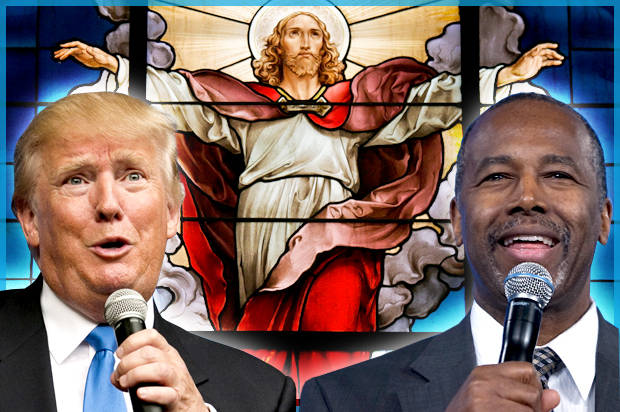
These religious clowns should scare you: GOP candidates’ gullible, lunatic faith is a massive character flaw

Their deluded debate answers removed any remaining doubt: These kooks belong nowhere near the White House

caption not required...
caption not required…

Source: salon.com

author: jeffrey tayler

emphasis mine

One of the most serious problems with religious faith is that it can afflict an otherwise intelligent person and incite her to utter arrant inanities with the gravitas of an old-time, Walter-Cronkite-style television newscaster. This problem is doubly striking when that intelligent person is herself a newscaster (of sorts). And triply striking when that newscaster (of sorts) is Megyn Kelly, the Fox News star who looks sane amid a roster of crazies headed by the faith-addled duo of Sean Hannity and Bill O’Reilly. Kelly is purportedly a Roman Catholic, but judging by her racy photos, divorce, and remarriage outside the church, the Pope and his bull(s) don’t play much of a role in her life. All of which is good, in my view.

Nonetheless, as the recent Fox News Republican presidential debates were coming to an end, Kelly decided to extract a (patently ridiculous) religion-related question from her channel’s Facebook feed and give it air time. Prefacing it by calling it “interesting,” she put the query to the politicians assembled on stage directly and in all seriousness: “Chase Norton on Facebook . . . wants to know this of the candidates: ‘I want to know if any of them have received a word from God on what they should do and take care of first.’” She paused. With just a hint of insouciance, and in one of the most understated segues I’ve ever witnessed, she then asked, “Senator Cruz, start from you. Any word from God?”

Now let’s pause and consider the situation. Kelly is a political science graduate from a major Northeastern university, an attorney by trade with some 10 years of practice behind her, and a citizen of one the planet’s most developed countries. Speaking on satellite television (a technological wonder, whether we still recognize it or not, and no matter what we think of Fox News) in the twenty-first century, this sharp, degree-bearing professional American has just asked, with a straight face, a senator (who happens himself to be a magna cum laude graduate of Harvard Law) if he is receiving messages from a supernatural being. Yet no one in the audience broke into guffaws or even chuckled. And, of course, no one cried out with irate incredulity at the ludicrousness of the supposition implicit in the question (that an imaginary heavenly ogre could possibly be beaming instructions down to one of his earthling subjects). But since the supernatural being in question goes by the name of “God,” in the clown show that was the Republican debate, everyoneaudience, MC, and the clowns themselves – simultaneously took leave of their senses and judged the matter at hand legit.

In any event, the question gave Cruz the chance to display his bona fides as a faith-deranged poseur. He told us, to waves of applause, that he was “blessed to receive a word from God every day in receiving the scriptures and reading the scriptures. And God speaks through the Bible.” He reminded us that his truant, once-alcoholic father had found Jesus and returned to the family; that he supports the sickening array of Religious Freedom Restoration Acts now pullulating pestilentially across the land; and that he’s against Planned Parenthood. Nothing new or even interesting here. Referring to conservatives, he noted that “the scripture tells us, ‘you shall know them by their fruit.’” Well, we know Cruz’s fruit, and it is poison to the cause of Enlightenment.

Kelly then turned to John Kasich, who, punctuating his speech with a strange mix of karate chops, head wobbles, and thumb-wags, brought up his family’s immigrant background and implied his election as Ohio’s governor was a miracle, but, oddly, did so without really implicating the Lord in it. He rambled on (godlessly) about the need for unity and respect, giving us reason to think – and this is a good thing – that he considered the issue of religion too divisive to dilate upon. He finally, though, did answer Kelly’s question: “In terms of the things that I’ve read in my lifetime, the Lord is not picking us. But because of how we respect human rights, because that we are a good force in the world, He wants America to be strong. He wants America to succeed.” This bland verbiage prefaced his closing non sequitur: “Nothing is more important to me than my family, my faith, and my friends.”

Given that he is a biblical literalist and believes he is destined for heaven, why Kasich chose to pass up the chance to spout piety is a mystery.  However, he (grudgingly) recognized the Supreme Court’s ruling in favor of same-sex marriage; quite possibly, he is content with leaving faith out of public affairs.  Just as the Constitution would have it.

Wisconsin governor Scott Walker spoke next. He admitted to being an “imperfect man” and straightaway proved it by claiming to have been redeemed of his sins “only by the blood of Jesus Christ.” Walker’s father is a Baptist preacher, and he himself took to the pulpit as a teen, so such language should hardly surprise us. But before you dismiss it as boilerplate Jesus jabberwocky, consider that it does serve to highlight the bizarre conceit of the Christian cult: that the good Lord could think of no other way to give us a boost a couple of millennia ago except by orchestrating a cruel, ghastly act of human sacrifice involving His own kid. (Some dad.) If nothing else, ghoulish talk of this sort should prompt Fox News post-factum to rate the entire debate NOT SUITABLE FOR MINORS, or, at the very least, VIEWER DISCRETION ADVISED.

(And where are all those annoying trigger-warning zealots when you need them? Why don’t they campaign to have the Bible stamped with “TRIGGER WARNING: contains multiple accounts of genocide, warfare, murder, enslavement, sexual abuse of women and underage girls, and ritual human and animal sacrifice”?)

In any case, Walker returned to reality, if only for a brief sojourn, and said the Lord hasn’t vouchsafed him a plan of action, and “hasn’t given me a list, a Ten Commandments, if you will, of things to act on the first day.” He closed saying he planned to live his “life in a way that would be a testimony to [God] and our faith.”

On this latter point journalists may wish to ask Walker to be more specific. Since he had just mentioned a bloody, barbaric, public act of execution and its lasting salvific effect on him, we are well within our rights to demand what sort of form his “testimony” will take. He has two sons. Might he consider offering at least one of them as a participant in one of the Philippines’ horrific real-life reenactments of the crucifixion that occur on Good Friday? Perhaps he would like to take part himself? Will he, if elected president, opt to introduce crucifixion as an approved means of execution? According to the Bible, God visited genocide, warfare, exile, slavery, and rape on humanity, and has drawn up plans to destroy the vast majority of us. Which of these banes would a President Walker chose, as part of his personal faith journey, to impose on his fellow Americans? Or would he limit himself to making merely cosmetic changes, such as replacing the White House’s annual National Security Strategy with the Book of Revelation?

Without responding to the Facebook user’s question about God’s to-do list, Senator Marco Rubio sputtered out permutations of bless (noun, verb, and adjective) in pitchman’s prattle too dull to merit space here, and spoke about the need for reform in the Veterans Administration (which Kelly had asked him to address, from the Lord’s perspective, of course). One might have concluded that he hardly believed in the supernatural at all, yet one would, of course, be erring grievously: he attends the extremist Christ Fellowship in Miami, a hotbed of exorcism, creationism and homophobia.

Kelly last turned to Dr. Ben Carson. Perhaps the most disturbing example of how high intelligence and belief in balderdash myths can jointly inhabit a single mind, Carson, so faith-deranged that he denies evolution and has had himself baptized twice, dodged God entirely and offered a reasonable look into how a neurosurgeon sees the issue of race relations. We can only surmise he felt he had elsewhere spoken enough about God. He gained nothing with his audience by leaving the Lord out, but by doing so he at least offered rationalists a tiny respite from the evening’s madness.

Presidential candidates have the constitutionally protected right to profess the religion of their choice and speak freely about it, just as atheists have the right – and, I would say, the obligation – to hold religion up to the ridicule and derision it so richly deserves. In that regard, nonbelieving journalists in particular should give openly devout candidates no passes on their faith. Religion directly influences public policy and politics itself, befouls the atmosphere of comity needed to hold reasoned discussions and arrive at consensus-based solutions, sows confusion about the origins of mankind and the cosmos, and may yet spark a nuclear war that could bring on a nuclear winter and end life as we know it. I could go on (and on), but the point is, we need to talk more about religion, and far more frankly, and now, before it’s too late.

Discussing religion freely and critically will desacralize it, with the result that the public professions of faith of which our politicians are so enamored will eventually occasion only pity, disgust and cries of shame! or, at best, serve as fodder for comedians. Faith should, in fact, become a “character issue.”

The advances of science have rendered all vestigial belief in the supernatural more than just obsolete. They have shown it to indicate grave character flaws (among them, gullibility, a penchant for wish-thinking and an inability to process information), or, at the very least, an intellectual recklessness we should eschew, especially in men and women being vetted for public office. One who will believe outlandish propositions about reality on the basis of no evidence will believe anything, and is, simply put, not to be trusted.

Come on, rationalist journos, be brave and do your job. Even if Megyn Kelly won’t do hers.


Jeffrey Tayler is a contributing editor at The Atlantic. His seventh book, “Topless Jihadis — Inside Femen, the World’s Most Provocative Activist Group,” is out now as an Atlantic ebook. Follow @JeffreyTayler1 on Twitter.

see: http://www.salon.com/2015/08/16/these_religious_clowns_should_scare_you_gop_candidates_gullible_lunatic_faith_is_a_massive_character_flaw/

7 ‘Inconvenient Truths’ for Trump About Immigration

For starters, the number of undocumented immigrants, especially Mexicans, has fallen. Trump and his followers don’t want their rage disrupted or redirected to the real causes of economic insecurity: how America’s capitalist system, exemplified by selfish strivers like Trump, has made a growing schism of have-nots and haves.

Source: AlterNet

Author: Stephen Rosenfeld

Emphasis Mine

 Trump and his followers don’t want their rage disrupted or redirected to the real causes of economic insecurity: how America’s capitalist system, exemplified by selfish strivers like Trump, has made a growing schism of have-nots and haves.

What will it take to get a majority of Republicans and an even bigger slice of Donald Trump supporters to reconsider their mistaken beliefs about Mexican immigrants and border enforcement? Though it’s unlikely, one might begin with the facts.

This week, a nationwide survey by Public Policy Polling reported that 51 percent of Republicans—and 63 percent of Trump supporters—would support a constitutional amendment to take U.S. citizenship away from children born in this country to the parents of undocumented immigrants. Their support for this exceptionally punitive measure, which, practically speaking is going nowhere, follows Trump’s ongoing and unapologetic comments that illegal Mexicans are a source of American woes.

Yet, according to academics and other demography experts, what’s been happening in the real world of U.S.-Mexico immigration trends and border enforcement is exactly the opposite from what Trump is bellowing and his flock is nodding their heads to.

The facts are that undocumented Mexican immigration has been going down during all of President Obama’s tenure; it peaked in 2007. Moreover, Trump’s remedy—a new wall—has largely been in place (fences, sensors, drones, patrols). But because his white and aging following grew up in a less diverse America following World War II, it will be hard to dislodge their racist perceptions and xenophobic views.

Here are seven facts that Trump and his flock are ignoring:

1. Undocumented Immigrant Numbers Have Fallen. According to a July report by the Pew Research Center, the total U.S. population of undocumented immigrants in has fallen in recent years and was 11.3 million people in 2014. “The population has remained essentially stable for five years, and currently makes up 3.5 percent of the nation’s population. The number of unauthorized immigrants peaked in 2007 at 12.2 million, when this group was 4 percent of the U.S. population.” In other words, this cannot be called a beckoning and burgeoning crisis.

2. Undocumented Mexicans Have Declined As Well. Pew noted that while Mexicans comprise a little more than half of all undocumented U.S. immigrants (52 percent), their numbers have been declining. “There were 5.9 million Mexican unauthorized immigrants living in the U.S. in 2012, down from 6.4 million in 2009,” according to Pew estimates.

Again, Trump is portraying a false boogeyman. Other academic experts who have studied the issue for years, such as academics at Princeton University’s Mexican Migration Project, describe the trend even more starkly. “Net unauthorized migration from Mexico to the U.S. has been zero or negative since 2008,” its research team wrote in the winter 2014 edition of International Migration Review.

“We find that undocumented migration from Mexico reflects U.S. labor demand and access to migrant networks and is little affected by border enforcement,” they explained, citing the underlying economics. “Mass undocumented migration from Mexico appears to have ended because of demographic changes there.”

3. As Mexico Ages, Would-Be Immigrants Shrink. Those demographic changes are a shrinking number of 15 to 24-year-olds in Mexico—the age cohort of the largest cohort of immigrants, the Princeton researchers found. This age group was only 18 percent of the population in 2015, The New York Times reported. That’s down from 22 percent in 2009 and is expected to fall to 16 percent in 2015, it reported. So, here too, is another factor that lessening unauthorized immigration from Mexico—not increasing it.

4. Last Summer’s Border Crisis Doesn’t Change These Trends. In 2014, an estimated 60,000 unaccompanied children from Central American massed at the border, seeking to get into the U.S. and prompting the federal government to set up processing centers—as Republicans criticized Obama for not taking a tougher approach. (They ignored that his administration had deported more migrants than any prior White House.) That refugee crisis was reflected in recent Census data, which has lead some republicans to suggest that a new historic tide of immigrants was beginning.

The Center for Migration Studies asked in a mid-August analysis if there was a surge. It concluded, “it is highly improbable based on: (1) the essentially unchanging patterns of apprehension data in the past few years; (2) the fact that the higher numbers in 2014 and 2015 are within the range of previous random fluctuations in the CPS data; and (3) the likelihood that the numbers for recent years partially reflect the return migration of previous legal residents; and (4) the fact that at least one of the conditions that brought about the significant reductions in unauthorized immigration over the past 15 years – enhanced immigration enforcement – is still in place and in fact has been augmented in recent years.”

5. More States Are Seeing The Undocumented Leave Than Stay. Before following up on the Center for Migration Studies’ last point—that until Obama issued his executive orders suspending some enforcement, his administration was deporting migrants—it’s worth noting that more states have seen undocumented populations fall than rise.

As Pew reported, “From 2009 to 2012, several East Coast states were among those with population increases, whereas several Western states were among those with population decreases. There were seven states overall in which the unauthorized immigrant population increased: Florida, Idaho, Maryland, Nebraska, New Jersey, Pennsylvania and Virginia. Meanwhile, there were 14 states in which the population decreased over the same time period: Alabama, Arizona, California, Colorado, Georgia, Illinois, Indiana, Kansas, Kentucky, Massachusetts, Nevada, New Mexico, New York and Oregon. Despite a decline, Nevada has the nation’s largest share (8 percent) of unauthorized immigrants in its state population.”

6. Not A Major Slice Of Job Market. Trump has also blamed unauthorized migrants for taking American jobs. But Pew also reported that “unauthorized immigrants make up 5.1 percent of the U.S. labor force,” saying that in 2012 there were 8.1 million people “either working or looking for work.” These are some of the lowest-paying jobs in America, not wanted by many people. Pew also said 7 percent of K-12 students have an undocumented parent, athough 80 percent of those youths were born here—the cohort that Trump and a majority of Republicans would penalize by revoking their U.S. citizenship.

7. Building A Bigger Wall Is A Big Myth. Trump’s solution to the non-existent migrant crisis is its jingoistic counterpart, building a bigger border wall. But as The Times noted, border enforcement under Obama has expanded—and the U.S. undocumented population has fallen and leveled off. Border personnel doubled since 2004, more than 650 miles of fencing and sensors built, and drone monitoring has been instituted. That’s both reduced illegal immigration, the Times said, while boosting smuggler profits and making the crossing far more dangerous. Moreover, “the rising cost of entry… ensured that those who made it stayed,” it said, citing experts at Princeton’s Mexican Migration Project.

In other words, building a bigger and better wall, as Trump bombastically suggests, would fuel the smuggling economy and ensure that most unauthorized migrants would not periodically return to their native countries, but remain here. It is a stark solution for an imagined problem that recent experience has shown would backfire.

“Mr. trump could blame the browning of America at least in part on the wall,” the Times reported. “In a cheeky bit of counterfactal analysis, the three [Princeton] researchers estimated that the tightening of border enforcement since 1986 actually added 4 million people to the population of immigrants living illegally in the United States in 2010.”

Mistaken Beliefs Versus Stubborn Facts

As that Times report concluded, “Analytical quibbles are unlikely to sway Mr. Trump or his followers.” And a separate Times analysis, by Thomas B. Edsall,explained why.

It’s not just that “a half-century of Republican policies on race and immigration have made the party the home of an often angry and resentful white constituency,” he wrote. It’s also because that Republican constituency “is now politically mobilized in the face of demographic upheaval.” What Edsall is referring to, and traces, is the growth of the U.S. Hispanic population—citizens and non-citizens—over the lifetime of Republicans in Trump’s generation. In short, many aging white Republicans feel threatened by an racially diverse America.

“From 1970 to 2010, the Hispanic population of the United States grew fivefold, from 9.6 million to 50.5 million,” Edsall wrote. “From 2000 to 2010, the number of white children under 18 declined by 4.3 million while the number of Hispanic children grew by 4.8 million. In 2013, white children became a minority, 47.6 percent of students ages 3 to 6.”

This past June, 63 percent of Republicans told Pew’s pollsters that immigrants were a burden. And last October, 52 percent told the Public Religion Research Institute that “discrimination against whites has become as big a problem as discrimination against blacks and other minorities.”  These findings confirm that in politics and life, fears and beliefs—however misdirected and mistakenoften reverberate at deeper levels than facts and sensible thinking. Trump and his followers don’t want their rage disrupted or redirected to the real causes of economic insecurity: how America’s capitalist system, exemplified by selfish strivers like Trump, has made a growing schism of have-nots and haves. Instead, it’s easier to falsely blame some of the most powerless people in America—undocumented immigrants—by fingering a fake threat, undocumented Mexicans, and a fake remedy, a bigger wall.

See:http://www.alternet.org/election-2016/7-inconvenient-truths-trump-about-immigration?akid=13445.123424.cOAhx8&rd=1&src=newsletter1041906&t=4

Bernie Bias: The Mainstream Media Undermines Sanders at Every Turn

The pattern is to ignore, downplay and mischaracterize Sanders’ positions.

Source: AlterNet

Author: Rima Regas

Emphasis Mine

Who knew, when Bernie Sanders announced a run in the Democratic primary, that not only would he meet with hostility from his main opponent’s chief surrogates, but that the media would acquiesce and even collude to such a great degree?

When analyzing the quantity and content of the vast majority of what is said and written about Sanders, his campaign platform, and appearances, one finds a running theme across the so-called liberal media. The New York Times has been called out by more than one analyst, myself included, for its complete lack of serious coverage of Bernie Sanders.

Since joining the staff at the New York Times, Maggie Haberman has written about Sanders on fewer than a handful of occasions, while she has written about the other candidates in the race more often. While it is understandable that Hillary Clinton would be the subject of more numerous articles, it makes no sense for Martin O’Malley to have more articles written about him than Sanders, given the pecking order that emerged right from the start, yet that is what has transpired so far.

In articles that address various aspects of the Democratic side of the primary, Senator Sanders’ ability to succeed is always described in doubtful terms, even as Hillary Clinton’s troubles in the polls are being described. The New York Times has published fewer than a dozen pieces that are Sanders campaign-specific and each is problematic in the way he is portrayed. Most often, Sanders’ age and hair are highlighted, and the incorrect moniker “socialist” is applied. (Socialist and Democratic socialist are not interchangeable terms.)

While the age of a candidate might matter to some when thinking about a candidate’s experience or mental capacity, Bernie Sanders is 73, only six years older than Hillary Clinton. His mental capacity has never been a subject of contention. One can only conclude from the repetition of negative references, that writers are attempting to condition readers into thinking of Sanders as the “unkempt” elderly stereotype.

Most presidential candidates have been older than 60. Think of Ronald Reagan. The distance between 67 to 73, in human years, isn’t that significant from either the experiential or health standpoints. If anything, Sanders’ breakneck schedule, accounting for work in the Senate, crisscrossing the nation to hold rallies, and appearing on cable news shows demonstrates a high level of mental and physical energy.

The most harmful way anti-Sanders media bias has been manifested is by omission. In this respect, the New York Times is joined by the vast majority of the mainstream media in not typically reporting on Sanders, especially on policy. Overall there is  a version of a “wall of silence” built by the media when it comes to serious reporting and analysis of his policies; or when analyzing or reporting on the policies of his opponents, a failure to mention Sanders’ in contrast, especially when his is the more progressive position. This behavior hasn’t gone unnoticed by readers. You can see numerous complaints from readers about the Times organization’s bias toward Sanders. You see it in the New York Times comments section, on the Facebook pages and comments sections of all the major publications, and just about everywhere else. Readers complain about the lack of substantive coverage as well as the bias in what little is published. The Times’ Jason Horowitz’ piece, “Bernie Sanders Draws Big Crowds to His ‘Political Revolution” drew over 1600 comments, double what the most popular columns usually fetch, with most in protest over the obvious bias of the piece and the Times’ egregious lack of coverage of Bernie Sanders news.

Bernie Sanders’ campaign has centered around economic justice and his plans to reform banking, taxation, trade, stimulate the economy, promote manufacturing at home, and institute jobs programs. I’ve yet to see side-by side comparisons of the top two Democratic candidates’ prescriptions for the US economy. Most economists and economic writers chose to publish pieces on the Clinton economic plan before she gave her speech. Few wrote about it after, and with reason: The speech didn’t deliver much in the way of specifics, and was vague about policies that the voting public expects. Sanders’ version of an economic plan has yet to garner serious analysis and discussion. Both Clinton and Sanders base their economic prescriptions on economist Joseph Stiglitz’ most recent work, Rewrite The Rules. Paul Krugman has, on three occasions, talked up Hillary Clinton’s economic platform, specifically on wages, without so much as mentioning Sanders. Clinton favors a minimum wage of $15 per hour in New York City, and $12 an hour nationally. Sanders has called for the minimum wage to be raised to $15 an hour for everyone. The Times had reported, in May, that Stiglitz’ work would likely greatly influence Clinton’s platform. If it has, one wouldn’t know it, judging by subsequent writings.

Plan for Racial Justice

While news outlets were reporting on the disruptions of Sanders by the Black Lives Matter movement, few followed up on the story as Sanders began to respond positively. Sanders gave a major speech to the Southern Christian Leadership Conference on July 27. It received very little attention from the press. And within a week, Sanders delivered his answer to Black Lives Matter, by way of a plan. The New York Times has yet to make mention of Sanders’plan for racial justice, link to the senator’s website, or publish it outright in an article. And the media has ignored the fact that the racial justice plan has received praise among a number of Black Lives Matter leaders, including activist Deray McKesson.

Clarence Page recently wrote about Sanders in an op-ed for the Chicago Tribune. He took a tack that many in the press now use: comparing and contrasting Sanders to Donald Trump. Given the kinds of controversy Trump has kicked up with his racial statements, and the treatment Sanders has received over his racial justice bona fides, it is no surprise that many of Sanders’ supporters are angry. Page begins his op-ed with: “The farther the left and right wings in politics move toward extremes, an old saying goes, the more they resemble each other.”

In any other context, that kind of contrast might have been fair, but not in a piece about Trump and Sanders. In his third paragraph, Page writes: “In recent days we have seen how both Trump, now a seasoned reality TV star, and Sanders, a self-described Democratic socialist, have faced sharp criticism within their separate political tribes for omitting or offending key constituencies.”

While it is true enough that Trump has been making racially offensive statements about all constituencies that aren’t key to his campaign, that same accusation does not apply to Bernie Sanders, who in stark contrast to his main opponent, has never, in 50 years of documented political activism and public office, uttered a racially offensive statement, or favored policies that are detrimental to minorities.

Page praises Sanders’ plan for racial justice, without any discussion of its points and then goes on to characterize the diversity of Sanders’ supporters: “But his impressively huge crowds have been even less diverse than his 95-percent-white home state of Vermont.” There’s not been a study or poll of the crowds at Sanders events. From what I could see of Sanders’ Los Angeles and New Orleans rallies, the crowds seemed to match the diversity of the locale. Of note is the fact that there hasn’t yet been a large-scale poll of the black community on its support of Sanders following the publication of his plan for racial justice.

Over a month after the publication of Sanders’ plan for racial justice, the media continues to portray him as someone who is racially wounded, when to begin with, that “problem” came into existence the day of the Netroots Nation disruption under the guise of eliciting needed policy from all candidates, even those who are considered friends. As the top Democratic candidate continues to owe such “needed policy,” Hillary Clinton continues to enjoy relative insulation from the perception of having any racial wounds, in spite of a record of promoting policies that have led to the very reasons for the birth of Black Lives Matter.

Over at Vox, coverage of Sanders by everyone but Ezra Klein has mostly been overtly negative. Dara Lind address a portion of the race issues in her interview of comedian Roderick Greer, who came up with the Twitter hashtag BernieSoBlack. But that piece contained much more than an explanation of some funny hashtag, and all of it was slanted in the direction of stripping Sanders of his civil rights achievements, even as the piece was titled to indicate Greer’s frustration at Sanders’ supporters. Attacking Sanders’ supporters and portraying them as racist or borderline racist has been a running theme in the press. Since his record on civil rights cannot be impeached and he has never committed a racial faux-pas, the only way to attack him on race is through his supporters, and that is how in piece after piece, Sanders’ record is being sullied.

The attacks on Sanders began with a curious refusal to give him any credit for taking part in the civil rights movement, and have been followed up by pieces designed to paint him as dispassionate about human rights and racial justice. Few are those who cite Sanders’ longstanding near-perfect rating by the NAACP and ACLU, or mention those, like Senator Cory Booker, who have spoken up in defense of Sanders’ lifelong record with the African-American community.

Since when don’t records matter?

Up until Bernie Sanders, a politician’s record has always been the measure by which evaluations are made. This is of particular import here because Sanders’ main opponent, Hillary Clinton, also has a very long record and it isn’t being scrutinized. When Clinton met with protesters in New Hampshire and she was confronted with policies of hers and Bill Clinton’s that have harmed the black community, little was made of it in the press. All chatter about Clinton’s behavior at that meeting has practically come to an end, and she has yet to publish her own policy proposals for racial justice.

Sanders has focused his tenure as a public official on economic justice. That doesn’t mean he paid no attention to racial justice. His stump speeches, with few exceptions, make mention of the racial disparities in our society. One example that comes to mind is Sanders’ appearance in front of the Council of La Raza, where he spent several minutes addressing racial disparities harming African Americans.

The characterization that Sanders’ position on solving the problems of racial injustice is through addressing economic inequality is patently false. Sanders has long been on record as saying that racial inequality is a separate problem that needs to be addressed in parallel. Almost to a voice, the U.S. mainstream press corps avoids any mention of that in order to cement the perception that Bernie Sanders isn’t serious about redressing America’s original sin.

At a time when economic and racial inequality are at their deepest, we are again at a similar moment in time as when the Reverend Martin Luther King Jr. was speaking out in favor of racial unity to fight poverty and inequality. In one of his last speeches, “The Three Evils of Society,” King described the conditions we find ourselves in today. His prescription came in the form of his Poor People’s Campaign, uniting the nation’s whites and blacks to fight for economic justice. It is painful to hear and read those who are intimately familiar with King’s speeches joining in the same behaviors as the rest of their colleagues in the media in praising Bernie Sanders and putting him down all at once, at times even using the very same Martin Luther King quotes included in Sanders’ plan for racial justice.

To Martin Luther King Jr., racial, educational and economic justice were always inexorably tied. To James Baldwin, racial, educational and economic justice were indivisible from each other. It takes a rare cynic who is well versed in the writings of Baldwin and King to use them as bludgeons against Sanders, all the while withholding salient facts from the public, so it can do its job as described in Baldwin’s The Fire Next Time:

“And here we are at the center of the arc, trapped in the gaudiest, most valuable, and most improbable water wheel the world has ever seen. Everything now, we must assume, is in our hands; we have no right to assume otherwise. If we—and now I mean the relatively conscious whites and the relatively conscious blacks, who must, like lovers, insist on or create, the consciousness of the others—do not falter in our duty now, we may be able, handful that we are, to end the racial nightmare, and achieve our country, and change the history of the world. If we do not now dare everything, the fulfillment of that prophecy, recreated from the Bible in song by a slave, is upon us: “God gave Noah the rainbow sign, No more water, the fire next time!”

In the absence of fair media coverage, how do we create the consciousness of the others? How do we achieve our country? How do we avoid repeating history?

Rima Regas is a Southern California-based writer and commentator with a passion for progressive politics, and social and economic justice. Her career has included stints as a congressional staffer, graphic designer, technical writer and editor. Follow her on Twitter @Rima_Regas and Blog#42

See: http://www.alternet.org/election-2016/bernie-bias-mainstream-media-undermines-sanders-every-turn?akid=13436.123424.g8v1mY&rd=1&src=newsletter1041847&t=2

Nationwide Poll: Majority of Republicans Have Nakedly Racist Worldview—Trump Has Found the Way to Unleash It

GOPers are living in a dangerous right-wing fantasyland—and are just fine with that.

Source: AlterNet

Author: Steven Rosenfeld

Emphasis Mine

A new national poll released Tuesday has found that a majority of the Republican Party is living in a strange and dangerous political fantasyland.

“Our new poll finds that [Donald] Trump is benefiting from a GOP electorate that thinks Barack Obama is a Muslim and was born in another country,” Public Policy Polling’s analysis said. “Sixty-six percent of Trump’s supporters believe that Obama is a Muslim to just 12 percent that grant he’s a Christian. Sixty-one percent think Obama was not born in the United States to only 21 percent who accept that he was.”

Not only did PPP’s analysis find that Trump’s lead was growing—it is now 29 percent—it also found that the second most popular Republican is one who has not criticized other candidates: retired neurosurgeon Ben Carson, who has 15 percent. The rest of the pack is all under 10 percent: Jeb Bush (9 percent), Carly Fiorina (8 percent), Marco Rubio (7 percent), Ted Cruz and John Kasich (6 percent), Scott Walker and Mike Huckabee (5 percent). Walker has fallen the most, compared to last winter when he was leading.

The biggest takeaway from the PPP pollis that a majority of the Republican Party’s base is living in a right-wing bubble where facts don’t matter—and it has become increasingly acceptable to publicly voice racist positions because the leading presidential candidate is modeling that behavior.

Not only did PPP find that a majority of Republicans believe the birther lie—that Obama was not actually born in Hawaii—but 51 percent of all Republicans polled want to amend the Constitution to eliminate birthright citizenship, which is granted to any person born on U.S. soil. Of Trump’s supporters, 63 percent want to eliminate that right, and a majority said undocumented children should be deported.

“I’m not terribly surprised by the birther numbers or the numbers about Obama’s religion,” said Tom Jensen, PPP director. He said the numbers are consistent with what he’s seen in GOP polls in recent years, and matched another new poll from Iowa where about 35 percent of the state’s GOP electorate are “birthers.”

But what is surprising to Jensen is how Trump’s candidacy has made Republicans more willing to publicly admit their xenophobic or racist positions.

Trump has sent a message that it’s okay to be racist,” he said. “So maybe some racist attitudes you previously held, or were not allowed to say in public, now one of the leading presidential candidates is saying them and not apologizing at all.”

The PPP poll also found that Trump was winning his war of words with Fox News’ Megyn Kelly, the on-air host who challenged him in the GOP’s first presidential debate for his history of sexist remarks about women.

“Trump is winning his fight with Megyn Kelly,” the poll’s analysis said. “When we last polled her in December of 2013 her favorability with Republicans nationally was 44/9. Her favorability is in a similar place now at 42% but her negatives have shot up to 20 percent, largely because she’s at 20/43 with Trump’s supporters.”

The poll also found that Carly Fiorina and John Kasich have become more popular with GOP voters. Since their July survey, Fiorina, the ex-Hewlett Packard CEO, has “gone from 4 percent to 8 percent, and her 53/23 favorability rating makes her the most popular GOP candidate other than Carson and Trump,” their analysis said. “Kasich’s gone from 3 percent to 6 percent and is all the way up to double digits at 10 percent with moderate voters, putting him in third place overall with that group.”

The Republican who has fallen the furthest is Scott Walker, “who was in second place at 17 percent last month and is now down all the way to a tie for eighth place at 5 percent. There is a little bit of silver lining for Walker. He’s one of only three Republicans to hit double digits when it comes to voters’ second-place choice.”

Bush is struggling for a variety of reasons, Jensen said. He’s not passionate enough, compared to Trump. His past positions embracing federal education standards and immigration reform rankle right-wing Republicans. And in an anti-establishment year, being a Bush [or a Clinton] is as mainstream and establishment as it gets.

Bernie and Hillary

On the Democratic side, PPP found that Bernie Sanders has a very long way to go to catch up with Hillary Clinton in national polling.

“Last month Hillary Clinton led Bernie Sanders by 35 points and this month she leads him by 35 points again—she’s at 55 percent to 20 pecent for Bernie Sanders, 4 percent for Martin O’Malley, 3 percent for Jim Webb, and 1 percent each for Lincoln Chafee and Lawrence Lessig,” the poll’s analysis said.

This is a striking contrast with Sanders’ numbers in Iowa and New Hampshire, where another PPP poll just last week found he was ahead of Clinton by 7 points. However, looking past those first two contests to the next states, Jensen said that Sanders hasn’t yet made inroads into communities of color.

“I think it’s quite possible he may do very well in Iowa and New Hampshire and not do well anywhere else,” Jensen said. “We found Hillary down in New Hampshire but not nationally.”

However, Jensen said he was “done making predictions” about what was likely to unfold on the GOP side. “There is nothing about this presidential race that anyone has seen before. Most experts expected things to become more normal by now.”

But things have not become normal. As one respected legal blogger wrote Monday, there is a path to the GOP nomination for Trump if he maintains his current standing in the polls, because of the arcane ways Republicans will be allocating delegates in their 2016 primaries.

Meanwhile, the PPP poll confirms that the modern Republican Party has a majority of members who live in a racist political fantasyland: they believe Obama wasn’t born in America, and is a Muslim, not a Christian; and they would revoke the birthright citizenship of the children of undocumented immigrants, and deport them as well.

“Trump’s beliefs represent the consensus among the GOP electorate,” their analysis said. “Fifty-one percent overall want to eliminate birthright citizenship. Fifty-four percent think President Obama is a Muslim. And only 29 percent grant that President Obama was born in the United States. That’s less than the 40 percent who think Canadian-born Ted Cruz was born in the United States.”

Steven Rosenfeld covers national political issues for AlterNet, including America’s retirement crisis, democracy and voting rights, and campaigns and elections. He is the author of “Count My Vote: A Citizen’s Guide to Voting” (AlterNet Books, 2008).

See:http://www.alternet.org/election-2016/nationwide-poll-majority-republicans-have-nakedly-racist-worldview-and-trump-has-found?utm_source=Steven+Rosenfeld%27s+Subscribers&utm_campaign=d25c3f7811-RSS_AUTHOR_EMAIL&utm_medium=email&utm_term=0_2cfcfe7b54-d25c3f7811-107153921

Bigotry Confirmed: 66% of Trump Supporters Believe Pres. Obama Is A Muslim

Source: occupydemocrats.com

Author: Colin White

Emphasis Mine

It really is astonishing just how far a misinformation campaign will go in this country. A recent poll by the Public Policy Polling firm reveals that just under two-thirds, around 66%, of Donald Trump supporters believe that President Obama is a Muslim. On top of that, 61% still believe the President wasn’t born in the United States. This kind of perpetual ignorance represents a deep disconnect with reality, tying into the narcissistic delusions of American exceptionalism that has become mainstream through the incessant trumpeting of FOX News and the right-wing echo chamber.

It symbolizes a fundamental refusal to recognize realities, dismissing rationality and reason in favor of appeals to our most base and primitive emotions- fear of difference and of the unknown. The Republican voting base has been reduced to malleable puppets on a string, rendered a quivering mess from a diet of constant self-righteous infallibility and hyperbolic fear-mongering, torn between two extremes so much that they are left as perpetually exploitable by those with the ability and charisma to manipulate them.

“America is under attack!” cries the right-wing. “Black Americans are murdering police officers and undermining the rule of law! Terrorists are going to attack our nation! Immigrants are coming to take your jobs! Healthcare services are murdering children!” It is the lowest and most despicable form of political manipulation, the kind that causes pogroms and race riots if it gets out of hand. The American people need to wake up and face the facts. Living in fear will get us nowhere. 

See:http://wp.me/p3h8WX-4ZV

Robert Reich: Why Our Economy No Longer Works for the Vast Majority of Americans

And what we can do about it.

Source: Robert Reich’s blog, vai AlterNet

Author:Robert Reich

Emphasis Mine

In 1928, famed British economist John Maynard Keynes predicted that technology would advance so far in a hundred years – by 2028 – that it will replace all work, and no one will need to worry about making money.

“For the first time since his creation man will be faced with his real, his permanent problem – how to use his freedom from pressing economic cares, how to occupy the leisure, which science and compound interest will have won for him, to live wisely and agreeably and well.”

We still have thirteen years to go before we reach Keynes’ prophetic year, but we’re not exactly on the way to it. Americans are working harder than ever.

Keynes may be proven right about technological progress. We’re on the verge of 3-D printing, driverless cars, delivery drones, and robots that can serve us coffee in the morning and make our beds.

But he overlooked one big question: How to redistribute the profits from these marvelous labor-saving inventions, so we’ll have the money to buy the free time they provide?

Without such a mechanism, most of us are condemned to work ever harder in order to compensate for lost earnings due to the labor-replacing technologies.

Such technologies are even replacing knowledge workers – a big reason why college degrees no longer deliver steadily higher wages and larger shares of the economic pie.

Since 2000, the vast majority of college graduates have seen little or no income gains.

The economic model that predominated through most of the twentieth century was mass production by many, for mass consumption by many.

But the model we’re rushing toward is unlimited production by a handful, for consumption by the few able to afford it.

The ratio of employees to customers is already dropping to mind-boggling lows.

When Facebook purchased the messaging company WhatsApp for $19 billion last year, WhatsApp had fifty-five employees serving 450 million customers.

When more and more can be done by fewer and fewer people, profits go to an ever-smaller circle of executives and owner-investors. WhatsApp’s young co-founder and CEO, Jan Koum, got $6.8 billion in the deal.

This in turn will leave the rest of us with fewer well-paying jobs and less money to buy what can be produced, as we’re pushed into the low-paying personal service sector of the economy.

Which will also mean fewer profits for the handful of billionaire executives and owner-investors, because potential consumers won’t be able to afford what they’re selling.

What to do? We might try to levy a gigantic tax on the incomes of the billionaire winners and redistribute their winnings to everyone else. But even if politically feasible, the winners will be tempted to store their winnings abroad – or expatriate.

Suppose we look instead at the patents and trademarks by which government protects all these new inventions.

Such government protections determine what these inventions are worth. If patents lasted only three years instead of the current twenty, for example, What’sApp would be worth a small fraction of $19 billion – because after three years anybody could reproduce its messaging technology for free.

Instead of shortening the patent period, how about giving every citizen a share of the profits from all patents and trademarks government protects? It would be a condition for receiving such protection.

Say, for example, 20 percent of all such profits were split equally among all citizens, starting the month they turn eighteen.

In effect, this would be a basic minimum income for everyone.

The sum would be enough to ensure everyone a minimally decent standard of living – including money to buy the technologies that would free them up from the necessity of working.

Anyone wishing to supplement their basic minimum could of course choose to work – even though, as noted, most jobs will pay modestly.

This outcome would also be good for the handful of billionaire executives and owner-investors, because it would ensure they have customers with enough money to buy their labor-saving gadgets.

Such a basic minimum would allow people to pursue whatever arts or avocations provide them with meaning, thereby enabling society to enjoy the fruits of such artistry or voluntary efforts.

We would thereby create the kind of society John Maynard Keynes predicted we’d achieve by 2028  – an age of technological abundance in which no one will need to work.

Happy Labor Day.

Robert B. Reich has served in three national administrations, most recently as secretary of labor under President Bill Clinton. He also served on President Obama’s transition advisory board. His latest book is “Aftershock: The Next Economy and America’s Future.” His homepage is www.robertreich.org

See:http://www.alternet.org/economy/robert-reich-why-our-economy-no-longer-works-vast-majority-americans?akid=13435.123424.9xvh1V&rd=1&src=newsletter1041823&t=2

What a Band of 20th-Century Alabama Communists Can Teach Black Lives Matter and the Offspring of Occupy

On the 25th anniversary of the groundbreaking history, Hammer and Hoe, author Robin D.G. Kelley discusses the lessons Alabama’s forgotten black communists can offer today’s activists.

Source: The Nation

Author: Sarah Jaffe

Emphasis Mine

When historian Robin D. G. Kelley began work in the 1980s on what would become his classic work of radical history, Hammer and Hoe: Alabama Communists During the Great Depression, he was surrounded by activism. There was an uprising against police violence in Liberty City, Florida; multiracial coalitions propelled Harold Washington to the mayor’s office in Chicago; and the presidential campaign of Jesse Jackson was gathering steam. As a young activist and campus organizer, Kelley was part of the movement that pushed the University of California system to divest from its holdings in South Africa, but he was also discovering a tradition of black radical organizing closer to home—that of the Communist Party in Alabama.

Kelley’s dissertation on that subject became Hammer and Hoe, a book that explores what might have seemed to be a fairly esoteric topic yet offered lessons that activists have been drawing on for twenty-five years. Throughout that time, the book has remained in print, winning awards and, more important to Kelley, a place in the hearts and strategic thinking of decades of young organizers struggling with the questions of race, gender, class, and solidarity.

In Hammer and Hoe, Kelley details in wonderfully vivid prose how black workers in Alabama made communism their own, blending the teachings of Marx and Lenin with those of the black church and the lessons of decades of resistance to slavery, segregation, and racist terrorism. They were sharecroppers and domestic workers, relief recipients and factory workers. They were men and women who had been denied access to “skilled” positions so that white men could take the jobs instead, and, through those experiences, had found their way to a radicalism that was international in scope but deeply local in practice.

Those Alabama communists, Kelley notes, did not see their struggles for voting rights as separate from their struggles against economic exploitation by property owners, factory bosses, or the ostensibly progressive leaders of an unequal New Deal order. To be able to fight either of those struggles they had to challenge the racist terror of the Ku Klux Klan, often in collusion with the police, and to escape the clutches of a criminal legal system that locked up and executed black people based on the thinnest shreds of evidence. The trials of the Scottsboro Nine are in Hammer and Hoe, but so are the stories of many people who have been forgotten, who dared to stand up to injustice and paid with their lives.

This summer, the University of North Carolina press published an updated, 25th-anniversary edition of the book. With a nod to the present moment, this edition comes with a new preface and a dedication to the young activists of recent years, whose fights against austerity, racism, militarism, and capitalism itself have echoed, consciously or unconsciously, the struggles of Kelley’s subjects.

Kelley is currently the Gary B. Nash Professor of American History at UCLA. He sat for an interview with The Nation’s Sarah Jaffe over this summer. Their conversation has been edited for length and clarity.

* * *

Sarah Jaffe: You write in the new preface that more people have reached out to you about this book than any other in the past few years. Why do you think that is?

Robin Kelley: The book does a few things that interest readers today. It is about a radical social movement that really was trying to shift the paradigm—it wasn’t about making better reforms, it wasn’t operating within the Democratic Party—in a very unlikely place like Alabama, where the conditions of repression were so enormous. [In doing so], it links two [contemporary] movements that we now think of as separate. One is anti-capitalism and its roots in the Occupy movement and elsewhere, the other is what has now been identified as Black Lives Matter, the struggle against police violence and the carceral state. It just so happens that the Communist party in Alabama focused on these two things so happens that the Communist party in Alabama focused on these two things directly. And for them these were inseparable. SJ: You write about the end of the Cold War and how anti-capitalism has begun to rise again since the 2008 financial crisis. Do you think this country is finally ready to understand the contributions of socialists and Communists to its history and to its present? 

RK: The Cold War has been so thoroughly suppressed in the public consciousness that there are whole generations of people who don’t have a clue. I have students who don’t even know what the Cold War is.

That kind of erasure creates a blank space. That’s the good news. The bad news is that the frame of reference has become so slim that the key debates even among some of the most vocal advocates for Occupy has been how to reform capitalism, and that really is about returning to the welfare state or imposing regulation, thinking capitalism is going to be with us forever, it’s just the way it is. But unless we can actually break paradigmatically with the structure of capitalism itself we’re not going to come up with good alternatives.

I think Naomi Klein’s book is important because she’s saying that capitalism itself is the problem. The question is, when can activists have the time and luxury to sit down and say, “How do we actually rebuild our new society?”

There’s a sense that we’re in a state of emergency. You’ve got home foreclosures and you’ve got death. You’ve got dispossession. You’ve got people who don’t have access to water. But then, to be honest, all those models of trying to create the alternative to capitalist living in indigenous communities, whether it’s the Zapatistas or elsewhere, have actually come out of states of emergency.

How does Hammer and Hoe relate to that? No one’s going to read that book and say the Communists of Alabama were able to create socialism. But they were functioning in a state of emergency and they were able to surmount differences that today, in today’s identity politics, people think are insurmountable. They got white people from the Klan to join their organization. Not all of them. But if you can get one, I’m applauding you!

The fact that they were able to make those leaps, that’s not tolerance of difference. That’s a transformational identity in a transformational movement that says we’re comrades.

SJ: You write about the way the Alabama communist party grew from the cultures and ideas of the people it served—particularly Alabama’s black working class—and the way that the white left has trouble sometimes seeing and understanding the black left. How are white progressives still misreading the black left?

RK: This is a mantra that has been repeated since the 19th century at least: that issues of race or issues of gender, that those issues are somehow a distraction from the real issues. But history has proven that these things are inseparable, because creating hierarchies of difference is essentially an ideological and economic project.

Slavery and dispossessing Indians and making sure that women are being paid wages that could allow them to buy hats, these are ideologies that actually structure capitalism. Anyone who’s serious about socialism, or some kind of non-capitalist path for development, must address them not as separate issues but as issues that help us have a deeper analysis of how political economy works. Again I come back to Hammer and Hoe, because part of the critique of the New Deal was to say this great welfare state expansion was built on a racial hierarchy in which they were allowed to pay black workers in public works programs less money, or pay southern workers less money than northern. In other words, it’s a hierarchy structured by race, by class, by gender. Unless we understand how the structure works we’ll never be able to address the economic problems.

Is making a revolution simply about having a fairer state? Making sure that everyone has decent housing? Or is it about changing our relationships to one another so that you don’t need state violence to keep the machine operating? How do you actually create a culture in which you can actually have something like a beloved community, where the struggle for the community is part of the project of making change?

That’s part of what I think the best elements of Occupy were trying to do, the best elements of Black Lives Matter: create new community.

SJ: You also wrote about the way white people’s fear of “social equality” for black people was a fear of interracial sex—a fear we heard echoed in Dylann Roof’s statement to his victims as he pulled the trigger in Charleston. Can you talk a bit about that, and the way the Alabama Communists organized against it? 

RK: From the very inception of the Communist Party’s presence in the south, anticommunists used sex as a way to mobilize fear and opposition. “What Communists want to do is nationalize your daughters”—I love that line. It’s the combination of sexual depravity associated with Communism and the fact that black rights was a central position. This is one of the ways they were able to keep people away from the Party. It didn’t quite work because, of course, in the south, then and now, there’s never been any real barriers to interracial sex. Especially if you’re talking about white men and women of color. Ask Strom Thurmond about that.

The issue is ultimately about the white supremacy’s treatment of women as property. It’s about women as property, masked in the form of security. For Dylann Roof to make the statement and kill six black women, out of nine, is to also repeat the notion that white women are mere property and that his job is to protect that property from being sullied by black men. That black men are natural rapists is such an old but ingrained myth that I can’t imagine what it’s going to take to uproot it.

SJ: Hammer and Hoe takes place during the Great Depression; we’re still living with the effects of the Great Recession. Can you compare and contrast the organizing that was happening then around jobs and labor and the unemployed, and what’s happening now?
RK: Nothing in the New Deal was a gift, it was all struggled over and fought for. The best parts of the New Deal weren’t so much relief. It was Section 7 of the National Industrial Recovery Act that said workers have the right to organize. Then in 1935 it became stronger. The fact that in most places, industrial trade unions could organize with some limited protections from the state allowed unions to grow.

Strong community-based organizing really matters. Nowadays there’s so much mobility, so much displacement that the notion of an established community, those days are over. So what takes its place? Virtual organizing. And I’m not criticizing it at all because I think it’s played a very important role in being able to mobilize huge numbers of people for different events. The problem is that virtual organizing, while successful at mobilizing for events, it’s very hard to sustain the day-to-day organizational structure that is required for long-term struggles.

People are trying to figure out how we develop stronger organizations—not bigger organizations, because, even in the days of the New Deal, some of the most effective movements were never huge mass movements, but they were movements that were able to sustain themselves, and they were movements that were able to put forward what we think of as transformative demands.

Transformative demands are those demands that, on the one hand, attend to a particular crisis, whether it’s we need relief or we need housing, etc. But then those demands are ratcheted up and ultimately question the very logic of the prevailing system. If you say we need housing then the state could respond and say, “We’re going to have a market system providing housing,” and they’re like, “no, that’s not going to work, we’re going to demand something different than a market-based system.”

One of the problems with so many exciting movements today is this tendency not to make transformative demands, not to make any demands, because somehow making a demand would formalize an organization in such a way where it would undermine democracy, it could be co-opted by the Democratic party or co-opted by the trade unions or whatever. So without those demands you don’t have a space or a platform in which to have a debate over what the future looks like.

I’m not saying it’s fixed like that. There are lots of organizations today that are making transformative demands, I name some in the book. But whatever we think about the problems of the Communist Party, and there are many, it was an international organization that was well-organized and put forward transformative demands.

I don’t know whether the refusal to make demands can lead to something even better. But one of the consequences is that you end up having a segment of the movement embrace the Obama administration’s agenda, which is that racial profiling is bad policing so we need more effective policing, body cameras for cops, better officer training, this sort of thing. We know from the history that none of that stuff really makes a difference. What we’re looking for is transformative changes, eventually the elimination of state violence and the police force itself.
SJ: In Hammer and Hoe, there’s a lot about the way violence was used specifically to quell labor and left organizing by black people in Alabama. You write, “Most scholars have underestimated the Southern Left and have underrated the role violence played in quashing radical movements…”

RK: State violence was necessary to suppress labor-based movements, any social justice movements. It was necessary to intimidate whole groups of people from even thinking about coming together. It was so embedded in the structure of everyday life that it became second nature. There was a constant distrust of working people who spoke up .  A constant distrust of black people. And a capacity to transfer that distrust to white working people who gave up cooperation for the sake of security.

The security of whiteness is a very fragile security. You have these systems operating, and at the base of them all is violence. Violence also becomes endemic in the culture in which men and women and children and parents inside their own households embrace that violence as a way to maintain hierarchy within those structures. They mirror the violence of the state. Private violence is tied directly to public violence.

Violence is everywhere, so unless we see that and understand its relationship to the maintenance of the current political economy we’re going to treat public violence separate from private violence, gendered private violence as a separate thing.  You’ve got police violence, which is very much tied to economic justice issues, because where does that police violence take place for the most part? In places like Baltimore where you can have a black regime running a city but people whose lives depend on the good graces of their neighbors, on very low wages, whatever’s left of the welfare state. People who live precarious lives are the ones who are most likely to experience that state violence.

That’s why whenever we have exceptional cases, people who actually are not living precarious lives, they just happen to be black, those are the stories that are raised up. They are important, but to raise them up above all other stories of state violence is to basically produce an analysis that’s devoid of class and that separates out the political economy from state violence.

We have to go back and make sure that we understand the relationship between all these forms of violence and their relationship to the economy, and not think of the economy as simply wages, housing, working conditions, consumerism, trade—economy is so much more than that. Economy is access to resources. Economy is being able to live a life that’s not precarious. Economy is racial. Economy is gendered. Economy is not a separate category from race or gender.

SJ: You write about how law enforcement and the state were complicit in extralegal violence and lynching, how law enforcement would arrest some organizer and turn him over to the Klan. How should that inform our understanding of situations like the killing of Trayvon Martin by George Zimmerman? 

RK: One of the ways, at least in the 1930s and before that, that the state was able to avoid the expense of prosecution, the expense of detention and also allow for the reproduction of white supremacy on a mass basis was lynching. You think of lynching as terrorizing black communities, terrorizing Mexican communities, it definitely does that. But what it also does is consolidate a white working class investment in a notion of security in a juridical structure that allows them some semblance of citizenship. These are people who, when you really look at their daily life, barely have the privileges of citizenship except in lynching. They could participate even if it’s just as observer.

Naomi Murakawa has this really important book called The First Civil Right, and she shows we had some changes: The Truman administration pushed forward civil rights legislation, more resources for policing to try to stop these kinds of acts of violence. Those resources then fed into a growing criminal justice system. What we end up getting is fewer lynchings—police shooting someone in the back isn’t exactly a lynching, it doesn’t function in the same way. Is it murder? Absolutely. Is it extrajudicial? Yes.

So the reduction of lynchings also means the expansion of a criminal justice system, which actually does detain live bodies and contain them and corrals them. It burgeons and burgeons. It also means that these extrajudicial killings take place with the sanction of the state. Now it’s with police officers who are better armed than they ever were. What hasn’t changed is the basic racial structure of the criminal justice process. The mechanisms change, the processes change, and those processes have enormous consequences, but the basic ideology over time, it’s tweaked.

SJ: Related to both of those, what about the use of armed self-defense among the people you researched? What can we learn from them to apply to today’s conversations about “riots” and how we’re obsessed with particularly black resistance being nonviolent?

RK: One of the biggest myths that is still perpetuated today is that somehow the only natural and legitimate forms of black politics have to embrace nonviolence. No other political agenda or movement has to do the same.

Nonviolence as a political strategy was pretty common among progressive forces in the postwar period, for good reason. However, if you take the history of black freedom struggles, self-defense has been the first principle. It had to be—during Reconstruction something like 58,000 black people were killed. Akinyele Omowale Umoja has this great book called We Will Shoot Back where he proves that in every county in Mississippi where you had organized armed self-defense they had less violence, fewer killings.

Now there’s a difference between armed self-defense and violence as a strategy of resistance. Riots are not necessarily violent strategies of resistance. Riots are oftentimes attacks on property. If you look at the body count of who dies in riots, it’s mostly the people who live in the ghettos. If we look at the body count of the history of riots, even going back to the late 19th and early 20th century, Tulsa, these are racial pogroms where, again, it’s mobs of white people reinforcing their citizenship and white privilege through the violence against the black bodies. Black people have been more the victims of violence than perpetrators of violence against the state.

These are the kind of mythologies that we have to contend with. The amazing thing about the Communist Party in Alabama is that they had dramatic moments and shootouts, yes, in the rural areas in particular you had these moments of militancy, but most of the activists, their strategy was more tricksterism, they wanted to avoid violence to live another day. They knew that they were outnumbered and they were outgunned and so they had to find strategies that were not nonviolent or proviolent but ones that were self-preserving and sustainable.

That’s why every time the question is raised or people have to pronounce their nonviolent intent, that’s about projecting the violence of the state onto the bodies of the very people who are the victims of violence. I am a supporter of nonviolence, but that’s another story.

SJ: Why do you think all of this is happening now?

RK: I think that these movements had been bubbling under the surface, especially with the Clinton administration. Clinton was such a disappointment that a lot of the oppositional movements that have laid the foundation for Occupy were established in the ’90s under Clinton, against welfare deform and all that. To me, the level of organization in preparation for Occupy means that Occupy wasn’t spontaneous. It was an opportunity. The crisis of 2008 was an opportunity, the mobilization around Trayvon Martin and the wave of deaths and social media create opportunities for existing organizations to become visible. If we did not have organization, we wouldn’t have this, that’s my argument. It goes against some of the prevailing wisdom, which is that the conditions just made people so angry and so frustrated that they came out. There’s some of that, but you can’t get people out without organization. That’s why, if there’s a lesson in here, it’s that you’ve got to always organize—whether it’s the optimal time or the non-optimal time, you’ve got to be ready, always.

SARAH JAFFE Sarah Jaffe is a fellow at the Nation Institute and an independent journalist. She is currently working on a book about social movements since the financial crisis.


See: http://www.thenation.com/article/what-a-band-of-20th-century-alabama-communists-can-teach-black-lives-matter-and-the-offspring-of-occupy/
 

After the Iran Deal: How to Make the Most of the Next 15 Years

If the US wants to make the Iran deal stick, we have to face up to our broken nuclear promises.

Source: TheNation.com

Author: Alice Slater

Emphasis Mine

A major sticking point for universal support for the Iran deal is the worry expressed repeatedly by doubters and supporters alike, in the plethora of mainstream media coverage, that in 15 years Iran may have the capacity to break out and produce a nuclear bomb only one year after the deal expires. David Petraeus and Dennis Ross, Obama’s former Special Assistant on the Middle East, have actually suggested, in The Washington Post, that we should “put teeth” into the deal by threatening now that “if Iran dashes toward a weapon especially after year 15, that it will trigger the use of force.”

How much better would the public be served if the extensive reporting on the deal also provided the information we need on how we could beat Iran to the punch and honor our own obligations under the 1970 Non-Proliferation Treaty to negotiate for the elimination of nuclear weapons?

First, we must stop provoking Russia and create a climate for negotiations. The United States should agree to a proposal made by Russia and China to negotiate a space weapons ban instead of continuing to block all discussions of a draft treaty they tabled at the UN in Geneva in 2008 and resubmitted this year. We should dismantle NATO, a rusty Cold War holdover, or at least reverse its eastward expansion which we promised Gorbachev would never happen beyond East Germany after the wall came down. And we should bring home the 300 US nuclear weapons now parked in five NATO countries: Germany, Belgium, Netherlands, Italy, and Turkey. We should reinstate our 1972 Anti-Ballistic Missile Treaty with Russia, which the United States walked out of in 2002 after 30 years, and remove our new missile bases in Turkey, Poland, and Romania. It is ironic that underpinning the deal that Kennedy negotiated with Khrushchev, to remove Soviet missiles from Cuba, was US removal of its missiles from Turkey. Well, they’re back!

Perhaps Russia would then agree to negotiate with us about eliminating our arsenals of 15,000 deadly nuclear bombs out of the 16,000 still threatening the planet. We could then call the seven other nuclear weapons states to the table—the UK, France, China, India-Pakistan, Israel, and North Korea—to give up their combined arsenals of 1,000 warheads in a negotiated treaty for complete nuclear disarmament. Civil Society has already produced a Model Nuclear Weapons Convention, an official UN document, laying out all the required steps for verified, monitored nuclear disarmament. We know how to do it! This is what we promised in 1970 in the Non-Proliferation Treaty (NPT), which provides that we “pursue negotiations in good faith on effective measures relating to cessation of the nuclear arms race at an early date and to nuclear disarmament.” President Obama has recently proposed that the United States spend $1 trillion over the next thirty years for two new nuclear bomb factories, delivery systems, and warheads. The US just tested a dummy bunker buster nuclear warhead in Nevada in August.

It is sad that we are only hearing about Iran’s obligations under the NPT and not about our own broken promises. With the proper cooperative attitude, the United States could easily accomplish verifiable and monitored nuclear disarmament in 15 years, so we won’t have to demonize Iran when the 15 years are up. As Walt Kelly’s Pogo said, “We have met the enemy and he is us!”

ALICE SLATER Alice Slater is the New York Director of the Nuclear Age Peace Foundation, and serves on the Coordinating Committee of World Beyond War.

See: http://www.thenation.com/article/after-the-iran-deal-how-to-make-the-most-of-the-next-15-years/

Paul Krugman: What’s It Going to Take for Voters to Understand How Dumb Republicans Are?

Source: AlterNet

Author: Janet Allon

Emphasis Mine

For some reason, it took Hurricane Katrina to expose the utter incompetence and disgusting lack of any semblance of humanity or leadership in the Bush Administration. Paul Krugman wonders in Monday’s column what it will take for Republican voters to see these same features in their favorite tough guys today, like Trump, Christie and Jeb Bush.

Among the lessons that Krugman says should have been learned from Katrina, but clearly wasn’t is “the huge gap between image and reality. Ever since 9/11, former President George W. Bush had been posing as a strong, effective leader keeping America safe. He wasn’t. But as long as he was talking tough about terrorists, it was hard for the public to see what a lousy job he was doing. It took a domestic disaster, which made his administration’s cronyism and incompetence obvious to anyone with a TV set, to burst his bubble.”

Now, we have a Republican field chock full of tough talking “political poseurs,” who are easily exposed by a modicum of digging into their actual record. Of course, Trump is the obvious example, but Chris Christie and Jeb Bush spring to Krugman’s mind as well. On Christie:

Not that long ago he was regarded as a strong contender for the presidency, in part because for a while his tough-guy act played so well with the people of New Jersey. But he has, in fact, been a terrible governor, who has presided over repeated credit downgrades, and who compromised New Jersey’s economic future by killing a much-needed rail tunnel project.

Now that Christie seems pathetic, it is not that he has actually changed, it’s just that the public has seen what he truly is.

Then there’s Jeb, “once hailed on the right as ‘the best governor in America,'” Krugman writes, “when in fact all he did was have the good luck to hold office during a huge housing bubble. Many people now seem baffled by Mr. Bush’s inability to come up with coherent policy proposals, or any good rationale for his campaign. What happened to Jeb the smart, effective leader? He never existed.

Krugman attempts to be even-handed, to find similar examples on the Democratic side, but comes up short. “In modern America, cults of personality built around undeserving politicians seem to be a Republican thing,” he writes.

Obama may not have turned out to be all that “starry-eyed liberals” had hoped he’d be, but he’s not utterly incompetent. Clinton’s e-mail scandal, ridiculous.

Then there’s Trump, whose rise everyone, except perhaps Krugman, seems to find shocking.

Both the Republican establishment and the punditocracy have been shocked by Mr. Trump’s continuing appeal to the party’s base. He’s a ludicrous figure, they complain. His policy proposals, such as they are, are unworkable, and anyway, don’t people realize the difference between actual leadership and being a star on reality TV?

But Mr. Trump isn’t alone in talking policy nonsense. Trying to deport all 11 million illegal immigrants would be a logistical and human rights nightmare, but might conceivably be possible; doubling America’s rate of economic growth, as Jeb Bush has promised he would, is a complete fantasy.

And while Mr. Trump doesn’t exude presidential dignity, he’s seeking the nomination of a party that once considered it a great idea to put George W. Bush in a flight suit and have him land on an aircraft carrier.

Conclusion: Don’t expect America to recognize this Emperor has no clothes for a long time.

See: http://www.alternet.org/paul-krugman-whats-it-going-take-voters-understand-how-dumb-republicans-are?akid=13430.123424.J1tkKL&rd=1&src=newsletter1041740&t=2

Donald Trump Is Joe McCarthy’s Doppelgänger, While the GOP Remains In a Dissociative State

Not a syllable escapes his duck lips without prior, due consideration as to how it will play to the rubes

Source: Smirking chimp, via AlterNet

Author:P.M. Carpenter

Emphasis Mine

f you’re one of the few who’s still not convinced that playing American football causes severe and irreversible brain damage, just listen to this: “I’m for common sense.” Those are the words of former New England Patriots offensive tackle Matt Light, who, in Politico’s words, “likes what Trump has to say.”

Mr. Light was in attendance at Trump’s nonfundraising fundraiser last night in Norwood, Mass., as was 83-year-old Joseph Fierro. We suspect Mr. Fierro also played football: “I don’t want to die in a socialist, progressive, Godless America, and Trump will save us.”

Trump has made no secret of his support for the socialist schemes of Social Security and Medicare, he has advocated the ultimate in progressive ideology — single-payer healthcare, and he wouldn’t know the Bible from the Bhagavad Gita. Yet Mr. Fierro shakes his cane in protest of all modernity, and in support of one — the very one among the GOP pack who most supports what Fierro opposes. A late-blooming case of chronic traumatic encephalopathy?

Barring brain-damage causations of the Trump phenomenon, we look to political psychology. Is there some occult like secret to Trump’s successful bamboozlement of the masses? Hardly.

Yesterday, Politico observed elsewhere that “Trump is rewriting the playbook in which politicians who offend respond by equivocating, clarifying or apologizing. Instead, he goes on offense.” But of course Trump is not “rewriting the playbook” at all. He is, rather, borrowing heavily from Joe McCarthy’s playbook. Never apologize; always attack, and counterattack. In pursuit of the White House, Ted Cruz got in on McCarthy’s rhetorical racket before Trump did. Both men are now following the same playbook, and thus we see the simpatico and authentically offensive alliance between Cruz and Trump. At any rate, the old McCarthyite tactic of rhetorical bullying is often interpreted — “out there” — as a sign of strong leadership.

That much is obvious, and the tactic is easy to master; it requires no genius to be consistently unapologetic and unceasingly rude. Nor do bullies have a difficult time in gathering a following of weak-minded admirers.

There’s something else, though, that lends to Trump’s popularity. How many times, in how many stories, have you read one of Trump’s followers say something to the effect of: “Wow, this guy is saying what we’ve been saying for years in our living rooms, at the kitchen table, around the watercolor. It’s so refreshing. He just says what’s on his mind — which is how we see the world — and he says it straight.”

Now that takes genius, or at least no little talent — to fake, that is, extemporaneous sincerity. Trump is as calculated as Hillary Clinton, perhaps more so.

Not a syllable escapes his duck lips without prior, due consideration as to how it will play to the rubes. He is well rehearsed, he knows what claptrap will send hearts (not minds) soaring, and he has, you will note, stuck to a script. Each rally is pretty much the rally before: Jeb is low energy, Lindsey is toast, China (or Mexico or Japan or South Korea or Saudi Arabia) is eating our lunch, and the Donald will somehow make America great again. Like a polished stand-up comedian, on occasion he tests new material (last night it was Anthony Weiner). Like a polished politician, however, he mostly adheres to the stump speech.

Such withering sameness won’t harm Trump for some time. The rabble likes the familiar (though it despises it in others). But we think back to the offensive, unapologetic McCarthy: His bullying sameness began to wear, his party knew it, and, in the end, it was Joe’s party that “got” Joe. McCarthy had assaulted “the establishment” once too often, and the establishment finally struck back.

It is to our benefit that Reince Priebus and Jeb Bush seem — are? — historically clueless. Trump may well destroy them before they assist Trump in destroying himself. Go with God, Reince and Jeb. You’ll need him, for you’ll have nothing else left, after Trump destroys the GOP.

See: http://www.alternet.org/news-amp-politics/donald-trump-joe-mccarthys-doppelganger-while-gop-remains-dissociative-state?akid=13428.123424.18v9DK&rd=1&src=newsletter1041670&t=6