John Kasich Was Against Poor People Before He Was for Them

The GOP hopeful’s campaign promises sure don’t line up with his Ohio tax policies.

Source: Mother Jones

Author: Hanna Levintova

Emphasis Mine

In the crowded field of GOP presidential hopefuls, Ohio Gov. John Kasich has earned a reputation as a moderate conservative on fiscal issues. He often brings up his empathy for the economic problems facing regular Americans, from burdensome health care costs to ballooning student debt and unemployment. Last year, at a biannual retreat for donors organized by conservative megadonors the Koch brothers, an attendee confronted Kasich about his decision to expand Medicaid in Ohio. “When I get to the pearly gates,” Kasich fired back, “I’m going to have an answer for what I’ve done for the poor.”

When he arrives at those pearly gates, he may have some explaining to do. The tax policies Kasich has championed and implemented since he was elected governor in 2010 left Ohio’s low-income folks worse off than they were decades ago. His economic policies have led to growing inequality in a state that should be in recovery. Median household incomes began falling in 2007 and continued to drop during Kasich’s governorship. They are currently lower than they were in 1984, even though the overall state economy has actually grown healthier.

“The real reason this growth has not translated into gains for the middle and working class is that an increasingly large share of the state’s economic gains has been directed to those at the top,” wrote researchers David Madland and Danielle Corley in a Center for American Progress report published last month.

When Kasich launched his bid for governor in 2009, the state was reeling from the recession, when Ohio lost almost 400,000 jobs. Kasich’s campaign promised to “right the ship,” using leaner budgets to boost employment and helps recovery. His big strategy: phasing out the personal income tax in Ohio, a goal that Kasich highlighted in nearly all of his campaign speeches. He argued that the tax hurt Ohio’s ability to attract businesses and new residents.

“We’ll march over time to destroy that income tax that has sucked the vitality out of this state,” Kasich said when he kicked off his bid for governor. He called getting rid of the income tax “absolutely essential” for the state, “so that we no longer are an obstacle for people to locate here and that we can create a reason for people to stay here.” He did acknowledge, however, that the state’s dire budget situation would make this difficult to do in his first term.

Nonetheless, when Kasich began his first term as governor, he sought to slash a different tax by proposing to eliminate Ohio’s income tax on capital gains, the profits that come from selling off assets like stocks or bonds. Kasich is intimately familiar with the hefty benefits the wealthy glean from this sort of tax, having worked for nearly eight years as an investment banker at Lehmann Brothers. Had he been successful, roughly three-fourths of the cut’s financial gain would have gone to the top 1 percent of Ohio’s earners, while middle-class taxpayers would have gotten an average tax cut of just $2. Kasich abandoned the extreme proposal after learning that the measure might be unconstitutional.

Still, the two-year budget that Kasich ultimately enacted was filled with tax breaks for the rich that would simultaneously hurt middle-class families. The budget either created or tweaked more than a dozen tax breaks for various industries, including energy and agriculture. Policy Matters Ohio, an economic policy research nonprofit, pointed out at the time that the lost government revenue from the budget’s tax cuts, new and old, would amount to about $7 billion a year—a big chunk came from money saved by industry and the wealthy as opposed to low- and middle-income families.

Perhaps the most debilitating cut Kasich introduced in the 2011 budget was the successful repeal of Ohio’s estate tax. This was another tax he vowed to eliminate during his bid for governor, telling audiences repeatedly that the tax was driving out successful Ohioans. He’s often joked that entrepreneurs were “moving to Florida,” which doesn’t have an estate tax.

In fact, when it still existed, the tax took just 6 or 7 percent of estates valued over $338,333—the lowest estate tax rate of any state—and affected only the wealthiest 8 percent of the state’s residents. Nearly all estate tax revenue (80 percent) went to fund local governments. The tax’s repeal meant that local governments statewide lost more than $200 million, leading to cuts in critical services, including public safety workers like police officers and firefighters, city planning, recreation, and emergency response. Cuts like this, says Wendy Patton, a senior project director at Policy Matters Ohio, tend to hit low-income communities harder.

“For example, the city of Toledo closed some pools. What is the impact on the family when the children don’t have a safe place to play for their summer recreation?” Patton says. “This is more important to a family that can’t purchase a pass to a private pool, and depends on public recreation centers. It’s an issue of greater importance when you go down the income scale.”

In the 2013 budget process, Kasich introduced still more tax cuts. His final budget package cut income tax rates by 10 percent and increased the state’s sales tax, moves that tilted the tax system to benefit wealthier families. This is because while income taxes are progressive, meaning different income brackets pay a proportional share, sales taxes are regressive: When the same percentage applies to everyone, it cuts deeper into the overall income of lower earners.

“The move to a higher sales tax and a lower income tax exacerbates inequality,” Patton says. “As the tax structure in Ohio becomes even more regressive, poor people pay a larger share of their income than wealthy people do.”

Kasich often points to his introduction of the 5 percent Earned Income Tax Credit in the state as another example of his compassionate conservatism. A version of this credit—a federal tax break for low-income working families adjusted based on income, marital status, and number of kids—is also implemented at the state level in 26 other states. Kasich has touted Ohio’s EITC, which he introduced in the 2013 budget, as an example of his commitment to helping the working poor.

In fact, the credit did little to help Ohio’s poorest families for two reasons: first, because it is nonrefundable, and then because it was introduced in the context of other tax changes that disproportionately burdened the poor. Both the federal credit and most states’ credits are refundable, which means that those who receive them often receive a greater refund at the end of the year. Not so in Ohio. Kasich’s nonrefundable credit doesn’t increase a family’s tax refund—it can only reduce the taxes already owed. This primarily hurts those who need the credit most: low-earning households that owe little to no taxes. Ohio is also the only state that caps its EITC.

Kasich’s credit was part of a budget that resulted in an overall tax increase for the bottom 40 percent of taxpayers, due to the rise in the sales tax and other tweaks. In 2015, for the third time in his tenure as governor and at the beginning of his second term, he proposed more cuts to income taxes and yet another jump in the sales tax from 5.75 percent to 6.25 percent. Ultimately, the budget compromise implemented an income tax cut (though a smaller one than Kasich had suggested), an additional sales tax for cigarettes, and an increased tax cut for businesses, among other measures.

Once again, the budget brought tax savings for the wealthy, and higher taxes for those who can least afford them. An analysis of the 2015 budget by the Institute of Taxation and Economic Policy found that about half the benefit of the tax cuts, totaling about $1 billion, would go into the pockets of the top 1 percent of Ohioans, while the only group that would see a tax increase was the bottom 20 percent of earners.

In spite of this layering of tax cuts, Kasich the presidential candidate has repeatedly trumpeted his commitment to helping the poor. “If you pick up Psalm 41, you know what the first couple of lines are? You’ll be remembered for what you do for the poor,” Kasich said in a Fox News interview in July. “You can’t allow people to be stuck in the ditch. You’ve got to help them to get out…And that’s what we’re doing in this state.”

But the reality in Ohio isn’t so optimistic. “The tax cuts are shifting the tax system so it is more dependent on lower- and middle-income taxpayers and less dependent on those who are most able to pay,” says Zach Schiller, research director at Policy Matters Ohio. “Wages have not gone up in a meaningful way for the bulk of Ohioans, and we are taking funds needed for municipalities and giving them to people who don’t need it. It’s a shocking set of priorities.”

Hannah Levintova reports and edits in Mother Jones’ DC bureau. For more of her stories, click here

See:http://www.motherjones.com/politics/2015/09/kasich-tax-policies-help-the-poor-not-so-much

WHY KIM DAVIS HAS MISSED HER MOMENT

Source: Religion Dispatches

Author: Sarah Posner

Emphasis Mine

Years ago, I remember Christian right leaders fretting about pastors going to jail if they expressed their anti-gay views; when that didn’t come to pass, they fretted about churches losing their tax-exempt status. These worst case scenarios never happened, because we have this thing called the First Amendment, which protects peoples’ and churches’ right to say gay people are going to hell, or shouldn’t be able to get married, or should be cured by divine redemption.

Years later, the Christian right finally has its martyr in Kim Davis. Thanks to United States district judge David Bunning—who, despite having other options for securing marriage licenses for all Rowan County, Kentucky residents, ordered Davis to jail for six days—a new heroine was born.

Yet while Davis is most obviously a symbol for a Christian right bent on claiming its religious freedom is under siege, she is really a symbol of something else entirely. The Republican Party, and even its most reliable base of support, the Christian right, is being forced to move on when it comes to the marriage issue. According to a 2014 Pew survey, 58 percent of Republican millennials (those born between 1981 and 1996) favor gay marriage. A Public Religion Research Institute survey conducted last year found “white evangelical Protestant Millennials are more than twice as likely to favor same-sex marriage as the oldest generation of white evangelical Protestants (43% vs. 19%).” That’s not a majority of millennial white evangelicals, but it’s certainly significant, given that this demographic has long been one of the staunchest opponents of marriage equality.

Davis, then, is a little late to the party, an anachronism delivered to the doorstep of the party’s most desperate presidential candidates. Her host and chief supporter Mike Huckabee reminded us at yesterday’s rally in Grayson, Kentucky, that Davis came to Christ just four and a half years ago. To her, everything is new again, but to evangelicals who have either embraced marriage equality or acquiesced to its inevitability, her rebirth as a celebrity victim of Rowan County’s gay and lesbian betrotheds and of the judiciary’s “tyranny” must feel a bit stale.

The Davis phenomenon has some Republicans worried, as Sahil Kapur and Greg Stohr report at Bloomberg. “I think the longer this lingers, the worse it is for the Republican Party and for the conservative movement,” John Feehery, a Republican strategist and lobbyist, told Bloomberg, adding that Davis’s stance “smacks of bigotry.”

Then there is the matter of the law. Yesterday Davis embraced Huckabee and lawyer Mat Staver, both of whom have pronounced the Supreme Court to be without authority to decide constitutional questions like whether bans on same-sex marriage are unconstitutional. Even Fox News host Gregg Jarrett called this view “stunningly obtuse” and his guest Sharon Liko, a lawyer, called it “ridiculously stupid.” Piling on, the network’s Shepard Smith described the entire spectacle as a “religious play” and criticized Davis’s refusal to accept an accommodation, adding, “Haters are going to hate. We thought what this woman wanted was an accommodation, which they’ve granted her, something that worked for everybody. But it’s not what they want.”

While not a majority view among a group of evangelical thought leaders interviewed for the web site Breakpoint, Hunter Baker, a lawyer and political science professor at Union University, opined, “Kim Davis’s office is obligated to perform the state function of issuing wedding certificates. She disagrees that marriage can exist between two people of the same sex. I agree with her.” But, Baker maintained, “the state of Kentucky has little choice other than to respect the ruling of the Supreme Court.”

Who else agrees with that statement? None other than Donald Trump, who called the Supreme Court’s decision in Obergefell v. Hodges “the law of the land.”

Trump’s perch atop the GOP field is, of course, driving his adversaries in search of a potent boost from the fractured evangelical base. At yesterday’s rally, a Huckabee aide did the Christ-like thing of blocking Ted Cruz from a key photo opportunity with Davis; after all, the Bible does say those polling in the single-digits shall reap the glory of exploitative publicity stunts.

While Trump’s summertime standing with evangelicals was thought to be a blip, it has persisted into September—along with continued analyses of why. “Mr. Trump’s criticism of the Obama administration and of Republican Party leaders has many social conservatives cheering for him,” theWall Street Journal reported yesterday.

Writing on the Fox News website, Robert Jeffress, the Texas megachurch pastor who in 2011 called Mormonism a “cult,” maintains, “No Evangelical I know is expecting Trump to lead our nation in a spiritual revival.” But, he goes on, President Barack Obama has “drastically lowered the threshold of spiritual expectations Evangelicals have of their president. No longer do they require their president to be one of them. Evangelicals will settle for someone who doesn’t HATE them like the current occupant of the Oval Office appears to.”

Do evangelicals need Kim Davis, political motivator? She may very well have missed her moment.


See: http://religiondispatches.org/why-kim-davis-has-missed-her-moment/?utm_source=Religion+Dispatches+Newsletter&utm_campaign=340945f750-RD_Daily_Newsletter&utm_medium=email&utm_term=0_742d86f519-340945f750-42427517

The Kim Davis debacle reveals a frightening truth about a desperate, radicalized christian right

They don’t have the numbers anymore, so they are turning to scarier and more radical demands to seize power in any way that they can.

Source: AlterNet

Author: Amanda Marcotte

Emphasis Mine

The saga of Kim Davis, the Kentucky county clerk who went to jail for a weekend rather than sign off on same-sex marriage certificates, might seem like it’s a last gasp for the anti-gay right; an attempt to eke out some kind of victory after having lost their two-decade fight against same-sex marriage. Unable to stop same-sex couples from marrying, Davis, along with a handful of anti-gay florists and bakers, strives instead to just make getting the license an embarrassing hassle. It’s childish sore loser behavior, the equivalent of a baseball player pouting in the dugout and refusing to shake hands with his opponent because he didn’t win the game.

Because of this, liberals can be forgiven for laughing and moving on, not particularly worried about Davis, whose temper tantrum isn’t even preventing the licenses from being issued any longer, as the judge authorized her deputies to hand them out. Unfortunately, though, Davis’s behavior isn’t just a bratty tantrum. This whole incident is also a sign of a troubling development in the religious right: As their cultural power declines in the face of growing diversity and liberalism, religious conservatives are embracing scary levels of radicalism. They don’t have the numbers anymore, so they are turning to scarier and more radical demands to seize power in any way that they can.

No doubt Davis is a comical figure whose self-righteousness is only equaled by her ignorance both of the text of the Bible she clings to and what it means to have a job as a government employee. But she’s being used by her legal team and other religious right leaders to spread the idea that religious conservatives are entitled to ignore –– or even overthrow — democracy and seize power just because they feel like it.

Some supporters, like Ryan Anderson of the New York Times, are claiming that Davis wants an “accommodation” for her religious beliefs. This is, to put it bluntly, a lie. Davis was offered just such an accommodation and told that she doesn’t have to personally issue the licenses so long as her deputies were allowed to do so. She declined that compromise, insisting that she be able to actually prevent same-sex couples from getting licenses in her county altogether.

What Davis is asking for is not an accommodation at all, but for the right to declare, by fiat, that Rowan County, Kentucky, is a mini-theocracy not beholden to the laws of the land, but by the whims of Kim Davis. Her legal team wants you to see her as a sweet but faithful woman, but in fact she’s trying to pull a coup here, claiming that “God’s authority” — read Kim Davis’s authority — trumps our entire democratic system.

It’s not just her, either. Rena Lindevaldsen, who works for the Liberty Counsel that is handling Davis’s case, has taken to boldly arguing that Christians have the right to overthrow the democratically elected government and simply impose their will by fiat. “Whether it’s zoning or taxes or marriage or abortion, in those issues, government doesn’t have authority to say that these things are appropriate because they’re contrary to Scripture,” Lindevaldsen recently argued in front of Liberty University. Which is to say that even though the government has declared abortion legal, if you decide you don’t want your neighbors getting abortions, you should be able to declare yourself a God-appointed authority and simply shut it down. If you don’t want to pay taxes, declare yourself a “sovereign citizen.”

Mike Huckabee has been at the frontlines of pushing the claim that Christian conservatives simply have the right to ignore or overturn democracy to impose their will, and not just because he’s been running around Kentucky, trying to get himself on camera as much as possible in support of Davis’s attempt to ban gay marriage by fiat. He’s also been using the campaign trail to argue that the president should be able to simply end rule of law and start ruling like a dictator.

He doesn’t just the word dictator, of course, but make no mistake, Huckabee has repeatedly and shamelessly promised that if he is elected president, he will start declaring his beliefs to be the law of the land without the cooperation of Congress. In a Google hangout, he laid out the scheme: Declare as president that there are “constitutional rights of the unborn” and simply ban abortion by fiat. He claimed a similar authority during the Republican debate, a moment that got startlingly little play even though it was literally a candidate for president arguing that he would make himself a dictator.

Despite his regular references to the constitution when making these proclamations, Huckabee’s scheme would mean voiding out the constitution, as well, and not just because, despite his claims to the contrary, there is not a single word in it that gives citizenship status to embryos. It’s also because his scheme would mean ending the balance of powers, concentrating all the power of the legislature and the courts into the hands of the president.

And once you believe that your interpretation of what God wants trumps rule of law, not just for yourself but for your neighbors, then it follows very quickly that you are entitled to use force and even violence to get your way.

Some religious right leaders are, in fact, making noises that sound very much like justifying the use of violent force in order to overturn the social progress brought upon the U.S. from the democratic system. “No one should want it and no one, myself included, does want it,” conservative pundit Erick Erickson argued in an op-ed about the Davis case. “But how much longer until we have another civil war?” You can be forgiven for being skeptical of his claim not to want this, of course. On the contrary, it reads very much like a threat: Either give up the gains made under the democratic system or face violent overthrow by religious fanatics.

Huckabee plays the same game of fantasizing about violent struggle to overturn democracy while pretending to abhor violence. In his Google hangout, he said that he expected that banning abortion by fiat would likely result in “extraordinary pushback, and goodness, perhaps riots in the streets.” He’s not wrong that simply dissolving rule of law and declaring yourself the sole authority would likely result in people resisting, but he shrugged this off as merely the price of doing business.

To be clear, all these fantasies of governmental overthrow to stop gay couples from marrying will likely remain fantasies. The religious right is aging and losing numbers quickly. This is why they’re getting increasingly fanatical in their rhetoric, of course, but it also makes it hard to imagine they could really get it together to act out their fantasies of seizing power by force.

Still, this isn’t just talk. The Republicans are still beholden to the religious right in many ways. The fact that so many Republican candidates were afraid to defend the rule of law and denounce Davis for her actions is a troubling symptom of this. The Christian right may not be up to armed revolution, but they are increasingly demanding that Republicans turn their backs on the basic rules of democracy to cater to a theocratic minority. That Republicans are listening is a danger to us all.

See:http://www.alternet.org/tea-party-and-right/kim-davis-debacle-reveals-frightening-truth-about-desperate-radicalized?akid=13461.123424.yorfx8&rd=1&src=newsletter1042171&t=2

Hillary’s emails in 4 sentences

Source: hillary.com

Emphasis Mine

Here are the four things you need to know about Hillary Clinton’s email use during her time at the State Department.

  1. Hillary takes responsibility for her decision to use a personal account, and the challenges it has created.
  2. Her use of a private email account was allowed under State Department rules.
  3. Nothing she sent or received was marked classified.
  4. She provided all of her work-related emails to the State Department.

Want to know more?

As the State Department has confirmed, there was no rule that prohibited Hillary from having a private email account like she used during her time at State. It was Hillary’s practice to email government officials on their official .gov accounts so that her messages were preserved within email archives. It was only after she left the State Department that regulations were changed. Nothing Hillary sent or received on her email account was marked “classified” at the time. Before each release of her emails, the State Department goes through a process that allows other agencies to review the emails. As is the case whenever any records are made public for the first time, sometimes agencies disagree about what should be classified, and material that was unclassified at the time can get upgraded to “classified” by other agencies during this stage.

Transparency is important. That’s why Hillary gave all of her work-related emails (more than 30,000) and her email server to the government. She’s making every effort to cooperate and to answer the important questions raised by the public, and to work with the Benghazi Committee, asking that her hearing be public so that the American people can hear their questions and her answers.

Still want to know more?

Check out the emails for yourself.

Or, click here for (lots) more answers to other questions you may have.


See:https://www.hillaryclinton.com/hillarys-emails-four-sentences/?utm_source=sp&utm_medium=email&utm_campaign=20150908hrc_email&utm_content=23458369-20150908-HRC-full%20(1)&utm_term=Hyperlink_20150903_140628027&spMailingID=23458369&spUserID=MTEyNDYwMjk4MzE5S0&spJobID=640876303&spReportId=NjQwODc2MzAzS0

Obama Shatters Republican Fantasies By Posting Lower Unemployment Numbers Than Reagan

Source: PoliticsUSA

Author: Jason Easley

Emphasis Mine

Reality bites Republicans again, as the unemployment numbers under President Obama are lower than at any time during the Reagan presidency.

This chart from Matt Yglesias at Vox delivers the stone cold truth:

Vox-reagan-obama

Before Republicans start scrambling for excuses, Yglesias pointed out that labor participation is lower now than when Reagan was in office, but that is due to the fact that the United States is an older country that has more retired people than when Reagan was in office. Labor participation rates have been dropping for decades so blaming Obama for decreasing labor participation rate is both false and disingenuous.

In 2011, President Obama became the biggest tax cutter in history, “Beneath all of the Republican and Tea Party grumbling about taxes, one key fact continues to be ignored. According to the Tax Policy Center, Federal taxes are lower than at any time since 1955. Obama has now reduced taxes by more than any president since Dwight D. Eisenhower.”

President Obama’s 2009 stimulus was the single biggest tax cut in US history:

The Obama tax cut is $282 billion which is larger than the tax cuts of Ronald Reagan, JFK, and George W. Bush. Even worse, Republicans voted against it.

According to the Wall Street Journal, George W. Bush’s first tax cut in 2001 was $174 billion. His second tax cut in 2004 and 2005 was $231 billion. As Steven Waldman of Beliefnet pointed out last week, Obama has kept a campaign promise to cut taxes that few Republicans thought he would keep.

Barack Obama has proven to be a more successful president than Ronald Reagan. President Obama brought the country back from a bigger economic crisis, has a lower unemployment rate, and reduced the deficit instead of shattering the finances of the nation like Ronald Reagan did with trickle down economics.

In the face of Republican obstruction, President Obama has built a lasting legacy of presidential accomplishments.

If you want to make a Republican explode, simply point out that even by their own metrics of success Barack Obama has been a better president than Ronald Reagan.

See:http://www.politicususa.com/2015/09/05/obama-shatters-republican-fantasies-posting-unemployment-numbers-reagan.html

5 Terrible things (among others) Ronald Regan did as President

iran contra
iran contra

Source: BLN

Author: Jessie Berney

Emphasis Mine

Conservatives like to pretend that President’s Day is a holiday for the exclusive celebration of Ronald Reagan, their favorite president and a man they lionize as an earthbound saint crossed with the world’s manliest cowboy.

So it’s a good idea to remember Reagan’s real legacy: a bad president surrounded by bad people who did bad things. Here are five of the worst things Reagan did as president to remind you exactly the kind of leader he was.

5. Reagan Stole Money from the Social Security Trust Fund

Remember those Saturday Night Live sketches in 2000 where Al Gore promised to put Social Security in a lockbox?

The reason Gore was so committed to protecting Social Security is that Ronald Reagan used the funds as his personal piggy bank. After his tax cuts devastated the federal treasury, ushering in the era of giant deficits we’re still mired in today, Reagan raised Social Security taxes, ostensibly to protect Social Security for future generations. Instead, he dumped that money into the general treasury fund to reduce the deficits he had created. Speaking of corruption…

4. Reagan Filled His Administration With Corrupt People

No administration was as corrupt as Ronald Reagan’s, not even Nixon’s. His attorney general resigned after he was involved with a company that received illegal no-bid contracts. His secretary of the interior, who thought his job was to sell off federal lands to defense contractors, was indicted on multiple counts of perjury.

Reagan’s vice president and successor, George Bush, pardoned six separate people for their roles in the Iran-Contra affair, including Reagan’s National Security adviser and his secretary of defense. Speaking of Iran-Contra…

3. Reagan Presided Over the Iran-Contra Affair

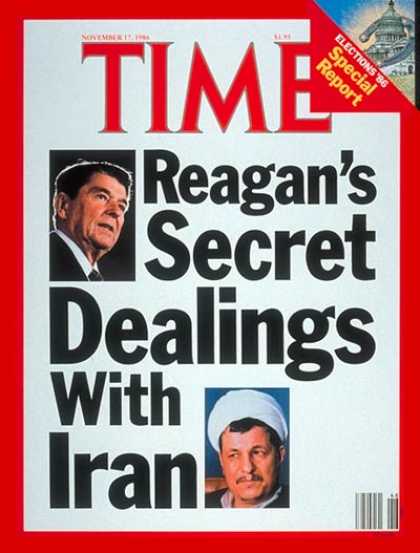
In 1985 and 1986, Ronald Reagan sold arms to Iran, locked in a horrific war with Saddam Hussein’s Iraq, for cash and the release of U.S. hostages. The sales to Iran violated sanctions against Iran.

But much of the money that came from the sales was diverted to fund the Contras, right-wing rebels fighting the left-wing Sandinista government of Nicaragua. That was in violation of laws against helping the Contras.

As noted above, George Bush had to pardon several Reagan aides in the wake of the scandal. Speaking of aides…

2. Reagan Refused to Mention AIDS, Then Cut Funding for Research

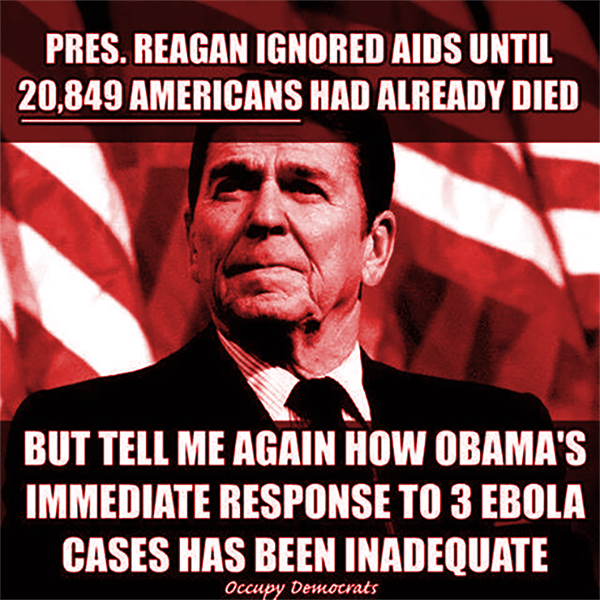
In the early 80s, a horrific new epidemic ravaged America’s gay population. Because so many of the victims of AIDS were gay, the right-wing viewed the disease as a kind of divine retribution for their sins.Reagan didn’t mention AIDS in public until September 1985, after more than 10,000 people had died from the disease. In 1986, Reagan called for a report on AIDS but also proposed cutting federal funds for research and patient care as treatments were just starting to make it to market. Speaking of inhumanity towards his fellow man…

ReaganAIDS

1. Reagan Opposed Sanctions on Apartheid Era-South Africa

When Congress looked likely to pass sanctions on South Africa to battle apartheid in 1985, Reagan vigorously opposed any action. In order to stop moderate Republicans from defecting, he issued a half-assed executive order imposing some sanctions.The next year, when Congress realized Reagan’s sanctions didn’t have teeth, it overwhelmingly passed a bill imposing real sanctions on the racist regime. Reagan vetoed the bill. Happily there were enough votes to override his veto, and the sanctions became a key part of the eventual end of apartheid.

References: Dissident Voice, Los Angeles Times, PBS.org, Philadelphia Inquirer, About.com


See:http://bluenationreview.com/5-terrible-things-ronald-reagan-president/

Sanders Rips Trump For ‘Using Racism’ To Blame Immigrants Instead Of Wall Street

Source:Occupy Democrats

Author:Omar Rivero

Emphasis Mine

Democratic presidential candidate and Vermont Senator Bernie Sanders takes aim at his rival across the aisle and calls out Donald Trump for his ham-fisted attempts to blame America’s economic problems on immigrants, when really it was wealthy tycoons like Trump who crippled the world’s economy with their high-risk gambling.

“You would think that an honest political discussion would say, “How do we address those issues?” But what certain candidates like Trump are trying to do is to say to Americans, “We have problems, do you know who the cause of the problems is? It’s all the immigrants.”

Well, to the best of my knowledge, undocumented people did not cause the greed and the illegal behavior on Wall Street, which destroyed this economy. To the best of my knowledge, undocumented people in this country did not cause the fact that we have not raised the minimum wage. … So what they are doing, are using, in this case, Latinos, as simply a whipping boy to deflect attention from the real issues facing America.

We can have a debate in this country about immigration reform, and people can have different points of view, but it is absolutely unacceptable for presidential candidates like Donald Trump to be using racism and demagoguery against a group of people. This is unacceptable. This is the year 2015, and I would have hoped that in this country we would have gone beyond this type of racism.”

Time and time again, Bernie Sanders refuses to stray from his laser-like focus on the important issues that matter to the American middle class. Every Republican presidential campaign is smoke and mirrors, distracting our attention from the real problems with divisive and utterly false social narratives, and we cannot let them pull the blinds over our eyes once again.

See:http://www.occupydemocrats.com/watch-sanders-rips-trump-for-using-racism-to-blame-immigrants-instead-of-wall-street/


Why You Need to Understand Evangelical Christianity’s Outrageous and Influential Far-Right Fringe

Its followers believe the Bible, and the laws contained within it, should rule over every aspect of life.

Source: AlterNet

Author:Bill Berkowitz

Emphasis Mine

Here’s a simple question: Have you ever heard of Christian Reconstruction, Rousas J. Rushdoony, or one of his most influential works, The Institutes of Biblical Law? Probably not! Christian Reconstruction, is a religious belief system, set out by the late Rushdoony, which maintains that every aspect of society – church, state, family, economy — should be based on Biblical law. It is evangelical Christianity’s right-wing fringe, yet its tentacles reach deep into the Clown Car that is the Republican Party’s field of presidential candidates. Is Christian Reconstruction so fringed out that it is not worthy of attention? Not according to Julie J. Ingersoll, author of the new book, Building God’s Kingdom: Inside the World of Christian Reconstruction, who posits that Reconstructionists’ “biblical worldview” played, and continues to play, a highly influential role, although subtle and often hidden, in contemporary right-wing politics.

When Christian Reconstructionists say God’s law –– as it is revealed in the Old and New Testaments — should control every aspect of life, they mean every aspect, interpreting the Bible as mandating a challenge to the legitimacy of democracy, justifying slavery, and advocating the stoning to death of homosexuals, adulterers, and Sabbath-breakers. If any of this sounds familiar, you might be thinking Taliban and/or ISIS.

As investigative reporter John F. Sugg pointed out in a 2004 extensive piece in Tampa, Florida’s Weekly Planet, “Most churchgoers have never heard of Christian Reconstruction or theonomy. Believers would be hard-pressed to define ‘dominion theology,’ ‘covenant theology,’ ‘pre-millennial,’ [or] ‘post- millennial.’ … Nor would most Americans reflexively embrace a ‘theology’ that denounced all government social programs, public schools, environmental protections — a religion that promoted mass executions for sins as minor as swearing at parents, …”

While a number of investigative reporters, researchers and writers such as John Sugg, and Chip Berlet, author of Eyes Right! Challenging the Right Wing Backlash, and Frederick Clarkson, author of Eternal Hostility: The Struggle Between Theocracy and Democracy, have delved deeply into this movement over the years, perhaps no one has been as immersed in it as Ingersoll.

In the Preface to Building God’s Kingdom: Inside the World of Christian Reconstruction (Oxford University Press, 2015), Ingersoll, an Associate Professor of Religious Studies at the University of North Florida, writes that she first encountered Christian Reconstruction in the early 1980s during and after her days at Rutgers University.

Steeped in the conservative movement, Ingersoll worked as a volunteer, intern, writer and researcher for several of the more significant New Right political organizations of that period, including the National Conservative Political Action Committee, Paul Weyrich’s Free Congress Foundation, and the American Life Lobby. She attended campaign schools run by the National Conservative Foundation, the Committee for the Survival of a Free Congress, and the College Republican National Committee Feldman School.

“In 1983,” Ingersoll writes, she “married a member of one of the Reconstructionist families,” and was divorced in the early 1990s. Although she had differences with many in the movement, mostly over issues related to the treatment of women – she was a supporter of the Equal Rights Amendment – she worked with a number of right-to-life groups, including Operation Rescue, and was the California chapter president of Feminists for Life.

Building God’s Kingdom is the result of nearly thirty years of research, writing, reflection, re-thinking, involvement with and detachment from evangelical Christian conservative movements. Ingersoll acknowledges that it is difficult to quantify the influence of Christian Reconstruction on mainstream politics as they have their own institutions and do not readily share their data, therefore leaving “the strategy of trying to trace the[ir] influence in more subtle, nuanced, and admittedly interpretive ways.”

Rushdoony: New Right intellectual “godfather”

According to Ingersoll, Rushdoony never received his props: He was one of the religious right’s “intellectual godfathers,” but he was “often treated like a crazy uncle.” Nevertheless, while Recostructionism never attracted “much [grassroots] support … the movement’s ideas became a driving force in American politics,” as Reconstructionists “found a home in Washington-based political organizations, such as the Moral Majority and Christian Voice.”

Howard Phillips, a major figure in the early development of the religious right called Rousas John Rushdoony the “most influential man of the 21st century” whose work brought about “historic changes in the thinking of countless leaders.” Phillips told Ingersoll that Rushdoony was “early and often on all the big issues, and he was a pioneer in the homeschool movement.”

On the occasion of Rushdoony’s death in February 2001, Gary North, a movement leader and Rushdoony’s son-in-law, credited him with “being the source of many of the core ideas of the New Christian Right,” and maintained that “the mainstream media” never understood the scope of his influence.

Ruashdoony’s appeal to religious right leaders was that he put the Bible at the center of everything. Rushdoony’s work permeated “arguments made by conservative Christians about biblical government that focus on the character and structure of families, free-market economics, the legal status of religion, the critique of public education, care for the poor, the right to own guns, the funding of health care.”

Ingersoll’s Building God’s Freedom “address[es] one aspect of the story of the contemporary conservative Christian subculture and the rise of the religious right: the impact of a small group of fundamentalists known as Christian Reconstructionists.”

“Well before the establishment of the Washington-based political organizations designed to harness the growing dissatisfaction among conservative Christians,” Ingersoll writes, “Reconstructionists were laying the intellectual foundation that would shape the twenty-first century conservative Christian subculture, developing what would become the religious right’s critique of the American social order, and plotting strategies to bring about change.”

While adherents of the religious right do not make up a majority of this country’s population, nevertheless, a substantial number of people believe – as Christian Reconstructionists do — that America is Christian nation, separation of church and state is a liberal-initiated shibboleth, patriarchy is the God-ordained structure for families, that the Bible, and the laws contained within it, should rule over every aspect of life.

Christian Reconstruction is playing the long game, and Ingersoll meticulously explores its “strategy” of “mak[ing] meaningful the mundane details of day-to-day life by situating them in a sweeping narrative framed as the fundamental purpose of God and his creation.” Building God’s Kingdom traces the origins of the New Christian Right back to the Old Christian Right; describes how Reconstructionists “helped the movement take root in the conservative Protestant subculture”; and, details how Reconstructionist ideas were planted in evangelical culture, even amongst those that didn’t identify with Reconstructionism.

Cyclically, mainstream media’s pundits and prognosticators bury the religious right. And while it is worthwhile pointing out that the religious right’s influence has ebbed and flowed over the past two decades, some of its issues — now most famously being played out under the meme of “religious freedom” — remains at center stage. While Reconstructionists are not responsible for totally birthing the religious right, and have rarely been in the spotlight, nevertheless its “influence continues, although often until recently unacknowledged and sometimes denied.”

Bill Berkowitz is a longtime observer of the conservative movement.

See:http://www.alternet.org/belief/why-you-need-understand-evangelical-christianitys-outrageous-and-influential-far-right-fringe?akid=13449.123424.A4shU_&rd=1&src=newsletter1041975&t=14

Trump Is Gifting Dems The Latino & Asian Vote, Costing Republicans The White House

Source: Occupydemocrats.com

Author: Sarah

emphasis mine

The United States of America is a nation of immigrants. It’s how the nation came to existence. No one person, outside that of the indigenous people who lived her prior to the arrival of the Pilgrims and the rest of our forefathers can say that this area of North America is exclusive to them and them alone. There’s a reason the Statue of Liberty has etched on it:

“Give me your tired, your poor, Your huddled masses yearning to breathe free…”

Because we are the nation that was a “new world” to immigrants worldwide, and we still are. That will become very clear in the upcoming election. To win the national general election in November of 2016, the winning candidate will need to have the Latino vote and Asian American votes. In 2012, President Obama took 71% of the Latino vote and 73% of the Asian-American vote. The results are now obvious. Given the current opinions of the Republican Party candidates on the immigration issue, it appears that the Democratic Party is in a very good spot for a repeat performance.

The xenophobic reaction to Trump’s anti-immigrant spiel can be seen in nearly every Republican candidate, and their individual approaches to immigration reform are all uniquely comical. It’s almost as if they’re in a contest to out-crazy each other.

Let’s take a look at where some of the candidates fall on the issue of immigration.

Donald Trump: Besides calling Mexicans rapists, murderers, drug dealers, etc. He also wants to build a big “beautiful” wall that will keep all immigrants from coming across the border. He also wants to make sure we make it easier for European immigrants to come. But don’t you dare call him “racist,” because you will run the chance of being called an “idiot” or a “moron” for suggesting such a thing. Even though he IS a raging racist. And his nationalistic white pride is literally written across his forehead.

Scott Walker: Here’s one of those guys who will literally say anything to be popular. He was likely the kid on the school yard who hung around next to the popular kids and laughed at all of their jokes. So when Walker suggested he would build a wall along Canada’s border to try to out-Trump Trump, when it wasn’t well received and laughed off as a joke, he said it was a joke. Basically because everyone else did too.

Chris Christie: Not to be out-crazied, Christie thought it wise to compare immigrants to FedEx packages and offered up the idea that we should track immigrants in the same way we would our shipments. He probably should’ve thought that idea through a little better, because the last time a leader put tracking codes on people it was to keep order on them inside concentration camps. So now, backtracking ever so slightly, Christie has resigned to just “finger-printing” immigrants. Although, at least he admitted that using the term “anchor babies” makes the Republicans sound anti-immigrant.

Jeb Bush: With an unfortunate last name weighing him down, Bush really doesn’t know where to stand on much of anything. Does he pander to bigots? Does he stay moderate? But it seems that he’s decided to be all over the map. As far as immigration, he can’t decide if using “anchor babies” is racist or not so he tries to undo the racist remark by making it more racist and adding Asians to mix. Once considered a moderate on this issue, he sees Trump pulling ahead, and doesn’t seem quite sure how racist he should go to up his poll numbers with the Republican base.

Both Ted Cruz, an immigrant himself from Canada, and Piyush “Bobby” Jindal, a son to immigrants, also seem to be steadfast in their disdain of anyone else entering the country after their family did. Jindal labeling “immigration without assimilation” an “invasion,” and Cruz calls any form of immigration reform that doesn’t line up with what he wants, “illegal amnesty.”

When did we decide to get away from that? When did the United States put a sign on the door that said “Sorry, we’re full!” We haven’t, and we never should. Immigrants are what makes this nation what it is — so diverse, so eclectic, so rich with cultural differences that enrich our every day lives. However, to this latest batch of Republican presidential candidates, you’d think the sign on America’s door read “Whites only,” or “Mexicans need not apply” reminiscent of the treatment of immigrants back in the early 20th century.

No matter how you slice it, Republicans are NOT embracing this topic with a level head that may actually produce a positive change and proper immigration reform. Immigration as it is, is not good enough. It’s nearly impossible for many to come here legally. Something MUST be done. And just building a wall or shooing immigrants away like they are pests is not the proper action to take. They need to either embrace immigration reform with logical thinking, or they will, without a doubt, lose in 2016.


See: http://wp.me/p3h8WX-51q

The GOP’s Problem Is Not Donald Trump

at least half of the GOP is unhinged and living in its own fact-free and perhaps Fox-fed reality

Source:motherjones.com

Author:David Corn

Emphasis Mine

Only a few weeks ago, pundits and political observers roundly proclaimed that Donald Trump, the reality-show tycoon who’s mounted a takeover of the GOP, would flame out, fade, implode, or whatever. Jeb Bush’s campaign aides were telling journalists that they had no concerns about Trump threatening a third Bush regime. “Trump is, frankly, other people’s problem,” said Michael Murphy, the chief strategist for Bush’s super-PAC. It’s becoming clearer, though, that Trump, still dominating the polls and the headlines as the Republican front-runner, could well pose an existential threat to the Grand Old Party (or at least its establishment, including the Bush campaign). But the fundamental problem for the Rs is not Trump; it’s Republican voters.

Trump is a brash and arrogant celebrity who is well skilled in pushing buttons, belittling foes, uttering outrageous remarks, causing a ruckus, and drawing attention to one thing: himself. He’s a smart marketer and a brilliant self-promoter. His name recognition is over 100 percent. He cooked up a wonderful ready-for-swag tagline: “Make America Great Again.” He’s incredible. He’s yooge. But none of this would matter if there was no demand for his bombastic, anger-fueled, anti-immigrant populism—that is, if Republican voters did not crave a leader who equates undocumented immigrants with rapists and who claims that everyone else in political life is a nincompoop selling out the US of A to the Chinese, the Mexicans, and just about every other government.

The polite way to say this is that Trump’s message is resonating with Republicans. And polls show that his support is not ideological. He’s winning over GOPers across the spectrum, from conservatives to evangelicals to supposedly moderate Rs. His assault on the GOP powers that be (or powers that were) is not the rebellion of one wing against another. (Political commentators are so programmed to view party conflicts as battles between conflicting factions.) Instead, Trump is tapping into a current that runs throughout the various strains of the GOP. It’s a current of frustration, despair, anger, and yearning—a yearning for a time when the United States will not be confronted by difficult economic and national security challenges, and when you will not have to press 1 for English and 2 for Spanish.

Republicans are pissed off. (In polls, they express far more dissatisfaction with the nation’s present course than Democrats.) And they believe the nation has been hijacked by President Barack Obama, whose legitimacy most Rs still reject. A recent Bloomberg/Des Moines Register poll of likely Iowa caucus participants found that 35 percent of Republicans believe Obama was not born in the United States. A quarter said they were not sure. (Nine out of ten Democrats said the president was born in the United States.) So nearly 60 percent of Rs believe there is cause to suspect Obama has hornswoggled the nation. Meanwhile, according to another poll, 54 percent of Republican voters say Obama is a Muslim. A third were not sure. Only 14 percent identified the president as a Christian.

These findings—which echo a long string of surveys conducted during the Obama years—would seem to indicate that at least half of the GOP is unhinged and living in its own fact-free and perhaps Fox-fed reality. To top it off, many Republican voters have expected the GOPers in control of Congress to kill Obamacare, shut down the government and slash the budget, prevent Obama from issuing executive orders, and impeach the pretender who inhabits the White House. Oh, and there’s this: Benghazi! So they are mighty ticked off and seriously disappointed. The Bloomberg/Des Moines Register poll found that half of GOP caucus-goers said they were unsatisfied with the US government and 38 percent were “mad as hell” at it. Slightly more than half were unsatisfied with Republicans in Congress; a fifth were mad as hell at them.

Given the psychological state of the GOP base, it’s not surprising that the fellow expressing the most outrage on the campaign trail—the guy who sounds like he, too, is mad as hell—has taken the express elevator to the penthouse floor of the polls. After all, he’s the only one in the pack who has confronted Obama on his birthplace. Trump has not renounced his birther ways. He has already made that point for this audience and can move on. (In the past few days, Trump also came close to endorsing another far-right conspiracy theory. He essentially accused Huma Abedin, Hillary Clinton’s longtime aide, of being a security problem because she is married to disgraced former Rep. Anthony Weiner and presumably shared classified State Department information with this “perv.” For years, conservative conspiracy theorists have claimed Abedin was a Muslim Brotherhood mole within the US government.)

The anti-immigrant, anti-Obama, anti-establishment sentiment that Trump is tapping runs deep within the Republican electorate. Many Republicans clearly see the president as a foreign-born secret Muslim with a clandestine plan to weaken, if not ruin, the United States—remember the death panels—and they have a dark, nearly apocalyptic view of Obama’s America. (My email box of late is full of fundraising notes from right-wing groups claiming Obama is about to confiscate all guns, suspend the Constitution so he can run for a third term, relinquish American sovereignty to the United Nations, and mount a military operation within the United States to subdue any opposition to him.)

If this is your perspective when seeking a presidential candidate who will represent your desires and demands, you are unlikely to be drawn to a politician who wants to gain your vote by presenting a 27-point economic plan or by advocating charter schools. Voters this dissatisfied and this detached from reality will be looking for someone who can vent for them. Trump does that. He also promises quick and simple action to address their concerns: a wall (not  a fence), great trade deals at a snap of the finger, the end of ISIS, you name it. And you just won’t believe how great this country will be after four years of President Trump. A focus group of Trump backers recently conducted by GOP pollster Frank Luntz found that Trumpites fancied Trump as much for his cut-the-crap manner as for the substance of his remarks.

As a way to counter Obama, the Republicans eagerly courted the tea partiers and other dissatisfied voters. They rode that tiger into the congressional majority in the low-turnout elections of 2010 and 2014. They whipped up the frenzy. (During the Obamacare fight, House Speaker John Boehner hosted a tea party rally on Capitol Hill, during which the crowd shouted, “Nazis, Nazis” when referring to Democrats.) Washington Republicans vowed they would take the country back from Obama for the tea party. They exploited the Obama hatred, but their often effective obstructionism was still not enough to feed the beast that had carried them into power.

Though Trump may beg to differ, Trumpmania is not about Trump. He’s merely supplying the rhetoric and emotion craved by a large chunk of the GOP electorate. That yearning won’t go away. Ben Carson, who in the latest Iowa poll tied for first place with Trump, is pushing a similar message—America is going to hell and the nation needs an outraged outsider to clean up the mess. His tone is kinder and gentler (and musical!). But like Trump, he is mining profound dissatisfaction and promising a national revival. Combine the Trump and Carson electorates at this point, and it’s close to a majority of Republicans.

A Trump-Carson ticket? Maybe not. (But if so, you heard it here first.) The point is, the GOP is overflowing with voters who long for a candidate who echoes their rage and resentment. Whatever happens with Trump in the months ahead, this bloc of voters won’t go away. Neither will their fury. This is the true dilemma for the Republican Party and its pooh-bahs. Trump, the deal-making businessman, is merely responding to market forces. He’s just the supplier. Trump is the drug, and the voters need to score. The demand is what counts.

See:http://www.motherjones.com/politics/2015/09/gop-doesnt-have-donald-trump-problem