Greenhouse gases building up in the atmosphere

Activists argue that every plan to increase dependency on fossil fuels must be fought. Their demands are that solar, wind, water, and other non polluting renewable energy sources be developed. In the wake of the disaster in Japan there is little support for nuclear power.

From:Peoples World

By:Thomas Riggins

Even as scientists around the world continue to warn that the build up of greenhouse gases, especially CO2 from carbon based fuels, is leading to drastic changes in the earth’s climate the major international oil and gas cartels continue to pump the substance while the leading governments of the world fail to take meaningful action.

Just this week Kerry Sheridan reported, in Agence France-Presse, that last year, according to the US Department of Energy (this is the one Gov. Perry couldn’t remember he wanted to abolish) carbon based fuels (oil, gas, and coal) dumped the largest yearly amount of greenhouse gases into the atmosphere in history.

Led by the world’s three greatest atmospheric polluters, China, the US, and India, the industrialized countries managed, despite all the warnings, to dump about 512 million metric-tons of additional carbon into the air in 2010; the most ever seen in a single year since data began being collected as far back as 1751. This means there are about 9.1 billion metric tons of carbon based gases floating around in the atmosphere, about 6% more than in 2009. This is no way to fight global warming.

John Abraham of the University of St. Thomas (Minnesota) School of Engineering was quoted as saying “This is very bad news. These results show that it will be harder to make the tough cuts to emissions if we are to head off a climate crisis.” Another climate scientist, Scott Mandis, remarked that “Science tells us that we are driving in a fog headed toward a cliff but are unsure just how far away it is. Given this warning, it is quite foolish to be stepping on the accelerator.” http://www.google.com/hostednews/afp/article/ALeqM5jEGR5mMmclpRFbFz35rSvwtk5d1A?docId=CNG.37fe1daad11cebb70185a595ccf6e937.31

In light of this it is shocking that so many people in our country don’t even believe in this largely man made atmospheric pollution: this due to deep seated ignorance of science spawned by a dysfunctional education system, media complicity with Wall Street corporations that profit from a carbon based fuel economy, and know nothing right wing politicians, especially exemplified by the Republican presidential candidates who publicly proclaim that global warming induced by the burning of fossil fuels is a “hoax.”

Fortunately the American people are beginning to wake up and take matters in their own hands. They are mobilizing to fight against states that desire to issue fracking permits to oil companies, and under the stimulus of the Occupy Wall Street movement and 350.org (the website devoted to mobilizing against global warming) have thrown a monkey wrench into the federal government’s plan to rush through approval of the oil pipeline from Canada to Texas.

Now they must mobilize against the oil drilling permits the government is handing out for off shore drilling in the Arctic and the Gulf of Mexico, especially the new ones to BP which hasn’t even paid its fines for the Gulf spill it caused.

Activists argue that every plan to increase dependency on fossil fuels must be fought. Their demands are that solar, wind, water, and other non polluting renewable energy sources be developed. In the wake of the disaster in Japan there is little support for nuclear power.

Emphasis Mine

see:http://peoplesworld.org/greenhouse-gases-building-up-in-the-atmosphere/

Politicians’ Public Acts Trump Their Personal Behavior

From National Memo,

by Cynthia Tucker

“I don’t want to talk about Newt Gingrich’s many marriages. I really don’t. Nor do I want to talk about an alleged extramarital affair that Herman Cain may have carried on for 13 years. There are so many better reasons to doubt the leadership skills of both men — sound, practical grounds to resist their claims of fitness for the nation’s highest office.

But we are destined for several more news cycles, it seems, dominated by the personal peccadilloes of public men. There are several reasons for that, but none more important than this: Cain and Gingrich belong to a political club that has branded itself the Party of Purest Personal Morality. The GOP has not worn its “family values” mantle wisely or well, but it insists on wearing it still.

So here we are, witnessing the spectacle of new and firmly denied charges of adultery (Cain) grabbing headlines while old, more-or-less acknowledged facts of adultery (Gingrich) are relegated to footnotes. Is there a statute of limitations?

(I don’t want to confuse allegations of a consensual affair with serious charges of sexual harassment and assault, which have also been leveled against Cain. Sexual harassment is an abuse of power that often crosses the line into illegal treatment of employees; it deserves public disclosure.)

For decades, I’ve watched as the flimsy veil of privacy afforded to presidential candidates was ripped, flayed and finally shred to tiny scraps, leaving every medical infirmity, every romance, every intemperate moment exposed to public view. I’m not sure we are better off for that.

The presidency of John F. Kennedy seems impossible now, given his very active social life. Lyndon Johnson would have been brought down by his lechery long before Vietnam did him in. The entrance of women into the presidential press corps did much to bring the private lives of politicians into public view. Feminists, understandably, rebelled against a journalistic standard that allowed too many powerful men to treat their wives shabbily while basking in the glow of an adoring public who believed them to be public servants of unblemished moral character.

But there was a certain naivete about the revelations that became standard news fare with the hapless Gary Hart: They sully a politician’s reputation without telling us much about the person’s character. Some voters still believe that a politician who lies to his spouse is unworthy of office because he cannot be trusted to keep his marriage vow. That thinking suggests that any person who betrays his sacred marital pledge will certainly betray the country sooner or later.

Alas, humankind is much too complicated for such a simple rule to be true. While Bill Clinton’s philandering kept his GOP rivals occupied for much of his second term, George W. Bush was never accused of stepping outside the bonds of marriage. Who was the better president? Clinton lied, disgustingly so, about Monica Lewinsky, but he didn’t lie about an issue critical to the fate of the republic.

Bush may never have betrayed his wife, but he betrayed the entire country by taking us to war on the wings of a wretched lie. Nothing about his marriage could have informed us about his capacity for deceiving the public.

So, does a politician’s personal life tell us anything we need to know? Perhaps.

If the politician is someone like Gingrich, who led the Republican House of Representatives when it impeached Clinton, it tells us much about his capacity for sheer, brazen hypocrisy. During the impeachment process, Gingrich was carrying on an extramarital affair with Callista Bisek, who later became his third wife.

Of course, Gingrich’s capacity for stunning hypocrisy was already clear before that. So is the hypocrisy of many “family values” Republicans, who cannot be bothered to care for poor children once they are outside the womb, who denounce gay couples as threats to heterosexual marriage, and who would split up immigrant families if any member is in the country illegally. Their public record tells us all we need to know.

We don’t need to peer through the keyhole to figure out whether our politicians are men and women of decency and integrity. Just look at what they do in public.”

(Cynthia Tucker, winner of the 2007 Pulitzer Prize for commentary, is a visiting professor at the University of Georgia. She can be reached at cynthia@cynthiatucker.com.)

Emphasis Mine

see: http://nationalmemo.com/content/politicians-public-acts-trump-their-personal-behavior


New Economic Data Shows the Need for the 99 Percent Movement

According to the federal Bureau of Economic Statistics, as a percentage of the GDP – the overall size of the economy – corporate profits are at a record high, while the percentage of the GDP made up by wages and salaries is the lowest it’s been since 1929.

From Workingamerica,

by Doug Foote

“For companies, these are boom times. For workers, the opposite is true.”

That’s how New York Times economic columnist Floyd Norris describes the latest reports on the state of the economy. According to the federal Bureau of Economic Statistics, as a percentage of the GDP – the overall size of the economy – corporate profits are at a record high, while the percentage of the GDP made up by wages and salaries is the lowest it’s been since 1929. Clearly, something is broken.

There’s nothing inherently wrong with companies or very wealthy people doing well, but in recent years their success has become completely disconnected from the economic health of the rest of us. And public policy, rather than helping alleviate that gap and lift everyone up, is often pushing in the direction of expanding the gap. In Washington D.C. and state capitals, we’re seeing efforts to strip away protections from workers, roll back the social safety net and push tax rates on the very wealthiest even lower than their current low levels.

These shifts are accentuated by the fact that a money-driven political system rewards those who can spend the most on campaign contributions, TV ads and lobbying. More and more, the political system responds not to the concerns of the majority but to the narrow financial interests of those who already have economic power. The political system is overzealously responsive to the top 1% of earners. And the rest of us? Left behind – without a safety net, in communities that can’t provide the services we depend on.

Out in the neighborhoods we visit, the people we talk to—thousands every week—get this at a fundamental level, and so do the many people who have occupied public spaces in New York and cities across the country. These new numbers from the Bureau of Economic Statistics aren’t just lines on a chart. They represent real people—workers worried that they will lose their jobs and be out of options, families trying to keep a roof over their heads, parents and grandparents afraid the next generation will have a harder time than they did.

And that’s why we’ve launched 9 Demands of the 99 Percent. It’s a set of common-sense proposals that would help restore some balance, making our political system and our economy work better for everyone, not just corporations and the very wealthy.

We can start to turn things around, but it will take determined effort and collective action. Add your voice to the 9 Demands of the 99 Percent today.

Emphasis Mine

see:http://www.workingamerica.org/blog/2011/11/29/

The Absurd Zombie Lie About the Economy Right-Wingers Desperately Cling To — And Why It’s Totally Wrong

Home loans didn’t bring on the recession; gimmicky financial instruments bloated to 100 times their value are what caused all this pain

From AlterNet

By Joshua Holland

Wall Street turned a few million home-loans into what Warren Buffet called “economic weapons of mass destruction,” cratered the global economy and then, when the bubble burst, turned around and insisted on a massive bailout courtesy of the American tax-payer.

That rightly infuriated most Americans, but it has nonetheless become something of an article of faith among conservatives that Wall Street bears little blame for the Great Recession. The dominant narrative on the right today is that “big government” is ultimately responsible for the crash. In the words of one of Andrew Breitbart’s bloggers, Democratic lawmakers like Barney Frank and Chris Dodd “brought down the banking industry by forcing banks to give loans to people who couldn’t afford them.”

That such a ludicrous claim could gain such wide traction is a testament to the intellectual debasement of modern conservative discourse. No bank was ever “forced” – or coerced or incentivized by the government in any way – to make a bad loan.

But the claim falls apart even before one digs into the particulars, for the simple reason that people’s mortgages didn’t bring down the banking system in the first place.

The entire subprime mortgage market was worth only $1.4 trillion in the fall of 2007, and that includes loans that were up-to-date. As former Goldman Sachs trader Nomi Prins noted in her book, It Takes a Pillage: Behind the Bailouts, Bonuses, and Backroom Deals from Washington to Wall Street, the federal government could have bought up every single residential mortgage in the country – good, bad and in between – and it would have cost a trillion less than the bailouts.

Short of that, notes Prins, if the crisis were really about people buying McMansions that they couldn’t afford, “we could have solved it much more cheaply in a couple of days in late 2008, by simply providing borrowers with additional capital to reduce their loan principals. It would have cost about 3 percent of what the entire bailout wound up costing, with comparatively similar risk.”

What brought down the global economy was as much as $140 trillion worth of financial gimmickery built on top of the mortgage industry. It was the alphabet soup of the credit meltdown – the CDOs, default swaps and other derivitaves that made less than a trillion dollars of foreclosed loans into an economic weapon of mass destruction that would cost the American economy alone $14 trillion in lost wealth.

Deregulation

A fair criticism of the government’s role is that it didn’t “meddle” in the free market sufficiently to protect borrowers, investors and the public – that $140 trillion house of cards was built in an environment created by decades of deregulation. But that situation is also the fault of Wall Street rather than an indication of the perfidy of “big government.” It was bought at great cost by the banking lobby (and as powerful chairs of congressional banking committees, the right’s bogeymen, Barney Frank and Chris Dodd, are two of the financial industry’s top recipients).

One could argue that the meltdown began with a chance meeting in 1997 in a line for coffee at Bank of America’s Chicago headquarters. According to the Financial Times’ Gillian Tett, a chance encounter brought together people working in BofA’s derivatives group with another team that was packaging mortgages into securities. From that meeting, as Tett wrote, “a new game was born: bankers began to use subprime loans to create these bundles of loan default risk, now called collateralized debt obligations (CDOs) on an explosively large scale.”

Present at that meeting was Robert Reoch, a trader who had come over from JPMorgan. In the mid-1990s, JPMorgan had found itself holding an abundance of loans on its books, which made it difficult to maintain the reserves required by banking regulators. They had come up with the idea of selling some of the risk of those loans off to investors, by bundling them into mortgage-backed securities. This had two consequencs that would eventually lead to the almost universally loathed Wall Street bailouts, a massive drop in employment, the forcelosure crisis and a skyrocketing deficit.

But the real origin of the crisis took place several years earlier. In 1994, some of the first derivatives – which allowed investors to gamble on interest rates – produced massive losses when currency markets began fluctuating wildly. Calls to regulate this shadowy field of financial speculation followed, but, as Tett noted, “the International Swaps and Derivatives Association fought back furiously, arguing that a regulatory clampdown would not only run counter to the spirit of capital markets, but also crush creativity.”

On the board of ISDA – whose lobbying expenditures more than doubled in 2010 to $2.4 million, as new rules on derivatives were being hammered out by federal regulators — sits managing directors of JPMorgan Chase, Morgan Stanley, Goldman Sachs, Citigroup and Bank of America Merrill Lynch, among other financial firms.

Its successful campaign against regulations on derivatives in the mid-1990s was only one battle in a long campaign to deregulate investment banking that dated back to the 1960s, when lobbyists reportedly bragged that the effort was putting their kids through college. Their primary target was the Glass-Steagall Act, a depression-era law that created a firewall between investment banking and the commercial banks that hold deposits and make loans. Their first victory came in 1986, when, under intense lobbying from Wall Street, the Federal Reserve reinterpreted a key section of the act, deciding that commercial banks could make up to 5 percent of their gross revenues from investment banking. After the board heard arguments from Citicorp, J.P. Morgan and Bankers Trust, it loosened the restrictions further – in 1989, the limit was raised to 10 percent of revenues; in 1996, they hiked it up to 25 percent.

According to a report by PBS Frontline, “in the 1997-98 election cycle, the finance, insurance, and real estate industries (known as the FIRE sector), spends more than $200 million on lobbying and makes more than $150 million in political donations. Campaign contributions are targeted to members of congressional banking committees and other committees with direct jurisdiction over financial services legislation.”

In 1999, after 12 unsuccessful attempts, Glass-Steagall, which would have made the crash of 2007-2009 impossible, was finally repealed. And it was only then that the explosion in shaky mortgage-backed securities began. “Subprime” loans made up 5 percent of the total the year before repeal, but skyrocketed to 30 percent of all mortgages at the time of the crash.

Fanny, Freddie and the Community Reinvestment Act

Jeb Hensarling, a notably obtuse Republican lawmaker from Texas, wrote that “the conservative case [against the government] is simple”:

The [Community Reinvestment Act] compelled banks to relax their traditional underwriting practices in favor of more “flexible” criteria. These subjective standards were then applied to all borrowers, not just low-income individuals, leading to a surge in lower-quality loans….Blame should [also be] directed at Fannie [Mae] and Freddie [Mac], and their thirst for weaker underwriting to help meet their federally mandated “affordable housing” goals…

This tale has everything a conservative could want: Big Government overreach and well-intentioned but out-of-touch liberals causing devastating unanticipated consequences with their social tinkering.

But, contrary to the conservative spin, University of Michigan law professor Michael Barr told a congressional committee that although there was in fact quite a bit of irresponsible lending in low-income communities in the late 1990s and the early 2000s, “More than half of subprime loans were made by independent mortgage companies not subject to comprehensive federal supervision; another 30 percent of such originations were made by affiliates of banks or thrifts, which are not subject to routine examination or supervision, and the remaining 20 percent were made by banks and thrifts [subject to CRA standards].” Barr concluded, “The worst and most widespread abuses occurred in the institutions with the least federal oversight.”

The reality is that no bank has ever been “forced to comply with government mandates about mortgage lending” – it’s a bald-faced lie.

There are no “government mandates,” and there never were. In order to qualify for government-backed deposit insurance—a benefit that banks aren’t forced to accept but enjoy having—the Community Reinvestment Act – and similar measures designed to prevent discrimination in lending (to qualified individuals) – only encourage banks to lend in all of the areas where they do business. And Section 802 (b) of the Act stresses that all loans must be “consistent with safe and sound operations”—it’s the opposite of requiring that lenders write risky mortgages.

There are no penalties for noncompliance with CRA guidelines. The only “stick” hanging over banks that fail to meet those standards is that their refusal might be taken into account by regulators when they want to open new branches or merge with other financial institutions. What’s more, there are no defined standards for CRA compliance, and within the banking community, the loose guidelines are considered to be somewhat of a joke.

As Sheila Blair, the chairwoman of the FDIC, asked in a December 2008 speech, “Where in the CRA does it say: make loans to people who can’t afford to repay? Nowhere! And the fact is, the lending practices that are causing problems today were driven by a desire for market share and revenue growth…pure and simple.”

Fannie and Freddie: Tempted by Easy Profits

Fannie Mae and Freddie Mac were created by an act of Congress, but they are (or were, until being taken over in the wake of the housing crash) private, for-profit entities whose dual mandate was to increase the availability of mortgages to moderate- and low-income families, and at the same time turn a profit for their shareholders. Fannie and Freddie did end up with a very large portfolio of subprime loans, with a high rate of default, but they didn’t get into the market early, or because the government mandated it. They dived in deep because there were profits to be made as the housing bubble expanded. As Mary Kane, a finance reporter for the Washington Independent, put it:

Neither the Community Reinvestment Act—the law most cited as the culprit—nor other affordable housing goals set by the government forced Fannie, Freddie or any other lender to make loans they didn’t want to. The lure of the subprime market was high yields and healthy profit margins—it’s as simple as that.

Creating a Market

None of this is to suggest that millions of Americans didn’t bite off more than they would eventually be able to chew in the housing market. A lot of people looking to turn a quick buck by capturing the booming value of real estate in the mid- to late-2000s bought property with “teaser” loans that offered very low rates for the first few years; the investors assumed they’d be able to turn a tidy profit before higher interest rates kicked in. Many of those individuals have since found themselves “under water”—owing more on their homes (and investment properties) than they’re worth.

Yet as Salon business reporter Andrew Leonard wrote, beginning in the 1990s, “The incentive for everyone to behave this way came from Wall Street…where the demand for (debt-backed securities) simply couldn’t be satisfied. Wall Street was begging the mortgage industry to reach out to the riskiest borrowers it could find, because it thought it had figured out a way to make any level of risk palatable.” He added, “Wall Street traders, hungry for more risk, fixed the real economy to deliver more risk, by essentially bribing the mortgage originators and ratings agencies to…make bad loans on purpose. That supplied (Wall Street) speculators the raw material they needed for their bets, but as a consequence threw the integrity of the whole housing sector into question.”

The bankers’ hard sell created so much demand that lenders wrote loans to just about anybody for just about anything; loans, after all, were the raw material for the alphabet soup of exotic investment vehicles: the “collateralized debt obligations (CDOs),” “credit default swaps,” and other innovative products that turned “toxic” toward the end of the decade. Wall Street had little to lose by giving investors more of these fancy new bets. Wall Street traders made their fees, and as long as the housing market—the hard assets underpinning all of the theoretical wealth that was created—held up, everyone was happy.

The most important point here is that the bankers knew they were playing with fire. The Los Angeles Times reported, “Before Washington Mutual collapsed in the largest bank failure in U.S. history, its executives knowingly created a ‘mortgage time bomb’ by making subprime loans they knew were likely to go bad and then packaging them into risky securities.”

According to the Wall Street Journal, U.S. prosecutors are, as of this writing, investigating whether Morgan Stanley misled investors about mortgage-derivatives deals it helped design and sometimes bet against.” And the Securities and Exchange Commission charged Goldman Sachs with “defrauding investors by misstating and omitting key facts about a financial product tied to subprime mortgages as the U.S. housing market was beginning to falter.”

They needed some help laundering the risk out of those shaky loans, and they got it. According to a Senate investigation concluded earlier this year S&P and Moody’s, the two dominant ratings agencies, “issued the AAA ratings that made … mortgage backed securities … seem like safe investments, helped build an active market for those securities, and then, beginning in July 2007, downgraded the vast majority of those AAA ratings to junk status.” And when they did so, it “precipitated the collapse of the [mortgage-backed securities] markets and, perhaps more than any other single event, triggered the financial crisis (PDF).”

According to the Senate investigation, in the years leading up to crash, “warnings about the massive problems in the mortgage industry” — including internal warnings from their own analysts — had been ignored because of “the inherent conflict of interest arising from the system used to pay for credit ratings.” The big “rating agencies were paid by the Wall Street firms” that were making a fortune selling that glossed-up garbage to credulous investors. This, again, was Wall Street’s doing rather than a result of some public policy passed by Congress.

This isn’t about ideology; it’s about pushing back on some notably dangerous historical revisionism. Because there is one thing that’s as sure as death and taxes: Big Finance’s lobbyists will continue to resist calls to re-regulate the financial sector. And absent effective regulation of the financial markets, we can expect to continue to suffer through an endless series of booms and busts, while the fat cats of Wall Street continue to get fatter.”

Joshua Holland is an editor and senior writer at AlterNet. He is the author of The 15 Biggest Lies About the Economy: And Everything else the Right Doesn’t Want You to Know About Taxes, Jobs and Corporate America. Drop him an email or follow him on Twitter.

Emphasis Mine

see:http://www.alternet.org/story/153217/the_absurd_zombie_lie_about_the_economy_right-wingers_desperately_cling_to_–_and_why_it%27s_totally_wrong?page=entire

Occupy Elections, With a Simple Message

Real power for change never comes from getting, or having, buckets of money; it always comes as a result of people becoming part of the democratic system for real, and believing in it enough to work to bring in the votes for those they know have the cajones to really enact change that benefits all. — NFM/RSN

By George Lakoff, Reader Supported News

hat’s next? That’s the question being asked as cities close down Occupy encampments and winter approaches.
The answer is simple. Just as the Tea Party gained power, the Occupy Movement can. The Occupy movement has raised awareness of a great many of America’s real issues and has organized supporters across the country. Next comes electoral power. Wall Street exerts its force through the money that buys elections and elected officials. But ultimately, the outcome of elections depends on people willing to take to the streets – registering voters, knocking on doors, distributing information, speaking in local venues. The way to change the nation is to occupy elections.

Whatever Occupiers may think of the Democrats, they can gain power within the Democratic Party and hence in election contests all over America. All they have to do is join Democratic Clubs, stick to their values, speak out very loudly, and work in campaigns for candidates at every level who agree with their values. If Occupiers can run tent camps, organize food kitchens and clean-up brigades, run general assemblies, and use social media, they can take over and run a significant part of the Democratic Party.

To what end? All the hundreds of the occupiers’ legitimate complaints and important policy suggestions follow from a simple general moral principle: American democracy is about citizens caring about one another and acting responsibly on that care.

The idea is simple but a lot follows from it: a government that protects and empowers everyone equally, a government of the Publicpublic roads and buildings, school and universities, research and innovation, public health and health care, safety nets, access to justice in the courts, enforcement of worker rights, and practical necessities like sewers, power grids, clean air and water, public safety including safe food, drugs, and other products, public parks and recreational facilities, public oversight of the economy – fiscal and trade policy, banking, the stock market – and especially the preservation of nature in the interest of all.

The Public has been what has made Americans free – and has underwritten American wealth. No one makes it on his or her own. Private success depends on a robust Public.

The rationale for the Occupy movement is that all of this has been under successful attack by the right wing, which has an opposing principle, that democracy is about citizens only taking care of themselves, about personal and not social responsibility. According to right-wing morality, the successful are by definition the moral; the one percent are taken to be the most moral. The country and the world should be ruled by such a “moral” hierarchy. Except for national security, the Public should disappear through lack of funding. The nation and the world should be ruled for private profit alone – and by force.

That idea is what is destroying American democracy, and America with it. That idea is what is behind everything the Occupy Movement opposes – and everything that is going wrong with America today.

Not only is America divided between two opposing principles, but a great many individuals are of those two minds at once: progressive on some matters, conservative on others – with all sorts of variations. They are called variously independents, moderates, or the center. They are mostly the population that elections depend on. They have not one fundamental principle, but are split between two.

What makes one of these ascendant in the individual brain is the language one hears most. That is why the domination of public discourse is so important. It is why advertising in the media is important, why talk radio and tv and social media matter. Elections are what focus attention on public discourse. That is why the next step for the Occupy Movement should be to occupy elections.

The way to begin any discussion should be: Do you care about your fellow citizens? If so, do you take responsibility to act on that care?

The next question is: Do you realize how much every American, no matter how rich or poor, depends upon The Public?

Only when those questions are answered can detailed policy questions make sense.

Those are the questions that should be dominating our public discourse. They are the implicit questions asked by the Occupy movement. It is time to make them explicit, and to do so where it counts: in occupying elections.”

Emphasis Mine

see:

5 Reasons the Religious Right Should Stop Whining About Being Persecuted

For decades Christian conservatives have claimed persecution. Their powerful hold on Washington tells a different story.

From: AlterNet

By: Rob Boston

“I’ve been writing about the Religious Right for nearly 25 years now, and one thing that never ceases to amaze me is when the leaders or supporters of these organizations claim they are being persecuted. Really? In a country that has a strong Christian culture and where at least 75 percent of the population professes some form of Christianity, it would seem odd that Christians would be persecuted. Yet the claim is made, constantly.

A new study on the power of religious advocacy groups in Washington by the Pew Forum on Religion & Public Life show yet again how absurd that claim is. Pew researchers examined 212 religious groups on the right and the left that engage in advocacy work in the nation’s capital. Their findings are illuminating. Anyone who believes the old saw that conservative Christians don’t have a voice in D.C. should take a look.  With that thought in mind, here are five reasons why the Religious Right should stop complaining about persecution:

1. Of the 10 largest religious advocacy groups in Washington, seven take the Religious Right line on most issues. 

Five of the top-10 groups (Family Research Council, Concerned Women for America, Home School Legal Defense Fund, Focus on the Family’s Citizenlink and the Traditional Values Coalition) are Religious Right organizations. The two other groups are the U.S. Catholic Conference of Catholic Bishops, which marches in lock step with the Religious Right on issues like abortion, same-sex marriage and taxpayer funding of religion, and the National Right to Life Committee, a more narrowly focused group that shares the Religious Right’s views on abortion. Marginalized movements don’t have this much representation in Washington.

2. These organizations raise a ton of money. 

The Pew report lists budget figures for each group examined. The numbers are staggering. In 2008, the Family Research Council, which, since the demise of the Christian Coalition has become the leading D.C.-based Religious Right group, took in more than $14 million. Concerned Women for America collected $12.5 million. Even the Traditional Values Coalition – a less prominent outfit run by gay-bashing minister Louis P. Sheldon and his daughter – raised $9.5 million. The figure for the Catholic bishops is even more impressive: $26.6 million. (Of course, not all of this money is spent on direct lobbying because these organizations advocate for their views in many ways.) Smaller Religious Right outfits didn’t make the top 10 but still raise considerable sums: the National Organization for Marriage brought in $8.5 million, and the American Life League raised $6.6 million. Remember anti-Equal Right Amendment crusader Phyllis Schlafly? Her Eagle Forum still exists. It raised $2.2 million in 2009.

If you add up the budgets of the seven conservative religious advocacy groups in the top 10, the figure tops $95 million. As infomercial pitchmen are fond of saying, “But wait, there’s more!” If you include budget figures for a few of the leading fundamentalist ministries (such as Pat Robertson’s Christian Broadcasting Network and the empire created by the late Jerry Falwell), many of which are overtly political, and add in a handful of the top Religious Right legal groups, the numbers reach the stratosphere, exceeding $1 billion annually. No political movement that has control of that much cash can claim to be persecuted.

3. These organizations enjoy incredible access to legislators. 

Most advocacy groups woo lawmakers with money (through allied political action committees) or by implying that there are votes to be had among their respective constituencies. Some far-right religious groups can offer both. The Family Research Council, for example, runs several PACs, including a new super-PAC that, thanks to the Supreme Court, can raise unlimited funds to pour into races. Do politicians take notice? You bet. At last month’sValues Voter Summit” sponsored by the Family Research Council in Washington, both House Speaker John Boehner and Majority Leader Eric Cantor took time out to address the crowd, and every major GOP presidential candidate was there as well.

Religious groups that can’t or don’t sponsor PACs trade on their generally good image. Most Americans think well of religion but not so well of politicians. Savvy political leaders know that granting broad access to clerics just makes good sense. Some of that goodwill may rub off. If conservative Christians were being persecuted or were considered pariahs, politicians would hardly be tripping over themselves to be seen with them, would they?

4. Religious groups get special breaks when it comes to lobbying. 

Non-profit groups, whether on the left or the right, must abide by federal regulations that curb the amount of lobbying tax-exempt entities can do. They must also file disclosure reports that are available to the public, so it’s possible to see how much they are spending on attempts to influence legislators. But the purely religious groups – the denominations and church offices – are exempt from this rule. Thus, the Catholic bishops can drop a quarter of a billion or more on Capitol Hill without accounting for a dime.

Other denominations follow suit. Pew reports that the Southern Baptist Convention’s D.C. public policy office had a budget of $3.2 million in 2008. How much of that was spent on lobbying? No one knows because they aren’t required to say. A secular group that refused to disclose this information would quickly find itself in hot water with the federal government. Far from being persecuted, religious groups actually receive preferential treatment in this area.

5. Some religious groups have played the bigotry card to their advantage.

Religious Right groups have mastered the art of intimidating their opponents. Thus, anyone who dares to criticize groups for their anti-gay views is labeled a bigot who doesn’t believe in religious freedom. Anyone who offers spirited opposition to a right-wing religious group’s policy planks is accused of trying to keep that group from speaking out. This skillful manipulation of the language of victimology comes not from a truly oppressed minority but from those who have so much power that they’ve learned to game the system as a way of shutting down the opposition.

To these groups, religious freedom has a curious definition: It’s the right to force you to live by their religion. They have been wildly successful in putting across the idea that to speak against their political agenda is the same as speaking against their religion. No truly persecuted movement is this savvy in the game of politics.

Right-wing religious groups may claim persecution, but the numbers tell a different story. If you doubt this, just spend a day shadowing their employees in Congress, where, increasingly, they are greeted with warm smiles and open arms.

A final note in the spirit of full disclosure: The organization I work for, Americans United for Separation of Church and State, is number 15 on Pew’s list – even though we don’t consider ourselves a religious group. (AU is non-sectarian; some of our members are people of faith, but others are non-believers.) Our advocacy takes many forms – working with legislators, litigating in the courts and educating the public, to name a few. Sometimes we win battles, and sometimes we don’t. When we lose, we regroup to fight another day. We don’t whine that we’re being persecuted.

Rob Boston is senior policy analyst at Americans United for Separation of Church and State.


Emphasis Mine

see:http://www.alternet.org/story/153207/5_reasons_the_religious_right_should_stop_whining_about_being_persecuted?page=entire

A populist uprising may shape 2012

Mentions of the phrase “income inequality” in print publications, web stories, and broadcast transcripts spiked from 91 times a week in early September to nearly 500 in late October, according to the website Politico — an increase of nearly 450%

From CBS News, by Andy Kroll

(N.B.: We were also helped in Ohio by the Grandmother ad..)

(TomDispatch) “No headlines announced it. No TV pundits called it. But on the evening of November 8th, Occupy Wall Street, the populist uprising built on economic justice and corruption-free politics that’s spread like a lit match hitting a trail of gasoline, notched its first major political victory, and in the unlikeliest of places: Ohio.

You might have missed OWS’s win amid the recent wave of Occupy crackdowns. Police raided Occupy Denver, Occupy Salt Lake City, Occupy Oakland, Occupy Portland, and Occupy Seattle in a five-day span. Hundreds were arrested. And then, in the early morning hours on Tuesday, New York City police descended on Occupy Wall Street itself, fists flying and riot shields at the ready, with orders from Mayor Michael Bloomberg to evict the protesters. Later that day, a judge ruled that they couldn’t rebuild their young community, dealing a blow to the Occupy protest that inspired them all.”

(Columbus OH 20111108)

Instead of simply condemning the eviction, many pundits and columnists praised it or highlighted what they considered its bright side. The Washington Post‘s Ezra Klein wrote that Bloomberg had done Occupy Wall Street a favor. After all, he argued, something dangerous or deadly was bound to happen at OWS sooner or later, especially with winter soon to arrive. Zuccotti Park, Klein added, “was cleared… in a way that will temporarily reinvigorate the protesters and give Occupy Wall Street the best possible chance to become whatever it will become next.”

The New York TimesPaul Krugman wrote that OWS “should be grateful” for Bloomberg’s eviction decree: “By acting so badly, Bloomberg has made it easy to see who won’t be truthful and can’t handle open discourse.  He’s also saved OWS from what was probably its greatest problem, the prospect that it would just fade away as time went on and the days grew colder.”

Read between the lines and what Klein, Krugman, and others are really saying is: you had your occupation; now, get real. Start organizing, meaningfully connect your many Occupy protests, build a real movement. As these columnists see it, that movement — whether you call it OccupyUSA, We Are the 99%, or the New Progressive Movement — should now turn its attention to policy changes like a millionaire’s tax, a financial transaction fee, or a constitutional amendment to nullify the Supreme Court’s Citizens United decision that loosed a torrent of cash into American elections. It should think about supporting political candidates. It should start making a nuts-and-bolts difference in American politics.

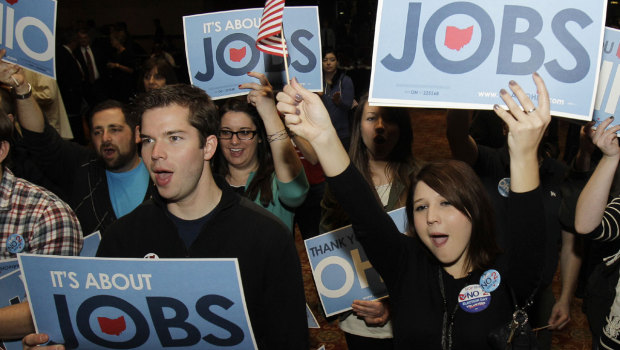
But such assessments miss an important truth: Occupy Wall Street has already won its first victory its own way — in Ohio, when voters repealed Republican governor John Kasich’s law to slash bargaining rights for 350,000 public workers and gut what remained of organized labor’s political power.

Commandeering the Conversation

Don’t believe me? Then think back to this spring and summer, when Occupy Wall Street was just a glimmer in the imagination of a few activists, artists, and students. In Washington, the conversation, such as it was, concerned debt, deficit, and austerity. The discussion wasn’t about whether to slash spending, only about how much and how soon. The Washington Post‘s Greg Sargent called it the “Beltway Deficit Feedback Loop” — and boy was he right.

A National Journal analysis in May found that the number of news articles in major newspapers mentioning “deficit” was climbing, while mentions of “unemployment” had plummeted. In the last week of July, the liberal blog ThinkProgress tallied 7,583 mentions of the word “debt” on MSNBC, CNN, and Fox News alone. “Unemployment”? A measly 427.

This all-deficit, all-the-time debate shaped the final debt-ceiling deal, in which House Speaker John Boehner and his “cut-and-grow”-loving GOP allies got just about everything they wanted. So lopsided was the debate in Washington that President Obama himself hailed the deal’s bone-deep cuts to health research, public education, environmental protection, childcare, and infrastructure.

These cuts, the president explained, would bring the country to “the lowest level of annual domestic spending since Dwight Eisenhower was president.” After studying the deal, Ethan Pollock of the Economic Policy Institute told me, “There’s no way to square this plan with the president’s ‘Winning the Future’ agenda. That agenda ends.” Yet Obama said this as if it were a good thing.

Six weeks after Obama’s speech, protesters heard the call of Adbusters, the Canadian anti-capitalist magazine, and followed the lead of a small crew of activists, writers, and students to “occupy Wall Street.” A few hundred of them set up camp in Zuccotti Park, a small patch of concrete next door to Ground Zero. No one knew how long the occupation would last, or what its impact would be.

What a game-changing few months it’s been. Occupy Wall Street has inspired 750 events around the world, and hundreds of (semi-)permanent encampments around the United States. In so doing, the protests have wrestled the national discussion on the economy away from austerity and toward gaping income inequality (the 99% versus 1% theme), outsized executive compensation, and the plain buying and selling of American politicians by lobbyists and campaign donors.

Mentions of the phrase “income inequality” in print publications, web stories, and broadcast transcripts spiked from 91 times a week in early September to nearly 500 in late October, according to the website Politico — an increase of nearly 450%. In the second week of October, according to ThinkProgress, the words most uttered on MSNBC, CNN, and Fox News were “jobs” (2,738), “Wall Street” (2,387), and “Occupy” (1,278). (References to “debt” tumbled to 398.)

And here’s another sign of the way Occupy Wall Street has forced what it considers the most pressing economic issues for the country into the spotlight: conservatives have lately gone on the defensive by attacking the very existence of income inequality, even if to little effect. As AFL-CIO president Richard Trumka put it, “Give credit to the Occupy Wall Street movement (and historic inequality) for redefining the political narrative.”

Wall Street in Ohio

The way Occupy Wall Street, with next to no direct access to the mainstream media, commandeered the national political narrative represents something of a stunning triumph. It also laid the groundwork for OWS’s first political win.

Just as OWS was grabbing that narrative, labor unions and Democrats headed into the final stretch of one of their biggest fights of 2011: an up-or-down referendum on the fate of Ohio governor John Kasich’s anti-union law, also known as SB 5. Passed by the Republican-controlled state legislature in March, it sought to curb the collective bargaining rights of 350,000 police, firefighters, teachers, snowplow drivers, and other public workers. It also gutted the political clout of unions by making it harder for them to collect dues and fund their political action committees. After failing to overturn similar laws in Wisconsin and Michigan, the SB 5 fight was labor’s last stand of 2011.

I spent a week in Ohio in early November interviewing dozens of people and reporting on the run-up to the SB 5 referendum. I visited heavily Democratic and Republican parts of the state, talking to liberals and conservatives, union leaders and activists.  What struck me was how dramatically the debate had shifted in Ohio thanks in large part to the energy generated by Occupy Wall Street.

It was as if a great tide had lifted the pro-repeal forces in a way you only fully grasped if you were there. Organizers and volunteers had a spring in their step that hadn’t been evident in Wisconsin this summer during the recall elections of nine state senators targeted for their actions during the fight over Governor Scott Walker’s own anti-union law. Nearly everywhere I went in Ohio, people could be counted on to mention two things: the 99% — that is, the gap between the rich and poor — and the importance of protecting the rights of the cops and firefighters targeted by Kasich’s law.

And not just voters or local activists either.  I heard it from union leaders as well. Mary Kay Henry, president of the Service Employees International Union, told me that her union had recruited volunteers from 15 different states for the final get-out-the-vote effort in Ohio. That, she assured me, wouldn’t have happened without the energy generated by OWS. And when Henry herself went door-to-door in Ohio to drum up support for repealing SB 5, she said that she could feel its influence in home after home. “Every conversation was in the context of the 99% and the 1%, this discussion sparked by Occupy Wall Street.”

This isn’t to take anything away from labor’s own accomplishments in Ohio. We Are Ohio, the labor-funded coalition that led the effort, collected nearly 1.3 million signatures this summer to put the repeal of SB 5 on the November ballot.  (They needed just 230,000.) The group outspent its opponents $30 million to $8 million, a nearly four-to-one margin. And in the final days before the November 8th victory, We Are Ohio volunteers knocked on a million doors and made nearly a million phone calls. In the end, a stunning 2.14 million Ohioans voted to repeal SB 5 and only 1.35 million to keep it, a 61% to 39% margin. There were repeal majorities in 82 of Ohio’s 88 counties, support that cut across age, class, race, and political ideologies.

Nonetheless, it’s undeniable that a mood change had hit Ohio — and in a major way. Pro-worker organizers and volunteers benefited from something their peers in Wisconsin lacked: the wind of public opinion at their backs. Polls conducted in the run-up to Ohio’s November 8th vote showed large majorities of Ohioans agreeing that income inequality was a problem. What’s more, 60% of respondents in a Washington Post-ABC poll said the federal government should act to close that gap. Behind those changing numbers was the influence of Occupy Wall Street and other Occupy protests.

So, as the debate rages over what will happen to Occupy Wall Street after its eviction from Zuccotti Park, and some “experts” sneer at OWS and tell it to get real, just direct their attention to Ohio. Kasich’s anti-union law might still be on the books if not for the force of OWS. And if the Occupy movement survives Mayor Bloomberg’s eviction order and the winter season, if it regroups and adapts to life beyond Zuccotti Park, you can bet it will notch more political victories in 2012.”

Bio: Andy Kroll is a staff reporter in the D.C. bureau of Mother Jones magazine and an associate editor at TomDispatch. This piece originally appeared on TomDispatch. The opinions expressed in this commentary are solely those of the author.

Emphasis Mine

see:http://www.cbsnews.com/8301-215_162-57328622/a-populist-uprising-may-shape-2012/

A Blueprint for Our Time, Our Cause, Our Victory

The Civil Rights Movement’s success was based on a
coordinated three-prong strategy of civil
disobedience, grass-roots organizing and mass
boycotts. To achieve similar victories, a national
“We are the 99%” movement must adopt and apply that
same approach.

Civil Rights Strategy and the ‘99%’ Movement

I’m Charles Pervo, and I approve of this message.

from Portside,

Applying the Successful Strategy of the Civil Rights
Movement to a National “We are the 99%” Movement

The Civil Rights Movement’s success was based on a
coordinated three-prong strategy of civil
disobedience, grass-roots organising and mass
boycotts. To achieve similar victories, a national
“We are the 99%” movement must adopt and apply that
same approach.

by Andrew Levison
The Democratic Strategist
November 17, 2011

“In the coming days the Occupy Wall Street movement faces
an extremely complex and difficult series of decisions
about its strategy and tactics. It cannot simply repeat
the initial tactic of occupying public spaces that it
has employed up to now but it has not yet developed any
clear alternative strategy for the future.

In debating their next steps the protesters – and the
massive numbers of Americans who support them – will
turn again and again to the history and example of the
civil rights movement for guidance. Martin Luther King’s
closest advisors including Jessie Jackson and Andrew
Young have noted the clear historical parallels that
exist between the two protest movements and both
activists and observers will urgently seek to find
lessons in the struggles of the past.

The discussion, however, will be hindered by the
profoundly oversimplified vision that many people today
have of how the victories of the civil rights movement
were actually achieved. Most Americans have little more
than a series of impressionistic images of the civil
rights movement – police dogs and fire hoses unleashed
against the demonstrators in Birmingham, Alabama in
1963, dramatic marches attacked by police in Selma,
Alabama in 1965 and, across the south, sit- ins and
freedom rides that rocked the region in the early years
of the decade. In this vision, dramatic confrontations
with the authorities appear to have been, in effect, the
movement’s entire “strategy.”

But, in fact, behind every major campaign of the civil
rights movement there was actually a very organised and
coherent three-pronged strategy. To seriously seek
guidance for the present in the struggles of the past,
it is absolutely indispensable to understand the basic
socio- political strategy that the movement employed.

The civil rights movement’s three-pronged strategy
combined: 1. Civil disobedience 2. Grass-roots
organising and voter registration 3. Boycotts and
economic withdrawal

In every single major campaign of the civil rights
movement – Montgomery, Birmingham, Selma – these three
elements of the overall strategy were employed in a
coherent, mutually supporting and reinforcing way. In
contrast, no part of this coordinated approach was ever
successful in isolation.

Seen in this light, there are indeed reasonable
comparisons between the civil rights movement and the
initial phase of Occupy Wall Street. OWS represents a
modern application of civil disobedience, the first
component of the civil rights movement’s three-pronged
strategy. The essence of civil disobedience (also called
nonviolent direct action“) is the use of dramatic
protests that disrupt normal activities and usually
violate the law. They are designed to call attention to
the existence of injustice and win public sympathy
through the demonstrators willingness to risk danger and
injury and to go to jail for their cause.

In the early phase of the civil rights movement the most
extensive applications of civil disobedience were the
freedom rides and the sit-in’s, actions that directly
violated the morally unjust laws enforcing segregation.
As the movement’s objectives turned to social and
economic issues in the latter part of the 60’s, the
targets of civil disobedience became more abstract and
symbolic, culminating in the establishment of a tent
city on the national mall during the Poor People’s
Campaign.

But civil disobedience was only tip of the iceberg of
the civil rights movements‘ struggle against
segregation. Behind the dramatic actions that captured
the headlines was a massive grass-roots organizing
effort across the South that involved thousands of
passionate young organisers. For every one sit-in
demonstrator there were a hundred grass-roots civil
rights activists who spent months and years traveling
around the South to conduct “freedom schools” in church
basements, restaurants, barber shops and meeting halls,
gatherings that were held in even the smallest towns and
rural areas. These freedom schools patiently built
support for voter registration efforts and laid the
foundations for later political campaigns by African-
American candidates. King and his lieutenants were
always absolutely clear in saying that the only long-
range solution to segregation lay in Black Americans
winning effective political representation.

Today it is the “We Are Ohio” movement and the Wisconsin
recall campaigns, rather than Occupy Wall Street, that
represent the modern equivalents of the civil rights
movement’s grass-roots organising campaigns. During
these recent campaigns against laws designed to
eliminate the right to union representation hundreds of
thousands of petitions were signed and thousands of
volunteers engaged in door to door canvassing,
literature distribution, the manning of tables in
shopping centers and the operation of phone banks – the
hard, grueling, unsung work that is indispensable for
successful grass-roots campaigns. The one- on-one, face-
to-face organising techniques of the Ohio and Wisconsin
movements actually displayed substantial similarities
with the techniques of traditional trade union
organizing as well as with the civil rights movement.

In short, comparisons between the movements of today and
the civil rights movement cannot be limited to Occupy
Wall Street. The “We Are Ohio” and Wisconsin recall
campaigns have an equally valid claim to kinship with
the earlier struggles of the civil rights era.

The third prong of the civil rights movement’s strategy
was boycott and economic withdrawal. In the Montgomery
campaign the bus system was boycotted, in Birmingham, it
was all downtown merchants. In view of King and his
associates it was economic withdrawal that was actually
the most powerful single weapon in the nonviolent
arsenal. It was the bus boycott that won King’s first
victory in Montgomery and the boycott of downtown stores
that ultimately forced the business and political
establishment of Birmingham to negotiate.

King himself referred to boycotts as “campaigns of
economic withdrawal” and described them as “nonviolence
at peak of its power”. Here is how he expressed it in
1967:[1]

In the past six months simply by refusing to purchase
products from companies which do not hire Negroes in
meaningful numbers and in all job categories, the
Ministers of Chicago under SCLC’s Operation
Breadbasket have increased the income of the Negro
community by more than two million dollars annually.
In Atlanta the Negroes’ earning power has been
increased by more than twenty million dollars
annually over the past three years…This is
nonviolence at its peak of power.

The modern application of this strategy can now be seen
in the “Move Your Money” and related campaigns that call
on people to withdraw funds from the major banks and
reinvest them in credit unions and other more socially
conscious institutions. There are a variety of
estimates[2] from credit unions and independent sources
that suggest the campaign has already had a significant
and measurable effect, but it is also clear that this is
still the very earliest trial run for future economic
withdrawal campaigns with potentially powerful
consequences.

Beyond the current campaign aimed at the largest banks,
the tactic of economic withdrawal can be applied to a
wide variety of firms and issues. Such campaigns will
all be united by a simple underlying concept: working
people should not spend or invest their money with firms
and institutions that use those same funds to bankroll
conservative candidates, laws and policies that
undermine those same workers’ economic security,
standard of living and hopes for the future.

Consumer product companies are particularly vulnerable
to campaigns of economic withdrawal because the damage
to their reputation and image can in many cases be more
devastating than the direct economic damage itself. The
quite effective campaign by People of Color to pressure
the advertisers of Glen Beck’s TV show in 2009
demonstrated the significant leverage consumer boycott
campaigns can bring to bear in the internet age.

There are already a variety of informal linkages
developing between the three social movements above —
the “Occupy Wall Street”, “We are Ohio/Wisconsin recall”
and “Move Your Money” campaigns. Organizations including
MoveOn.org, Van Jones’ American Dream Movement and the
AFL-CIO/Working America federations have played a
significant “behind the scenes” role in supporting the
OWS, “We are Ohio” and Move Your Money” actions and also
in popularizing and promoting the broader “We are the
99%” political movement and perspective around the
country.

But the critical historical lesson that can be drawn
from the civil rights movement is the vital need for the
three prongs of the movements’ strategy – civil
disobedience, grass- roots organizing/political
mobilization and boycott/economic withdrawal – to be
employed in a coordinated way as part of a single
integrated approach. The movement’s key victories in
Montgomery, Birmingham and Selma all depended on this
coordination.

There is currently no single leader with the immense
stature of a Martin Luther King or grass-roots
organizations like SCLC and SNCC to provide such
coordination for a national “We Are the 99%” social
movement. In the modern internet-connected world,
however, more diversified and decentralized forms of
organisationare more likely to develop and are more
likely to be effective as well.

But for a “We Are the 99%” movement to achieve
substantial victories, coordination must be achieved.
Neither Occupy Wall Street nor the Ohio and Wisconsin
campaigns nor campaigns of economic withdrawal like
“Move Your Money” can, in isolation, produce
transformational victories of the scope and significance
of the victories of the civil rights movement.

In coordination, on the other hand, these three tactics
are immensely powerful. It was the combination of these
three approaches, employed in a coherent overall
strategy, that broke the back of the system of Southern
segregation within a single decade and that same three-
pronged strategy can profoundly transform America once
again today.”

1. http://teachingamericanhistory.org/library/index.asp?document=1426

2. http://www.dailykos.com/story/2011/11/11/1035479/-Ten-stories-of-people-moving-their-money,-despite-bankefforts-to-stopthem?detail=hide

[Andrew Levison was for many years a research assistant
to Mrs. Coretta Scott King, Andrew Young and other
participants in the civil rights movement. The analysis
presented here was first formulated at a 1971 conference
of The Institute for Nonviolent Social Change that
included many of the leaders of the major campaigns of
the civil rights movement.]

Emphasis Mine.

see: http://www.thedemocraticstrategist.org/

The Great GOP Primary Crash and Burn: 5 Republican Would-Be Saviors Flame Out in Hilarious Ways

The GOP’s “anyone but Romney” strategy has backfired.

From AlterNet, by Brad Reed

“In a normal democracy, a competent opposition party would have no difficulty in defeating Barack Obama next year.

After all, unemployment is still around 9 percent, economic growth is sluggish at best and the Democratic base feels disenchanted with the hope and change they voted into office a mere three years ago. A competent opposition party shouldn’t have to nominate a superlative candidate in this environment; instead it can win by simply nominating someone with decent hair, who can string together words in a language vaguely resembling English and who has no obvious debilitating mental illnesses.

For Republicans, this generic good-hair, able-to-talk, not-overtly-insane candidate is Mitt Romney. But there’s just one problem with this scenario: The Republican base hates Mitt Romney. The reasons for this are pretty obvious since Romney’s work establishing a universal health care system in Massachusetts provided the main blueprint for Obamacare, the healthcare law passed in 2010 that the GOP base feels is the ultimate symbol of an overreaching and tyrannical government. And that’s in addition to Romney’s assorted flip-flops on issues such as abortion and gay rights that have given social conservatives fits over the years. In fact, Multiple Choice Mitt is such a notorious opportunist that his entire political career can be summed up by paraphrasing a classic Snoop Dogg song: “Take a stance when it’s popular, but drop it when it’s not, drop it when it’s not.”

So the Republican base has spent the past year looking for someone, anyone, who can be the anti-Mitt Romney in the GOP primary. The problem is that the GOP has been unable to find even one half-normal human to stand in against him. The result has been a hysterical roller-coaster of a primary season where new candidates rise rapidly as GOP “front runners” for a month before flaming out in spectacular and hilarious ways. In this article we’ll chronicle the assorted saviors that Republican voters have fallen in love with for brief periods of time before quickly recoiling in horror upon realizing they’ve become smitten with a unelectable lunatic.

Failed Savior #1: Donald Trump.

How he rose: Ugh. Remember this? Trump’s major appeal to the GOP base was akin to G.G. Alin’s appeal to teenage boys: They loved him because he would say whatever the hell he wanted no matter how many media squares would get offended. Want to publicly question the validity of Barack Obama’s birth certificate? Trump went there. Want to speculate that Obama was hiding his birth certificate because it listed him as a Muslim? Yeah, that was Trump territory, too. Want to imply that Obama only got accepted into Columbia and Harvard Law due to the dread specter of affirmative action? Trump was your guy.

The result was that Trump depressingly surged to the head of the GOP pack in April, according to a CNN poll. But the Donald’s rapid rise in the polls was only matched by his epic crash less than two weeks later.

How he fell: It became more difficult for Trump to publicly crow about his birther credentials after Obama actually released his long-form birth certificate. Making matters worse, the release of Obama’s birth certificate came just days before Trump attended the White House correspondents’ dinner where he was roasted relentlessly both by the president and by comedian Seth Meyers.

This sort of public humiliation took away a lot of Trump’s mojo since he was no longer viewed as an all-American bad boy with the guts to speak truth to power. Instead he was seen, correctly, as a clown. He announced that he was not going to run for the presidency shortly afterward.

Failed Savior #2: Newt Gingrich

How he rose: The very idea of Newt Gingrich being a legit presidential candidate should be enough to violate at least 23 different laws of quantum mechanics and collapse our universe into a tiny puddle of cosmic gloop. But the GOP field in 2011 is a warped incarnation of Andy Warhol’s vision of the future where every has-been right-wing crank is allowed to nationally humiliate himself for 15 minutes.

At any rate, Newt’s entire appeal, if it can be called that, was that he’s supposed to be a “man of ideas.” It doesn’t matter that most of his ideas involved going to war with Iran or privatizing Medicare — in the current GOP field anyone who put on shoes without causing themselves critical bodily harm is considered a visionary. So Newt was to be the primary race’s leading intellectual, which is about as useful an honor as being named the world’s most well-hung eunuch.

How he fell: He was Newt. That’s pretty much all there was to it and it was entirely predictable to anyone who knows his history.

Let’s go over the grisly recap: Newt got in trouble during the very first week of his campaign when he sought to flash his “Man of Ideas” credentials by critiquing Paul Ryan’s Satanic Randroid plan to boot seniors off Medicare and force them into the private insurance market. For many conservatives this was like standing up in the middle of a church and shouting out, “Man, this Jesus dude ain’t all that, people.”

Newt had to backtrack pretty quickly after this heresy and he did indeed back away from his statements in the only way he knows how: Through shameless bullshitting. You see Newt can never just say he’s sorry and be done with it. No, that’s something that shows weakness and if people start thinking Newt is weak then dark-skinned foreigners all over the world will start pointing and laughing at him and implying that he is lacking in the manhood department. So instead of apologizing, Newt went on the attack against the media by saying it was now out of bounds to accurately quote his criticism of Ryan’s plan.

No, seriously, he actually said this: “Any ad which quotes what I said on Sunday is a falsehood, because I have said publicly those words were inaccurate and unfortunate.”

And just as the nation had stopped laughing about this, Gingrich flack Rick Tyler added insult to injury by putting out a statement portraying Newt as a noble paragon in the style of Ulysses and William Wallace who would lead America to its former standard of greatness through the sheer force of his magical ideas.

“A lesser person could not have survived the first few minutes of the onslaught,” wrote Tyler of the torrent of mockery directed at his boss. “But out of the billowing smoke and dust of tweets and trivia emerged Gingrich, once again ready to lead those who won’t be intimidated by the political elite and are ready to take on the challenges America faces.”

Whoooa, slow down there, Homer. I don’t recall the part in the Odyssey where Ulysses decides to divorce Penelope when she’s struck with an illness so he can go shack up with a hot young Siren.

N,B.: As of 17 Nov, he is still surviving – see below.

Failed Savior #3: Michele Bachmann

How she rose: Ah, why not? With Trump and Gingrich out of the picture, Bachmann was there to fill the “anyone-but-Romney” void for a brief time. Bachmann had all the credentials the base was looking for: A born-again Christian who supported outlandish conspiracy theories and who called Obama anti-American before it was cool. So over the summer Bachmann got her brief period in the spotlight and regularly came in second place in many national polls.

As I said, why not?

How she fell: There was no real defining moment that marked Bachmann’s slide in the polls, which leads me to believe that the GOP faithful slowly started getting spooked about Bachmann’s electability. To be fair, this is a very legitimate concern since she comes off as a cross between Dana Carvey’s Church Lady character and Charles Manson. You see, many people generally like politicians who talk about their religious faith because it makes them feel as though their leaders identify with them culturally. But if a candidate seems convinced that she’s actually receiving messages from God about whom to appoint to her campaign staff, voters start to get concerned.

While Bachmann has been known to say a lot of loopy things over the years, she first really started to freak out the normals when she attacked Rick Perry because he mandated girls in Texas schools get HPV vaccinations to prevent them from contracting cervical cancer. Although Bachmann could have reasonably attacked this policy as a prime example of Perry’s crony capitalism, she decided to go Full Metal Wingnut and suggest that the vaccine could be responsible for causing mental retardation in children. The medical community was quick to condemn Bachmann’s remarks since they had precisely zero basis in reality.

“There are people out there who, because of this kind of misinformation, aren’t going to get their daughter immunized,” said Dr. Kenneth Alexander, a pediatric infectious disease expert at the University of Chicago Medical Center, during an interview with Rueters. “As a result, there will be more people who die from cervical cancer.”

To sum up: If you watch enough Michele Bachmann, you can legitimately see her starting a war with the entire Middle East in an attempt to kickstart the Rapture.

Failed Savior #4: Rick Perry

How he rose: For a wee bit it looked as though Rick Perry was the perfect Republican candidate: He was a three-term governor of deep-red Texas, he’d executed lots and lots and lots of people, he wrote a book describing Social Security as a Ponzi scheme, and to top it off, he had good hair. Perry’s entrance into the race in August immediately shook up the field and he surged to the head of national polls, topping Mitt Romney by more than 10 points in late August.

But then something bad happened to Perry: He began to talk.

How he fell: As evidenced by George W. Bush, Republican voters don’t put too much stock in being articulate. At the same time, a candidate should be able to put words together in such a manner that people can at least guess the type of language he’s trying to speak. Sadly, this task has proven to be far too difficult for Perry to handle.

For example: At this point in the campaign season, anyone over the age of five can come up with a stinging critique of Mitt Romney’s serial flip-flops over the years. Hell, just point out that he’s running against Obamacare despite signing a law in Massachusetts that was essentially the same piece of legislation. It’s not at all difficult.

But when Perry tried to execute this extremely simple maneuver he… well, I’ll just let the man himself say it:

“I think Americans just sometimes don’t know which Mitt Romney they’re dealing with. Is it the Mitt Romney that was on the side of against the Second Amendment before he was for the Second Amendment? Was it before he was before the social programs from the standpoint of he was for standing up for Roe versus Wade before he was against verse, uh, Roe versus Wade? He was for Race to the Top, he’s, uh, for Obamacare and now he’s against it.”

And there are other problems for Perry as well: When asked what he’d do if terrorists within Pakistan acquired nuclear weapons he said he’d call India to “make sure they know they’re an ally of the United States.” Yeah, I’m sure the first things the Indian government would want in that situation is a friendly pick-me-up phone call. Perry also said that “sharing a border with Mexico” was the primary reason his state has one of the lowest high school graduation rates in the country. And unlike Perry, we’ll never forget the time he couldn’t remember which three federal agencies he’d abolish upon becoming president.

Even in our currently debased political culture that sort of thing just won’t cut it. Americans may not like voting for high-fallutin’ intellectuals much, but we thankfully still have enough sense to support candidates that are marginally smarter than ficus plants.

Savior #5: Herman Cain

How he rose: As a Tea Party favorite who has never held political office, Herman Cain can credibly claim to be a Washington outsider who has never taken part in the dirty profession of governing. And it must be said, the former CEO of Godfather’s Pizza and the National Restaurant Association has a certain goofy charm to him at first. He comes across as a lighthearted guy with a good sense of humor and he has a knack for catchy slogans. Let’s face it, his “9-9-9” tax plan, as absurdly regressive and unworkable as it is, rolls off the tongue much easier than, say, the Patient Protection and Affordable Care Act.

How he fell: Well, four women have accused Cain of sexually harassing them. That’s never a good thing. Nor was it good when Cain said he was unaware if the National Restaurant Association had paid out any settlements to two of his accusers despite the fact that they both received settlements of roughly a year’s pay. It was also not good when Cain quickly backtracked and said that he knew there was an agreement between the association and his accusers, but that the agreement was not the same thing as a settlement.

“When I first heard the word ‘settlement,’ I thought legal settlement,” Cain said. “My recollection later is that there was an agreement. So, I made an assumption about the word ‘settlement’ that was legal. I didn’t think there was a legal settlement, but an agreement. Remember, this happened 12 years ago.”

And, uh, OK.

But alleged sexual improprieties aren’t Cain’s only problem. He also apparently never dreamed that he’d be considered a GOP frontrunner and thus has never bothered to read very much about current events. When asked about Obama’s war in Libya recently, Cain replied thusly: “Okay, Libya. President Obama supported the uprising, correct? President Obama called for the removal of Gaddafi? Just want to make sure we’re talking about the same thing before I say yes, I agree, or no, I didn’t agree. I do not agree with the way he handled it for the following reason. Nope, that’s a different one. I’ve got to go back, and see. Got all this stuff twirling around in my head.”

Watching the video of this answer almost made me feel sorry for Cain until I remembered that he’s not a hungover frat boy getting picked on by a professor at an 8am history class but is, in fact, a grown man running for president of the United States. Holy Mother of God.

Failed Savior #6: Newt Gingrich

How he rose: The very idea of Newt Gingrich being a legit presidential candidate should be enough to violate at least 23 different laws of quantum mech… Wait a minute, didn’t I already write this part? Yes, I did. But I had to write it again because after his initial implosion this past summer Newt is apparently getting a second look and has surged in the polls.

There’s no point in writing anymore about this because you know he’ll screw it up and GOP voters will soon be reduced to begging Alan Keyes to hop in the race. So at this point, I’d like to announce my candidacy for the Republican nomination for president of the United States. As president I will repeal Obamacare, cut taxes for job creators and reassert America’s military might. And sure, these positions might not gel with positions I once held as recently as this morning, but c’mon Republicans: At least I’m not Mitt Romney.”

Brad Reed is a writer living in Boston. His work has previously appeared in the American Prospect Online, and he blogs frequently at Sadly, No!.

Emphasis Mine

see:http://www.alternet.org/story/153097/the_great_gop_primary_crash_and_burn%3A_5_republican_would-be_saviors_flame_out_in_hilarious_ways?akid=7864.123424.JYduCI&rd=1&t=2

American health care is remarkably diverse.

In fact, it’s hard to avoid the sense that Republicans are especially eager to dismantle government programs that act as living demonstrations that their ideology is wrong. Bloated military budgets don’t bother them much —

From: NY Times, via Truthout

N.B.: Republicans continue to lie, while people continue to die, and before I die, I hope the word ‘socialism’ is no longer pejorative, along with ‘atheism’, and ‘humanism’, in our country.

By: Dr. Paul Krugman

“In terms of how care is paid for and delivered, many of us effectively live in Canada, some live in Switzerland, some live in Britain, and some live in the unregulated market of conservative dreams. One result of this diversity is that we have plenty of home-grown evidence about what works and what doesn’t.  

Naturally, then, politicians — Republicans in particular — are determined to scrap what works and promote what doesn’t. And that brings me to Mitt Romney’s latest really bad idea, unveiled on Veterans Day: to partially privatize the Veterans Health Administration (V.H.A.).

What Mr. Romney and everyone else should know is that the V.H.A. is a huge policy success story, which offers important lessons for future health reform.

Many people still have an image of veterans’ health care based on the terrible state of the system two decades ago. Under the Clinton administration, however, the V.H.A. was overhauled, and achieved a remarkable combination of rising quality and successful cost control. Multiple surveys have found the V.H.A. providing better care than most Americans receive, even as the agency has held cost increases well below those facing Medicare and private insurers. Furthermore, the V.H.A. has led the way in cost-saving innovation, especially the use of electronic medical records.

What’s behind this success? Crucially, the V.H.A. is an integrated system, which provides health care as well as paying for it. So it’s free from the perverse incentives created when doctors and hospitals profit from expensive tests and procedures, whether or not those procedures actually make medical sense. And because V.H.A. patients are in it for the long term, the agency has a stronger incentive to invest in prevention than private insurers, many of whose customers move on after a few years.

And yes, this is “socialized medicine” — although some private systems, like Kaiser Permanente, share many of the V.H.A.’s virtues. But it works — and suggests what it will take to solve the troubles of U.S. health care more broadly.

Yet Mr. Romney believes that giving veterans vouchers to spend on private insurance would somehow yield better results. Why?

Well, Republicans have a thing about vouchers. Earlier this year Representative Paul Ryan famously introduced a plan to convert Medicare into a voucher system; Mr. Romney’s Medicare proposal follows similar lines. The claim, always, is the one Mr. Romney made last week, that “private sector competition” would lower costs.

But we have a lot of evidence about how private-sector competition in health insurance works, and it’s not favorable. The individual insurance market, which comes closest to the conservative ideal of free competition, has huge administrative costs and has no demonstrated ability to reduce other costs. Medicare Advantage, which allows Medicare beneficiaries to buy private insurance instead of having Medicare pay bills directly, has consistently had higher costs than the traditional program.

And the international evidence accords with U.S. experience. The most efficient health care systems are integrated systems like the V.H.A.; next best are single-payer systems like Medicare; the more privatized the system, the worse it performs.

To be fair to Mr. Romney, he takes a somewhat softer line than others in his party, suggesting that the existing V.H.A. system would remain available and that traditional Medicare would remain an option. In practice, however, partial privatization would almost surely undermine the public side of these programs. For example, one problem with the V.H.A. is that its hospitals are spread too thinly across the nation; this problem would become worse if a substantial number of veterans were encouraged to opt out of the system.

So what lies behind the Republican obsession with privatization and voucherization? Ideology, of course. It’s literally a fundamental article of faith in the G.O.P. that the private sector is always better than the government, and no amount of evidence can shake that credo.

In fact, it’s hard to avoid the sense that Republicans are especially eager to dismantle government programs that act as living demonstrations that their ideology is wrong. Bloated military budgets don’t bother them much — Mr. Romney has pledged to reverse President Obama’s defense cuts, despite the fact that no such cuts have actually taken place. But successful programs like veterans’ health, Social Security and Medicare are in the crosshairs.

Which brings me to a final thought: maybe all this amounts to a case for Rick Perry. Any Republican would, if elected president, set out to undermine precisely those government programs that work best. But Mr. Perry might not remember which programs he was supposed to destroy.

Emphasis Mine

see:http://www.nytimes.com/2011/11/14/opinion/krugman-vouchers-for-veterans-and-other-bad-ideas.html?_r=2